
Pathogen: Diplocarpon rosae (also called Marssonina rosae)
Also called: Black spot, black spot of rose, rose black spot, rose leaf spot
Rose Black Spot
The bottom-up leaf stripper
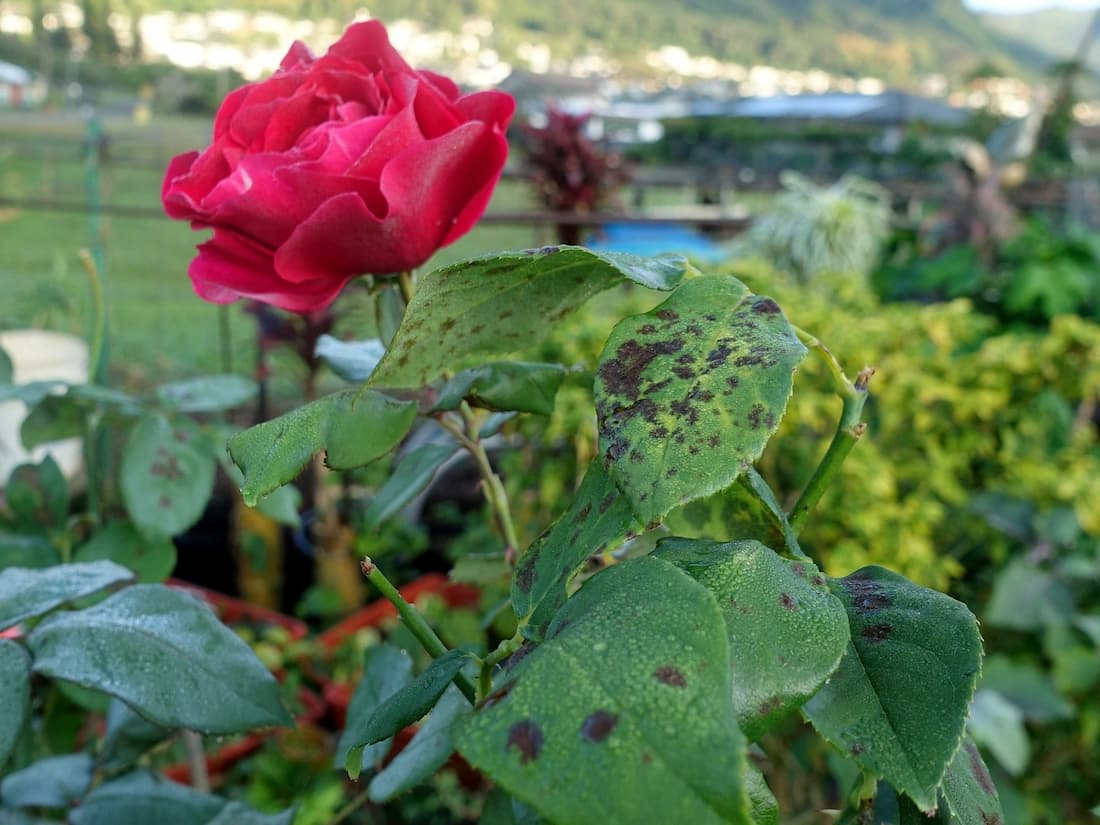
Featured Image Credit: "Rose: Black spot" by Plant pests and diseases is marked with CC0 1.0.
Rose Black Spot At-a-Glance
Plant Group
Roses
Plant Part
Leaves
Flowers & Buds
Stems & Twigs
Whole Plant
Is Spraying Worth It?
Sometimes Worth It
Disease Type
Fungal
Active Season
Early Spring
Late Spring & Early Summer
Mid to Late Summer
Fall
Damage Potential
Weakens Over Time
Can Be Fatal
Rose Black Spot Quick Answers
What Rose Black Spot Looks Like
From a Few Feet Away
From a few feet away, an infected rose looks bare at the bottom and leafy at the top. In late spring, a few lower leaves show dark spots. Over the following weeks, leaves turn bright yellow around those spots and drop, and the leaf loss climbs the bush. By midsummer, a susceptible rose can be down to bare lower canes with a tuft of foliage and fewer, paler flowers at the top.
Symptoms by Plant Part
Leaves. Round black or dark brown spots, 1/10 to 1/2 inch across, form mostly on the upper surface. The best clue is a fringed, feathery edge that looks like it’s growing outward into the green leaf. Many spots show it, though not all. The tissue around each spot turns yellow, and the yellow spreads until the whole leaflet is yellow with the black spots still in it, then the leaflet drops. Spots often merge into larger blotches. Leaf stalks and the small leafy flaps at their base can be spotted too.
Canes. Only this year’s green canes are infected. They show raised purple-red blotches that later turn black and blistered. These lesions are easy to miss in summer, but they’re how the fungus gets through the winter.
Flowers and buds. Petals can develop small red spots and some distortion. The main effect is indirect: a rose that has lost its leaves produces fewer, smaller and paler blooms.
Over the season. Spots start on the lowest leaves in late spring, then work up through the middle and top of the bush through summer, peaking in late summer. Progress often pauses during stretches above 85°F and resumes with cool, wet fall weather. On the most susceptible varieties, especially hybrid teas and yellow or copper roses, a bush can lose nearly all its leaves by midsummer. Repeated years of this leave plants stunted and more prone to winter injury and cane cankers.
Signs of the Fungus
The fungus itself shows up as tiny, raised black dots inside older leaf spots and cane lesions. These are its spore-producing structures. They’re easiest to see with a 10x hand lens on a spot that’s been there a week or two. In wet weather, older spots can also show tiny white, slimy spore masses under magnification. Black spot never produces orange dust, white powder or gray fuzz, and that absence is useful for diagnosis.
Identification Photos
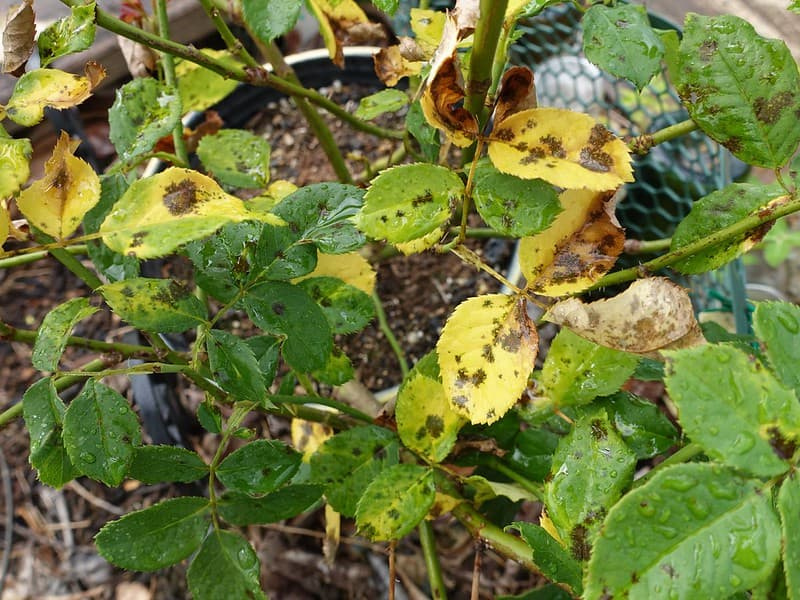
Severe Infection: Heavily spotted leaves turn yellow and drop early, starting low on the plant and moving up.
“Rose: Black spot” by Plant pests and diseases is marked with CC0 1.0.
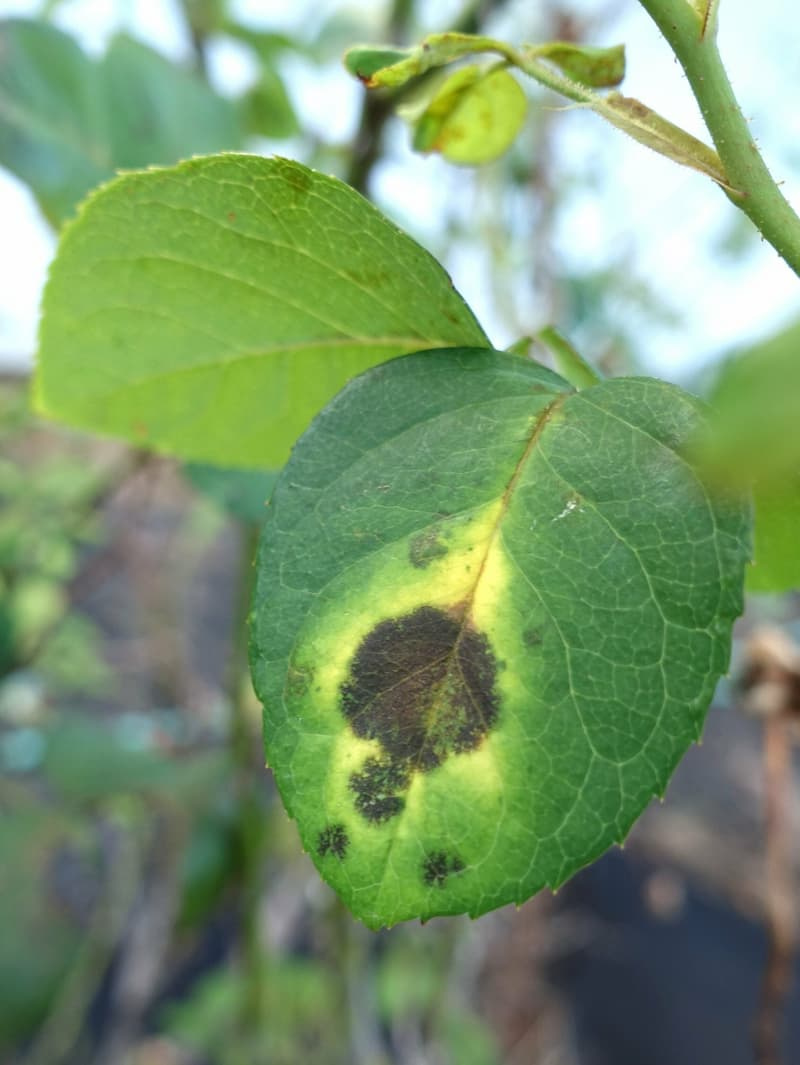
Diagnostic Feature: A black spot with feathery, fringed edges, surrounded by yellowing leaf tissue.
“Rose: Black spot” by Plant pests and diseases is marked with CC0 1.0.
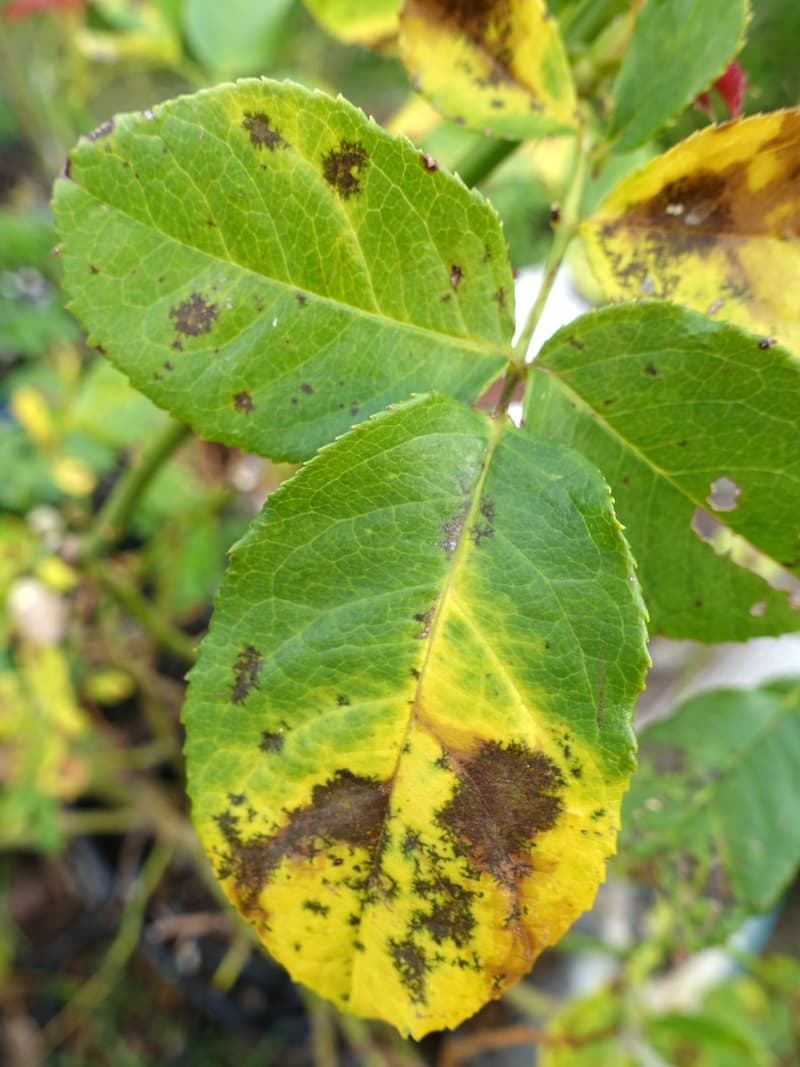
As It Progresses: Spots enlarge and merge while the rest of the leaf turns yellow.
“Rose: Black spot” by Plant pests and diseases is marked with CC0 1.0.
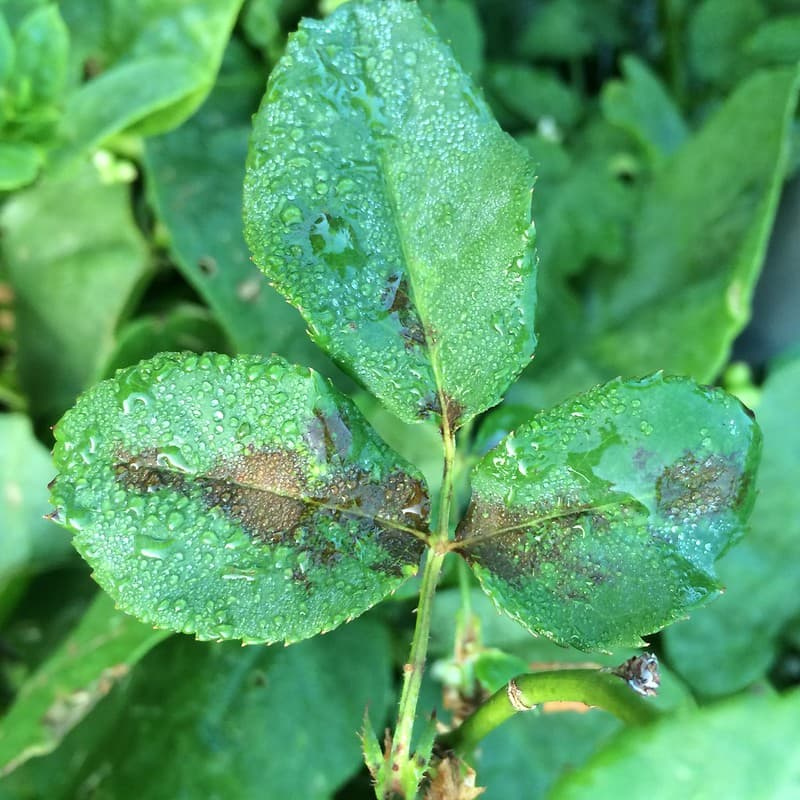
Early Infection: Dark, feathery blotches appear on wet leaves first. The fungus needs water on the leaves to infect.
“Rose: Black spot” by Plant pests and diseases is marked with CC0 1.0.
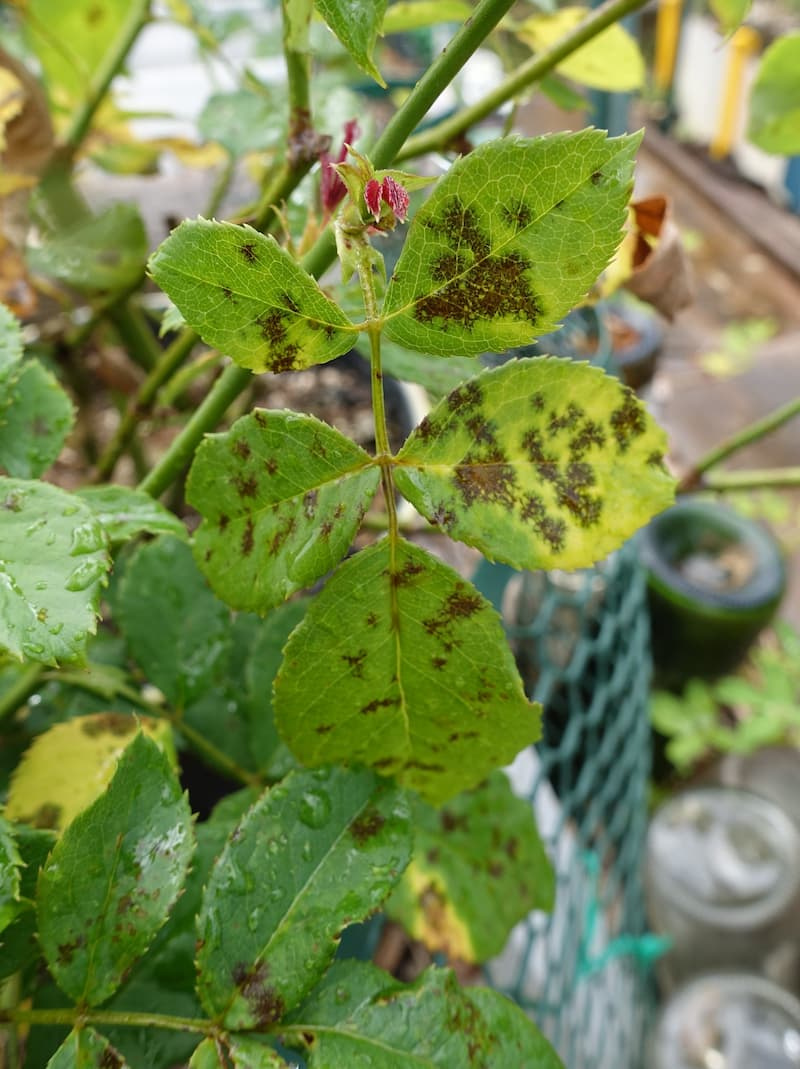
Heavy Spotting: Blotches multiply across every leaflet, often with yellowing in between.
“Rose: Black spot” by Plant pests and diseases is marked with CC0 1.0.
Could It Be Something Else?
Common Lookalikes
Downy Mildew causes purple-red to dark blotches and can strip leaves even faster than black spot. The confusion happens because both cause dark spots, yellowing and heavy leaf drop. Downy mildew is a cool-weather disease, though, and its blotches stop at the leaf veins, which gives them an angular shape.
Anthracnose (spot anthracnose) makes small dark spots on leaves and canes that look like early black spot. As they age, the centers turn light gray or white and often fall out, leaving holes.
Spider Mites cause yellowing and leaf drop in hot, dry weather, which is when people expect black spot. Mite damage is fine pale speckling across the leaf rather than distinct black spots, often with faint webbing underneath.
Field Checks Before You Treat
- Check the spot edges. Look at several spots on the upper leaf surface in good light, using a hand lens if you have one. Fringed, feathery edges that look like they're spreading into the green tissue mean black spot. Not every spot shows them, so check more than one. Smooth spots with red-purple borders point to anthracnose.
- Look at the spot centers. Black spot centers stay solid black. Centers that turn gray or white and drop out, leaving shot holes, point to anthracnose.
- Flip the leaf over. Black spot shows nothing on the underside except the dark spot coming through. Gray-purple fuzz on the underside in cool, damp weather means downy mildew. Raised orange pustules mean rust.
- Check where the leaf loss started. Black spot starts on the lowest leaves, near the soil, and climbs. A bush that's bare at the bottom and still leafy at the top fits black spot.
- Inspect this year's green canes. Raised purple-red blotches that later turn black and blistered confirm black spot on the canes. These lesions are where it overwinters.
- Tap a yellowing leaf over white paper. Tiny moving specks mean spider mites, not black spot.
Plants at Risk
Commonly Affected Plants
Black spot infects only roses, but some kinds are far more affected than others:
- Hybrid tea roses, the most commonly and severely affected class
- Grandiflora roses
- Miniature roses, which are susceptible as a group, though a few varieties hold up well
- Floribunda roses
- Yellow- and copper-flowered roses of any class
- Climbing roses
Shrub roses, old garden roses and rugosa roses are generally much less affected.
Resistant Choices
Resistance reduces black spot but doesn’t make a rose immune. Results vary with site, care and the local strains of the fungus.
- Shrub and landscape roses. ‘Knock Out’, ‘Carefree Beauty’, ‘Bonica’, ‘Simplicity’ and HomeRun are rated resistant. ‘Carefree Wonder’ and ‘All That Jazz’ are moderately resistant.
- Cold-climate shrub roses. The Canadian Explorer series, including ‘John Cabot’ and ‘Henry Kelsey’, is hardy and disease-resistant.
- Rugosa roses. ‘Blanc Double de Coubert’, ‘Frau Dagmar Hastrup’, ‘Rugosa Alba’ and ‘Topaz Jewel’ resist black spot, powdery mildew and Cercospora leaf spot. Never spray these with chlorothalonil.
- Hybrid teas. ‘Pride N Joy’, ‘Coronado’ and ‘Fortyniner’ are resistant. ‘Duet’, ‘Eiffel Tower’, ‘Grand Slam’, ‘Jamaica’ and ‘Matterhorn’ are moderately resistant.
- Grandifloras. ‘Prima Donna’ and ‘Grand Opera’ are resistant. ‘Queen Elizabeth’, ‘Camelot’, ‘John S. Armstrong’ and ‘Pink Parfait’ are moderately resistant.
- Floribundas. ‘Sexy Rexy’ is resistant. ‘Golden Slipper’ and ‘Saratoga’ are moderately resistant.
- Old garden roses. As a group they’re generally more resistant than modern hybrid teas. ‘Alba Semi-Plena’ is a reliable choice.
Why It Shows Up
Conditions That Trigger It
Black spot is driven by how long the leaves stay wet, not by rain itself. A spore that lands on a rose leaf needs about 7 hours of continuous wetness to grow into it, whether from rain, dew or a sprinkler. If the leaf dries sooner, the infection fails.
The fungus handles a wide range of air temperatures. Spores germinate well around 65°F, and the disease builds fastest when daytime air temperatures run from the mid-70s into the mid-80s°F. Above about 85°F it slows, which is why black spot often stalls during the hottest stretch of July and August and picks up again in cool, wet fall weather.
- Evening or night sprinklers. Water that lands late in the day stays on the leaves all night and easily passes the 7-hour mark.
- Shade. Roses getting less than 6 to 8 hours of direct sun stay wet with dew longer each morning.
- Crowding and still air. Tight spacing, dense bush centers, and walls or windbreaks trap humid air around the leaves and slow drying.
- Last year’s leaves and canes. Fallen infected leaves and spotted canes left in the bed provide the spores that start each spring’s infections.
- Susceptible varieties. Hybrid teas, grandifloras, miniatures and most yellow- or copper-flowered roses get hit hardest.
How It Survives and Spreads
The fungus spends the winter in fallen infected leaves and in the purple-black lesions on canes that grew the previous year. It doesn’t live in the soil, and loose spores die within about a month, so last year’s leaves and canes are its only way to survive the winter.
In spring, rain and sprinkler water splash spores from that debris and those canes onto the lowest new leaves. After 7 or more hours of wetness the spores infect, and spots can appear in as little as 3 days in warm, wet weather. About 10 to 14 days after infection, each spot starts producing new spores, which splashing water and wind-driven rain carry to higher leaves and nearby roses. This cycle repeats all season, so the disease builds up through summer and does the most damage in late summer. The fungus doesn’t use insects or other plants to spread. It moves only on water and infected rose material.
Where It Hits Hardest: Regional Notes
Black spot is a problem almost everywhere roses grow east of the Rockies. It’s worst in the Southeast and Gulf Coast, where long, warm, wet springs and humid summers make it the most serious rose disease in Florida. In the Midwest and Northeast it shows up every year. In Nebraska, for example, conditions favor it from mid-May through mid-September. In California and the dry interior West it’s uncommon, except in foggy or humid coastal areas or where roses are watered by sprinklers in the evening.
Rose Black Spot Diagnostic Profile
Check what you see against the full set of signs. The more that match, the more likely this is your problem.
What You’ll See
Symptom Color
Yellow
Brown
Red, Pink or Purple
Black or Dark
Visible Signs
Black Spots or Pustules
Plant Symptoms
Leaf Spots
Yellowing
Cankers
When and Where
Weather Triggers
Cool & Wet
Warm & Humid
Warm Days, Cool Humid Nights
Long Leaf Wetness (Dew or Rain)
Spread Pattern
Lower Leaves First
From the Soil Line Up
Controlling Rose Black Spot
Every practice here works by doing one of two things: cutting the time leaves stay wet below 7 hours, or removing the spores that start the season.
- Water the soil, not the leaves. Use a soaker hose or drip line at the base of the plant. If you must wet the foliage, do it early in the morning so the sun dries the leaves within a few hours instead of leaving them wet overnight.
- Give roses full sun. Plant where they get at least 6 to 8 hours of direct sun. Morning sun matters most because it burns off dew quickly.
- Open up the bush and the bed. Space roses so air moves between them, and prune to an outward-facing bud to keep the center open. Moving air dries leaves faster.
- Pick off spotted leaves as they appear. Each spot starts producing new spores within about two weeks, so removing early spots slows the summer buildup. Do this when foliage is dry.
- Clean up in fall or winter. Rake out all fallen leaves and remove the old mulch under infected roses. Put down fresh mulch before spring growth starts so it covers any leftover debris and blocks rain splash.
- Cut out spotted canes before budbreak. In late winter or early spring, prune canes with black or purple lesions back to clean wood. These lesions are where the fungus overwinters. Prune in dry weather, and disinfect pruners between cuts with 70% rubbing alcohol, or 1 part household bleach to 9 parts water (soak about 2 minutes, rinse, then oil the blades).
- Choose resistant roses. This is the single most effective step, because it cuts out most of the spraying (see Resistant Choices).
Spraying is sometimes worth it. It’s worth it for susceptible roses, such as hybrid teas, grandifloras, floribundas and miniatures, in humid regions where they lose their leaves every summer. A preventive program is the only way to keep those plants leafy. It isn’t worth it on resistant shrub roses, or in dry climates where leaves rarely stay wet for 7 hours.
Fungicides only protect. They form a barrier that stops spores from getting into new leaves, but they can’t clear existing spots. Start when the first new leaves open in spring, before symptoms appear. Repeat every 7 to 14 days, and reapply after more than 1/4 inch of rain or overhead watering, which washes the barrier off. In long dry spells you can stretch the interval or skip a spray. On susceptible varieties, continue until the first frost.
| Active ingredient | FRAC group | Notes |
|---|---|---|
| Chlorothalonil | M5 | Reliable protectant. Don’t use it on rugosa roses or their hybrids, because it can cause severe leaf damage. |
| Mancozeb, captan | M3, M4 | Broad protectants with low resistance risk. |
| Copper | M1 | Organic options are available. Can burn leaves in hot or humid weather. |
| Sulfur | M2 | Organic option. Can burn leaves in hot weather, so follow the label’s temperature limit. Don’t combine it with horticultural oil sprays. |
| Myclobutanil, propiconazole, tebuconazole | 3 | Absorbed into the leaf, so rain washes them off less easily. Alternate with a group M product. |
| Thiophanate-methyl | 1 | Absorbed into the leaf. The fungus can become resistant to it with repeated use, so always rotate it with other products. |
| Neem oil, potassium bicarbonate | Not classified | Lower-impact options. They work best under light disease pressure. |
Rotate between FRAC groups so the fungus doesn’t become resistant to any one product. Rose leaves are waxy, so if the product doesn’t already include a spreader-sticker, check the label to see whether you can add one. Strobilurin fungicides (FRAC 11, such as azoxystrobin) are mainly professional products. They can stretch intervals to as long as 21 days in dry weather. Never spray open blooms while bees are working them.
Removal, Disposal and Replanting
When to remove: Keep a rose that leafs out well each spring, even if it gets spotty by late summer. Replace it if it’s bare by midsummer year after year despite good care, if it’s losing canes to winter dieback, or if you’d rather not run a spray program. In that case, a resistant variety is the better use of the space.
Disposal: Bag fallen leaves, stripped leaves and pruned canes for trash or yard-waste pickup. Burning works where local rules allow it. Purdue and Clemson both advise against composting this material, because a typical home pile doesn’t get hot enough to kill the fungus. Leaves can go into a pile only if it reliably runs above 140°F, and that compost still shouldn’t go back around roses. Canes always go in the trash, because the fungus overwinters inside their lesions. Never shred infected rose material into mulch.
Replanting: You can replant in the same spot. The fungus doesn’t live in soil, so clearing fallen leaves, old mulch and any leftover stems removes it. Put down fresh mulch and choose a resistant rose. Planting another susceptible hybrid tea in the same shady or crowded spot will bring the same problem back.
When to Call a Pro
Send a sample to your county extension office or the state plant diagnostic lab when:
- The spots don’t fit. There are no fringed edges, the blotches stop at the veins, or there’s fuzz underneath. Downy mildew can strip a rose in days and needs different products.
- Canes look wrong. Clusters of red, overly thorny shoots (a “witches’ broom”) point to rose rosette, an incurable virus disease, not black spot.
- A well-timed spray program fails. If roses defoliate despite sprays every 7 to 14 days starting at leaf-out, a lab can confirm what’s actually happening.
Send fresh leaves still attached to a stem, showing both healthy and spotted tissue. Wrap them in dry paper towels inside a sealed bag, and mail early in the week so the sample doesn’t sit over a weekend.
Frequently Asked Questions
These answers are synthesized from plant pathology research and diagnostic guidance published by university extension services and plant disease clinics.
It’s probably working. Fungicides protect healthy leaves from new infections, but they can’t remove spots that are already there, and spotted leaves will still yellow and drop. Judge the spray by the new growth: if leaves that opened after you started spraying stay clean, the program is doing its job.
Resistant isn’t immune. The fungus exists in several strains, and resistance that holds in one region or year can weaken in another, especially in shade, crowded beds or under evening sprinklers. A few spots on a resistant rose are normal. Fix the site and watering before you consider spraying.
Remove spotted leaves early, not all at once later. Picking off the first few spotted leaves in late spring slows the buildup, because each spot starts producing new spores within about two weeks. On a heavily infected bush in late summer, focus on raking up what falls and doing a thorough cleanup in fall, rather than pulling off most of the plant’s remaining leaves.
The canes were still carrying it. The fungus also overwinters in lesions on last year’s green canes, so leaf cleanup alone leaves part of the spore supply in place. Cut out spotted canes before budbreak, replace the mulch, and remember that spores can also splash over from neighboring roses. Cleanup delays and weakens the spring start, but on a susceptible rose in a humid climate it rarely prevents black spot completely.
Scientific Authority
This profile is built on plant pathology research and diagnostic guidance from university extension services and plant disease clinics. We prioritize accurate identification and cultural control first, recommending fungicides only where research shows they are justified, and naming them by active ingredient rather than brand.
Primary Resources
- University of California Statewide IPM Program — Black Spot
- Purdue University Extension — Diseases of Landscape Plants: Rose Black Spot (BP-139-W)
- Clemson Cooperative Extension, Home & Garden Information Center — Rose Diseases
- Clemson Cooperative Extension, Home & Garden Information Center — Garden Sanitation
- University of Illinois Extension — Black Spot
- Iowa State University Extension and Outreach — Rose Black Spot
- University of Nebraska–Lincoln Extension — Black Spot of Roses (G1060)
- University of Maine Cooperative Extension — Black Spot of Rose (Fact Sheet #5097)
- University of Florida IFAS Extension — Black Spot of Rose (PP268)
- Rutgers Cooperative Extension — Black Spot of Rose (FS1158)
- Penn State Extension — Rose Diseases (Outdoors)
- University of Minnesota Extension — Roses: Spots on Leaves