
Pathogen: Gymnosporangium juniperi-virginianae
Also called: Cedar apple rust, apple rust, cedar rust, juniper rust
Cedar-Apple Rust
The rust that needs two trees
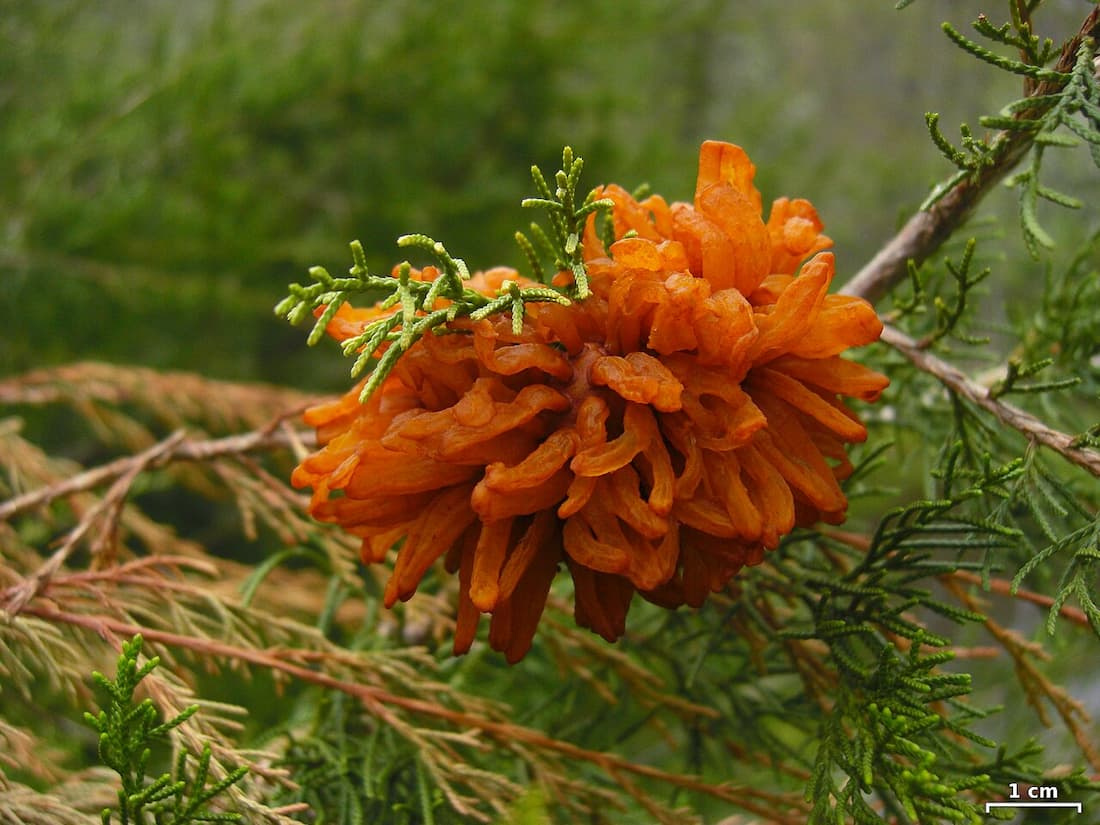
Featured Image Credit: Jason Hollinger, via Wikimedia Commons, CC BY 2.0
Cedar-Apple Rust At-a-Glance
Plant Group
Shade Trees
Evergreen Trees
Evergreen Shrubs
Plant Part
Leaves
Stems & Twigs
Is Spraying Worth It?
Rarely Worth It
Disease Type
Fungal
Active Season
Early Spring
Late Spring & Early Summer
Mid to Late Summer
Winter
Damage Potential
Cosmetic Only
Weakens Over Time
Cedar-Apple Rust Quick Answers
What Cedar-Apple Rust Looks Like
From a Few Feet Away
In spring, a juniper or red cedar looks as if it’s been hung with bright orange ornaments: jelly-like tendrils sprouting from brown galls all over the outer twigs after a rain. A few weeks after a nearby crabapple blooms, its leaves turn speckled with bright yellow-orange spots. By late summer a susceptible crabapple may be yellowing and dropping leaves early, sometimes nearly bare by August.
Symptoms by Plant Part
- Juniper twigs. Galls start as small greenish-brown swellings and take 18 to 20 months to mature into hard, round, brown galls up to about 2 inches across, pitted like a golf ball. They release spores for one spring, then die but stay attached for a year or more. The twig beyond a gall often turns brown and dies; the rest of the plant is unharmed.
- Crabapple leaves. Pale yellow spots appear on the upper surface 10 to 14 days after infection, shortly after bloom. Through early summer they grow to about 1/4 to 1/2 inch, turn bright yellow-orange with a reddish edge, and develop tiny black dots in the center. By mid to late summer the tissue underneath bulges and grows short, fringed tubes. Heavily spotted leaves can pucker, yellow and drop, especially in a dry summer.
- Crabapple twigs and fruit. On susceptible varieties, new shoots can develop corky swellings up to about 1 inch long, and badly affected twigs may die back. Fruit gets spots like the leaf spots but larger, mostly near the blossom end, and may drop early.
- Color varies with the tree. Spots look bright yellow on many white-flowered crabapples and more red-orange on dark-pink or red-flowered ones, so don’t rule out rust because the color doesn’t match a photo exactly.
Signs of the Fungus
On junipers, the sign is impossible to miss: during warm spring rains, the brown galls push out bright orange, jelly-like horns, usually 1/2 to 3/4 inch long and sometimes up to 2 inches. Look right after a rain in April or May. When the weather dries, the horns shrivel into dark threads, then swell again with the next rain — up to seven times in one spring.
On crabapples, look closely at the center of a leaf spot in late spring for tiny raised black dots, sometimes with a droplet of orange liquid. By mid to late summer, turn the leaf over: short, pale, fringed tubes about 1/10 inch long stick out beneath each spot and shed a fine orange-brown dust. That dust is the spore stage that blows back to the junipers.
Identification Photos
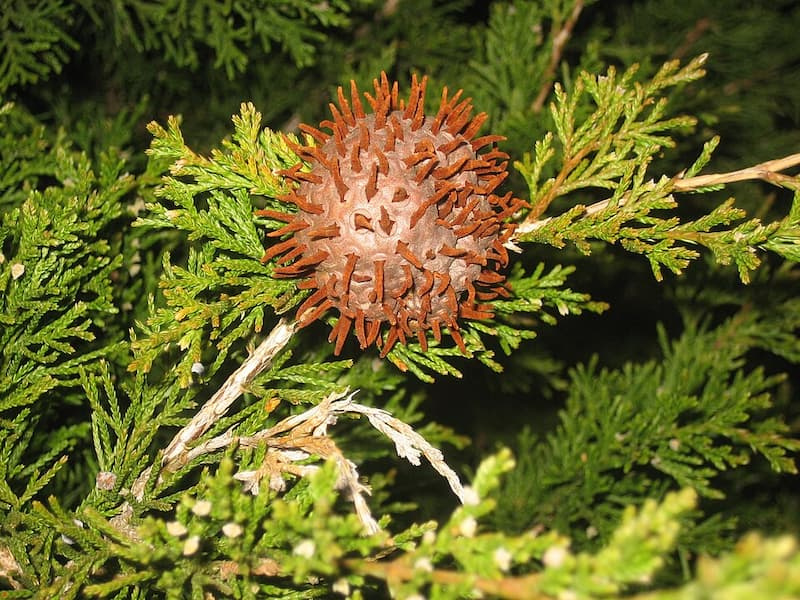
Dry Gall: For most of the year the galls are hard, brown and easy to mistake for a cone, sitting quietly on juniper twigs.
Botond Balogh, via Wikimedia Commons, public domain
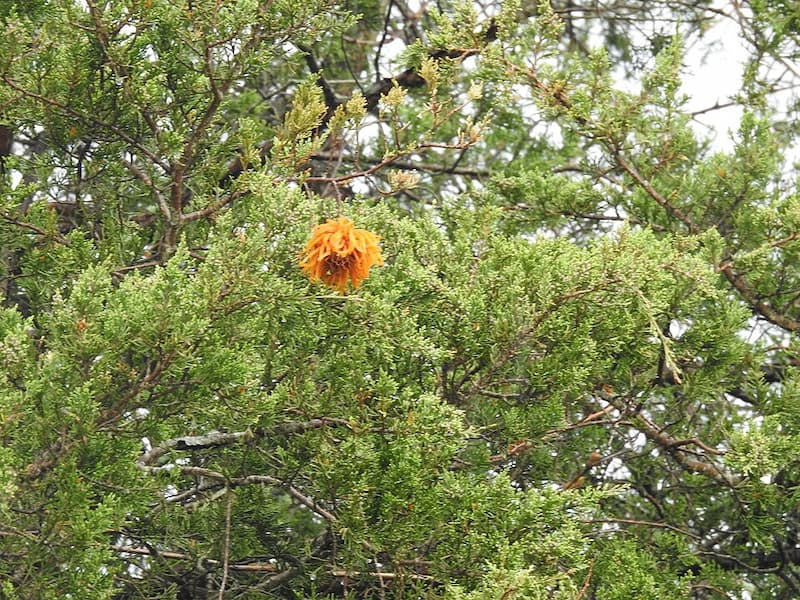
Spring Rains: After warm spring rains, the galls swell into bright orange horns that stand out on the tree and release spores onto nearby crabapples.
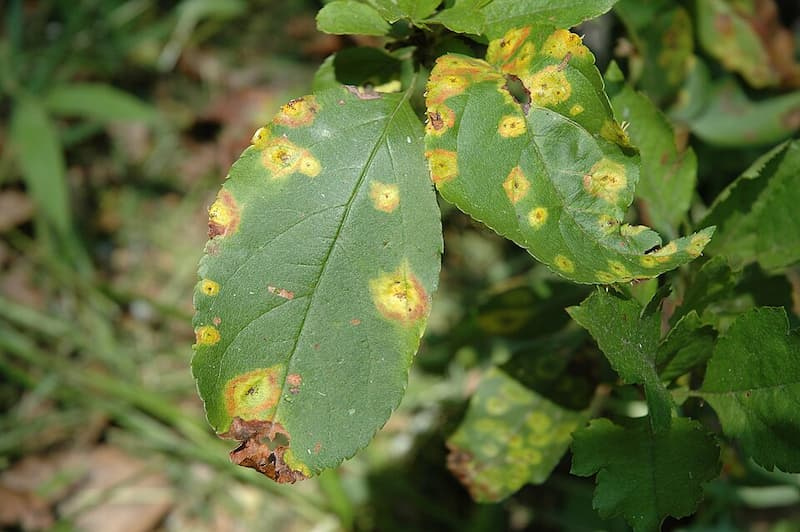
On Crabapple: A few weeks later, bright yellow-orange spots appear on crabapple leaves, the second host the fungus needs to complete its cycle.
Littleinfo, via Wikimedia Commons, public domain
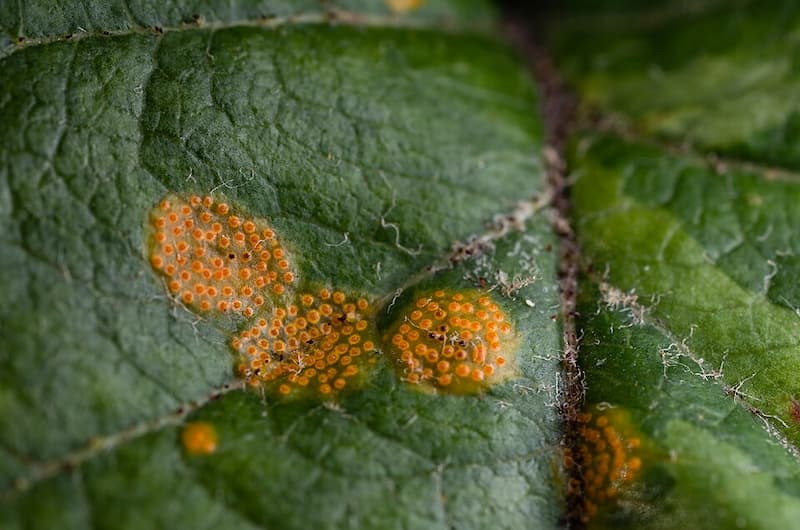
Up Close: Each spot fills with tiny dark specks as it matures, a sign the fungus is producing spores on the leaf.
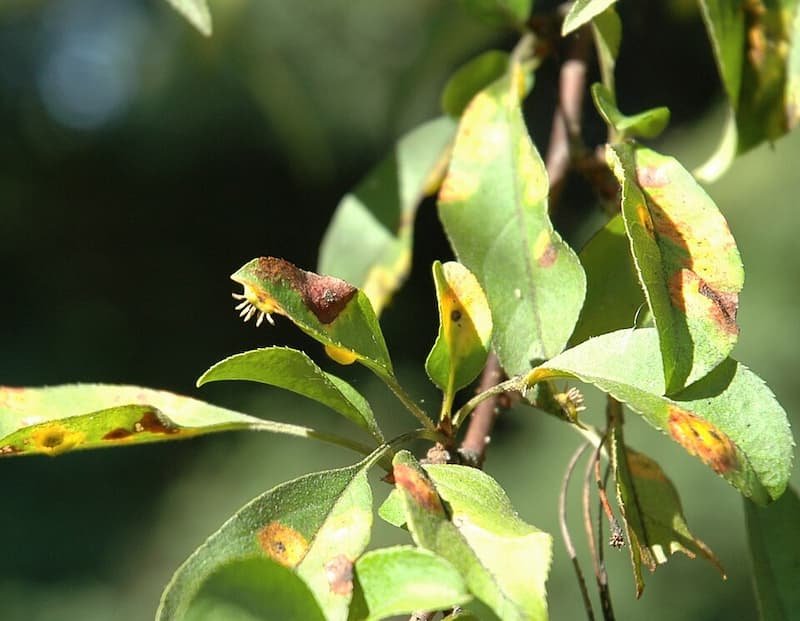
Under the Leaf: By midsummer, small fringed tubes form under each spot and release spores that blow back to junipers, where new galls start.
Littleinfo, via Wikimedia Commons, public domain
Could It Be Something Else?
Common Lookalikes
Apple Scab is the disease most often blamed on rust, or the reverse, because both spot crabapple leaves and both strip the tree in midsummer. Scab spots are olive-green to sooty black and velvety, not bright yellow-orange. The difference matters: scab survives the winter in fallen crabapple leaves, so raking helps against scab but does nothing against rust. Many crabapples carry both at once.
Cedar-Quince Rust uses the same junipers and also oozes orange in spring, so the two are easy to mix up on the evergreen side. Quince rust makes long swellings along branches that crack and peel, with shapeless orange blobs instead of finger-like horns, and those swellings keep producing spores for several years. On a crabapple it attacks fruit and green twigs and usually leaves the leaves alone.
Field Checks Before You Treat
- Check the juniper after a spring rain. Round galls on small twigs with finger-like orange horns mean cedar-apple rust. Orange blobs coming out of a long, cracked swelling along a branch mean cedar-quince rust.
- Look at gall shape in winter. Cedar-apple galls are hard, brown, round and up to about 2 inches across, with dimples like a golf ball. Old galls that have already released their spores stay on the twig as dry, dead shells.
- Read the leaf spot color. Bright yellow to orange spots with a reddish edge and tiny black dots in the center point to rust. Olive-green, velvety or sooty spots point to apple scab.
- Flip the leaf in midsummer. Short, pale tubes with fringed tips under each spot confirm rust. A smooth underside with dark, scabby spots means scab.
- Compare leaves and fruit. Spotted leaves point to cedar-apple rust. Fruit and green twigs covered in small white tubes, with clean leaves, point to cedar-quince rust.
- Look for a juniper nearby. Rust on a crabapple means a juniper is within spore range, usually within a few hundred yards. Not seeing one doesn't rule rust out, because spores can ride the wind for miles.
Plants at Risk
Commonly Affected Plants
The two sides of the disease:
- Flowering Crabapple — the main ornamental host; spotting ranges from none to severe depending on variety.
- Eastern Red Cedar — the most important juniper host and the usual spore source east of the Plains.
- Rocky Mountain Juniper — the main juniper host in the West.
- Chinese Juniper, Common Juniper, Creeping Juniper and Savin Juniper — susceptible in some varieties, resistant in many others.
Apple trees are infected the same way as crabapples. Rust on hawthorn, quince or serviceberry is usually one of the related cedar rusts rather than cedar-apple rust. Pears, roses, maples, perennials and lawns are never infected.
Resistant Choices
- Crabapples. Resistant: ‘Adams’, ‘David’, ‘Donald Wyman’, ‘Indian Summer’, ‘Mary Potter’, ‘Prairie Fire’, ‘Professor Sprenger’, ‘Red Jewel’, ‘Royalty’, ‘Snowdrift’, ‘White Angel’, ‘Winter Gold’, Sargent crabapple, Japanese flowering crabapple (Malus floribunda) and tea crabapple (Malus hupehensis). Avoid: ‘Hopa’, ‘Radiant’ and ‘Vanguard’, plus native wild sweet crabapple and prairie crabapple. ‘Special Radiant’ is resistant even though ‘Radiant’ is not, so check the full name on the tag.
- Eastern red cedar. Resistant selections include ‘Burkii’, ‘Grey Owl’, ‘Hillspire’, ‘Skyrocket’ and ‘Tripartita’. Unselected seedling red cedars are among the most heavily galled hosts.
- Other junipers. Resistant selections include Chinese juniper ‘Hetzii’, ‘Keteleer’, ‘Mountbatten’ and ‘Spartan’; Sargent juniper; savin juniper ‘Broadmoor’; creeping juniper ‘Douglasii’; and Rocky Mountain juniper ‘Medora’ and ‘Moonglow’. Unselected Rocky Mountain juniper is highly susceptible.
- Non-host replacements. Any flowering tree outside the rose family, such as redbud or flowering dogwood, and any evergreen outside the juniper family, such as yew or boxwood, cannot get cedar-apple rust.
Why It Shows Up
Conditions That Trigger It
Cedar-apple rust is a disease of rainy springs, and only for about a month. Infection happens when crabapple leaves stay wet for 4 to 6 hours at air temperatures of 50–75°F while the juniper galls are releasing spores. That window opens around crabapple bloom and closes about a month later: by then the galls are spent and the leaves have toughened enough to resist infection. A dry spring at bloom means little rust that year, no matter how many galls are nearby.
What raises the risk:
- Junipers within a few hundred yards. Most infections come from nearby galls, and eastern red cedar and Rocky Mountain juniper carry the heaviest loads.
- A susceptible crabapple. Variety matters more than anything else you can control: resistant crabapples stay nearly clean beside heavily infected junipers.
- Wet weather at bloom. Repeated spring rains rewet the galls again and again, and each rewetting releases a new round of spores.
- Leaves that dry slowly. Shade, crowding and sprinklers that wet the canopy in the evening all add hours of leaf wetness during the infection window.
How It Survives and Spreads
This fungus can’t finish its life on one plant. It has to move from a juniper to a crabapple and back again, and the round trip takes two years.
In spring, rain swells last year’s mature galls on junipers. The orange horns release spores that blow onto young crabapple leaves and start the yellow spots. In mid to late summer, tubes under those spots release a second kind of spore, which can infect only junipers. Those spores land on juniper needles and twigs, and over the next 18 to 20 months the infection grows into a new gall. That gall releases spores for one spring, then dies.
Two things follow from this. Spores from a crabapple can’t infect another crabapple, and spores from a juniper can’t infect another juniper. And the fungus survives the winter only in living juniper galls, not in fallen leaves, soil or tools. Spores travel by wind alone: most land within a few hundred yards, but some ride the wind for miles.
Where It Hits Hardest: Regional Notes
Cedar-apple rust is most common across the eastern half of the country, wherever wild Eastern Red Cedar grows near planted crabapples. That covers the Midwest, the Northeast and Mid-Atlantic, and the upper South; extension services from Minnesota and Iowa to Connecticut and South Carolina all report it. Farther west it shows up where Rocky Mountain Juniper is planted alongside crabapples, such as the Plains and the Colorado Front Range. It’s uncommon in the Pacific Northwest and the dry Southwest, where neither host grows wild in large numbers.
Cedar-Apple Rust Diagnostic Profile
Check what you see against the full set of signs. The more that match, the more likely this is your problem.
What You’ll See
Symptom Color
Yellow
Brown
Red, Pink or Purple
Orange or Rust
Black or Dark
Visible Signs
Orange Spore Dust
Black Spots or Pustules
Orange Gelatinous Horns
Plant Symptoms
Leaf Spots
Curled or Distorted Leaves
Yellowing
Browning & Dieback
Galls & Swellings
When and Where
Weather Triggers
Cool & Wet
Long Leaf Wetness (Dew or Rain)
Spread Pattern
Scattered
Controlling Cedar-Apple Rust
- Plant resistant varieties. This is the only control that works every year with no effort. Resistant crabapples stay almost spot-free even next to heavily galled junipers, and resistant junipers carry few or no galls.
- Keep the two hosts apart. Don’t plant junipers and crabapples within a few hundred yards of each other. This lowers infection but won’t end it, because spores can travel miles.
- Prune galls in late winter. On small junipers, cut off the brown galls before the orange horns appear, ideally by early April. A gall removed before spring can’t release spores. This works best when only a few junipers are nearby; on a large red cedar it’s rarely practical. Disinfect pruners between cuts with 70% rubbing alcohol, or 1 part household bleach to 9 parts water (soak about 2 minutes, rinse, oil the blades).
- Keep crabapple leaves dry around bloom. Water the soil, not the canopy, and run sprinklers before sunrise rather than in the evening. Infection needs hours of wet leaves, so every hour you remove helps.
- Don’t count on raking. Fallen crabapple leaves don’t carry cedar-apple rust into next year, because only the juniper galls do. Raking is still worth doing against apple scab, which often shares the tree.
- Help a defoliated tree recover. A crabapple that dropped its leaves early has less stored energy, so water deeply during dry spells in late summer and fall rather than adding fertilizer.
Spraying is rarely worth it on an established crabapple, and junipers don’t need it at all. Most crabapples handle the spots without lasting harm, and spraying a full-size tree several times each spring is a lot of work and chemical for a mostly cosmetic problem. It can make sense for a young crabapple, or a valued susceptible one that loses most of its leaves every summer.
If you do spray, timing is everything. Fungicides only protect leaves before infection; once spots appear, it’s too late. Start when the flower buds show color or when orange horns first appear on nearby junipers, whichever comes first. Repeat at the label interval, usually 7 to 14 days, for three or four sprays, until the horns dry up about a month after bloom.
| Active ingredient | FRAC group | How well it works | Notes |
|---|---|---|---|
| Myclobutanil | 3 | Most effective | The first choice of extension sources for crabapple rust; homeowner products available |
| Mancozeb | M03 | Protectant | Works only on leaf surfaces it covers before rain |
| Chlorothalonil | M05 | Protectant | Use only products labeled for ornamental trees |
| Copper | M01 | Less effective | Can injure tender leaves, especially in hot weather |
| Sulfur | M02 | Less effective | Can injure leaves in hot weather; don’t mix with horticultural oil |
These products are labeled for ornamental trees. If you eat the fruit — crabapple jelly, or an apple tree in the yard — check that the label covers edible fruit before you spray.
Removal, Disposal and Replanting
Remove a crabapple only when it’s a susceptible variety that loses most of its leaves by midsummer, year after year, and you don’t want to spray. Repeated early leaf loss drains the tree and leaves it open to winter injury, borers and other problems. One bad year is not a reason to remove a tree. Junipers almost never need removal: the disease doesn’t kill them, and pruning off galls handles the worst of it.
Bag pruned galls and send them out with the trash. Galls cut in winter can still release spores if they get wet in spring. Fallen crabapple leaves don’t carry rust into next year, but they often carry apple scab, so send them to yard-waste pickup unless your compost pile reliably runs above 140°F.
You can replant in the same spot right away. The fungus can’t live in soil or dead roots. Choose a resistant crabapple, a resistant juniper, or a plant from outside the rose and juniper families.
When to Call a Pro
Send a sample to your state’s extension plant diagnostic lab if the spots or swellings don’t match the description here, especially if fruit and twigs are damaged but the leaves aren’t, or if a tree is declining beyond normal leaf spotting. Mail fresh twigs with symptomatic leaves or intact galls, wrapped in dry paper towels in a paper bag, early in the week so they don’t sit in transit over a weekend. Call an ISA Certified Arborist when galls are out of reach on a large red cedar, when a mature crabapple needs spraying from the ground up, or when a tree has lost its leaves several years in a row and you want its health assessed.
Frequently Asked Questions
These answers are synthesized from plant pathology research and diagnostic guidance published by university extension services and plant disease clinics.
They’re the spore horns of cedar-apple rust. Brown galls that formed on the twigs over the past two years soak up spring rain and push out these orange tendrils, which release spores that infect nearby crabapples. They look alarming but do the juniper very little harm. By early summer they dry up for good, and the dead galls stay on the twigs as brown shells.
Usually not. Removing the closest red cedars lowers the spore load, but spores can travel miles, so other trees in the neighborhood keep the disease going. Fruit growers clear red cedars across miles, which isn’t realistic for a home yard. Replacing a susceptible crabapple with a resistant one solves the problem far more reliably.
Because the infection happened months earlier. The spots you see in summer started as infections around bloom, when the juniper galls were releasing spores. Once the fungus is inside the leaf, no fungicide can reach it. Sprays only work as a shield applied before infection, from when the flower buds show color until about a month after bloom.
Not for the juniper’s sake. The galls cause some twig-tip dieback but won’t seriously harm the plant. Removing them in late winter is still a good-neighbor step if anyone within a few hundred yards grows crabapples or apples, and it keeps the plant looking tidier. Remember that a crabapple you can’t see may still be within spore range.
Scientific Authority
This profile is built on plant pathology research and diagnostic guidance from university extension services and plant disease clinics. We prioritize accurate identification and cultural control first, recommending fungicides only where research shows they are justified, and naming them by active ingredient rather than brand.
Primary Resources
- University of Minnesota Extension — Cedar-apple rust and related rust diseases
- University of Illinois Extension — Cedar Apple Rust
- Purdue University Extension — Cedar Apple and Related Rusts (BP-35)
- Penn State Extension — Cedar Apple and Related Rusts on Ornamentals
- Iowa State University Extension and Outreach — Cedar-Apple Rust
- Clemson University HGIC — Cedar-Apple Rust
- University of Connecticut Home & Garden Education Center — Apple Rust Disease
- Cornell University Plant Disease Diagnostic Clinic — Cedar-Apple Rust
- The Morton Arboretum — Cedar-Apple Rust
- Missouri Botanical Garden — Cedar-Apple Rust
- Missouri Botanical Garden — Apple Scab