
Pathogen: Erwinia amylovora (a bacterium)
Also called: fireblight, blossom blight, shoot blight, twig blight, canker blight
Fire Blight
The rose family's scorched-branch disease
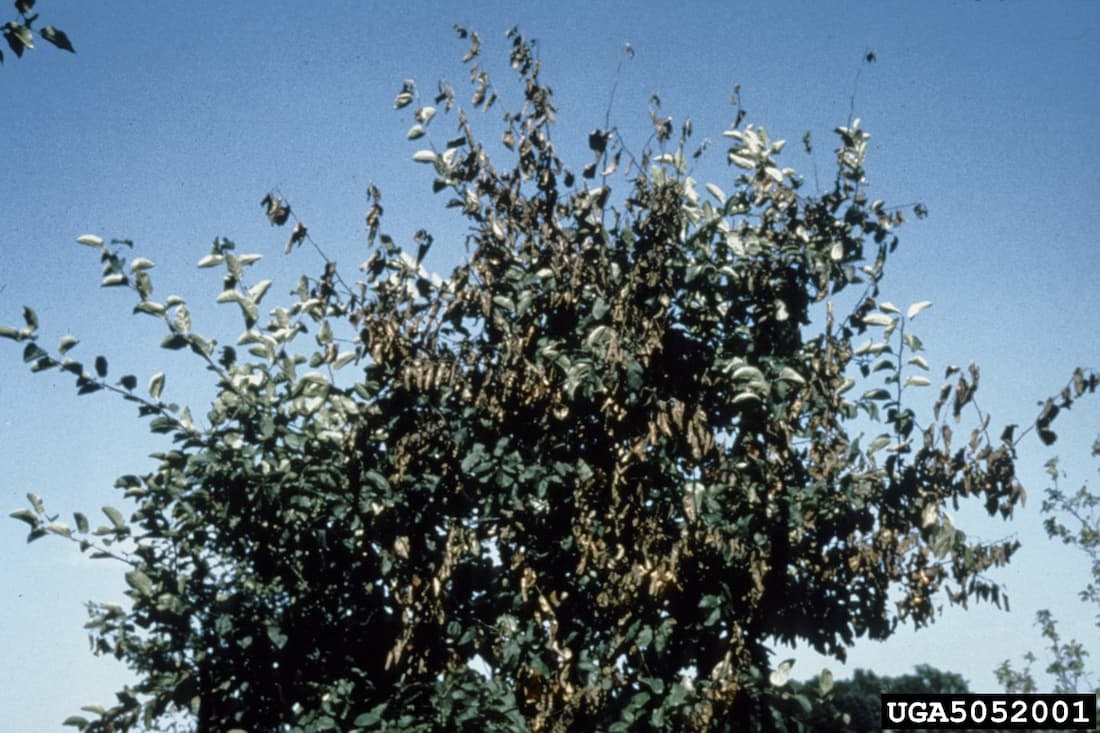
Featured Image Credit: Joseph OBrien, USDA Forest Service, Bugwood.org, CC BY 3.0 US
Fire Blight At-a-Glance
Plant Group
Shade Trees
Evergreen Trees
Flowering Shrubs
Evergreen Shrubs
Plant Part
Leaves
Flowers & Buds
Stems & Twigs
Branches & Trunk
Roots & Crown
Whole Plant
Is Spraying Worth It?
Rarely Worth It
Disease Type
Bacterial
Active Season
Early Spring
Late Spring & Early Summer
Mid to Late Summer
Fall
Damage Potential
Weakens Over Time
Can Be Fatal
Fire Blight Quick Answers
What Fire Blight Looks Like
From a Few Feet Away
From across the yard, a fire-blighted tree or shrub looks like someone ran a blowtorch over the branch tips: scattered shoot ends wilt and turn dark brown or black while the rest of the canopy stays green. Many dead tips bend over into a hook, and the dead leaves and shriveled fruit stay stuck to the twigs all season and often into winter. On older infections, dark, sunken patches of dead bark show on larger branches and sometimes the trunk.
Symptoms by Plant Part
Fire blight moves from the outside of the plant inward, following the order the parts are infected.
- Flowers. One to three weeks after bloom, blossom clusters look water-soaked, then droop, shrivel and turn brown or black. They stay attached to the twig. On some plants the flower stems turn orange before dying.
- Shoots and twigs. Young shoots wilt and turn gray-green, then brown or black, and the tip often bends into a shepherd’s crook. The leaf midribs and leaf stems darken first, then the whole leaf.
- Leaves. Dead leaves curl and cling tightly to the twig. Their color depends on the plant: black on pears, dark to chocolate brown on crabapples, mountain ash and most other hosts, reddish brown on cotoneaster. Pear leaves may turn red, then black, in fall. Hawthorn is the exception — infected leaves turn yellow, then brown, and drop early.
- Fruit. Young fruit blackens, shrivels into a hard mummy and can hang on for months.
- Branches and trunk. Where the infection stops, it leaves a canker: dark, slightly sunken bark, often with cracks along its edge. Under the bark the wood is stained reddish brown. A canker that rings a branch kills everything above it; one that rings the trunk can kill the tree.
- Rootstock. On grafted trees, bacteria that reach the rootstock blacken the bark at the base. In late summer or early fall the whole canopy turns reddish and wilts, and the tree can collapse quickly.
Damage peaks from bloom through early summer while shoots are growing. Once shoots stop growing in mid to late summer, the infection stops spreading, but the dead leaves and cankers remain visible through fall and winter.
Signs of the Fungus
The only visible sign of the bacterium is bacterial ooze: sticky droplets that seep from canker edges, blighted shoots, flower stems and shriveled fruit. Fresh ooze is watery and cream, light yellow or light tan; it darkens to amber or brown as it dries and leaves dark streaks down the bark. Look on warm, humid spring mornings after rain — ooze rarely shows in dry weather, so its absence proves nothing. Under the bark of an active canker, the wood is stained reddish brown, which you can see by shaving the bark at the canker’s edge.
Identification Photos
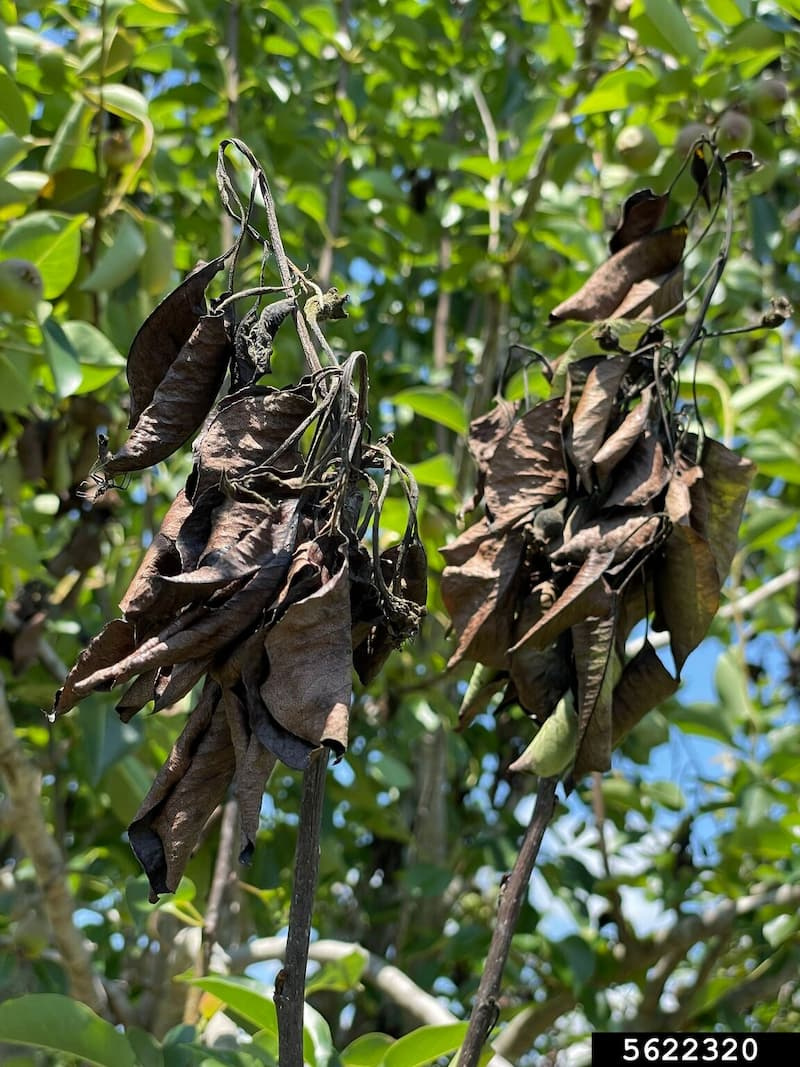
Scorched Look: Infected shoots wilt and turn black or dark brown, as if burned by fire, and the dead leaves stay attached instead of falling.
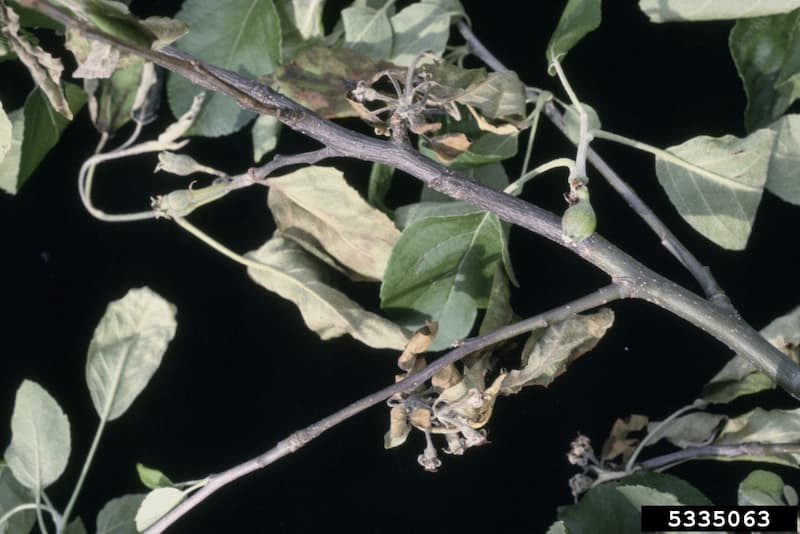
Shepherd’s Crook: The tips of infected shoots bend over into a hook. It’s one of the easiest ways to tell fire blight from drought or frost damage.
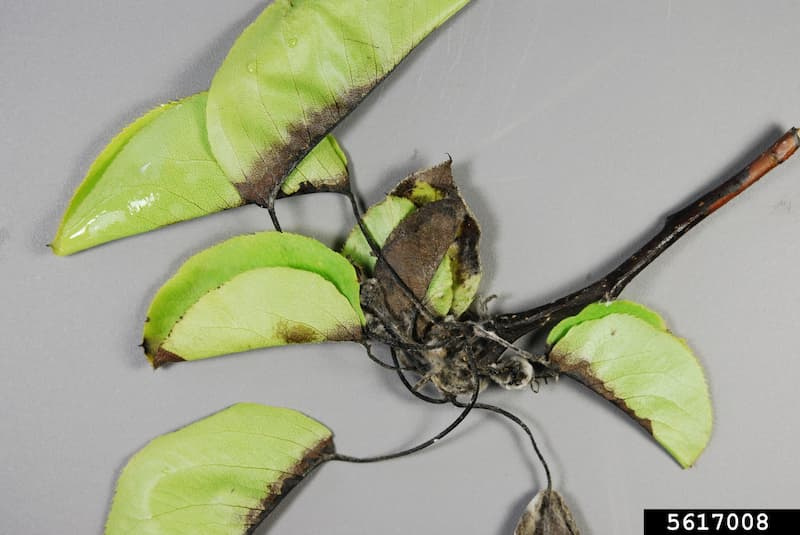
Ornamental Pears: Callery (Bradford) pears are highly susceptible, and infection shows first as dark, water-soaked tissue on leaves and stems.
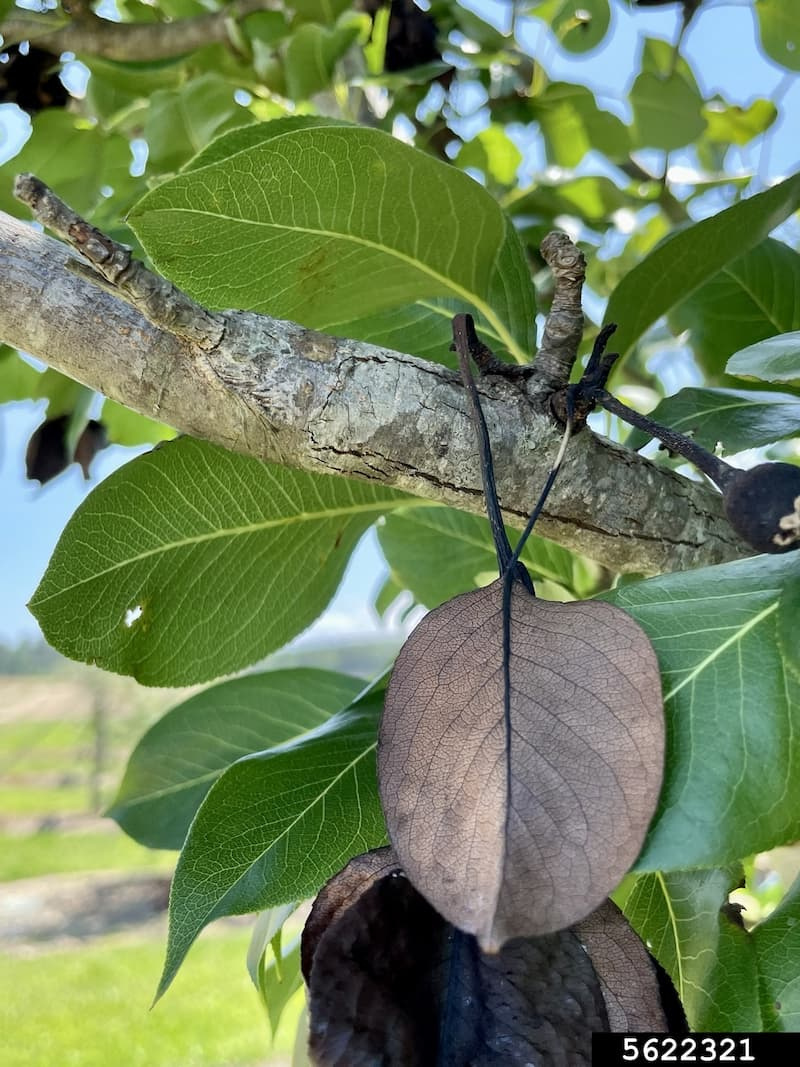
Branch Cankers: The bacteria spread into the wood and form dark, sunken cankers, where they overwinter and restart the disease each spring.
Could It Be Something Else?
Common Lookalikes
Bacterial blast blackens blossoms and flower clusters on pears and crabapples in spring, and the flower symptoms can look identical. The difference is the weather and how far it goes: blast follows frost or freezing temperatures plus moisture, never produces ooze, and usually stops at the base of the flower cluster instead of running down the twig into a canker.
Frost injury turns tender new leaves and shoot tips black or brown overnight, which looks like fire blight’s scorched tips. Frost is not choosy — it hits every exposed plant in the area, including ones outside the rose family — and it damages leaves and new growth without discoloring the stem. Frost-hit stems usually push new growth from the same twigs; fire blight kills the whole tip and keeps moving down.
Field Checks Before You Treat
- Check the plant family. Fire blight attacks only the rose family: pears, crabapples, apples, hawthorn, pyracantha, cotoneaster, mountain ash, serviceberry, quince and their relatives. If the plant is a maple, oak, dogwood, hydrangea or conifer, it is not fire blight.
- Look for the hook. Find dying shoot tips on the outer canopy. A tip bent sharply downward like a shepherd's crook points to fire blight. Not every infected tip hooks, but a whole tree of straight, brittle dead twigs points elsewhere, such as drought or borers.
- Tug a dead leaf. Dead brown or black leaves that cling tightly to the twig for months, often into winter, fit fire blight. Hawthorn is the exception: its infected leaves turn yellow, then brown, and drop early.
- Shave the bark at the canker edge. With a clean knife, shave off the thin outer bark where dark, sunken bark meets healthy bark. Reddish-brown streaks in the wood beneath mean the bacteria are active there; clean, pale wood means that spot is clear.
- Check for ooze after rain. On a warm, humid spring morning, look at canker edges and blighted shoot stems for cream to amber droplets. Ooze confirms fire blight; no ooze in dry weather does not rule it out.
- Check the neighbors. If non-rose-family plants nearby show the same blackened new growth after a cold night, frost is the likelier cause.
Plants at Risk
Commonly Affected Plants
Fire blight attacks only plants in the rose family. The ones homeowners most often find it on:
- Ornamental (Callery) pear, including ‘Aristocrat’ and other highly susceptible cultivars
- Flowering crabapple
- Hawthorn
- Pyracantha (firethorn)
- Cotoneaster, including hedge and groundcover plantings
- Mountain ash
- Serviceberry
- Flowering quince
- Loquat (in the South and on the West Coast)
Less often: photinia, toyon, spirea and roses. It does not infect plants outside the rose family.
Resistant Choices
No rose-family plant is fully immune; resistant varieties blight less and slow the spread enough to prune in time.
- Crabapple. ‘Adams’, ‘David’, ‘Dolgo’, ‘Profusion’, ‘Red Baron’, ‘Prairifire’, ‘Callaway’, ‘Harvest Gold’, ‘Indian Summer’, ‘Jewelberry’, ‘Liset’, ‘Selkirk’, ‘Sentinel’, ‘Adirondack’, ‘Camelot’, ‘Donald Wyman’.
- Ornamental pear. ‘Bradford’, ‘Capital’ and ‘Cleveland Select’ (also sold as ‘Chanticleer’) are the least susceptible; ‘Aristocrat’ is highly susceptible. Even ‘Bradford’ blights in bad years, and Callery pear is invasive in many states, so a non-pear replacement is often the better choice.
- Hawthorn. Washington hawthorn (Crataegus phaenopyrum), cockspur hawthorn (C. crus-galli), ‘Winter King’ (C. viridis) and ‘Ohio Pioneer’ (C. punctata).
- Cotoneaster. Creeping cotoneaster (C. adpressus) and bearberry cotoneaster (C. dammeri var. radicans).
- Pyracantha. ‘Mohave’, ‘Navaho’, ‘Teton’ and ‘Shawnee’.
- Outside the rose family. Where fire blight keeps coming back, a tree or shrub from outside the rose family — such as redbud, dogwood, maple or viburnum — ends the problem entirely. Serviceberry, quince and photinia are rose-family plants and don’t count.
Why It Shows Up
Conditions That Trigger It
Fire blight is a warm-spring disease, and bloom is its doorway. The bacteria become active once air temperatures pass about 65°F, and the worst outbreaks come when rainy or humid weather lines up with daytime highs of 75–85°F and nights above 55°F during bloom. Rain, heavy dew or fog matters because water washes the bacteria from the flower’s tip down into its nectar glands, where they get inside. The bacteria stop multiplying above about 86°F, which is why the disease slows in hot, dry summer weather. Blossom symptoms appear one to three weeks after the flowers open.
Site and care factors that raise the risk:
- Too much nitrogen. Heavy feeding pushes soft, fast-growing shoots with thin cell walls that the bacteria enter and move through easily.
- Heavy pruning. Hard cuts trigger the same flush of soft, susceptible growth.
- Sprinklers on the canopy during bloom. Overhead water splashes ooze onto open flowers and keeps blossoms wet.
- Hail and storm damage. Torn leaves and shoots give the bacteria open wounds at the same moment the weather supplies moisture.
- Shade and crowding. Dense, shaded canopies stay wet longer after rain and dew.
- Young age and susceptible varieties. Thin-barked young trees and highly susceptible cultivars let the bacteria reach the trunk before the plant can wall them off.
- Late or repeat bloom. Plants that keep flowering after the main bloom offer open flowers through warmer, riskier weather.
How It Survives and Spreads
Fire blight spends the winter in one place only: the living bark at the edges of cankers formed the year before. It does not survive in soil, and it does not last in fallen leaves or dead, dried wood. In spring, as the weather warms past 65°F, the bacteria multiply in those canker edges and push out through bark cracks and pores as a sweet, sticky ooze.
Bees, flies and other insects feed on the ooze and carry the bacteria to open flowers. Rain splash, wind-driven droplets and sprinkler water move it to nearby blossoms and shoots, and pruning tools carry it into fresh cuts. Infected nursery plants bring it to new yards. Once inside a flower, shoot tip or wound, the bacteria travel down through the twig’s tissue, killing it as they go, and keep moving toward larger branches while the shoots are still growing. When shoot growth stops in mid to late summer, the advance halts and the edge of the dead area becomes a new canker — next spring’s source of ooze.
Where It Hits Hardest: Regional Notes
Fire blight is native to North America and turns up wherever rose-family trees and shrubs grow. It is most damaging where springs are warm and wet during bloom: the Southeast and South, where it limits ornamental pears, and much of the Midwest, Mid-Atlantic and Northeast. In Minnesota and other cold-spring areas, flower infections are less common because bloom usually falls in cool weather, but shoot blight on crabapple, mountain ash and cotoneaster is still common. In the drier West and Intermountain West, outbreaks are sporadic and usually follow a warm spring rain, a hailstorm or sprinklers that wet trees in bloom.
Fire Blight Diagnostic Profile
Check what you see against the full set of signs. The more that match, the more likely this is your problem.
What You’ll See
Symptom Color
Yellow
Brown
Red, Pink or Purple
Orange or Rust
Black or Dark
Visible Signs
Bacterial Ooze
Discolored Sapwood Streaks
Plant Symptoms
Curled or Distorted Leaves
Wilting
Yellowing
Browning & Dieback
Cankers
When and Where
Weather Triggers
Warm & Humid
Long Leaf Wetness (Dew or Rain)
Spread Pattern
One Side or Branch
Tips Back Toward the Trunk
Scattered
Controlling Fire Blight
Cutting out the cankers that hold the bacteria over winter, and avoiding the soft growth they feed on, does more than any spray. The practices below are listed in order of impact.
- Do the main cleanup in late winter. While the plant is dormant and the bacteria are inactive, cut out every blighted twig, cankered branch and clinging dead fruit. Cut at least 8 inches below the visible edge of the canker, back to a side branch or the trunk, without leaving a stub. This removes next spring’s ooze source before it can start.
- Cut where it counts. A cut that falls short of the infection — inside wood the bacteria have already reached — is the most common pruning mistake. Before cutting, shave a little bark just below your planned cut; if the wood shows reddish-brown streaks, go lower.
- Disinfect tools between cuts. Dip or wipe blades with 70% rubbing alcohol, or soak them about 2 minutes in 1 part household bleach to 9 parts water, then rinse and oil the blades. Bleach corrodes steel, which is why the rinse and oil matter.
- Prune in spring only for fast-moving strikes. Growing-season cuts can spread the bacteria, so leave most strikes until summer or winter. The exception is a strike on a highly susceptible or young plant that is heading toward a main limb or the trunk: on a dry day, cut it out 12 inches below the visible damage and disinfect your tools after each cut. In actively growing wood the bacteria are farther ahead than the dead tissue shows.
- Prune only in dry weather. Wet bark lets ooze move in water films into fresh cuts.
- Go easy on nitrogen. Fertilize only when a soil test shows a need. Soft, fast shoots are the easiest tissue for the bacteria to invade and race through.
- Avoid heavy pruning. Hard cuts trigger the same flush of soft shoots. Prune moderately and spread big changes over several years.
- Keep sprinklers off the canopy during bloom. Water at the base with drip or soaker lines so flowers stay dry and ooze isn’t splashed around.
- Give plants sun and air. Space new plantings so canopies don’t overlap; open, sunny canopies dry faster after rain and dew.
- Remove root suckers and water sprouts. These soft shoots are easy entry points, and an infection in a sucker can reach the rootstock.
- Replace repeat offenders with resistant plants. A highly susceptible tree that blights every spring keeps feeding bacteria to every rose-family plant nearby.
Spraying is rarely worth it for fire blight in a home landscape. Sprays only protect open flowers and surface bark from new infections; nothing cures a twig or canker that is already infected, and timing has to match bloom to the day. Fungicides don’t work at all, because the cause is a bacterium — only copper and the antibiotic streptomycin act on it.
Spraying can make sense in one situation: a young or high-value, highly susceptible tree (such as a crabapple or ornamental pear) that blighted badly last year, in a spring that is turning warm and wet at bloom. Even then, sanitation pruning does more.
| Active ingredient | Group | When | Home use and cautions |
|---|---|---|---|
| Fixed copper (copper hydroxide, copper sulfate, copper soap, Bordeaux mixture) | FRAC M01 | Before bud break, ending by the time green tissue shows about ½ inch | Sold to homeowners. Lowers bacteria on bark surfaces before bloom; gives only partial control. Sprayed on leaves and flowers it can burn them, especially in cool, wet weather. Copper-resistant fire blight bacteria are known in some areas. |
| Streptomycin | FRAC 25 (antibiotic) | When flowers first open, repeated every 3 to 4 days while blossoms are open | Sold to homeowners, but many labels list fruit trees only. Use it only if your plant is named on the label. Protects flowers, not shoots or cankers. Resistant bacteria are widespread in some fruit-growing regions. |
| Oxytetracycline, kasugamycin, prohexadione calcium | Various | Bloom and early shoot growth | Professional or commercial use; a certified arborist can apply newer antibiotic products to a high-value tree. |
Don’t spray insecticides during bloom. Bees spread fire blight, but killing pollinators doesn’t stop the disease, and the label forbids bloom sprays on most products.
Removal, Disposal and Replanting
Remove the whole plant when cankers have reached the main trunk or the graft, when more than half the canopy is dead, or when a highly susceptible variety blights badly every spring despite pruning. Once the trunk is infected the tree will likely die anyway, and leaving it — stump included — keeps a bacteria source next to every other rose-family plant in the yard. For a badly blighted cotoneaster hedge, cut the whole planting to about 6 inches above the ground in late winter instead; if only a few stems are affected, prune those out.
Disposal: bag infected leaves, twigs and wood for the trash or yard-waste pickup, or burn or bury them where local rules allow. Never compost them and never chip infected wood into mulch — a home pile rarely gets hot enough to kill the bacteria in woody tissue, and mulch spreads them around your beds. Get prunings out of the yard promptly rather than leaving them piled under the tree.
Replanting: you can replant in the same spot right away. The bacteria live only inside living plant tissue and don’t survive in soil, so there is nothing to treat or replace. Choose a resistant variety or a plant from outside the rose family.
When to Call a Pro
Call an ISA Certified Arborist if cankers have reached the trunk or large limbs, if the infected wood is too high to reach safely from the ground or near power lines, or if dieback has made a tree structurally unsafe. An arborist is also the route for professional bloom sprays on a valuable specimen tree. Send a sample to your state extension diagnostic lab if you can’t tell fire blight from frost, bacterial blast or a fungal canker: cut a fresh branch section that includes both the dead bark and the healthy bark next to it, wrap it in dry paper towel, seal it in a plastic bag, keep it cool and ship it right away. Completely dead, dry wood is useless for diagnosis.
Frequently Asked Questions
These answers are synthesized from plant pathology research and diagnostic guidance published by university extension services and plant disease clinics.
Because the bacteria kill the shoot too fast for the plant to drop them. Healthy trees shed leaves by forming a separation layer at the base of each leaf stem, and that takes living tissue and time. Fire blight kills the twig before that layer forms, so the dead leaves stay locked on — one of the easiest ways to spot it in fall and winter. Hawthorn is the exception and drops its infected leaves early.
It is bacterial ooze, and it is how fire blight spreads. In warm, wet spring weather, bacteria that spent the winter in old cankers multiply and push out through cracks in the bark as a sugary liquid packed with bacteria. Insects feed on it and carry it to open flowers, and rain splashes it onto nearby shoots. Seeing it means the canker it comes from should be cut out at the next dry opportunity, ideally before bloom ends.
Hail opens thousands of small wounds at the same time it wets the tree. In warm weather, bacteria splashed onto those fresh wounds get straight inside, and infected shoots blacken within days — sometimes across much of the canopy at once. This storm-triggered outbreak, often called trauma blight, can hit even after bloom. Check susceptible trees closely in the week after any spring or early-summer hailstorm.
No. Wound dressings and paints don’t stop fire blight and can trap moisture against the wound. What protects the cut is where you make it: far enough below the infection that the blade touches only healthy wood, on a dry day.
Scientific Authority
This profile is built on plant pathology research and diagnostic guidance from university extension services and plant disease clinics. We prioritize accurate identification and cultural control first, recommending fungicides only where research shows they are justified, and naming them by active ingredient rather than brand.
Primary Resources
- University of California IPM — Pest Notes: Fire Blight
- University of California IPM — Bacterial Blossom Blast
- Penn State Extension — Fire Blight in Ornamentals
- University of Minnesota Extension — Fire Blight
- Clemson Cooperative Extension, Home & Garden Information Center — Fire Blight of Fruit Trees
- University of Illinois Extension — Fire Blight (Hort Answers)
- University of Illinois Extension — Report on Plant Disease 801: Fire Blight
- University of Illinois Extension — Fire Blight or Frost?
- NC State Extension — Fire Blight
- The Morton Arboretum — Fire Blight