
Pathogen: Apiognomonia and related host-specific fungi, e.g. Apiognomonia veneta (sycamore), A. errabunda (ash), A. quercina (oak), Ophiognomonia leptostyla (formerly Gnomonia leptostyla, walnut), Discula destructiva (dogwood)
Also called: shade tree anthracnose, sycamore anthracnose, oak anthracnose, ash anthracnose, maple anthracnose, walnut anthracnose, dogwood anthracnose, leaf blight, shoot blight, twig blight
Tree Anthracnose
The cold, wet spring leaf drop
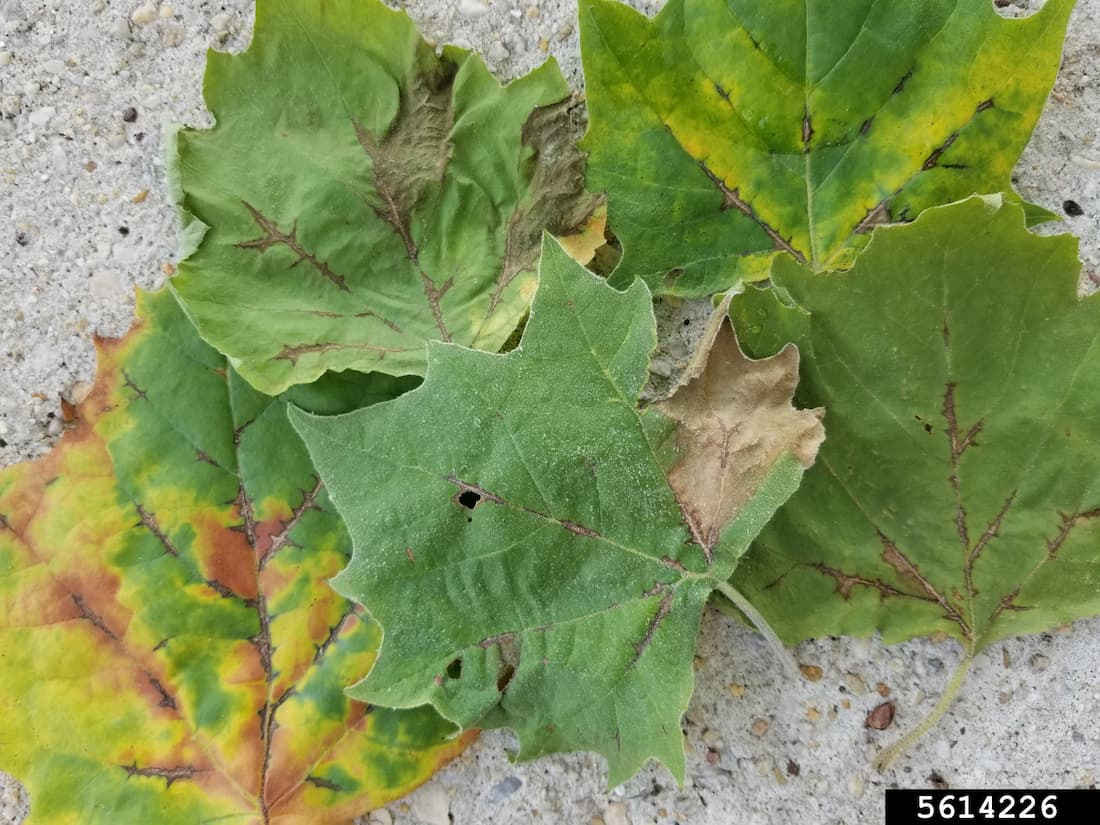
Featured Image Credit: Nancy Gregory, University of Delaware, Bugwood.org, CC BY 3.0 US
Tree Anthracnose At-a-Glance
Plant Group
Shade Trees
Evergreen Trees
Flowering Shrubs
Plant Part
Leaves
Flowers & Buds
Stems & Twigs
Branches & Trunk
Is Spraying Worth It?
Rarely Worth It
Disease Type
Fungal
Active Season
Early Spring
Late Spring & Early Summer
Mid to Late Summer
Damage Potential
Cosmetic Only
Weakens Over Time
Can Be Fatal
Tree Anthracnose Quick Answers
What Tree Anthracnose Looks Like
From a Few Feet Away
In late spring, the tree’s new leaves look scorched, crinkled and blotched with brown, and the lower and inner branches start dropping them while the top of the tree stays greener. A badly hit sycamore can look nearly dead in May, with bare twig tips and leaves littering the lawn. By midsummer, most shade trees push out a fresh set of normal green leaves. On flowering dogwood, the damage instead climbs from the lower branches upward, and blighted leaves cling to the twigs.
Symptoms by Plant Part
Leaves. Infection starts on soft, expanding leaves as small tan to brown spots that grow into large, irregular dead blotches, often following the main veins. Very young leaves infected while they are still expanding cup, curl and twist, because only part of the leaf dies and the rest keeps growing. Leaves infected later stay flat with smaller spots. Infected leaves fall early, in late May through June in a cool, wet year.
Buds and flowers. In a bad spring, buds can be killed before they open, which looks a lot like frost. On dogwood, the white or pink flower bracts get spotted and distorted in rainy bloom seasons.
Shoots and twigs. The fungus can grow from the leaf stalk into the twig, killing new shoots and one-year-old twig tips. Dead twigs show slightly sunken, discolored bark.
Branches and trunk. Repeated twig cankers kill branch tips year after year. The buds below then sprout into crooked, bushy clusters called witches’ brooms. On dogwood, sunken cankers spread down branches into the trunk, where they can girdle and kill the tree. Roots are never involved.
What sets the main hosts apart:
| Tree | What to look for |
|---|---|
| Sycamore and London plane | The most severe shade-tree form: buds and new shoots die suddenly, blotches run along the veins, twig cankers cause witches’ brooms and gnarled limbs. |
| Oak | Tan to brown blotches along the veins of young, often cupped leaves; small orange-brown blisters or a brown band on young twigs. White oaks suffer most. |
| Ash | Little twisting but heavy leaf drop: leaflets fall while still partly green, piling up on the lawn in late May and June. |
| Maple | Large brown patches or brown streaks along the veins; leaves distort in cool, wet springs. |
| Black walnut | Brown spots with yellow halos on the leaflet undersides in summer; leaflets yellow, brown and drop, leaving the tree bare by August. |
| Flowering dogwood | Tan spots with purple borders on leaves and bracts, starting low; gray, blighted leaves that cling to twigs; trunk cankers and many water sprouts. Can kill the tree. |
Signs of the Fungus
The fungus shows itself as tiny, pimple-like dark specks, smaller than a pinhead, on the undersides of infected leaves, mostly along the veins, and on the slightly sunken, discolored bark of dead twigs. To the naked eye they look like a scattering of black dots on dead tissue; a 10x hand lens shows they are raised. Look on the underside of a fresh brown blotch right after a rainy spell, when the fungus is actively producing spores. On walnut, the specks sit inside brown spots on the leaflet undersides.
Identification Photos
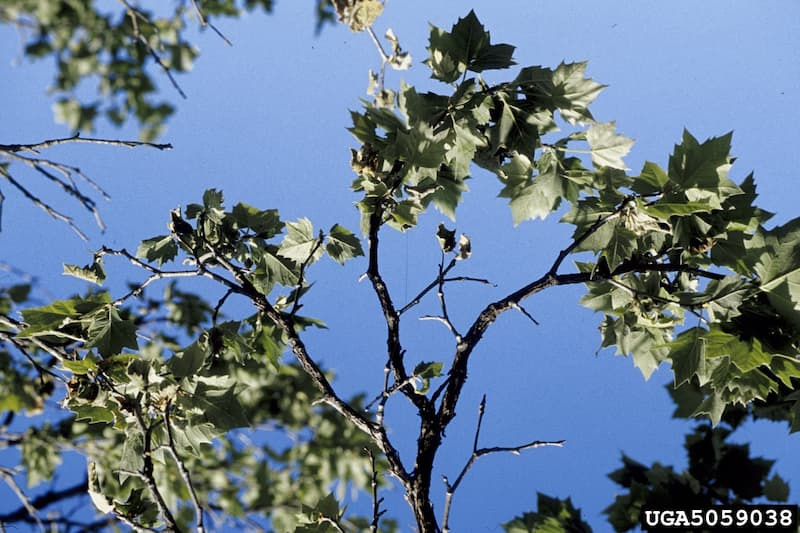
Thin Spring Canopy: After a cool, wet spring, infected trees can look thin and scorched, and some drop many of their first leaves.
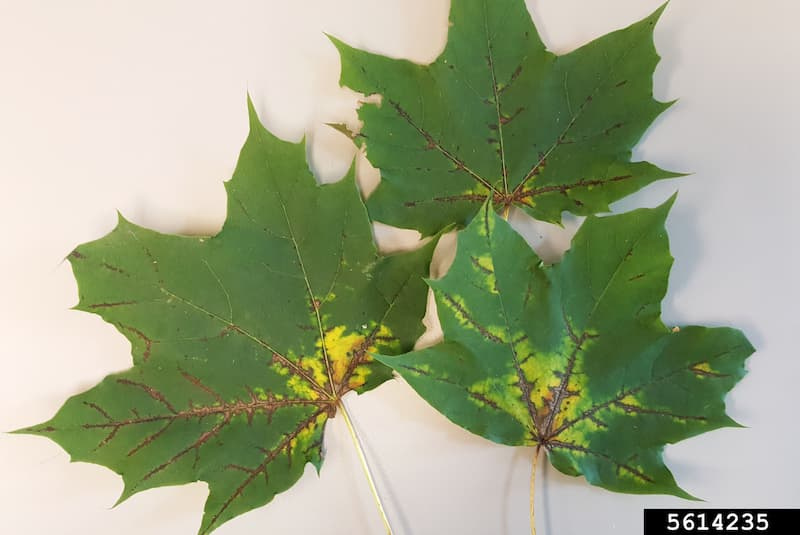
On Maples: Maple anthracnose shows up as tan to brown patches along and between the veins, often on leaves of the lower canopy first.
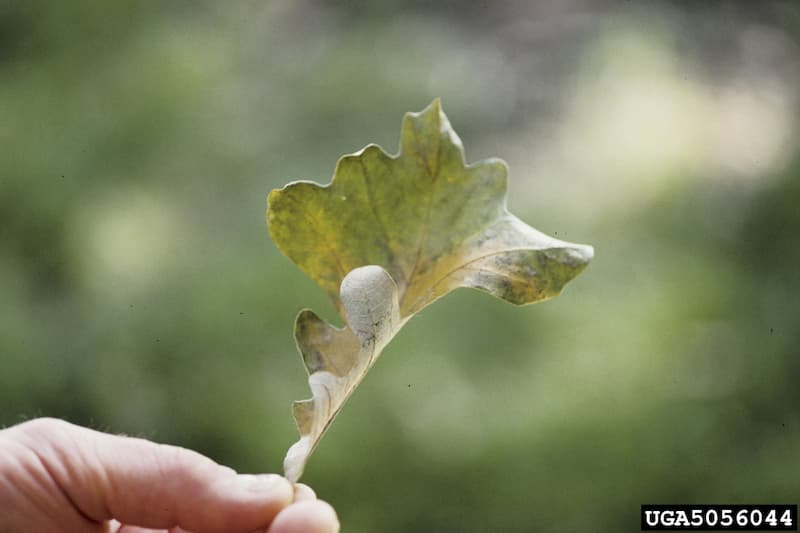
On Oaks: Oak leaves develop large, irregular brown blotches and may curl or pucker where the dead tissue stops the leaf from growing evenly.
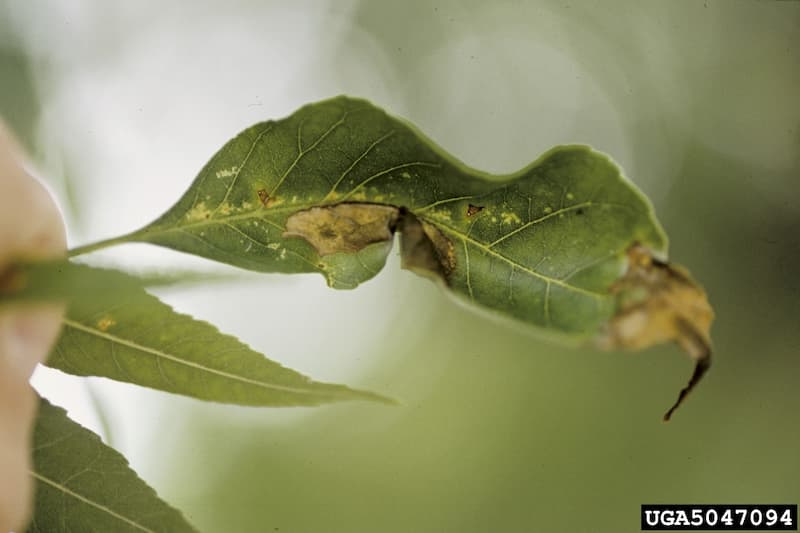
On Ash: Ash leaflets get tan, irregular blotches, usually along the edges, and heavily infected leaflets drop early in the season.
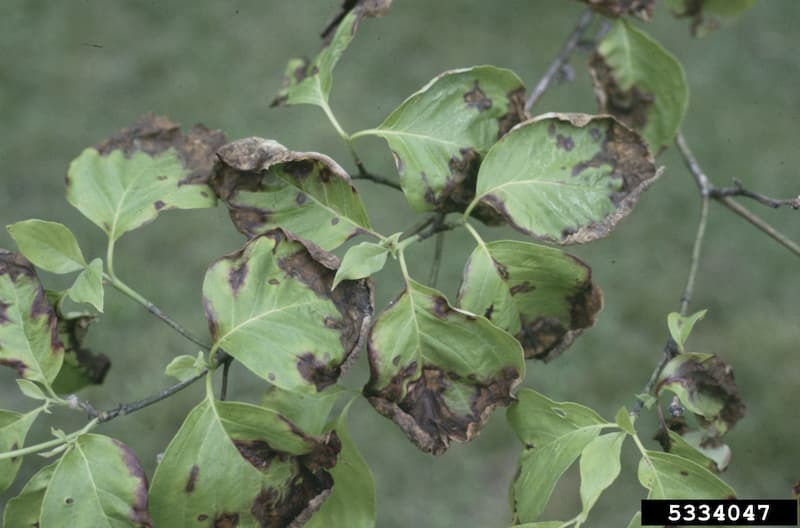
Dogwood Is Different: Dogwood anthracnose leaves tan, purple-edged blotches and, unlike most shade tree anthracnose, can spread into twigs and kill the tree.
Could It Be Something Else?
Common Lookalikes
Frost injury is the most common mix-up. A late spring frost kills new leaves and shoots at the same moment anthracnose strikes, and the browned, shriveled growth looks almost the same. The difference is that frost browns many kinds of plants overnight and leaves no fungal specks, while anthracnose hits one kind of tree and its blotches follow the leaf veins.
Oak Wilt is the confusion that matters most on oaks, because it can kill a tree in one summer. Both diseases brown oak leaves, but oak wilt shows up in summer, usually starts at the top of the crown, and browns leaves from the edges inward, while anthracnose is a spring disease of the lower, inner branches.
Spot Anthracnose is the look-alike on flowering dogwood. Both diseases make tan spots with purple borders on leaves and flower bracts, but spot anthracnose stays in the leaves and bracts as tiny, cosmetic spots, while dogwood anthracnose moves into the twigs and trunk.
Field Checks Before You Treat
- Step back and look at the whole tree. Stand 10 to 15 feet away. Anthracnose damage is worst on the lower and inner branches, with healthier leaves at the top. Browning that starts at the very top of the crown points away from anthracnose and toward oak wilt or a root or drought problem.
- Look at the veins. Pick five to ten browning leaves. On sycamore and oak, anthracnose blotches run along the main veins and sometimes leave the leaf cupped or twisted. Neat, round spots scattered between the veins point to an ordinary leaf spot instead.
- Turn a leaf over. After rain, check the underside of a fresh blotch with a 10x hand lens. Tiny raised dark specks along the veins confirm anthracnose. A white powder means powdery mildew. Fine yellow speckling with silky webbing means spider mites.
- Check the neighbors. If shrubs, perennials and different kinds of trees all browned in the same few days, it's frost. If only one kind of tree is affected, it's anthracnose.
- On dogwood, check the twigs and trunk. Follow a spotted leaf back to its twig. Sunken brown cankers where leaves attach, or many water sprouts on the lower trunk, mean dogwood anthracnose. Clean twigs with spots only on leaves and bracts, about 1/8 inch across, mean spot anthracnose.
- Watch it in July. A tree with anthracnose stops getting worse once weather turns warm and dry, and it grows a fresh set of leaves by midsummer. Decline that keeps going through hot, dry weather is not shade-tree anthracnose. Get a diagnosis.
Plants at Risk
Commonly Affected Plants
- American sycamore and London plane (California sycamore in the West)
- White oak and other oaks in the white oak group; coast live oak and black oak in California
- Ash, especially green ash and Modesto ash
- Maples, including red maple and Japanese maple
- Black walnut
- Flowering dogwood and Pacific dogwood
- Chinese elm in humid areas
Birch, hornbeam, hickory and butternut get it too, less often.
Resistant Choices
- Dogwood. Kousa dogwood (Cornus kousa) is generally resistant and the best replacement where native dogwoods have died. Also resistant: the Rutgers hybrids ‘Aurora’, ‘Celestial’, ‘Constellation’, ‘Galaxy’, ‘Ruth Ellen’, ‘Star Dust’ and ‘Stellar Pink’, and flowering dogwood ‘Appalachian Spring’.
- Sycamore. London plane cultivars ‘Bloodgood’, ‘Columbia’ and ‘Liberty’ resist anthracnose far better than American or California sycamore. ‘Bloodgood’ trades this for more powdery mildew. ‘Yarwood’ is susceptible.
- Ash. Blue ash is highly resistant; ‘Raywood’, Moraine and evergreen (Shamel) ash hold up better than Modesto, green or Chinese ash.
- Oak. Red oak is relatively resistant; white oak is highly susceptible. In California, valley, blue, canyon live and pin oak resist it.
- Maple. Silver, bigleaf and evergreen maple resist it; Japanese maples are susceptible.
- Elm. Chinese elm ‘Drake’ is resistant; ‘Evergreen’ and ‘True Green’ get cankers in humid areas. Rock elm is the most resistant elm.
- Walnut. Heartnut and Japanese walnut are less susceptible than black walnut.
Why It Shows Up
Conditions That Trigger It
Anthracnose is decided by the weather in the first couple of weeks after the buds open. Cool, wet weather at that moment is what drives it: Penn State puts the danger zone at an average daily air temperature of 50 to 55°F during bud break and leaf-out. If daily air temperatures average above 60°F at bud break, the disease usually stays mild. The fungus needs a film of water on brand-new leaves to infect, so frequent spring rain matters, and a dry spring can mean almost no anthracnose at all. Once leaves mature and the weather turns warm and dry, new infections nearly stop.
Site and care factors that make it worse:
- Low, shaded branches. The lower and inner canopy stays wet longest after rain and sits closest to infected leaf litter, so it is always hit first and hardest.
- Shade and crowding. Dense canopies, crowded plantings and understory growth slow drying. Dogwood anthracnose is worst in cool, moist, shady spots.
- Sprinklers that wet the leaves. Irrigation spray keeps leaves wet and splashes spores onto new growth. This matters most on small trees and on irrigated evergreens such as coast live oak and Chinese elm.
- Too much nitrogen. Heavy feeding pushes soft new shoots, which are the tissue the fungus infects.
- Stress and youth. Drought, compacted soil and recent transplanting don’t cause anthracnose, but they make it harder for a tree to regrow its leaves afterward. Young trees have smaller energy reserves.
How It Survives and Spreads
The fungus spends the winter in two places: inside small cankers on infected twigs and branches in the tree, and in fallen infected leaves on the ground. Which matters more depends on the tree. On sycamore and dogwood, the twigs carry most of it. On walnut and on trees whose branches hang close to the ground, the leaf litter does. On irrigated evergreens such as coast live oak and Chinese elm, it can stay active on leaves and twigs all year.
In spring, as buds open, rain and wind carry spores from these sources onto the soft new leaves and shoots. The spores need water to sprout and enter the leaf; they can’t infect dry tissue. Each new infection soon makes its own spores, and splashing rain spreads them to nearby leaves, so a wet, cool spring builds the disease in waves. The fungus can grow from a leaf down its stalk into the twig, killing shoots and forming the cankers that carry it to the next spring. Pruning tools can move it from cut to cut. It does not spread through the soil.
Where It Hits Hardest: Regional Notes
Anthracnose follows cool, wet springs, so it shows up wherever those happen. It is most common and most visible across the Midwest, Northeast and Mid-Atlantic, where American sycamore, white oak, ash and maples can look badly scorched after a rainy April and May. On the West Coast it is common in coastal California on California sycamore, London plane, Modesto ash and coast live oak. Chinese elm anthracnose is rare in California’s warm interior valleys. In the Southeast, dogwood anthracnose is most severe at higher elevations in the Appalachians (above about 2,000 feet in South Carolina) and in cool, moist, shady lowland sites. Where springs are usually dry, it is minor.
Tree Anthracnose Diagnostic Profile
Check what you see against the full set of signs. The more that match, the more likely this is your problem.
What You’ll See
Symptom Color
Tan or Straw
Yellow
Brown
Red, Pink or Purple
White or Gray
Black or Dark
Visible Signs
Black Spots or Pustules
None Usually Visible
Plant Symptoms
Leaf Spots
Curled or Distorted Leaves
Wilting
Yellowing
Browning & Dieback
Cankers
When and Where
Weather Triggers
Cool & Wet
Long Leaf Wetness (Dew or Rain)
Spread Pattern
Lower Leaves First
Tips Back Toward the Trunk
Controlling Tree Anthracnose
Care changes do most of the work, because the fungus depends on wet new leaves and on the infected material left from last year.
- Rake up fallen leaves. Rake and remove infected leaves and twigs during the season and again in fall before snow. This removes part of the fungus that would splash back onto next spring’s leaves, especially under walnut and trees with low branches.
- Cut out dead twigs in dry weather. Prune dead and cankered twigs back into clean, healthy wood when the fungus is inactive: in winter for shade trees, and in hot, dry summer weather for dogwood. Disinfect tools between cuts with 70% rubbing alcohol, or 1 part household bleach to 9 parts water (soak about 2 minutes, rinse, oil the blades), so you don’t carry spores to fresh cuts. On oak and sycamore the cankers are too small and numerous to chase, so just remove dead wood. On a tree hit hard this year, pruning can wait a year.
- Remove dogwood water sprouts. The soft shoots that sprout from a dogwood’s trunk and lower limbs get infected easily and carry the fungus straight into the trunk, so cut them all off.
- Keep sprinklers off the leaves. Aim sprinklers away from the canopy or switch to drip or soaker hoses. Watering the roots instead of the leaves avoids both the wet leaves and the splash that spreads spores.
- Open the canopy, but don’t hack it. Thin crowded growth and clear understory plants so air and sun dry the leaves faster. Avoid heavy cuts on large limbs, which trigger bushy, weakly attached sprouts that catch other diseases.
- Help the tree regrow its leaves. In summer dry spells, water deeply about once a week at the root zone and keep a mulch ring under the canopy. Drought stress makes the second flush of leaves harder.
- Hold the nitrogen. Don’t fertilize during an outbreak, because soft new growth is exactly what the fungus infects. Fertilize later only if a soil test shows a need, after the leaves are fully out and spring rains have stopped.
- Plant smart. Put susceptible trees in full sun with good air movement, and never transplant wild dogwood seedlings from the woods, because they can carry the fungus.
Spraying is rarely worth it: healthy shade trees regrow their leaves by midsummer, and a homeowner can’t cover a tall canopy anyway.
Fungicides only protect new leaves before the fungus arrives. They can’t cure leaves that are already spotted, so spraying after you notice damage does nothing for this year. Spraying makes sense in three situations:
- Dogwood anthracnose caught before branch dieback begins. This is the case where spraying can save the tree.
- A small, valuable tree that has lost most or all of its leaves several years in a row.
- Modesto ash in California, the one shade tree where UC trials show spraying works well.
Start when the buds begin to open, cover all new growth, and spray before rain is forecast. Repeat every 7 to 14 days while new leaves keep expanding and the weather stays cool and wet. Stop once leaves are fully expanded or daily temperatures average above 60°F, because new infections largely stop then.
| Active ingredient | FRAC group | Notes |
|---|---|---|
| Chlorothalonil | M05 | Contact protectant. Among the most effective in UC trials on ash. |
| Copper fungicides | M01 | Contact protectant. Can burn leaves if mixed or applied off-label. |
| Mancozeb | M03 | Contact protectant. Listed for dogwood and shade trees. |
| Propiconazole | 3 | Moves into the leaf. Also used by arborists for trunk injection. |
| Thiophanate-methyl | 1 | Moves into the leaf. Some products are professional-only, so check the label. |
Large trees need professional help: high-pressure spray rigs, or trunk or root-flare injection by a certified arborist, which can protect a valuable tree for more than one season.
Removal, Disposal and Replanting
When to remove. Shade trees almost never need removal for anthracnose. Even a tree that drops most of its leaves in spring grows them back. Consider removal only if a tree is in serious structural decline from years of dieback or rot, which an arborist should judge. Remove a dogwood when dogwood anthracnose cankers girdle the main trunk or have killed most of the crown, because it won’t recover and keeps producing spores.
Disposal. Send infected leaves to yard-waste pickup or the trash. Compost them at home only if your pile reliably runs above 140°F, because a cooler pile lets the fungus survive the winter. Infected twigs, cankered branches and dogwood wood should never be composted or chipped for mulch, since the fungus lives in the wood. Bag them or haul them away.
Replanting. The fungus doesn’t live in the soil, and each species attacks only its own kind of tree, so you can replant in the same spot right away. Choose a different kind of tree or a resistant cultivar. Where a dogwood died of dogwood anthracnose, don’t plant another native flowering dogwood. Use kousa dogwood, a resistant Rutgers hybrid or ‘Appalachian Spring’ instead.
When to Call a Pro
- Dogwood with cankers or dieback. Have a sample checked by your extension diagnostic lab to tell lethal dogwood anthracnose from cosmetic spot anthracnose, since treatment only works before dieback starts.
- Oak browning in summer. An oak browning from the top in summer needs a lab diagnosis right away to rule out oak wilt, which can’t be confirmed by eye. Send leaves still attached to small living twigs that show the edge between dead and healthy tissue, wrapped in dry paper towels.
- A tree bare several years running. Call an ISA Certified Arborist when a large tree loses most of its leaves year after year, or if you want spraying or trunk injection.
- Dead limbs over people or property. Repeated twig kill and cankers leave dead wood that can fall. An arborist should assess it.
Frequently Asked Questions
These answers are synthesized from plant pathology research and diagnostic guidance published by university extension services and plant disease clinics.
It isn’t dead. Cool, wet weather at leaf-out let the fungus kill the first buds, shoots and leaves before they could expand. Sycamores have plenty of backup buds, and once the weather turns warm and dry, usually by June, they push out a second set of leaves and look normal by midsummer.
Moisture and spore placement. Lower and inner branches get less sun and air, so their leaves stay wet longer after rain, and wet leaves are what the fungus needs. They also sit closest to infected leaves on the ground, where spring rain splashes spores up onto them first.
Witches’ brooms. When anthracnose kills a branch tip, the buds just behind it sprout instead, making several shoots where there was one. Repeat that over several wet springs and you get crooked limbs ending in dense twig clusters. They look odd, but they don’t threaten the tree’s life.
Not during the outbreak. Nitrogen pushes soft new growth, which is exactly the tissue the fungus infects. Fertilize only if a soil test shows a need, and only after the leaves are fully out and spring rains have stopped. Deep watering in summer dry spells helps recovery more.
Only if next spring is cool and wet. The fungus stays in the tree’s twigs and in leftover leaves, so it’s ready every year, but the weather at bud break decides whether it causes real damage. A dry spring often brings little or no anthracnose on the same tree.
Scientific Authority
This profile is built on plant pathology research and diagnostic guidance from university extension services and plant disease clinics. We prioritize accurate identification and cultural control first, recommending fungicides only where research shows they are justified, and naming them by active ingredient rather than brand.
Primary Resources
- UC IPM (University of California) — Pest Notes: Anthracnose
- University of Minnesota Extension — Anthracnose of shade trees
- Penn State Extension — Anthracnose On Shade Trees
- Penn State Extension — Walnut Anthracnose
- Clemson Cooperative Extension (HGIC) — Dogwood Diseases & Insect Pests
- Clemson Cooperative Extension (HGIC) — Sycamore Diseases & Insect Pests
- University of Illinois Extension — Anthracnose [Trees and Shrubs] (HortAnswers)
- University of Illinois Extension — Dogwood Anthracnose (HortAnswers)
- University of Illinois Extension — Cool, wet weather sets the stage for Anthracnose
- Purdue University Extension — Cool, wet spring favors common tree disease