
Pathogen: Verticillium dahliae (less often Verticillium albo-atrum)
Also called: Verticillium, Verticillium dieback, vascular wilt
Verticillium Wilt
The one-sided wilt that starts underground
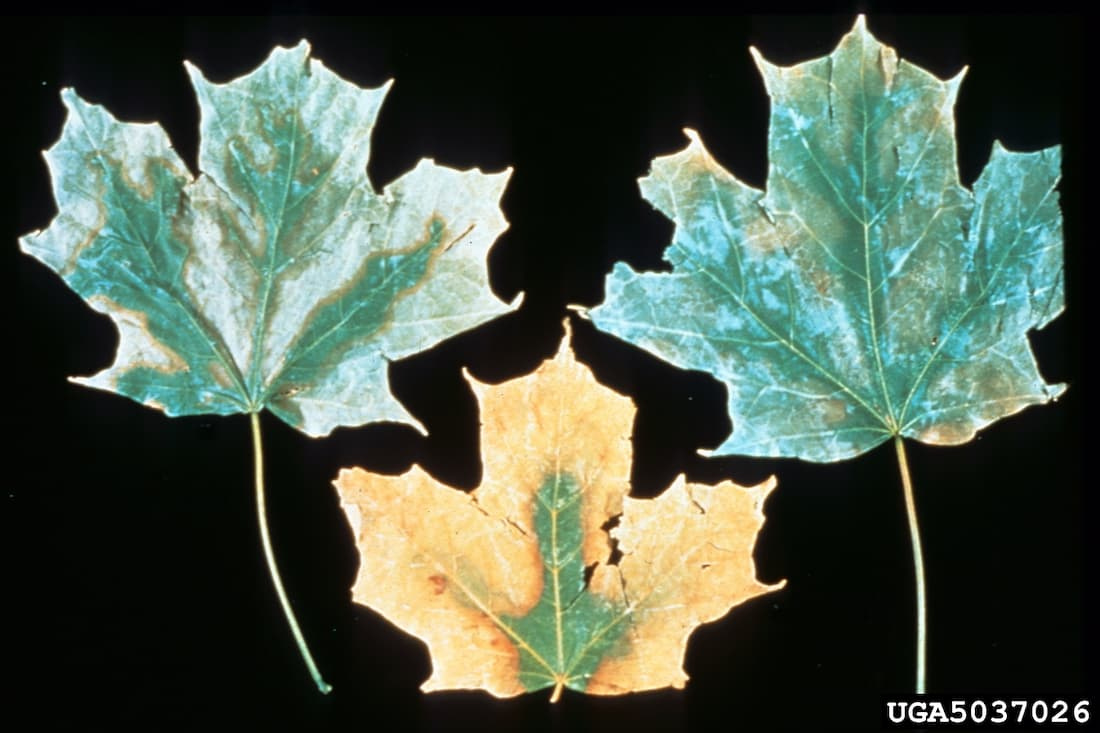
Featured Image Credit: Joseph OBrien, USDA Forest Service, Bugwood.org, CC BY 3.0 US
Verticillium Wilt At-a-Glance
Plant Group
Shade Trees
Flowering Shrubs
Roses
Perennials
Annual Flowers
Plant Part
Leaves
Stems & Twigs
Branches & Trunk
Whole Plant
Is Spraying Worth It?
Won't Help
Disease Type
Fungal
Active Season
Late Spring & Early Summer
Mid to Late Summer
Damage Potential
Weakens Over Time
Can Be Fatal
Verticillium Wilt Quick Answers
What Verticillium Wilt Looks Like
From a Few Feet Away
The classic picture is one branch or one side of a tree wilting and turning yellow, brown or straw-colored while the rest of the plant stays green. Dead leaves often hang on the branch for a while before they drop. Earlier, or in slow cases, the tree may just look a little off: smaller, paler leaves, browning leaf edges and an unusually heavy seed crop. On flowers, the lowest leaves yellow and brown first and the damage climbs the stem.
Symptoms by Plant Part
- Leaves. Leaves yellow between the veins or along the edges, then brown, dry, curl and drop. On sumac, smoke tree, redbud and maple they may turn red before browning. In slow, chronic cases leaves stay small and pale all season. Ash often drops leaves while they’re still green.
- Shoots and twigs. Young shoots droop in afternoon heat, then dry out and die back from the tips.
- Branches. Whole branches wilt suddenly, often on one side of the tree. Under the bark, the wood shows streaks that follow the grain; in a cross-cut they form a ring or arcs of dark dots. The smallest twigs may show no staining.
- Whole plant. Small trees, shrubs and flowers can wilt and die in a single season. Large trees usually lose branches over several years, may hold on for a long time with a thin crown, and sometimes recover.
- Flowers (herbaceous plants). On chrysanthemum, dahlia, peony, snapdragon and similar flowers, yellowing starts on the lower, older leaves while the top stays green, and the stem shows brown streaks inside.
Through the season, symptoms most often appear in early July, after cool spring weather allowed infection and summer heat raised the plant’s demand for water. In very hot weather the fungus slows down, and a tree may push new leaves late in summer. Streak color depends on the plant:
| Plant | Streak color under the bark |
|---|---|
| Maple, sumac, magnolia | Olive-green to dark green; black in some maples |
| Redbud | Chocolate-brown |
| Black locust | Dark reddish-brown to black |
| Elm, linden, most others | Brown |
| Cherry, smoke tree | Yellowish-brown |
| Japanese tree lilac | Dark olive to gray (often absent in common lilac) |
| Ash | Usually none (about 1 in 20 trees shows streaks) |
Signs of the Fungus
You won’t see the fungus itself. It lives inside the plant’s water-carrying wood and in the soil as specks too small to see without a microscope. What you can see is the plant’s reaction: dark streaks in the wood just under the bark of a wilting branch. Those streaks are the plant plugging its own water pipes to wall off the fungus, and they are the best clue you have.
Identification Photos
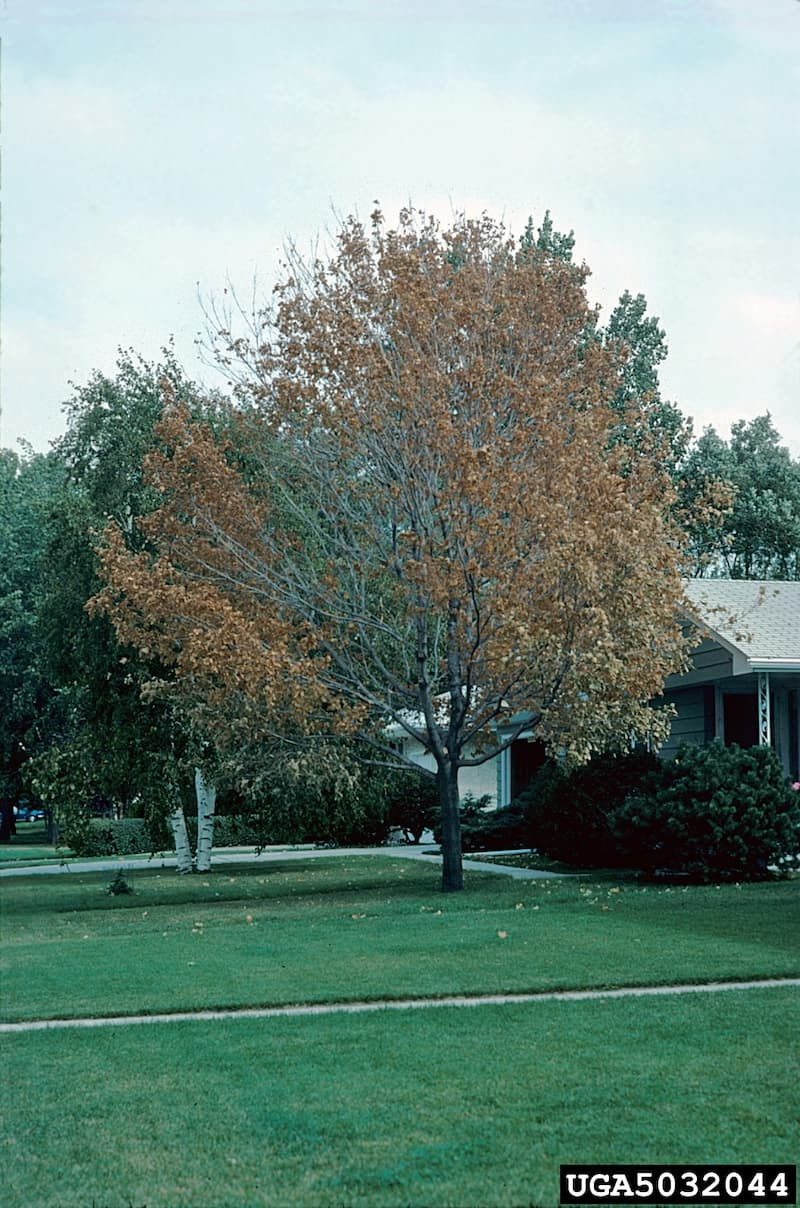
One-Sided Decline: Wilt often hits one branch or one side of the tree first, because the fungus blocks the water-conducting tissue only where it has spread.
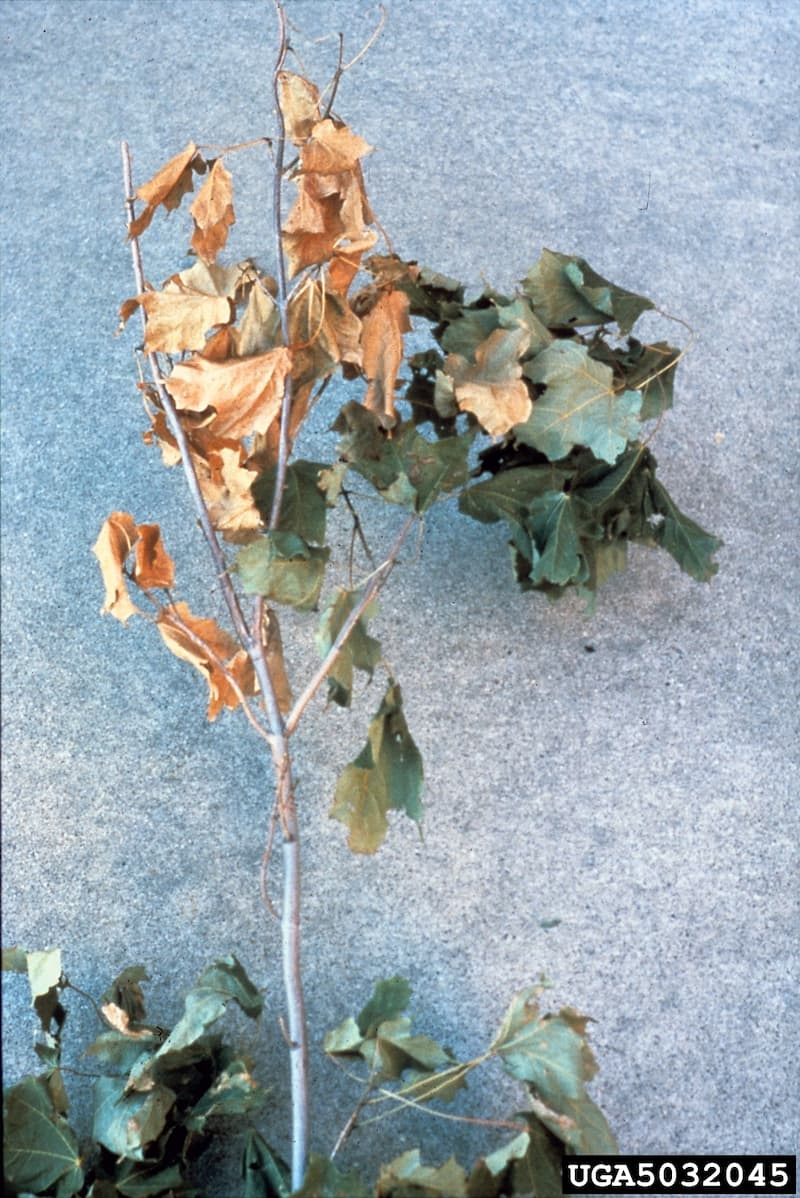
Sudden Wilt: Leaves on affected branches can wilt and die within days in summer, often while nearby branches still look healthy.
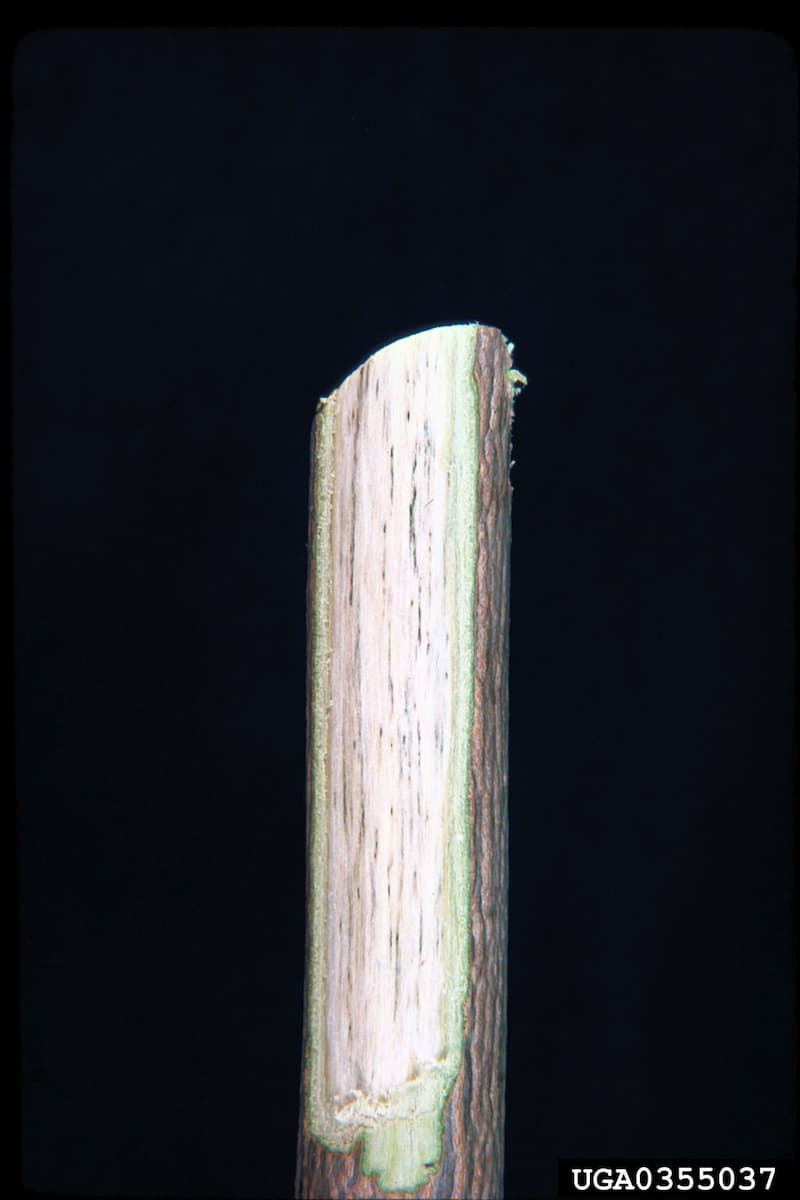
Check Under the Bark: Peeling the bark on a wilting branch often reveals olive-green to brown streaks in the sapwood, the clearest field sign of the disease.
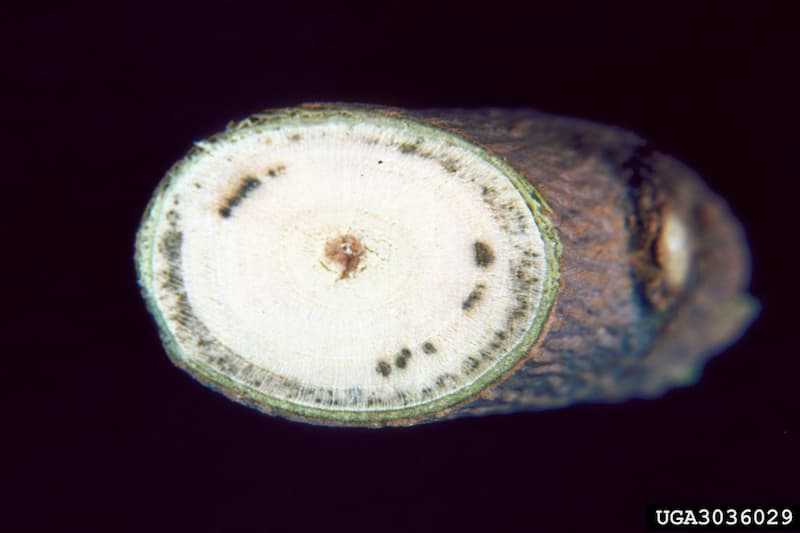
In Cross Section: A cut through an infected branch shows dark dots or partial rings in the outer wood where the water-carrying vessels are clogged.
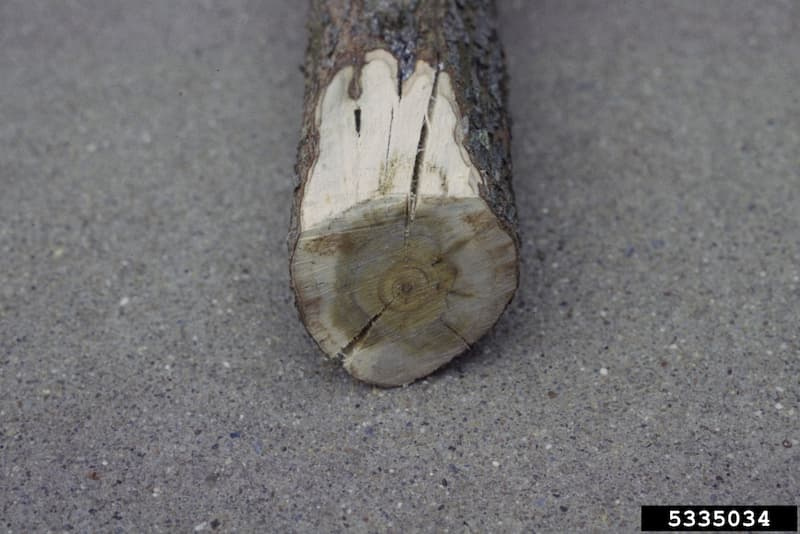
Beyond Maples: Smoketree, redbud, catalpa and many other landscape shrubs and trees are also susceptible and show the same stained wood.
Could It Be Something Else?
Common Lookalikes
Fusarium wilt causes the same yellowing, one-sided wilting and stained wood, and the two can’t be told apart by eye. It is mostly a problem on flowers rather than trees. Only a lab culture separates them, and the good news is that the advice is nearly the same for both: remove the plant and replant with something resistant.
Leaf scorch from drought or heat browns leaf edges and drops leaves, just like Verticillium. The difference is the pattern: drought scorch shows up across the whole canopy, worst on the sunny or windward side, and the wood under the bark is clean.
Girdling roots slowly choke a tree and cause small, yellow leaves and dieback that can look like chronic Verticillium. A root wrapped tightly around the trunk at or just below the soil line gives it away.
Field Checks Before You Treat
- Step back. Stand 10 to 15 feet away and look at the whole plant. Wilting or dead leaves on one branch or one side, next to healthy green foliage, points to a wilt disease. Even browning across the whole canopy points to drought, heat or root trouble.
- Peel a wilting branch. Pick a branch about 1/2 to 1 inch thick that is wilting but still alive, with leaves attached. Shave off the bark with a sharp knife. Healthy wood is cream to white; Verticillium leaves streaks running with the grain. Skip dead, dry branches, because other fungi stain dead wood.
- Cut it across. Make a clean cut through the same branch. A ring, arc or circle of dark dots in the outer wood matches Verticillium.
- Match the streak color to the plant. Maples and sumac show olive-green to black, redbud chocolate-brown, black locust dark reddish-brown, elm and linden brown, Japanese tree lilac dark olive to gray, cherry and smoke tree yellowish-brown.
- Don't clear an ash or lilac on clean wood. Streaks show up in only about 1 in 20 infected ash trees and are often missing in lilac. Ash may also drop leaves while they are still green.
- Check the trunk base. Pull mulch back from the trunk flare. A root wrapped around the trunk points to girdling roots instead.
- Slice a flower stem. On perennials and annuals, cut the lower stem lengthwise. Brown streaks inside, with yellowing that started on the lowest leaves, point to a wilt disease.
Plants at Risk
Commonly Affected Plants
- Maple (sugar, red, Norway, silver and Japanese): the most common and most often killed
- Ash
- Redbud
- Smoke tree
- Catalpa
- Elm
- Sumac and barberry
- Lilac, including Japanese tree lilac
- Rose
- Chrysanthemum
It also hits magnolia, tulip tree, black locust, linden, viburnum, spirea, weigela, and flowers such as dahlia, peony, snapdragon, marigold, aster and delphinium.
Resistant Choices
On a site where Verticillium has killed a plant, choose from these. No list is a guarantee, but these are consistently rated resistant or immune by extension services.
- Conifers. Pine, spruce, fir, arborvitae, juniper and yew can’t be infected.
- Shade trees. White oak and bur oak (not red or pin oak), honey locust, ginkgo, hackberry, sweetgum, sycamore, birch, beech, hickory, katsura tree and hornbeam.
- Small and flowering trees. Crabapple, hawthorn and mountain ash.
- Shrubs. Holly and firethorn (pyracantha).
- Perennials. Ornamental grasses resist Verticillium and can replace shrubs or flowers in an infested bed.
Why It Shows Up
Conditions That Trigger It
Verticillium infects in spring and shows up in summer. The fungus gets into roots while the soil is cool to mild and moist. It grows best at about 70–85°F and stops growing when air temperatures stay above about 90°F. The damage often stays hidden until the first hot, dry stretch, when the plant needs more water than its plugged wood can carry, so a tree that looked fine in May can wilt suddenly in July.
These factors raise the risk or make the damage worse:
- Infested soil. Ground where a maple, smoke tree or redbud already died of wilt, or where potatoes, tomatoes, peppers or eggplant grew, can hold the fungus for many years.
- Root and trunk wounds. Trenching, grading, deep digging, and mower or trimmer damage at the trunk base open easy doors into the roots.
- Drought stress. Dry spells don’t cause infection, but they turn a mild case into wilting and dieback, because the plant is already short on working water pipes.
- Poor drainage and overwatering. Constantly wet, heavy soil stresses roots and makes infection easier.
- Too much nitrogen. High-nitrogen fertilizer pushes soft new growth that the fungus invades more easily.
- Infected mulch. Wood chips from an infected tree, or mulch of unknown origin, can carry the fungus into a clean bed.
How It Survives and Spreads
The fungus survives in soil for many years as tiny, tough resting bodies, and it also lives on in dead infected roots, branches and leaves. When roots of a susceptible plant grow nearby, their natural sap leaks wake the resting bodies, and the fungus grows into the roots, most easily through wounds. It then moves up into the wood that carries water, mostly in the current year’s growth.
Inside, the fungus blocks some of the water pipes, and the plant blocks more with gums as it tries to wall the fungus off. That is why one branch or one side wilts: it is fed by the plugged section. When infected leaves and wood die and break down, the fungus returns to the soil, ready to infect again.
It moves to new places in soil on shovels, shoes and tools; in infected nursery plants; in chipped wood mulch from diseased trees; in fallen leaves from sick trees; and on pruning tools that cut from a sick branch into a healthy one. It does not blow from tree to tree on the wind.
Where It Hits Hardest: Regional Notes
Verticillium wilt turns up across the US. It is a regular problem on maple, ash and other shade trees in the Midwest and Northeast, and on many trees and flowers in California and the interior West. Risk is highest in neighborhoods built on former farmland that grew potatoes, tomatoes or other susceptible crops, and on heavy, poorly drained soils. In hot low-desert areas the fungus goes quiet during summer, when air temperatures stay above about 90°F, and symptoms tend to show in spring and fall instead.
Verticillium Wilt Diagnostic Profile
Check what you see against the full set of signs. The more that match, the more likely this is your problem.
What You’ll See
Symptom Color
Tan or Straw
Yellow
Brown
Red, Pink or Purple
Black or Dark
Visible Signs
Discolored Sapwood Streaks
None Usually Visible
Plant Symptoms
Curled or Distorted Leaves
Wilting
Yellowing
Browning & Dieback
When and Where
Weather Triggers
Cool & Wet
Wet or Poorly Drained Soil
Drought or Heat Stress
Spread Pattern
Lower Leaves First
One Side or Branch
Scattered
Controlling Verticillium Wilt
There’s no cure for an infected plant, so good care has two jobs: keep a valuable plant alive longer, and stop the fungus from reaching new plants. A vigorous tree keeps growing new wood each year, and that new wood can carry water around the plugged sections.
- Water deeply in dry spells. Give established trees and shrubs about 1 inch of water a week when rain falls short, with a soaker hose or drip line near the outer edge of the branches. Drought is what turns a quiet infection into sudden wilting.
- Don’t drown the roots. Plant in well-drained spots and water only when the soil is drying, because soggy soil stresses roots and invites infection.
- Feed lightly. Use a soil test as the guide and pick a slow-release fertilizer lower in nitrogen and higher in potassium. Potassium helps the plant manage water, while heavy nitrogen pushes soft growth the fungus invades easily.
- Remove grass under the tree. Clearing turf from the root zone cuts competition for water and nutrients.
- Mulch with clean material. Use 1 to 2 inches on heavy clay or 3 to 4 inches on sandy soil, kept 4 inches from the trunk. Use only shredded hardwood, pine or cedar from a known source, never chips from a diseased tree or mulch of unknown origin.
- Prune out dead wood. Remove branches that wilted and died, but leave any that leafed out again the same summer, because that wood is still working. Disinfect tools between cuts with 70% rubbing alcohol, or 1 part household bleach to 9 parts water (soak about 2 minutes, rinse, oil the blades), so you don’t carry the fungus into healthy wood.
- Protect roots and trunk. Avoid trenching, grading or deep digging in the root zone, and keep mowers and trimmers off the trunk base, since wounds let the fungus in.
- Clean up leaves. Rake up and bag leaves that fall from sick trees.
- Buy clean plants and plant resistant ones. Where wilt has been a problem, plant only species the fungus can’t infect.
Spraying won’t help. The fungus lives inside the plant’s wood and in the soil, where no spray or drench can reach it or clear it from plugged wood, and no fungicide is sold to homeowners for it. Professional trunk injections of a benzimidazole fungicide (FRAC group 1) have given unpredictable results because many strains of the fungus tolerate it, and soil fumigation is a restricted, licensed-applicator treatment that lowers the fungus before planting but never wipes it out.
Removal, Disposal and Replanting
When to remove. Pull annuals and perennials as soon as they wilt, with as much of the root system as you can. Remove a shrub or tree when most of it is dead, when it has kept declining for several seasons, or when dead limbs could fall on people or property. A big tree with a few dead branches can usually stay.
Disposal. Bag leaves and small debris for trash or yard-waste pickup, and send branches, trunk wood and roots to the landfill, or burn them where local rules allow. Don’t compost or bury any of it, and never chip an infected tree into mulch, because the fungus survives inside the wood chips, even after composting.
Replanting. Don’t put a susceptible plant back in the same spot, because the fungus stays in that soil for many years. A new maple or smoke tree may look fine for a few years before it starts to wilt. Choose from the resistant list instead. If you’re set on a susceptible plant, cover the moist soil with clear plastic through the summer (solarization) and keep the spot bare for at least a year. That lowers the fungus but doesn’t remove it, so it improves the odds rather than guaranteeing success.
When to Call a Pro
Send a sample to your state’s extension plant diagnostic lab before you remove a valuable tree or decide what to replant, because drought, girdling roots and other wilts look the same from the outside. Cut 8 to 12 inches of a branch about 1 inch thick that is wilting but not yet dead, keep it cool, and get it to the lab quickly. The lab can’t culture the fungus from dead, dry wood.
Call an ISA Certified Arborist when a large tree near a house, driveway or play area is losing big limbs or much of its crown. They can judge whether the tree is still safe and worth keeping.
Frequently Asked Questions
These answers are synthesized from plant pathology research and diagnostic guidance published by university extension services and plant disease clinics.
Because the fungus plugged the pipes feeding that side. Verticillium enters through certain roots and moves up the water-carrying wood above them, so the branches supplied by that part of the root system wilt while the rest of the tree stays green. That lopsided pattern is one of the clearest clues that you’re dealing with a wilt disease rather than drought.
No. Ash rarely shows streaks; Illinois Extension puts it at about 1 infected tree in 20. Lilac often doesn’t show them either. If an ash or lilac has the one-sided wilting pattern, a lab test is the only way to know.
No, leave it. When summer heat slows the fungus, some trees push out new leaves on branches that wilted earlier. If it leafed out, that wood still carries water, and removing it only shrinks the tree. Cut only branches that stay bare and dead.
Shredded hardwood, pine or cedar from a source you trust. Avoid free chips of unknown origin, since a tree that died of Verticillium may be in them, and never use chips from your own infected tree. Keep mulch 4 inches from the trunk, and use 1 to 2 inches on clay soil or 3 to 4 inches on sandy soil.
Scientific Authority
This profile is built on plant pathology research and diagnostic guidance from university extension services and plant disease clinics. We prioritize accurate identification and cultural control first, recommending fungicides only where research shows they are justified, and naming them by active ingredient rather than brand.
Primary Resources
- UC Statewide IPM Program — Verticillium Wilt (Pest Notes)
- UC Statewide IPM Program — Landscape Trees and Shrubs Resistant to Verticillium Wilt
- UC Statewide IPM Program — Verticillium Wilt (Flowers)
- Penn State Extension — Verticillium Wilt of Woody Ornamentals
- University of Illinois Extension — Verticillium Wilt [Shrubs and Trees]
- University of Illinois Extension — Verticillium Wilt [Annuals and Herbaceous Perennials]
- University of Illinois Plant Clinic — Verticillium Wilt of Woody Ornamentals
- University of Wisconsin–Madison Plant Disease Diagnostics Clinic — Verticillium Wilt of Trees and Shrubs
- Purdue Extension — Verticillium Wilt of Woody Plants (BP-6-W)
- Iowa State University Extension and Outreach — Verticillium Wilt
- University of Minnesota Extension — Japanese Tree Lilac: Wilted Leaves
- University of Minnesota Extension — Basswood/Linden: Leaves Wilt
- NC State Extension — Common Disease Pests of Maple in North Carolina
- University of Maryland Extension — Verticillium Wilt Disease of Trees and Shrubs
- Colorado State University Extension (PlantTalk Colorado) — Verticillium Wilt of Catalpa and Other Trees
- University of Arizona Cooperative Extension — Verticillium Wilt (AZ1034)