
Wild Onion At-a-Glance
Weed Type
Monocot — an onion relative, not a true grass, sedge, or broadleaf (controlled with broadleaf/systemic chemistry, not grass herbicides)
Life Cycle
Bulbous perennial (cool-season active)
Growth Habit
Clumping, erect
Root Type
Bulb
Spreading Risk
Moderate — by bulb division and aerial bulblets, rarely by seed
Pull
No (With Caution)
Identity & Diagnostics
Visual Fingerprint
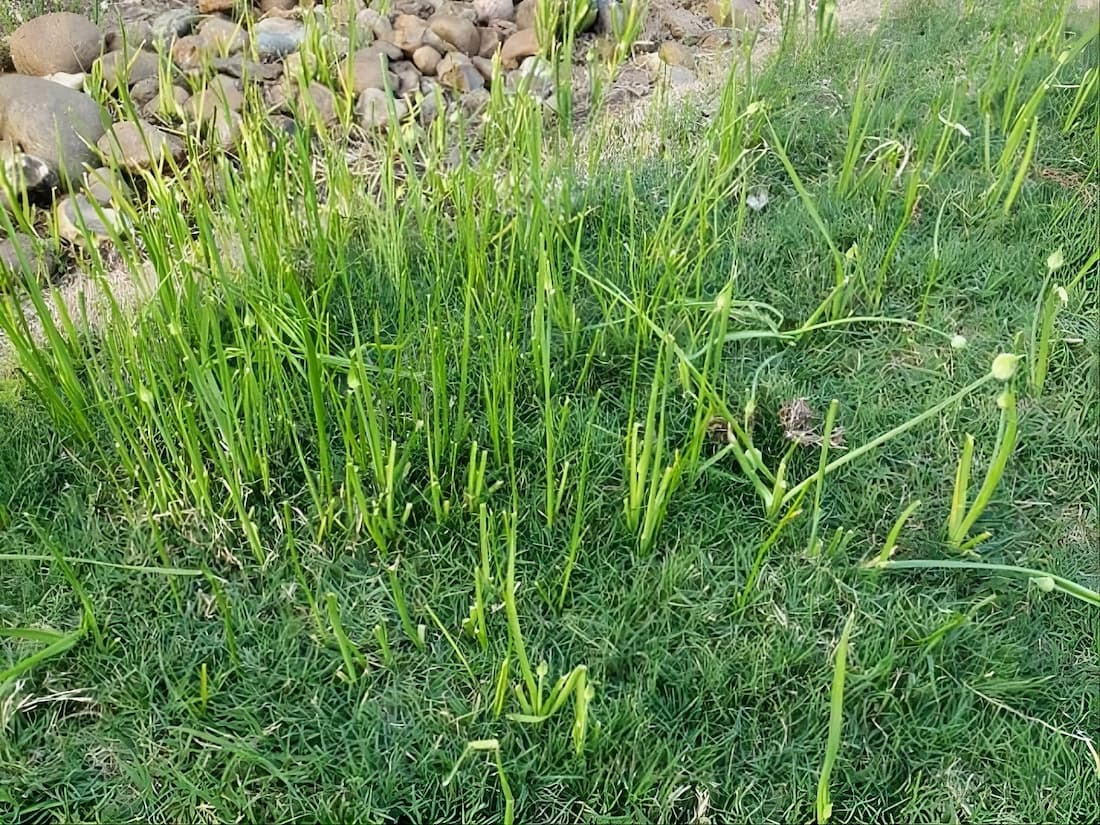
Wild onion shows up as upright, slender, grass-like green clumps that grow faster than your lawn and stand a clear head above it — most obvious in late winter and early spring. The leaves are smooth, waxy, and a slightly deeper green than turf. The giveaway costs nothing to check: crush a leaf between your fingers. A strong onion smell confirms it instantly. No smell means it isn’t wild onion, and that distinction can matter a lot.
Structural Anatomy
Get down and look closely and three features lock the identification. First, the leaves are flat and completely solid — pinch one and roll it, and there’s no hollow tube inside. Second, they’re smooth, waxy, and rise straight from the base of the plant, not off a central stem. Third, dig one up and the bulb wears a dry, coarse, net-like fibrous jacket — almost a woven mesh — around the outside.
The flowering stalk, when it comes, is different from the leaves: it’s round and solid, stiff, and leafless, rising above the foliage to a single cluster at the top.
But the feature that beats every look-alike is chemical, not visual: crushed leaves smell distinctly of onion. That smell means it belongs to the onion family (Allium), full stop — no grass, sedge, or ornamental lily can fake it. When there’s no flower to help you, the combination of flat solid leaves + onion smell + a net-jacketed bulb is a confident species-level ID.
Growth Patterns & Life Stages
Wild onion runs on a cool-season clock. Bulbs sprout in late autumn as the soil cools, sending up thin shoots that look almost exactly like young grass — easy to miss entirely at this stage. Through winter and early spring those shoots build into dense upright clumps 8 to 18 inches tall that outpace the lawn and become impossible to ignore. In late spring a round, leafless stalk rises and opens into a domed cluster of small star-shaped white-to-pink flowers — or, just as often, a tight knot of small reddish aerial bulblets in place of flowers. By summer the whole plant yellows and dies back to the ground, leaving only the bulb waiting underground for fall.
The control lesson lives in that timeline: the plant is easiest to treat while it’s actively growing in fall and early spring, and most dangerous to disturb once those aerial bulblets mature in late spring.
Gallery
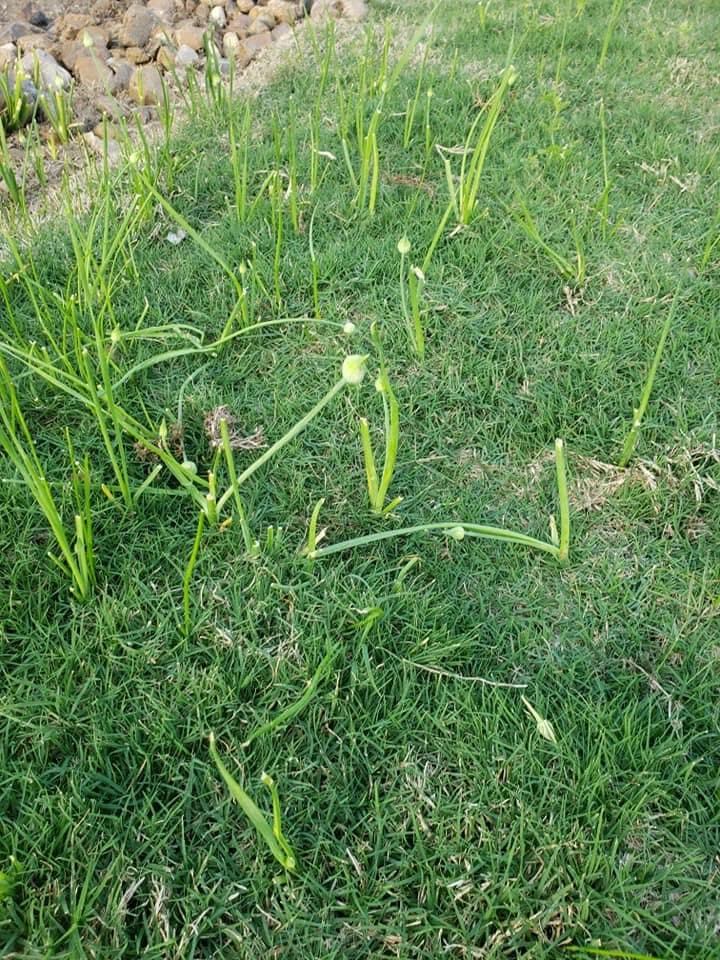
Wild onion (Allium canadense) growing in turfgrass, identified by its flat, solid leaves and tall flowering stalks with developing terminal spathes.
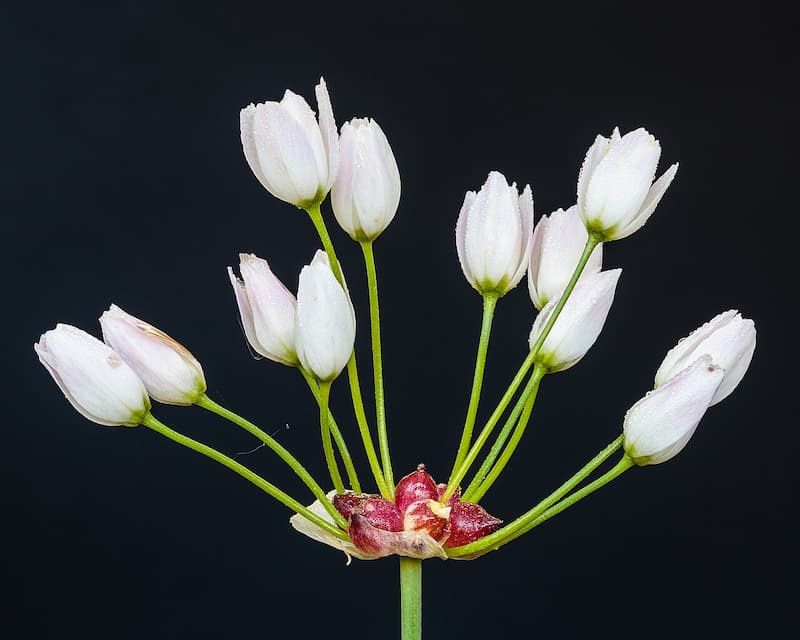
A detailed look at the flower umbel and bulbous base, showing the bulbils that give Allium canadense its distinctive topsetting habit.
“Gesloten bloemen van Allium canadense. 13-06-2021. (d.j.b)” by Dominicus Johannes Bergsma is licensed under CC BY-SA 4.0.
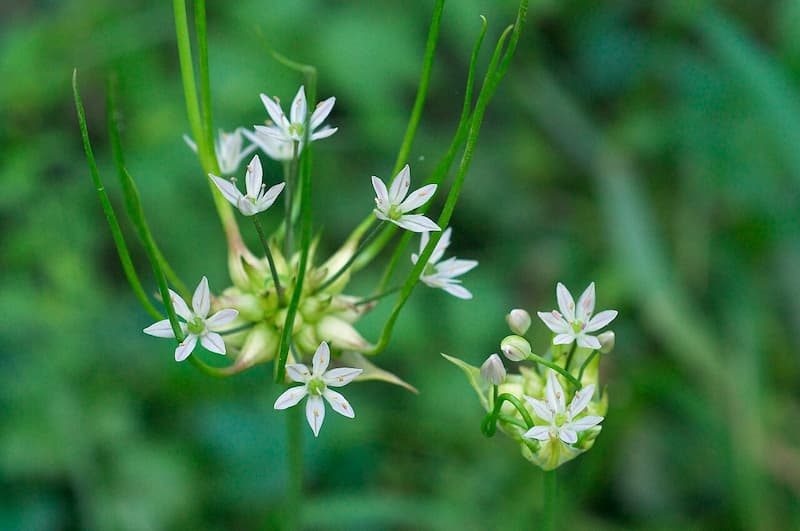
Allium canadense in full bloom — clusters of white star-shaped flowers are a hallmark of this native wild onion.
“Allium canadense var canadense” by Eric Hunt is licensed under CC BY-SA 4.0.
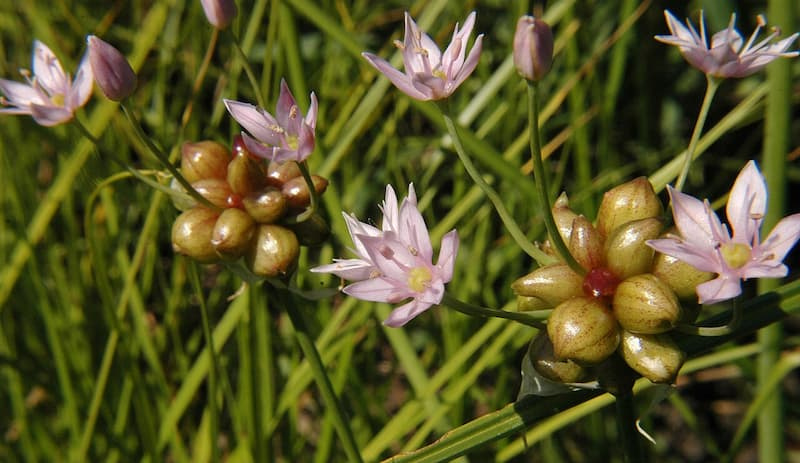
Pink blossoms and bulbil clusters growing side by side — a classic sign you've found true wild onion (Allium canadense).
“Allium canadense WILD ONION” by George F Mayfield is licensed under CC BY-SA 2.0.
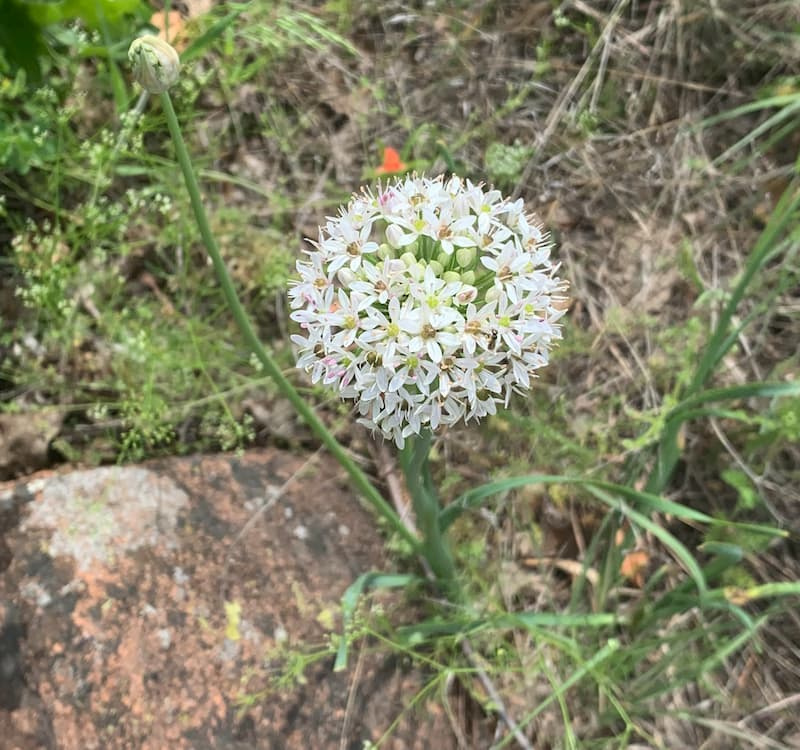
Wild onion growing in its natural rocky, grassy habitat, with a full round umbel of white flowers.
“Allium canadense var. hyacinthoides” by Cleome Serrulata is marked with CC0 1.0.
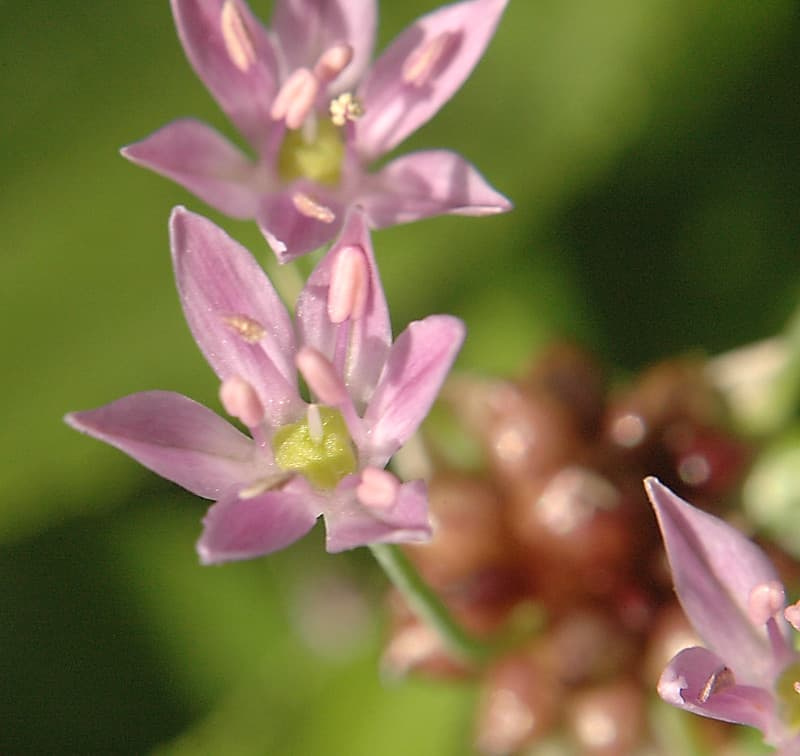
A macro view highlighting the delicate pink petals of a single wild onion flower.
“Allium canadense WILD ONION” by gmayfield10 is licensed under CC BY-SA 2.0.
The Identity Trap
Common Lookalikes
- Wild Garlic (Allium vineale) — the sibling species, and the single most common mix-up; both are onion-smelling clumps that appear at the same time of year.
- Star-of-Bethlehem (Ornithogalum umbellatum) — grass-like and bulbous like wild onion, and easy to confuse right after emergence, but it’s a genuinely dangerous plant to get wrong.
Identification Differentiators: How to Tell Them Apart
- Wild Garlic: Check the leaf. Wild garlic leaves are round and hollow (like a chive), and they attach partway up the flowering stem. Wild onion leaves are flat, solid, and strictly basal — they rise only from the very bottom. If the leaf is a hollow tube, it’s garlic, not onion.
- Star-of-Bethlehem: Use your nose. Star-of-Bethlehem has no onion or garlic smell at all when crushed, and its leaves carry a distinctive white stripe down the middle. This isn’t a trivia difference: Star-of-Bethlehem is highly poisonous to people and pets, so the smell test doubles as a safety check. No smell — don’t assume it’s a harmless onion.
Growing Conditions
Host Grasses
Wild onion isn’t picky about which lawn it invades — it establishes in cool-season turf like tall fescue and in warm-season turf like bermudagrass, zoysiagrass, centipedegrass, and St. Augustinegrass. What it needs isn’t a particular grass, it’s an opening. Thin, worn, or under-fed turf gives its fall shoots room to establish. It’s just as at home in ornamental beds as in lawns, so the turf itself is less the story than the gaps in it.
Host Environment/Area
Wild onion is a generalist that shows up almost anywhere: open lawns, garden beds, fencerows, roadside ditches, and low damp spots. It prefers full sun and moist, well-drained soil but tolerates a huge range — heavy clay to sand, wet ground to occasionally dry, full sun to partial shade. It shows no meaningful preference for lawn over bed; it establishes readily in both. The one environment it reliably exploits is a thinned or recently disturbed stand, where the canopy has opened up.
Soil Indicators: What the Presence of This Weed Reveals About Your Yard
Wild onion is a poor soil-diagnostic weed: its presence does not reliably signal a specific pH, drainage flaw, or nutrient shortage, because it grows across nearly every soil condition. What it does signal is history — a spot that’s been disturbed, thinned, or allowed to lose density, which let a long-lived bulb already in the ground finally push up. Read wild onion as a sign of an opening in the stand, not a soil test result.
Lifecycle and Season
Lifecycle Category and Management Implications
Wild onion is a bulbous perennial, and that one fact decides everything about controlling it. It does not die at season’s end and it does not start each year from seed — it regrows from a bulb that’s already sitting in your soil. That makes pre-emergent herbicides essentially useless against it (there’s no seed germinating to intercept), and it makes pulling and mowing frustratingly ineffective (the bulb stays put and re-sprouts). The only tool that reaches the bulb is a systemic post-emergent herbicide, timed to when the plant is moving food down into that bulb. Everything below is built on that logic.
Germination Trigger
Wild onion doesn’t wait on a warm-soil seed trigger like a summer annual. Its bulbs break dormancy and sprout as soil cools in autumn, roughly when nighttime lows settle into the mid-50s °F for several consecutive days (about September in the north, late September to early October farther south). A second, smaller flush of overwintered structures pushes up in early spring. Emergence, not seed germination, is what you’re timing against.
In cool-season lawns, wild onion emerges in late fall and grows all winter, standing tallest and most obvious in early spring while the turf is still slow. There’s no meaningful pre-emergent window — skip it. The post-emergent window is fall (roughly September–October) and again in early spring during active growth. Fall is the stronger of the two, and the reason is worth knowing: as days shorten, the plant pulls sugars down into its bulb for winter, and a systemic herbicide rides that downward current straight to the target. A spring-only program treats the leaves while the bulb is least reachable.
Warm-season lawns create wild onion’s best opportunity. From late fall through early spring the turf is dormant and straw-brown, and the bright green onion clumps grow completely uncontested and stand out from across the yard. Time post-emergent treatment for November–December once shoots have fully emerged, then repeat in February or early March — and only when daytime temperatures have run above 60 °F for several days, so the plant is actively moving the chemical inward. The hard rule: do not spray during spring green-up. As bermudagrass and zoysiagrass break dormancy they’re extremely vulnerable to herbicide injury, and a poorly timed application causes yellowing, stunting, and delayed green-up. Non-selective options (glyphosate, glufosinate) work only on fully dormant turf.
The transition zone is the hardest case, because it stacks two conflicts on top of each other.
First, a temperature trap. Wild onion is most exposed in late winter, towering over dormant warm-season turf — but it’s often below 50 °F then, and standard synthetic-auxin herbicides (2,4-D, dicamba, MCPP) translocate poorly in the cold, so they burn the leaves without reaching the bulb. Wait for warmth to fix that, and the warmth triggers warm-season green-up, when the turf is easily injured. The workaround extension programs point to is cold-active combination chemistry — carfentrazone- or sulfentrazone-based mixes stay effective near 50 °F, letting you treat before green-up begins.
Second, an overseeding collision. The ideal fall treatment window (late September–November) overlaps the fall seeding window for tall fescue. If you apply a synthetic-auxin herbicide, you must wait three to four weeks before sowing, and you can’t safely spray young seedlings until they’ve been mowed several times — which often pushes safe treatment past the best window. You’re choosing between seeding and spraying; you rarely get both cleanly in the same fall.
Herbicide Control
Skip it. Pre-emergent herbicides stop seeds from establishing, and wild onion barely bothers with seed — it comes back from an established bulb that a pre-emergent barrier can’t touch. There’s no labeled pre-emergent that meaningfully controls established wild onion in turf, and applying one against this weed is wasted effort and money. Your control tool is post-emergent.
Verdict up front: this is a multi-season job, not a one-and-done — plan on two to four years.
The effective tools are systemic herbicides that get absorbed and carried down into the bulb; contact-only products just scorch leaves and change nothing underground. The workhorses are three-way synthetic-auxin mixes (2,4-D + MCPP + dicamba), and on warm-season and certain cool-season turf, ALS-inhibitor products (metsulfuron-methyl, sulfosulfuron, imazaquin) and sulfentrazone/carfentrazone mixes for cold-weather activity. (Turf safety varies sharply by product — metsulfuron injures tall fescue and ryegrass, imazaquin injures cool-season grass, and centipede/St. Augustine need reduced 2,4-D rates — so match the product to your grass; see the Herbicide Application Reference.)
Timing follows the plant’s own plumbing: treat in fall as the plant moves sugars down to the bulb, so the herbicide travels with them, and repeat in early spring. Two adjustments make or break the result, both aimed at the waxy leaf:
- The waxy leaf sheds spray. Wild onion’s near-vertical, waxy leaves cause droplets to bead up and roll off. Always add a non-ionic surfactant (about 0.25% by volume) or crop oil concentrate, and choose the ester form of 2,4-D over the amine — the ester is oil-soluble and cuts through the waxy coat.
- Mow right before, then wait to mow after. Mowing immediately before spraying tears the leaf tips and opens a wound the herbicide can enter directly, bypassing the wax. After spraying, hold off mowing for 10–14 days so the chemical has time to travel down into the bulb before you remove the leaves carrying it.
Even done perfectly, one round usually only burns back the top. Bulbs on staggered dormancy keep waking up, so a genuine program is repeated fall-and-spring applications across two to four years until the bulb bank is exhausted.
Wild onion is a weak competitor, so a dense, vigorous lawn is your cheapest long-term defense — a thick canopy shades the soil and denies fall shoots the opening they need. Practically: mow toward the high end of your grass’s range (about 3–4 inches for cool-season turf) to shade the surface; fertilize on a schedule that feeds the turf, not the weed — for cool-season lawns that means a fall nitrogen push (around 1 lb N/1,000 sq ft in September–October, exactly when onion is emerging), and for warm-season lawns it means feeding in summer while the turf is active and avoiding late-winter/early-spring nitrogen that would only fuel the onion over dormant grass; keep soil pH around 6.0–7.0 so the grass competes at its best; and overseed thin spots in fall to close the gaps. One more: mow before the aerial bulblets mature so the plant can’t finish and drop them.
Same verdict as the lawn: pre-emergents don’t control established wild onion, because there’s no seed germination event to intercept — the bulb just re-sprouts. A bed pre-emergent aimed at other weeds may catch the occasional dropped bulblet or true seed at the surface, but don’t expect it to touch an established clump.
Near ornamentals you lose the option to broadcast broadleaf herbicide, so control gets more surgical. The two realistic routes are carefully directed non-selective herbicide (a spot or wipe application of glyphosate onto the onion foliage only, shielding nearby plants) and precise full-bulb digging (often the better call in loose bed soil — see Lawn vs. Bed Pulling Difference). Keep two cautions in view: synthetic-auxin esters can vaporize and drift onto ornamentals in hot weather (above ~85 °F), and metsulfuron-containing products can be taken up through the roots of nearby ornamentals and trees even without direct contact, so keep them away from beds and driplines. Verdict for beds: like the lawn, multi-season — but hand-digging in cultivated soil can shorten the job considerably compared to turf, because you can actually get the whole bulb. (Buying tip: not every product labeled “Roundup” is glyphosate anymore — check the active-ingredient panel.)
Mulch earns a spot but has a clear ceiling here. A 2–4 inch layer blocks light and suppresses newly dropped bulblets and seed at the surface, which slows new colonization. It does not stop an established bulb — that fully-charged bulb simply drives a shoot straight up through several inches of mulch. Treat mulch as a tool against fresh spread, not against the plants already rooted.
Herbicide Application Reference
A few product-specific warnings unique to controlling this weed:
- Ester 2,4-D volatility. The ester forms that penetrate wild onion’s waxy leaf best are also the most likely to vaporize and drift above roughly 85 °F. Spray in cooler conditions, especially near gardens and beds.
- Metsulfuron root uptake. Metsulfuron-methyl can injure ornamentals and trees through root absorption from treated turf nearby — keep it clear of beds and driplines, and don’t use clippings from treated areas as mulch.
- Warm-season turf sensitivities. Centipedegrass and St. Augustinegrass are sensitive to 2,4-D (use reduced rates or spot-treat), and all warm-season grasses are vulnerable to injury during spring green-up.
- Non-selective products. Glyphosate and glufosinate kill any green tissue they touch — safe only over fully dormant warm-season turf, never on green or cool-season lawns.
A product note that is easy to miss: the consumer “Roundup” brand no longer reliably means glyphosate. Several reformulated versions now use different active ingredients, and some of them — imazapic is one — stay active in the soil, where nearby ornamental roots can take them up. That is the exact problem glyphosate is chosen to avoid here. Before you buy, read the active-ingredient panel and pick a product whose only active ingredient is glyphosate.
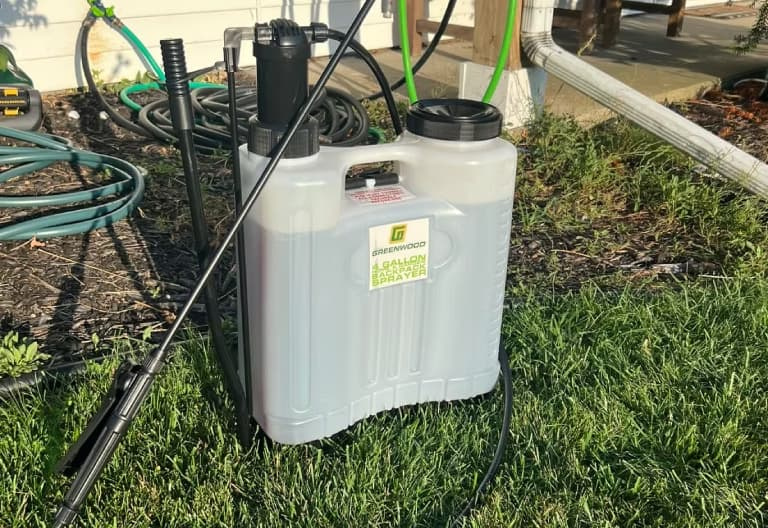
Herbicide Application Guide
New to spraying, or want to get it right? Our Herbicide Application Guide covers the practical steps this page assumes — mixing, calibration, protective gear, and the wind and temperature limits that decide whether a treatment works or drifts. Read it before you spray.
See Guide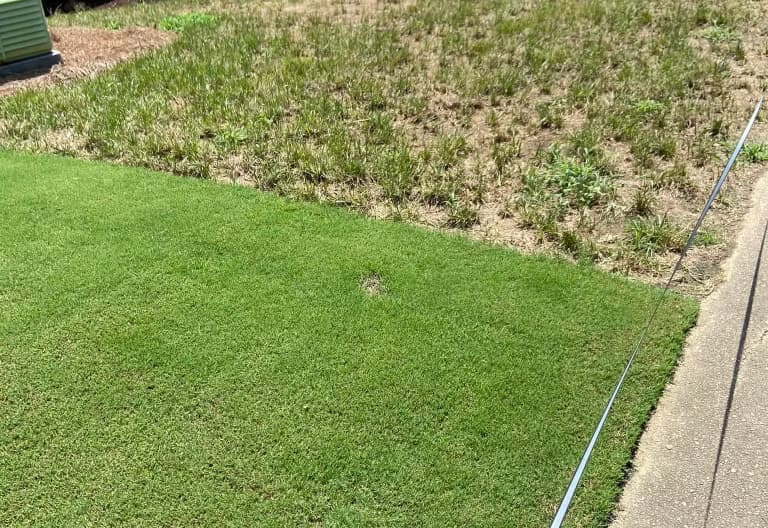
Where Two Lawns Meet
Does your lawn border a neighbor’s — or meet a different type of grass? Spraying near that line can quietly damage the yard next door, sometimes weeks later. Where Two Lawns Meet shows you how to treat safely without harming either side.
Read ArticlePulling
Don't rely on pulling — for wild onion it's a near-total miss.
The Biological Reason
Here’s the part that surprises most people: the bulb isn’t buried deep. It sits just 1 to 3 inches down — shallow enough that you’d expect a firm tug to pop it right out. It won’t. The leaves are slick and waxy and weakest right at the soil line, so when you pull, the foliage snaps off clean and the bulb stays behind, completely intact. You walk away thinking you removed the weed; underground, nothing changed. Within days the untouched bulb spends its stored energy pushing up fresh shoots, right where you pulled.
This is a different failure than a dandelion’s. A dandelion punishes you for breaking its root — leave a fragment and it regrows. Wild onion punishes you for never reaching the bulb at all. It’s not fragment regrowth; it’s a clean detachment that leaves the whole plant’s engine in the ground.
Mowing fails for the same underlying reason. The growing point lives down in the bulb, below any blade you can set, so mowing only trims the leaves cosmetically — the plant keeps photosynthesizing and refilling the bulb beneath the cut. Repeated mowing slowly drains a little bulb energy but will not, on its own, kill an established stand.
To actually remove a plant by hand you have to dig the whole bulb out, not pull it. Use a narrow trowel, work when the soil is moist, and lift the entire clump — bulb, roots, and the small offset bulblets clustered at its base. And mind the calendar: if you dig or yank once the aerial bulblets on the flower stalk have matured in late spring, the motion scatters them across the lawn and seeds a fresh crop of plants. Disturb wild onion before it goes to bulblet, or you multiply it.
Underground Structure Explainer
How wild onion stores and spreads itself underground. The whole plant runs on one storage organ — a true bulb, wrapped in a coarse net-like jacket, sitting shallowly in the soil. That bulb is a full-charged battery of stored sugars, which is why a sprout can shoulder straight up through a pre-emergent barrier and why snapped-off leaves regrow so fast.
Wild onion thickens a patch mainly by bulb division — the parent bulb splits and buds small offset bulblets around its own base, and the clump slowly widens into a dense tuft. Worth knowing, and worth not confusing with its cousin: wild onion does not make the hard-shelled, brown offset bulblets that wild garlic does — the kind that lie dormant in the soil for years. Wild onion’s offsets are simpler bulb divisions. Its long-term staying power comes instead from the parent bulbs themselves, which can survive dormant in the soil for several years. That’s the real reason one season of treatment is never enough: you’re not fighting this spring’s plant, you’re fighting a bank of bulbs on different wake-up schedules.
Lawn vs. Bed Pulling Difference
In loose, cultivated bed soil, hand-digging actually becomes a realistic control method — moist bed soil lets you slide a trowel under the whole clump and lift the bulb and its offsets out intact, which you can almost never do in dense, compacted turf. The catch is the same in both places: break the lifted soil apart over a bag or bucket so stray offset bulblets don’t drop back into the bed and reseed it.
Quick Reference Summary
| Field | Wild Onion |
| Lifecycle | Bulbous perennial (cool-season active) |
| Active Zones | Cool-season, warm-season, transition (all three) |
| Emergence Trigger | Bulb sprouts as autumn soil cools (~mid-50s °F, dropping) — not seed-driven |
| Pre-Emergent | No — useless against established bulbs |
| Post-Emergent Timing | Fall (primary) + early-spring repeat, during active growth |
| Pull | No / With Caution — leaves snap off, bulb stays; dig small patches only |
| Lawn Primary Tool | Systemic post-emergent (synthetic auxin or ALS), fall-timed, with surfactant + pre-spray mow |
| Bed Primary Tool | Directed glyphosate, or full-bulb digging in moist soil |
| One-and-Done or Multi-Season | Multi-season — 2 to 4 years |
Frequently Asked Questions
These answers are synthesized from botanical morphology studies and herbicide efficacy trials conducted by leading university agricultural extensions.
Because you’re almost certainly not removing the bulb. Wild onion’s waxy leaves snap off clean at the soil line and leave the bulb — which sits only 1–3 inches down — completely intact underground. It re-sprouts within days using stored energy. To remove a plant by hand you have to dig the whole bulb out with a trowel in moist soil, not pull it.
Mowing won’t kill it. The growing point sits down in the bulb below any mowing height, so the plant just regrows. Worse, if you mow after the aerial bulblets on the flower stalk have matured, you’ll scatter them and spread the weed. Mowing does help in two narrow ways: cutting before those bulblets form prevents that year’s spread, and a mow right before spraying opens the waxy leaves so herbicide can get in.
Yes — plants in the onion family are toxic to dogs, cats, and livestock if eaten in quantity, so discourage pets from grazing a patch. There’s a bigger hazard in disguise: the main look-alike, Star-of-Bethlehem, is highly poisonous to people and pets and has no onion smell. If a grass-like bulb plant in your yard doesn’t smell of onion when crushed, don’t assume it’s harmless.
Wild onion is technically edible, but this is the wrong place to forage. Its odorless look-alike Star-of-Bethlehem is genuinely poisonous, and lawn plants may have been treated with herbicides or other pesticides. Unless you’re certain of the ID by the crushed-leaf onion smell and certain the area is untreated, leave it be.
Not immediately. After a synthetic-auxin herbicide (2,4-D, dicamba, MCPP) you typically need to wait three to four weeks before sowing grass seed, and some products like metsulfuron require longer. This is the core reason fall treatment and fall overseeding collide in the transition zone — plan one around the other rather than doing both at once.
Scientific Authority
This profile is constructed using forensic botanical data and Integrated Pest Management (IPM) research. We prioritize scientifically-vetted identification and control methods that protect the broader ecosystem while ensuring successful eradication based on peer-reviewed agricultural studies.
Primary Resources
- Penn State Extension — Wild Onion and Wild Garlic
- Purdue University Turf — Controlling Wild Onion or Wild Garlic in Lawns; Wild Garlic
- Cornell CALS Weed Science — Wild Garlic profile
- Rutgers Cooperative Extension (NJAES) — Broadleaf Weed Control in Cool-Season Lawns (FS385)
- University of Illinois Extension — Weed Management
- Michigan State University Extension — Wild Garlic vs. Wild Onion
- Clemson Cooperative Extension (HGIC) — Wild Garlic & Wild Onion; Managing Weeds in Warm-Season Lawns
- University of Georgia Extension / GeorgiaTurf — “A Stinky Story”: Controlling Wild Garlic in Home Lawns; Wild Garlic (Pests)
- University of Florida IFAS Extension — Common Poisonous Weed and Invasive Plant Species in Florida Residential Landscapes; Metsulfuron-Methyl-Containing Herbicides Potentially Damaging Ornamentals (FOR332); Allium canadense (Center for Aquatic and Invasive Plants)
- NC State Extension (TurfFiles / Plant Toolbox) — Wild Garlic; Fall Weed Control Options for Home Lawns; Allium canadense (Plant Toolbox)
- Texas A&M AgriLife Extension (AggieTurf) — Wild Onion
- Louisiana State University AgCenter — Controlling Wild Garlic/Onion; Strike Early on Weed-Infested Winter Lawns
- Auburn University / Alabama Extension (ACES) — Home Lawns: Chemical Weed Control
- University of Arkansas Cooperative Extension — Weed Control in Landscape Plantings
- Virginia Tech / Virginia Cooperative Extension — Wild Garlic weed profile; Spring and Summer Lawn Management (Cool- and Warm-Season); Mulching: Purpose, Benefits, and Essential Information
- University of Missouri Extension (Mizzou WeedID / IPM) — Wild Garlic; Star-of-Bethlehem; Managing Lawns and Turfgrass
- Kansas State Research and Extension — Wild Garlic and Wild Onion (Allium spp.)
- University of Tennessee Extension (UTIA) — Wild Garlic (Allium vineale); Star-of-Bethlehem
- West Virginia University Extension — Star-of-Bethlehem — Weed of the Week
- Oklahoma State University Extension — Controlling Weeds in Home Lawns (HLA-6421)
- Mississippi State University Extension — Controlling Wild Garlic in Mississippi Lawns
- Iowa State University Extension — How Do I Control Onion Grass in My Lawn?
- Invasive Plant Science and Management (peer-reviewed) — chipping/chilling of bulbous monocots