
Pathogen: Rhytisma acerinum, Rhytisma americanum and Rhytisma punctatum
Also called: Tar Spot, Maple Tar Spot, Tar Spot of Maple, Speckled Tar Spot, Giant Tar Spot, Black Spots on Maple Leaves
Maple Tar Spot
Alarming black spots, little real harm
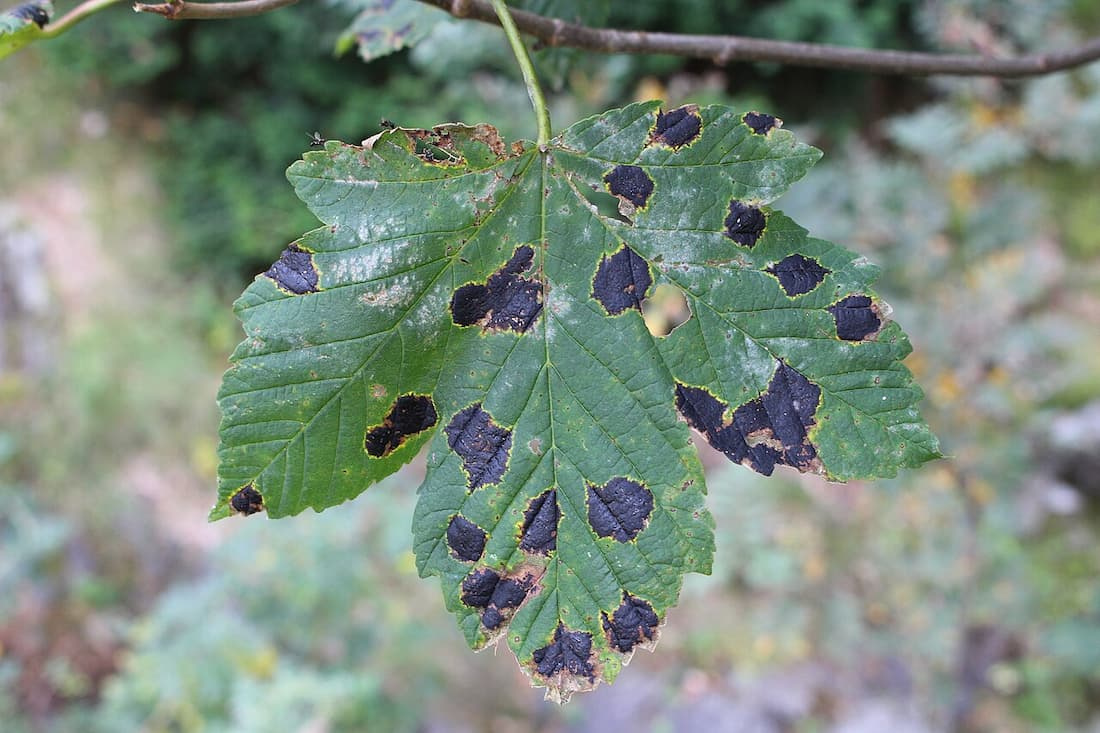
Featured Image Credit: Léna Gahéry, via Wikimedia Commons, CC BY-SA 4.0
Maple Tar Spot At-a-Glance
Plant Group
Shade Trees
Plant Part
Leaves
Is Spraying Worth It?
Rarely Worth It
Disease Type
Fungal
Active Season
Early Spring
Late Spring & Early Summer
Mid to Late Summer
Fall
Damage Potential
Cosmetic Only
Maple Tar Spot Quick Answers
What Maple Tar Spot Looks Like
From a Few Feet Away
From midsummer on, the leaves look as if someone flicked black paint or tar across them. Each leaf carries raised, glossy black spots, often with a yellow ring, scattered across the upper surface between the veins. The spotting is usually heaviest on low branches near the center of the tree. Most people first notice it in fall, when they rake up leaves covered in black blotches.
Symptoms by Plant Part
Leaves, late spring to early summer. Around mid-June, small pale green to yellow spots, under 1/8 inch across, appear on the upper leaf surface. They’re easy to miss and may stay small or grow to about 3/4 inch.
Leaves, midsummer to fall. From mid-July into August, black flecks form inside the yellow spots and thicken into a raised, shiny, tar-like crust. The underside of the spot looks slightly lighter and cupped. The spots look different depending on which maple and which fungus you have:
- Silver and red maple. Usually one raised black spot per yellow patch, about 1/4 to 3/4 inch across, with wavy, fingerprint-like ridges on its surface.
- Norway maple. Many pinhead-sized black dots, often 20 to 50 per leaf, that merge into flatter, smooth to slightly rough black masses up to 1.5 inches across, sometimes with a yellow border. This is the “giant tar spot” seen in many Northeast towns.
- Speckled tar spot (several maples). Clusters of tiny raised black dots, each about 1/25 inch, grouped inside a yellow patch rather than merging into one spot.
Leaf stems and early leaf drop. When a spot forms on the leaf stem, it cuts off the leaf’s supply and the leaf drops early, often in August and early September. Norway maples in a bad year can shed many leaves this way. In fall, spotted areas sometimes stay green after the rest of the leaf turns.
Seeds. The fungus can also form small black spots on maple seed wings (samaras). It never affects twigs, branches or the trunk.
Signs of the Fungus
The black “tar” is the fungus itself: a hard, shiny crust of fungal tissue that grows just under the leaf’s top layer and then breaks through it. On native silver and red maples, look closely at a large spot and you’ll see wavy ridges that look like a fingerprint. In spring, the same black spots on last year’s fallen leaves crack open along slits to release spores. That stage is real but hard to spot, so the spots on living leaves from midsummer on are the sign to look for.
Identification Photos
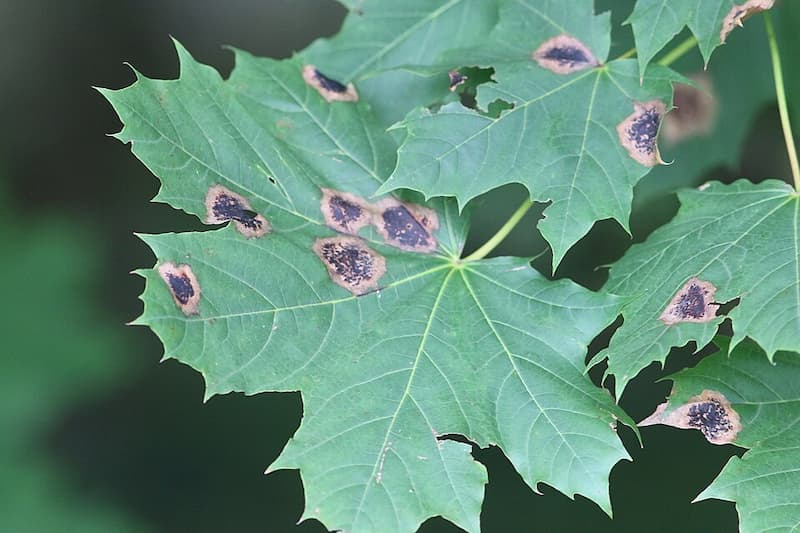
Developing Spots: Pale yellow-green spots appear in early summer, then darken at the center as the fungus forms its tar-like crust.
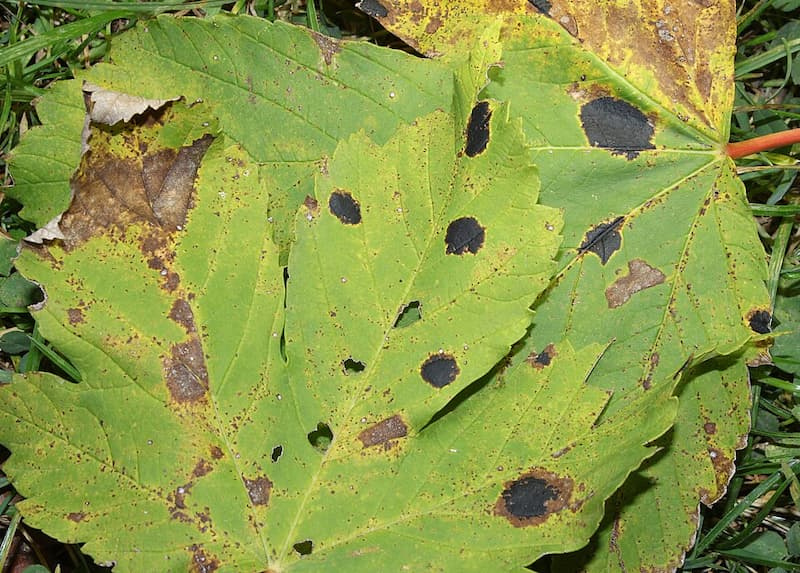
Mature Tar Spots: By late summer the spots turn raised, shiny and black, up to about an inch across, like drops of tar on the leaf.
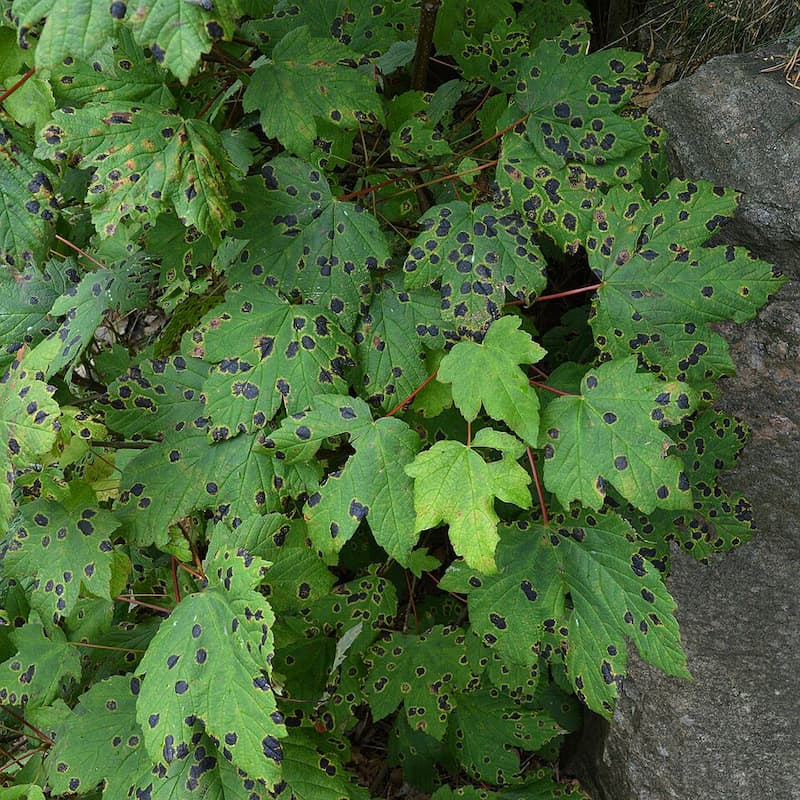
Looks Worse Than It Is: Even heavily spotted trees usually stay healthy. Tar spot is mainly cosmetic and rarely harms an established maple.
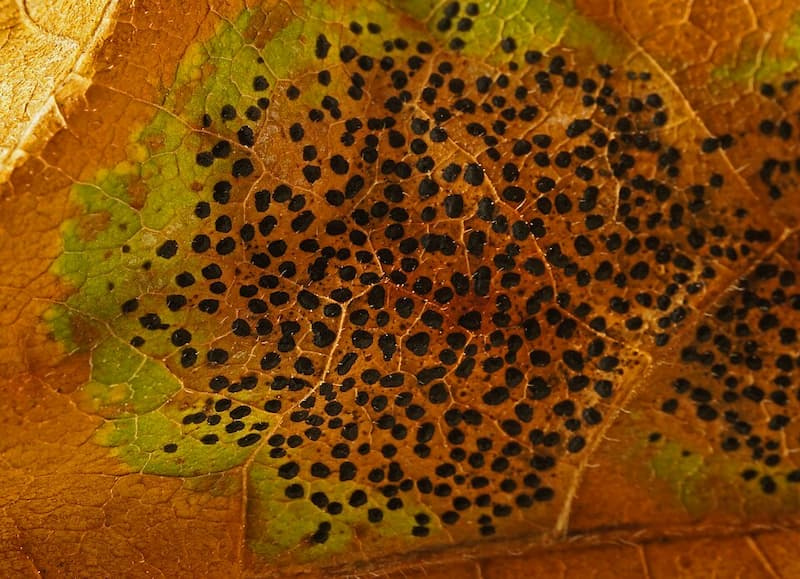
Speckled Tar Spot: A related fungus produces clusters of tiny black dots instead of one large spot. It is just as harmless.
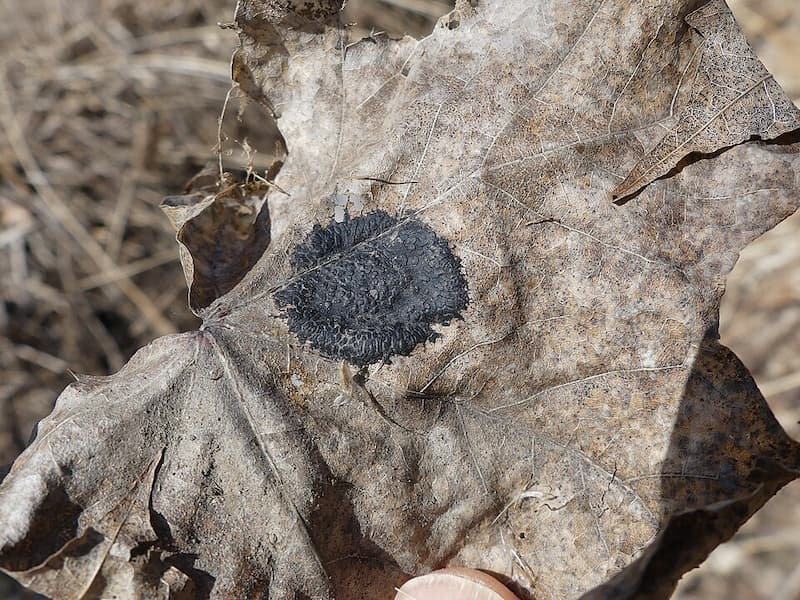
Overwintered Leaves: The fungus survives winter on fallen leaves and releases spores onto new foliage in spring, so raking up leaves in fall cuts down next year’s spots.
Could It Be Something Else?
Common Lookalikes
Anthracnose is the other common maple leaf disease, and people often blame it for any spotted maple. It shows up in spring, not late summer, as tan, brown or reddish-brown dead patches that follow the leaf veins, sometimes with curled or shriveled young leaves. Tar spot is never brown dead tissue along the veins; it is a raised black crust on a living yellow-green patch.
Phyllosticta Leaf Spot can fool you because it also has tiny black specks in its spots, much like speckled tar spot. The difference is underneath the specks: Phyllosticta spots are dead, light tan centers with a purple or reddish ring, while speckled tar spot specks sit on yellow-green tissue that is still alive.
Sooty Mold is a black, soot-like coating that grows on the sticky honeydew dripped by sap-feeding insects like Aphids. It looks like black blotches from a distance, but it sits on top of the leaf and rubs off, while a tar spot is part of the leaf and doesn’t budge.
Field Checks Before You Treat
- Rub the spot. Wipe a black spot firmly with a damp paper towel. If the black comes off, it's sooty mold and the real problem is insects; if it stays put and feels raised and hard, it's tar spot.
- Look for the yellow halo. Tar spots sit inside a yellow or yellow-green patch of living leaf. A dead tan center with a purple or reddish ring points to Phyllosticta leaf spot instead.
- Check whether the damage follows the veins. Brown or reddish-brown dead tissue running along the veins, especially in spring, is anthracnose. Tar spots sit between veins as separate black islands.
- Check the calendar. Tar spot turns black from mid-July into fall. Black spots in May or early June are something else, because tar spot is only faint yellow at that stage.
- Look at the lower, inner branches first. Tar spot is usually heaviest on low branches near the center of the tree, where leaves stay damp longest. Damage concentrated at the top of the tree or on one dying branch points to a different problem.
- Confirm it's a maple. The maple tar spot fungi infect only maples, including boxelder. Black spots on any other tree or shrub are a different disease.
Plants at Risk
Commonly Affected Plants
Tar spot is a maple-only disease. These are the maples homeowners most often find it on:
- Norway Maple, which gets the largest spots and the most early leaf drop
- Silver Maple
- Red Maple
- Sugar Maple
- Boxelder
- Bigleaf Maple, the main host in the Pacific Northwest
- Striped Maple
It can turn up on many other maple species as well.
Resistant Choices
- Maples. No maple cultivar has been shown in extension trials to resist tar spot, so a new maple can still get it if there are spotted maples nearby. Norway maple usually looks the worst, with native maples less dramatic but still spotted in wet years.
- Replacements. If you’re planting a new shade tree and don’t want tar spot at all, pick any non-maple shade tree. Oak, linden or hackberry can’t be infected by the maple tar spot fungi, so spores blowing in from the neighbors have nowhere to land.
Why It Shows Up
Conditions That Trigger It
Tar spot is decided in a few weeks of spring, not in summer. Infection happens only while new leaves are unfolding and still tender, and only when they stay wet long enough for spores to sprout and grow into the leaf. Once leaves are fully expanded, they are no longer at risk for the year. That’s why a wet, rainy spring at leaf-out predicts a bad tar spot year, whatever the summer weather does. Extension specialists tie recent outbreaks to springs with above-average rainfall.
Site and care factors that raise the risk:
- Moist, sheltered sites. Trees that get hit every year tend to grow in low, damp or wind-sheltered spots where leaves dry slowly after rain and dew.
- Crowded plantings. Trees packed close together or against buildings get poor air movement, so leaves stay wet longer.
- Dense lower canopy. Low, inner branches stay humid the longest, which is why they usually carry the most spots.
- Sprinklers that wet low branches. Lawn irrigation that sprays into the lower canopy in spring adds hours of wet leaves during the only window when infection can happen.
- Infected leaves left under the tree. Last fall’s leaves are the only source of spores, so a thick layer left lying through spring loads the tree for another round.
How It Survives and Spreads
The fungus spends the winter in the black spots on fallen leaves. In spring, as maple buds open, wet weather makes those overwintered spots crack open and shoot microscopic spores into the air. Wind carries them up to the new leaves, and splashing rain helps move them onto low branches. A spore that lands on a wet, young leaf sprouts and grows into it.
From there, the fungus grows slowly. Faint pale green to yellow spots appear around mid-June and are easy to miss. From mid-July into August, the black crust forms inside them. The spots you see in summer don’t infect other leaves, so there is only one round of infection a year, at leaf-out. In fall, the spotted leaves drop and the cycle starts over. The fungus doesn’t live in bark, buds, wood or soil, and pruning tools and insects don’t spread it. Because the spores ride the wind, leaves from a neighbor’s maple can infect your tree even if you rake every one of your own.
Where It Hits Hardest: Regional Notes
Tar spot is most common across the northern half of the country, especially the Upper Midwest and Northeast, wherever Norway Maple, Silver Maple and Red Maple are planted in large numbers. It shows up yearly in Michigan, where the Norway maple fungus has been getting more common, and it has recently reached Minnesota. In the Pacific Northwest it is common on native Bigleaf Maple in moist, sheltered sites. It also occurs in the Southeast but is less common in yards there, showing up more in forests. Everywhere, how bad a year gets depends mostly on how wet the spring was.
Maple Tar Spot Diagnostic Profile
Check what you see against the full set of signs. The more that match, the more likely this is your problem.
What You’ll See
Symptom Color
Yellow
Black or Dark
Visible Signs
Black Spots or Pustules
Plant Symptoms
Leaf Spots
Yellowing
When and Where
Weather Triggers
Cool & Wet
Long Leaf Wetness (Dew or Rain)
Spread Pattern
Lower Leaves First
Scattered
Controlling Maple Tar Spot
Tar spot can’t be cured once you see it, and it doesn’t need to be. The goal is fewer spots next year, and the way to get there is to remove the spores’ home and shorten the time new leaves stay wet in spring.
- Rake and remove fallen leaves. Collect the leaves in fall, or in early spring before buds open, and bag them for yard-waste pickup. Those leaves are the only source of next spring’s spores, so this is the single most effective step.
- Get your neighbors on board. Spores travel on the wind, so raking works best when nearby maple owners rake too. On a street lined with spotted maples, one clean yard only cuts the problem, it doesn’t end it.
- Don’t count on mowing leaves in. Shredding leaves into the lawn destroys many spots and won’t hurt the tree, but the pieces left on top can still release spores in spring. If you want fewer spots, bag them instead.
- Keep sprinklers off the lower branches. Aim lawn irrigation below the canopy, or water early in the morning, so low leaves aren’t wet for hours during leaf-out in spring.
- Open up crowded growth. Thinning crowded lower and interior branches, and spacing new trees for their mature size, lets air and sun dry leaves faster after rain.
- Choose the site for a new maple carefully. Avoid planting maples in damp, sheltered low spots, where tar spot comes back hardest every year.
Spraying is rarely worth it. Fungicides can prevent new spots, but tar spot does no lasting harm, and a home spray rig can’t cover a mature maple. Most extension specialists say control is unnecessary for landscape trees.
Fungicides only protect leaves before infection. They can’t remove, shrink or stop spots that are already there. Spraying after you see black spots does nothing, because the infection happened months earlier when the leaves came out.
If you have a reason to spray, such as a small young maple that is heavily spotted every year and that you can reach completely:
- Use a labeled active ingredient. Copper fungicides (FRAC group M01) or mancozeb (FRAC group M03) are the ones extension services name for tar spot. Both are sold to homeowners. Check that the product label lists maple or ornamental trees.
- Spray three times at leaf-out. Spray first as buds open, again when leaves are about half-expanded, and again when they’re full size, which works out to roughly 10 to 14 days apart. Those are the only weeks when leaves can be infected.
- Cover every leaf, top and bottom. Any unsprayed leaf can be infected, which is why spraying a large tree is a job for a licensed tree care company, not a homeowner.
- Expect to repeat it. The spray protects only that year’s leaves, and spores keep arriving from neighboring trees, so a spray program usually has to run every spring.
Removal, Disposal and Replanting
Never remove a maple for tar spot alone. It doesn’t kill twigs, branches or roots, and even trees that drop leaves early every year leaf out normally the next spring. If a spotted maple is truly declining, with dead branches or a thinning crown, something else is causing it, and that problem is what should decide whether the tree stays.
Disposal is about the leaves, not the tree:
- Bag leaves for yard-waste pickup. This is the default. Municipal compost sites run hot enough to kill the fungus, and the spores leave your property with the leaves.
- Home compost only in a hot pile. The pile should reliably reach about 140°F, and the leaves need to be turned into the center before spring so none sit exposed on top when buds open. A cool pile with leaves on the surface releases spores just like the lawn would.
- Burning or burying also works. Burn only where local rules allow it.
- Wood is safe. Branches and logs from a tar-spotted maple carry no infection and can be chipped, mulched or burned as firewood.
Replanting in the same spot is safe, because the fungus doesn’t live in soil or roots. A new maple will face the same spores from nearby maples as the old one did, so plant a non-maple if you want to avoid tar spot completely.
When to Call a Pro
Plain tar spot almost never needs a professional. Call an ISA Certified Arborist if you want a large maple sprayed, since full coverage needs professional equipment and a licensed applicator. Also call one if the tree shows problems tar spot doesn’t cause: dead branches, thinning at the top, cracks or oozing on the trunk.
Send a sample to your state’s extension plant diagnostic lab if:
- The spots don’t match. Brown, dead patches along the veins, purple-ringed spots or black spots that rub off point to something else.
- Leaves fall early in spring or summer. Heavy leaf drop while leaves are still expanding, or before August, isn’t typical of tar spot.
- Branches wilt or die. Tar spot never kills branches, so dieback means another problem.
Collect several fresh, symptomatic leaves still on the tree (not dry ones from the ground), press them flat between dry paper towels in a sealed bag, and mail early in the week so the sample doesn’t sit in a warm truck over the weekend.
Frequently Asked Questions
These answers are synthesized from plant pathology research and diagnostic guidance published by university extension services and plant disease clinics.
Because the fungus grows very slowly inside the leaf. Spores infect the new leaves in April or May, but for weeks the only sign is a faint yellow-green spot that most people never notice. The black crust doesn’t form until mid-July or August, so the problem you’re seeing now was settled during last spring’s wet weather.
It will be lighter, but probably not gone. Raking removes the spores in your own yard, but they’re light enough to blow in from neighboring maples, parks and woodlots. A wet spring can still bring a moderate year even after a thorough cleanup. The more of the street that rakes, the better it works.
No. Corn tar spot is caused by a completely different fungus that attacks only corn. The maple fungi infect only maples, so a cornfield next door poses no risk to your trees, and your maples pose no risk to the corn.
Tar spot on the leaf stems. When the fungus forms a spot on the stem that attaches the leaf to the twig, it cuts off the leaf’s supply and the leaf falls early. It looks alarming, but by August the tree has already stored most of the year’s food, and Norway maples come back with a full canopy the next spring.
Scientific Authority
This profile is built on plant pathology research and diagnostic guidance from university extension services and plant disease clinics. We prioritize accurate identification and cultural control first, recommending fungicides only where research shows they are justified, and naming them by active ingredient rather than brand.
Primary Resources
- University of Wisconsin–Madison Extension — Tar Spot of Trees and Shrubs
- University of Wisconsin Plant Disease Diagnostics Clinic — Tar Spot of Trees and Shrubs (fact sheet)
- The Morton Arboretum — Tar Spot of Maple (Rhytisma spp.)
- Cornell Cooperative Extension, Rensselaer County — Tar Spot of Maple: Rhytisma spp.
- Cornell University Tree IPM — Tar Spot of Norway Maple
- University of Connecticut Home & Garden Education Center — Tar Spot of Maple
- University of Illinois Extension — Tar Spots of Maple
- University of Illinois Extension — Unsightly Black Spots on Maple Leaves Won’t Harm Trees
- University of Minnesota Extension — Maple: Spots or Blotches on Leaves
- University of Minnesota — Tar Spots (Diseases of Forest and Shade Trees)
- Michigan State University Extension — Why Do My Maple Leaves Have Spots?
- Purdue University Plant & Pest Diagnostic Lab — Tar Spot on Maple
- Iowa State University Extension and Outreach — Maple Tar Spot
- Penn State Extension — Maple Diseases
- Washington State University Extension (HortSense) — Maple: Tar Spots
- Clemson University Home & Garden Information Center — Maple Diseases & Insect Pests