
Pathogen: Capnodium, Fumago, Scorias and related fungi (non-parasitic sooty molds)
Also called: black mold, black fungus on leaves, black soot on plants
Sooty Mold
The sap-sucker's black calling card
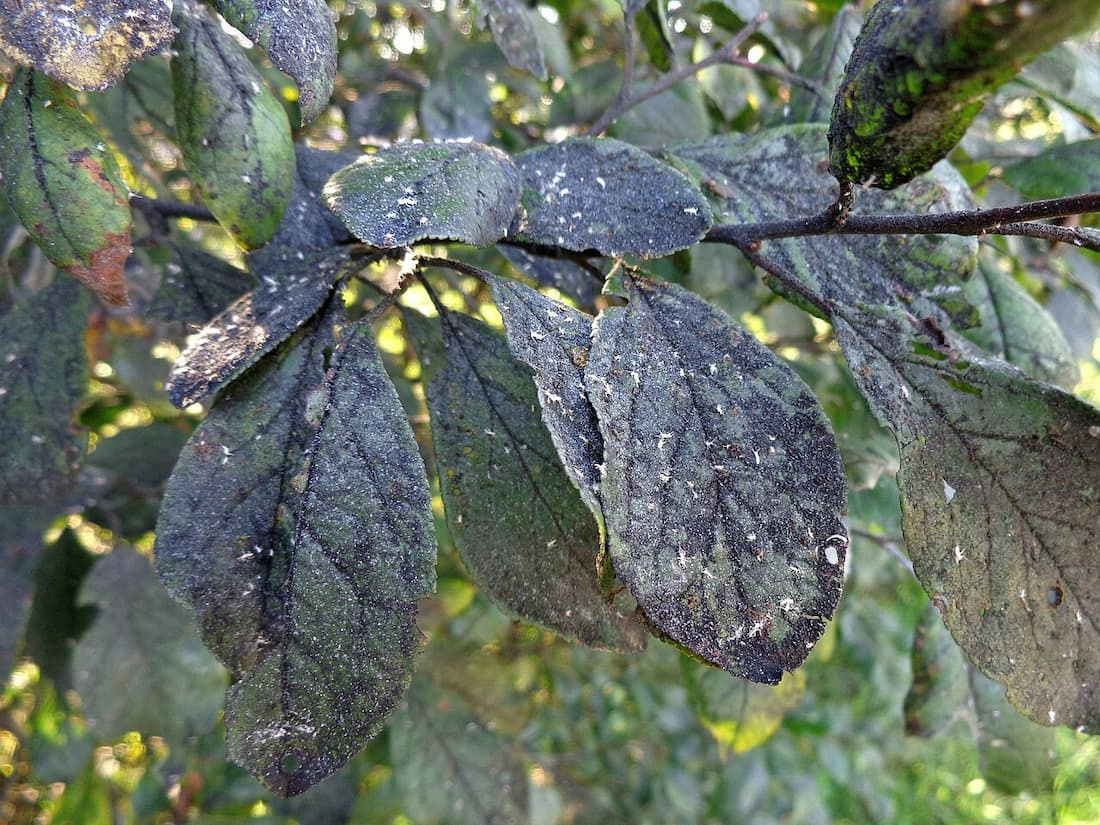
Featured Image Credit: AfroBrazilian, via Wikimedia Commons, CC BY-SA 3.0
Sooty Mold At-a-Glance
Plant Group
Shade Trees
Evergreen Trees
Flowering Shrubs
Evergreen Shrubs
Roses
Perennials
Annual Flowers
Plant Part
Leaves
Flowers & Buds
Stems & Twigs
Branches & Trunk
Whole Plant
Is Spraying Worth It?
Sometimes Worth It
Disease Type
Fungal
Non-Pathogenic
Active Season
Late Spring & Early Summer
Mid to Late Summer
Fall
Winter
Damage Potential
Cosmetic Only
Weakens Over Time
Can Be Fatal
Sooty Mold Quick Answers
What Sooty Mold Looks Like
From a Few Feet Away
The plant looks as if it’s been dusted with fireplace soot. The black is heaviest on the upper surfaces of the lower leaves and on everything below the plant — shrubs, mulch, the deck, the car. Before the black shows, leaves often glisten with a sticky, varnish-like sheen. Upper and inner growth is usually cleaner, because that’s where the insects are feeding and the honeydew is falling from.
Symptoms by Plant Part
- Leaves. A dull charcoal film on the upper surface, where honeydew lands. Undersides stay mostly clean unless insects are feeding there. Under a heavy coating, leaves turn yellow and drop early because too little light gets through. Aphid-infested leaves may also curl or pucker — that’s feeding damage from the insects, not the mold.
- Flowers and buds. Spent flower clusters and seed pods get crusted black, especially on crape myrtle.
- Stems and twigs. Black felt along green shoots, often with scale bumps, white cottony mealybugs or aphid colonies tucked into leaf joints beneath it. Heavy insect feeding stunts shoots and can kill twig tips.
- Branches and trunk. Bark turns black as honeydew runs down. On crape myrtle, a black trunk mixed with white or gray waxy crust points to crape myrtle bark scale.
- Plants underneath. Groundcovers and low shrubs under a dripping tree can be coated solid even though nothing is feeding on them.
The coating appears in late spring as scattered specks, merges into a film by early summer, and is thickest in late summer and fall. Some host differences help diagnosis: on American beech, beech blight aphids feed a thick, black, spongy mass on lower limbs instead of a thin film. On tuliptree, aphids high in the crown drip onto lower leaves, which go black while upper leaves stay clean. On yew and other conifers, the covering can look black, brown or gray on needles, with small brown scales at needle bases (Fletcher scale) or white waxy mealybugs on twigs.
Signs of the Fungus
The black coating is the fungus. It starts as scattered black spots made of fine fungal threads, spreads into a dull charcoal-gray film, and in heavy cases forms a sheet that peels off the leaf like black tissue paper. On beech and a few other trees, one type builds a thick, black, spongy mass on lower branches. Look on upper leaf surfaces, twigs and anything under the plant — and look for the clear, sticky honeydew that feeds it, which shines like varnish in sunlight. It shows from late spring through fall and is thickest in late summer.
Identification Photos
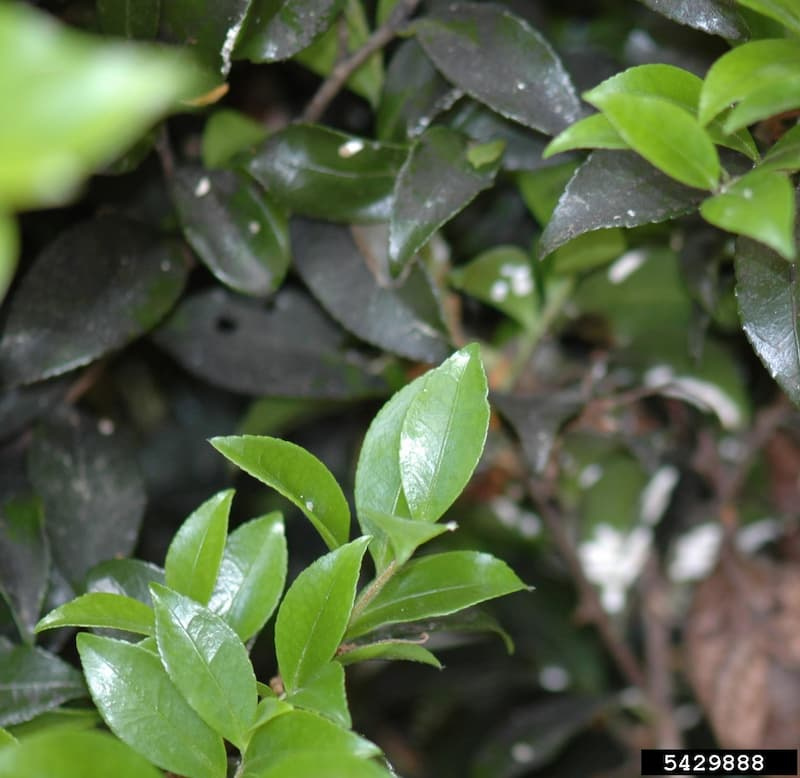
Look Above the Mold: The black coating grows on honeydew dripping from sap-feeding insects, like these cottony camellia scales on the leaves overhead.
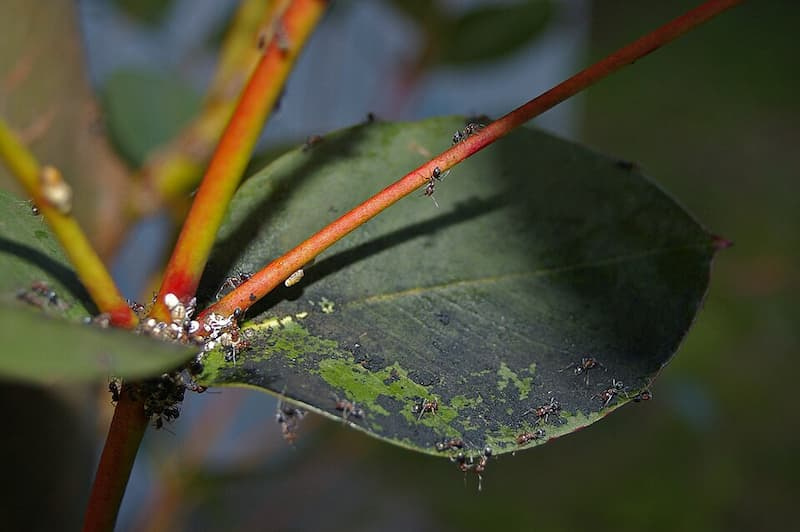
Ants Are a Clue: Ants farm honeydew-producing insects and protect them from predators, so ants trailing up a plant often point to the source.
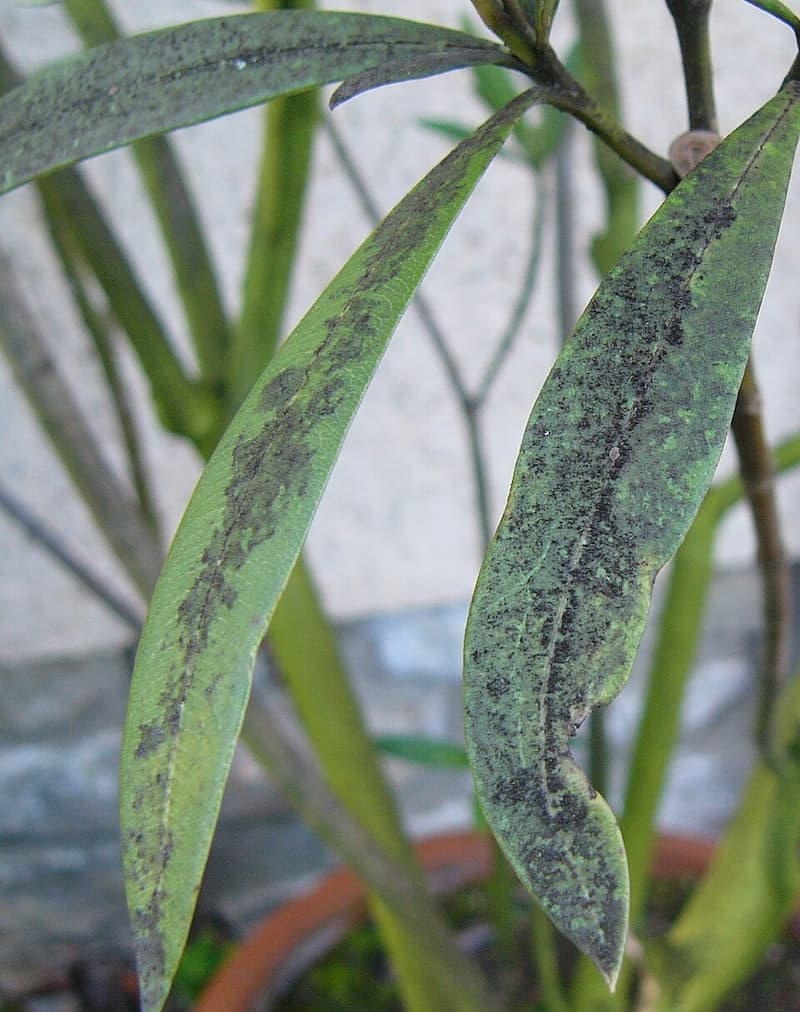
On the Surface Only: Sooty mold sits on top of the leaf rather than infecting it, so it can often be wiped or washed off, revealing green tissue underneath.
Rv, via Wikimedia Commons, public domain
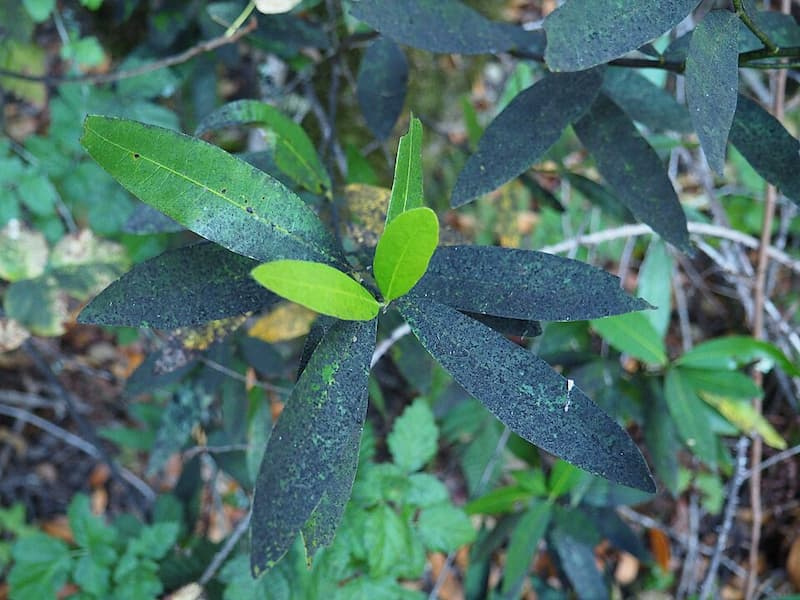
Heavy Coatings: A thick layer blocks sunlight and can weaken a plant over time. The real fix is controlling the insects, after which the mold weathers away.
Could It Be Something Else?
Common Lookalikes
Black spot and other fungal leaf spots (such as tar spot on maples) are the most common mix-up. They’re also black on the leaf, but they’re real infections: the black is inside the leaf, often with yellow or dead tissue around it, and it won’t wipe off.
Powdery mildew is the other coating homeowners confuse with it. It also sits on the leaf surface, but it’s white to grayish-white and there’s no sticky film under it.
Slime flux (bacterial wetwood) causes dark, wet streaks running down a trunk from a crack or wound. It can look like a blackened trunk from sooty mold, but it starts at one oozing spot on the bark rather than covering branches and leaves from above.
Field Checks Before You Treat
- Wipe a leaf. Rub the black layer with a damp paper towel. If it comes off and leaves clean, green, healthy leaf underneath, it's sooty mold. If the black stays in the leaf, it's a leaf spot disease.
- Touch for stickiness. Feel the leaves, and the car, bench or paving under the plant. A tacky, shiny film is honeydew, and sooty mold doesn't grow without it.
- Look above the worst patches. Turn over leaves and check twig tips and stems directly above the blackest leaves. Clusters of aphids, white fluffy mealybugs, tiny white whiteflies that flutter up, or immobile bumps (scale) are the source.
- Scrape a crape myrtle bump. On crape myrtle with white or gray waxy crust on the bark, scrape a bump with a fingernail. Reddish fluid means live crape myrtle bark scale; a dry shell with no fluid is an old, dead scale.
- Watch for ant trails. Ants marching up and down the trunk confirm a honeydew colony overhead — and tell you the ants are guarding it from the insects that would otherwise eat it.
Plants at Risk
Commonly Affected Plants
Any plant that hosts honeydew insects, or grows under one, can go black. These are the ones homeowners find it on most:
- Crape myrtle — crapemyrtle aphid and crape myrtle bark scale
- Gardenia — whiteflies and soft scales
- Camellia — soft scales
- Holly — soft scales and whiteflies
- Azalea — whiteflies and bark scale
- Maple — cottony maple scale and aphids
- Tuliptree — tuliptree aphid and tuliptree scale
- American beech — beech blight aphid
- Linden — aphids
- Yew — Fletcher scale and Taxus mealybug
Roses, oleander, magnolia, privet and groundcovers like pachysandra and English ivy under infested trees are also common.
Resistant Choices
- Crape myrtle. These Lagerstroemia indica × fauriei hybrids have moderate resistance to the crapemyrtle aphid, the main source of honeydew on this tree: ‘Acoma’, ‘Apalachee’, ‘Biloxi’, ‘Caddo’, ‘Choctaw’, ‘Comanche’, ‘Fantasy’, ‘Hopi’, ‘Lipan’, ‘Miami’, ‘Muskogee’, ‘Natchez’, ‘Osage’, ‘Pecos’, ‘Sioux’, ‘Tonto’, ‘Tuscarora’, ‘Tuskegee’, ‘Wichita’, ‘Yuma’ and ‘Zuni’. The rating covers the aphid only, not crape myrtle bark scale.
- Everything else. No plant is resistant to sooty mold itself, and extension sources don’t list honeydew-insect-resistant cultivars for most other landscape plants. The practical choice is site: a plant in the sun and spacing it likes resists scale and aphids better than a stressed one. If a plant is attacked by the same insects year after year despite good care, replace it with a different kind of plant those insects don’t feed on.
Why It Shows Up
Conditions That Trigger It
Sooty mold has no weather of its own; it follows the insects. Anything that lets aphids, scales, whiteflies or mealybugs multiply leads to more honeydew, and more honeydew means more black coating. Warm weather speeds up insect generations, so the coating builds from late spring and peaks in late summer. Rain works against it: heavy rain washes honeydew off before the mold can use it, so dry spells let deposits pile up.
- Living under a honeydew tree. Plants beneath an infested crape myrtle, maple, tuliptree or linden get dripped on all season, even if nothing is feeding on them.
- Ants. Ants guard honeydew insects from lady beetles, lacewings and tiny parasitic wasps, so colonies grow unchecked.
- Broad-spectrum insecticide sprays. Sprays that kill everything wipe out the insects’ natural enemies, and the pest population often rebounds bigger than before.
- Too much nitrogen. Heavy feeding pushes soft new shoots, the growth aphids and many other sap-feeders prefer.
- Dense, shaded canopies. A crowded, unpruned canopy stays cool and humid, which helps scale insects survive.
- Stressed plants. Plants short on water or in the wrong site struggle more against scale and other sap-feeders.
The only temperature that matters for your actions is the one for spraying oil — see the spraying section.
How It Survives and Spreads
Sooty mold fungi are everywhere in the air, so the mold doesn’t need to “spread” from plant to plant the way an infection does. Spores land on every leaf; they just can’t grow until honeydew arrives. What spreads is the insects: aphids fly, scale and mealybug crawlers are carried by wind, birds and people, and new infestations often arrive on infested nursery plants.
Honeydew falls straight down, which is why the lower leaves, the plants underneath, and the car parked below go black first. The fungus survives the winter as dormant threads and spores on twigs, bark and evergreen leaves, while the insects overwinter as eggs or young scales on the same plant. On deciduous plants, fall leaf drop takes most of the coating with it. On evergreens like holly, gardenia and camellia, coated leaves stay black until rain weathers them clean or they’re shed and replaced.
Where It Hits Hardest: Regional Notes
Sooty mold occurs throughout North America. It’s worst in the Southeast, the Gulf Coast and California, where mild winters let whiteflies and soft scales feed nearly year-round and broadleaf evergreens stay black through winter. Crape myrtle bark scale is a newer cause spreading across the South, turning whole crape myrtle trunks black. In the Mid-Atlantic and Northeast, spotted lanternfly produces enough honeydew to coat everything under an infested tree. Farther north, it’s mainly a mid-to-late summer problem on maples, lindens, tuliptrees and yews.
Sooty Mold Diagnostic Profile
Check what you see against the full set of signs. The more that match, the more likely this is your problem.
What You’ll See
Symptom Color
Yellow
Brown
Black or Dark
Visible Signs
Black Spots or Pustules
Slimy or Crusty Layer
Plant Symptoms
Powdery or Sooty Coating
Curled or Distorted Leaves
Yellowing
Browning & Dieback
When and Where
Weather Triggers
Warm & Humid
Hot & Humid
Drought or Heat Stress
Spread Pattern
Lower Leaves First
Scattered
Controlling Sooty Mold
The fix is to stop the honeydew; the mold then stops growing on its own. Washing the black off is optional and cosmetic.
- Identify the insect first. Check leaf undersides and twigs above the worst patches. Aphids, scales, whiteflies and mealybugs need different controls, and many sprays miss scale entirely.
- Hose it off. A strong stream of water knocks aphids and young insects off the plant and rinses away honeydew before the mold can use it. Repeat every few days during heavy drip, including the paving and furniture below.
- Cut off the ants. Wrap the trunk with a band and apply a sticky barrier compound to it, trim branches that touch buildings or other plants, and set out ant baits. Without ant guards, lady beetles, lacewings and parasitic wasps move in and eat the honeydew producers.
- Protect the natural enemies. Skip broad-spectrum insecticides with long-lasting residues; they kill the predators doing your work and often bring the pest back worse.
- Feed and water for steady growth. Fertilize based on a soil test, not for a growth spurt, because flushes of soft new shoots draw aphids. Water deeply in dry spells so the plant isn’t stressed.
- Prune out the worst of it. Cut off twigs and suckers that are crusted with scale or packed with aphids or mealybugs, and thin dense canopies so they stay drier and less hospitable to scale.
- Wash the mold off small plants if you want. Spray foliage with 4 ounces of dish soap per gallon of water, wait 3 to 4 minutes, then rinse thoroughly with a strong stream of water. Try it on a few leaves first, since soap at this strength can burn tender growth.
Spraying the black mold itself won’t help, but treating the insects behind it is sometimes worth it — on shrubs and small trees with a heavy, confirmed infestation. No fungicide cures sooty mold, because the fungus never enters the plant; it lives on honeydew sitting on the surface. Kill the honeydew supply and the mold stops.
Start with the mildest option that matches your insect, and expect to repeat it, because scale crawlers hatch over several weeks.
| Active ingredient | Best against | When | Cautions |
|---|---|---|---|
| Insecticidal soap (potassium salts of fatty acids) | Aphids, whiteflies, mealybugs, scale crawlers | When insects are active; repeat | Kills only what it touches when wet; no residue, so natural enemies recover. |
| Horticultural oil (narrow-range) | Soft scales, aphids, mealybugs; also loosens the mold so it weathers off faster | Dormant season, or when crawlers are active (late spring to summer) | Don’t spray above 90°F air temperature, below 32°F, or in fog. Water drought-stressed plants first. |
| Imidacloprid (soil drench) | Aphids and most soft scales | Spring | Takes weeks to move up a large plant. Doesn’t control armored scales or cottony cushion scale. |
| Dinotefuran (soil drench) | Crape myrtle bark scale | Spring, as new growth begins | The most effective option for crape myrtle bark scale; one drench lasts at least a year. |
| Bifenthrin + 2% horticultural oil | Crape myrtle bark scale crawlers | Late April–May and again in late summer | Broad-spectrum; also kills lady beetles and other predators, so keep it for this one pest. |
Imidacloprid and dinotefuran are systemic: the plant takes them up into its leaves and flowers. On plants bees visit, such as crape myrtle, follow the label’s pollinator directions closely. Spraying the full canopy of a mature shade tree is rarely worth it for a homeowner — you can’t reach the top, the drift kills beneficial insects, and the tree tolerates the mold. That’s a job for an arborist, if it needs doing at all.
Removal, Disposal and Replanting
Never remove a plant for sooty mold alone — the coating fades once the insects are controlled. Removal makes sense only when the insect infestation itself keeps returning and the plant keeps losing branches and vigor despite treatment.
Leaves that carry only sooty mold can go in a home compost pile; the fungus isn’t a plant disease, and its spores are already in every yard. Twigs and branches crusted with live scale or packed with mealybugs are different: bag them for yard-waste pickup or the trash so the crawlers don’t walk back onto your plants. Spotted lanternfly egg masses scraped off trunks should be dropped into rubbing alcohol or hot soapy water before disposal.
You can replant in the same spot right away, because sooty mold doesn’t live in soil. If the old plant failed from repeated insect attacks, choose a different kind of plant rather than the same one.
When to Call a Pro
Call an ISA Certified Arborist when the infestation is in the canopy of a mature tree you can’t reach from the ground, or when heavy scale keeps returning year after year on a valued tree. Send a sample to your county extension office or the state plant diagnostic lab when you can’t identify the insect, or when leaves are yellowing, spotting or dying back in ways the black coating doesn’t explain. Include fresh twigs and leaves showing both the mold and the insects, sealed dry in a plastic bag. Report suspected spotted lanternfly or crape myrtle bark scale to your extension office if it hasn’t been found in your county yet.
Frequently Asked Questions
These answers are synthesized from plant pathology research and diagnostic guidance published by university extension services and plant disease clinics.
Almost always, no. It’s honeydew, the sugary waste of aphids, scales and other sap-feeding insects in the canopy. Trees rarely drip sap from their leaves, so a sticky film on the car or patio under a tree is one of the first signs that sooty mold is coming.
No. The fungus lives on the honeydew, not in the plant, so there’s nothing for a fungicide to cure. Control the insects producing the honeydew, and the mold stops growing.
Yes, gradually, once the honeydew stops. Rain, wind and sun weather the dry mold off over weeks, and deciduous plants drop it with their leaves in fall. A horticultural oil spray or a soap wash speeds it up; on evergreens, the oldest leaves may stay stained until the plant replaces them.
They’re farming the honeydew. Ants don’t cause sooty mold, but they protect aphids and scales from lady beetles and parasitic wasps so they can keep collecting the sugar. Blocking ants with a sticky trunk barrier and baits lets those natural enemies bring the insects down.
Wash the honeydew off early and often. Hosing down the car, paving and furniture under the tree every few days during heavy drip removes the honeydew before the mold sets in. Once a black layer has formed, it takes soap, water and scrubbing, and it will come back until the insects in the tree above are controlled.
Scientific Authority
This profile is built on plant pathology research and diagnostic guidance from university extension services and plant disease clinics. We prioritize accurate identification and cultural control first, recommending fungicides only where research shows they are justified, and naming them by active ingredient rather than brand.
Primary Resources
- University of California Statewide IPM Program — Sooty Mold (Pest Notes 74108)
- University of California Statewide IPM Program — Scales (Pest Notes)
- University of California Statewide IPM Program — Black Scale
- NC State Extension — Sooty Molds
- NC State Extension — Beech Blight Aphid
- NC State Extension, Caldwell County Center — Weekly Q&A: Sooty Mold on Nellie Stevens Holly
- Clemson Cooperative Extension Home & Garden Information Center — Crape Myrtle Diseases & Insect Pests
- Clemson Cooperative Extension Home & Garden Information Center — Crapemyrtle Bark Scale
- Clemson Cooperative Extension Home & Garden Information Center — Gardenia Diseases & Other Problems
- Penn State Extension — Spotted Lanternfly Frequently Asked Questions
- Penn State Extension — Tulip Poplar Diseases
- University of Minnesota Extension — Non-Harmful Tree Conditions
- University of Minnesota Extension — Yew: Blackened Needles
- University of Wisconsin–Madison Extension — Cottony Maple Scale (A3123)