
Pathogen: Gaeumannomyces graminis and closely related root-infecting fungi
Also called: Take-all patch, TARR, bermudagrass decline, take-all
Take-All Root Rot
The root rot you can't see
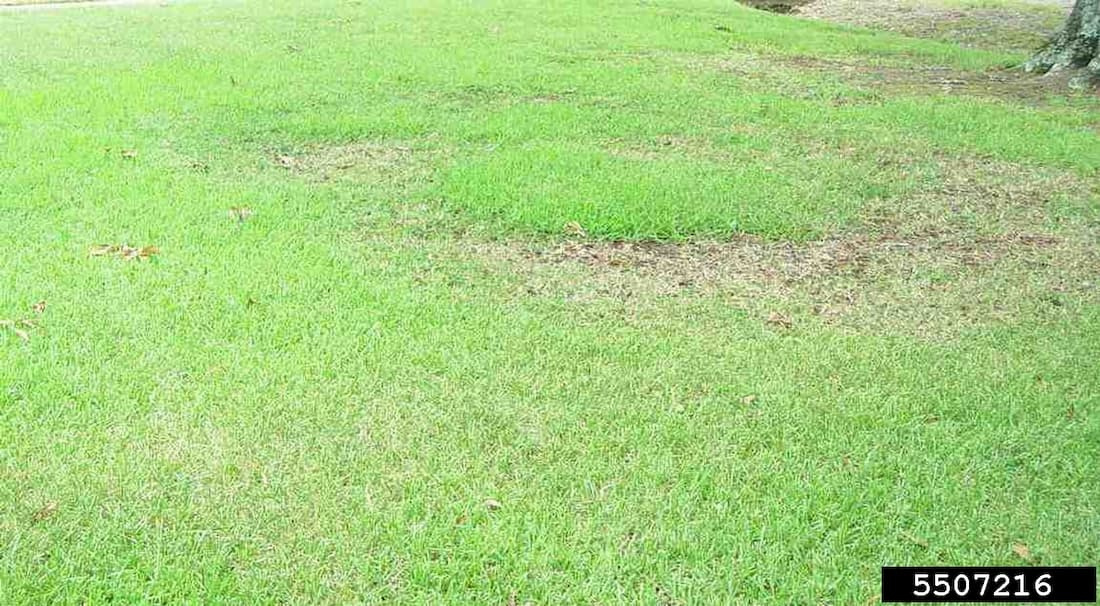
Featured Image Credit: Clarissa Balbalian, Mississippi State University, Bugwood.org, CC BY 3.0 US
Take-All Root Rot At-a-Glance
Grass Type Affected
Warm-Season Grasses
Recovers on Its Own?
Usually Not
Is Spraying Worth It?
Sometimes Worth It
Disease Type
Fungal
Active Season
Early Spring
Late Spring & Early Summer
Mid to Late Summer
Fall
Damage Potential
Weakens Over Time
Can Be Fatal
Take-All Root Rot Quick Answers
What Take-All Root Rot Looks Like
From Standing Height
It starts as a yellow or light-green cast in patches from several inches to about 2 feet across, often looking like a nutrient problem. Over the following weeks the grass thins and turns tan to brown, and the patches spread and merge into large, irregular dead areas that can reach 3 to more than 20 feet across. Weeds move quickly into the bare ground. On bermudagrass it often shows as a general thinning that extra fertilizer doesn’t fix, rather than clean patches.
Up Close: Blades, Crowns and Roots
The leaves themselves have no spots, bands or lesions, because the fungus never infects them. The yellowing starts on the older, lower leaves and moves up, and blades may fold along the midrib like thirsty grass. These leaf symptoms are just the plant starving for water and nutrients its roots can no longer deliver.
The real damage is underground. Healthy warm-season roots are long and white to light tan. Infected roots start thin and off-white with scattered black spots, then become short, black and brittle, and there are few of them. Runners and underground stems develop black streaks, especially at the nodes where roots should form, and eventually rot. Because the roots are gone, a runner lifts out of the soil with almost no pull, but the leaves stay firmly attached to it. In severe cases the crown at the base of the plant darkens too.
Signs of the Organism
You won’t see the fungus on the leaves, at any time of day. It grows only underground, as dark brown to black strands running along the outside of roots, runners (stolons) and underground stems. These strands carry tiny gray, lobed attachment pads that let the fungus grip the root and grow into it. With a 10x hand lens and a washed runner you can sometimes spot the pads on its underside, but a sure identification usually takes a diagnostic lab’s microscope.
Identification Photos
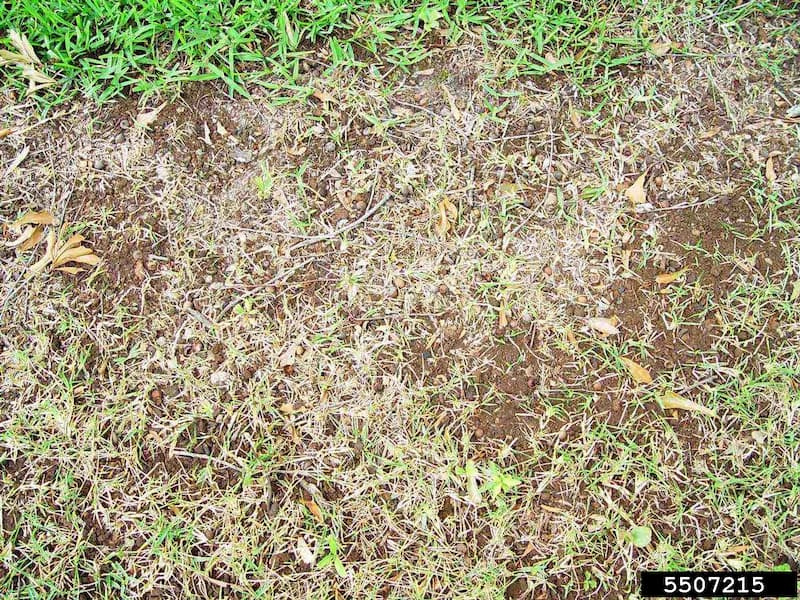
Thinning Patches: Affected areas yellow, thin out and eventually die back to bare soil, often with no clear border between sick and healthy grass.
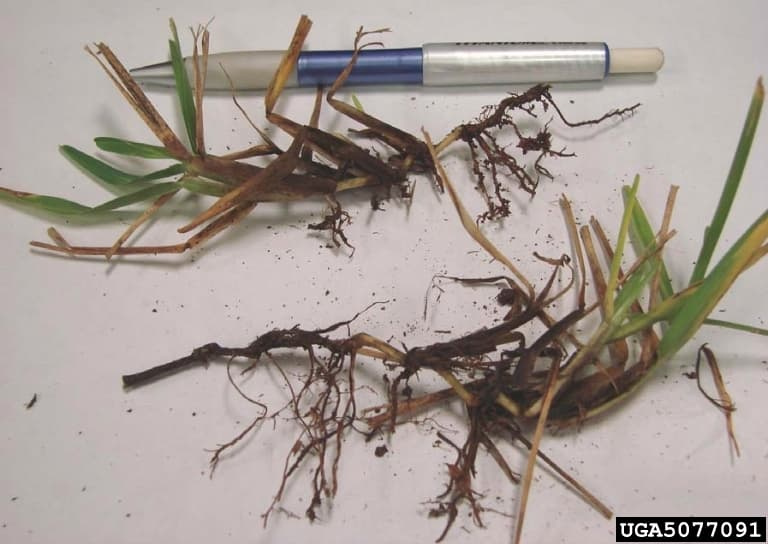
Rotted Roots: The clearest sign is below ground. Infected roots turn black, rot and stay short, so the grass pulls up easily.
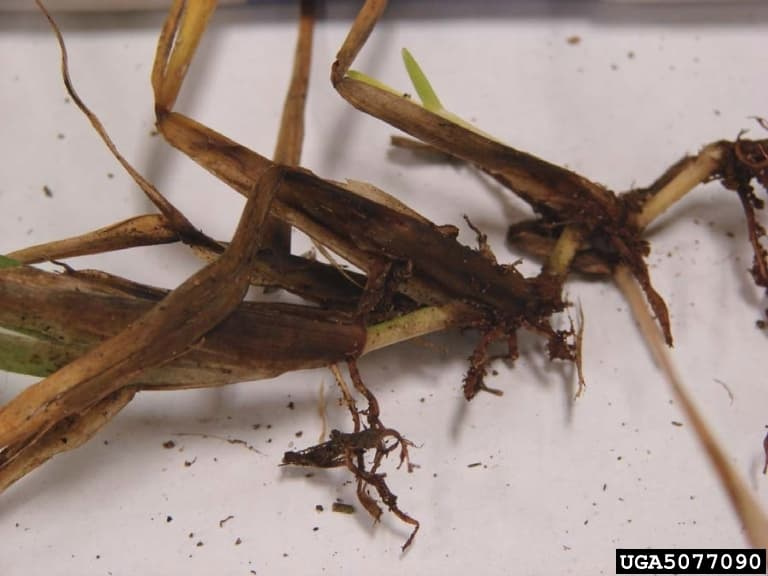
Dark Fungal Strands: The fungus runs along the stolons and roots as dark brown to black threads, which a lab can confirm under a microscope.
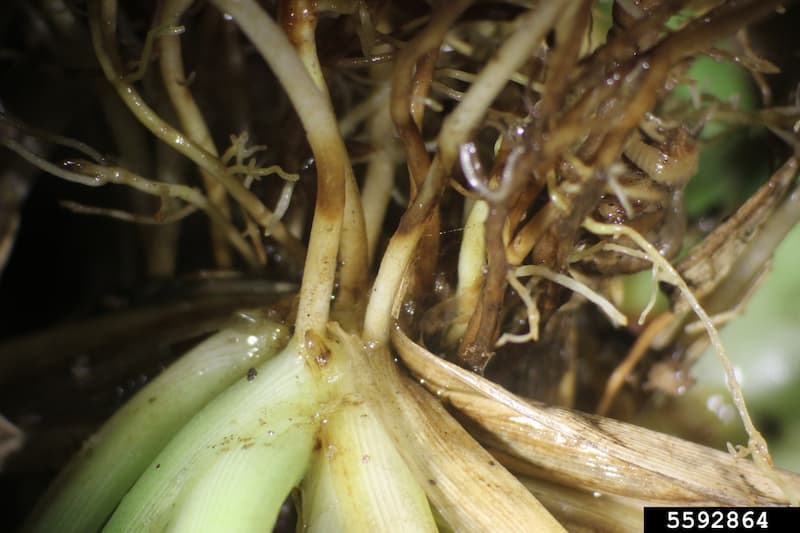
Early Damage: Root lesions start well before the lawn shows symptoms, which is why decline often appears suddenly once heat or drought stress arrives.
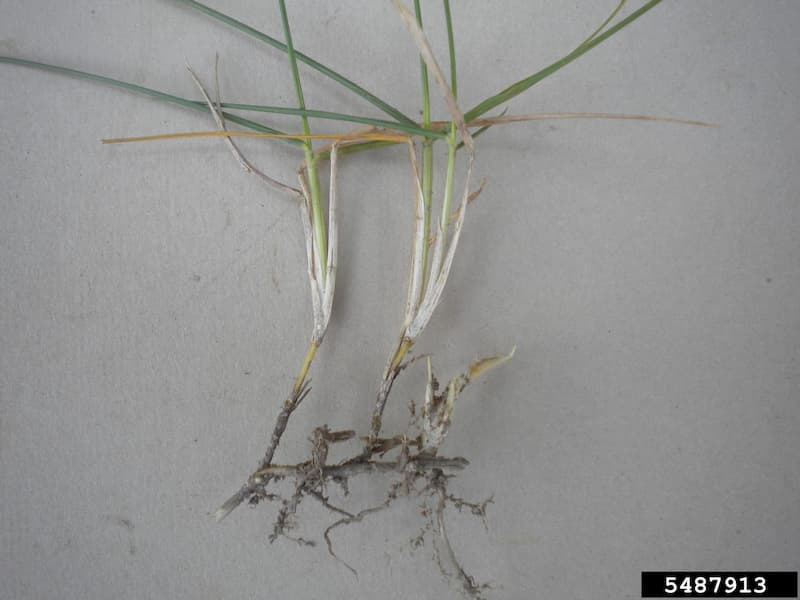
Not Just St. Augustine: Zoysiagrass, bermudagrass and other warm-season grasses can also be infected, with the same short, darkened roots.
Could It Be Something Else?
Common Lookalikes
Large Patch is the disease most often mistaken for take-all, because both cause big yellow-to-brown patches in St. Augustinegrass and zoysiagrass. The timing gives Large Patch away: it shows up in cool, wet fall and spring weather and fades as summer heats up, while take-all gets worse in summer heat.
Chinch bugs cause the same summer yellowing and thinning in St. Augustinegrass, often starting in the hottest, sunniest spots next to pavement. Since take-all also does its worst damage in full sun, the two are easy to confuse until you check for insects and look at the roots.
White grubs chew off grass roots, so the turf lifts from the soil just as it does with take-all. The difference is that grubs leave roots missing, with the C-shaped larvae in the soil below, while take-all leaves roots that are present but black and rotted.
Field Checks Before You Treat
- Do the tug test. At the edge of a yellow patch, grab a runner and pull gently upward. If the whole runner lifts out with almost no resistance and the leaves stay firmly attached, that points to take-all. If the leaves slip off the runner easily and show a dark, slimy rot at their base while the runner stays rooted, it's Large Patch.
- Wash and look at the roots. Dig a plug about 3 inches deep where yellow grass meets green, and rinse the soil off in a bucket of water. Take-all roots are short, sparse, dark brown to black and brittle, with few healthy white roots. Long, white to light-tan roots rule it out.
- Look for grubs under the sod. Cut three sides of a 1-foot square at the patch edge and peel the turf back. Several C-shaped, cream-colored grubs in the top 2 inches of soil, with roots chewed off rather than blackened, mean grub damage.
- Run a soap flush for chinch bugs. Mix 2 tablespoons of liquid dish soap into 1 gallon of water and pour it over 1 square yard at the edge of the damaged area, where green meets yellow. Within a few minutes, chinch bugs crawl up: adults are black, about 3/16 inch long, with white wings, and the young are smaller and red with a white band. Many bugs and white, healthy roots mean insect damage.
Grasses at Risk
Host Grasses
Which Grasses Suffer Most
St. Augustinegrass suffers most. Every cultivar is susceptible, and none has shown real resistance, so care decides how badly a lawn is hit. Bermudagrass is the other common victim, where the disease has long been called bermudagrass decline. Zoysiagrass and Centipedegrass can be infected but hold up much better. Zoysiagrass tolerates infection longer before showing damage, and take-all is rarely reported on centipedegrass growing in the acidic soil it prefers. Buffalograss is a listed host in Texas but seldom has problems, and Bahiagrass is rarely diagnosed with it. Cool-season lawn grasses aren’t affected.
There’s no truly resistant cultivar yet, and NTEP trials don’t rate cultivars for take-all. Vigorous, coarse-runner St. Augustinegrass types can regrow faster once care is corrected, but they still get infected.
Why It Shows Up
Conditions That Trigger It
Take-all is a stress disease. The fungus is already common on the roots of most southern warm-season lawns, and it turns into a problem when the grass is weakened and the soil favors the fungus. It works on the roots for at least two to three weeks before the leaves show anything, and the yellowing appears when the grass suddenly needs more root than it has. That happens at spring green-up and again in summer, especially after long stretches of rain. UGA lists warm to hot weather of 77–90°F as favorable, and NC State’s lab work puts the fungi’s fastest growth at soil temperatures of 77–86°F.
The conditions that tip a lawn into disease:
- High soil pH. Disease is most common when the top 4 inches of soil are above pH 6.5. High pH also locks up manganese, a nutrient the roots use to defend themselves.
- Lime. Liming raises pH and is one of the most common triggers. Alabama Extension names heavy liming as a leading cause.
- Nitrate nitrogen and too much nitrogen. Nitrate fertilizers (ammonium nitrate, calcium nitrate) raise the pH right at the root surface. Heavy feeding pushes leaf growth at the expense of roots and builds thatch.
- Too much water. Long rainy spells, frequent shallow watering, evening watering and poorly drained low spots all keep the root zone wet for the fungus.
- Compaction and thatch. Hard soil and thick thatch keep roots shallow and short of air.
- Low mowing and scalping. Cutting too short removes the leaf area the plant needs to feed a damaged root system.
- Sun and shade. Damage is usually heaviest on sunny sites, where heat drives up the grass’s water demand. Shade is a stress too, because it weakens the grass and slows root regrowth.
- Herbicide stress. St. Augustinegrass is sensitive to some herbicides, and root-inhibiting products slow root recovery.
How It Survives and Spreads
The fungus survives year-round as dark strands on living and dead roots, runners and underground stems, so it never really leaves a lawn. It spreads through the turf by growing along these underground parts from plant to plant, which is why patches widen slowly instead of popping up overnight.
Over longer distances it travels when infected plant pieces or soil are moved: new sod or sprigs from an infested field, topsoil, and equipment like core aerators and dethatchers that tear up and carry runners. Mowing alone doesn’t spread it unless the mower picks up roots or runners, and the leaf blades themselves don’t carry it.
Where It Hits Hardest: Regional Notes
Take-all root rot is a southern disease because it attacks only warm-season grasses. It’s one of the most common serious lawn diseases from Florida and the Gulf Coast through Georgia, the Carolinas, Alabama, Mississippi, Louisiana and Texas. Texas lawns are especially prone because many sit on naturally alkaline, limestone-based soils and some are irrigated with salty water. In Florida, heavy summer rains and the dominance of St. Augustinegrass keep it common.
It’s not a home-lawn problem in the North, the Upper Midwest or the Pacific Northwest, where lawns are cool-season grasses like Kentucky Bluegrass, Tall Fescue and Perennial Ryegrass, which this disease doesn’t attack.
Take-All Root Rot Diagnostic Profile
Check what you see against the full set of signs. The more that match, the more likely this is your problem.
What You’ll See
Symptom Color
Tan or Straw
Yellow
Brown
Black or Dark
Visible Signs
None Usually Visible
Lawn Pattern
Circular Patches
Irregular Patches
Overall Thinning
Patch Size
6 to 12 Inches
1 to 3 Feet
Over 3 Feet
Blade Symptoms
Rotted Roots
When and Where
Weather Triggers
Cool & Wet
Warm & Humid
Hot & Humid
Long Leaf Wetness (Dew or Rain)
Wet or Poorly Drained Soil
Drought or Heat Stress
Where in the Lawn
Shade
Low or Wet Spots
Compacted or High-Traffic Areas
New Seedings
Open, Sunny Lawn
Controlling Take-All Root Rot
Care changes do more against take-all than any spray. Most of them work by doing one thing: lowering the pH right around the roots, where the fungus lives.
- Stop liming. Don’t lime a lawn with take-all, even if a general soil test suggests it. Lime raises pH, which feeds the fungus and starves the roots of manganese.
- Bring the pH down. Aim for soil pH below 6.5, ideally 5.5 to 6.0. Topdress with sphagnum peat moss, which is strongly acidic, at 1 bale (3.8 cubic feet) per 1,000 sq ft, and up to 2 bales once or twice a year where the problem is severe. On alkaline soils above pH 7, Texas A&M adds powdered elemental sulfur at 3 to 5 lb per 1,000 sq ft per year, split into several light applications and mixed with compost. Don’t push the pH below 5.5 except on centipedegrass.
- Switch your nitrogen. Use ammonium sulfate or a slow-release nitrogen, and skip nitrate fertilizers. Ammonium forms acidify the soil at the root surface, while nitrate forms raise its pH. Keep each feeding to no more than 1 lb of soluble nitrogen per 1,000 sq ft, keep the yearly total under 4 lb for St. Augustinegrass and 5 lb for bermudagrass, and avoid fall feeding.
- Balance with potassium. Apply 1 lb of potassium for every 1 to 2 lb of nitrogen, or equal amounts on sandy Florida soils. Potassium helps roots and runners hold up under stress. Use manganese sulfate only if a soil or leaf tissue test calls for it.
- Water deeply, early and less often. Water only when the grass shows thirst (folding or dull blue-gray leaves), wet the soil 6 to 8 inches deep (about 3/4 inch of water per watering on most lawns) and finish before sunrise. Avoid late-afternoon and evening watering, which keeps the turf wet overnight. A working rain shut-off on an automatic system matters, because overwatering feeds this disease.
- Raise the mower. Mow at the top of your grass’s range, about 3 inches for St. Augustinegrass and 1.5 to 2 inches for bermudagrass, and never cut off more than a third of the blade at once. More leaf means more food for the damaged roots.
- Fix drainage and compaction. Core aerate to open hard soil and help water drain, and regrade or drain spots where water stands. Fungicides fail in soil that stays saturated.
- Control thatch. Remove thatch deeper than about 1 inch by vertical mowing during active growth. Thick thatch holds moisture and keeps roots shallow.
- Go easy on herbicides. Use them only where needed, at label rates, and avoid root-inhibiting products on a lawn that’s trying to regrow roots.
- Clean the equipment. Wash soil and plant debris off aerators and dethatchers before moving from a diseased area to a healthy one.
Spraying is worth it only to prevent take-all on a lawn with a confirmed history of it, and only alongside the care changes above. It won’t rescue grass that’s already yellow. By the time leaves change color, the roots have been rotting for weeks. These fungicides work by moving through the plant, so they need living roots to take them up, and dead roots can’t. Alabama Extension notes that fungicides haven’t been shown to work reliably against take-all on St. Augustinegrass and recommends them only as prevention on lawns damaged before.
| Active ingredient | FRAC group | Availability | Notes |
|---|---|---|---|
| Azoxystrobin | 11 | Homeowner and professional | Safe to use in hot weather |
| Thiophanate-methyl | 1 | Homeowner and professional | Safe to use in hot weather |
| Propiconazole | 3 | Homeowner and professional | Avoid high rates in summer heat |
| Myclobutanil | 3 | Homeowner and professional | Avoid high rates in summer heat |
| Pyraclostrobin | 11 | Mostly professional | Also sold in professional combination products |
| Triadimefon | 3 | Mostly professional | Avoid high rates in summer heat |
- Timing. Start about a month before symptoms usually show in your lawn, which in most of the South means early spring and again in early fall. Repeat at the interval on the label (usually 3 to 4 weeks) while weather favors the disease.
- Get it to the roots. Mix liquids in at least 3 gallons of water per 1,000 sq ft and water in right away with about 1/4 to 1/2 inch, or as the label directs. Water granular products in the same way. A fungicide left on the leaves never reaches the fungus. Rake out dead runners first, and don’t apply right after a soaking rain.
- Rotate groups. Alternate FRAC numbers, for example group 11 one season and group 3 the next, so the fungus doesn’t build resistance.
- Watch the heat. Group 3 fungicides can act like growth regulators in late spring and summer heat, stunting St. Augustinegrass and especially bermudagrass. Azoxystrobin and thiophanate-methyl are the safer choices in hot weather.
Recovery and Repair
Recovery is slow. Expect at least a full growing season of corrected care before thin areas fill back in, and dead patches with rotted runners usually don’t come back at all. Raising the mower, topdressing with peat moss and switching to ammonium or slow-release nitrogen all speed regrowth in lightly affected areas.
Where patches are dead, renovate rather than wait:
- Clear the patch. Rake out the dead grass, rotted runners and weeds down to bare soil.
- Acidify the soil. Work about 4 cubic feet of sphagnum peat moss per 1,000 sq ft into the top 2 to 4 inches. Don’t lime.
- Choose the grass carefully. Don’t lay new St. Augustinegrass sod straight over the old patch, because the fungus in the soil will attack its new roots. On acidic soil, centipedegrass is a better replacement. On alkaline soil, consider zoysiagrass.
- Plant during active growth. Sod or sprig in late spring to early summer, when warm-season grass roots fastest.
- Water new sod by stages. Water once or twice a day at half your normal run time the first week, then daily at full run time as roots form. Once the sod corners resist lifting (about 3 to 4 weeks), switch to every other day, and move to deep, infrequent watering by fall.
- Feed lightly. Wait 30 to 60 days, until the sod has rooted, then fertilize at about a quarter of the normal rate with no nitrate nitrogen.
When to Call a Pro
Send a sample to your state’s extension plant diagnostic lab when the tug test and root wash don’t clearly point to take-all, or when patches keep growing after a season of corrected care. Getting it confirmed before you spend money on fungicides or new sod also pays, because chinch bugs, grubs and Large Patch need completely different fixes.
Take the sample from the edge of a patch, where yellow grass meets green, never from dead brown turf. Include leaves, runners and roots with 2 to 4 inches of soil, wrap the soil and roots in plastic, and mail it early in the week so it doesn’t sit in a warm post office over a weekend. For large lawns or repeated failures, a licensed lawn care professional has access to more fungicide options and can run a preventive program.
Frequently Asked Questions
These answers are synthesized from plant pathology research and diagnostic guidance published by university extension services and plant disease clinics.
It comes down to soil pH. The fungus thrives in neutral to alkaline soil, and high pH also locks up manganese, a nutrient grass roots need to fight infection. Lime raises the pH and helps the fungus. Sphagnum peat moss is strongly acidic, so it lowers the pH right where the roots grow and frees up that manganese.
Probably not. The timing was the problem. By the time grass yellows, the roots are already rotted, and these fungicides need living roots to carry them into the plant. Fungicides only help as prevention, applied in spring and fall before symptoms on a lawn that has had take-all before, while you fix pH, watering and mowing.
Only if care changes haven’t stopped it. No St. Augustinegrass cultivar resists take-all, so laying the same grass back into infested soil often fails. Centipedegrass is the usual replacement on acidic soil, where take-all is rarely reported on it. Zoysiagrass is the choice on alkaline soil, where centipedegrass struggles.
Not by itself. Low manganese makes grass more susceptible, and UGA and UF recommend manganese sulfate where a soil or leaf tissue test shows a shortage. Without a test, lowering soil pH with peat moss and ammonium sulfate is the more reliable way to make the manganese already in your soil available to the roots.
Not quite. Southern extension services often use the names interchangeably for this warm-season lawn disease. Strictly speaking, take-all patch is a related disease of bentgrass on golf greens in cool climates, caused by a different variety of the fungus, and it doesn’t affect home lawns of St. Augustinegrass or bermudagrass.
Scientific Authority
This profile is built on plant pathology research and diagnostic guidance from university extension services and plant disease clinics. We prioritize accurate identification and cultural control first, recommending fungicides only where research shows they are justified, and naming them by active ingredient rather than brand.
Primary Resources
- Alabama Cooperative Extension System — Take-All Root Rot on St. Augustinegrass
- University of Georgia Extension — Take-All Root Rot of Warm-Season Grasses (Circular 1102)
- LSU AgCenter — Take-All Root Rot
- LSU AgCenter — Louisiana Home Lawn Series: Take-All Root Rot (Pub. 3624-BB)
- University of Florida IFAS Extension — Take-all Root Rot (SS-PLP-16/LH079)
- University of Florida IFAS Extension, Okaloosa County — Take-All Root Rot
- Texas A&M AgriLife Extension — Take-all Patch, Bermuda Decline, Take-all Root Rot (Texas Plant Disease Handbook)
- Texas A&M AgriLife Extension — Take-All Root Rot in Turfgrass: Symptoms and Control
- Texas A&M AgriLife Extension — Take-all Root Rot of Turfgrass (L-5170)
- NC State Extension — Take-All Root Rot: A Complex Disease