
Scientific Name: Stenotaphrum secundatum
Common Names: St. Augustinegrass, St. Augustine grass, Charleston grass, shore grass, quickgrass, mission grass, pimento grass
St. Augustinegrass
The only warm-season lawn grass that takes deep shade and salt air, and the first one a hard freeze kills.
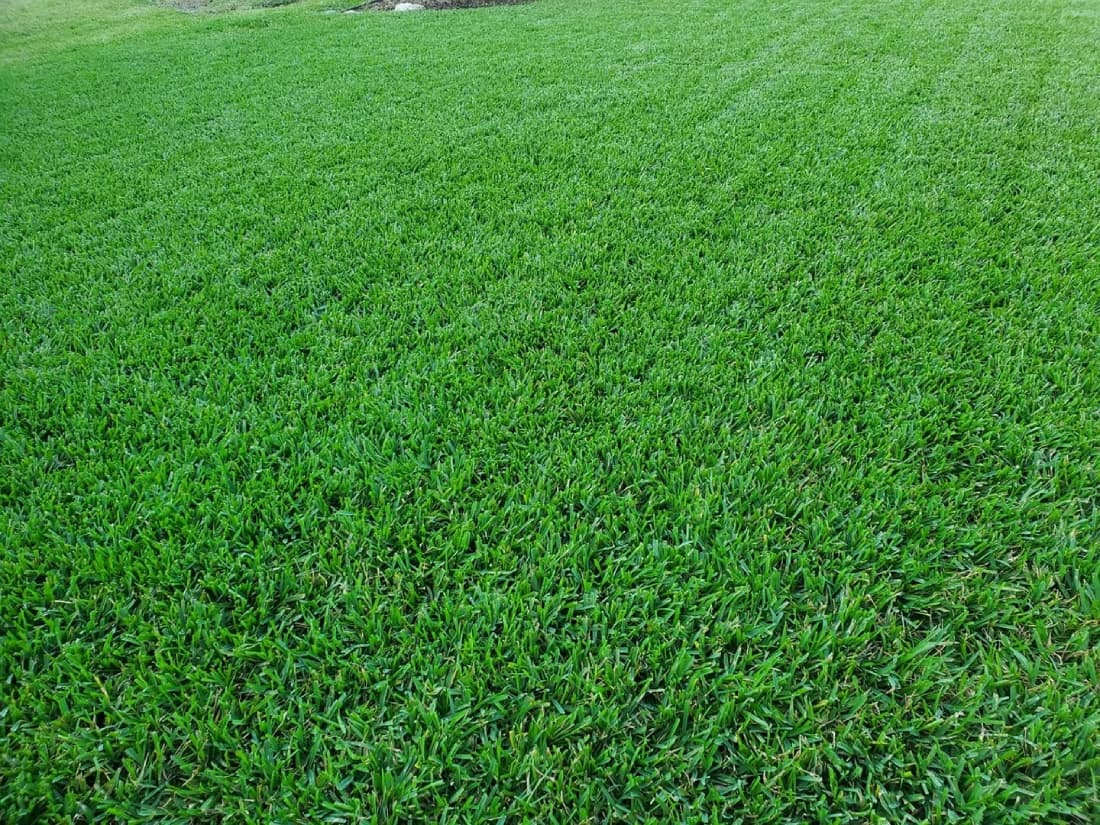
St. Augustinegrass At-a-Glance
Hardiness Zone Min
Zone 8
Water Requirement
High
Sun Requirement
Shade Tolerant
Wear Tolerance
Very Low
Establishment Speed
Fast
Labor Intensity
High
From Coastal Pioneer to Southern Lawn
St. Augustinegrass did not start out as a lawn grass. It started out as a beach plant. Its wild habitat is sandy shoreline, dune edge, and the brackish margin where a marsh meets a lagoon — open, salty ground where most plants fail and a fast-running surface stem is the winning strategy.
Where exactly it came from is honestly unsettled, and the universities do not agree. UF/IFAS says the coastal Gulf of Mexico and the Mediterranean. Auburn says the Gulf of Mexico and the Caribbean. NC State’s plant records say warm parts of Africa and South America along with the southeastern United States. What everyone agrees on is that it was already growing in the Carolinas before 1800 and that it is a coastal pioneer wherever it is native.
That beach history explains everything this grass does well and the one thing it cannot do at all. Salt does not bother it, because salt spray was normal where it evolved. Shade does not stop it, because its blade twists 90 degrees at the collar and lies flat to catch whatever light gets through a canopy. And a plant that evolved on frost-free coasts never needed a way to survive a hard freeze — so it never developed one.
The turf era began in 1973, when the University of Florida and Texas A&M jointly released ‘Floratam’. It was bred to solve two problems at once: the southern chinch bug and a virus called St. Augustine Decline. It worked, and ‘Floratam’ became the most widely planted lawn grass in Florida. Then it stopped working. By about 1985 a tougher biotype of chinch bug had overcome the resistance, and today ‘Floratam’ is fully susceptible. Decades later a second virus, sugarcane mosaic, moved into South Florida and now kills ‘Floratam’ outright.
That arc is worth understanding, because it is still the story of this grass. Since there is no seed, every lawn is a single clone. Plant one clone everywhere and eventually something catches up with it. It is why breeding programs at Florida, Texas A&M, and NC State are still working, and why the grass you buy today is a different plant from the one your parents bought.
Gallery
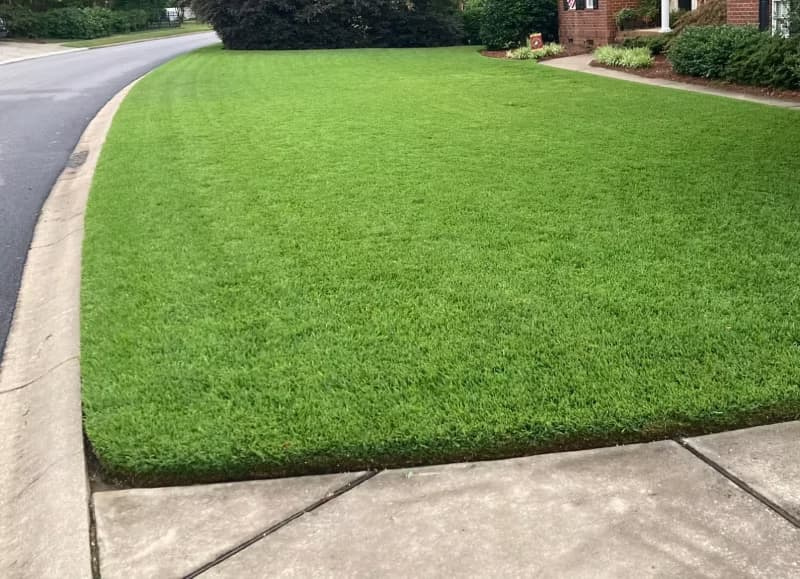
Front yard established with Palmetto St. Augustinegrass, known for its deep green color and high shade and cold tolerance.
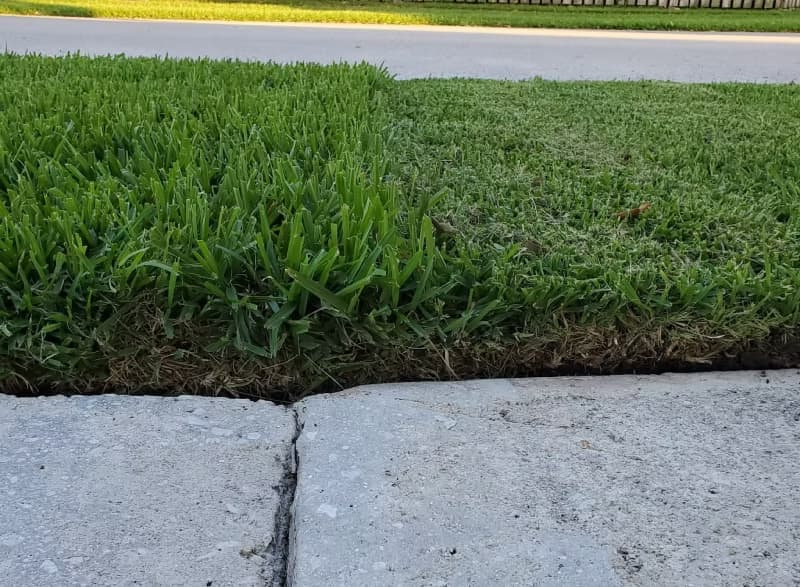
Direct profile view demonstrating how a taller mowing height preserves leaf tissue and root depth along concrete edges.
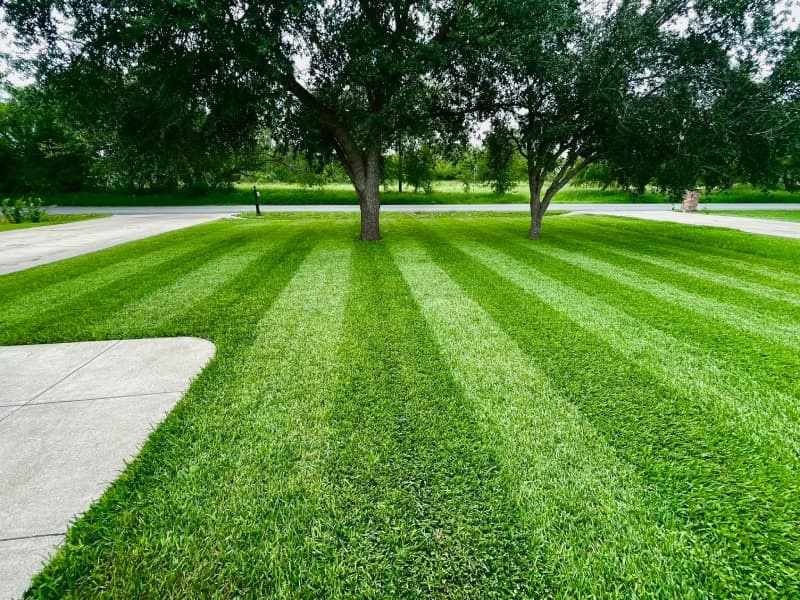
St. Augustinegrass performing under partial tree shade with distinct striping patterns.
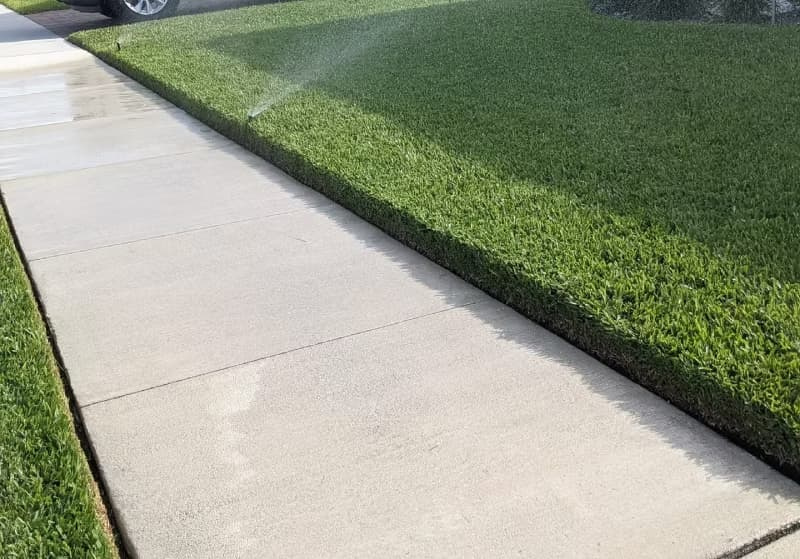
A clean, raised St. Augustinegrass border along hardscaping, showing dense canopy height and active irrigation.
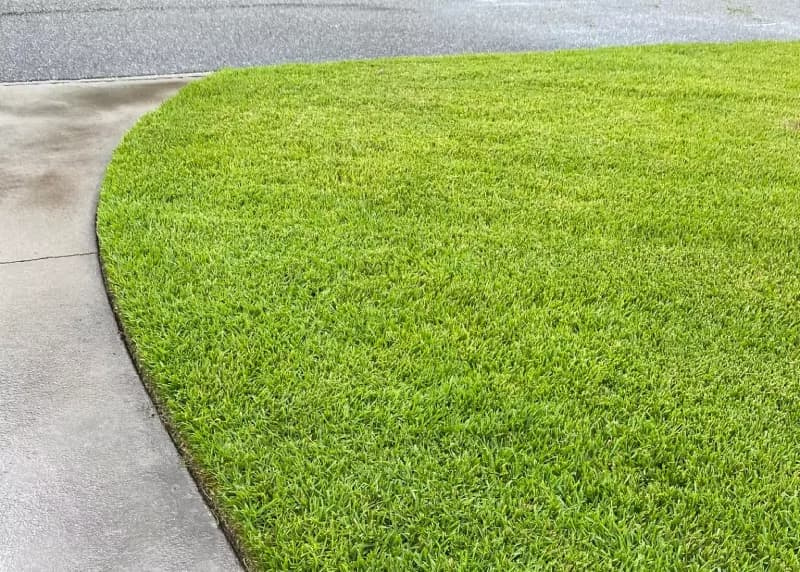
Cleanly edged St. Augustinegrass along a concrete curve, demonstrating its thick growth habit and sod density.
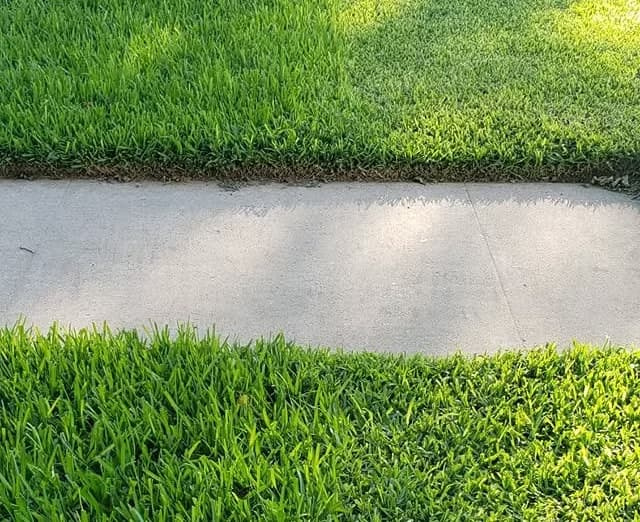
Side-by-side comparison showing the health and density benefits of maintaining St. Augustinegrass at a higher 3.5-inch mowing height versus an overly short 1.5-inch cut.
Telling It Apart
St. Augustinegrass has a distinctive fingerprint once you know where to look. The new leaves are folded in the bud, which makes the mature leaf sheath flat and compressed — squeeze a stem and it feels wide and flat, not round. Where the sheath meets the blade, the collar carries a 90-degree twist that turns the wide blade sideways so it lies flat. That twist is not a curiosity; it is why the grass is so shade-tolerant, because a horizontal blade catches the most possible light under a canopy.
The blade itself is very coarse and wide — NC State measures it at 0.16 to 0.4 inch across, the widest of any common lawn grass — with a blunt, rounded, boat-shaped tip. It spreads by thick aboveground runners only, with no underground stems at all, and carries its leaves in opposite pairs at each node. Healthy stands are a rich medium-to-dark green or blue-green. The seedhead, when it appears, is a single thick, chunky spike.
Two grasses get confused with it. Centipedegrass is also coarse and creeping, but its leaves grow alternately rather than in opposite pairs, come to a narrow point instead of a blunt boat tip, and the whole lawn is a lighter apple-green. Carpetgrass looks almost identical in wet ground, but it lacks the sharp collar twist, has tiny hairs along the leaf margins near the base, and throws a tall, crabgrass-like seedhead instead of a single thick spike.
One naming trap is worth knowing before you read advice from overseas. In Australia and South Africa this species is commonly sold as “buffalo grass,” and it is also called “carpet grass” in places. Neither name means what it means in the United States — American buffalograss is Bouteloua dactyloides, a completely different plains grass, and American carpetgrass is Axonopus. If a care guide sounds wrong for your lawn, check which grass the author actually means.
Identification Photos
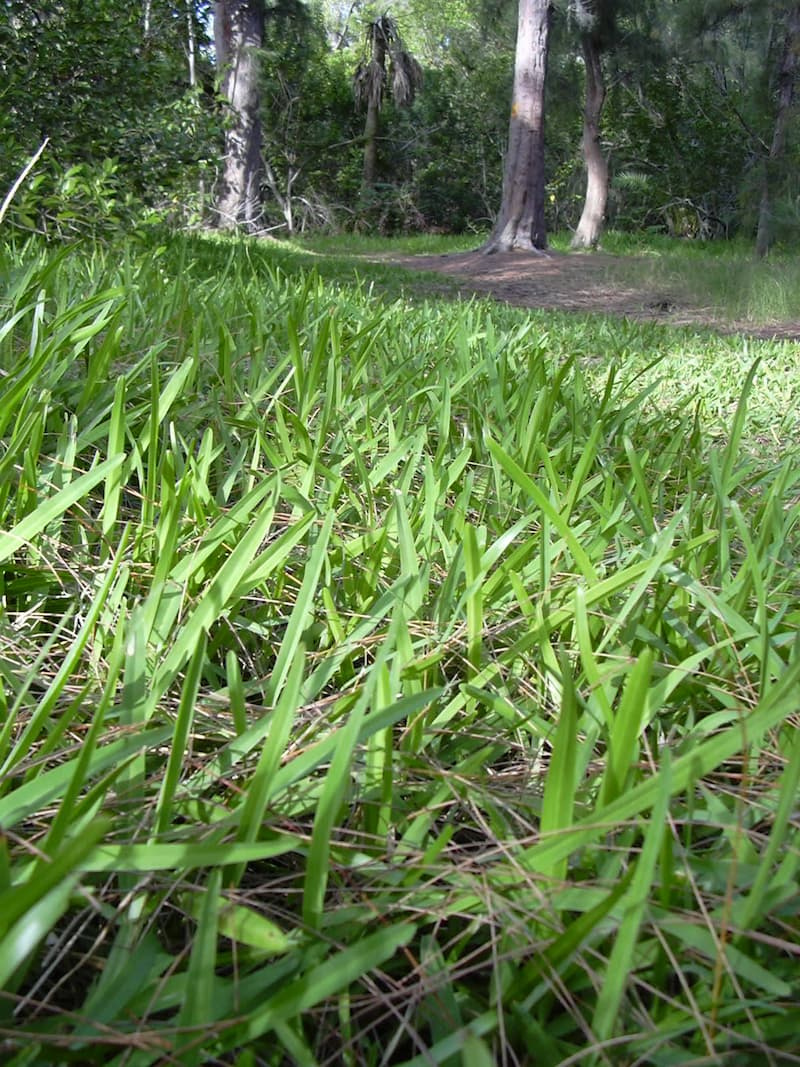
Look For: Broad, flat blades with blunt, rounded tips. They are wider and coarser than those of most other warm-season lawn grasses.
“Starr 031108-0098 Stenotaphrum secundatum” by Forest & Kim Starr is licensed under CC BY 3.0.
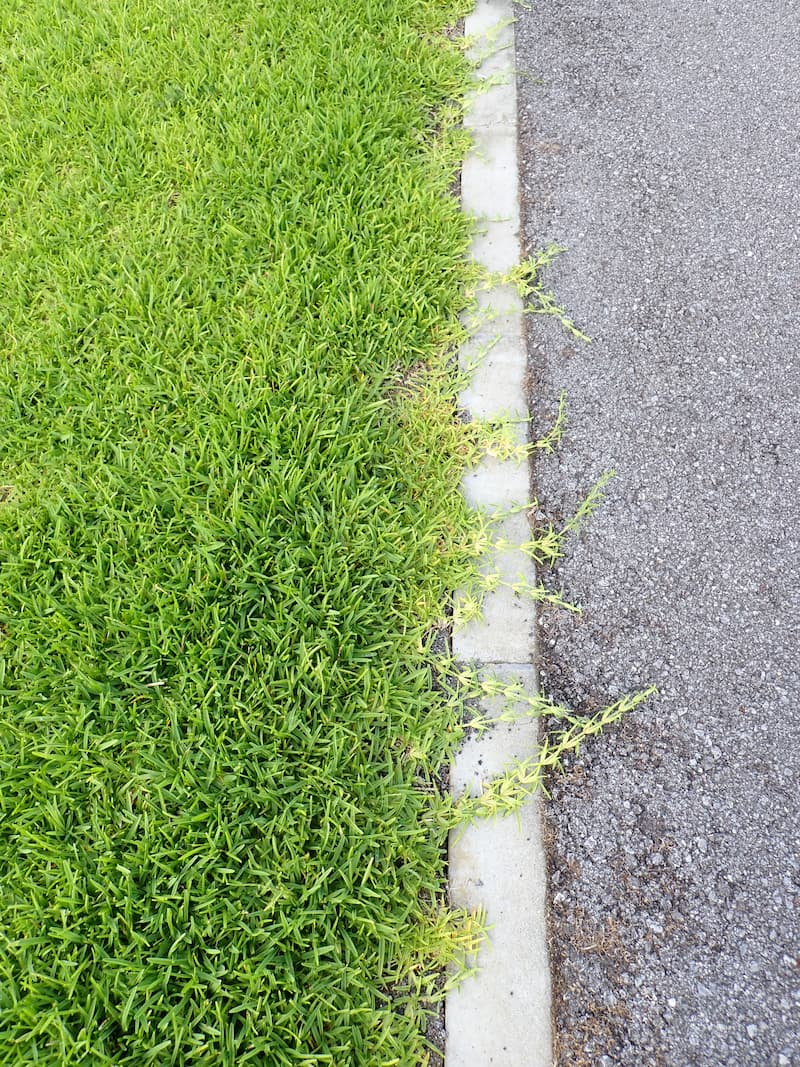
Key Identifier: Stolons that creep across hard edges. St. Augustinegrass spreads over curbs and pavement, which makes it easy to spot along lawn edges.
“Stenotaphrum secundatum stolon in Furusutobaru Castle ruins, Ishigaki, Okinawa” by M108t is licensed under CC BY 4.0.
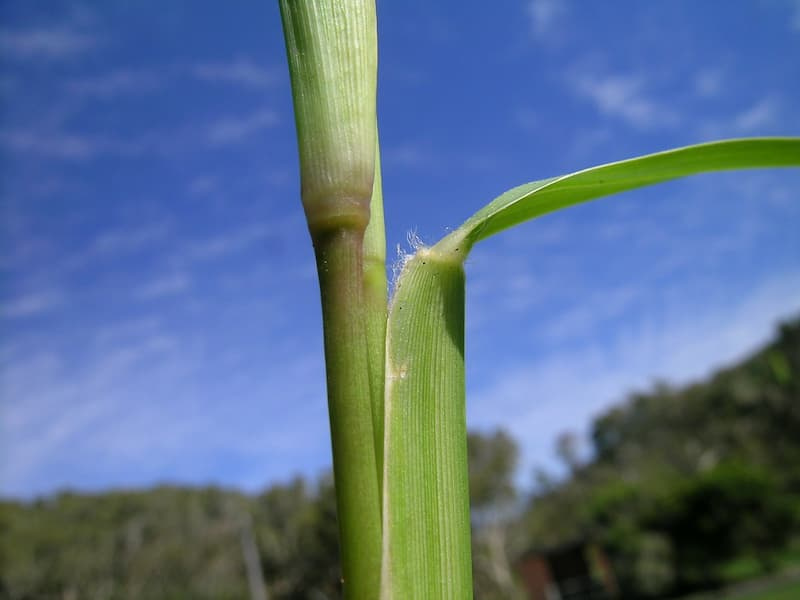
Look For: A flattened stem with a broad blade that angles away sharply at the node. These wide, angled blades set St. Augustinegrass apart from the narrower, more upright blades of centipedegrass.
“Stenotaphrum secundatum node1” by Macleay Grass Man is licensed under CC BY 2.0.
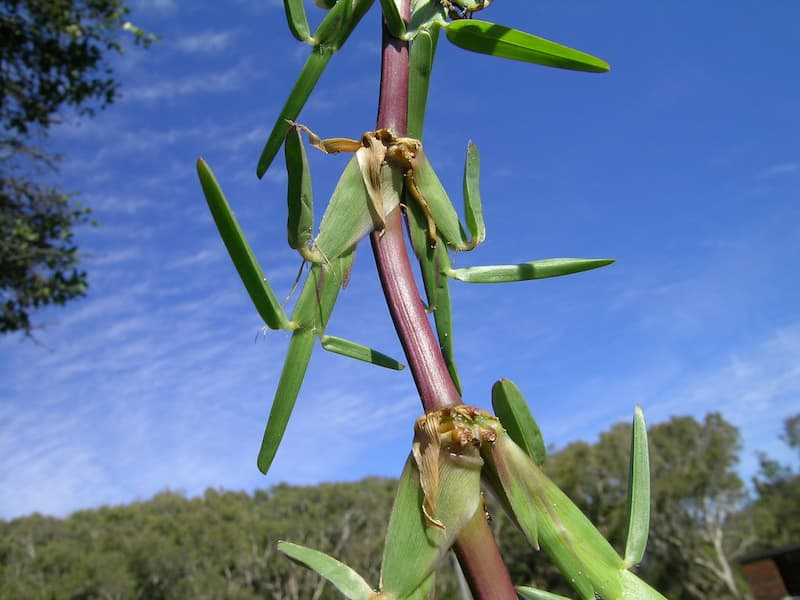
Diagnostic Feature: Thick, flattened stolons. St. Augustinegrass spreads by above-ground runners with short, wide blades at each node.
“Stenotaphrum secundatum stolon1” by Macleay Grass Man is licensed under CC BY 2.0.
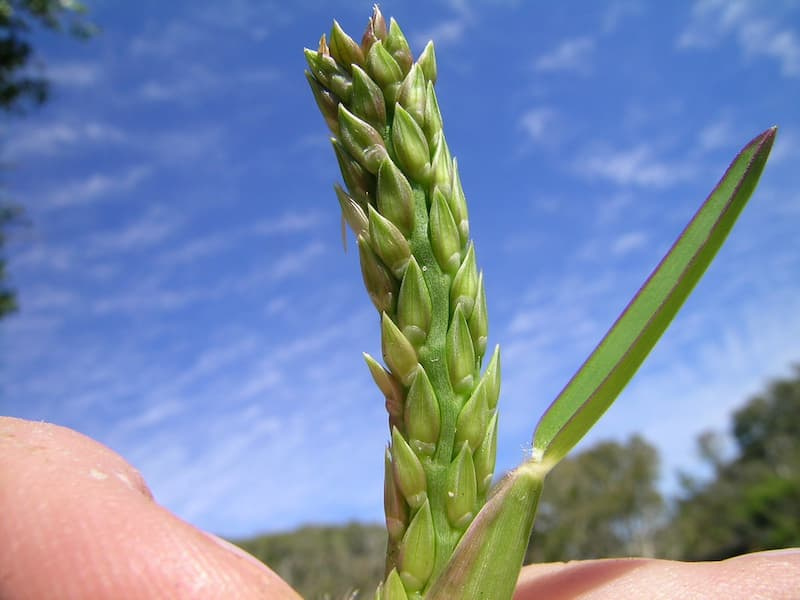
Diagnostic Feature: A thick, flattened seed spike. The spikelets sit in shallow pockets along a stout, flat stem.
“Stenotaphrum secundatum head2” by Macleay Grass Man is licensed under CC BY 2.0.
Is St. Augustinegrass Right For Your Yard?
Advantages:
The best shade tolerance of any warm-season lawn grass. Where bermudagrass thins out and dies under a tree canopy, this holds a stand on roughly 4 to 6 hours of direct or high-quality filtered light.
Excellent salt tolerance, second only to seashore paspalum among warm-season lawn grasses. It handles coastal salt spray and reclaimed irrigation water.
Fast, easy establishment. Sod pegs down in a couple of weeks and plugs close in 45 to 90 days, which is quick for a grass that can only be planted vegetatively.
A dense stolon mat that shades out weed seeds on its own, which matters a lot given how few herbicides are safe on it.
A thick, attractive blue-green lawn in exactly the warm, humid coastal conditions where many other grasses struggle.
Well adapted to a wide range of soils, from coastal sand to Gulf Coast clay, as long as drainage is decent.
Best If:
- You are in USDA Zone 8b through 10, on the Gulf or South Atlantic coastal plain, where hard freezes are rare.
- Your yard is shaded. If you have mature trees or structural shade and you want a warm-season lawn, this is the answer, and there is not a close second.
- You are near the coast and dealing with salt spray, or you irrigate with reclaimed water.
- You want ground covered quickly and are willing to pay for sod or wait a couple of months on plugs.
- The lawn is decorative rather than a play surface — you look at it more than you walk on it.
- You are prepared to mow weekly through summer and to watch the lawn closely rather than treating it on a schedule.
Disadvantages:
The least cold-hardy common warm-season grass. Near 10°F it does not go brown — it dies, and you resod.
No safe drought dormancy. Where bermudagrass browns out and waits, this wilts, browns, and dies. That makes it a poor fit anywhere watering restrictions bite.
Very poor wear tolerance and slow recovery. Every growing point is on the surface, so traffic destroys them, and there are no rhizomes to regrow from.
Narrow herbicide tolerance, and a prohibited list that includes several products that are standard on bermudagrass.
Heavy thatch production combined with the fact that you cannot dethatch it aggressively without killing it.
The coarsest texture of any common lawn grass, which some people simply do not like the look or feel of.
A single-clone lawn with no genetic diversity, which is why a new virus can take out a whole stand rather than thinning it.
High labor: mowing every 5 to 7 days in summer, constant thatch watching, and real vigilance about chinch bugs.
Avoid If:
- Winter temperatures in your area reach about 10°F, or you are north of the Dallas to central Mississippi to central North Carolina line. In Zone 8a it is a gamble even with a cold-hardy type.
- You face watering restrictions or want a lawn that survives on rainfall through a dry summer. With no safe dormancy, one bad drought is a dead lawn rather than a brown one.
- The lawn takes real traffic — kids, dogs running the same path, a backyard that doubles as a ball field. Wear tolerance is the worst on the roster and recovery is slow.
- You want a fine-textured lawn. This is the coarsest common turfgrass there is.
- You are not going to keep up with mowing. Missing a week here means scalping the next time, and scalping on a surface-crowned grass does real damage.
- Your soil stays wet through the growing season and you cannot fix the drainage.
Is It Safe for Pets and Kids?
No toxicity to pets, livestock, or people is documented for St. Augustinegrass in the extension sources used here, and it does not appear on toxic-plant lists; it has a history of use as pasture and forage. This is an explicit negative, not an unknown. The real pet issue on this grass is urine spotting, which is a salt and nitrogen burn, not a poisoning risk.
Where It Grows and Where It Fails
St. Augustinegrass is a coarse, fast-spreading warm-season grass built for the warm, humid South. Its home range runs the coastal plain and Gulf Coast from Texas east through the Carolinas to coastal Virginia. Where winters are mild, it makes a thick, blue-green lawn faster than almost anything else you can plant.
The wall it runs into is cold. This is the least cold-hardy of the common warm-season grasses, and that one fact draws its whole map. The reliable northern edge is USDA Zone 8b. When air and soil sit near 10°F for a few hours, the crowns and runners freeze and the lawn dies outright — not “goes brown,” but dies. The real boundary runs roughly from Dallas, through central Mississippi, to central North Carolina. North of that line it only hangs on in warm pockets: the southern third of Arkansas, warm coastal counties, or city neighborhoods where pavement and buildings hold enough heat to blunt the worst nights. Zone 8a is possible but it is a stretch, and it only works with a cold-hardy type.
Freeze damage arrives two different ways, and knowing which one you have tells you what to fix. In a winter thaw, dormant crowns soak up water; if the temperature then crashes, ice forms inside the cells and bursts them. That is why low, wet, poorly drained spots die first while the high ground comes through fine. Separately, dry winter wind pulls moisture out of the leaves faster than frozen soil can replace it, drying the plant to death. Both are worse on saturated soil, which means drainage matters here as much as the thermometer does.
Here is how it lines up against the five climate types.
Warm-Humid is home. It thrives — but the same heat and humidity that suit it also feed its fungal diseases, so this is where disease pressure runs highest.
Warm-Arid, meaning central and west Texas, is a stretch. It will grow, but only on steady irrigation. It cannot live on the rainfall there, and because it has no safe dormancy, a watering restriction in a bad summer is not an inconvenience — it is a dead lawn.
Transition is a toehold. It survives in mild coastal counties and warm urban microclimates, and even there a bad winter can take it out.
Cool-Humid and Cool-Arid are simply too cold. It will not make it through the winters.
What makes this grass worth the trouble is a niche no other warm-season grass fills. It handles dense shade and salty coastal air at the same time. A shaded, salt-sprayed yard under live oaks is exactly where St. Augustinegrass wins and where every one of its competitors fails. That is its entire reason for existing, and if your yard is not that yard, there is usually a better choice.
Getting Established
St. Augustinegrass is planted from living pieces of grass, never from seed. That is not a preference — usable seed does not exist. The plant makes very little viable seed, what it does make grows into off-type plants that do not match the parent, and nearly all modern named cultivars are patented clones that only stay true when grown from cuttings. So you establish it as sod or plugs.
Sod covers the ground instantly, stops erosion the same day, and pegs down within about 14 to 21 days. Do not mow it until it does — if you can lift a piece without real effort, the roots have not taken hold. Plugs are small chunks set 6 to 12 inches apart; they are much cheaper and take 45 to 90 days to close in, depending on spacing and warmth. UF/IFAS allows spacing out to 24 inches, but every extra inch buys you cost savings and pays for it in months of open ground and the weeds that move into it. Sprigs — bare runners — are the third technical option, and several extension programs do not recommend them for home lawns because they dry out so easily. For most yards, sod or plugs are the real choices.
Plant in late spring to early summer, roughly May through August. The reason is survival, not convenience. Planting into warm soil gives the grass several months to build roots and store energy before its first winter. A lawn planted late goes into the cold with shallow roots and often does not come back.
During grow-in, keep new plugs and sod damp with light, frequent watering for the first 10 to 14 days, then shift to deeper and less frequent watering to pull the roots downward. Hold off on nitrogen until the grass has rooted, about 30 to 60 days. An unrooted plant cannot use it, so early nitrogen just leaches past the roots and into the groundwater. And do not use weed preventers: pre-emergent herbicides stop root growth and can kill a new stand, so they wait a full year.
One establishment rule is unique to this grass. St. Augustinegrass is never blended or mixed. Because it cannot be grown from seed, there is no way to combine two types in one lawn the way you would blend fescues or mix bluegrass into a tall fescue stand — a lawn is one cloned cultivar of sod or plugs, full stop. That guarantees perfect visual uniformity, and it is also the grass’s structural weakness: a single-clone lawn has no internal genetic defense against a new pathogen. It is precisely why a sugarcane mosaic outbreak can take out an entire ‘Floratam’ lawn rather than thinning it. There is no mixing ratio to get right here; the whole decision is which single type you buy, and that decision belongs to the subtype pages.
Keeping It Healthy
Mowing. Cutting height depends on which type you have. Standard, coarse cultivars are mowed tall, about 3.5 to 4.0 inches. Dwarf and semi-dwarf types are mowed lower, around 2.0 to 2.5 inches. Recommendations vary a little by state — LSU runs Louisiana lawns at 2.5 to 3 inches and Texas A&M gives a 2 to 4 inch band — so treat the type you have as the guide and mow toward the top of its range. Never remove more than one-third of the blade at once. Scalping is especially dangerous on this grass, and the reason is anatomy: St. Augustinegrass keeps all of its growing points on top of the soil, on its runners. Cut into the runners and you cut out the plant’s ability to regrow, and a badly scalped lawn can die. Scalping is worst on bumpy ground, where the mower dips and shaves the high spots to bare dirt. Keep the blade sharp too — a dull blade shreds the tips, and the frayed, browning edges are open doors for disease.
Fertilizer. How much nitrogen depends on where you are and what your soil is. Sandy Florida soils leach and need more; heavier soils hold nutrients and need less. Roughly: North Florida 2 to 4, Central Florida 2 to 5, South Florida 4 to 6 because it grows nearly year-round, the Carolinas and Georgia 2 to 4, and the heavier soils of Arkansas and Louisiana capped at 3 pounds of nitrogen per 1,000 square feet per year. Texas A&M sets Texas at 1 to 4. Never lay down more than 1 pound in a single application, or half a pound from a quick-release source, because over-feeding sets off a chain reaction: a flush of soft growth builds thatch, thatch shelters chinch bugs, and the tender new leaves invite gray leaf spot and large patch. With this grass, more fertilizer is usually the cause of the problem, not the fix. Phosphorus and potassium should follow a soil test rather than a fixed ratio — and in Florida, phosphorus is restricted by rule. If the lawn yellows on high-pH soil, that is iron or manganese locked up by the pH, not a nitrogen shortage; correct it with a foliar iron spray, and do not answer it with more nitrogen.
Watering. In summer it wants about 1.0 to 1.25 inches of water a week. Water deeply and less often to send roots down; on sandy soil, split it into lighter, more frequent runs. Aim each application at roughly the top 8 inches of soil, because that is where the great majority of the roots actually are. This is where the grass has a real weakness. It is less drought-tough than bermudagrass, and — this is the key point — it does not go dormant safely. Bermudagrass can turn brown, wait out a drought, and green back up. St. Augustinegrass, pushed too far, wilts, browns, and dies, and you are buying sod. Watch for the warning signs: a dull blue-gray color, folded leaves, and footprints that stay pressed into the grass. Water before it crosses that line.
A note on rooting depth. You will see this grass sold on a “deep root system.” The measured extension guidance does not support it. UF/IFAS sets the irrigation rate specifically to wet the top 8 inches of soil, where the majority of the roots sit, and no extension source used here publishes a measured maximum rooting depth. Mow high and water deeply because those practices genuinely encourage what rooting the plant can manage — not because there is a deep root system down there waiting to save the lawn in a drought.
Thatch. This grass builds thatch fast, because its runners are high in a tough material that breaks down slowly. Here is the trap: you cannot rip thatch out of St. Augustinegrass the way you would with bermuda. Bermuda has underground stems and regrows after hard raking. St. Augustinegrass has none — its entire network sits on the surface, so aggressive power-raking slices up the runners and can kill the lawn. If you must dethatch, do it only in late spring or summer when the grass is growing hard, with the machine’s blades set wide (2 to 3 inches apart, versus 1 to 2 for bermuda), shallow, and running in one direction only. Crosswise passes shred it. Better still, lean on the gentler tools: core aeration to open the soil, and a thin ¼-inch topdressing of sand or compost, which feeds the soil microbes that eat thatch without cutting any runners.
Overseeding. Do not overseed dormant St. Augustinegrass with ryegrass for winter color. Extension programs warn against it specifically, and the reason is competition rather than looks. This is a poor competitor. The ryegrass shades it through winter and then fights it for water and light in spring, right when it is trying to wake up. The lawn thins and declines year over year. Take the tan winter, or use a colorant.
What Goes Wrong
Diseases. Three fungal diseases and two viruses matter, and the humid climate drives the fungal ones.
Gray leaf spot is worst in warm, wet summers on over-fed grass. It puts tan-to-gray oval spots with dark purple edges on the leaves, and a bad case looks like the whole lawn was scorched. Large patch shows up in the cool, wet shoulder seasons of spring and fall as expanding circles a foot to several feet across, often ringed in orange, with a soft rot at the base of the leaves so they pull off the runner easily and smell foul. Take-all root rot is sneakier and more serious: it rots the roots underground, favored by wet, alkaline, compacted soil, so by the time you see yellow thinning patches the roots are already black and short and the runners lift right off the soil. All three are managed first by not overwatering, not overfeeding, and watering early in the morning so the leaves dry fast.
The two viruses are different diseases and should not be confused. St. Augustine Decline, caused by Panicum mosaic virus, is the older Gulf Coast and Texas problem — a yellow mosaic mottling that thins the lawn over about three years. Sugarcane mosaic virus, which can progress to Lethal Viral Necrosis, is the newer South Florida epidemic that browns and kills ‘Floratam’ outright. Neither can be sprayed away; there is no cure for a plant virus. Both spread on contaminated mower blades and infected sod, so the defenses are resistant types, mowing only when the grass is dry, and disinfecting equipment between lawns.
Insects. The southern chinch bug is the pest of this grass, full stop. It clusters in the hottest, sunniest, driest spots — next to sidewalks and driveways — sucks fluid from the runners, and injects a toxin that clogs the plant, so the damage looks exactly like drought: irregular yellow-to-brown dead patches. One tell separates them. Chinch-damaged turf stays firmly rooted, because the roots are never touched. Behind chinch bugs come white grubs, which chew roots until the sod rolls up like carpet; tropical sod webworms, caterpillars that notch and window the leaves; and mole crickets, whose tunneling shears roots.
Nematodes. On sandy soils, especially in Florida, microscopic root-feeding nematodes are a real and under-diagnosed problem. The symptoms are frustrating precisely because they are not dramatic: a thin stand, weak growth, a shallow root system, and a lawn that is slow to perk up after rain or irrigation when it should bounce straight back. They cannot be identified by eye — it takes a lab test on a soil sample through your extension office. Treatment options for home lawns are limited and expensive, so the practical response is cultural: raise the mowing height, water less often but more deeply, and keep soil potassium adequate, all of which help the plant grow the roots it can.
Other problems. Winterkill is the number-one non-living threat. On alkaline soil above about pH 7.0 to 7.5, iron gets locked up and the grass yellows between the veins on its newest leaves — fix that with a foliar iron spray, not granular iron, which just binds in the soil. Scalping, thatch decline, and herbicide injury round out the list, and the herbicide sensitivity is serious enough to get its own section.
Telling look-alike problems apart. Because so many of these turn the grass yellow, the season and a couple of quick tests sort them out. Chinch bugs work in hot, dry summer and leave the roots anchored. Large patch works in cool, wet spring and fall, and its leaves slip off a rotted base. Take-all rots the roots so the runners lift off the soil, but the individual leaves do not slip off. Drought browns broadly and evenly and recovers after watering. Nematode damage is diffuse, chronic, and worst on sand, with no patch edge at all. When in doubt, pull at the edge of a patch and look at both the base of the leaves and the roots.
Weeds In This Grass
The thing to understand about controlling weeds in St. Augustinegrass is that its herbicide tolerance is narrow, and it is not the same as bermudagrass. Several products that are perfectly safe on bermuda will kill St. Augustinegrass. Check the grass before you reach for a product.
The workhorses are the triazines, atrazine and simazine, which control many broadleaf and grassy weeds and are absorbed through both roots and leaves. A few Group 2 products are also tolerated — metsulfuron, halosulfuron, and sulfosulfuron — and are the go-to for sedges and certain broadleaves. The synthetic-auxin three-way mixes (2,4-D, MCPP, dicamba) are rate-sensitive: they work, but only at the reduced rates labeled specifically for St. Augustinegrass, or they burn and curl it. Older uncertified “common” St. Augustinegrass is more sensitive still, and Alabama Extension says 2,4-D and MCPP should never go on it at all.
The prohibited list is where lawns die by accident. Quinclorac, MSMA and DSMA, sethoxydim, triclopyr, clethodim, fluazifop, trifloxysulfuron, and foramsulfuron are all injurious to lethal on standard St. Augustinegrass. Several of them — quinclorac, foramsulfuron, trifloxysulfuron — are exactly what you would safely use on bermuda, which is why borrowing a product from a neighbor is such a common way to lose a lawn.
Two timing rules protect the stand. First, heat: most of these products cause injury above roughly 85 to 90°F, so summer spraying is restricted. Second, age: no pre-emergent weed preventers on a stand less than a year old, because they stop the runners from rooting. Spring green-up is a third sensitive window, when the grass is putting out tender new growth and has the least tolerance to spare.
The best weed control is not chemical. A thick, correctly mowed and fertilized St. Augustinegrass lawn shades the soil and physically blocks weed seeds from sprouting. The dense stolon mat is the real defense, and thin, gappy turf is what lets weeds in. That is worth emphasizing here because the chemical options are so limited: grassy weed control in particular is largely a pre-emergent game, since there are few safe post-emergent choices.
For renovation, non-selective herbicides are used to clear an area before replanting, with a 10 to 14 day wait before laying new sod. One caution on product labels: the common “Roundup” brand name no longer reliably means glyphosate. If a renovation calls for glyphosate specifically, read the active-ingredient panel and confirm it. Do not assume the brand tells you what is inside.
Subtypes
Cold-Hardy St. Augustinegrass
The St. Augustines bred to survive winter at the northern edge of the range, where a standard variety dies outright.
Best For: Lawns in the Carolinas, northern Georgia and Alabama, central-to-northern Arkansas and inland Texas, where winter lows reach the teens every few years. Also for anyone in that band with a low, wet corner where cold air settles and the ground drains slowly.
Tradeoff: This buys about one hardiness zone, not immunity — with no underground stems to regrow from, a hard enough freeze still kills the whole lawn.
Drought-Tolerant St. Augustinegrass
The two that last longest without water, in a grass that dies rather than going dormant.
Best For: Open, full-sun yards on sandy soil across Florida and the Gulf South, especially where watering days are restricted. This is also the pick for a plain warm-season lawn with no shade, cold or virus problem to solve.
Tradeoff: Drought tolerance here means lasting longer before dying, not surviving — pushed past its limit this grass browns and dies rather than going dormant, and you resod.
Shade-Tolerant St. Augustinegrass
The cultivars that hold a dense lawn under a live oak, where the standard sun types stretch out and thin.
Best For: A yard under mature tree canopy or shaded by the house for much of the day, getting 4 to 6 hours of direct or bright filtered sun — ideally in the morning. Anywhere in the warm, humid South where hard freezes are rare.
Tradeoff: They build thatch faster than a standard St. Augustine, so annual aeration or light verticutting becomes a permanent job rather than a one-off.
Virus-Resistant St. Augustinegrass
The two replacements Florida extension recommends when lethal viral necrosis has killed a Floratam lawn — they get infected and survive it.
Best For: Southeastern Florida, Palm Beach County above all, plus Pinellas and the scattered other counties where sugarcane mosaic virus is confirmed. Anyone whose Floratam lawn is dying in expanding yellow-mottled patches, or whose neighbours' lawns are.
Tradeoff: Neither is immune — both catch the virus and simply survive it — and neither is a like-for-like swap for Floratam's maintenance.
The Seasonal Care Calendar

Spring (Mar-May)
Waiting Out a Slow Green-Up
Green-up is slow here and it runs on soil warmth, not the calendar — April along the warm coastal south, mid-May farther inland. Be patient. The most common spring mistake is fertilizing too early, before the grass is actively growing and before the roots can take anything up. Wait until the lawn has fully greened and you have mowed it at least twice. Feeding a half-awake lawn just feeds the weeds and risks pushing tender growth into a late frost.
Large patch is the spring disease, showing up in cool, wet weather as expanding circles with a soft rot at the leaf base. Fungicides are difficult and disappointing on it; drainage, air movement, and holding nitrogen down work better.
Spring green-up is also a sensitive window for herbicides. The new growth has little tolerance to spare, so if you are treating weeds, do it before green-up or wait until the stand has hardened off. And if you planted last year, remember the one-year rule: no pre-emergent on a stand under a year old.
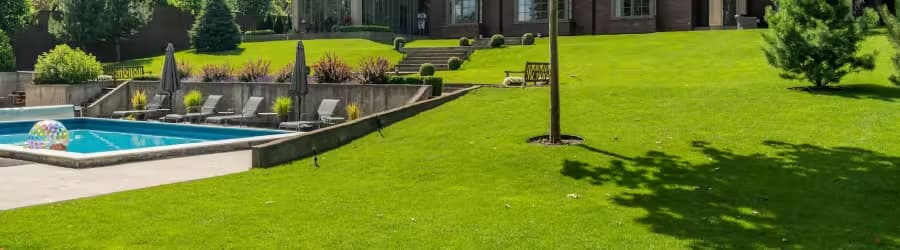
Summer (Jun-Aug)
Chinch Bug Season and Spray Limits
Summer is when this grass grows hard and when most of its problems arrive. Mow every 5 to 7 days at the top of the range for your type, and keep the blade sharp. This is the only safe window for dethatching or verticutting, because the grass has to be growing vigorously to recover from having its runners cut.
Watch the hot, dry, sunny strips along driveways and sidewalks — that is where chinch bugs start. The damage mimics drought, so use the root test: chinch-damaged turf stays firmly anchored. Resist the urge to feed a struggling summer lawn. Heavy nitrogen in the heat produces exactly the soft tissue that chinch bugs and gray leaf spot want.
Most herbicides are off the table above roughly 85 to 90°F, so summer is not a spray season. Water about 1.0 to 1.25 inches a week, deeply, and split it into lighter runs on sand. Watch for folded blades and lingering footprints, and get ahead of them — this is the grass that does not recover from being pushed too far.
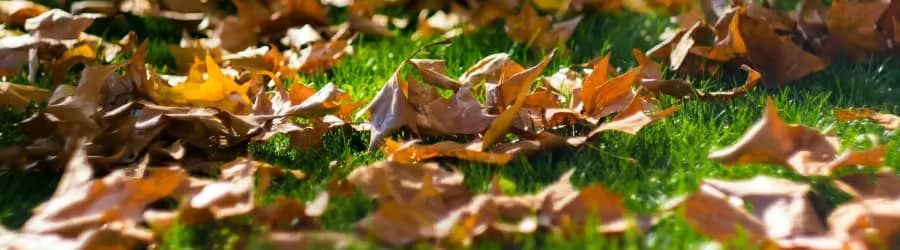
Fall (Sep-Nov)
Feeding Early Enough to Beat Frost
Fall is about setting the lawn up to survive winter, and the timing rule is the whole game: the last nitrogen application should go out at least 4 to 6 weeks before your area’s historic first frost. Clemson puts the cutoff at the end of August for South Carolina. Feed later than that and you push soft new growth into the exact weeks it is most likely to be frozen, which turns a routine winter into winterkill.
Large patch returns in the cool, wet weather of fall, on the same terms it appeared in spring. Keep nitrogen down and stop watering in the evening.
This is also the moment to fix drainage, because low, wet spots are where freeze damage will start. If a corner of the yard held water all summer, deal with it now rather than after the lawn dies there. And do not overseed with ryegrass for winter color — it shades the lawn all winter and then competes with it in spring, when the grass can least afford it.
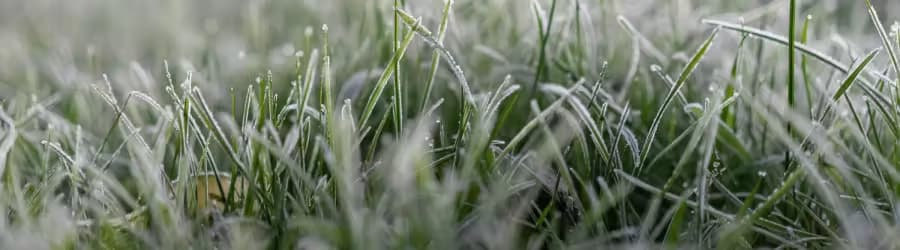
Winter (Dec-Feb)
Dormant, Exposed, and Easy to Lose
After the first hard frost, the grass drops its leaves and rests. At the cold edge of its range it goes fully dormant and turns a uniform tan. In frost-free South Florida it never really stops and stays green year-round. Either way, winter is when this lawn is most vulnerable, because dormancy here is not the protective shutdown that bermudagrass gets — it is just an exposed plant waiting out the cold.
There is little to do and that is mostly the point. Do not fertilize. Dormant grass does not need mowing. Do keep an eye on watering during warm, dry, windy stretches, because winter desiccation is a real killer: dry wind pulls moisture from the leaves faster than frozen or cold soil can replace it.
Keep traffic off dormant turf. With every growing point sitting on the surface and no active growth to repair damage, a winter path across the lawn can still be visible in June. If a freeze does hit, wait before doing anything. Do not judge the damage until green-up, and then test suspect patches by pulling at the edge — anchored, firm runners mean dormant; loose, hollow ones mean gone.
Choosing It Over Zoysia or Centipede
Against the other warm-season options, St. Augustinegrass sits at predictable ends of the scale, and the choice usually comes down to which trade you are willing to make.
Versus bermudagrass. Bermuda wins on wear, recovery, drought, and cold. It has rhizomes, so it regrows from below ground after traffic and heals its own damage. It also has a real drought dormancy — it browns out and comes back. St. Augustinegrass wins on exactly one thing, and it is decisive: bermuda needs full sun and will not hold a stand under a canopy. If your yard is shaded, bermuda is not an option and this is.
Versus zoysiagrass. Zoysia is finer-textured, takes more traffic, and is considerably more cold-hardy. It is moderately shade-tolerant but not in this grass’s league. The catch is establishment: zoysia plugs can take a full season or two to close, where St. Augustinegrass plugs close in 45 to 90 days. Zoysia is the better lawn if you can wait for it and your shade is light.
Versus centipedegrass. Centipede is the low-input choice — it wants roughly a third of the nitrogen and far less attention, which is its whole appeal. It is also less cold-hardy than zoysia, less shade-tolerant than St. Augustinegrass, and it declines if you over-manage it. If your yard is sunny, your soil is acidic, and you want to do less, centipede is the better answer.
Versus bahiagrass. Bahia is tougher, cheaper, drought-hardier, and can be seeded, which none of these can. It is also coarse, open, and light green, and it throws tall seedheads constantly. It is a functional cover, not a showpiece lawn.
The short version: pick St. Augustinegrass for shade and salt in a mild-winter coastal climate. If you do not have shade or salt, one of the others is almost certainly a better fit, because you would be taking on the poorest cold-hardiness, the poorest wear tolerance, and no safe drought dormancy in exchange for advantages you are not using.
Find Your Precision Match
Choosing between species requires balancing your specific soil profile, local micro-climate, and maintenance goals. Use our Turf Match Tool to generate a data-backed recommendation for your specific yard.
Start Your MatchTechnical Specifications
Scientific Name: Stenotaphrum secundatum
Common Names: St. Augustinegrass, St. Augustine grass, Charleston grass, shore grass, quickgrass, mission grass, pimento grass
Family: Poaceae (grass family), subfamily Panicoideae, genus Stenotaphrum, tribe Paniceae.
Origin: A coastal pioneer of sandy beaches, dune edges, and brackish marsh margins around the warm Atlantic. The original native range is genuinely unsettled and extension sources differ: UF/IFAS says the coastal regions of the Gulf of Mexico and the Mediterranean; Alabama Extension says the Gulf of Mexico and the Caribbean; the NC State Extension Gardener Plant Toolbox says warm regions of Africa and South America as well as the southeastern United States. It was recorded in the Carolinas before 1800.
Season Type: Warm-Season
Growth Habit: Stoloniferous
Growth Rate: Fast
Texture: Very Coarse
Root System Depth: Most of the root mass sits in the top 8 inches of soil; UF/IFAS sets its irrigation rate (½ to ¾ inch per application) specifically to wet that top 8 inches, "where the majority of the roots are."
Spread Mechanism Intensity: Aggressive surface stolons only. NC State records rhizomes as absent. Runners creep across the soil surface and root at each node, which is why the grass closes ground fast, climbs over walks and into beds, and yet cannot regenerate from below ground once the surface is destroyed. Every growing point is exposed.
Typical Lifespan & Invasiveness Risk: Long-lived perennial. A lawn is a single clone that persists indefinitely as a spreading mat, so there is no stand-replacement cycle the way a short-lived cool-season grass has one. Within the yard the nuisance is edge creep, not weediness: stolons run into beds, over walks, and up curbing, and need edging rather than herbicide.
Hardiness Zone Min: Zone 8
Hardiness Zone Max: Zone 10
Hardiness Zone Notes: Ideal band is Zone 8b through 10. Zone 8a is a stretch that survives but struggles, and only with a cold-hardy cultivar. The species floor is roughly 10°F: at that air and soil temperature, held for a few hours, crowns and runners freeze and the lawn dies outright rather than browning and recovering. The practical northern boundary runs Dallas, through central Mississippi, to central North Carolina, with warm pockets holding on north of it in southern Arkansas, warm coastal counties, and urban heat islands. Two separate freeze mechanisms matter and both are worse on wet ground. First, crowns take up water during a winter thaw and burst when the temperature crashes, which is why low, poorly drained spots die first — drainage is as much a hardiness question here as the thermometer. Second, dry winter wind pulls moisture from leaves faster than frozen soil can replace it and desiccates the plant. Note that the ACF Select carries whole zones only, so the 8a versus 8b distinction that actually decides survival lives in this field.
Cold Tolerance Rating: Very Low
Winter Color Profile: Dormant
Climate Cool Humid: Unsuitable
Climate Cool Arid: Unsuitable
Climate Warm Humid: Excellent
Climate Warm Arid: Poor
Climate Transition: Poor
Sun Requirement: Shade Tolerant
Shade Tolerance: High
Water Requirement: High
Drought Survival Strategy: No Safe Dormancy (declines/dies)
Soil Texture Fit:
Sand
Loamy Sand
Sandy Loam
Loam
Silt Loam
Clay Loam
Clay
pH Optimal Min: 6
pH Optimal Max: 7.5
pH Stress Max: 7.5
Wet Feet Tolerance: Low
Compaction Tolerance: Low
Salinity Tolerance: High
Wear Tolerance: Very Low
Recovery: Low
Recovery Mechanism: Stolons
Input Intensity: Moderate
Labor Intensity: High
Thatch Production: High
Annual N Figure: Roughly 1 to 6 lb N per 1,000 sq ft per year, set by region and soil rather than by preference. Most of the Gulf and coastal Southeast lands at 2 to 4. North Florida 2 to 4, Central Florida 2 to 5, South Florida 4 to 6 because it grows nearly year-round. Heavy Arkansas and Louisiana soils cap at 3. Texas A&M states 1 to 4 for Texas. Never apply more than 1 lb N per 1,000 sq ft in a single application, or ½ lb from a quick-release source. Florida's Urban Turf Fertilization Rule sets a higher legal ceiling (up to 2 lb N with at least 65 percent controlled release, and no more than 0.7 lb soluble N at once), so the 1 lb figure is a recommended practice sitting inside the legal limit, not the limit itself.
Urine Resistance: Low
Establishment Methods:
Sod
Plugs
Germination Speed: Vegetative only (no seed)
Establishment Speed: Fast
Improved Cultivar Availability: High
NTEP Note: Two negative guardrails belong to the species, not to a subtype: first, buy certified named sod (Blue Tag) rather than generic uncertified "common," which carries weeds, is prone to St. Augustine Decline, and is unusually sensitive to 2,4-D and MCPP; second, treat any chinch-bug resistance claim as temporary — 'Floratam' was released in 1973 with documented resistance and had lost it to a new bug biotype by 1985.
Deep Dives & Practical Guides
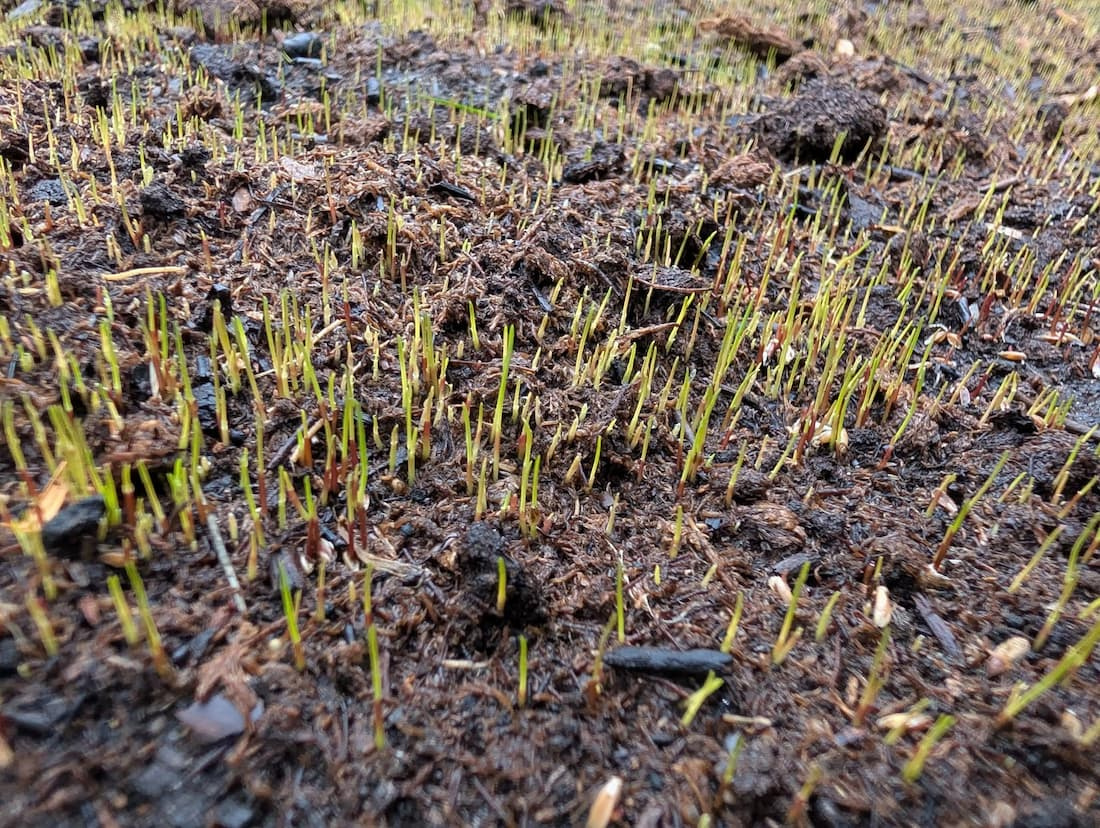
How to Establish a New Lawn From Bare Soil to First Mow
Bare soil doesn't turn into a lawn just because you scattered seed or rolled out sod — it becomes one based on a handful of specific steps done in the right order, matched to your specific grass. This guide walks through soil prep, seeding or planting method, starter fertilizer, watering as the grass grows, and knowing when it's actually safe to mow, for both cool-season and warm-season lawns.
Read Article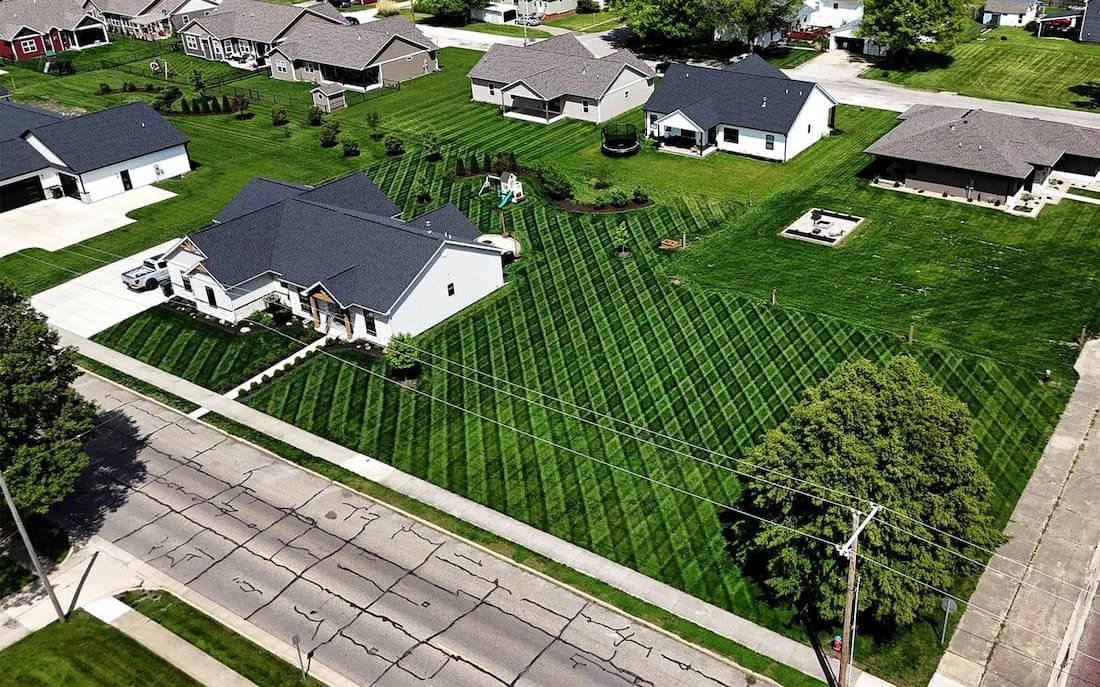
Cool Season vs Warm Season Lawn and Landscape Guide
Your lawn and your flower beds don't follow the same calendar — one runs on a cool-season engine, the other on a warm-season one, and using the wrong playbook on either can do real damage. This guide helps you figure out which system you actually have and how to care for it correctly, plus how the same cool/warm split applies to your ornamental beds.
Read Article
The Hole You Dug Is Killing Your New Plants
A shrub that looked fine all summer and stalled the next year usually didn't fail because of the plant, the weather, or the nursery. It failed because the hole it went into was a container — smooth-walled, water-holding, and impossible to root out of.
Read Article
What You Can Actually Change About Bad Soil
Heavy clay and loose sand feel like permanent sentences, and half of that is true. What your soil is made of will not change. How those particles are arranged will — and that is the half that decides whether anything grows.
Read Article
Why Your Plants Survive Winter and Die in July
Your hardiness zone is built from one number — the coldest night of an average year. It says nothing about the hottest afternoon, which is what actually kills most plants people lose. Here's how to read the other half of the map.
Read Article
Why Poa Annua Keeps Coming Back — and the 3-Year Plan That Finally Ends the Cycle
You've pulled it. You've sprayed it. You've watched the little white seedheads mock you every single spring. And every fall, like clockwork, it's back — in the lawn, in the beds, in the cracks you didn't know you had. Here's the hard truth nobody at the big-box store will tell you: you're not losing because you're doing it wrong — you're losing because you're fighting the wrong enemy on the wrong timeline. Poa annua isn't a one-season problem, and once you understand why, the three-year plan below stops feeling like a chore and starts feeling like a countdown.
Read Article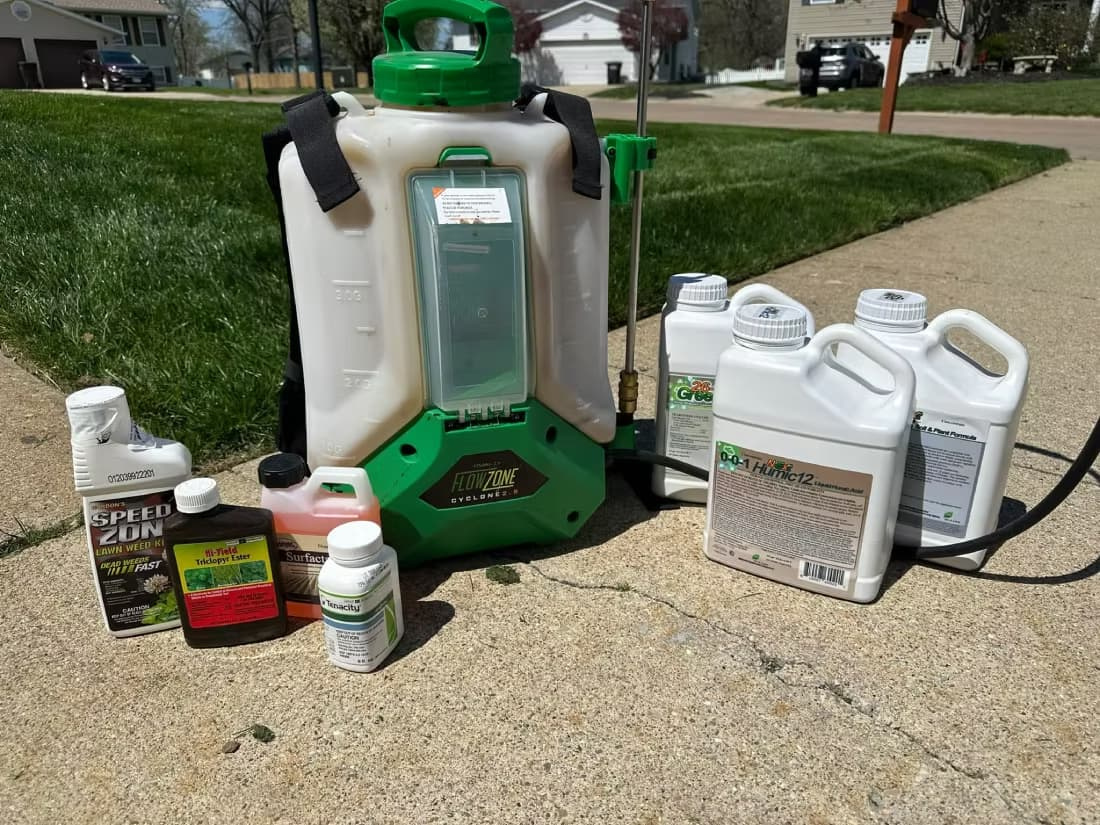
How to Apply Herbicides Correctly in Your Lawn and Garden Beds
Getting real results from a weed product has almost nothing to do with the brand on the bottle and everything to do with matching the method to the moment — the right chemistry, in the right place, at the right time. Learn how to apply herbicides correctly across both your lawn and your garden beds, whether you’re stopping weeds before they sprout or killing the ones already growing, without wasting product or harming the plants you want to keep.
Read Article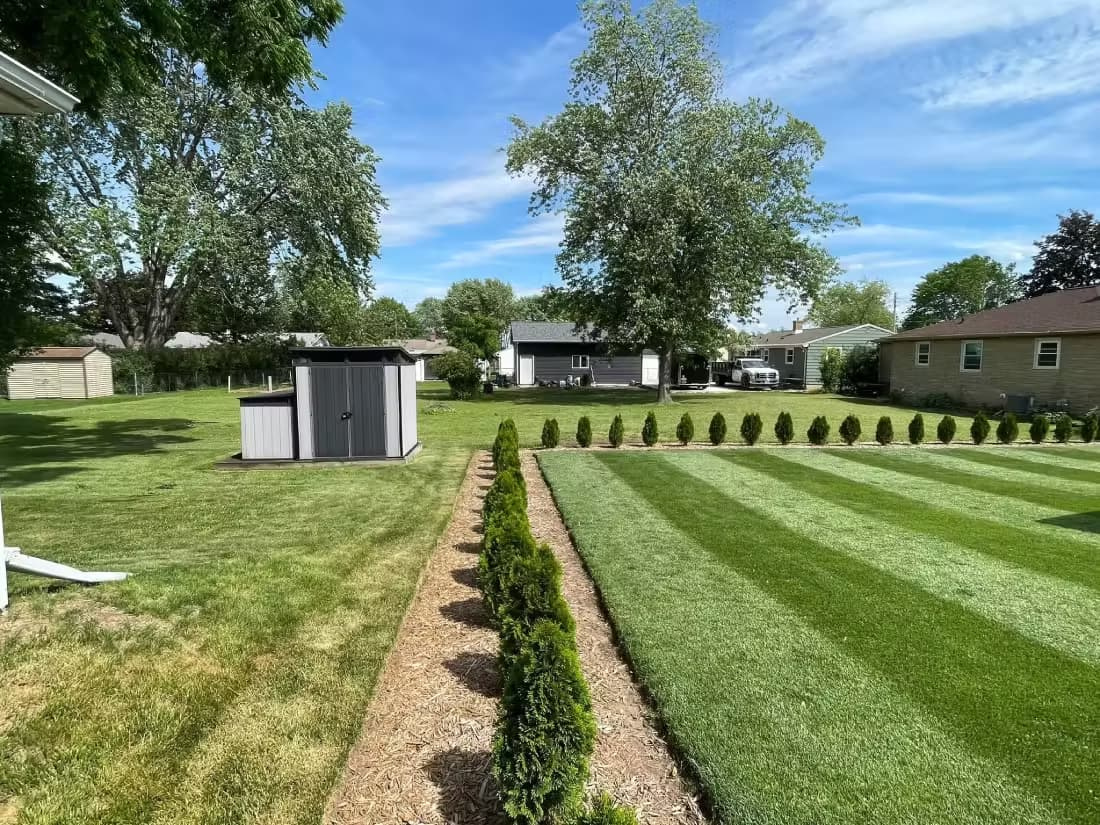
How to Kill Weeds Where Two Lawns Meet Without Harming Your Neighbor’s Grass
Controlling weeds along a shared property line is where good intentions quietly backfire—the season that's safe for your own lawn is often the season the lawn next door is most easily harmed. Learn the seasonal timing collision behind most fence-line damage, and the two habits that prevent it—reading what's actually in the bottle and spraying directed instead of broadcast—so you can clear the weeds without hurting your grass, your neighbor's, or the peace between you.
Read Article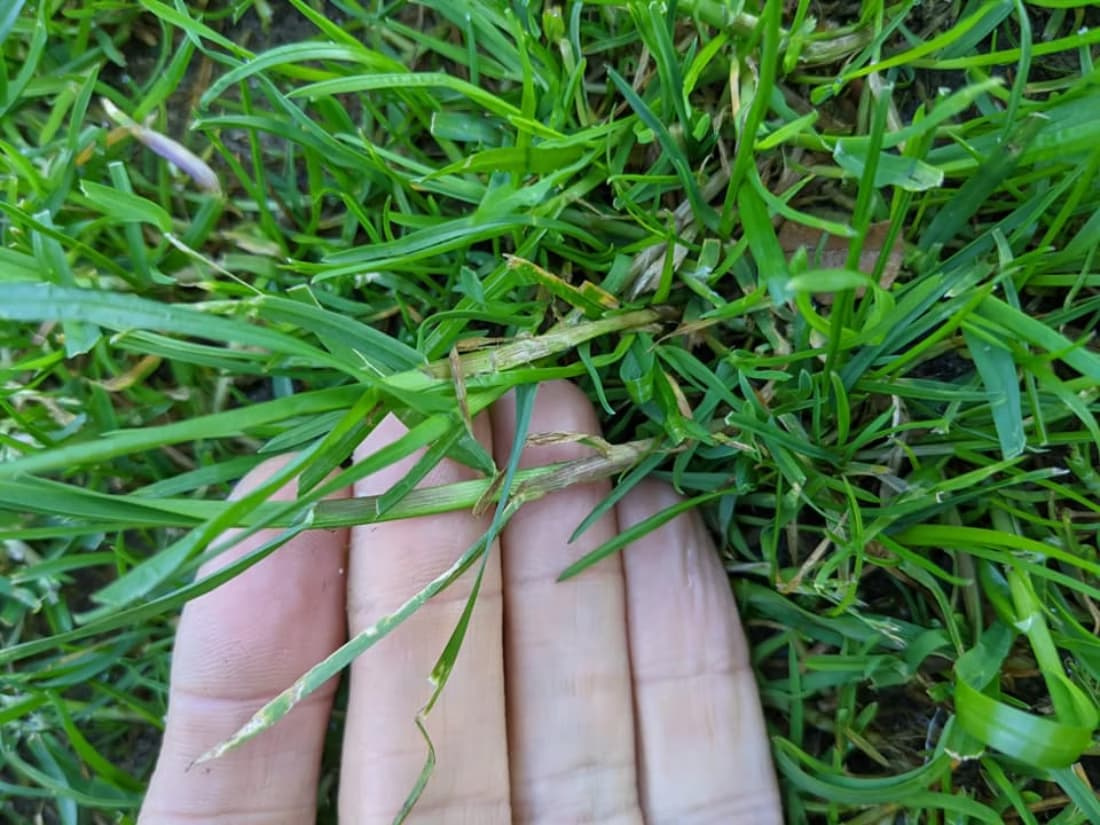
The Truth About One-and-Done Weed Control
Most homeowners lose the fight against weeds not because they work too little, but because they act before they understand. One-and-done weed control is real — but it only works when identification, timing, and the right tool all line up. This guide explains how that sequence works across your lawn and your ornamental beds, and how each weed page in the MFY hub puts it into practice for your specific invader.
Read Article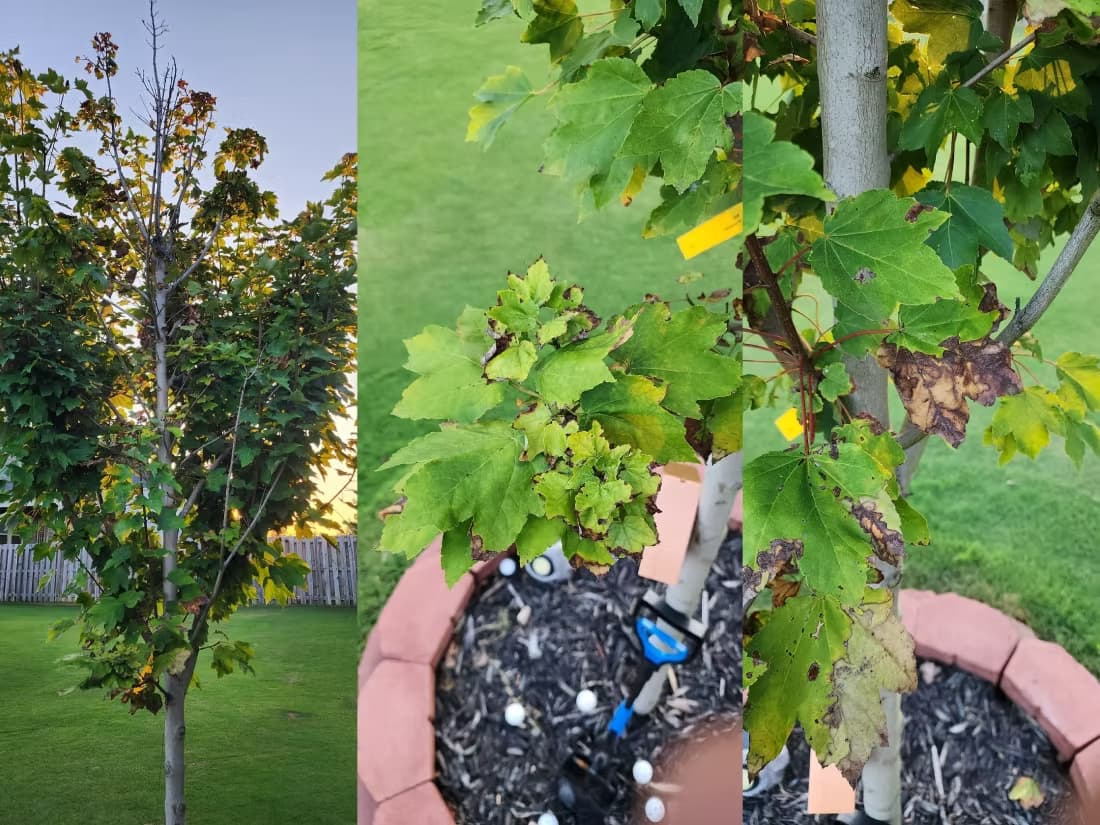
Solving the Mystery of the False Evidence in Your Lawn and Landscape
A brown leaf or a yellowing lawn is rarely what it seems. When symptoms act as decoys, a calm, forensic approach brings clarity to the confusion. Learn how to look past the surface to find the quiet truth of what your plants are truly asking for.
Read Article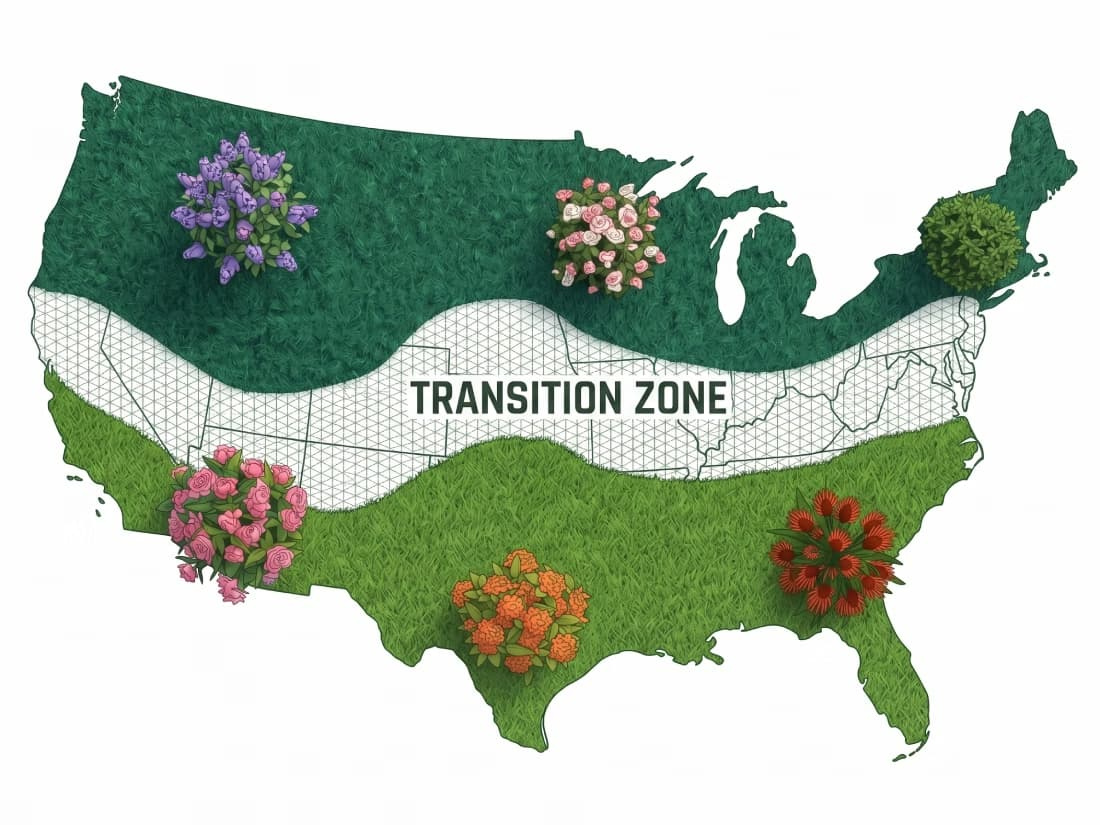
Living in the Middle: The Deep-Dive Guide to Transition Zone Lawns and Landscapes
The Transition Zone is a biological tug-of-war where neither northern nor southern species perfectly adapt. By using resilient "bridge" species and mastering maintenance levers like the Mowing Pivot, you can transform a struggling yard into a healthy landscape.
Read Article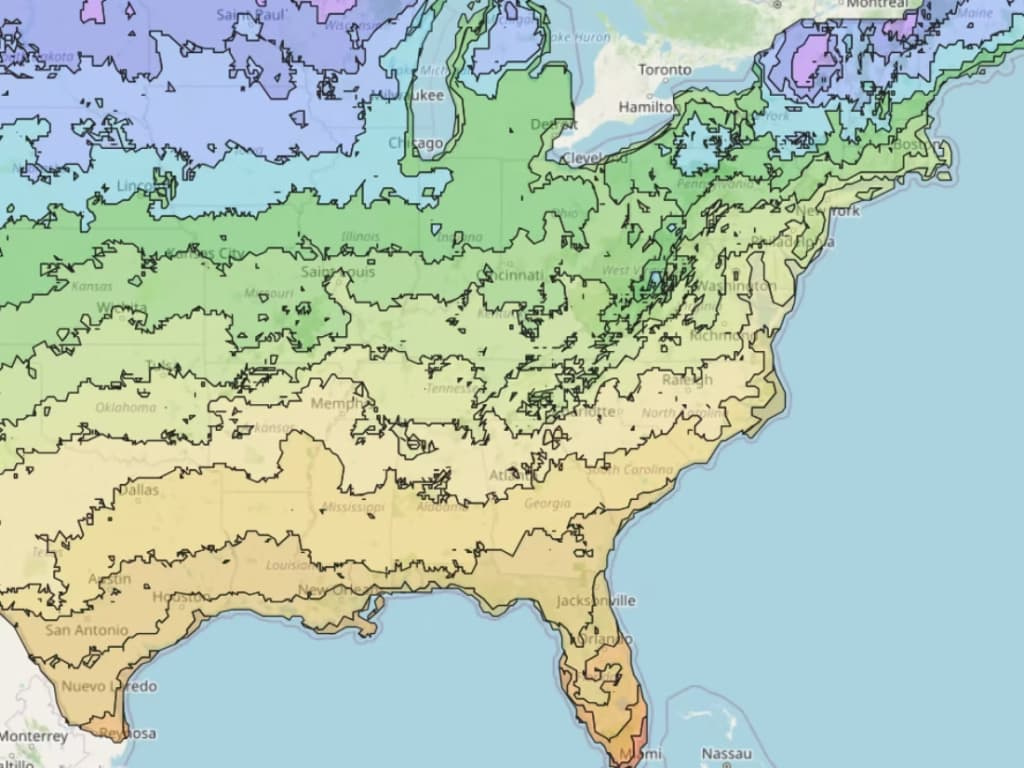
What Your Hardiness Zone Really Means for Your Lawn and Plants
Uncover the foundation of a resilient landscape by mastering the science of hardiness zones. Learn how these climate boundaries are calculated and why understanding your local temperature limits is the first step toward choosing plants that thrive year after year.
Read ArticleFrequently Asked Questions
Our maintenance and establishment guidance is derived from long-term agronomic field studies and turfgrass performance data from top research institutions.
Probably not. This is the single most expensive misunderstanding about this grass. Bermudagrass has a real dormancy: it can turn brown, shut down, wait out a drought, and green back up from underground stems. St. Augustinegrass has no underground stems and no safe dormancy. Pushed past its limit it wilts, browns, and dies, and the only fix is new sod. Watch for the warning signs and water before it crosses the line: a dull blue-gray cast, leaf blades folding in half, and footprints that stay pressed into the lawn instead of springing back.
Pull at the edge of a bare patch. Dormant grass still has firm, pale runners anchored to the soil with white roots; you have to tug. Dead grass lifts away with no resistance and the runners are brown and hollow. Freeze kill is patchy by design, because it hits low, wet, poorly drained spots first — meltwater soaks into the crowns, then refreezes and bursts the cells. If the high, dry parts of the lawn came through and the low corner did not, that is winterkill, and the low corner needs drainage before it needs sod.
No, and doing it is one of the common ways homeowners kill this lawn. Bermuda regrows from underground stems after a hard raking. St. Augustinegrass has none — its whole network sits on the surface, so aggressive power-raking slices up the runners and takes the plant with them. If thatch genuinely needs removing, do it only in late spring or summer when the grass is growing hard, with the blades set wide (2 to 3 inches apart, versus 1 to 2 for bermuda), shallow, and in one direction only. Better still, lean on core aeration and a thin ¼-inch topdressing of sand or compost, which feeds the microbes that eat thatch without cutting anything.
Check the label first, every time. This grass has a narrow herbicide tolerance and it is not the same as bermudagrass. Quinclorac, MSMA and DSMA, sethoxydim, triclopyr, clethodim, fluazifop, trifloxysulfuron, and foramsulfuron all run from injurious to lethal on standard St. Augustinegrass — and several of those are exactly what a bermuda lawn would use safely. Borrowing a product across the fence is one of the most common ways this grass gets killed by accident.
No. Extension programs specifically warn against it for this species, and the reason is competition rather than cosmetics. St. Augustinegrass is a poor competitor. Ryegrass shades it through winter, then fights it for water and light in spring at exactly the moment it is trying to wake up. The lawn thins and declines year over year. Accept the tan winter, or use a turf colorant if the look matters.
Almost certainly the opposite. With this grass, more fertilizer is usually the cause rather than the fix. A heavy nitrogen push produces a flush of soft growth; soft growth builds thatch; thatch shelters chinch bugs; and the tender new leaves are what gray leaf spot and large patch infect. Get the annual total right for your region, split it into applications of 1 lb N per 1,000 sq ft or less, and fix the watering before reaching for the bag.
Treat that claim as temporary. ‘Floratam’ was released in 1973 with University of Florida-documented chinch bug resistance and it worked — until about 1985, when a tougher biotype of the bug overcame it. Today ‘Floratam’ is fully susceptible. No cultivar’s chinch resistance has held up permanently, which is why cultural control matters no matter what you plant: do not over-fertilize, because the soft tissue that heavy nitrogen produces is exactly what the bugs feed on.
Scientific Authority
This profile is grounded in turfgrass agronomy and soil science. Every recommendation—from irrigation requirements to nutrient management—is verified against agricultural research data to ensure optimal plant health and environmental sustainability in the Transition Zone.
Primary Resources
- UF/IFAS Extension: St. Augustinegrass for Florida Lawns (ENH5/LH010)[cite: 1]
- Texas A&M AgriLife Extension: St. Augustinegrass Lawn Management (EHT-144)[cite: 2]
- LSU AgCenter: St. Augustinegrass Profile[cite: 3]
- NC State Extension TurfFiles: St. Augustinegrass Profile[cite: 4]
- Clemson Cooperative Extension: St. Augustinegrass (HGIC 1211)[cite: 5]
- Clemson Cooperative Extension: St. Augustinegrass Yearly Maintenance Program (HGIC 1218)[cite: 6]
- Clemson Cooperative Extension: Managing Weeds in Warm-Season Lawns (HGIC 2310)[cite: 7]
- Alabama Cooperative Extension System: St. Augustinegrass Lawns (ANR-0262)
- University of Arkansas Cooperative Extension Service: Lawn Care Calendar: St. Augustinegrass (FSA-6119)
- National Turfgrass Evaluation Program (NTEP): National St. Augustinegrass Test Data
- UF/IFAS Extension: Mosaic Disease of St. Augustinegrass Caused by Sugarcane Mosaic Virus (PP313)
- University of Hawaii CTAHR: Salt and Wind Tolerance of Landscape Plants for Hawai’i (L-13)
- NC State Extension Gardener Plant Toolbox: Stenotaphrum secundatum Profile