
Scientific Name: Paspalum notatum Flüggé. Accepted varieties: var. saurae (diploid; the Pensacola / cold-hardy line) and var. notatum (tetraploid; the Argentine and common lines)
Common Names: Bahiagrass, bahia grass, bahia, highwaygrass, Pensacola bahia, Argentine bahia
Bahiagrass
Unmatched drought survival on poor, sandy, acidic ground, paid for in coarse texture and constant seedhead mowing.
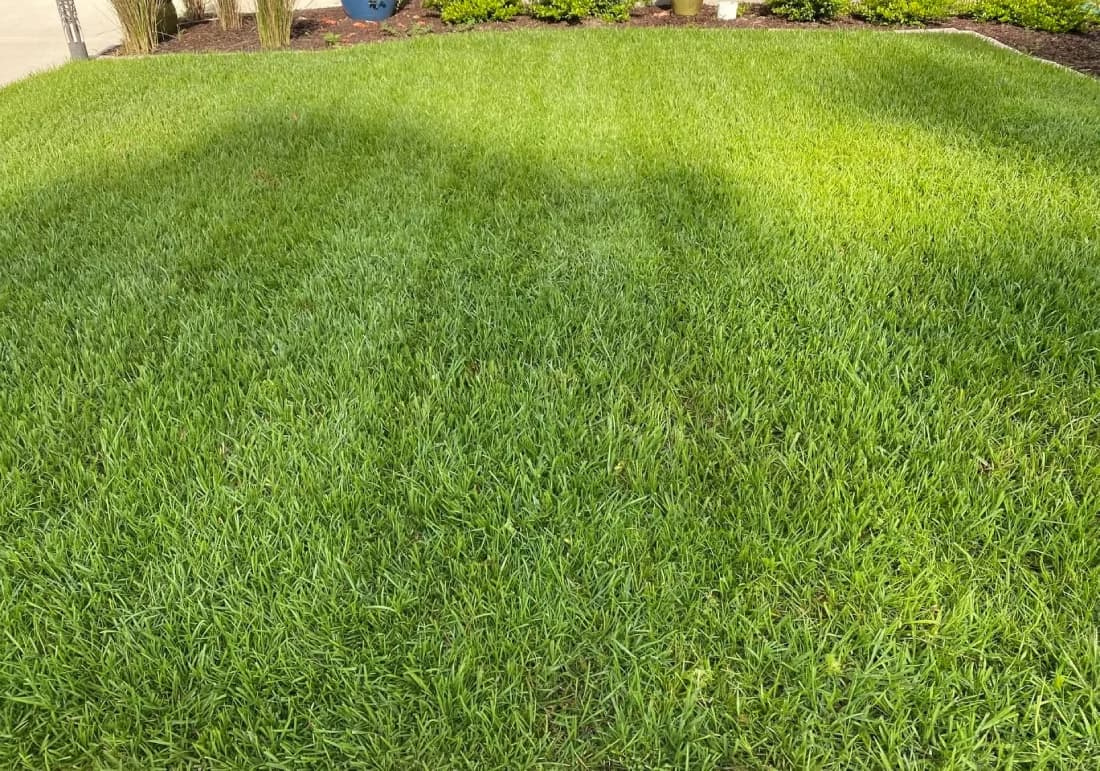
Bahiagrass At-a-Glance
Hardiness Zone Min
Zone 7
Water Requirement
Low
Sun Requirement
Full Sun (6+ hrs direct)
Wear Tolerance
Moderate
Establishment Speed
Slow
Labor Intensity
Moderate
From Ship Ballast To Southern Lawns
Bahiagrass never set out to be a lawn. It came to Florida in 1913 from South America, where it grows wild across northern Argentina, Brazil, Bolivia, Paraguay and Uruguay, and it was brought here to feed cattle on sandy ground that could not support much else. Almost everything that makes it a strange lawn grass — the open canopy, the coarse blades, the seedheads that never stop — is left over from that job. A pasture grass is supposed to make seed. A lawn grass is not.
That first introduction, sold as Common bahiagrass, was slow to establish, cold-sensitive and not very productive. It is no longer planted, and it is the one bahiagrass you should not buy for a lawn.
The grass that actually took over the South arrived by accident. Sometime before 1935, a South American bahiagrass came into Florida in ship ballast dumped at the Pensacola docks. In 1935 a county extension agent named Ed Finlayson found it growing in the streets and vacant lots around the port, recognized that it was tougher and more cold-hardy than what Florida was planting, and it went into production as Pensacola bahiagrass. It became the most widely planted bahiagrass in the United States. A second selection was brought in from Argentina in 1944 with wider, darker leaves and fewer seedheads later in the season — which is exactly why the sod trade preferred it.
Those two introductions are still the whole story, and they are not different species. They are the same plant split by ploidy, meaning how many copies of each chromosome the plant carries. The Pensacola line is diploid and reproduces sexually, so a bag of seed is genetically variable and the lawn comes up slightly uneven. The Argentine line is tetraploid and apomictic, meaning its seed is effectively a clone of the parent, which is why it grows in uniform. One difference in how the plant reproduces explains most of what you see in the finished lawn.
Breeding since then has been aimed at cattle, not lawns. Tifton 9, released by the Georgia Coastal Plain Experiment Station in the late 1980s, was selected for seedling vigor and forage yield, and a later selection from it went after the hard-seed problem that makes bahiagrass so slow to come up. Good work — but the target was pounds of beef per acre. No one has ever run a national turf trial on bahiagrass. That absence is the most important fact about shopping for it, and it is why this page can tell you which type to plant while no honest source can rank cultivars for lawn quality.
Gallery
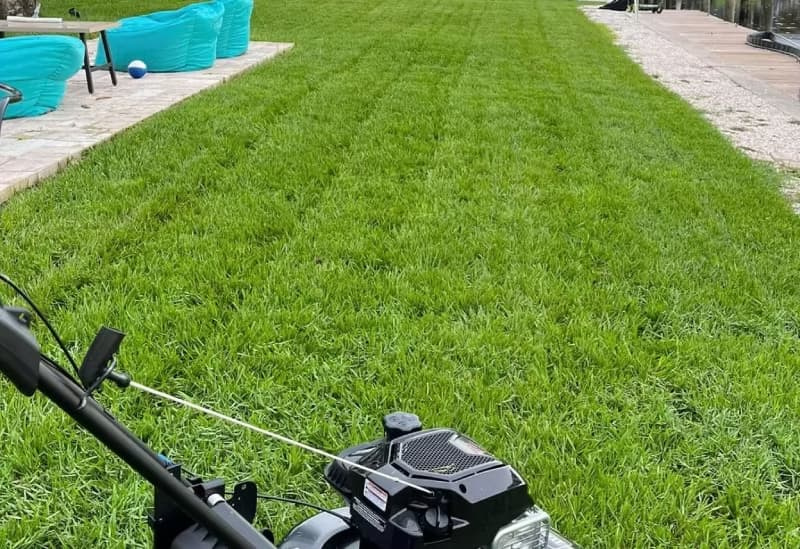
Rotary lawn mower maintaining a bahiagrass lawn, illustrating the frequent high-cut mowing required to suppress its rapid seedhead production.
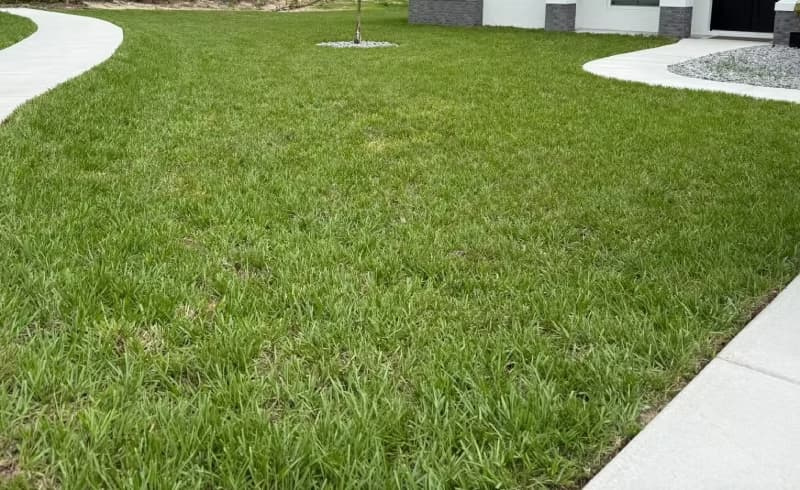
Bahiagrass (Paspalum notatum) established from sod in a residential front yard, showing its open canopy habit framed by concrete walkways.
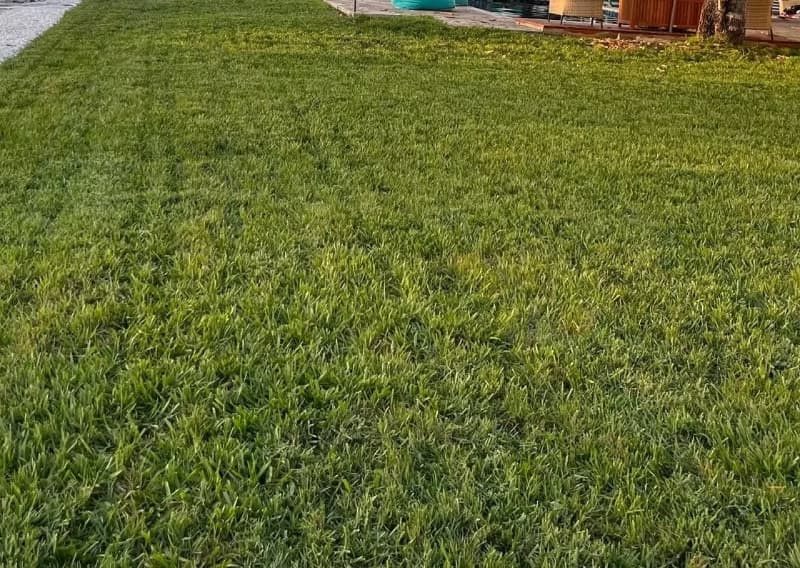
Bahiagrass established in a central Florida residential yard, highlighting its coarse leaf blade texture, open growth habit, and strong adaptation to poor, sandy soils.
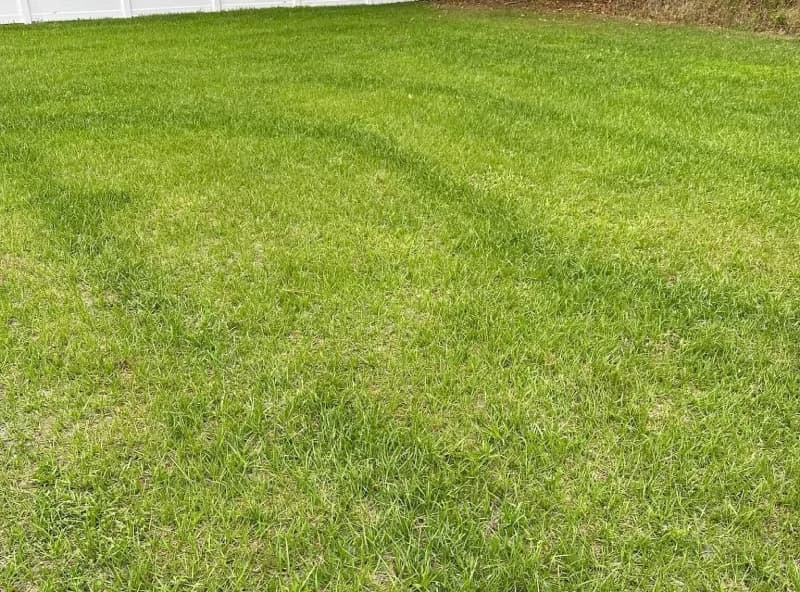
Uneven green-up and surge growth in bahiagrass following fertilizer application, highlighting its quick response to nitrogen availability.
Telling It Apart
Once bahiagrass flowers it is one of the easiest grasses to identify, because of one unmistakable feature.
The seedhead is the giveaway. In summer bahiagrass sends up tall, erect stalks topped by a bipartite raceme — exactly two spikes forking from the top in a V or Y shape, lined with double rows of tiny dark seeds. Nothing else common looks quite like it. A third branch is not normal. If you count three or more spikes, you are looking at a different grass, usually dallisgrass or goosegrass.
Before it flowers, work the vegetative characters. Vernation is rolled, though the blade can flatten and read as folded. The ligule is membranous with a fringe of white hairs on the back. There are no auricles. The leaf sheath is flattened and glossy, often tinged pink to purple at the base. Blades are coarse and light green, with fine hairs along the margins near the base. Underneath, the plant runs thick, woody, J-shaped rhizomes that form a tough mat, and Mississippi State flags the purplish color of those rhizomes as a useful marker.
Bahiagrass has no true aboveground stolons, and this trips up more than just homeowners. The rhizomes often run right at the soil surface, so they look like stolons, and some extension publications describe the grass as stoloniferous on that basis. Treat it as a rhizome grass with surface-running rhizomes — that is what UF/IFAS and USDA-NRCS describe, and it is what explains the plant’s slow lateral spread. One more minor disagreement worth knowing about: UF/IFAS describes the collar as divided, NC State as continuous and hairy, so treat the collar as a supporting clue rather than a decider.
One correction to a claim you will read elsewhere. Bahiagrass is genuinely coarse, but not because the blade is unusually wide. USDA-NRCS measures the blade at an eighth to a quarter inch, which is the same band as tall fescue. What actually makes it feel and look coarse is the combination of an open canopy that never closes, a fibrous blade that frays instead of cutting cleanly, and seed stalks standing above the leaf line most of the summer. If you are choosing on texture, that is the thing to picture — not blade width.
The one look-alike that really matters is dallisgrass, a cousin in the same genus with overlapping range. Separate them on growth habit and seedhead. Dallisgrass grows as a loose, upright bunch with no thick rhizomes, and its seedhead carries three to six spikes arising at different points along a central stem, drooping as they age — against bahiagrass’s clean twin fork off a single point. A secondary and much rarer confusion is thin paspalum, which has glossier young leaves and a looser, multi-spikelet seedhead.
Spotting bahiagrass invading another lawn. In bermudagrass it stands out as much coarser-bladed, with tall seedheads shooting above the low turf. In St. Augustinegrass, bahiagrass lacks the thick aboveground stolons, the boat-shaped leaf tips and the twisted collar. In centipedegrass, bahiagrass grows faster, runs robust rhizomes, and has a hairy-backed rather than cottony ligule.
Identification Photos
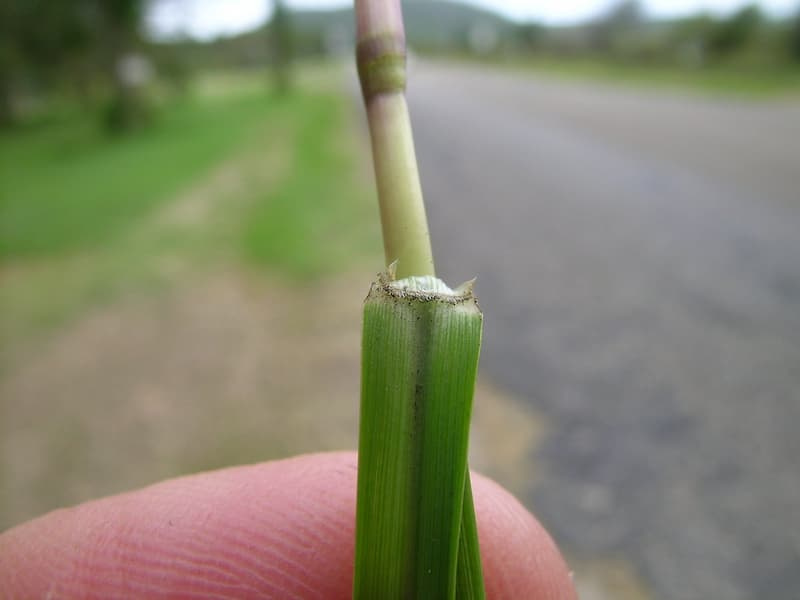
Look For: A very short, membranous ligule at the collar and a flattened sheath. It is small, so a hand lens helps.
“Paspalum notatum ligule1” by Macleay Grass Man is licensed under CC BY 2.0.
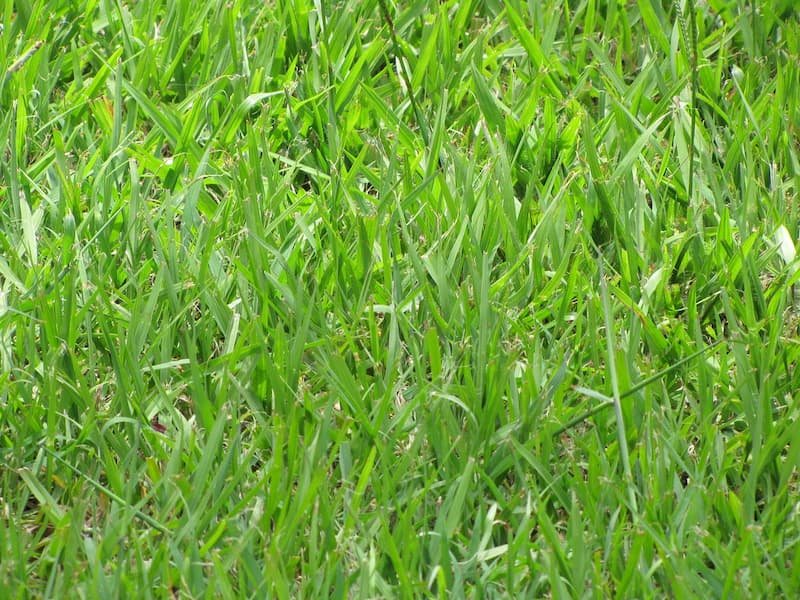
Key Identifier: A coarse, open, light green turf that looks stemmy up close. Bahiagrass blades are wide and flat.
“starr-090828-4772-Paspalum_notatum-in_lawn-MISC_Piiholo-Maui” by Starr Environmental is licensed under CC BY 2.0.
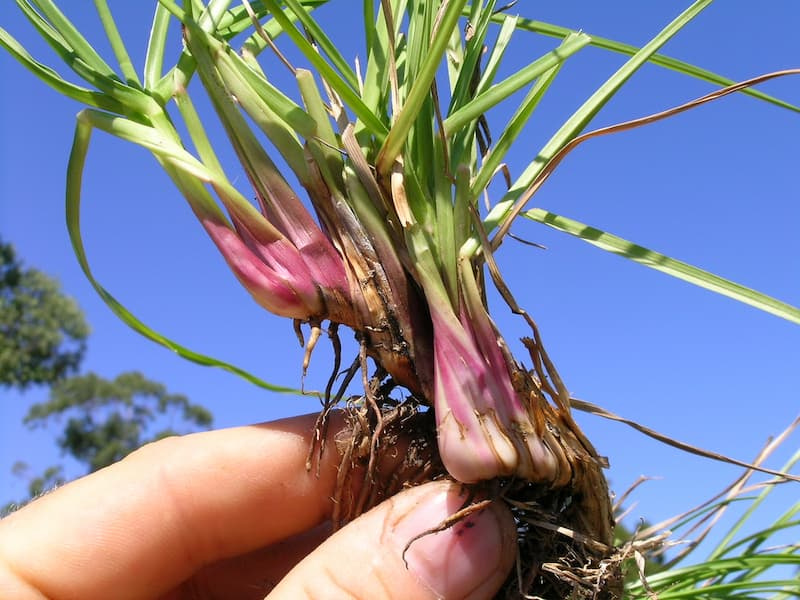
Look For: A thick, stubby rhizome with purple-tinged leaf sheaths at the base. Bahiagrass has short, thick rhizomes rather than long runners.
“Paspalum notatum stem base3” by Macleay Grass Man is licensed under CC BY 2.0.
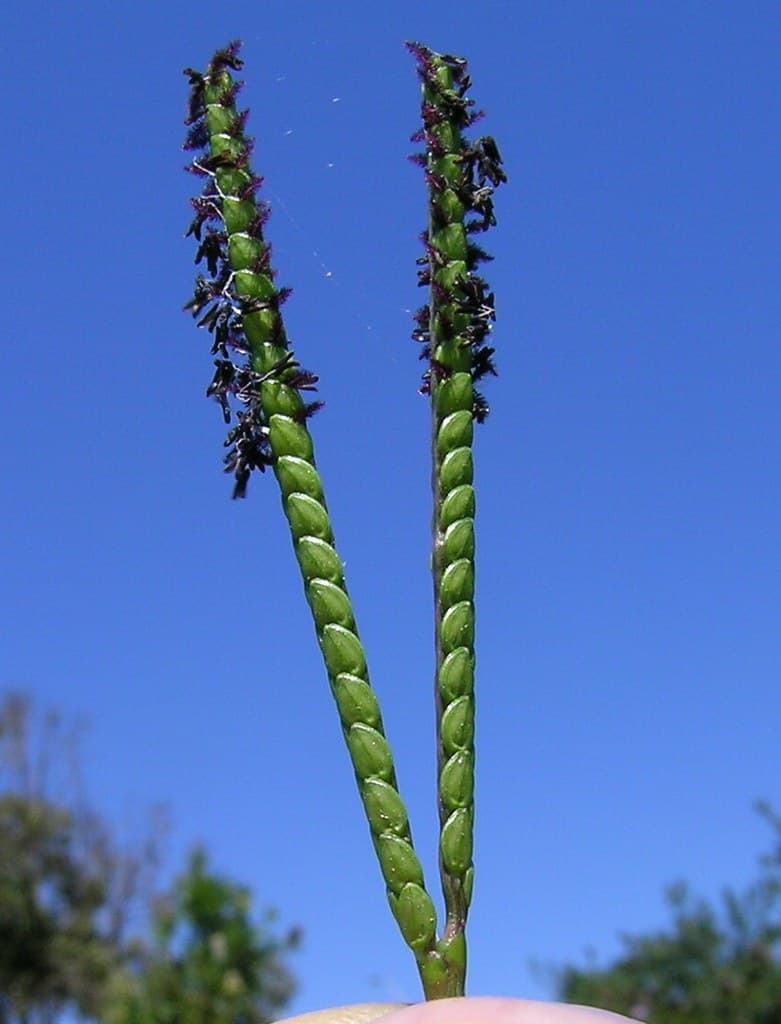
Diagnostic Feature: The V-shaped seedhead. Bahiagrass sends up two racemes from the top of a tall stalk, forming a V, and the seedheads reappear soon after mowing.
“Paspalum notatum flowerhead2” by Macleay Grass Man is licensed under CC BY 2.0.
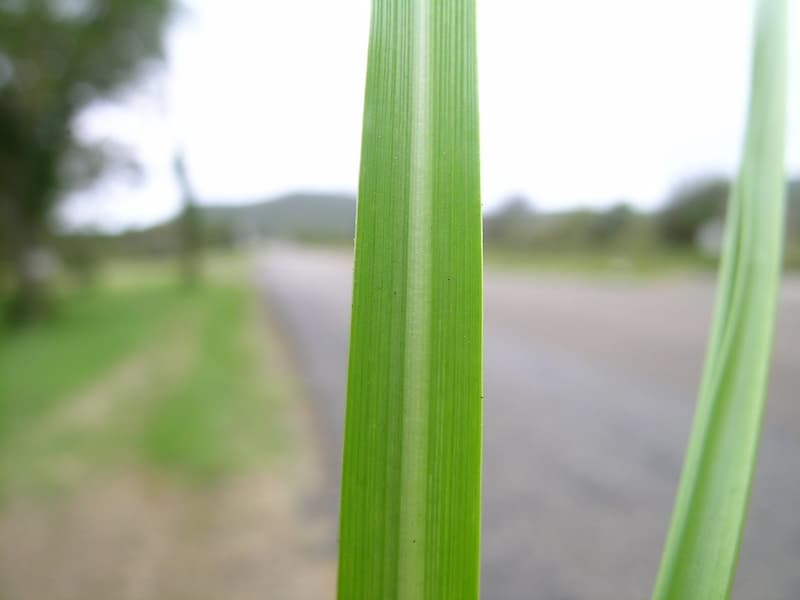
Look For: Wide, flat, glossy blades with a blunt-pointed tip. Bahiagrass leaves are wider than those of bermudagrass, zoysiagrass or centipedegrass.
“Paspalum notatum leaf1” by Macleay Grass Man is licensed under CC BY 2.0.
Is Bahiagrass Right For Your Yard?
Advantages:
Survives drought better than almost any lawn grass in the South. Deep roots carry it through dry spells, and when the soil finally runs out it goes brown and dormant rather than dying — roughly two months with no water at all, then green again within days of rain.
Thrives on infertile, acidic, sandy soil where bermudagrass, centipedegrass and St. Augustinegrass struggle.
One of the very few warm-season grasses you can plant from seed, which makes a large lot dramatically cheaper to establish than sod or sprigs.
Very low fertilizer demand — 1 to 2 lb of nitrogen per 1,000 sq ft a year, against three to four times that for a good bermudagrass lawn.
Barely produces thatch, so no dethatching, no vertical mowing, no topdressing program.
Unusually free of disease and insect problems for a Southern lawn grass, and notably resistant to nematodes and ground pearls — the pests that make centipedegrass and St. Augustinegrass hard to keep.
Handles wet feet and short flooding better than bermudagrass, so soggy low spots are not a dealbreaker.
Works without an irrigation system at all, which is the specific situation it beats everything else in.
Best If:
- You have a large, sunny lot — half an acre and up — where the cost of sodding or irrigating anything else is out of proportion to what you want from it.
- You have no irrigation system and no plans to install one.
- You have sandy, acidic soil that tests below pH 6.5.
- You live in USDA zone 8a through 11, or in 7a to 7b and are willing to plant the cold-hardy type and accept some winterkill risk.
- You want a lawn you can mostly ignore between mowings, and would rather spend an hour a week on a mower than a weekend a month on fertilizer, dethatching and disease control.
- You care more about ground cover that holds soil than about how the lawn photographs.
- You have a history of ground pearls or lawn nematodes on the property, which bahiagrass largely shrugs off.
Disadvantages:
Never forms a dense, closed canopy. This is genetic, not a management failure, and it means weed seeds keep germinating no matter how well you care for it.
Constant summer seedheads. You mow every 7 to 14 days to remove seed stalks, not because the grass is growing tall — the mowing burden is the price of the low fertilizer bill.
No selective herbicide exists for grassy weeds in a bahiagrass lawn. Crabgrass, goosegrass and dallisgrass have to be pulled or spot-killed along with the grass around them.
Coarse texture and a light, apple-green color. It will never look like a manicured lawn, and no cultivar closes that gap.
Slow to establish from seed — 50 to 60 percent germination in the first 30 days and the rest across a year, with a patchy, weedy first season.
Slow to repair itself. Short rhizomes mean damaged areas take a long time to fill in, so wear damage lingers.
Fails above pH 7.0 with iron chlorosis that fertilizer will not fix, and has very poor salt tolerance — wrong grass near limestone, coastal spray or reclaimed irrigation water.
Goes fully brown and dormant every winter, and no overseeding fix is available because overseeding permanently thins the stand.
Woody seed stalks dull mower blades fast, and dull blades leave frayed brown leaf tips.
Avoid If:
- You want a fine-textured, dark green, tightly knit lawn. Bahiagrass cannot do it, and no cultivar changes that.
- Your soil tests above pH 7.0, or sits over limestone, shell fill or a concrete foundation apron.
- You are on the coast with salt spray, or irrigate with reclaimed or softened water.
- More than a small part of the yard is shaded. Around eight hours of direct sun is the working requirement, and shade brings the disease problems with it.
- You are north of USDA zone 7. Winterkill is the limit and management does not move it.
- The lawn takes heavy, concentrated traffic — a sports area or a dog run. Bahiagrass survives wear but repairs slowly, so damage accumulates.
- Skipping a mow for two weeks in July would bother you. That is when the seed stalks take over.
- You have an HOA with an appearance standard, or neighbors on maintained bermudagrass or St. Augustinegrass — bahiagrass spreads into them and is one of the harder lawn weeds to remove.
Is It Safe for Pets and Kids?
No toxicity of bahiagrass foliage to dogs or cats is documented in extension or veterinary literature. That is a documented absence — nothing suggests the grass itself is a hazard to household pets. The one real toxicity is indirect and lives in the seedhead: heads infected with the fungus Claviceps paspali carry tremorgenic toxins that cause a nervous staggers syndrome in grazing livestock, and USDA-NRCS specifically warns that pregnant mares can abort after eating large quantities of infected heads. Argentine types are the susceptible ones; the Pensacola line resists it. This matters where a lawn adjoins a paddock, not for a dog on a mown yard, and mowing the heads off removes the risk. Separately, bahia grass pollen is a documented major aeroallergen with an unusually long pollination season.
Where It Grows and Where It Fails
Bahiagrass is a Deep South grass, and the boundary is sharp. Extension services across the Gulf and coastal plains put it in USDA zones 7a through 11, with 8a through 11 the comfortable range and 7a to 7b the edge where it survives but struggles. Above that, a hard winter kills the crowns outright and no amount of good management prevents it. North Carolina State does not recommend it as a lawn grass anywhere in that state.
Winterkill is the honest failure mode at the northern edge, and it is the one place where the choice between bahiagrass types changes the answer. The cold-hardy type holds green color later into fall and survives up into North Florida, the upper coastal plain of Georgia and roughly the I-40 line in Arkansas. The Argentine type is more cold-tender and is reliable mainly in central and south Florida and the milder coastal plains. Read the failure correctly, though: every bahiagrass browns off at the first frost. Brown top growth in December is normal and means nothing about survival. What kills it is cold reaching the crowns.
Cold is the ceiling. Heat and drought are where this grass is close to unbeatable. It lives on dry, sandy soil that would kill most other lawn grasses, pulling water from far down the soil profile with a root system UF/IFAS describes as capable of reaching 7 feet or more. That same deep rooting is why bahiagrass shrugs off the nematode pressure that damages other Florida lawn grasses, and why it feeds itself on soil that would starve them. Because it is only grown where it belongs, extension only documents its performance in the warm-humid climate, where it thrives, and marginally in the transition zone at its cold edge, for utility use. Its behavior in cool or arid climates is undocumented — which is itself the answer, because nobody grows it there.
Where bahiagrass genuinely wins is a specific and fairly common situation: a large, sunny lot with no irrigation system, on infertile, acidic, sandy soil. Extension services say plainly that this is where it beats bermudagrass, centipedegrass and St. Augustinegrass. It also handles wet feet and short flooding better than bermudagrass, so low spots that stay soggy after a storm are not a problem.
It has two hard requirements. First, sun. Shade tolerance is poor — it thins out under trees, and it wants around eight hours of direct sun to hold a stand. It is marginally better than bermudagrass in shade and clearly worse than St. Augustinegrass, so “better than bermuda” is not a reason to plant it under a canopy. Second, acidic soil. Bahiagrass is an acid-lover that wants a pH around 5.5 to 6.5, and UF/IFAS puts the optimum right at 5.5. Above 6.5 it starts going yellow and stunted; above 7.0 — common near limestone, concrete foundations, coastal ground or over-limed soil — it develops iron chlorosis, a yellowing of the new leaves that no amount of fertilizer fixes. It also has very poor salt tolerance, which rules it out for coastal salt spray and for reclaimed or softened irrigation water.
Getting Established
Bahiagrass is one of the very few warm-season grasses you can reasonably plant from seed, and that is its biggest practical advantage. Hybrid bermudagrass and St. Augustinegrass have to be sodded or sprigged. Bahiagrass seed is widely sold and comparatively cheap, and the grass reseeds itself in nature. There are two real pathways.
Seed is the primary and cheapest method, and the catch is patience. Bahiagrass produces hard seed — seed that is alive but will not germinate right away, because the coat has to break down first. Only about 50 to 60 percent comes up within the first 30 days and the rest trickles in across the first year, so the early stand looks patchy no matter what you do. Scarified seed, treated to break that coat, germinates faster and more evenly and is worth paying for. Seed at 10 lb per 1,000 sq ft, which is what UF/IFAS specifies for adequate coverage; 5 lb is the practical floor and anything less trades a few dollars of seed for an open stand that weeds and erosion take over. That is the heaviest seeding rate of any Southern lawn grass, and it is not a typo — the seed is large. Centipedegrass, on the same UF/IFAS table, goes down at a quarter pound. Cover no deeper than half an inch, and plant in spring through early summer once frost danger has passed and the soil has warmed.
Buy certified, weed-free seed. Cheap uncertified bahiagrass seed is frequently contaminated with Brunswickgrass, an aggressive and unpalatable perennial whose seed closely mimics bahiagrass. You will not spot it in the bag, and you cannot selectively remove it later.
Sod gives an instant lawn but costs far more, and bahiagrass sod has a specific weakness: it has no tight root net, so slabs tend to fall apart during installation. It is often cut from pasture and rolled with plastic netting to hold it together, and pasture sod frequently carries hard-to-control weeds, so inspect it before you accept the delivery. It is also not available everywhere — the LSU AgCenter reports bahiagrass sod is not commercially grown in Louisiana at all, which leaves seed as the only option there.
Plugs and sprigs are not recommended for home lawns. Bahiagrass spreads sideways too slowly, so plugs leave open soil for weeds far too long to be worth it.
Grow-in is where most bahiagrass lawns are won or lost. A seeded lawn needs several months to a full season to fill in; sod pegs down and roots in about three to four weeks. Water is everything during that window. For seed, keep the surface moist but not soaked — several short irrigations spread through the day for the first week or two until germination finishes, then shift to once a day at a quarter to half an inch, then to two or three times a week as roots go down. Hold off on nitrogen for 30 to 60 days after planting; fertilizing too early feeds weeds and leaches past roots too shallow to catch it.
Weed pressure during that slow grow-in is high, and the chemical restrictions are strict. Do not spray any herbicide on young bahiagrass until it is at least 6 inches tall, and do not apply a pre-emergent until the stand has been in the ground a full year — pre-emergents prune the roots of a young stand and cause it to fail. Until then, mowing high at 3 to 4 inches is your only safe weed control, cutting taller weeds off above the seedlings.
One thing bahiagrass does not do is blend. It is sold and planted as a pure monostand, the opposite of cool-season lawns. The two types differ so much in leaf width, color, growth rate and seedhead height that mixing them produces a visibly patchy lawn, so extension recommends one type, pure. Blends only appear in non-residential erosion and utility mixes, where bahiagrass is combined with bermudagrass or tall fescue and appearance does not matter.
Keeping It Healthy
Bahiagrass has a reputation as a no-work grass. That is half true. It needs very little fertilizer and very little water. It also demands a surprising amount of mowing, and that paradox is the whole experience of owning one.
Mowing. Keep bahiagrass at 3 to 4 inches; LSU allows down to 2.5. Height matters because the grass is naturally open and low-density, so cutting it short exposes bare soil to sun and weeds. Mow high because the leaf area is what feeds those deep roots through summer heat — scalp it and you starve the system that makes the grass drought-proof. Then comes the part that surprises people. Through summer, bahiagrass throws up tall, tough, Y-shaped seed stalks constantly, and they shoot well above the leaves even on a lawn that is barely fertilized. So you mow every 7 to 14 days, not because the grass is growing tall but to keep the seed stalks down. UF/IFAS puts it directly: mowing cycles on bahiagrass are dictated by seedhead production. Texas A&M classifies the species as a weed in high-end turf for exactly this reason. Those woody stalks also dull mower blades fast, and dull blades shred the fibrous leaf tips into a ragged brown mess that invites disease, so sharpen often. This is the real trade — a low-fertility grass with a high-mowing habit.
Fertility. Bahiagrass needs about 1 to 2 lb of nitrogen per 1,000 sq ft per year, and UF/IFAS publishes that same range for all three regions of Florida. Louisiana sits near the bottom at about 1 lb; Clemson allows up to 4 lb in South Carolina where a higher-quality look is wanted. Apply only after full spring green-up, split across two or three applications, and stop by mid-to-late August — late-season nitrogen keeps the grass soft going into winter and makes winterkill worse. The failure mode here is over-fertilizing, and it is worth understanding why. Because the grass is genetically open, extra nitrogen does not make it denser. It drives more vertical growth and more seedheads, which means more mowing; it pushes top growth at the expense of root growth, which undercuts the drought tolerance you planted it for; and it leaves the tissue soft and disease-prone. On bahiagrass, more fertilizer buys problems, not a better lawn.
If the soil pH is above 7.0 and the new leaves go yellow, that is iron chlorosis and the fix is iron, not nitrogen. Dissolve about 2 ounces of ferrous sulfate in 3 to 5 gallons of water and spray it over 1,000 sq ft, repeating roughly every six weeks. Iron greens the grass without triggering growth or seedheads. On high-pH soils, granular iron only works if it is chelated (EDTA, DTPA or EDDHA) — plain iron binds up in the soil and does nothing.
Watering. A bahiagrass lawn kept actively green wants around an inch of water a week, but the better approach is the one UF/IFAS now recommends: water when the grass tells you to, not on a calendar. When blades start to wilt or turn blue-gray, apply half to three-quarters of an inch. Between those signals, leave it alone. Its drought strategy is avoidance first, then dormancy — deep roots carry it through dry spells, and when the soil finally runs out it turns brown and shuts down to protect the crowns. A healthy stand can survive roughly two months with no water in that brown state and green back up within days of rain. The one thing that kills it is letting the crowns fully dry out in an extreme drought, so if a dry spell runs past that window, apply half an inch every two to three weeks. That will not turn the lawn green, and it is not supposed to. It is life support, not a wake-up call.
Cultivation. Good news: bahiagrass barely makes thatch, so routine dethatching is unnecessary, and aggressive dethatching actively damages the woody surface rhizomes the plant spreads with. Do not do it. Compaction is the real threat, especially on finer soils. If the ground is compacted, core-aerate in late spring through summer, May to August, when the grass is growing hard enough to heal the holes before weeds find them.
Do not overseed. Farmers overseed bahiagrass pasture with winter ryegrass to extend grazing, and that practice does not transfer to a lawn. On a lawn the cool-season grass outcompetes the bahiagrass at exactly the moment it is trying to green up in spring, thins it permanently, and blocks the weed control you would otherwise be able to use. Extension does not recommend it.
What Goes Wrong
Bahiagrass is one of the most disease- and pest-free lawn grasses in the South, and extension lists that low pest load as a real advantage over St. Augustinegrass and bermudagrass. A handful of specific problems still show up, and most get worse in humid weather.
Dollar spot is the most common disease — small, sunken, straw-colored patches, worst in warm, humid weather with heavy dew, and made worse by low nitrogen rather than high. A light feeding of about half a pound of N plus deep, infrequent watering usually lets the grass grow through it. Susceptibility splits between the two types; the subtype pages carry which is which.
Leaf rust appears as orange-red powdery pustules that rub off on your hands and shoes, worst in humid spring weather in central and south Florida. Balanced fertility and mowing off infected tips reduce it.
Take-all root rot is a soil disease that hits stressed grass on high-pH, compacted ground — irregular yellow patches with rotted, blackened roots underneath. The fix runs opposite to most lawn advice: do not lime, because high pH is the trigger. Relieve the compaction and acidify with peat instead.
Ergot infects the seedheads and matters mainly if livestock graze the lawn or an adjoining paddock. The fungus replaces developing seed with hard, dark bodies about a sixteenth to an eighth of an inch across, and those carry toxins that cause a nervous staggers syndrome in cattle and horses. USDA-NRCS specifically warns that pregnant mares can abort after eating large quantities. Mowing the seedheads off removes them. The Argentine types are the susceptible ones — the Pensacola line resists it.
Shade makes every one of these worse, which is why bahiagrass is classed as needing critical morning sun. Shade keeps the leaves wet longer and thins the protective leaf cuticle, letting fungi in. That is a mechanical reason not to plant bahiagrass in shade, on top of the aesthetic thinning.
Mole crickets are the most destructive insect pest. They tunnel through the top inch or two of soil, sever roots and heave the surface, leaving dying straw-colored patches and drawing digging raccoons and armadillos. To check, do a soap flush: mix about 1.5 ounces of lemon dish soap into 2 gallons of water and pour it over a few square feet. If a couple of crickets surface within three minutes, treat. Two natural enemies do most of the work across Florida and the Gulf — the wasp Larra bicolor and a beneficial nematode.
Caterpillars — fall armyworm, sod webworm and grass loopers — can defoliate a lawn in late summer, leaving a see-through windowpane look on the leaves. Over-fertilized, lush lawns get hit hardest, which is one more reason to keep nitrogen low.
Ground pearls are worth naming for the opposite reason. They devastate centipedegrass and barely touch bahiagrass, so on a property with a history of them, bahiagrass is a smart choice.
Nematodes are also less damaging here than on other Florida lawn grasses, and UF/IFAS credits the deep, extensive root system for that — there is simply more root than the nematodes can meaningfully take out.
Two physical disorders round it out. Winterkill at the cold edge is freeze damage to the crowns, worst when late nitrogen or compacted wet soil has kept the grass soft. Feed potassium (a 15-0-15 or similar 1-0-1 product), stop nitrogen by late September, and keep it mowed high through fall to insulate the crowns. Scalping is the other: because the crowns sit up on surface rhizomes, mowing too low or over uneven ground physically cuts them off and leaves bare spots for weeks. High, consistent mowing prevents it.
Telling look-alike problems apart. Yellowing is the trap. Iron chlorosis yellows the newest leaves, with green veins still showing through. Nitrogen and sulfur deficiency yellow the oldest, lower leaves first, and do it uniformly. Mealybug damage — purple-red streaks that turn to browning — is easily mistaken for drought or leaf spot. And billbug damage looks like mole cricket or grub damage, except the soil underneath stays firm, which is a quick way to separate them before you treat for the wrong thing.
Weeds In This Grass
Bahiagrass has a permanent weed problem built into its biology, and it is only fair to say so up front. Because the grass is genetically open and never forms a fully closed canopy — even under perfect care — sunlight reaches the soil and weed seeds keep germinating. Extension calls this a density ceiling. So with bahiagrass, mowing high, feeding lightly and watering deeply help the grass compete but cannot close the door. Cultural practices work alongside herbicides here, not instead of them.
The chemistry is unusually restrictive, and this is the part to understand before you buy anything. There is no selective herbicide that removes grassy weeds — crabgrass, goosegrass, dallisgrass — from a bahiagrass lawn. Bahiagrass is a grass and shares their vulnerabilities, so nothing selective exists. Your options are hand-pulling or a spot treatment that kills the bahiagrass along with the weed. That single fact makes pre-emergent prevention the foundation of weed control here rather than an optional extra.
Safe pre-emergents on an established stand — over one year old — include pendimethalin, prodiamine, dithiopyr and isoxaben. Time summer-annual pre-emergents for crabgrass and goosegrass in late winter or early spring, before soil temperature reaches 55°F. Time winter-annual pre-emergents for annual bluegrass, henbit and chickweed by mid-September. Water them in with a quarter to half an inch within two weeks. Never apply a pre-emergent to a stand under a year old — it prunes the roots and causes stand failure.
Safe post-emergents are limited to broadleaf weeds and sedges. Bahiagrass tolerates the synthetic-auxin broadleaf herbicides — 2,4-D, dicamba and MCPP, the common three-way products — best applied in spring, around May, when weeds are small and temperatures sit between 60 and 85°F. Above 85°F they can injure the grass and drift onto ornamentals, so choose amine over ester formulations near landscaping. For nutsedge, halosulfuron is safe on bahiagrass.
Some herbicides injure bahiagrass, and that matters precisely because they are standard on other Southern lawns. Atrazine and simazine damage it — bahiagrass cannot detoxify them the way St. Augustinegrass does. Quinclorac causes severe, irreversible injury. The grass-killers sethoxydim and fluazifop take it out entirely; they are in fact what people use to remove bahiagrass from other lawns. And metsulfuron splits by type: it badly injures the Pensacola-derived cold-hardy types while the Argentine types tolerate it, so check which one you have before reaching for it.
Renovation. Starting over means a clean, weed-free seedbed: a non-selective herbicide to kill the existing vegetation, then repeated tillage before seeding. If a grass-killer like fluazifop is tank-mixed in, wait 30 days before seeding so the residue does not kill your new bahiagrass. One practical caution, since the goal here is growing grass rather than killing it — check the active-ingredient panel on whatever non-selective product you buy. Consumer brand names no longer reliably tell you what is inside, and some current non-selective formulations contain grass-killers or growth regulators that behave very differently on a lawn you intend to replant.
The reverse question. “Is this bahiagrass in my lawn?” is one of the most common questions Southern extension offices get, because bahiagrass invades bermudagrass, St. Augustinegrass and centipedegrass lawns and its tall seedheads wreck the look. Removing it from those lawns is done with the grass-killers and metsulfuron named above.
Subtypes
Argentine Bahiagrass
The one bahiagrass actually selected for lawns instead of pastures: darker, denser, and far fewer seed stalks to chase.
Best For: A large, sunny lot in Zone 8b or south on sandy, acidic soil with no irrigation system, where you want bahiagrass economics but the yard still faces the street. Best where winter lows rarely reach the crowns and you would rather not mow twice a week all summer.
Tradeoff: Gives up cold-hardiness. It is only reliable from about Zone 8b south, so above that line one hard winter can take the whole stand.
Cold-Hardy Bahiagrass
The cold-hardy half of the species: winter survival at the Zone 7b and 8a edge, bought with a sparse, seedy, forage-bred look.
Best For: A big, sunny, unirrigated lot at the species' northern edge — north Florida, the upper coastal plain of Georgia, Arkansas south of I-40 — where Argentine would winterkill. Also the right pick for utility ground held cheaply: back acreage, a slope that needs holding, anywhere green and alive beats finished.
Tradeoff: Every cultivar in this group is forage-bred. The canopy stays open and sparse, and it shoots tall seed stalks within days of a cut, so you mow more often and it never looks finished.
The Seasonal Care Calendar

Spring (Mar-May)
Green-Up Comes Late And Slow
Bahiagrass greens up in April or May, later than bermudagrass and noticeably later than your neighbors will expect. In south Florida it may barely have gone off-color at all; farther north the wait is longer and the transition is patchy. Do not read a slow spring as a dead lawn.
The single most important spring rule is to wait for full green-up before the first feeding. Nitrogen applied to a lawn that is still partly dormant feeds weeds instead, and in north Florida an early feeding can push soft growth straight into a late frost. UF/IFAS puts the first application in early to mid-April for central and north Florida respectively.
Spring is also the window for broadleaf weed control. Around May, when weeds are small and temperatures sit between 60 and 85°F, is when the three-way products work best and injure the grass least. Get the summer-annual pre-emergent down earlier than that — before soil temperature reaches 55°F, which is usually late winter — because once crabgrass has germinated the pre-emergent has nothing left to do. And on a stand less than a year old, skip the pre-emergent entirely and mow high instead.
If you are seeding, spring through early summer is the window, once frost danger has passed and the soil has warmed.
Summer (Jun-Aug)
Seedheads Every Week All Summer
Summer is the seedhead season, and it defines the whole ownership experience. Tall, tough, Y-shaped seed stalks shoot above the leaf canopy continuously, and they keep coming even on a lawn you have barely fertilized. Plan on mowing every 7 to 14 days from roughly June through September, and understand that you are mowing the seedheads, not the grass.
Keep the height at 3 to 4 inches and sharpen the blade often — those woody stalks dull an edge fast, and a dull blade shreds the fibrous leaf tips into a brown, frayed mess that invites disease. Never take off more than a third of the blade in one pass, and leave the clippings on the lawn.
Water only when the grass asks. Blades that wilt or turn blue-gray are the signal; then apply half to three-quarters of an inch and stop. If a real drought sets in, let it go brown. That is the plant protecting its crowns, not dying, and it can hold there for around two months. Only if the dry spell runs longer should you put down half an inch every two to three weeks, purely to keep the crowns alive.
Summer is also the aeration window, May through August, when the grass is growing hard enough to heal the holes before weeds find them. Do not dethatch — bahiagrass barely makes thatch, and aggressive dethatching tears up the surface rhizomes it spreads with. Watch for mole crickets and for late-summer caterpillars, and keep an eye out for dollar spot in humid, dewy stretches.
Fall (Sep-Nov)
Hardening Off Before First Frost
Fall is short and it has one job: get the plant hard enough to survive winter. Stop nitrogen by mid-to-late August, and by late September at the very latest. Late nitrogen keeps the tissue soft and lush going into the cold, and soft tissue is what winterkills. This matters most at the northern edge of the range and matters less the farther south you are.
Potassium is the fall nutrient. A 1-0-1 product such as 15-0-15 supports cold hardening without pushing the growth that nitrogen would. Keep mowing at the high end of the range through fall — that leaf canopy insulates the crowns, which sit up on surface rhizomes and are more exposed than most people realize.
Get the winter-annual pre-emergent down by mid-September for annual bluegrass, henbit and chickweed. Miss that window and you are dealing with them in the spring instead, when your options are narrower.
And resist the overseeding temptation. A brown winter lawn is genuinely unappealing, and ryegrass looks like the obvious answer, but on a home bahiagrass lawn it thins the stand permanently by outcompeting it exactly when it is trying to green up in spring. Pastures get overseeded; lawns should not.
Winter (Dec-Feb)
Fully Brown And Best Left Alone
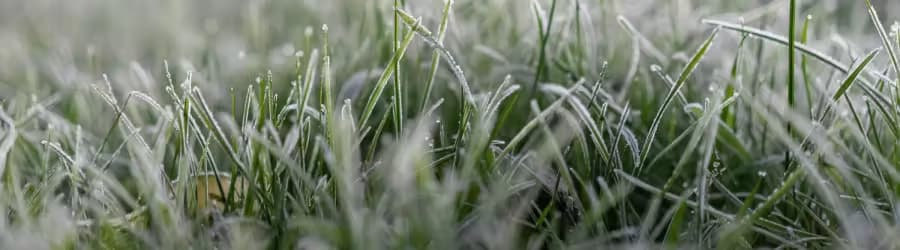
Bahiagrass goes fully brown and dormant for winter, roughly November through late winter, and it does so quickly. A UF/IFAS county trial that photographed plots four days after a three-hour freeze found both bahiagrass types scored near the bottom of the group on appearance, well below St. Augustinegrass. Expect brown, and expect it fast. Only in south Florida does it stay green through most of the winter.
Brown does not mean dead. The crowns and rhizomes are alive under a brown canopy, and they will green back up in April or May. The distinction matters because the temptation in February is to do something, and there is nothing useful to do.
So: no fertilizer, no herbicide on dormant turf beyond what your pre-emergent program already put down in September, and no aeration. Keep traffic light — dormant crowns sitting on surface rhizomes are easy to damage, and the lawn cannot repair itself until it is growing again.
The one real risk is winterkill in zones 7a to 7b. If a hard freeze takes out patches, you will not know until green-up fails in April or May, and repair means reseeding into those areas in late spring. If that happens more than once, the honest read is that the site is past this grass’s northern limit — and the cold-hardy type is the only lever available.
Choosing Bahiagrass Over Bermuda Or Centipede
The honest comparison is narrower than it looks, because bahiagrass is not competing across the board. It is competing for one specific site.
Against bermudagrass. Bermudagrass makes a far better-looking lawn — finer, denser, deeper green — and it repairs itself quickly, which bahiagrass does not. It also wants three to four times the nitrogen, more water, dethatching, and a mowing schedule closer to every three to five days. Bermudagrass beats bahiagrass on almost every quality measure and loses badly on cost and on tolerance for poor, acidic, unirrigated sandy ground. Bahiagrass also handles wet feet and short flooding better, and is marginally better in shade, though neither grass belongs under trees.
Against centipedegrass. This is the closest comparison, because both are low-input, acid-loving Southern grasses. Centipedegrass gives a denser, finer, better-looking lawn at similar fertility, so on a small lot it usually wins. Bahiagrass wins on drought — centipede has a shallow root system and shows stress far earlier — and it wins decisively where ground pearls are present, since they devastate centipedegrass and barely touch bahiagrass. Centipedegrass is also seeded at a quarter pound per 1,000 sq ft against bahiagrass’s ten, so on a very large lot the seed cost runs the other way than you would expect.
Against St. Augustinegrass. St. Augustinegrass is the shade grass of the Deep South and much better looking, but it cannot be seeded, needs more water and fertilizer, and carries chinch bugs and a heavier disease load. It also holds winter color much better through a freeze. Bahiagrass beats it on drought, on establishment cost, and on poor sandy soil, and loses on appearance and shade.
Against zoysiagrass. Zoysia is denser, finer and far more wear-tolerant, and is the better answer for a traffic area. It is also slow to establish, expensive to install, and needs more input. There is no site where zoysia and bahiagrass are close on quality — they are close only on the question of what you are willing to spend.
The pattern is consistent. Every one of those grasses makes a better-looking lawn than bahiagrass. Bahiagrass wins on one axis and it is a real one: large, sunny, unirrigated lots on infertile, acidic, sandy soil, where the alternative is not a nicer lawn but bare ground and weeds. Its defining trade is giving up fine texture and a manicured look in exchange for unmatched drought survival and the ability to grow where other grasses die. If your site is not that site, one of the grasses above is a better choice.
Find Your Precision Match
Choosing between species requires balancing your specific soil profile, local micro-climate, and maintenance goals. Use our Turf Match Tool to generate a data-backed recommendation for your specific yard.
Start Your MatchTechnical Specifications
Scientific Name: Paspalum notatum Flüggé. Accepted varieties: var. saurae (diploid; the Pensacola / cold-hardy line) and var. notatum (tetraploid; the Argentine and common lines)
Common Names: Bahiagrass, bahia grass, bahia, highwaygrass, Pensacola bahia, Argentine bahia
Family: Poaceae (grass family), subfamily Panicoideae, tribe Paspaleae. Older extension literature places the genus in tribe Paniceae; both refer to the same group. Genus Paspalum.
Origin: South America — abundant across northern Argentina, Brazil, eastern Bolivia, Paraguay and Uruguay. Introduced to Florida in 1913 as a pasture forage. Now planted on more than 2 million acres in Florida and over 4 million acres across the southeastern United States (UF/IFAS SS-AGR-332; UGA Bulletin 1362; Clemson HGIC 2316).
Season Type: Warm-Season
Growth Habit: Rhizomatous
Growth Rate: Moderate
Texture: Coarse
Root System Depth: Deep. UF/IFAS describes a fibrous root system capable of reaching 7 feet or more, and repeatedly credits an extensive, deep root system for both the drought survival and the unusually low nematode damage compared with other Southern lawn grasses. No measured typical rooting profile for maintained home-lawn turf has been published, so the 7-foot figure is a documented maximum rather than what sits under an average lawn.
Spread Mechanism Intensity: Short, stout, woody, J-shaped rhizomes running at or just below the soil surface, plus heavy self-seeding. No true aboveground stolons. Lateral spread is slow, so the canopy never fully closes and damaged areas repair slowly — the two facts that drive most of this grass’s weed and wear behavior.
Typical Lifespan & Invasiveness Risk: Long-lived perennial; stands persist for decades under low input. Outside the lawn it is naturalized rather than a designated natural-area invader across most of its US range, and it is used deliberately by NRCS for erosion control on waterways, pond banks and critical-area plantings. The documented invasiveness is agricultural and horticultural: USDA-NRCS records it as an invasive weed of well-maintained turf, bermudagrass pasture and vegetable gardens, driven by prolific seed production plus rhizome spread. Seed survives passage through cattle, which is how it moves between pastures. NC State treats it as a weed of improved turf rather than as a lawn grass, and it is one of the most common grass identifications Southern extension offices are asked for.
Hardiness Zone Min: Zone 7
Hardiness Zone Max: Zone 11
Hardiness Zone Notes: Ideal range is Zone 8a through 11. Zones 7a to 7b are the stretch edge, where it survives most winters and then loses whole areas in a hard one. The limiting mechanism is crown death from cold, not top-growth burn — top growth browns off at the first frost everywhere in the range, which tells you nothing about whether the plant lived. Late-season nitrogen and compacted, wet soil both make winterkill worse by keeping tissue soft going into the cold. This cold edge is the single axis where the subtype choice changes the outcome. Extension consensus does not carry the species above Zone 7, and NC State does not recommend it as a lawn grass anywhere in North Carolina.
Cold Tolerance Rating: Low
Winter Color Profile: Dormant
Climate Cool Humid: Unsuitable
Climate Cool Arid: Unsuitable
Climate Warm Humid: Excellent
Climate Warm Arid: Poor
Climate Transition: Poor
Sun Requirement: Full Sun (6+ hrs direct)
Shade Tolerance: Low
Water Requirement: Low
Drought Survival Strategy: Both (avoidance then dormancy)
Soil Texture Fit:
Sand
Loamy Sand
Sandy Loam
Loam
pH Survival Min: 4.5
pH Optimal Min: 5.5
pH Optimal Max: 6.5
pH Stress Max: 7
Wet Feet Tolerance: High
Compaction Tolerance: Low
Salinity Tolerance: Very Low
Wear Tolerance: Moderate
Recovery: Low
Recovery Mechanism: Rhizomes
Input Intensity: Low
Labor Intensity: Moderate
Thatch Production: Very Low
Annual N Figure: About 1 to 2 lb N per 1,000 sq ft per year. UF/IFAS publishes 1 to 2 lb for all three Florida regions and LSU anchors the low end near 1 lb; Clemson allows up to 4 lb in South Carolina where a higher-quality look is wanted. The low end is the recommendable default — on this grass, extra nitrogen buys seedheads and mowing, not density.
Preferred NPK Ratio: A 1-0-1 product such as 15-0-15 is the standard Florida extension form, chosen because most Florida soils already test adequate in phosphorus and because the potassium supports cold hardening in fall. Outside Florida, route phosphorus and potassium through a soil test rather than assuming the ratio.
Establishment Methods:
Seed
Sod
Germination Speed: Very Slow (21+ days)
Establishment Speed: Slow
Seeding Rate: 10 lb per 1,000 sq ft is the UF/IFAS figure for adequate coverage (ENH-03/LH013); 5 lb is the practical floor, and dropping below it trades seed cost for an open stand that weeds and erosion move into. That is the heaviest seeding rate of any Florida lawn grass, and the reason is seed size — centipedegrass, at the other end of the same table, goes down at 0.25 lb per 1,000 sq ft. Cover no deeper than 1/2 inch. No overseeding rate applies: a home bahiagrass lawn should not be overseeded, with ryegrass or anything else.
Improved Cultivar Availability: Low
NTEP Note: NTEP has never run a bahiagrass trial — the species is absent from the program, so no standardized multi-cultivar turf-quality dataset exists at any level. Cultivar guidance rests entirely on state extension recommendations, and it resolves to a single lever: cold hardiness. Everything else a matching tool would score — shade, drought, wear, heat, input level — is documented as identical across the two types. Only cold hardiness, and its correlated aesthetic axis of blade width, canopy density and seedhead load, actually splits. Route on winter severity: milder winters take the wider-bladed, denser, later-seeding type; the cold edge and low-budget utility plantings take the narrow-bladed, more cold-hardy, heavier-seeding type.
Deep Dives & Practical Guides
How to Establish a New Lawn From Bare Soil to First Mow
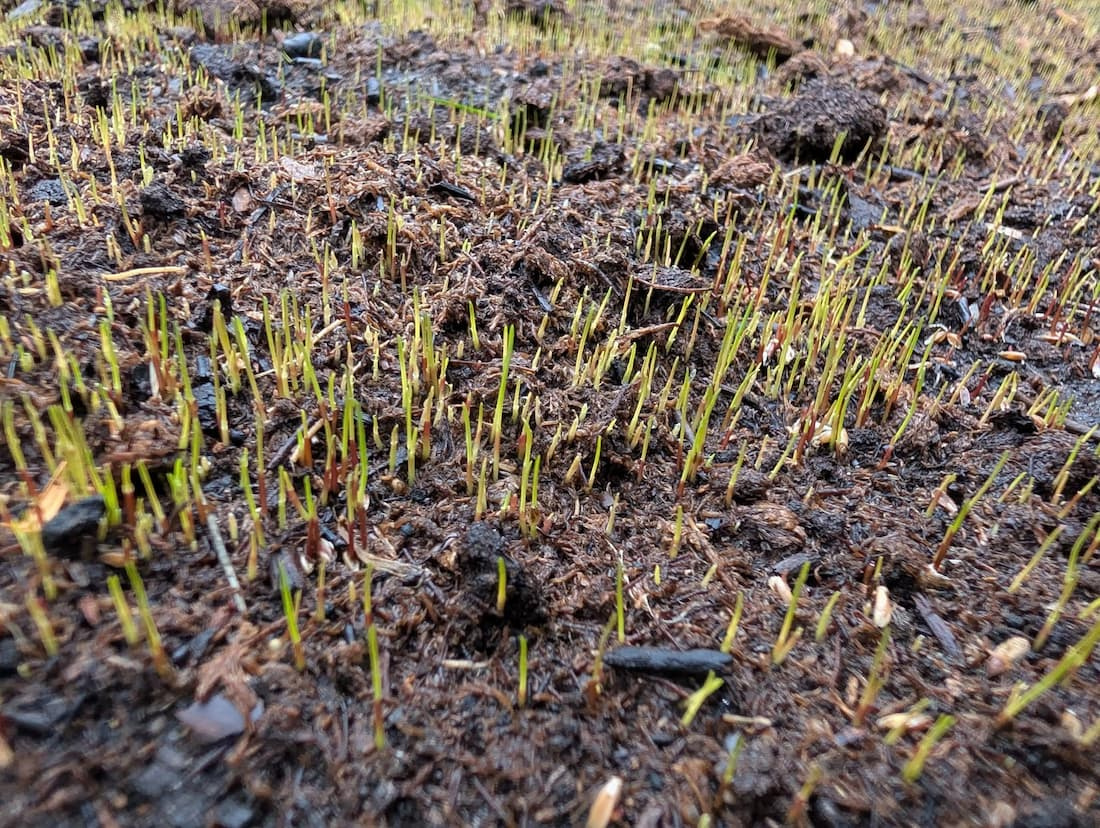
Bare soil doesn't turn into a lawn just because you scattered seed or rolled out sod — it becomes one based on a handful of specific steps done in the right order, matched to your specific grass. This guide walks through soil prep, seeding or planting method, starter fertilizer, watering as the grass grows, and knowing when it's actually safe to mow, for both cool-season and warm-season lawns.
Read Article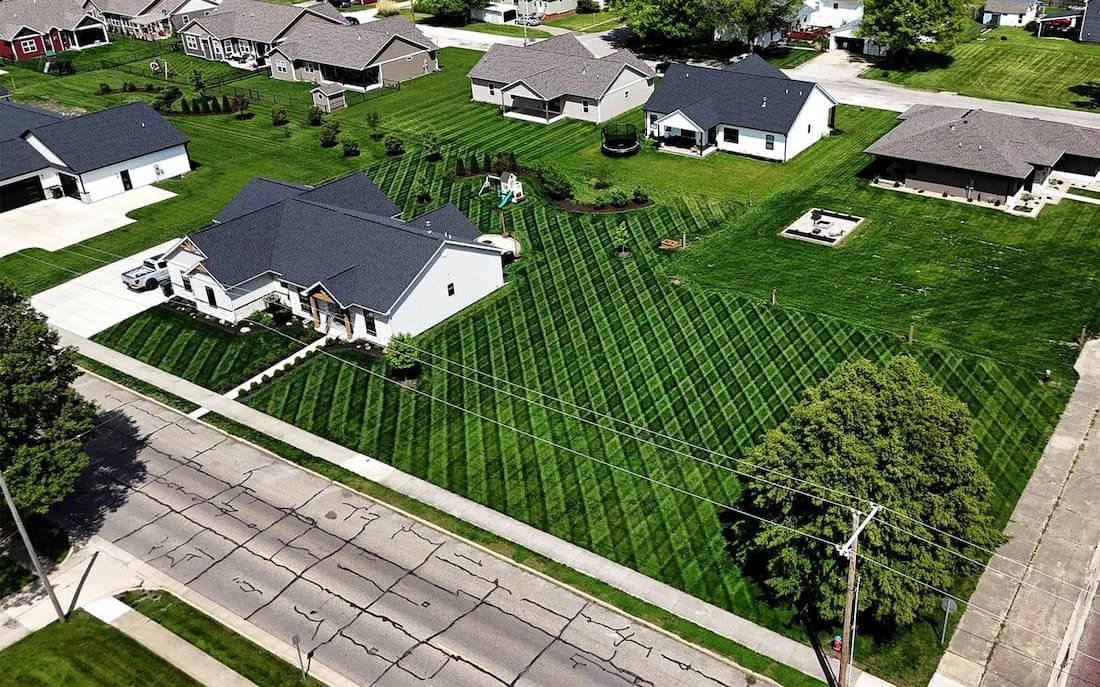
Cool Season vs Warm Season Lawn and Landscape Guide
Your lawn and your flower beds don't follow the same calendar — one runs on a cool-season engine, the other on a warm-season one, and using the wrong playbook on either can do real damage. This guide helps you figure out which system you actually have and how to care for it correctly, plus how the same cool/warm split applies to your ornamental beds.
Read Article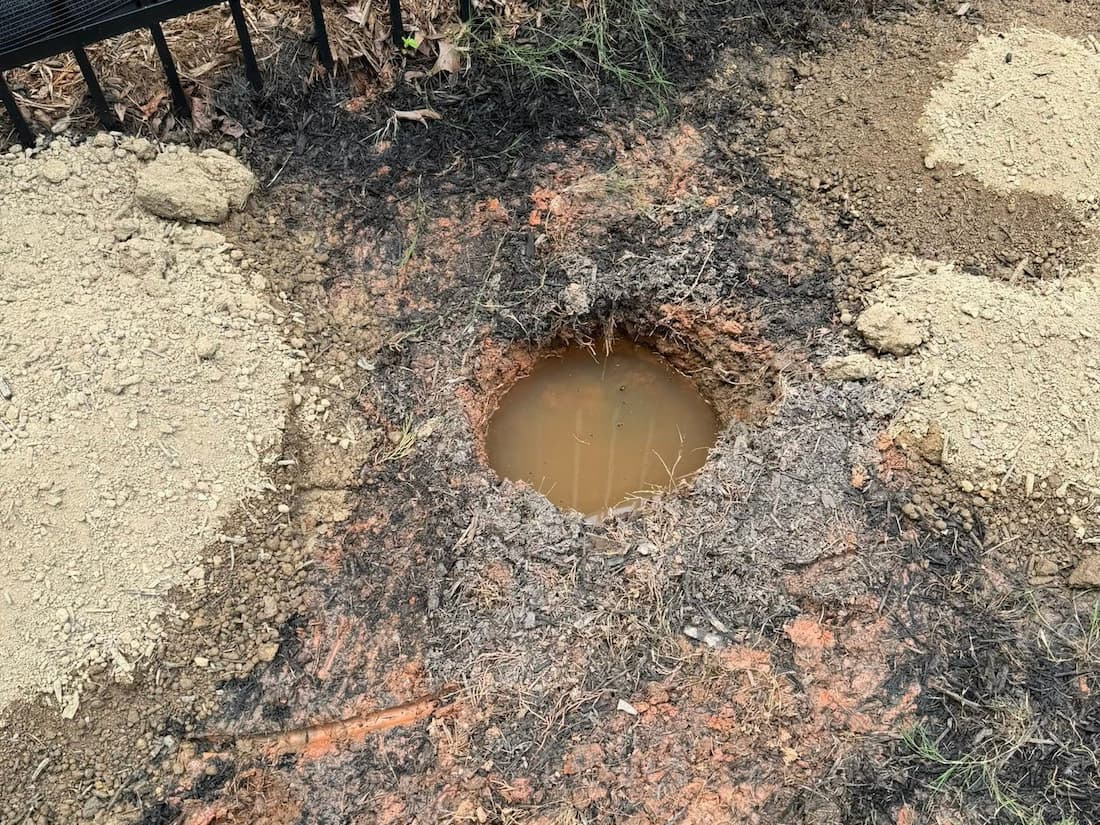
The Hole You Dug Is Killing Your New Plants
A shrub that looked fine all summer and stalled the next year usually didn't fail because of the plant, the weather, or the nursery. It failed because the hole it went into was a container — smooth-walled, water-holding, and impossible to root out of.
Read Article
What You Can Actually Change About Bad Soil
Heavy clay and loose sand feel like permanent sentences, and half of that is true. What your soil is made of will not change. How those particles are arranged will — and that is the half that decides whether anything grows.
Read Article
Why Your Plants Survive Winter and Die in July
Your hardiness zone is built from one number — the coldest night of an average year. It says nothing about the hottest afternoon, which is what actually kills most plants people lose. Here's how to read the other half of the map.
Read Article
Why Poa Annua Keeps Coming Back — and the 3-Year Plan That Finally Ends the Cycle
You've pulled it. You've sprayed it. You've watched the little white seedheads mock you every single spring. And every fall, like clockwork, it's back — in the lawn, in the beds, in the cracks you didn't know you had. Here's the hard truth nobody at the big-box store will tell you: you're not losing because you're doing it wrong — you're losing because you're fighting the wrong enemy on the wrong timeline. Poa annua isn't a one-season problem, and once you understand why, the three-year plan below stops feeling like a chore and starts feeling like a countdown.
Read Article
How to Apply Herbicides Correctly in Your Lawn and Garden Beds
Getting real results from a weed product has almost nothing to do with the brand on the bottle and everything to do with matching the method to the moment — the right chemistry, in the right place, at the right time. Learn how to apply herbicides correctly across both your lawn and your garden beds, whether you’re stopping weeds before they sprout or killing the ones already growing, without wasting product or harming the plants you want to keep.
Read Article
How to Kill Weeds Where Two Lawns Meet Without Harming Your Neighbor’s Grass
Controlling weeds along a shared property line is where good intentions quietly backfire—the season that's safe for your own lawn is often the season the lawn next door is most easily harmed. Learn the seasonal timing collision behind most fence-line damage, and the two habits that prevent it—reading what's actually in the bottle and spraying directed instead of broadcast—so you can clear the weeds without hurting your grass, your neighbor's, or the peace between you.
Read Article
The Truth About One-and-Done Weed Control
Most homeowners lose the fight against weeds not because they work too little, but because they act before they understand. One-and-done weed control is real — but it only works when identification, timing, and the right tool all line up. This guide explains how that sequence works across your lawn and your ornamental beds, and how each weed page in the MFY hub puts it into practice for your specific invader.
Read Article
Solving the Mystery of the False Evidence in Your Lawn and Landscape
A brown leaf or a yellowing lawn is rarely what it seems. When symptoms act as decoys, a calm, forensic approach brings clarity to the confusion. Learn how to look past the surface to find the quiet truth of what your plants are truly asking for.
Read Article
Living in the Middle: The Deep-Dive Guide to Transition Zone Lawns and Landscapes
The Transition Zone is a biological tug-of-war where neither northern nor southern species perfectly adapt. By using resilient "bridge" species and mastering maintenance levers like the Mowing Pivot, you can transform a struggling yard into a healthy landscape.
Read Article
What Your Hardiness Zone Really Means for Your Lawn and Plants
Uncover the foundation of a resilient landscape by mastering the science of hardiness zones. Learn how these climate boundaries are calculated and why understanding your local temperature limits is the first step toward choosing plants that thrive year after year.
Read ArticleFrequently Asked Questions
Our maintenance and establishment guidance is derived from long-term agronomic field studies and turfgrass performance data from top research institutions.
Almost certainly dormant. Bahiagrass browns off for two separate reasons and neither one is death. In winter it goes fully dormant from about November through late winter and greens back up in April or May. In a summer drought it turns brown to protect its crowns and can hold there for roughly two months, then green up within days of rain. The way to tell the difference is timing and recovery: if it is brown in January, wait. If it is brown in July and has been dry, water half an inch every two to three weeks to keep the crowns alive — that will not turn it green, and it is not meant to. Real death shows up as areas that fail to green up in April or May after a hard winter, and that is winterkill, which only happens at the cold edge of the range.
No, and this is the most expensive misconception about this grass. Bahiagrass is genetically open — it does not form a closed canopy at any fertility level. Extra nitrogen does not add density. It drives vertical growth and more seedheads, which means more mowing; it pushes top growth at the expense of roots, which undercuts the drought tolerance you planted it for; and it leaves the tissue soft and disease-prone. Stay at 1 to 2 lb of nitrogen per 1,000 sq ft per year. If you want a dense lawn, you want a different grass.
Because that is what a pasture grass does. Bahiagrass was introduced to feed cattle, and heavy, continuous seed production is exactly what it was selected for. Through summer it pushes tall Y-shaped seed stalks above the leaf canopy constantly, on almost no fertilizer. You are not doing anything wrong and there is no product that stops it. The practical answer is a mowing schedule of every 7 to 14 days through summer and a sharp blade, because those woody stalks dull an edge fast. If a fortnight of seed stalks in July would bother you, this is the wrong grass.
No. There is no selective herbicide that removes grassy weeds — crabgrass, goosegrass, dallisgrass — from bahiagrass, because bahiagrass is a grass and shares their vulnerabilities. Anything that kills them kills it. Worse, several products that are perfectly safe on other Southern lawns will damage bahiagrass: quinclorac causes severe, irreversible injury, and atrazine and simazine damage it even though St. Augustinegrass tolerates them. That is why pre-emergent prevention matters so much more here than on other lawns. For weeds already up, it is hand-pulling or a spot treatment that takes the grass with it. Broadleaf weeds and sedges are a different story — those you can treat.
Look at which leaves are yellow. If it is the newest leaves, with green veins still showing through, that is iron chlorosis from high soil pH, and more nitrogen will not fix it — bahiagrass is an acid-lover that starts going yellow above pH 6.5 and clearly struggles above 7.0. The fix is iron: about 2 ounces of ferrous sulfate in 3 to 5 gallons of water sprayed over 1,000 sq ft, repeated roughly every six weeks. On high-pH soil, granular iron only works if it is chelated. If instead the oldest, lower leaves are yellowing uniformly, that is a nitrogen or sulfur deficiency and a light feeding is the answer.
No — and this is one where the advice for pastures does not transfer to lawns. Farmers overseed bahiagrass pasture with winter ryegrass to extend grazing. On a home lawn the cool-season grass outcompetes the bahiagrass exactly when it is trying to green up in spring, thins the stand permanently, and blocks the weed control program you would otherwise be running. Extension does not recommend it. A brown winter lawn is part of the deal with this grass.
Not necessarily, and the difference is not just cultivar. Cheap, uncertified bahiagrass seed is frequently contaminated with Brunswickgrass, an aggressive perennial weed whose seed closely mimics bahiagrass. You cannot spot it in the bag, and once it is in the lawn there is no selective way to remove it — it is a grass in a grass. Buy certified, weed-free seed. Separately, look for scarified seed, which has been treated to break the hard seed coat and germinates faster and more evenly.
Because low-maintenance means low-input, not low-effort, and bahiagrass splits those two things unusually far apart. It genuinely needs very little — 1 to 2 lb of nitrogen a year, no irrigation system, no dethatching, no topdressing, and very little disease or insect treatment. What it does need is mowing, every 7 to 14 days through summer, to keep the seed stalks down. So the money is low and the time is not. If your constraint is budget and lot size, that is a good trade. If your constraint is weekends, it is not.
Scientific Authority
This profile is grounded in turfgrass agronomy and soil science. Every recommendation—from irrigation requirements to nutrient management—is verified against agricultural research data to ensure optimal plant health and environmental sustainability in the Transition Zone.
Primary Resources
- UF/IFAS Extension: Bahiagrass for Florida Lawns (ENH6/LH006)[cite: 1]
- UF/IFAS Extension: Establishing Your Florida Lawn (ENH-03/LH013)[cite: 2]
- UF/IFAS Agronomy: Homeowners Guide to Bahiagrass Management in Florida (Lindsey, 2024)[cite: 3]
- UF/IFAS Extension: Bahiagrass (Paspalum notatum Flüggé): Overview and Pasture Management (SS-AGR-332/AG342)[cite: 4]
- University of Georgia Extension: The Management and Use of Bahiagrass (Bulletin 1362)[cite: 5]
- Texas A&M AgriLife Extension: Bahiagrass Utilization in East Texas (SCS-2001-12)[cite: 6]
- USDA-NRCS Plant Materials: Plant Guide for Bahiagrass (PANO2)[cite: 7]
- NC State Extension: Carolina Lawns and Extension Gardener Handbook
- Clemson Cooperative Extension: Bahiagrass Profiles & Maintenance (HGIC 2316 / HGIC 1201)
- Mississippi State University Extension: Bahiagrass (Paspalum notatum) Profile
- Alabama Cooperative Extension System: Bahiagrass in Alabama
- UF/IFAS Extension Osceola County: Warm-Season Turfgrass Aesthetic Freeze Tolerance Observation (2019)
- LSU AgCenter: Bahiagrass Management Guide (Publication 3624)
- University of Arkansas Cooperative Extension: Bahiagrass Production and Management (FSA-3144)