“I’ve got clay, so I’m tilling in a few bags of sand.” “Gypsum breaks up clay, everyone knows that.” “I dug a big hole and filled it with good topsoil.” “Put gravel in the bottom for drainage.” “I till the beds every spring to keep them loose.” Somewhere along the way, improving soil turned into a set of rituals nobody has tested. The results are predictable: a clay bed that sets harder after the sand than it was before, a shrub sitting in an amended hole that fills with water like a bathtub, and a vegetable-free flower bed that gets tighter and greyer every year it is tilled. Nearly every one of these habits makes things measurably worse — and they all come from confusing the one thing about your soil you cannot change with the one thing you can.
The MFY Advice
Stop trying to change what your soil is made of and start protecting how it is arranged. That means three habits and almost nothing else: put a quarter inch of compost on the surface every year and let worms and water carry it down, stay off the soil entirely when it is wet, and never till ground that already has plants in it. Those three do more for heavy clay or loose sand than any bagged amendment on the shelf, they cost very little, and unlike sand or gypsum they cannot backfire. The catch is that they work on a scale of years rather than weekends, which is exactly why the rituals stay popular.
The Two Things People Keep Confusing
Texture is what your soil is made of — the proportion of sand, silt, and clay particles. It is set by geology, it is measured in a lab, and for practical purposes it never changes.
Structure is how those particles are arranged. Whether they sit packed together as a solid mass, or bind into crumbs with air spaces between them. Structure is built by living things, it can be destroyed in an afternoon, and it is entirely within your control.
Here is why the distinction matters. Two soils can return an identical lab result — same percentage of clay, same texture class, same everything — and one grows a lawn while the other grows moss and standing water. The difference is not in the report. It is in the architecture, and the report does not measure it.
Why Texture Cannot Be Changed
The numbers make this obvious in a way arguments do not. The top 6 inches of a 1,000 square foot area weighs roughly 20 tons of dry mineral soil. Not the whole yard — a patch about the size of two parking spaces.
To shift a clay soil into a loam across that depth, you would need to add somewhere between 15 and 20 tons of coarse sand, mixed thoroughly through the whole profile. That is roughly the weight of the soil already there, or about a full dump truck load for every 1,000 square feet. For an average lawn you are looking at five or six truckloads and a rotary tiller working ground that will not cooperate.
Nobody does this, which is fine, because the smaller version is worse than doing nothing.
What Actually Happens When You Add Sand to Clay
Sand only improves a soil once the grains are touching each other and carrying the structural load, with too little fine material left to fill the gaps between them. That is how a well-drained sandy soil works — a rigid skeleton with open pores running through it.
Below that point you get the opposite. The clay particles, which are hundreds of times smaller, pack neatly into every space between the sand grains. Instead of a skeleton with pores you have a dense matrix with none. Density goes up, drainage goes down, and root penetration gets harder than before you started.
The worst results land at roughly 50 to 70 percent sand — which is precisely where a few bags tipped onto a clay bed puts you. This is the same principle that makes concrete work, and it is the reason the advice fails so reliably that it has become a running joke among soil scientists.
Gypsum has the same problem for a different reason. It does exactly one useful thing: it supplies calcium that displaces excess sodium, letting dispersed clay clump back together. That is a real condition, called sodic soil, and it is uncommon outside irrigated arid regions. On ordinary clay there is no sodium to displace, so the gypsum dissolves, adds calcium and sulfate to the soil water, and washes through. It is one of the most reliably wasted purchases in home lawn care.
Structure Is the Part You Control
Good structure means soil particles bound into stable crumbs, with two different sizes of pore space between them. Large pores drain excess water and let air reach roots. Small pores hold water where roots can reach it. A soil with good structure does both jobs at once, which is why the same clay can be a problem in one yard and excellent in another.
What does the binding is biological, almost entirely. Fungal threads physically wrap around particles and hold them together like netting. Bacteria secrete sticky polysaccharides that glue them. Roots exude sugars and acids that feed both. Earthworms eat soil and excrete it as ready-made aggregates with a mineral and mucus coating.
All of that runs on one input — organic matter — which is why every genuine soil improvement recommendation eventually comes back to compost. You are not feeding the plants. You are feeding the organisms that build the house the plants live in.
The Glass of Water Test
You can see your own soil structure in about twenty minutes, and it is the most informative free test available.
Take a dry clod about an inch across from 3 or 4 inches down. Fill a clear glass with water and lower the clod in gently without dropping it. Then leave it alone and watch.
Well-aggregated soil holds its shape. It may soften at the edges, but an hour later it is still recognizably a clod and the water above it is clear. Poorly aggregated soil slumps almost immediately, collapsing into a heap of loose particles and clouding the water within a few minutes.
That difference is the organic binding agents doing their job or not being there. Run the test on a bed you have composted for years and again on an untouched patch of the same soil, and the two glasses will not look like the same material.
What Builds Structure and What Destroys It
Builds it: compost, applied as a surface topdressing and left to be worked down by worms and rainfall. Living roots in the ground as much of the year as possible. Mulch on beds, both to feed the surface and to absorb raindrop impact. Mowing high and leaving clippings.
Destroys it: tilling, which shatters existing aggregates and exposes protected organic carbon to a burst of microbial decomposition — beds tilled every spring get worse every year, not better. Traffic on wet soil, which smears aggregates into a solid mass and is the single largest cause of compaction in home lawns. Bare ground, where raindrop impact breaks the surface apart and the fines wash into the pores below and seal them.
The pattern is worth noticing. Everything that builds structure is slow, cheap, and biological. Everything that destroys it is fast, feels productive, and usually involves a machine.
Why the Planting Hole Trick Backfires
Digging a hole in heavy clay and backfilling with bagged compost or topsoil is intuitive, widely recommended, and reliably fatal to the plant.
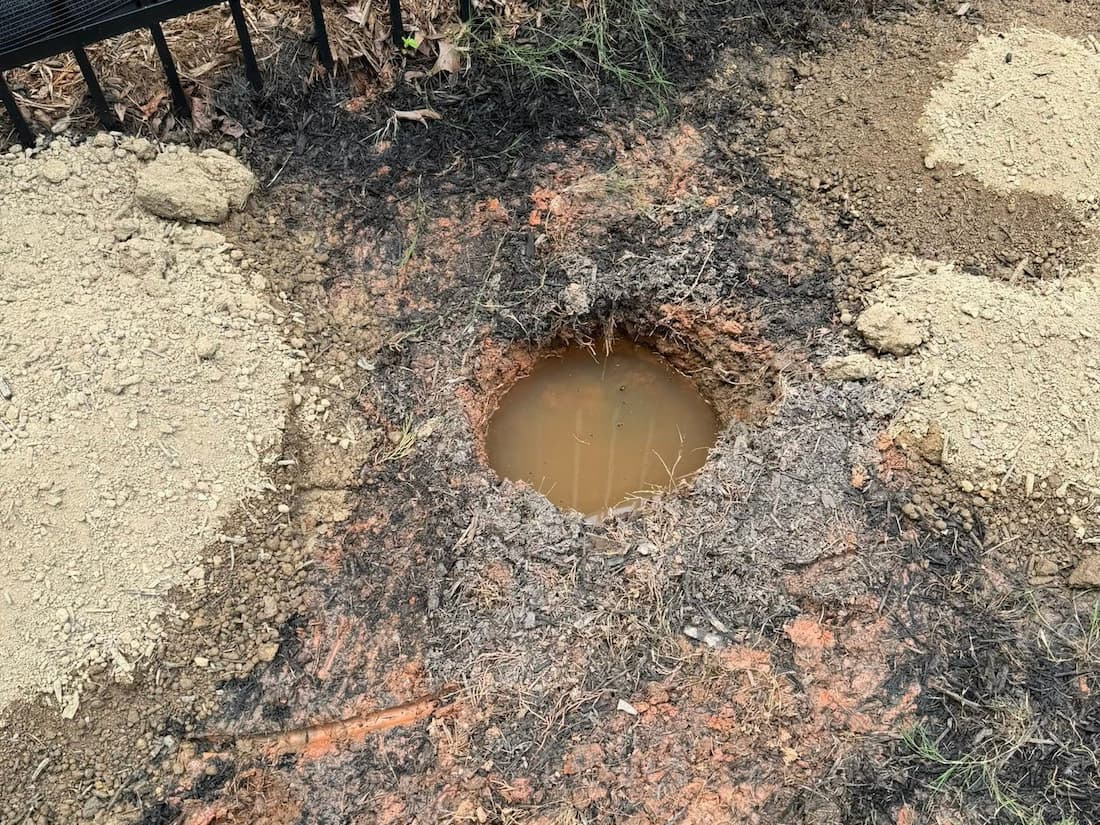
Water does not readily cross the boundary between two different soil textures. It moves through the loose backfill, reaches the clay wall, and stops. What you have built is an unlined container in the ground, and it fills up. Roots sitting in it drown, and because roots also resist growing out of comfortable soil into dense soil, the plant often stays effectively pot-bound for years.
The same physics explains why gravel in the bottom of a pot makes drainage worse rather than better, which surprises almost everyone who hears it.
The fix is to dig wide rather than deep — two to three times the width of the root ball, no deeper — backfill with the native soil you took out, set the root collar slightly above grade, and put the organic matter on top as mulch where it belongs.
How Long This Actually Takes
Longer than anyone wants, and the timeline depends on your texture.
Coarse soils are the impatient case. Sandy soils are warm and full of oxygen, which is exactly what decomposing microbes want, so organic matter you add burns off fast. Annual topdressing on sand is not building toward a total — it is replacing what disappeared. That sounds discouraging and it is simply the job.
Fine soils are the rewarding case. Clay and silty soils are cooler and hold less oxygen, so organic matter breaks down far more slowly and your additions accumulate. Progress on clay is genuinely cumulative, which is why heavy soil that has been looked after for a decade outperforms almost anything else.
Either way, expect three to five years before a structural change is obvious, and longer on the heaviest soils. What you will notice first, usually within a season or two, is water soaking in faster instead of pooling. That is the aggregates opening up, and it arrives well before the soil looks any different.
Safety & Sensitivity Audit: Protecting Your Home and Environment
Compost and bagged potting media are safe to handle with basic care, but dry material worth taking seriously: both can carry Aspergillus mould spores and Legionella bacteria, and the risk comes from inhaling airborne dust rather than from touching it, so dampen the pile before you spread it, open bags away from your face, and wear a dust mask if you are working with dry material in an enclosed space or have a compromised immune system. Wear gloves and keep your tetanus vaccination current, since soil is where tetanus lives and a scratch from a buried piece of wire is all it takes. Avoid fresh or partly rotted manure entirely around ornamental beds and lawns where children and pets spend time, and use only fully finished compost. And be aware that mushroom compost is often high in soluble salts, so keep it away from anything salt-sensitive and away from newly planted material until it has weathered a season.