
Yellow Nutsedge At-a-Glance
Weed Type
Sedge (not a grass, not a broadleaf)
Life Cycle
Tuberous perennial
Growth Habit
Erect, clumping, grass-like
Root Type
Tuber (fed by rhizomes and a basal bulb)
Spreading Risk
High — by tuber
Pull
No
Identity & Diagnostics
Visual Fingerprint
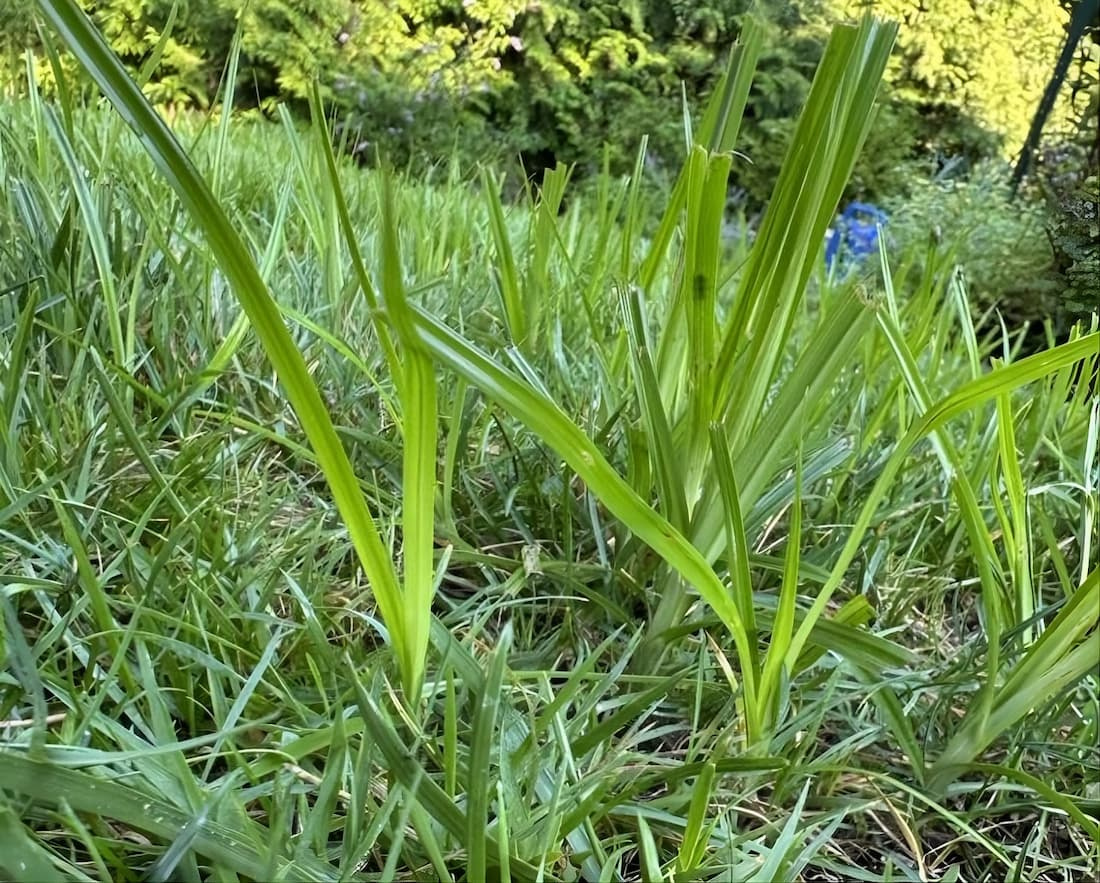
Yellow nutsedge looks like a grass that’s in a hurry. The leaves are a glossy, waxy, light yellow-green — noticeably paler and shinier than the turf around them — and they stand stiff and upright. The giveaway is speed: within two or three days of mowing, nutsedge shoots stand visibly taller than the lawn, leaving a patchy, uneven surface. If left unmowed, it sends up a triangular stem topped with a golden, straw-colored, umbrella-shaped seedhead.
Structural Anatomy
Three features confirm it, and you can check all of them without a seedhead present.
Sedge-Specific Anatomy
- Roll the stem between your fingers — it has three sharp edges. True grass stems are round or flat and hollow, with swollen joints (nodes). Nutsedge stems are solid, filled with soft pith, jointless, and perfectly three-sided. This is the old field rhyme: “Sedges have edges, rushes are round, grasses have nodes from their tips to the ground.” One finger-roll settles it.
- Leaves come off the stem in three rows, not two. Grasses put out leaves in two opposite rows (flat, like a fan). Nutsedge puts them out in three rows set at 120° to each other, so the base looks like a little three-pointed star rather than a flat fan.
- No ligule, no auricles, no collar. Peel back the outer leaves and the parts you’d use to name a grass simply aren’t there. The leaf sheath just wraps smoothly around the triangular stem.
The tuber and the taste test (species-level ID). Dig gently at the base and follow the thin, white, scaly rhizomes outward. Yellow nutsedge grows its tubers (“nutlets”) singly, one at the very tip of each rhizome — never in chains. The tuber is round, about ¼–½ inch, white when young and brown-to-black when mature. The definitive check against its cousin Purple Nutsedge is taste: a yellow nutsedge tuber is sweet and almond-like (it’s the same “tiger nut” or chufa people eat), while a purple nutsedge tuber is bitter and unpleasant, with rough dark scales and tubers strung in chains.
Growth Patterns & Life Stages
- Early shoot (late spring): A single spear pushes up from a tuber or basal bulb. Easy to mistake for a grass seedling, but even now it’s triangular at the base and paler than the turf. True seedlings from seed are rare — this plant almost never bothers with seed.
- Vegetative clump (early summer): The window that matters for control. The plant is growing fast on the parent tuber’s stored energy and hasn’t yet built new tubers. Shoots are 3–8 leaves, glossy, upright, spreading sideways by white rhizomes into daughter plants.
- Flowering / seedhead (mid–late summer): Golden, straw-colored, branched seedhead on a triangular stem, with a long leaf-like bract sticking up well past it. By the time you see this, the plant has usually already built its new tubers underground — the control window has closed for the year.
Gallery
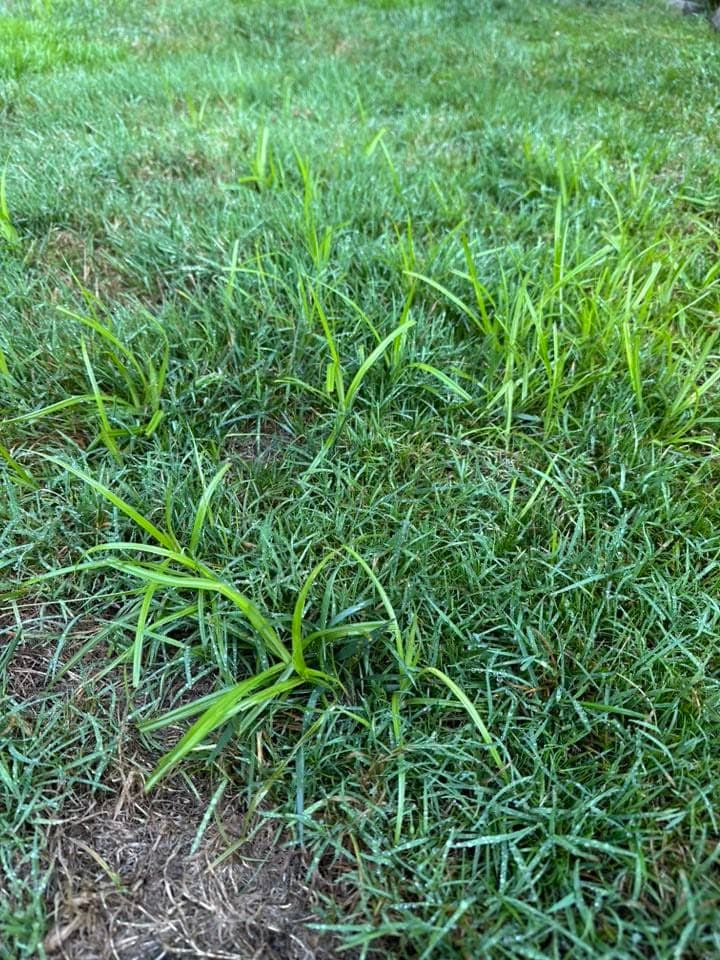
A widespread yellow nutsedge infestation forming prominent, light-colored patches across a cool-season lawn.
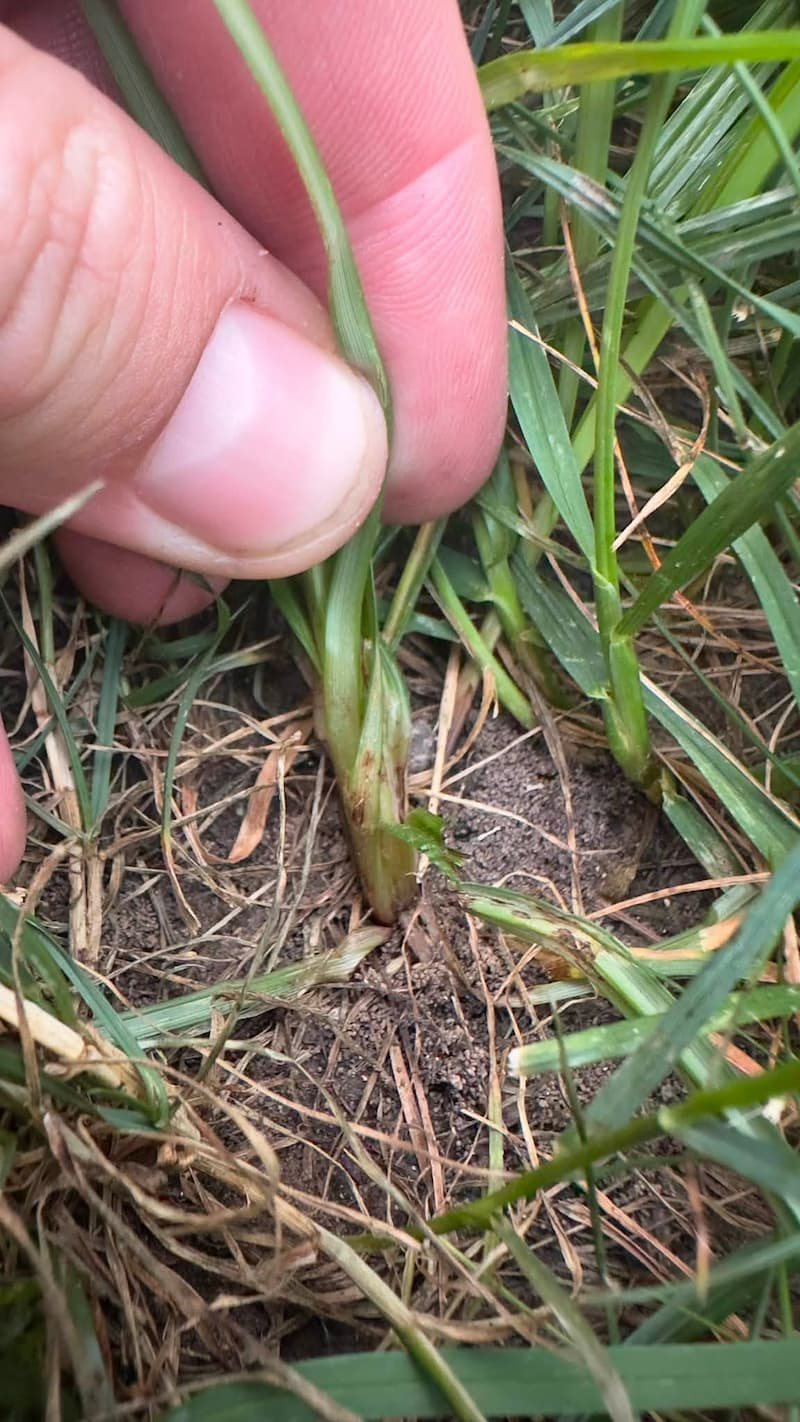
Base of a yellow nutsedge shoot at the soil line, highlighting the tight cluster where leaf sheaths converge.
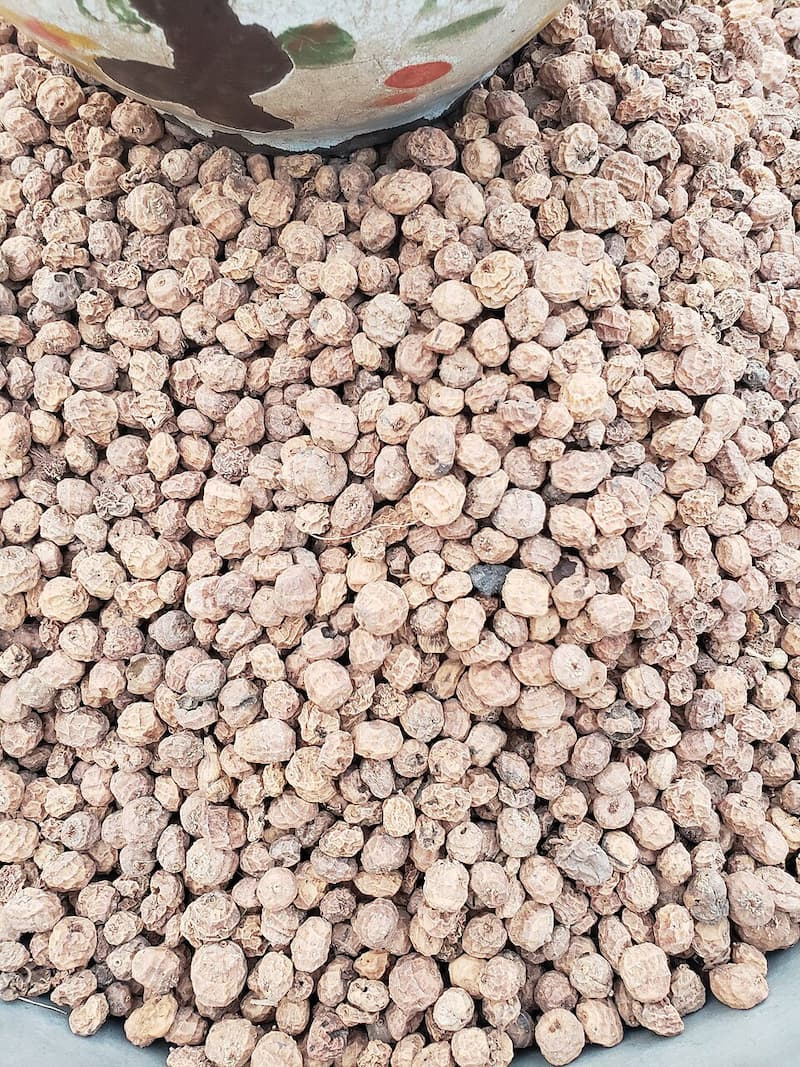
Diagnostic Feature: Yellow nutsedge spreads by underground tubers like these — the same structure sold commercially as "tiger nuts" or "chufa." Leave even one behind when pulling the plant, and it can sprout a whole new colony.
“Dried tiger nut 1” by Achiri Bitamsimli is licensed under CC BY-SA 4.0.
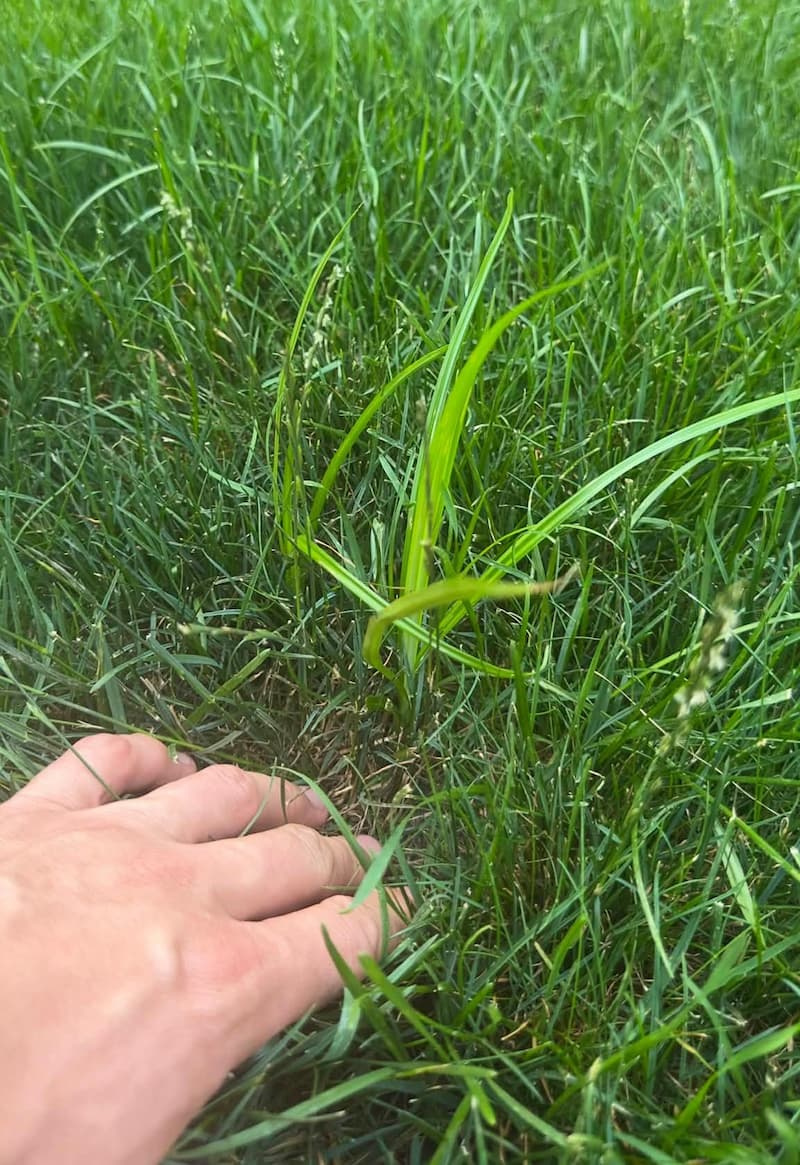
A solitary yellow nutsedge shoot demonstrating its characteristic rapid vertical growth above surrounding turfgrass.
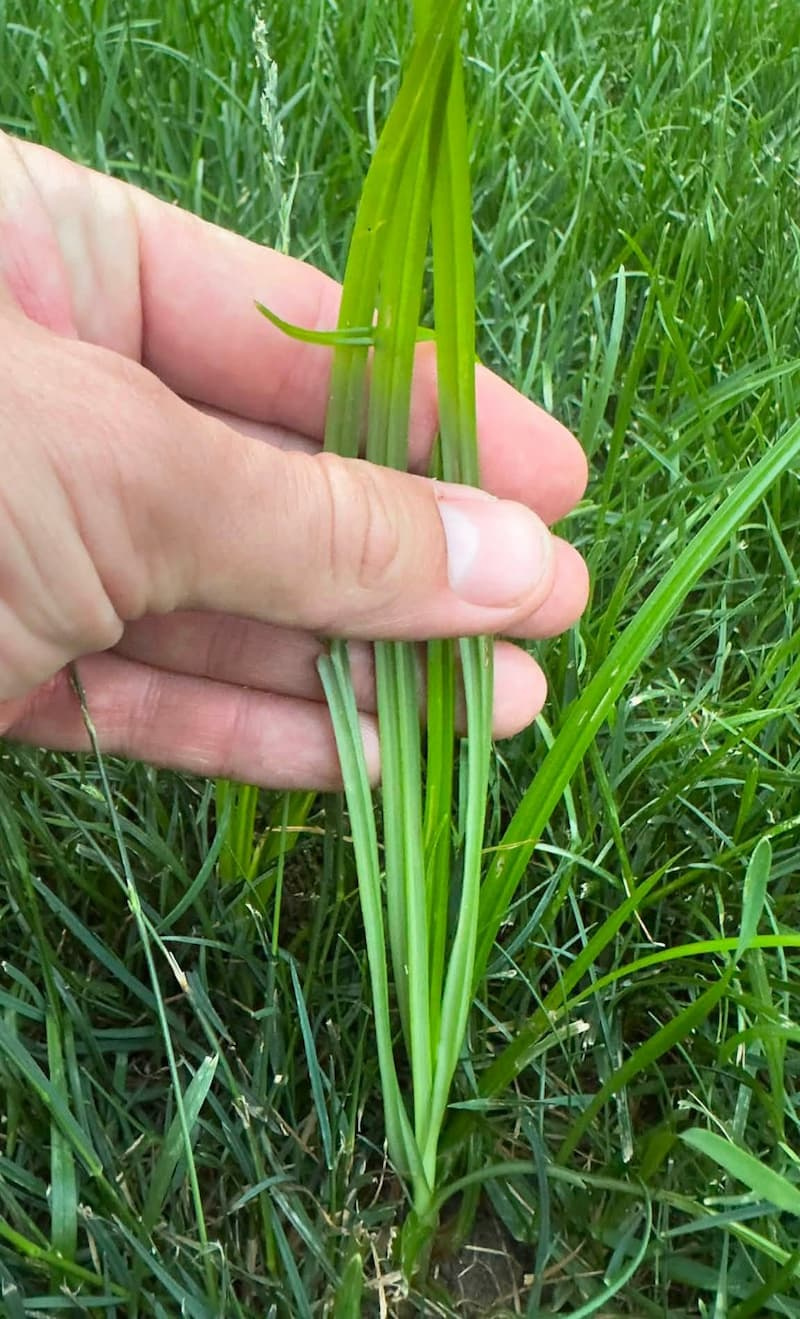
Diagnostic view of yellow nutsedge leaves originating in three distinct directions from a rigid, triangular stem base.
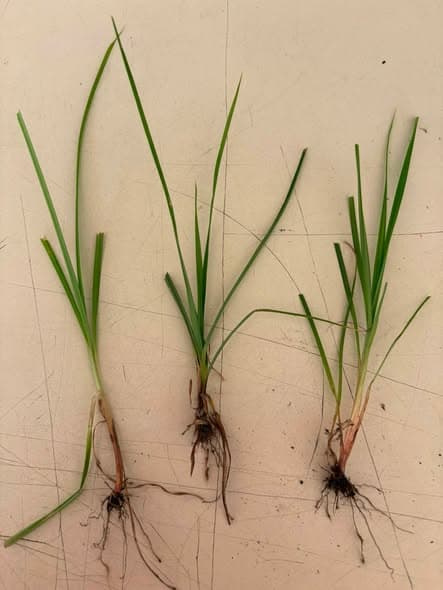
Uprooted yellow nutsedge specimens showing slender fibrous roots and light-colored basal bulb architecture.
The Identity Trap
Common Lookalikes
- Grassy weeds (especially crabgrass): The most common and most expensive mix-up. People assume it’s a grass, reach for crabgrass killer, and nothing happens — because sedges shrug off grass herbicides entirely.
- Purple Nutsedge: The sibling. Same overall look, but different enough underground and in the seedhead to matter, since a few products control one and not the other.
Identification Differentiators: How to Tell Them Apart
- vs. any grass: Roll the stem. Three hard edges and no nodes = sedge, not grass. That single test redirects you from a wasted grass-herbicide purchase to the right sedge chemistry.
- vs. Purple Nutsedge: Three tells. Leaf tips — yellow nutsedge tapers gradually to a fine needle point; purple ends more abruptly. Seedhead — yellow is golden/straw; purple is reddish-purple to brown. Tubers — yellow grows them singly at rhizome tips and they taste sweet; purple grows them in chains and they taste bitter.
Growing Conditions
Host Grasses
Yellow nutsedge doesn’t play favorites — it invades cool-season stands (Kentucky bluegrass, tall fescue, perennial ryegrass, fine fescue) and warm-season stands (bermudagrass, zoysiagrass, St. Augustinegrass, centipedegrass) alike. What it needs isn’t a particular grass, it’s an opening. In cool-season lawns it strikes in July and August, when the grass is heat-stressed and thin and this heat-loving sedge is at full throttle. In warm-season lawns it exploits the thin spring canopy before the turf fully greens up. Centipedegrass is the most vulnerable warm-season turf, because it thins fast under compaction and insect damage, handing nutsedge the bare ground it wants.
Host Environment/Area
This weed follows water. It establishes first in the wet, low, poorly drained parts of a yard — swales, depressions, spots under a leaky sprinkler head, anywhere the soil stays saturated. There’s a real reason for that, not just a preference: a fresh tuber is coated in a natural sprouting inhibitor, and it only wakes up once soil moisture washes that coating off. Constantly wet soil keeps triggering new sprouts. Once established, though, the plant’s deep roots let it tolerate normal watering and even drought, so it spreads outward from the wet spot into healthy turf.
Beds are more favorable to it than lawns. Open ground between shrubs means full sun on bare, loose, irrigated soil — ideal for fast tuber-making — whereas in a lawn the turf canopy and mowing at least keep it partly in check. A single tuber dropped into a mulched bed can take the whole bed over.
Soil Indicators: What the Presence of This Weed Reveals About Your Yard
Yellow nutsedge is one of the most reliable “read-the-soil” weeds you’ll find in a lawn. Where it keeps coming back, it’s telling you the soil is chronically wet, poorly drained, or compacted — low infiltration, a compacted layer below, or a high water table. It’s specifically adapted to survive the low-oxygen conditions of saturated, packed soil that make desirable grass roots suffocate and die. In other words, it isn’t only a weed problem; it’s a drainage diagnosis. Fix the water and you remove its home-field advantage.
Lifecycle and Season
Lifecycle Category and Management Implications
Yellow nutsedge is a tuberous perennial, and that single fact dictates everything. It does not die and start over from seed each year — it overwinters as dormant tubers packed with stored energy, and a single plant can build from over a thousand up to 6,000 new tubers in one season. Because the plant comes back from these underground tubers rather than from germinating seed, ordinary pre-emergent herbicides are nearly irrelevant, and hand-pulling backfires. The only reliable chemical route is a sedge-specific, systemic herbicide that travels down into the tubers, applied in a narrow early-summer window, repeated over several seasons.
Germination Trigger
This is one of the last weeds to show up in spring. Dormant tubers can begin breaking dormancy once soil reaches the mid-40s°F, but widespread emergence needs soil consistently in the low-to-mid 50s°F (around 53–54°F) — roughly two to three weeks after crabgrass appears. Sprouting is tied to moisture as much as heat: the tuber must have its natural sprouting-inhibitor coating washed off by wet soil before its buds will fire. Emergence isn’t one clean flush — tubers keep sprouting through spring and summer.
Shoots emerge late April into May and hit full speed in July and August, exactly when cool-season turf is thinning under summer heat. Target the post-emergent window in late May to mid-June, while shoots are young (3–8 leaves) and still living off the parent tuber — before new tuber production kicks off in late June/early July. The reason timing is everything: once the plant starts making new tubers, its internal sugar flow shifts and herbicide can no longer ride down into the tubers to kill them. Pre-emergent is not a standalone tool here.
Emergence begins as soils warm into late spring, with the peak by early June. Same rule applies — treat late spring to early summer, before the July tuber-formation switch. The added warm-season wrinkle is turf safety: avoid spraying during spring green-up, when warm-season grasses are running on stored root energy and are easily stunted, and never spray when air temperatures top 90°F (85°F for some products), which fries sensitive turf like St. Augustine and centipede.
The most complicated zone, because both grass types share the lawn. Nutsedge emerges early May and exploits both weak points — cool-season grass wilting in summer heat, and warm-season grass still thin during its slow spring green-up. The post-emergent target holds at late May to mid-June. Two hard scheduling conflicts define this zone: the “no pre-emergent after July 1” rule if you plan to overseed cool-season grass in fall, and the fact that the strongest warm-season sedge herbicides will kill the cool-season grass in a mixed stand.
Herbicide Control
Mostly not your tool. Standard pre-emergents (prodiamine, pendimethalin, dithiopyr) are built to kill germinating seeds, and this weed barely uses seed — it comes back from established tubers those products can’t touch. There is a narrow exception: a few soil-applied chemistries (the Group 15 chloroacetamides — S-metolachlor, dimethenamid-P) can suppress a shoot as it sprouts up from a tuber, catching it just above the bulb. But the catch for lawns is turf safety: S-metolachlor is not labeled for cool-season lawns (it will burn them) and is warm-season/landscape only, and dimethenamid-P (Tower) is largely a golf-course/landscape product. A couple of combination products (e.g., prodiamine + sulfentrazone) are labeled for cool-season turf and add some early activity. Even at best, a surface barrier can’t reach tubers sprouting from 8–14 inches down, so pre-emergent is a supporting player at most — post-emergent chemistry does the real work.
This is the primary tool, and it’s a multi-season program, not a one-and-done. First, why the herbicide aisle usually fails you: broadleaf killers (2,4-D, dicamba) and grass killers (fenoxaprop, sethoxydim) do nothing to sedges — wrong plant family, and they can’t even wet the waxy leaf. You need sedge-specific chemistry, and the single most important distinction is whether it reaches the tuber:
- Systemic (kills the tuber) — the backbone. Halosulfuron (Sedgehammer) is the workhorse: an ALS-inhibitor that’s absorbed by leaves and roots and travels down into rhizomes and tubers, killing the whole plant, and it’s safe on all major cool-season grasses. Apply at the 3–8 leaf stage, before tuber formation. Imazosulfuron (Celero) works similarly. Both need a non-ionic surfactant so the spray doesn’t bead off the waxy leaf. If regrowth appears, repeat in 6–10 weeks. Mesotrione (Tenacity) is another cool-season-safe systemic (it bleaches the foliage white) but needs two applications 14 days apart.
- Contact (burns the top, spares the tuber) — the fast but shallow option. Sulfentrazone (Dismiss) scorches foliage within 24–48 hours and is the fastest knockdown, but it barely reaches the tuber, so the plant regrows unless you hit it repeatedly. Bentazon (Basagran) is similar — contact-only, needs a crop-oil adjuvant, and repeat sprays. Both make the lawn look better fast while leaving the real target alive.
Why timing beats everything: a spray in June rides down into the tuber and kills it; the same spray in August mostly can’t, because the plant has flipped its sugar flow toward storing energy in newly-formed tubers, and those new tubers are already insulated and will resprout next spring. The most common failure is spraying too late. The second most common is skipping the follow-up: because tubers sprout on their own schedule, a second wave shows up 4–10 weeks after the first spray, and a single application only ever hit the first wave. Mowing note for any post-emergent: hold off mowing 2–3 days before and after so there’s leaf surface to absorb the spray.
The realistic verdict: expect 2–4 years of correctly-timed sprays plus the cultural fixes under Cultural Prevention in Lawn to knock the tuber bank down ~90%. Even 1% of surviving tubers can refill a lawn in one season if the wet-soil conditions aren’t fixed.
Cultural control here isn’t garnish — it’s half the program, because it removes the conditions the weed requires.
- Fix the water first. Regrade or drain low spots, repair leaky irrigation, and switch to deep, infrequent watering (about an inch once a week, letting the top inch or two dry out) instead of frequent light sprinkling. Dry surface soil literally prevents tubers from sprouting.
- Mow high. Keep cool-season turf at 3–3.5+ inches. Nutsedge can’t stand shade — trials show weekly mowing at 3 inches cut new-tuber production by about 63% purely by shading the soil. Warm-season grasses get mowed at their upper recommended height for the same reason.
- Time nitrogen for the fall. Nutsedge shrugs off fertilizer (it doesn’t grow faster with N), so summer feeding just thickens the grass’s competition weakly while risking heat damage. Feed cool-season turf in fall instead, so the grass, not the sedge, gets denser.
Repair thin turf fast. Bare ground is an open invitation; overseed and close the canopy before the next spring.
Beds actually have more pre-emergent options than lawns, because you’re not protecting a grass canopy. S-metolachlor (Pennant Magnum), dimethenamid-P (Tower/Freehand), and, around established woody plants only, dichlobenil (Casoron) are labeled around many ornamentals and can suppress shoots sprouting from tubers. Two real cautions: check the specific ornamental — S-metolachlor, for instance, is safe on many conifers but injures white pine during bud break — and mind the mulch. If you spray pre-emergent over existing mulch, roughly 85% of it binds to the mulch and never reaches the soil where tubers sprout. Apply to weed-free soil before mulching, or water it in with ¼–½ inch of irrigation so it reaches the soil surface.
Same verdict as the lawn — systemic chemistry, applied young — but delivered as a careful directed spray. Halosulfuron (SedgeHammer/Sandea) is again the best choice: systemic, reaches the tubers, and labeled around many established ornamentals — but it’s harsh on young broadleaf plants, so keep it off desirable foliage. Imazaquin (Image) controls both yellow and purple nutsedge and is over-the-top safe on select groundcovers like liriope and mondo grass. Bentazon is contact-only (fast burn, tuber survives). Glyphosate is a common reach but only marginally works on nutsedge — it won’t translocate into mature tubers, so it only does anything on young shoots under 5 leaves, and it kills anything green it touches. Whatever you choose, use directed, shielded, low spray with medium-to-coarse droplets to avoid drift onto ornamentals (spruce is extremely sensitive to glyphosate; thin-barked trees can get bark cankers). Verdict for beds: still multi-season, and disturbance discipline (no tilling) matters even more than in turf.
Disposal rule that surprises people: whatever you remove — plants, roots, soil clumps — bag it and trash it. Never compost it. Home compost rarely holds the 145°F needed to kill tubers, so composting just breeds a fresh infestation you’ll spread with the finished compost.
Mulch is a weak barrier against this particular weed, so don’t over-rely on it. A 2–4 inch layer smothers annual weeds that germinate from tiny seeds, but nutsedge sprouts from energy-loaded tubers with enough push to drive straight up through several inches of mulch. Worse, its leaf tips are rigid and needle-sharp — they puncture through landscape fabric and even black plastic (which actually makes things worse by warming the soil and triggering sprouting). Fabric fails fastest at seams and edges, and once mulch on top of fabric breaks down into a thin soil layer, the weed roots right through the fabric pores and locks itself in. Mulch helps at the margins; it does not stop established nutsedge.
Herbicide Application Reference
- Surfactant is mandatory, and the type is specific. Sedge leaves are waxy enough to bead off a plain spray. Halosulfuron and the other sulfonylureas need a non-ionic surfactant; bentazon needs a crop-oil concentrate. Skip it and the spray rolls off — a leading cause of “it didn’t work.”
- Do NOT add surfactant to sulfentrazone (Dismiss) on turf — it sharply raises the risk of burning your own grass.
- Heat and drought limits are real. Don’t spray sedge herbicides above 90°F (85°F for some), or onto drought-stressed turf — you’ll injure the lawn and get poor uptake in the weed.
- Transition-zone selectivity is a trap. The strongest warm-season sedge products — trifloxysulfuron (Monument) and flazasulfuron (Katana) — are designed to remove cool-season grass and will wipe out any tall fescue, bluegrass, or ryegrass in a mixed lawn. On mixed stands, stay with halosulfuron or bentazon, which are safe over both grass types. And imazaquin (Image) must not be applied during spring green-up on warm-season turf.
A product note: if you do reach for glyphosate, read the active-ingredient panel first. The consumer “Roundup” brand no longer reliably means glyphosate — several reformulated versions contain other active ingredients, and some leave residue in the soil that nearby roots can take up.
Herbicide Application Guide
New to spraying, or want to get it right? Our Herbicide Application Guide covers the practical steps this page assumes — mixing, calibration, protective gear, and the wind and temperature limits that decide whether a treatment works or drifts. Read it before you spray.
See Guide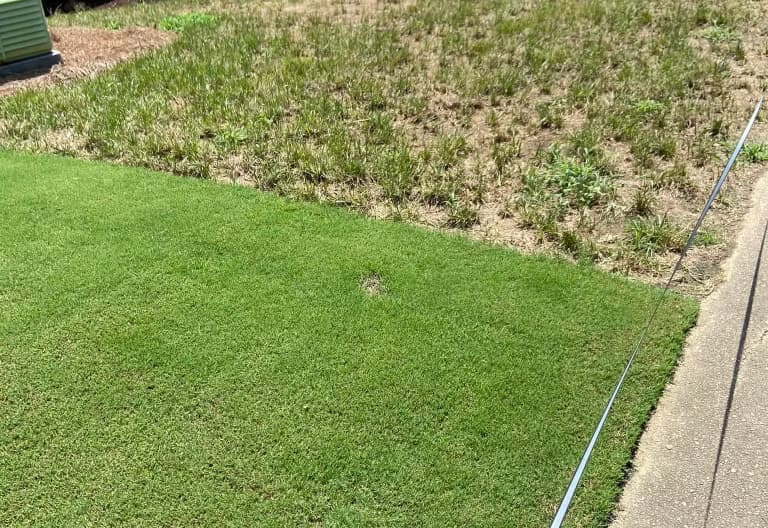
Where Two Lawns Meet
Does your lawn border a neighbor’s — or meet a different type of grass? Spraying near that line can quietly damage the yard next door, sometimes weeks later. Where Two Lawns Meet shows you how to treat safely without harming either side.
Read ArticlePulling
Don't pull it. Pulling makes it worse. This is one of the few weeds on MFY where the standard "just yank it" instinct actively multiplies the problem.
The Biological Reason
Two things go wrong when you pull, and both come straight from the plant’s underground design.
Underground Structure Explainer
The underground system has four parts. A basal bulb (a swollen stem base) sits in the top ~3 inches. From it, thin white rhizomes run sideways and down. Each rhizome ends in a single round tuber — the survival capsule, loaded with stored sugar. A fibrous root fan pulls in water. Over 80% of tubers sit in the top 6 inches, but rhizomes and stragglers reach 8–14 inches down, and shoots can climb up from as deep as 18 inches.
Problem one: you remove none of it. The link between the leaves and the basal bulb is deliberately weak, so when you pull, the plant snaps clean at the soil line. The bulb, the rhizomes, and every tuber stay behind. Hand-pulling removes 0% of the tuber bank. The plant regrows to full height within days.
Problem two — the multiply trap: pulling wakes the backups. Each tuber carries 3 to 7 buds (“eyes”), but normally only one or two sprout. The growing shoot sends a chemical “stay asleep” signal (apical dominance) down to the rest. Snap that shoot off, and the signal stops — and the sleeping buds on that tuber, plus buds on connected neighbor tubers, all wake and sprout at once. You pull one shoot and a few weeks later you’re looking at several where there used to be one. A single tuber can push out shoot after shoot this way, and doing so burns its reserves — the first sprout uses roughly 60% of its stored energy, the second another 20%.
That last fact is the only opening for mechanical control, and it’s a narrow one: because each sprouting drains the tuber, relentless removal of every shoot before it reaches about 5 leaves — pulling every week or two, all season, for two-plus seasons — can eventually starve the tuber bank out. Miss the timing even once and it resets: past ~5 leaves, a shoot flips from spending the tuber’s energy to recharging it and building new tubers, erasing your progress. For any area bigger than a small patch this is labor-prohibitive (commercial hand-pulling runs $200–$400 per acre per season), which is why chemistry, not muscle, is the real tool.
Lawn vs. Bed Pulling Difference
The verdict is the same in both — don’t pull — but beds make the disturbance mistake far worse. In loose, cultivated bed soil, a hoe or (especially) a rototiller slices the rhizomes and drags tubers all over the bed, dropping them into exactly the loose, airy conditions that trigger instant sprouting. One localized clump becomes a bed-wide infestation. Never rototill a nutsedge patch. In compacted turf there’s less scattering, but the snap-and-multiply trap still applies to every pull.
Quick Reference Summary
| Lifecycle | Tuberous perennial (sedge) |
| Active Zones | All three — cool, warm, transition |
| Emergence Trigger | Soil consistently ~53–54°F + wet soil (late; ~2–3 wks after crabgrass) |
| Pre-Emergent | Limited — only special sedge chemistry, mostly a supporting tool |
| Post-Emergent Window | Late May–mid-June, 3–8 leaf stage, before July tuber-set |
| Pull | No — pulling multiplies it |
| Lawn Primary Tool | Systemic sedge herbicide (halosulfuron) + drainage/shade |
| Bed Primary Tool | Directed systemic sedge herbicide + no tilling + bag-don’t-compost |
| One-and-Done or Multi-Season | Multi-season (2–4 years) |
Frequently Asked Questions
These answers are synthesized from botanical morphology studies and herbicide efficacy trials conducted by leading university agricultural extensions.
Because pulling snaps the shoot off and leaves 100% of the tubers in the ground, and the act of pulling wakes up the tuber’s backup buds. Each tuber holds several sleeping buds that the growing shoot keeps dormant; remove the shoot and they all sprout. One pull genuinely turns one plant into several. Use a systemic sedge herbicide instead.
You almost certainly used a broadleaf or crabgrass product. Nutsedge is a sedge — a different plant family — and those products do nothing to it. You need a sedge-specific herbicide (look for halosulfuron), and you need a surfactant so it doesn’t bead off the waxy leaves.
Not immediately. Halosulfuron stunts new grass roots if you seed within about two weeks of spraying. And if you’re planning a fall overseeding, don’t apply pre-emergent nutsedge products after July 1 — the soil residue will stop your new grass seed from rooting.
No — yellow nutsedge isn’t toxic. Its tubers are actually the edible “tiger nut” (chufa) and taste sweet. It’s a nuisance and a lawn-health problem, not a poisoning risk.
No. Mowing doesn’t touch the tubers, and nutsedge regrows above the turf within days. Mowing high helps only indirectly, by shading the soil so fewer new shoots and tubers form — but it’s a suppression tactic, not a kill.
No — that’s the diagnosis. Yellow nutsedge is a reliable signal of chronically wet, poorly drained, or compacted soil. Fix the drainage in that corner and you remove the main reason it’s winning there.
Scientific Authority
This profile is constructed using forensic botanical data and Integrated Pest Management (IPM) research. We prioritize scientifically-vetted identification and control methods that protect the broader ecosystem while ensuring successful eradication based on peer-reviewed agricultural studies.
Primary Resources
- Penn State Extension — Lawn and Turfgrass Weeds: Yellow Nutsedge (Cyperus esculentus); Indicator Weeds Provide Insight into Growing a Better Lawn
- Purdue Extension / Purdue Turf — TURF-45: A Problem Weed: Controlling Yellow Nutsedge in Lawns; Sedge Control for Turf Professionals; Controlling Yellow Nutsedge with SedgeHammer+
- Rutgers Cooperative Extension (NJAES) — FS1341: Nutsedge Life Cycle Disruptions for Effective Control
- Cornell CALS / Cornell Cooperative Extension — Yellow Nutsedge weed profile; Controlling Nutsedge (Nassau County)
- Michigan State University Extension — Controlling Yellow Nutsedge in Turfgrass; Yellow Nutsedge — Plant & Pest Diagnostics
- University of Minnesota Extension — turfgrass weed management (nutsedge)
- UF/IFAS Extension — ENH1305/EP569: Biology and Management of Yellow and Purple Nutsedge in Ornamental Crop Production and Landscapes; Weeds as Indicators of Soil Conditions in Lawns and Landscapes
- UC IPM / UC ANR — Pest Notes: Nutsedge; Weed Management in Landscapes
- NC State Extension / TurfFiles — Yellow Nutsedge; Controlling Sedges in Landscape Plantings; Tower / Pennant Magnum labels
- Clemson Cooperative Extension (HGIC) — Nutsedge; Weed of the Month: Yellow Nutsedge; Weeds as Indicators
- LSU AgCenter — Louisiana Home Lawn Series: Yellow Nutsedge; turfgrass tolerance tables
- University of Georgia CAES / GeorgiaTurf — Yellow Nutsedge; Weed Control in Home Lawns
- Texas A&M AgriLife (AggieTurf) — Nutsedge and Kyllinga Control for Homeowners; Homeowner’s Guide to Herbicide Selection for Warm-Season Lawns
- University of Nebraska (UNL Turf) — Yellow Nutsedge Control; Strategies for increased yellow nutsedge control with halosulfuron/sulfentrazone
- Virginia Tech / VCE — Driving Homeowners ‘Nuts’: Sedge in the Lawn
- West Virginia University Extension — Yellow Nutsedge
- University of Tennessee (Plant Sciences) — Yellow Nutsedge; Nutsedge and Kyllinga Species
- University of Missouri Extension — Managing Lawns and Turfgrass
- Oklahoma State University Extension — Controlling Weeds in Home Lawns (HLA-6421)
- University of Kentucky Extension — herbicide recommendations for KBG/tall fescue lawns; transition-zone bermudagrass management
- Kansas State Research and Extension — MF2385: Weed Control in Home Lawns
- Ohio State University Extension — Ohio Perennial and Biennial Weed Guide: Yellow Nutsedge
- University of Arkansas Cooperative Extension — Yellow Nutsedge
- Auburn / Alabama Cooperative Extension (ACES) — Home Lawns: Chemical Weed Control