
Scientific Name: Eremochloa ophiuroides (Munro) Hack. Basionym: Ischaemum ophiuroides Munro. The genus has not been reassigned in modern turfgrass literature — unlike tall fescue, this grass carries one accepted binomial, and Eremochloa placement is stable across extension, USDA, and peer-reviewed sources.
Common Names: Centipedegrass; centipede grass; centipede. Historically "China grass" in the early USDA literature. Widely nicknamed "lazy man's grass," and in Clemson's account also "poor man's grass," from its Depression-era spread as a lawn nobody had to feed or mow much.
Centipedegrass
The Southern lawn grass that dies from too much care, not too little.
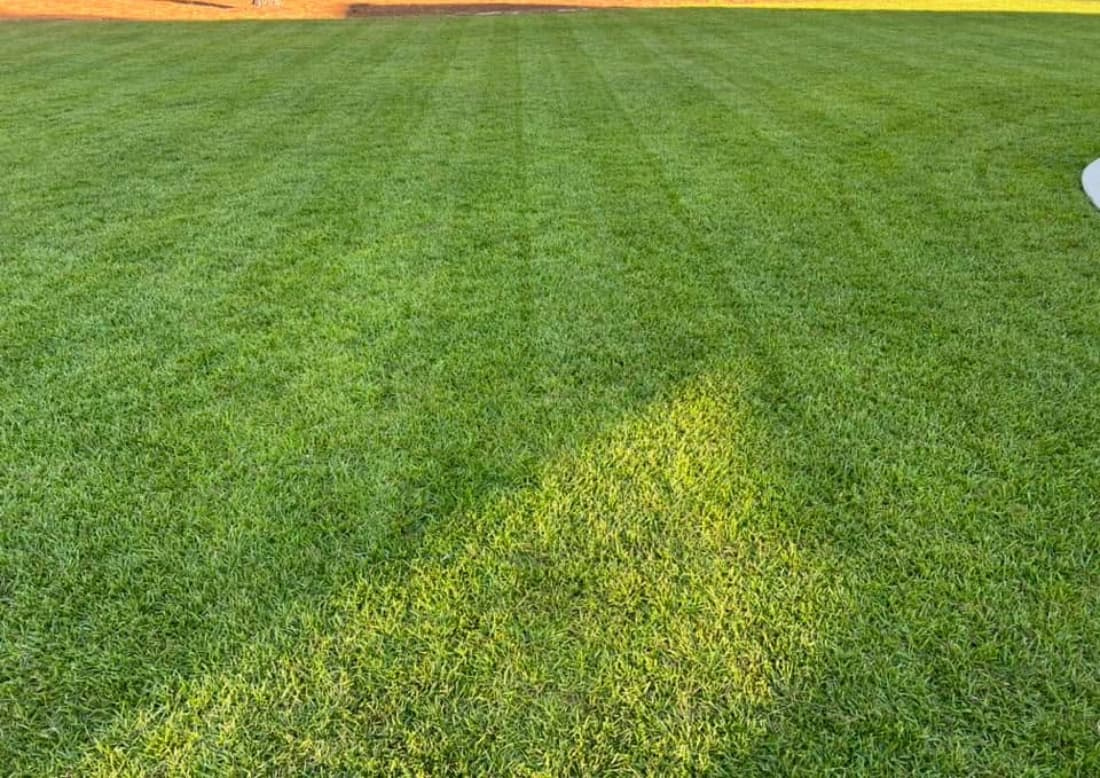
Centipedegrass At-a-Glance
Hardiness Zone Min
Zone 7
Water Requirement
Moderate
Sun Requirement
Full Sun to Light Shade
Wear Tolerance
Low
Establishment Speed
Slow
Labor Intensity
Low
The Narrowest Gene Pool in Turf
Almost every centipedegrass lawn in America traces back to one bag of seed.
In 1916 a USDA plant explorer named Frank N. Meyer collected seed in southern China and sent it home. Meyer died on that expedition — he disappeared on his fourth trip to China — and the seed in his baggage became the founding stock for the entire United States population. Botanists call a collection like that an accession. Nearly the whole species in this country came from that one.
That single introduction explains most of what this grass is. In its home range across southern and central China and into Southeast Asia, centipedegrass grows on acidic soils that are low in phosphorus and high in aluminum — ground that starves most plants. It evolved to run on almost nothing. When it reached the American Southeast it found the same conditions waiting in the sandy, acidic coastal plain, and it took hold fast.
Its first American job was cemeteries, where nobody wanted to mow. It moved into home lawns during and after the Depression, when nobody could afford to. The nicknames followed and stuck: lazy man’s grass, and in Clemson’s telling, poor man’s grass. Early USDA writing simply called it China grass.
The narrow start came with a permanent cost. Because nearly all US centipedegrass descends from that one accession, the species has one of the narrowest gene bases in turf, and breeders have had very little raw variation to work with. USDA records no infraspecific taxa for it at all — no natural varieties, no subspecies, nothing to divide it into.
So improvement has come slowly and in small steps, and it has come almost entirely out of university programs. Glenn Burton and Wayne Hanna worked the species for decades at the USDA and University of Georgia station in Tifton, and the 1997 release of TifBlair is the one that mattered most, because it pushed the grass’s usable northern edge outward rather than just changing how it looked. Auburn produced a sterile dwarf in AU Centennial, the University of Tennessee released TennTurf, Oklahoma State released Oaklawn, and the University of Florida released Hammock for subtropical South Florida.
Read that list as history, not as a shopping aisle. What it tells you is where the real variation sits. After a century of breeding on a narrow base, the differences that exist are cold hardiness above all, then how far south the heat can be taken, then how fine and dense the turf grows. Those three are handled on the subtype pages. Everything else on this page applies to all centipedegrass, everywhere it grows.
Gallery
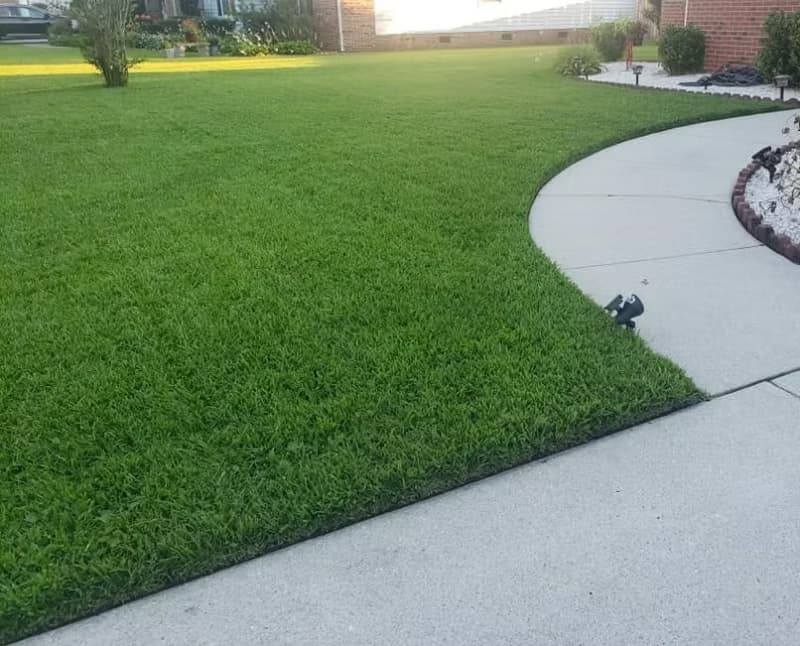
A mature centipedegrass lawn exhibiting high canopy density and crisp mechanical edging along a curved walkway.
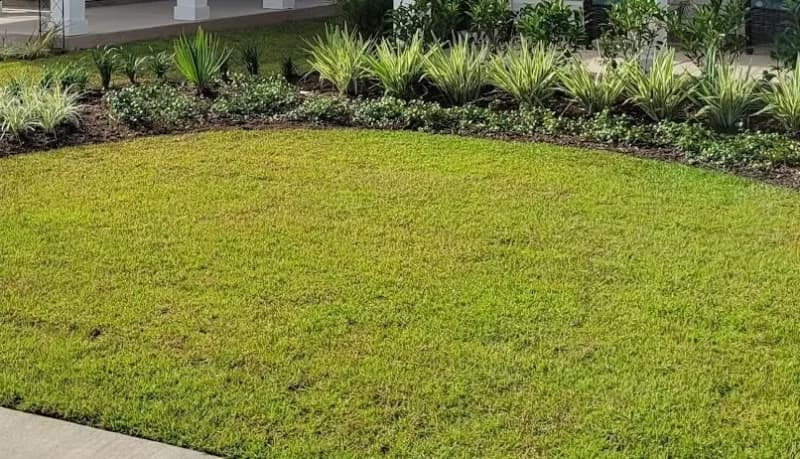
Centipedegrass established in a coastal landscape setting, demonstrating its natural adaptation to acidic, sandy soils and low nitrogen inputs.
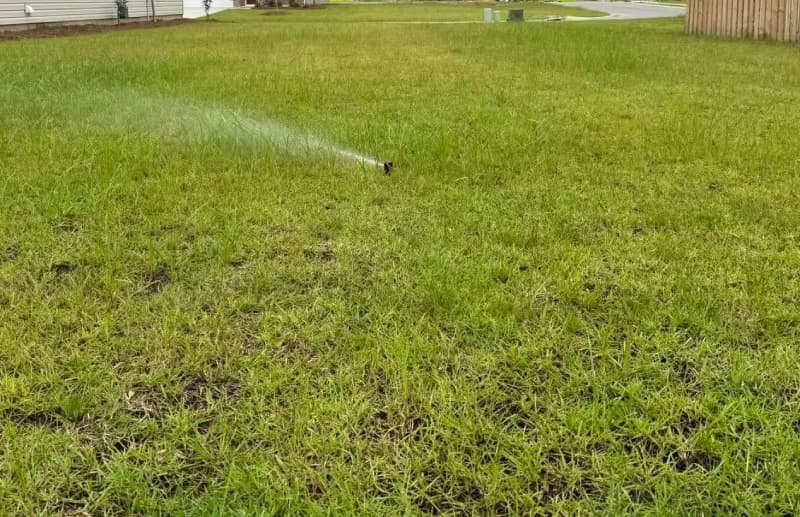
Early-stage centipedegrass sod establishment displaying an open canopy, highlighting its slow fill rate compared to aggressive warm-season turf species.
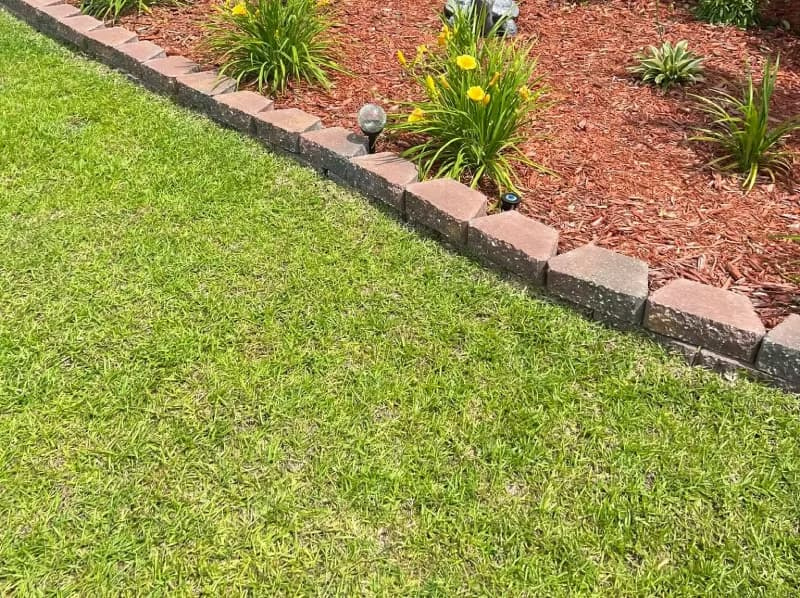
Above-ground stolons of centipedegrass encroaching across landscape borders, illustrating its aggressive lateral spreading habit.
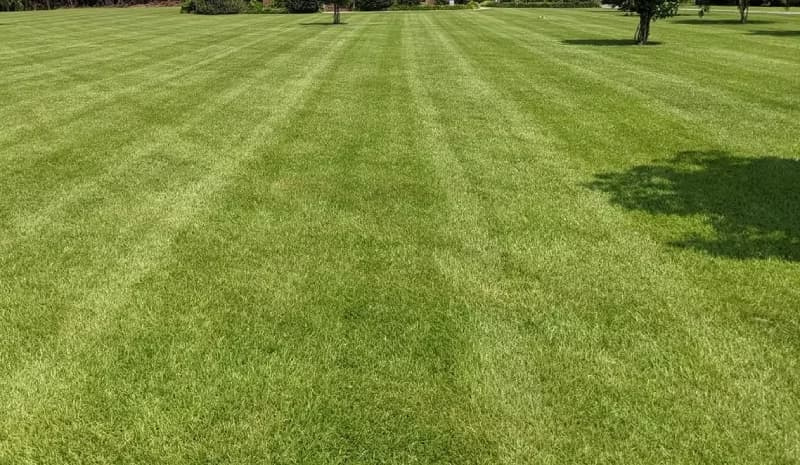
A large-acreage centipedegrass lawn showing its light apple-green color and clean striping response under commercial reel or rotary mowing.
Telling It Apart
Centipedegrass is easiest to recognize by color and habit: a low, creeping lawn of pale apple-green — often described as Granny Smith green — that spreads only by surface runners and never sends up underground stems.
Up close, here is the checklist.
- Blade width is medium, about 1/8 to 3/16 inch, flat, with a strong white central vein and a hard crease down the middle. NC State measures it at 0.1 to 0.2 inch.
- Blade tip is pointed to bluntly rounded.
- Blade edges carry a few short hairs near the base.
- Ligule — the small collar where blade meets sheath — is a short purplish membrane topped with fine hairs, only about 0.02 inch long.
- Auricles — the little ear-like clasps some grasses have — are absent.
- Collar is broad, pinched by a fused crease, and hairy at the lower edge.
- Leaf sheath is flattened and split, with grayish tufts of hair at the throat.
- Seedhead is a single slender spike about 3 to 5 inches long, purple when flowering and browning as it matures.
- Rhizomes are absent. Only stolons. This one is diagnostic.
The look-alike that matters most is St. Augustinegrass, since both are stoloniferous Southeastern grasses with broad-looking leaves. Three tells separate them reliably.
- Leaf arrangement. Centipedegrass leaves alternate along the stolon. St. Augustine’s come in opposite pairs. This is the most dependable single test.
- Width and color. Centipedegrass is narrower-bladed and pale apple-green. St. Augustine is roughly twice as wide, with a rounded boat-shaped tip and a darker blue-green color.
- Stolon thickness. Centipedegrass stolons are slender. St. Augustine’s are thick and stout.
The secondary confusion is young common bermudagrass before its canopy fills in. Bermuda has underground stems — rhizomes — that centipedegrass entirely lacks. Its ligule is a simple fringe of hairs rather than a purplish membrane. And its leaf tips are sharply pointed, with a ring of hairs at the base.
Two commonly repeated details did not hold up in the sources behind this page, so they are left out rather than stated as fact: that the name “centipede” comes from short stolon internodes, and that the seedhead is distinctly curved. Both are undocumented at this level.
Identification Photos
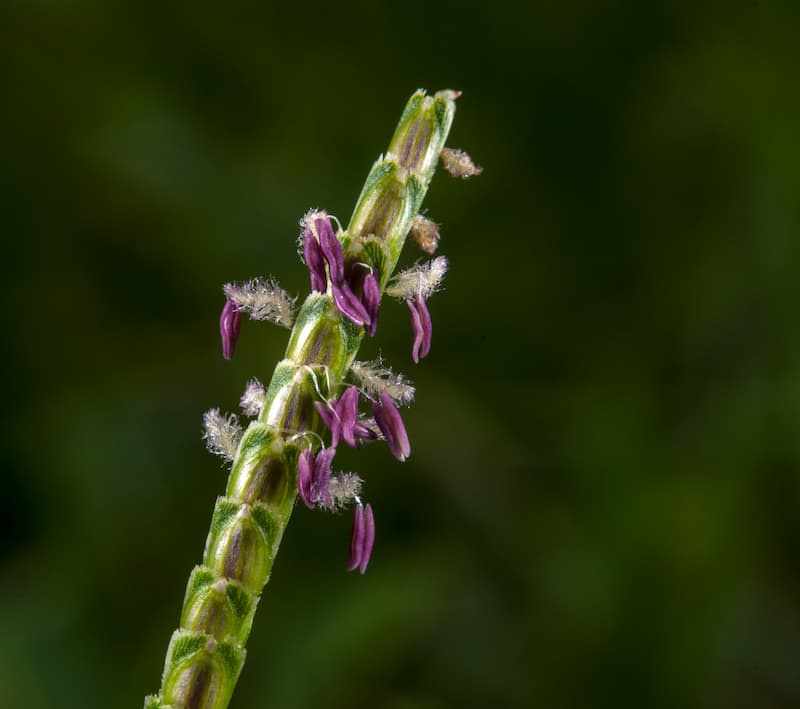
Look For: A single, slender, unbranched spike, often with pink or purple stigmas showing at flowering.
“Eremochloa ophiuroides infloresence at anthesis” by T.M.Jones is licensed under CC BY-SA 3.0.
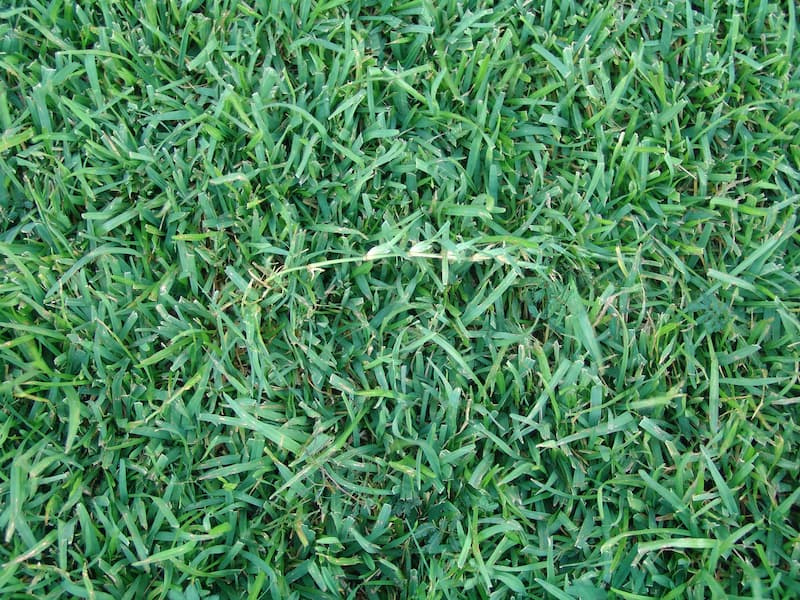
Look For: A low, dense mat of medium-textured blades, typically a lighter, yellow-green shade than bermudagrass or zoysiagrass.
“Centipede Grass” by James Becwar JamesBecwar (talk) is marked with CC0 1.0.
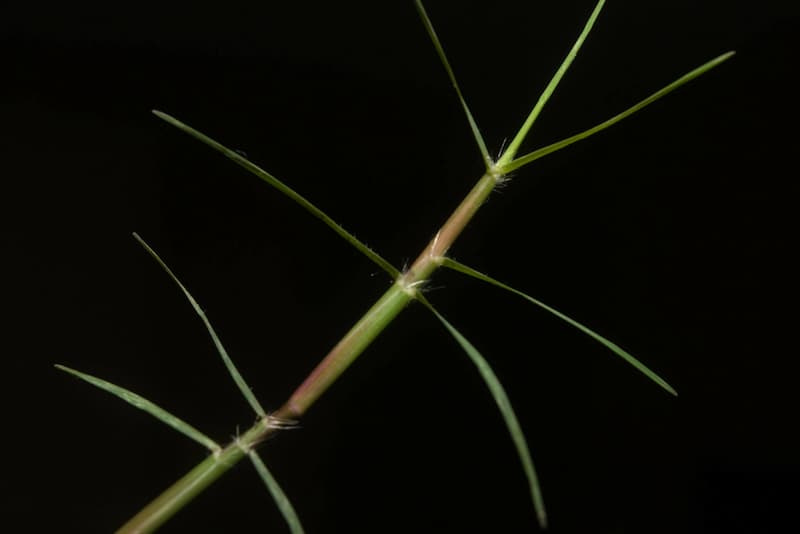
Diagnostic Feature: Slender, creeping stolons with short leaves branching off at each node.
“Eremochloa ophiuroides” by Kevin Faccenda is licensed under CC BY 4.0.
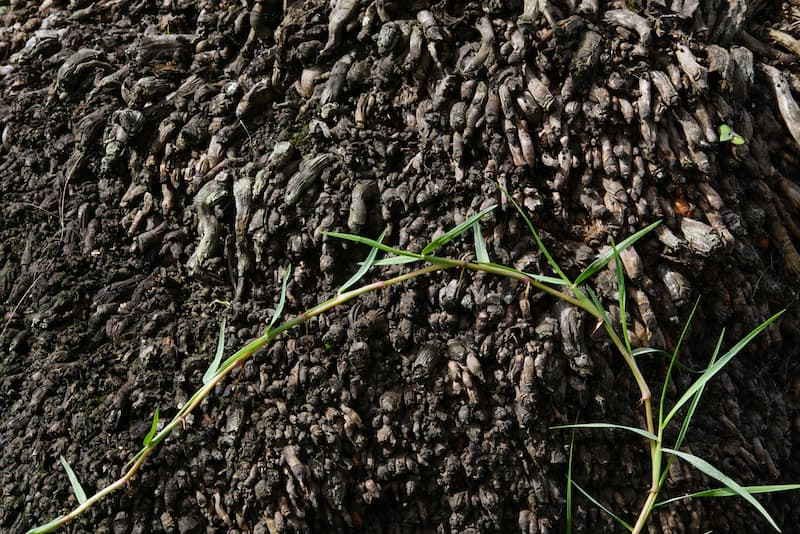
Look For: Runners that extend across bare soil and root at the nodes, with a short tuft of blades at each node. This is how centipedegrass moves into open ground.
“Centipedegrass 00722” by Vengolis is licensed under CC BY-SA 4.0.
Is Centipedegrass Right For Your Yard?
Advantages:
The lowest fertilizer demand of any common Southern lawn grass. About 1 pound of nitrogen per 1,000 square feet per year, against 4 to 6 for hybrid bermudagrass. That is a real, recurring cost difference.
Very little mowing. Every 10 to 14 days in peak season, because it genuinely grows slowly rather than because you are letting it go.
It thrives on soil that defeats other grasses — acidic, sandy, infertile ground is its native condition, not a compromise. It evolved on acidic, phosphorus-poor soil in southern China.
Dense enough to suppress weeds once established, which reduces herbicide need in a grass that tolerates herbicides poorly.
Few serious pest problems where it is properly adapted and correctly managed. Most of its trouble is self-inflicted.
Easy to keep out of beds and walks. Because it spreads only by surface runners with no rhizomes, edging actually holds.
Genuinely low input cost overall. It is one of the least expensive lawns to run in the Southeast, year over year.
Best If:
- You are in USDA Zone 8a or 8b in the humid Southeast or Gulf Coast — Florida’s Panhandle and north, Georgia, Louisiana, the southern halves of Alabama and Arkansas, eastern Carolinas, or East Texas.
- Your soil is sandy and acidic, ideally pH 5.0 to 6.0. This is the grass that wants the soil everything else struggles on.
- You want the lowest-input lawn available in the region and you actually mean it — you are prepared to fertilize once a year and leave it alone.
- Your lawn is decorative rather than functional. Light foot traffic only, no play field, no dog run, no parking on it.
- You get 6 or more hours of direct sun, with morning sun in particular so the canopy dries early.
- You can accept a pale apple-green color and a uniformly brown winter without reaching for the fertilizer spreader.
- You are willing to spend on sod, or wait two to three years on seed. Either is fine. Wanting a fast lawn cheaply is not.
Disadvantages:
The weakest cold tolerance of the common warm-season lawn grasses. Winterkill at the northern edge is erratic and can take an entire lawn in one bad season.
Very poor recovery. With stolons only and no rhizomes, voids take months to close, and severe damage requires physical replanting rather than waiting.
Poor traffic and compaction tolerance. The canopy is loose and tears under use. NC State lists traffic and compaction among the conditions it flatly does not tolerate.
The poorest drought tolerance among warm-season grasses. Shallow roots. It survives drought by going dormant rather than by performing through it.
Extremely slow to establish from seed — two to three years to a fully dense lawn, with the ground open to weeds and erosion the whole time.
Unusually sensitive to herbicides, which narrows your weed-control options right when a slow-establishing lawn needs them most.
Fails from over-care. Too much nitrogen, lime, water, or mowing drives thatch, iron chlorosis, and centipedegrass decline. The instinct to help it actively hurts it.
Naturally pale. The apple-green color is normal and permanent, and it will never look like a fed bermudagrass lawn. Chasing dark green is what kills it.
No salt tolerance at all — coastal spray, brackish groundwater, or softened irrigation water all rule it out.
Almost no cultivar-level trial data. The narrow gene base and thin NTEP record mean the usual selection tools barely apply.
Avoid If:
- Your soil pH is 6.5 or above, or the soil is alkaline or calcareous — coral sand, marl, or heavily limed ground. This is a hard exclusion, not a challenge to manage.
- You are exposed to salt in any form: coastal spray, saltwater intrusion, brackish or softened irrigation water.
- The lawn will take real traffic — children playing, dogs running, sports, or regular vehicle parking. It tears and does not come back.
- You are north of Zone 7, or in the transition zone and unwilling to accept that a bad winter can take the whole stand.
- You are in a cool or arid climate. Cold rules it out in the north, and in dry climates the irrigation needed to keep it green defeats the reason for planting it.
- The site has less than about 6 hours of direct sun, or heavy shade of any kind.
- The soil is heavy clay, muck, or poorly drained, or the area stays saturated during the growing season.
- You want a dark green, manicured, golf-course-looking lawn. You will fertilize it to death trying.
- You want fast repair after damage. Choose a rhizomatous grass — bermudagrass or zoysiagrass — if self-repair matters to you.
Is It Safe for Pets and Kids?
No toxicity to pets, livestock, or people is documented in the university-extension, USDA, or peer-reviewed literature reviewed for this page. Separately, and unrelated to plant toxicity: this grass has low urine resistance, so dog spots burn in and then persist, because there are no rhizomes to fill the void back in.
Where It Grows and Where It Fails
Centipedegrass belongs to the warm, humid lower South. The edges of that range are sharp in every direction, and each one fails for a different reason.
It is recommended statewide in Florida, Georgia, and Louisiana, across the southern halves of Alabama and Arkansas, throughout eastern North and South Carolina, and on the sandy soils of East Texas. In USDA hardiness terms, Zones 8a and 8b are home. It stretches into Zone 7 and reaches Zone 9 in central Florida, but both of those are compromises rather than comfortable fits.
The northern edge is cold, and it fails unevenly. Centipedegrass has the weakest cold tolerance of the common warm-season lawn grasses. At the top of its range winter injury is erratic — it can wipe out one lawn completely while the identical lawn next door comes through untouched. That unevenness is not luck. Three separate mechanisms are running, and you can influence all three.
- A warm spell in late winter — a false spring — coaxes the grass partly out of dormancy and its crowns fill with water. If a hard freeze below about 23°F follows, ice forms inside those swollen cells and ruptures them.
- Sustained cold below about 25°F for several days kills it outright, with no false spring needed.
- Dry, windy winters pull water out of the crowns while frozen soil stops the roots from replacing it.
Three things you control make all three worse. A thick thatch layer lifts the crowns off the soil that would otherwise insulate them. Late-season nitrogen pushes soft growth that never hardens off. And low potassium — common in sandy soils — leaves cells short of the dissolved salts that lower their freezing point. North-facing slopes and heavy shade pile on by keeping the soil colder and wetter for longer.
The southern edge is not heat. Centipedegrass handles subtropical heat fine. What stops it in South Florida is soil chemistry and pests: alkaline, calcareous soil locks iron away from the plant, and sting and ring nematodes run hard in those sands. UF/IFAS calls the species well adapted to central and northern Florida and the most common home lawn grass in the Panhandle, and notes that only one cultivar has ever been bred for South Florida conditions.
The western edge is water. Its roots are shallow, so it cannot feed a dense lawn through heat and drought without constant irrigation — and irrigating that hard defeats the entire point of a low-input grass.
Across the five climate profiles the verdict is clean. Warm-humid is home, because acidic sandy flatwoods soil is exactly what it evolved for. Warm-arid is a poor fit. The transition zone is poor, on the false-spring winterkill above. Cool-humid is unsuitable — winters simply exceed its cold tolerance. Cool-arid was not documented by any source reviewed, though every mechanism that rules out the cool and arid profiles individually applies there at once.
Two site conditions rule centipedegrass out no matter which zone you are in. A soil pH at or above 6.5, or any alkaline or calcareous soil, and salt exposure of any kind — coastal spray, brackish groundwater, or softened irrigation water. These are not warnings to manage around. They are reasons to plant something else.
Getting Established
You can start centipedegrass two ways, and the tradeoff is stark enough that you should decide with your eyes open.
Sod gives you an instant, uniform, weed-suppressing lawn that roots in within three to four weeks. It costs more up front. Seed is far cheaper for large, flat areas, but centipedegrass is one of the slowest grasses in turf to establish, so the ground stays open to weeds and erosion for a long time. Extension offices across every zone generally steer homeowners to sod for that reason, and reserve seeding for tight budgets or large areas where erosion is not a risk. Plugs are best kept for patching.
How slow is seed, exactly? Germination takes 14 to 21 days, and up to 28 in dry conditions. Basic roots take six to eight weeks. A fully dense lawn takes two to three years. The old saying about it is accurate: the first year it sleeps, the second year it creeps, and the third year it leaps.
If you seed, plant in late spring to early summer once soil temperature is reliably above 60°F. Active growth kicks in around 65°F measured at a 4-inch depth. The seed is tiny, so mix it with 10 to 20 pounds of dry sand or cornmeal per 1,000 square feet to spread it evenly, at a rate of about 0.25 to 0.5 pound of pure live seed per 1,000 square feet. For vegetative starts, lay sod tight in a staggered brick pattern and roll it for firm soil contact, and set sprigs or plugs on 6- to 12-inch centers.
The grow-in is where people accidentally start a lawn down the path to decline. It comes down to one rule: do not push it, and do not feed it phosphorus.
Centipedegrass is phosphorus-sensitive. Excess phosphorus locks up soil iron and turns the grass yellow, so skip the standard high-phosphorus starter fertilizers that every other new lawn gets. Clemson and NC State recommend a slow-release, low-phosphorus product instead — something on a 15-0-15 with iron pattern — worked in before planting, with quick-release nitrogen held to no more than about 1 pound per 1,000 square feet.
Forcing nitrogen to speed up coverage backfires, and the mechanism is worth understanding because it explains half this page. Nitrogen drives soft top growth at the expense of roots. A shallow, succulent young lawn is exactly what winterkill, drought, and decline pick off first. You are not buying speed, you are buying fragility.
Keep a seeded bed constantly moist — like a wrung-out sponge — for the first two to three weeks, then water less often but more deeply to pull the roots down.
One more grow-in trap: young centipedegrass is very easily injured by weed killers. Pre-emergent herbicides stop root growth on seedlings and sprigs the same way they stop weeds. A new seeded lawn should be mowed at least three times before any weed killer goes down. There is more detail on this below.
Mixing and blends. Establish and manage centipedegrass as a single-species, single-cultivar monostand. Warm-season grasses differ too much in habit and needs to blend the way cool-season lawns do, and mixing centipedegrass with bermuda or zoysia gives you a patchy, uneven lawn where the more aggressive grass slowly wins.
There is one documented exception. LSU AgCenter validates companion-seeding with common carpetgrass (Axonopus fissifolius) at establishment. It works because carpetgrass shares centipedegrass’s apple-green color, similar texture, and preference for acidic soil, but germinates far faster — so it covers bare soil and holds it against erosion during the long window while the centipedegrass fills in and eventually dominates. Note honestly that no specific seeding ratio for that mix is published in the sources behind this page; the practice is validated, the exact percentages are not. Outside that one case, keep it a monostand.
Keeping It Healthy
Everything in the maintenance program bends toward less. That is not a style preference. Over-management is the primary way this grass dies.
Mowing. Keep it at 1 to 2 inches, with some regions going slightly higher — up to 2.5 inches in Florida. Do not drop below 1 inch. That scalps the surface stolons and thins the canopy, and because the grass has no underground stems to regrow from, thin spots fill in slowly and let weeds in. Follow the one-third rule and never remove more than a third of the leaf at once. If it gets away from you, lower the height gradually across several mowings rather than all at once. In heat, drought, or light shade, raise the height by a quarter to a half inch so the extra leaf can feed the plant and shade the soil. Centipedegrass grows slowly, so you will mow it far less often than bermuda — roughly every 10 to 14 days.
Fertility, which is the heart of it. The standard is about 1 pound of nitrogen per 1,000 square feet per year (UGA, LSU AgCenter, Texas A&M), rising toward 2 pounds only on sandy, high-rainfall coastal soils that leach. Rates are adjusted regionally, and UF/IFAS allows 0.4 to 2.0 pounds in North Florida and more in the longer-season south. More than that is the single most common way people kill this grass.
Timing matters as much as amount. Never feed in early spring while it is still greening up. That burns stored energy the roots need and leaves the lawn exposed to a late frost. Wait until it has fully greened and soil hits 65°F at a 4-inch depth, then apply once in mid-to-late May using a slow-release product, or split a soluble feed into a half pound in May and a half pound in July or early August. Stop all nitrogen by mid-August in the transition zone, or by about September 1 on the coast, so the grass can harden off before winter.
Here is the part that catches people. Centipedegrass is naturally pale — an apple-green that looks underfed if you are used to bermuda or St. Augustine. So homeowners fertilize to green it up, and that is the trap. To get color safely, use iron instead of nitrogen. Ferrous sulfate at about 2 ounces in 3 to 5 gallons of water per 1,000 square feet, or chelated iron per label, applied when it is below 80°F to avoid burning the leaf. Skip complete fertilizers like 8-8-8 or 10-10-10 entirely unless a soil test proves a phosphorus shortage. Do add potassium heading into fall — about 1 pound of potash per 1,000 square feet, four to six weeks before first frost — because potassium is what stiffens the plant against cold.
Soil pH, the signature number. Centipedegrass is acid-loving. It wants a pH of 5.0 to 6.0, tolerates acidity down to 4.5, and starts to suffer above about 6.0 to 6.5. Above that line iron becomes chemically locked in the soil, the grass cannot make chlorophyll, and it yellows badly even when nitrogen is plentiful. That is iron chlorosis, and it is a leading driver of long-term decline.
If a soil test shows pH too high, lower it with elemental sulfur — but cap each application. Clemson says no more than 5 pounds per 1,000 square feet, LSU allows up to 8, and UF up to 10 to move pH a full unit. Apply only below 80°F to avoid scorching the grass, and water it in. If pH is below 5.0, raise it with small, split applications of lime. Do not lime this lawn on a schedule or out of habit. Routine liming is one of the most reliable ways to ruin it.
Water. During active summer growth it needs about 1 to 1.25 inches per week, applied deeply and infrequently — enough to wet the soil 5 to 8 inches down — so roots follow the moisture downward. On sandy soil, split that into smaller doses, say a half inch every third day. On clay, water in cycles so it soaks in instead of running off. Water in the very early morning. Midday loses a lot to evaporation, and evening watering leaves the canopy wet overnight, which feeds disease.
Drought behavior — be honest with yourself here. Centipedegrass has the poorest drought tolerance of the warm-season grasses, and the reason is those shallow roots that cannot reach deep water. What saves it in a short dry spell is dormancy: it browns out, shuts down to protect its crowns, and greens back up when rain returns, holding on that way for a few weeks. So it survives drought better than it performs in one. In a genuinely dry climate it needs so much irrigation to stay green that it is simply the wrong grass. In severe drought, NC State suggests a half inch of water every three weeks purely to keep the crowns alive without breaking dormancy. One caution: a lawn already weakened by thatch, compaction, or nematodes may not have enough root left to survive dormancy at all, and can die where a healthy stand would have recovered.
Thatch and cultivation. Under proper low-input care, centipedegrass makes very little thatch. But its stolons are rich in lignin, a tough woody material that resists rotting, so when the grass is over-fed or over-watered the extra growth piles up faster than it can break down. Only dethatch if the layer tops about a half inch, and do it carefully: late May or early summer only, never fall, with blades set 2 to 3 inches apart at a quarter-inch depth, and — this is the critical part — in one direction only. Because the grass has no underground stems to recover from, aggressive multi-direction verticutting, the way you would treat bermuda, strips the stolons and can kill the lawn outright. Core-aerate in late spring or early summer if the soil is compacted, since compaction starves those shallow roots of oxygen.
Seasons and winter color. Centipedegrass greens up slowly — late February to March in the Deep South, April to May near the Virginia border — and goes dormant when soil cools to about 70°F, from mid-October in the transition zone to December further south. In winter it turns uniformly brown across nearly its whole range. It stays green only in frost-free South Florida, where it is rarely grown anyway because the alkaline soils there do not suit it.
Do not overseed it with ryegrass for winter color. Extension is firm on this and the mechanism is clean: ryegrass is aggressive and fast, and it outcompetes low-vigor centipedegrass for light and nutrients right when the centipede is trying to break dormancy in spring. The result is thinning, delayed green-up, and decline. You trade one brown winter for a permanently weaker lawn.
What Goes Wrong
Centipedegrass decline is the disorder to understand, because it is the endpoint of most mistakes.
It is not one disease. It is a slow collapse driven by over-management and stress interacting, often with a root-rotting fungus riding along — take-all root rot, Gaeumannomyces graminis var. graminis. The drivers are the same ones this page keeps warning about: too much nitrogen, high pH or over-liming plus excess phosphorus (both lock out iron), thick thatch, root damage from pre-emergent herbicides, cold injury, and drought.
It shows up in spring as a lawn that will not green up, or that greens up and then yellows, wilts, thins, and dies in circular patches. The giveaway is the peel test. Dead turf lifts off the ground like a carpet when you pull the stolons, because there is no living root left underneath. That is what separates decline from ordinary drought browning, where the sod stays anchored.
The fix is not a product. It is backing off. Cut nitrogen to 1 to 2 pounds a year, or 0.5 to 1 on clay or organic soils. Correct pH and iron. Control thatch. Water deep and infrequently.
Large patch (Rhizoctonia solani) is the most destructive true disease, and it is a humid-climate problem. It attacks in the transition seasons, spring and fall, when thatch temperatures sit between 50 and 70°F, and it needs leaves to stay wet for 48 hours or more — so high humidity and long dew periods are the trigger. Look for circular patches from 3 feet to more than 25 feet across, with a bright orange or yellow edge where it is actively spreading. Leaves pull out easily and the base smells of rot. Manage it by shortening leaf wetness (water only around sunrise), aerating and controlling thatch, and holding nitrogen for six weeks before fall dormancy and three weeks after spring green-up. If you spray, do it preventively in fall when soil hits 80°F for five straight days. Curing it after spring symptoms appear is very hard.
Dollar spot is the opposite kind of disease — it targets under-fed and stressed lawns rather than over-fed ones. It favors 60 to 85°F with heavy dew, and makes small, sunken, straw-colored spots with reddish-brown borders. The fix is often just adequate nitrogen plus deep, infrequent watering and morning dew removal, with fungicide only as a backup.
On the pest side, the sandy soils centipedegrass loves come with a specific crew.
- Ground pearls are scale insects that feed on roots. They are a classic and stubborn centipedegrass problem with no easy chemical answer.
- Two-lined spittlebugs hit dense, thatchy lawns — another reason thatch control matters.
- Sting and ring nematodes prune the roots so badly the grass wilts even when the soil is moist. If a lawn looks droughty despite watering, nematodes are a prime suspect. Sample soil 4 to 6 inches deep from the edge of a failing patch, not the dead center, where the nematodes have already moved on.
Abiotic troubles round it out: winterkill; scalping from mowing too low; and a purple-red tint in the leaves that signals compaction stress.
Weeds In This Grass
Centipedegrass is unusually sensitive to weed killers, and it helps to know why before you reach for anything.
Two mechanisms stack. It has no underground stems to regrow from if a chemical burns its surface stolons. And it has a slow metabolism, so it breaks herbicides down slowly and stays exposed to them longer than tougher grasses do. Chemicals that bermudagrass shrugs off can yellow, stunt, or kill this one. The tolerance list is narrow and worth respecting exactly.
What it tolerates. The triazines — atrazine and simazine — which is lucky, because atrazine does double duty as both a pre-emergent and a post-emergent and is a mainstay of centipedegrass weed control. It also tolerates sethoxydim, the main over-the-top option for grassy weeds like crabgrass and goosegrass. The hard limit on both: never apply during spring green-up, when the waking grass is most easily stunted.
What it does not tolerate. Fluazifop is damaging as a broadcast spray. The common broadleaf hormone herbicides — 2,4-D, MCPP, and dicamba — carry only intermediate tolerance, so they must be used at reduced rates and never during green-up or in summer heat.
Two useful specialists: Celsius WG is the one broadleaf product labeled safe to use during spring green-up, and metsulfuron handles winter broadleaf weeds.
One resistance note. Because sethoxydim is one of the only selective grass killers labeled here, it has been overused, and UGA has confirmed sethoxydim-resistant crabgrass and goosegrass. Rotate modes of action rather than leaning on it every single year.
Pre-emergents split by stand age, and this catches people out. On established turf several are safe — dithiopyr, pendimethalin, prodiamine, metolachlor, and isoxaben. On a new stand they are not, because they root-prune seedlings by exactly the same mechanism that stops weed seedlings. Wait 9 weeks (UF/IFAS) to 2 months (Arkansas) after a pre-emergent before seeding. After seeding, withhold pre-emergents until the grass is 2 to 3 inches tall, spreading by runners, or mowed three times — then apply at half the normal rate. For sod, sprigs, or plugs, put nothing down until the roots have knitted in and the sod resists a gentle tug, then also start at half rate and water it in.
The number one weed in centipedegrass is common bermudagrass creeping in from adjacent lawns. And it usually means something: bermuda invades where the centipede has been over-fed or over-watered into a weak, open canopy. Fix the cause and you fix most of the problem.
The best control is cultural, and it plays to bermuda’s one real weakness, which is shade. Raise the mowing height to 2.5 inches so the centipede canopy shades the bermuda out. Cut or stop nitrogen to starve the nutrient-hungry invader. Water deep and infrequently. Chemically your options are thin — sethoxydim suppresses bermuda, though the low rates allowed here cap how well it works, and the effective tank mixes and non-selective sprays either damage centipedegrass or kill it right along with the bermuda, forcing a resod.
If you do reach for a non-selective spray to clear a bad patch before replanting, check the active-ingredient panel on the bottle. The consumer “Roundup” brand name no longer reliably means glyphosate. The replacement ingredients behave differently in the soil, and that changes how long you must wait before you can replant.
Subtypes
Cold-Hardy Centipedegrass
The centipedegrass for the northern edge of the range, where cultivar choice stops being taste and becomes survival.
Best For: Zone 7 yards at the top of centipedegrass country — north of central Alabama, the southern half of Arkansas, the South Carolina upstate and North Carolina piedmont, southern Virginia, and the Tennessee valleys. Same acidic, sandy, low-input site as anywhere else, but with winters that periodically kill unimproved centipedegrass outright.
Tradeoff: Even the hardiest cultivars are stretching here — a false spring followed by a hard freeze can still take the lawn, and with no rhizomes there is nothing underground to grow back from.
Dwarf Centipedegrass
A sterile dwarf that gives centipedegrass a dense, manicured look — if you can find a grower who still cuts it.
Best For: A Gulf South yard where appearance matters more than cost and the owner is willing to lay sod or plugs rather than seed. The site requirements don’t change: acidic soil, at least six hours of sun, no real traffic.
Tradeoff: There is no seed and almost no supply — Alabama’s own extension service names TifBlair as the only improved centipedegrass readily available in the state that released this one.
Standard Centipedegrass
Everyday centipedegrass for the heart of its range, where the whole decision is certified seed or a generic bag.
Best For: A sunny Zone 8 yard on acidic, sandy soil — Florida, Georgia, Louisiana, the Carolina coastal plain, south Alabama, East Texas — with a soil test under pH 6.0 and no real foot traffic. It suits an owner who wants to mow every couple of weeks, feed once a year, and otherwise leave the lawn alone.
Tradeoff: Seeding is what makes it cheap, and it also means two to three years of thin, weed-prone lawn before the stand closes in.
Subtropical Centipedegrass
The only centipedegrass bred for subtropical Florida, and the only one with a hard northern limit at Orlando.
Best For: Peninsular Florida lawns on acidic sandy soil from roughly Orlando south — the Treasure Coast, Palm Beach, the interior flatwoods, and the southwest coast. It suits an owner who wants centipedegrass’s low-input character in a climate where the standard cultivars labor through sustained heat.
Tradeoff: It gives up what little cold tolerance the species has — it loses color and enters dormancy earlier than any other cultivar, and north of Orlando that becomes winter injury.
The Seasonal Care Calendar

Spring (Mar-May)
Wait Out the Slow Green-Up
The rule for spring is patience, and it is the hardest season to get right.
Centipedegrass greens up slowly — late February to March in the Deep South, April to May near the Virginia border. It will look thin, patchy, and worrying while your neighbor’s bermuda is already going. Leave it alone.
Do not fertilize during green-up. This is the most common and most damaging spring mistake. Feeding while the grass is still waking burns through stored energy the roots need, and it pushes tender growth right into the path of a late frost. Wait until the lawn has fully greened and soil temperature reaches 65°F at a 4-inch depth. In practice that usually means mid-to-late May, not March.
Do not apply weed killers during green-up either. Atrazine, simazine, and sethoxydim are all tolerated by this grass, but not while it is breaking dormancy — that is precisely when it stuns most easily. Celsius WG is the one broadleaf product labeled safe to use during green-up if you cannot wait.
Set the mower at 1 to 2 inches and make the first cut once growth is genuinely active. If the lawn got tall over winter, bring the height down gradually across several mowings rather than scalping it in one pass.
Watch for what spring reveals. A lawn that will not green up, or greens and then yellows and thins in circular patches, is showing centipedegrass decline. Pull at the stolons — if the turf lifts like a carpet with no roots under it, that is decline, not dormancy. Large patch also hits now, as thatch temperatures pass through the 50 to 70°F window. Hold nitrogen for three weeks after green-up if large patch has appeared.
If pH needs correcting, spring is a reasonable time to start, as long as air temperature stays below 80°F and you keep sulfur applications within the per-application cap. Do not lime unless a soil test tells you to.
Summer (Jun-Aug)
Feed Once and Use Iron
Summer is the only window this grass gets fed, and it is a small one.
Once the lawn is fully green and soil has hit 65°F at 4 inches, apply about 1 pound of nitrogen per 1,000 square feet — once, in mid-to-late May, as a slow-release product. If you prefer a soluble feed, split it: a half pound in May and a half pound in July or early August. On sandy, high-rainfall coastal soil you can go toward 2 pounds. That is the whole fertility program for the year.
If the color disappoints you, reach for iron, not nitrogen. This is the single most useful habit on this page. Ferrous sulfate at about 2 ounces in 3 to 5 gallons of water per 1,000 square feet, or chelated iron per the label, gives you green without the growth. Apply below 80°F to avoid burning the leaf, which in a Gulf Coast summer means early morning.
Water deeply and infrequently. About 1 to 1.25 inches per week during active growth, enough to wet the soil 5 to 8 inches down. Split it into smaller doses on sand; use cycle-and-soak on clay so it absorbs instead of running off. Water in the very early morning — midday evaporates, and evening leaves the canopy wet overnight, which is what large patch and dollar spot need.
Raise the mower a quarter to a half inch through the worst heat. More leaf means more photosynthesis to feed the plant and more shade on the soil, and both matter for a grass whose roots are shallow. Keep mowing every 10 to 14 days.
Cultivation happens now or not at all. If thatch tops a half inch, dethatch in late May or early summer — never fall — with blades 2 to 3 inches apart at a quarter-inch depth, and in one direction only. Core-aerate now too if the soil is compacted.
If it browns in a dry spell, that is dormancy doing its job. Let it. In severe drought, a half inch of water every three weeks keeps the crowns alive without breaking dormancy. Watch for the wilt-despite-watering pattern that points to nematodes, and remember that a lawn already weakened by thatch or compaction may not have the root reserve to come back out of dormancy.
Stop all nitrogen by mid-August in the transition zone, or about September 1 on the coast. Everything after that date is winter preparation.
Fall (Sep-Nov)
Potassium Now and No More Nitrogen
Fall is entirely about surviving winter, and what you withhold matters more than what you apply.
No nitrogen. None. Late-season nitrogen pushes soft growth that never hardens off, and soft tissue is what ruptures when a freeze arrives. This is one of the three homeowner-controlled factors behind erratic winterkill, and it is the easiest to avoid.
Do apply potassium. About 1 pound of potash per 1,000 square feet, four to six weeks before your first expected frost. The mechanism is worth knowing: potassium raises the concentration of dissolved salts inside the cells, which lowers their freezing point. Sandy soils leach potassium readily, so the grass most likely to need it is exactly the grass growing where it belongs.
Get the thatch layer down before winter if you have not already — but do not dethatch now. Fall verticutting is explicitly ruled out, because the grass has no time and no rhizomes to recover before dormancy. If thatch is thick going into winter, note it for next May and accept the elevated risk this season. Thatch lifts the crowns off the soil that would otherwise insulate them.
Large patch returns. Thatch temperatures drop back through the 50 to 70°F window, and long fall dew periods supply the 48-plus hours of leaf wetness the fungus needs. Hold nitrogen for six weeks before dormancy — which you are doing anyway — and if you spray preventively, the timing is when soil hits 80°F for five consecutive days. Waiting until spring symptoms show is much harder to fix.
Keep watering until dormancy. Dry, windy conditions going into winter desiccate the crowns, and that is a distinct kill mechanism from freeze damage. Do not let the lawn enter winter dry.
Do not overseed with ryegrass. The temptation peaks now, as the lawn browns and the neighbors’ lawns go green. Ryegrass will outcompete centipedegrass in spring, right at green-up, and cost you a thinner lawn permanently in exchange for one green winter.
Dormancy arrives when soil cools to about 70°F — mid-October in the transition zone, as late as December in the Deep South.
Winter (Dec-Feb)
Brown Dormancy and False Spring Danger
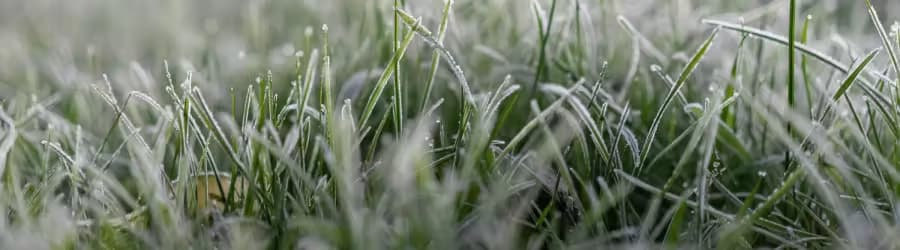
A uniformly brown lawn in winter is normal and correct. Centipedegrass goes dormant across nearly its entire range, staying green only in frost-free South Florida, where it is rarely grown anyway because the soils there are too alkaline. There is nothing to fix.
The real winter risk is a warm spell. A false spring in late winter coaxes the grass partly out of dormancy, and its crowns take up water. If a hard freeze below about 23°F follows, ice forms inside those swollen cells and ruptures them. This is why winterkill is so erratic at the northern edge of the range — one lawn dies and the identical lawn next door does not, depending on microclimate, slope, thatch, and how it was fed last fall. Sustained cold below about 25°F for several days will kill it outright even without the false-spring cycle.
You cannot control the weather, but the setup happened in fall. Thatch, late nitrogen, and low potassium are the three things that turn a survivable freeze into a dead lawn. If those went wrong, winter is when you find out.
Keep traffic off dormant turf, especially when it is frozen. There are no rhizomes to repair crushed crowns, and damage done now shows up as bare patches that will not close until well into summer.
Do not fertilize, do not lime, do not dethatch, and do not water on a schedule. Occasional water during a long dry, windy stretch is worthwhile, because desiccation kills crowns when frozen soil blocks the roots from replacing lost water. Otherwise leave it alone.
Winter broadleaf weeds are visible now against the brown canopy. Metsulfuron handles them. Hold any pre-emergent and any green-up-sensitive product until the spring timing rules apply.
Resist diagnosing a dead lawn in February. Brown is expected, and green-up runs late — as late as April or May near the northern edge. If you want to check, pull at the stolons. Dormant turf stays anchored; dead turf peels up like carpet with no roots underneath.
When Another Southern Grass Fits Better
Centipedegrass occupies a narrow and genuinely useful niche: acidic sandy soil, full sun, light use, and an owner who wants to do almost nothing. Step outside any one of those and something else is the better grass.
Against St. Augustinegrass. These two get confused constantly and suit different sites. St. Augustine takes considerably more shade, tolerates salt and higher pH, and produces a denser, darker lawn. It also wants more nitrogen, more water, and more mowing, and it is prone to chinch bugs. Choose St. Augustine for shade, coastal exposure, or alkaline soil. Choose centipedegrass for acidic soil and low input. If you cannot tell which one you already have, check the leaf arrangement: alternate along the runner means centipedegrass, opposite pairs mean St. Augustine.
Against bermudagrass. Bermuda is the opposite grass in nearly every respect. It has excellent wear tolerance and repairs itself fast because it spreads by both rhizomes and stolons, and it takes traffic, salt, and drought far better. It costs you 4 to 6 pounds of nitrogen per 1,000 square feet a year, frequent mowing, and real thatch management. Choose bermuda for a lawn that gets used. Choose centipedegrass for a lawn that gets looked at. Note the direction of invasion, too — bermuda creeps into centipedegrass, not the other way around.
Against zoysiagrass. Zoysia gives you better wear tolerance, better recovery, better cold tolerance, and a finer, denser turf, at a higher price for both establishment and upkeep. It is the upgrade choice when the site is right for centipedegrass but the lawn needs to take some use.
Against bahiagrass. Bahia is the other low-input Southern option and shares the acidic sandy soil preference. It is coarser and more open, sends up tall seed heads that need frequent mowing to control, and gives a lower-quality look. But it is tougher through drought and takes more abuse. Choose bahia for large, rough, utility areas, and centipedegrass for a home lawn you want to actually look tidy.
Against carpetgrass. Carpetgrass is the closest match in appearance — similar apple-green color, similar texture, same preference for acidic soil — and it beats centipedegrass in one specific place: genuinely wet ground. Centipedegrass does not tolerate saturated soil. Carpetgrass does. It also establishes far faster, which is why LSU AgCenter validates it as a companion at seeding. As a permanent lawn it is coarser and produces prolific seed heads.
One comparison that is not a real choice: the cool-season grasses. Tall fescue, Kentucky bluegrass, and the fine fescues do not survive the lower South’s summers, and centipedegrass does not survive their winters. If you are in the transition zone weighing centipedegrass against tall fescue, you are choosing which season you would rather lose, and tall fescue usually wins that argument in Zone 7.
Find Your Precision Match
Choosing between species requires balancing your specific soil profile, local micro-climate, and maintenance goals. Use our Turf Match Tool to generate a data-backed recommendation for your specific yard.
Start Your MatchTechnical Specifications
Scientific Name: Eremochloa ophiuroides (Munro) Hack. Basionym: Ischaemum ophiuroides Munro. The genus has not been reassigned in modern turfgrass literature — unlike tall fescue, this grass carries one accepted binomial, and Eremochloa placement is stable across extension, USDA, and peer-reviewed sources.
Common Names: Centipedegrass; centipede grass; centipede. Historically "China grass" in the early USDA literature. Widely nicknamed "lazy man's grass," and in Clemson's account also "poor man's grass," from its Depression-era spread as a lawn nobody had to feed or mow much.
Family: Poaceae (grass family), subfamily Panicoideae, tribe Andropogoneae. Genus Eremochloa holds roughly eight species, and centipedegrass is the only one grown for turf.
Origin: Native to southern and central China and parts of Southeast Asia, where it grows naturally on acidic, phosphorus-poor, aluminum-rich soils. Introduced to the United States in 1916 from seed collected in South China by USDA plant explorer Frank N. Meyer, who died on that expedition. Nearly all US centipedegrass descends from that single accession, which is why the species has one of the narrowest gene bases in turf. Naturalized across the Southern Coastal Plain from Texas to southern North Carolina and north into Arkansas. Introduced, not native.
Season Type: Warm-Season
Growth Habit: Stoloniferous
Growth Rate: Slow
Texture: Medium
Root System Depth: Shallow. Extension is consistent and unanimous on the description — Clemson states the species inherently has a shallow root system, the University of Tennessee calls the roots somewhat shallow compared to many other turfgrasses, and UGA ties thatch buildup directly to an even shallower-rooted, more cold- and drought-susceptible stand. No measured rooting depth for centipedegrass is published in the university literature reviewed. Do not read irrigation targets as root depth: UGA's instruction to wet the soil 5 to 7 inches down and Clemson's 6-inch target are watering depths, not measurements of where the roots reach. Shallow rooting is the mechanism behind the poor drought performance, the wilt-despite-moist-soil nematode signature, and the winterkill sensitivity, so it carries real weight even without a number attached.
Spread Mechanism Intensity: Stolons only — surface runners that root at the nodes. No rhizomes. NC State records rhizome presence as absent. Spread is slow: a seeded stand needs two to three growing seasons to close, and voids in an established lawn take months rather than weeks to fill. The absence of any below-ground stem is the single most consequential structural fact about this grass — it is why recovery is so poor, why aggressive dethatching kills it, and why scalping thins a canopy that does not readily come back.
Typical Lifespan & Invasiveness Risk: Long-lived perennial. A correctly managed stand persists indefinitely; where lawns fail it is from centipedegrass decline or winterkill, not from the plant aging out. Ecological invasiveness risk is low. It is not listed as a federal noxious weed and carries no invasive designation in the Southeastern states where it is grown. USDA Forest Service treats it as an introduced species naturalized across the Southern Coastal Plain, and it does volunteer along roadsides and disturbed ground within its adapted range — but the mechanism caps the risk. It has no rhizomes, spreads slowly by surface stolons only, needs acidic soil, and is easily edged: Clemson notes it is simple to control at bed and walk borders precisely because the runners stay on the surface where you can cut them. Within a lawn it is not weedy. The realistic nuisance is the reverse case — it creeps into a neighbor's bed or a neighbor's bermudagrass creeps into it.
Hardiness Zone Min: Zone 7
Hardiness Zone Max: Zone 9
Hardiness Zone Notes: Ideal band is Zone 8a to 8b. Zone 7 is a real stretch with high and erratic winterkill risk, and Zone 9 is reachable but constrained. Northern limit mechanism: cold, acting three ways. A late-winter false spring pulls the grass partly out of dormancy and hydrates the crowns, so a following hard freeze below roughly 23°F ruptures the swollen cells; sustained cold below roughly 25°F for several days kills outright without any false spring; and dry, windy winters desiccate crowns when frozen soil blocks water uptake. Thatch, late-season nitrogen, and low potassium each make all three worse. Virginia Tech puts the northern edge at coastal and southern Virginia counties only. Southern limit mechanism is not heat — it is alkaline, calcareous soil that locks out iron, plus heavy sting and ring nematode pressure in South Florida's sands. UF/IFAS calls the species well adapted to central and northern Florida and the most common home lawn grass in the Panhandle, with only one cultivar bred for South Florida conditions. Zone 10 sits outside the recommendable range for the species as a whole and is reachable only through the subtropical types, on non-alkaline soil, with nematode pressure managed.
Cold Tolerance Rating: Very Low
Winter Color Profile: Dormant
Climate Cool Humid: Unsuitable
Climate Cool Arid: Unsuitable
Climate Warm Humid: Excellent
Climate Warm Arid: Poor
Climate Transition: Poor
Sun Requirement: Full Sun to Light Shade
Shade Tolerance: Low
Water Requirement: Moderate
Drought Survival Strategy: True Dormancy
Soil Texture Fit:
Sand
Loamy Sand
Sandy Loam
Loam
pH Survival Min: 4.5
pH Optimal Min: 5
pH Optimal Max: 6
pH Stress Max: 6.5
Wet Feet Tolerance: Low
Compaction Tolerance: Low
Salinity Tolerance: Very Low
Wear Tolerance: Low
Recovery: Very Low
Recovery Mechanism: Stolons
Input Intensity: Very Low
Labor Intensity: Low
Thatch Production: Low
Annual N Figure: About 1 lb of nitrogen per 1,000 sq ft per year is the standard and the number to build a program around (UGA, LSU AgCenter, Texas A&M). Rising toward 2 lb is justified only on sandy, high-rainfall coastal soils that leach. Full documented band across state programs runs roughly 0.4 to 3.0 lb, with UF/IFAS allowing 0.4 to 2.0 lb in North Florida and more in the longer-season south, and Clemson framing the safe envelope as 0 to 2 lb. On clay or organic soils, drop to 0.5 to 1 lb. The band is wide because soils and season length differ — but the failure mode is one-directional. Nobody kills centipedegrass by underfeeding it.
Urine Resistance: Low
Preferred NPK Ratio: 15-0-15 with iron, or any slow-release product on that 1-0-1 nitrogen-to-potassium pattern carrying zero phosphorus (Clemson, NC State). This is a rare case where extension does publish a usable ratio instead of routing everything through a soil test, and the reason is specific: centipedegrass is phosphorus-sensitive, and excess phosphorus locks up soil iron and yellows the grass. Avoid complete fertilizers such as 8-8-8 and 10-10-10 unless a soil test documents an actual phosphorus deficiency. Potassium matters most heading into fall — about 1 lb of potash per 1,000 sq ft, four to six weeks before first frost — because potassium is what stiffens cells against cold.
Establishment Methods:
Seed
Sod
Sprigs
Plugs
Germination Speed: Slow (14–21 days)
Establishment Speed: Slow
Seeding Rate: 0.25 to 0.5 lb of pure live seed per 1,000 sq ft. The seed is very small, so mix it with 10 to 20 lb of dry sand or cornmeal per 1,000 sq ft as a carrier to spread it evenly — otherwise it goes down in clumps and streaks. Seed in late spring to early summer, once soil temperature is reliably above 60°F. For vegetative starts: lay sod tight in a staggered brick pattern and roll it for soil contact; set sprigs or plugs on 6- to 12-inch centers. Overseeding rate: not applicable, and that is a deliberate entry rather than a gap. Extension advises against overseeding centipedegrass with ryegrass for winter color, because ryegrass outcompetes the low-vigor centipede in spring exactly as it tries to break dormancy.
Improved Cultivar Availability: Low
NTEP Note: NTEP coverage for centipedegrass is historically thin. There is no comprehensive multi-year national cultivar evaluation comparable to what exists for bermudagrass or zoysiagrass, and that absence is a finding rather than a gap in this build — it is the direct consequence of the species' narrow gene base. USDA also records no infraspecific taxa for the species: there are no natural varieties or subspecies to divide it into. The practical result is that reliable, university-vetted trait data for centipedegrass stops at the species level. Shade, wear, traffic, and drought ratings on this page are species-wide; the trial data to separate them below that level does not exist. One axis does separate, and it is cold hardiness. That is the one lever that maps to a real stressor a homeowner faces, because the northern edge of this grass's range is where it actually dies. Propagation method — whether a type is available as seed or only as sod, plugs, and sprigs — is the practical secondary selector, since it decides both cost and how the lawn gets started. A third, weaker axis is habit: some types run finer and denser than the standard wild form. Route selection by those traits to the subtype pages rather than by cultivar name. One shopping guardrail belongs at species level, because it is about seed quality rather than variety choice: generic unlabeled "common" centipedegrass seed is a variable wild population that produces uneven color and weaker cold tolerance. Buy certified seed, and if you buy generic anyway, insist on a label showing at least 90 percent purity and 85 percent germination.
Deep Dives & Practical Guides
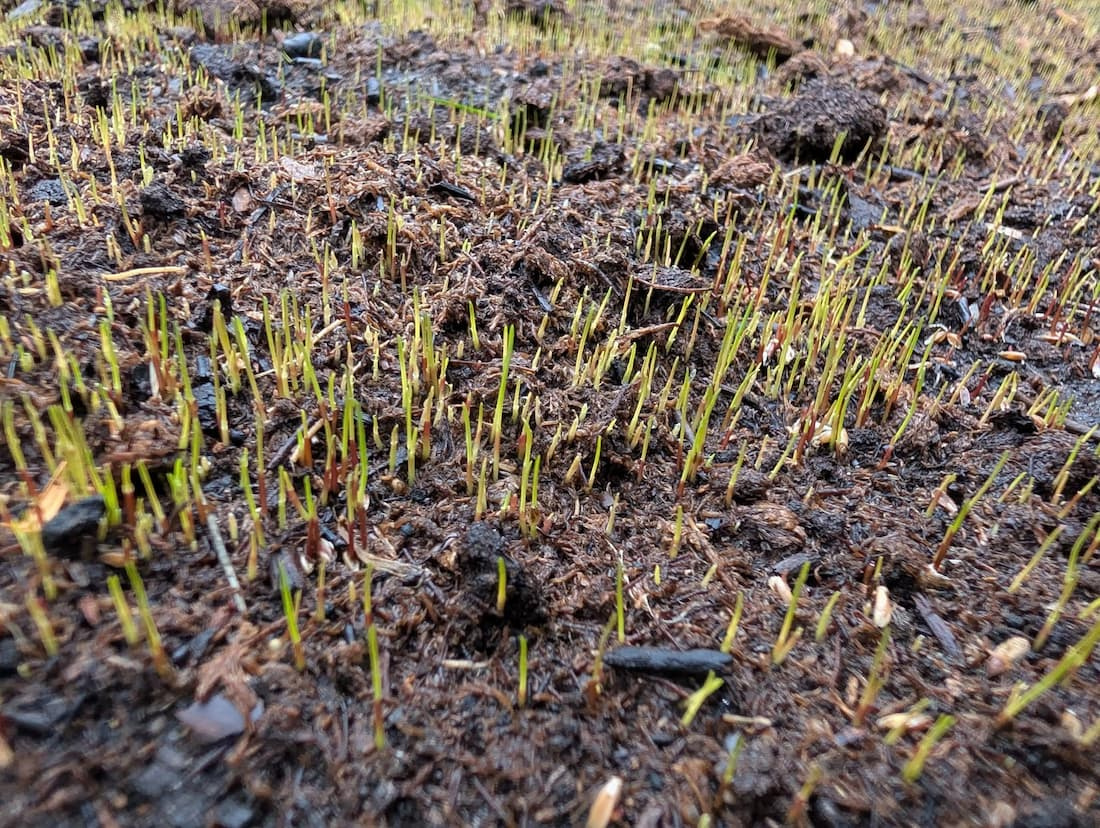
How to Establish a New Lawn From Bare Soil to First Mow
Bare soil doesn't turn into a lawn just because you scattered seed or rolled out sod — it becomes one based on a handful of specific steps done in the right order, matched to your specific grass. This guide walks through soil prep, seeding or planting method, starter fertilizer, watering as the grass grows, and knowing when it's actually safe to mow, for both cool-season and warm-season lawns.
Read Article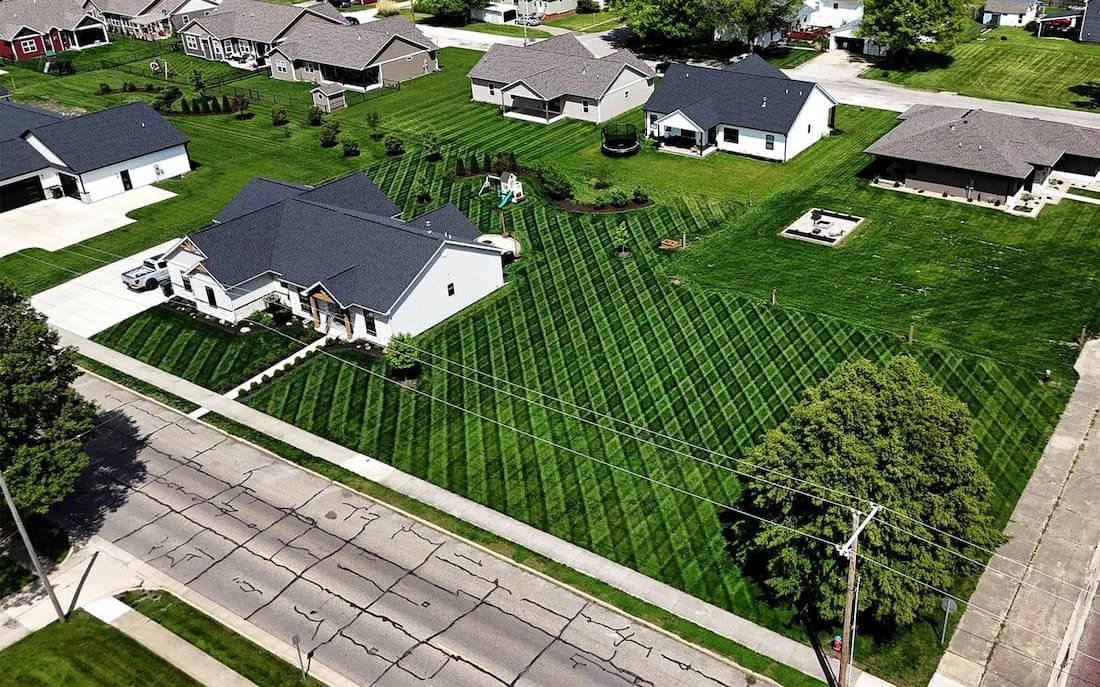
Cool Season vs Warm Season Lawn and Landscape Guide
Your lawn and your flower beds don't follow the same calendar — one runs on a cool-season engine, the other on a warm-season one, and using the wrong playbook on either can do real damage. This guide helps you figure out which system you actually have and how to care for it correctly, plus how the same cool/warm split applies to your ornamental beds.
Read Article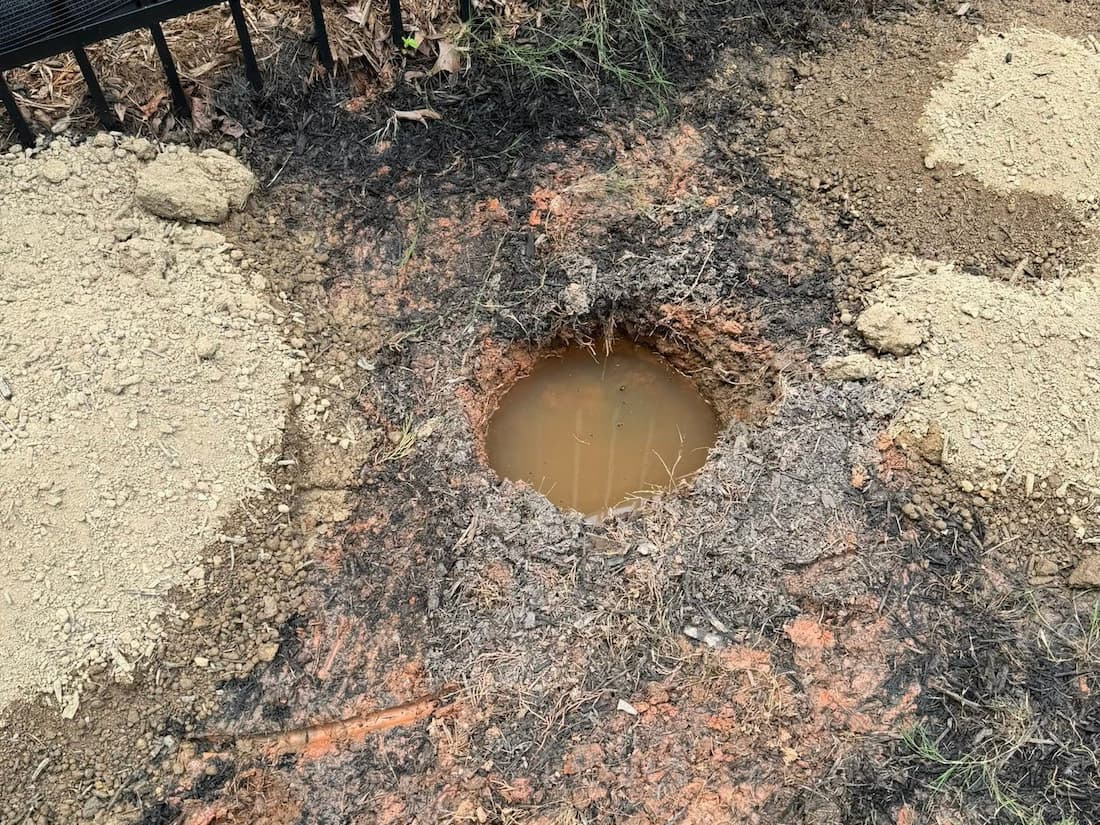
The Hole You Dug Is Killing Your New Plants
A shrub that looked fine all summer and stalled the next year usually didn't fail because of the plant, the weather, or the nursery. It failed because the hole it went into was a container — smooth-walled, water-holding, and impossible to root out of.
Read Article
What You Can Actually Change About Bad Soil
Heavy clay and loose sand feel like permanent sentences, and half of that is true. What your soil is made of will not change. How those particles are arranged will — and that is the half that decides whether anything grows.
Read Article
Why Your Plants Survive Winter and Die in July
Your hardiness zone is built from one number — the coldest night of an average year. It says nothing about the hottest afternoon, which is what actually kills most plants people lose. Here's how to read the other half of the map.
Read Article
Why Poa Annua Keeps Coming Back — and the 3-Year Plan That Finally Ends the Cycle
You've pulled it. You've sprayed it. You've watched the little white seedheads mock you every single spring. And every fall, like clockwork, it's back — in the lawn, in the beds, in the cracks you didn't know you had. Here's the hard truth nobody at the big-box store will tell you: you're not losing because you're doing it wrong — you're losing because you're fighting the wrong enemy on the wrong timeline. Poa annua isn't a one-season problem, and once you understand why, the three-year plan below stops feeling like a chore and starts feeling like a countdown.
Read Article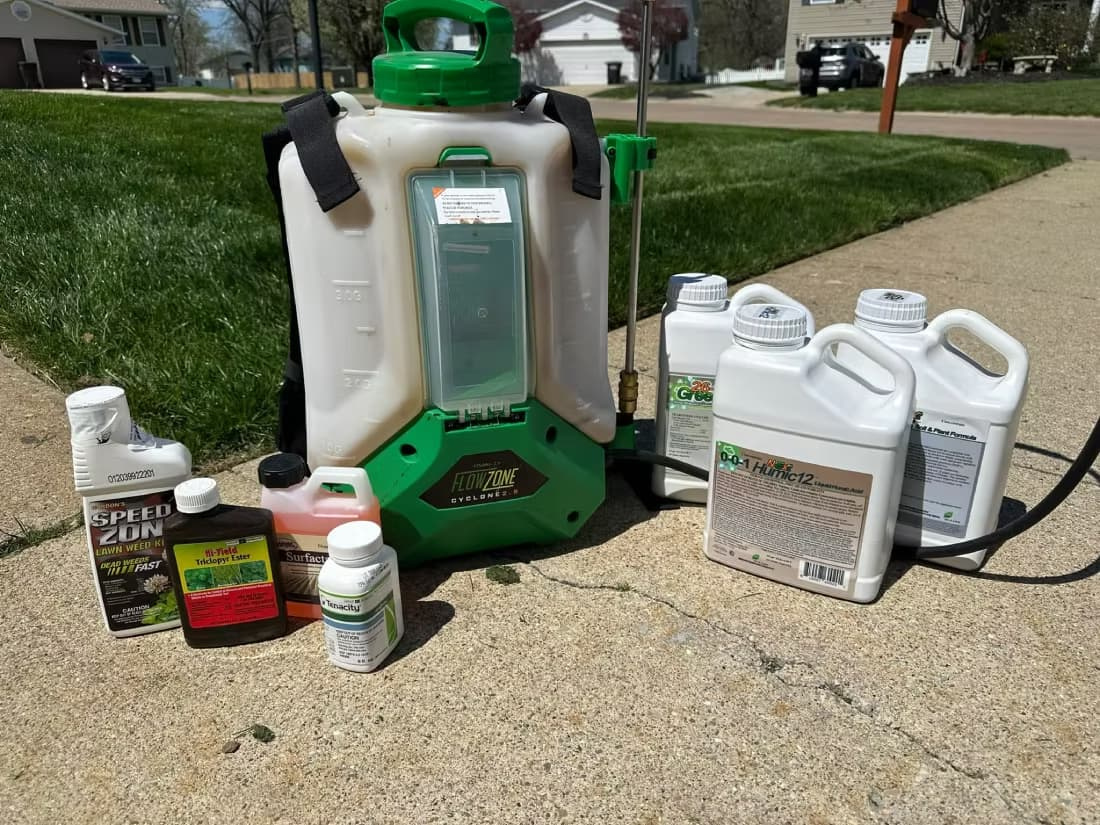
How to Apply Herbicides Correctly in Your Lawn and Garden Beds
Getting real results from a weed product has almost nothing to do with the brand on the bottle and everything to do with matching the method to the moment — the right chemistry, in the right place, at the right time. Learn how to apply herbicides correctly across both your lawn and your garden beds, whether you’re stopping weeds before they sprout or killing the ones already growing, without wasting product or harming the plants you want to keep.
Read Article
How to Kill Weeds Where Two Lawns Meet Without Harming Your Neighbor’s Grass
Controlling weeds along a shared property line is where good intentions quietly backfire—the season that's safe for your own lawn is often the season the lawn next door is most easily harmed. Learn the seasonal timing collision behind most fence-line damage, and the two habits that prevent it—reading what's actually in the bottle and spraying directed instead of broadcast—so you can clear the weeds without hurting your grass, your neighbor's, or the peace between you.
Read Article
The Truth About One-and-Done Weed Control
Most homeowners lose the fight against weeds not because they work too little, but because they act before they understand. One-and-done weed control is real — but it only works when identification, timing, and the right tool all line up. This guide explains how that sequence works across your lawn and your ornamental beds, and how each weed page in the MFY hub puts it into practice for your specific invader.
Read Article
Solving the Mystery of the False Evidence in Your Lawn and Landscape
A brown leaf or a yellowing lawn is rarely what it seems. When symptoms act as decoys, a calm, forensic approach brings clarity to the confusion. Learn how to look past the surface to find the quiet truth of what your plants are truly asking for.
Read Article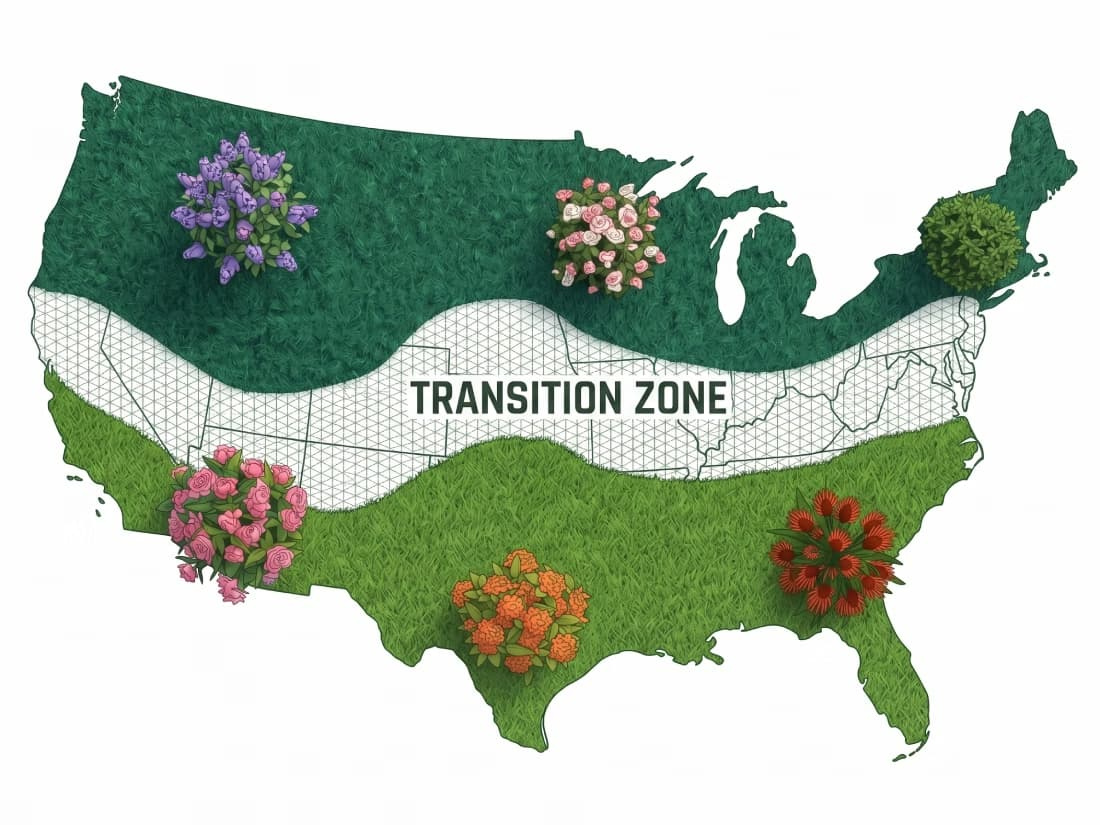
Living in the Middle: The Deep-Dive Guide to Transition Zone Lawns and Landscapes
The Transition Zone is a biological tug-of-war where neither northern nor southern species perfectly adapt. By using resilient "bridge" species and mastering maintenance levers like the Mowing Pivot, you can transform a struggling yard into a healthy landscape.
Read Article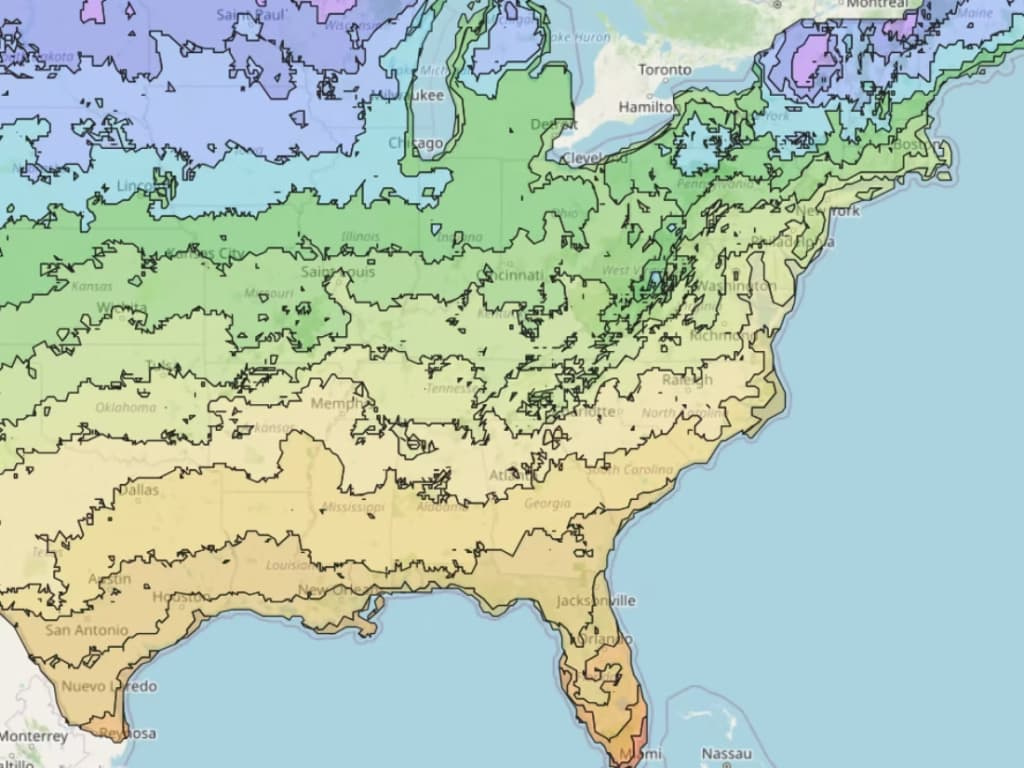
What Your Hardiness Zone Really Means for Your Lawn and Plants
Uncover the foundation of a resilient landscape by mastering the science of hardiness zones. Learn how these climate boundaries are calculated and why understanding your local temperature limits is the first step toward choosing plants that thrive year after year.
Read ArticleFrequently Asked Questions
Our maintenance and establishment guidance is derived from long-term agronomic field studies and turfgrass performance data from top research institutions.
Almost certainly not. Pale apple-green is this grass’s natural color, not a symptom — it is genetically lighter than bermuda or St. Augustine and always will be. Fertilizing to darken it is the single most common way people kill centipedegrass, because excess nitrogen drives thatch, soft growth that winterkills, and eventually centipedegrass decline. If you want more color, use iron rather than nitrogen: ferrous sulfate at about 2 ounces in 3 to 5 gallons of water per 1,000 square feet, applied below 80°F. One exception worth checking: if the yellowing is bright, with greener veins showing through, that is iron chlorosis from high soil pH, and the fix is correcting pH, not feeding.
Almost never, and routine liming is one of the fastest ways to ruin this lawn. Centipedegrass wants an acidic soil pH of 5.0 to 6.0 and tolerates acidity down to 4.5. Above about 6.0 to 6.5, iron gets chemically locked in the soil, the grass cannot make chlorophyll, and it yellows badly no matter how much you feed it. Only lime if a soil test shows pH below 5.0, and then in small split applications. If your test comes back above 6.5, you have the opposite problem and need elemental sulfur — capped per application, applied below 80°F, and watered in.
In winter, brown is normal — centipedegrass goes fully dormant across nearly its whole range, and green-up can run as late as April or May near the northern edge. Use the tug test to tell the difference. Pull at the stolons: dormant turf stays anchored to the ground, while dead centipedegrass peels up like a carpet because there is no living root left underneath. That peel-up is the signature of centipedegrass decline or winterkill. In summer, brown usually means drought dormancy, which is the grass protecting its crowns and is survivable for a few weeks.
No, and extension is unusually firm about this one. Ryegrass is aggressive and fast, and it outcompetes low-vigor centipedegrass for light and nutrients in spring — precisely when the centipede is trying to break dormancy and is at its weakest. The result is thinning, delayed green-up, and long-term decline. You would be trading one brown winter for a permanently weaker lawn. Accept the dormancy.
No, and this mistake kills lawns outright. Bermudagrass recovers from aggressive verticutting because it has rhizomes — underground stems that regenerate the stand. Centipedegrass has none. All its growing points sit on surface stolons, so multi-direction verticutting strips them away with nothing left to regrow from. If thatch tops about a half inch, dethatch in late May or early summer only, never fall, with blades 2 to 3 inches apart at a quarter-inch depth, and in one direction only.
Because centipedegrass spreads only by surface stolons, with no rhizomes, and it grows slowly on top of that. Voids take months to close rather than the weeks you would expect from bermuda or zoysia, and severe damage needs physical replanting rather than patience. This is the defining limitation of the grass. If the spot is larger than a dinner plate, plug or sod it instead of waiting. And work out what caused it — traffic, urine, scalping, disease — because the same cause will reopen it.
Start by treating the invasion as a symptom. Bermuda moves into centipedegrass where the stand has been over-fed or over-watered into a weak, open canopy, so the cultural fix is both the most effective control and the cheapest. Raise the mowing height to 2.5 inches to shade the bermuda out, cut or stop nitrogen to starve it, and water deep and infrequently. Chemically your options are genuinely thin: sethoxydim suppresses bermuda but only at rates low enough to limit how well it works, and the tank mixes that actually kill bermuda will damage or kill the centipedegrass too. If you clear a patch with a non-selective spray before replanting, read the active-ingredient panel — the consumer “Roundup” brand name no longer reliably means glyphosate, and the replacement ingredients have different soil residual times that change how long you must wait to replant.
It survives drought better than it performs in one, and the distinction matters when you are choosing a grass. Its roots are shallow, so it cannot reach deep soil water — it has the poorest drought tolerance of the warm-season grasses. What saves it in a short dry spell is dormancy: it browns out, shuts down to protect its crowns, and greens back when rain returns, holding on that way for a few weeks. In severe drought, a half inch of water every three weeks keeps the crowns alive. But in a genuinely dry climate it needs so much irrigation to stay green that it is the wrong grass entirely. One caution: a lawn already weakened by thatch, compaction, or nematodes may not have enough root left to come back out of dormancy at all.
Scientific Authority
This profile is grounded in turfgrass agronomy and soil science. Every recommendation—from irrigation requirements to nutrient management—is verified against agricultural research data to ensure optimal plant health and environmental sustainability in the Transition Zone.
Primary Resources
- Clemson Cooperative Extension: Centipedegrass (HGIC 1210)[cite: 1]
- Clemson Cooperative Extension: Selecting a Lawn Grass (HGIC 1201)[cite: 2]
- NC State Extension TurfFiles: Centipedegrass Profile[cite: 3]
- NC State Extension Gardener Plant Toolbox: Eremochloa ophiuroides Profile[cite: 4]
- UF/IFAS Extension: Centipedegrass for Florida Lawns (ENH8/LH009)[cite: 5]
- UGA Cooperative Extension: Centipedegrass Decline (Circular C1003)[cite: 6]
- University of Tennessee Extension: Turfgrass Selection: Centipedegrass (W159-C)[cite: 7]
- University of Hawaii at Manoa CTAHR: Centipedegrass Turf Management (TM-14)
- LSU AgCenter: Centipedegrass Establishment and Maintenance
- Texas A&M AgriLife Extension: Warm-Season Turfgrass Management Guide
- Alabama Cooperative Extension System: Home Lawns: Centipedegrass
- University of Arkansas Cooperative Extension Service: Centipedegrass Management Profile
- Virginia Cooperative Extension (Virginia Tech): Turfgrass Adaptation and Selection
- USDA Forest Service FEIS: Eremochloa ophiuroides Species Review
- National Turfgrass Evaluation Program (NTEP): Evaluation Data
- Peer-Reviewed Turfgrass Literature: Genetic Diversity and Germplasm of Eremochloa ophiuroides (Hanna & Burton)