
Scientific Name: Axonopus fissifolius (Raddi) Kuhlm. Accepted synonym: Axonopus affinis Chase. Basionym: Paspalum fissifolium Raddi. Related species covered on this page: Axonopus compressus (Sw.) P. Beauv., tropical or broadleaf carpetgrass.
Common Names: Common carpetgrass, carpetgrass, carpet grass, narrowleaf carpetgrass, Louisiana grass, mat grass, caratao grass. Tropical carpetgrass and broadleaf carpetgrass refer to the separate species A. compressus.
Carpetgrass
The grass for low, wet, sour ground where nothing better will grow.
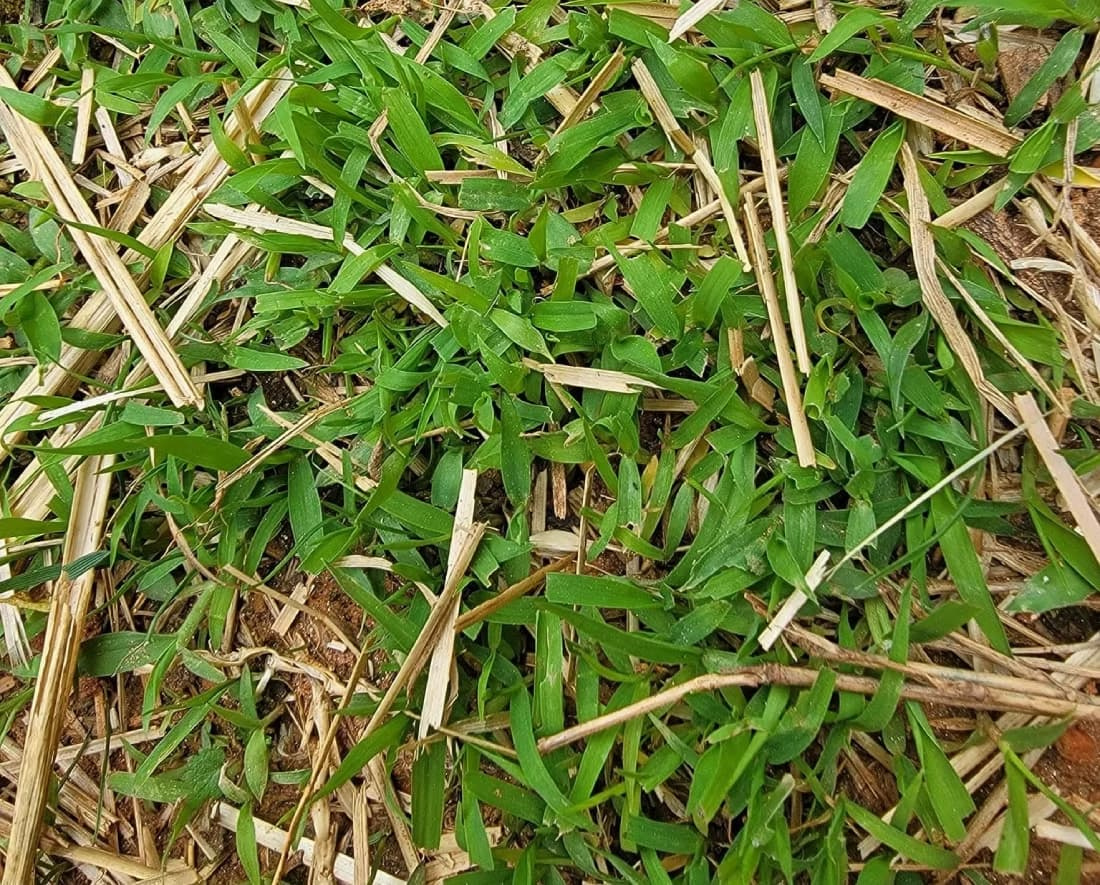
Carpetgrass At-a-Glance
Hardiness Zone Min
Zone 8
Water Requirement
High
Sun Requirement
Tolerates Partial Shade
Wear Tolerance
Low
Establishment Speed
Moderate
Labor Intensity
High
How A Wetland Native Became Turf
Carpetgrass did not arrive here. It was already here.
USDA-NRCS and NC State Extension both list common carpetgrass (Axonopus fissifolius) as native to the warm parts of the Americas — Virginia south to Florida, west to Texas and Oklahoma, and on through Central and South America to Argentina. Its natural home is pine flatwoods, wet fields, ditch banks and roadsides across the Southern coastal plain. Federal wetland ratings classify it as a facultative wetland plant, which is a formal way of saying it usually grows where the ground stays wet.
You will sometimes read that carpetgrass is a West Indian import brought over in the early 1800s. Clemson’s fact sheet says exactly that. The reason is that older write-ups describe both carpetgrass species together under one name, and the other one — tropical carpetgrass, Axonopus compressus — really is introduced. When a source separates the two, common carpetgrass comes out native.
It is a close relative of the paspalums. Botanists place Axonopus in the same subtribe as Paspalum, which makes bahiagrass and seashore paspalum its nearest turf cousins. That relationship is visible in the lawn: all three throw up thin, branched, whip-like seed stalks that look nothing like the tidy heads of bluegrass or fescue.
Its career as a planted grass started in pastures, not lawns. USDA-NRCS records it as grazed year-round by livestock and managed as pasture in parts of the South, and as a cover for campgrounds, parking areas, ballfields and picnic grounds — low-value ground nobody wanted to fertilize or drain. It became a lawn grass the same way. It was already growing on the wet corner of the property, and mowing it was cheaper than fixing the drainage.
Almost no breeding ever happened. Clemson lists a single improved selection, ‘Chase’, and it has effectively disappeared from the retail seed trade. Public programs at Mississippi State and the University of Florida have worked on the one trait that would actually change this grass — fewer seed stalks — but nothing has reached the market. NTEP, the national program that runs side-by-side cultivar trials for every major lawn grass, does not evaluate carpetgrass at all. So the seed you can buy today is unnamed common seed: essentially the wild plant, sold as it grows.
Gallery
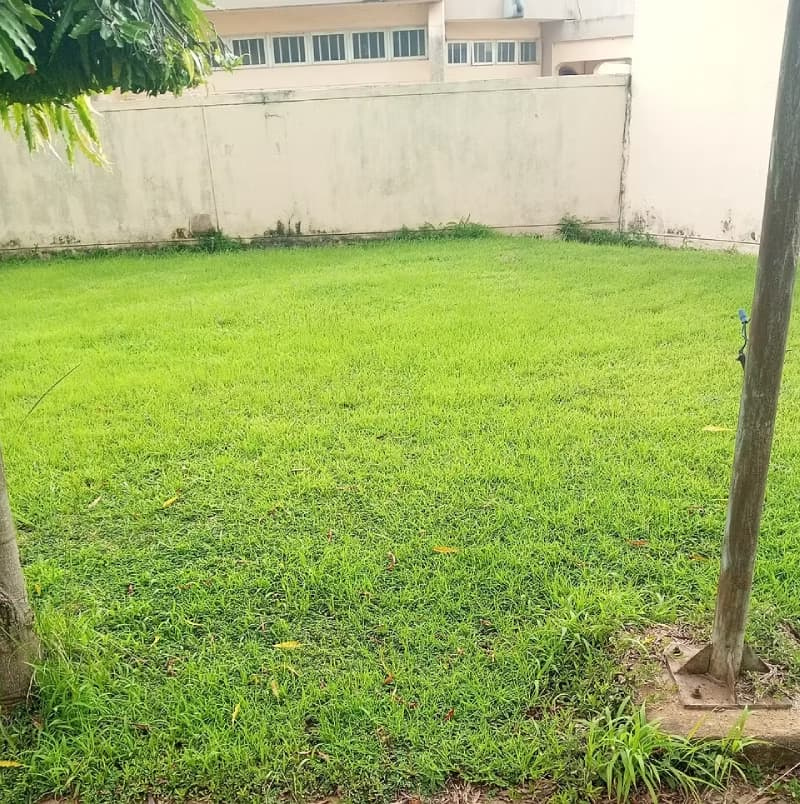
An established carpetgrass (Axonopus) lawn displaying its characteristic light green color and dense turf cover under full sun.
“Beautiful Carpet Grass at Arewa house Kaduna State” by Bambi Cia is licensed under CC BY-SA 4.0.
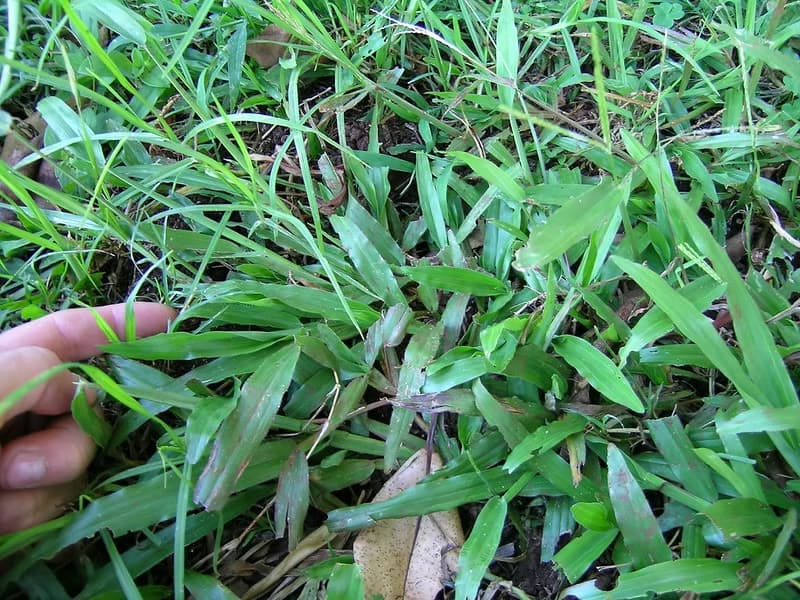
Broad-leaf carpetgrass (Axonopus compressus) leaf blades inspected up close to demonstrate blade width, texture, and prostrate growth habit.
“Axonopus compressus habit3” by Macleay Grass Man is licensed under CC BY 2.0.
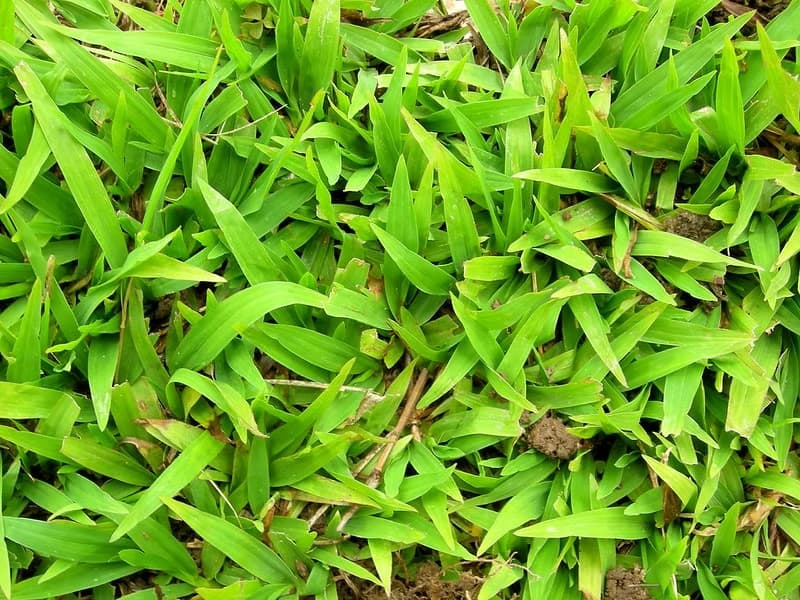
Top-down view of broad-leaf carpetgrass stolons forming a tight, low-growing vegetative layer over soil.
“Axonopus compressus habit1” by Macleay Grass Man is licensed under CC BY 2.0.
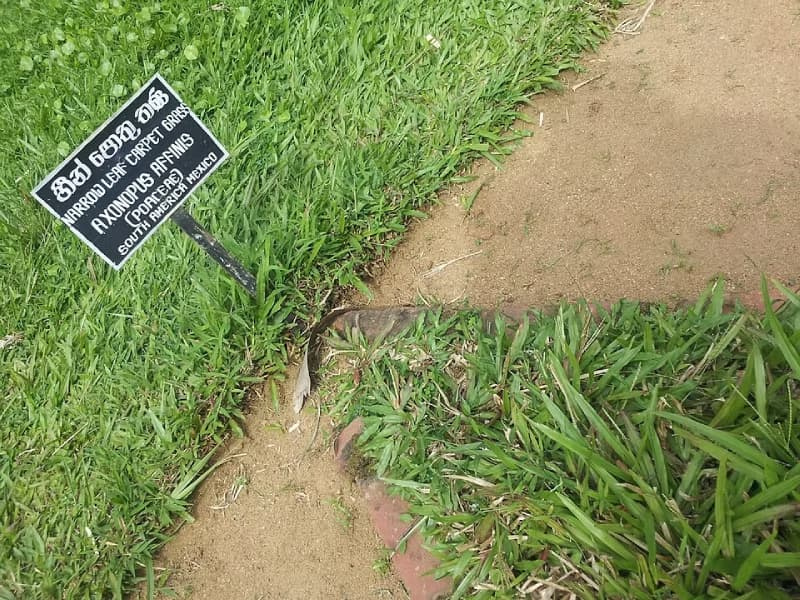
Narrow-leaf carpetgrass (Axonopus affinis) in an educational botanical garden display, highlighting its species identification marker and distinct finer leaf texture compared to broad-leaf carpetgrass (Axonopus compressus).
“File:Axonopus affinis at Peradeniya Royal Botanical Garden.jpg” by Gihan Jayaweera is licensed under CC BY-SA 3.0.
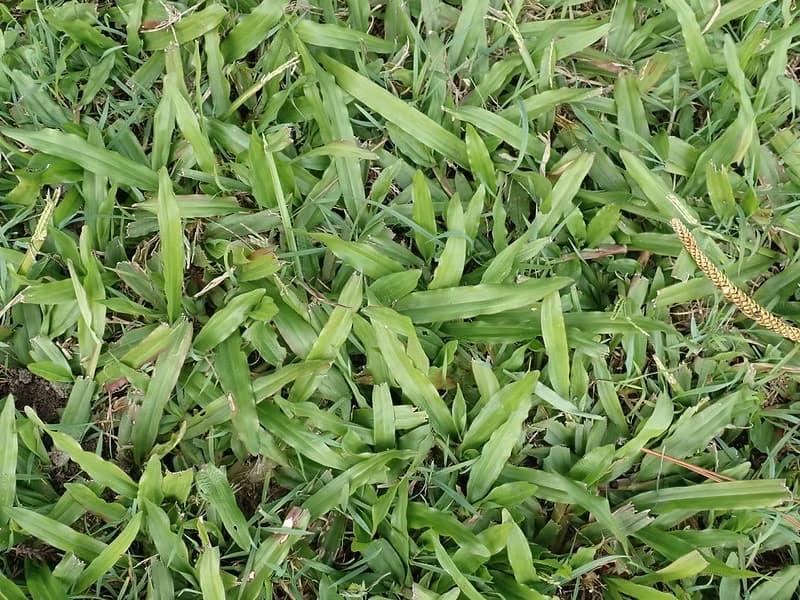
Close-up of broad-leaf carpetgrass (Axonopus compressus), illustrating its coarse leaf texture, blunt tips, and undulating blade margins.
“Axonopus compressus plant Burringbar1” by Macleay Grass Man is licensed under CC BY 2.0.
Telling It Apart
Because carpetgrass is so easily injured by the wrong spray, identifying it correctly is not a botany exercise. It decides what you are allowed to put on your lawn.
The giveaway is the seedhead: a tall, thin stalk carrying two to five slender, crabgrass-like spikes, usually a pair forming a V with a third branching just below. Texas extension describes the branches as looking like braided leather whips, which is a better description than any measurement. If the seed stalks have been mowed off, go by the leaf — a blunt, rounded, boat-shaped tip, a flat blade 0.16 to 0.31 inches wide (roughly 3/16 to 5/16 inch), a wavy edge carrying only a few hairs near the base, and a light green to yellow-green color that reddens or purples in cold weather.
Three grasses get confused with it, and the differences are worth learning.
- Centipedegrass shares the pale color and the creeping habit. The separator is the leaf edge: centipede carries a continuous line of fine hairs along its margins and produces a single, unbranched seed spike. Carpetgrass has smooth margins apart from a few hairs near the base, and a branched, multi-spiked head. When there is no seedhead to look at, that hair line is the fastest reliable check.
- Augustinegrass is much coarser and darker. It carries its leaves opposite each other on the stem where carpetgrass alternates them, and its seed spike is thick, flat, fleshy and unbranched — nothing like carpetgrass’s thin whips.
- Bahiagrass is the one people miss, because it is a close relative and carries the same V-shaped branched seedhead. Look at the spikes themselves: bahiagrass lines them with conspicuous, shiny, bead-like seeds, while carpetgrass’s are fine and nearly smooth to the eye. Bahiagrass blades are also much tougher, and bahia holds up on dry sand where carpetgrass would already be dead.
Identification Photos
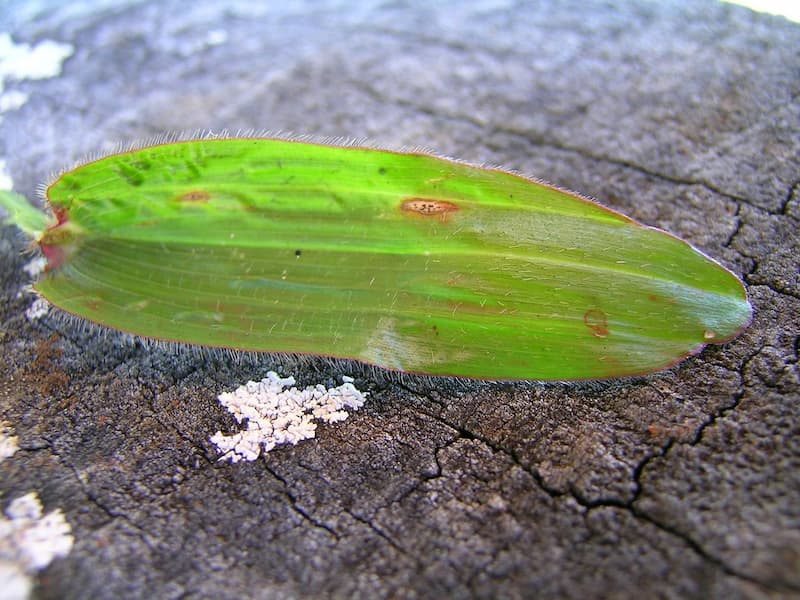
Key Identifier: A wide blade with a blunt, rounded tip. Carpetgrass blades are noticeably broader and blunter than those of centipedegrass, which it is often mistaken for.
“Axonopus compressus leaf1” by Macleay Grass Man is licensed under CC BY 2.0.
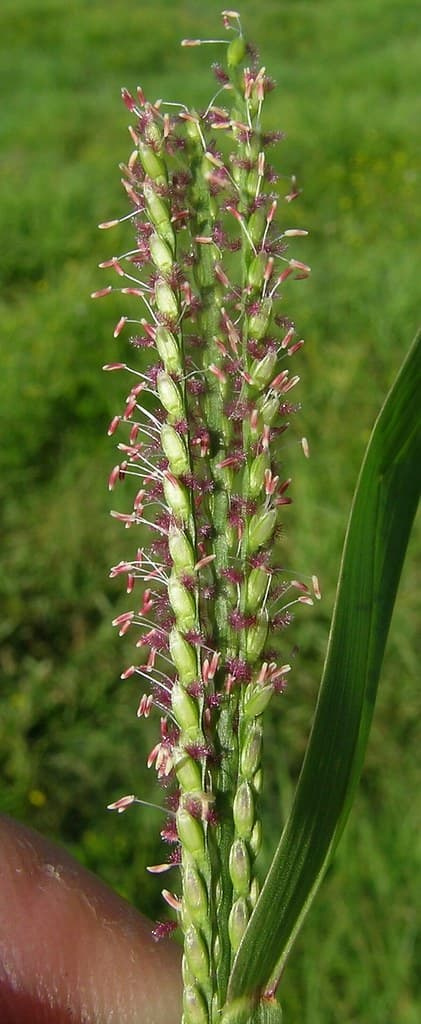
Look For: A narrow raceme of small spikelets in two rows, with pink to purple stigmas showing at flowering.
“Axonopus fissifolius flowerhead at anthesis” by Macleay Grass Man is licensed under CC BY 2.0.
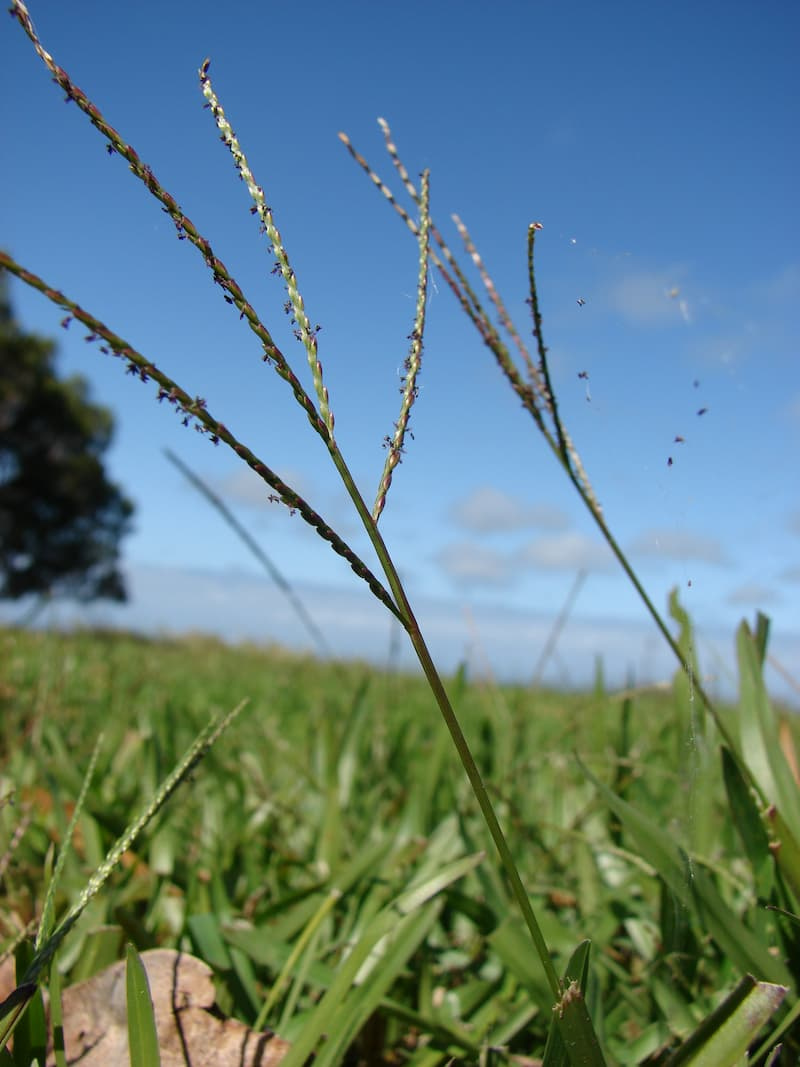
Look For: Thin, wiry seed stalks standing well above a low mat of broad blades.
“Starr 090121-1001 Axonopus fissifolius” by Forest & Kim Starr is licensed under CC BY 3.0.
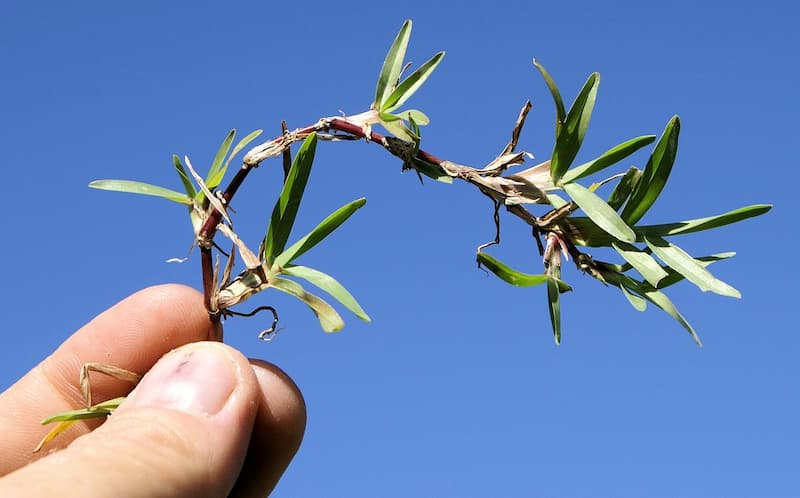
Look For: Creeping stolons with short, flat leaves at each node. Carpetgrass spreads by these runners to form a low, dense mat, especially in wet or poorly drained spots.
“Axonopus fissifolius stolon2” by Macleay Grass Man is licensed under CC BY 2.0.
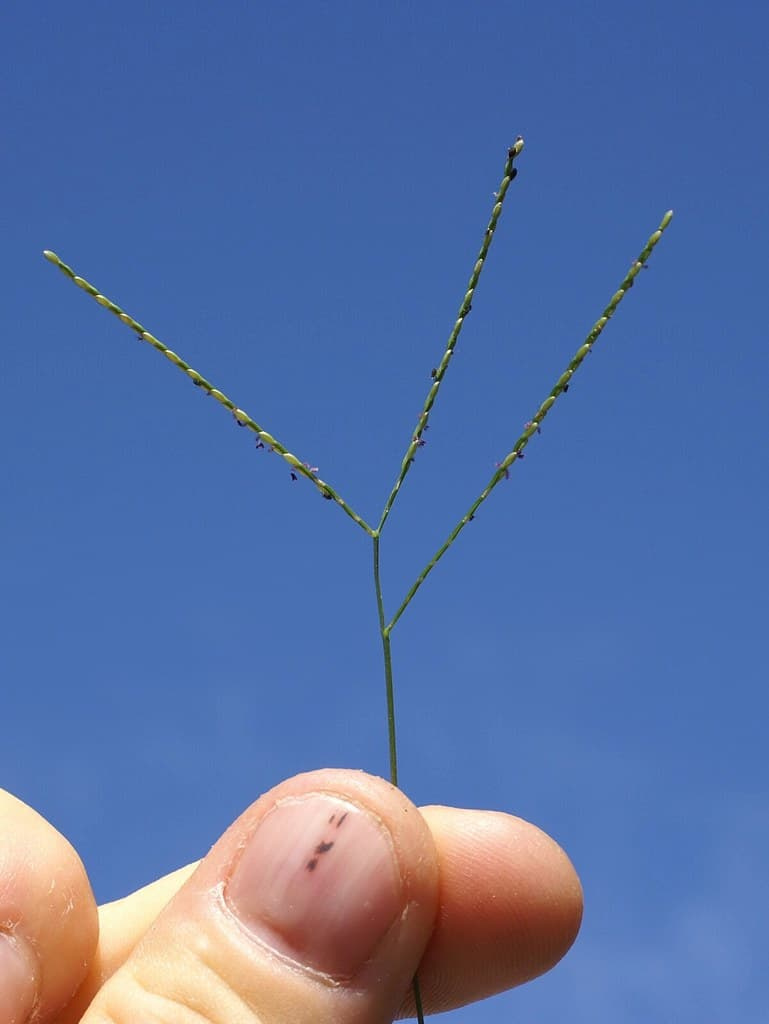
Diagnostic Feature: A slender stalk with two to three narrow racemes. The seedhead is held on a very thin stem well above the leaves.
“Axonopus fissifolius flowerhead” by Macleay Grass Man is licensed under CC BY 2.0.
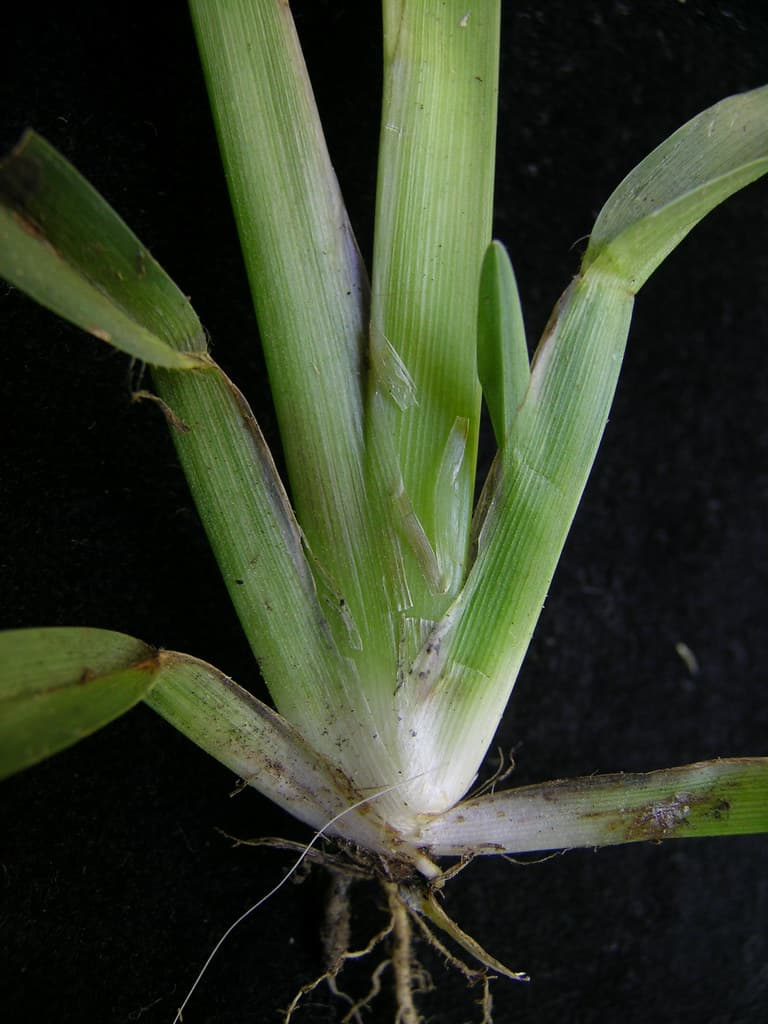
Diagnostic Feature: A flattened, fan-shaped base. Carpetgrass leaf sheaths are compressed and overlap like a fan at the crown.
“Axonopus fissifolius plant base1” by Macleay Grass Man is licensed under CC BY 2.0.
Is Carpetgrass Right For Your Yard?
Advantages:
It grows in wet, poorly drained, even briefly flooded ground where bermudagrass, zoysiagrass and centipedegrass drown.
It handles strongly acid soil, down to about pH 4.0, and does not need the lime most lawn grasses do.
It needs almost no fertilizer — 1 pound of nitrogen per 1,000 square feet a year, applied once.
It grows on any soil texture, including the peats and mucks that defeat most turf.
It establishes cheaply and easily from seed, which is unusual for a warm-season grass, and covers in about 10 weeks.
It holds up under roughly a half day of sun, so it works in part shade where bermudagrass will not.
It is native to the Southeast, so it asks nothing unusual of the site.
Once dense, it crowds out weeds on its own ground.
Best If:
- You have a low, wet, acidic, infertile spot where better grasses have already failed.
- You are in Zone 8b or warmer along the Gulf or lower Atlantic coastal plain.
- You want a lawn that costs almost nothing to feed.
- You can mow weekly through the summer.
- You would rather have functional green ground cover than a showpiece lawn.
- You have a site that gets at least a half day of sun.
- You can irrigate, or the site stays naturally moist through summer.
Disadvantages:
Drought kills it. It has no true dormancy, so a dry spell without irrigation does not make it go brown and wait — it makes it die.
Cold hurts it. Reliable use stops at Zone 8b, and the crowns rupture at around the mid-20s°F.
Salt hurts it. Damage starts around 500 to 600 ppm of dissolved salts in irrigation water.
It wears poorly and recovers slowly, and having no rhizomes means damaged areas heal only from the edges.
The summer seedheads never stop, so you mow weekly from June into fall just to keep the lawn from looking abandoned.
It is coarse and pale next to any premium lawn grass, and it browns early and greens up late.
It is unusually easy to injure with herbicides, which rules out most weed-and-feed products.
There are no improved cultivars on the market and no NTEP trials, so there is nothing to shop for and no performance data to compare.
Sod is not commercially available.
It escapes. Once it seeds into a neighboring centipedegrass or St. Augustinegrass lawn, no selective herbicide will take it back out.
Avoid If:
- Your site drains well and gets full sun — nearly every other Southern grass will beat it there.
- You cannot irrigate through a dry summer, since carpetgrass dies rather than going dormant.
- You are in Zone 7 or the transition zone.
- You irrigate with brackish, reclaimed or softened water.
- The lawn takes real traffic from children, pets or games.
- You already have centipedegrass or St. Augustinegrass and want to keep it that way.
- You want a fine, dark, uniform lawn.
- You rely on standard weed-and-feed products.
Is It Safe for Pets and Kids?
No toxicity to pets or livestock is documented for this species. USDA-NRCS records it as grazed year-round by livestock, and it carries no toxic endophyte of the tall fescue kind. State that as a documented negative, not as a blank: canine urine tolerance specifically has never been studied for A. fissifolius.
Where It Grows and Where It Fails
Carpetgrass works in one place — the warm, humid, wet lower South — and fails everywhere else.
Its home ground is the coastal plain from the Carolinas through Georgia, Alabama, Mississippi and Louisiana into East Texas. In the warm-humid climate it is genuinely well suited. In the transition zone it is a poor bet: it winterkills, greens up too late, and hands cool-season weeds a long open window. In cool climates and in any dry climate it does not work at all.
Cold is the wall it hits. Plant references list it as hardy from Zone 7a to 10b, but reliable lawn use starts at Zone 8b. In Zone 7, expect winter damage most years. The reason is physical. Carpetgrass is a near-tropical plant whose growing points — the crowns — sit right at the soil surface with nothing over them. When temperatures drop to around the mid-20s°F, the water inside those crowns freezes and bursts the cells, and whole patches die. Wet ground makes it worse, because dormant crowns take up water during a winter warm spell and then rupture when the cold slams back. Carpetgrass also browns at the first hard cold spell and wakes up slowly, so it hands you a long stretch of brown lawn on both ends of winter. Only in frost-free South Florida does it hold color year-round.
Now the flip side, which is the entire reason to plant it. Carpetgrass tolerates wet, waterlogged, even standing-water soil that drowns bermudagrass or zoysiagrass. It grows on nearly any soil texture — clay, silt, loam, sand, and the organic peats and mucks most lawn grasses will not touch. It wants acid soil, ideally pH 5.0 to 5.5, and it will run up to about 6.0 without complaint. Push the pH above 7.0 and it turns yellow from iron chlorosis, because alkaline soil locks up the iron the plant needs to build chlorophyll. And it needs almost no fertility. It evolved on starved ground and barely responds to feeding.
Two things end it. The first is drought. Its roots are shallow — Clemson calls them very shallow, and no one has published a measured depth for the species — so a dry spell without irrigation does not put carpetgrass to sleep the way it does bermudagrass. It kills the crown. This is the single most important thing to understand about this grass, and it is the opposite of how every other Southern lawn grass behaves. The second is salt. Damage starts at roughly 500 to 600 parts per million of dissolved salts in irrigation water, which is a very low bar, so carpetgrass is a poor choice anywhere you irrigate with brackish or softened water.
Getting Established
Seed. For almost every homeowner that is the answer, and carpetgrass is one of the few warm-season lawn grasses where seeding is the standard route rather than a compromise. Sod is not commercially grown, so it is not an option.
Seeding. Sow about 1 pound of seed per 1,000 square feet for a new lawn, or 2 pounds when you are patching a thin, weedy stand. The seed is tiny, so it needs only shallow contact with the soil — rake it in lightly and do not bury it. Timing is where people go wrong. Wait until the soil is truly warm: about 69°F at a 2-inch depth, or daytime air temperatures holding steadily above 60°F, which usually means mid-April at the earliest. Seeded into warm soil and kept damp, it germinates in 7 to 10 days and knits into usable turf in about 10 weeks.
Plugs and sprigs. Vegetative planting is the backup for two situations: slopes where you need something holding soil right away, and shade where seed struggles. Plugs set a foot apart take one to two years to close in fully, and that means a long stretch of hand-weeding in between. Because sod is not sold, vegetative material usually gets dug from an existing stand.
During grow-in, water lightly every day for the first two weeks to keep the surface damp, then back off to about an inch a week — or half an inch every third or fourth day on sand — to push roots down. Hold fertilizer until 2 to 3 weeks after the seedlings are up, and never apply more than 1 pound of actual nitrogen per 1,000 square feet at one time, because early or heavy nitrogen burns seedlings and feeds weeds. Weed pressure will be high while the grass is young and slow, and you mostly cannot spray your way out of it: young carpetgrass is very easily injured by herbicides. Pre-emergent weed preventers in particular must not be used until the lawn is a full year old.
About mixing it with centipedegrass. Carpetgrass has long been sold blended with centipedegrass as a fast nurse grass, covering ground while the slower centipede fills in. Clemson recommends against it. On ground that drains, centipede eventually dominates; on wet acid ground, carpetgrass takes over; and either way you end up with a patchy two-texture, two-color lawn. The trap is that no selective herbicide removes carpetgrass from centipedegrass, so the mix is permanent once it happens. Plant one or the other. If you have inherited a mixed stand and want centipede to win on the drier ground, NC State’s advice is to manage the whole lawn on centipede rules — mow at 1.5 to 2 inches and hold nitrogen to no more than 1 pound per 1,000 square feet per year.
One more buying note. Cheap seed mixes sometimes carry carpetgrass as undisclosed filler. If you want a clean centipedegrass or St. Augustinegrass lawn, skip bargain mixes, because once carpetgrass is in, it stays.
Keeping It Healthy
Carpetgrass is cheap to own and expensive to keep. It costs almost nothing in fertilizer and lime, and a great deal in mowing and watering. People who call it low-maintenance are counting only the bag.
Mowing. Keep it at 1.5 to 2 inches; the workable range is 1 to 2.5 inches. Cutting shorter scalps it, and scalping is worse here than on most grasses because carpetgrass has no underground stems. Every growing point it owns sits on the surface in the stolons, so taking the top off takes the plant’s ability to regrow with it, leaving bare ground that heals slowly and fills with weeds. Follow the one-third rule and never remove more than a third of the leaf height in one pass — the blades are the plant’s solar panels, and cutting off too much forces it to burn stored energy and starve its own roots.
Then there are the seedheads, which are the real reason this grass is work. From June into fall carpetgrass throws up tall, thin, wiry seed stalks — 12 to 30 inches if you let them — and they make a lawn look ragged and weedy within days of a mowing. There is no fix except cutting them off, so you mow roughly weekly all summer just to stay ahead of the seed stalks, even though the leaves themselves grow slowly.
Feeding. Almost nothing. One pound of actual nitrogen per 1,000 square feet per year is the standard, and 2 pounds only on very sandy, leached soil. Put it down in early summer, around mid-June, with an optional second half-pound in mid-August near the coast, and skip spring feeding entirely. Early nitrogen pushes soft, thin-walled growth, which is exactly what Large Patch is waiting for. Over-feeding is a real failure mode with this grass: it builds thatch, invites disease, and leaves the stand weaker rather than stronger. And if the lawn turns yellow on high-pH soil, that is iron chlorosis, not hunger. Treat it with iron rather than nitrogen — a chelated iron product or ferrous sulfate. No carpetgrass-specific rate has ever been published, so the usual practice borrows the centipedegrass rate of about 2 ounces of ferrous sulfate in 5 gallons of water per 1,000 square feet.
Watering. This is the other half of the cost. Carpetgrass needs about an inch of water a week, or half an inch every three days on sandy soil, because those shallow roots dry out fast. In a real drought it will not coast on stored reserves the way bermudagrass does — the crowns dry out and die. If you cannot keep it green through a dry spell, at least keep it alive with a survival soak of half an inch every three weeks. That will not restore color, but it holds the crowns. Water before dawn rather than in the evening so the leaves dry quickly and disease gets less of a window.
Thatch and aeration. Thatch is usually a non-issue unless you overfeed or overwater. Only dethatch if the layer tops half an inch, and go shallow when you do — a vertical mower set to a quarter-inch depth with wide 2- to 3-inch blade spacing. Do not use a tight-spaced dethatcher, because it will tear out the surface stolon network the whole lawn depends on. Core-aerate about once a year during active growth to relieve compaction, which builds quickly on wet, trafficked ground.
Winter color. Expect a fully brown lawn all winter and a slow green-up that does not begin until days hold steadily in the 60 to 90°F range. Do not overseed with ryegrass for winter color. The cool-season grass shades and starves an already sluggish carpetgrass right when it is trying to wake up, and most of the herbicides used to clean up winter weeds are off-limits on carpetgrass anyway.
What Goes Wrong
Carpetgrass lives where the ground is wet and the air is humid, so disease is its main health threat, and the gatekeeper is one thing: how long the leaves stay wet. Water before dawn, keep air moving across the lawn, and do not overfeed, and you prevent most of what follows.
Large Patch (Rhizoctonia solani) is the disease that matters. It flares in the cool, wet shoulder seasons — fall and again in spring — when nights drop below 70°F and the leaves stay wet for 10 to 12 hours at a stretch. It shows up as roughly circular tan-to-brown patches, sometimes ringed with a darker smoky edge, and the leaf sheaths rot at the base so blades pull away with almost no resistance. Manage it by watering only before sunrise, keeping nitrogen off in spring and fall, and aerating wet soil. If you have to spray, fall applications of azoxystrobin, PCNB, thiophanate-methyl or myclobutanil watered down into the crown are the tools. One naming note: older extension material, including Clemson’s carpetgrass fact sheet, calls this brown patch. It is the same fungus. The warm-season version was renamed large patch to separate it from the cool-season disease.
Dollar spot is minor here, and it behaves backwards — it tends to show up when the grass is underfed, so a proper summer feeding usually grows it out. In ground that stays saturated, take-all root rot can thin the roots, and the real fix for that is drainage, not fungicide.
On the pest side, nematodes are a chronic drain on sandy wet soils, quietly thinning and yellowing the turf and making it wilt even when the soil is plainly moist. Chemical control is not practical on a home lawn, so raise the mowing height and water deeply but less often to push roots down. Tropical sod webworm actually prefers carpetgrass; the caterpillars feed at night and skeletonize the blades, so check for them with a soap flush and treat the young larvae with Bt, spinosad or a pyrethroid. White grubs chew roots until the turf feels spongy and peels back like a rug — prevent them with a soil insecticide applied and watered in from spring to early summer. Ground pearls, waxy little root scales that thrive in exactly the acidic soil carpetgrass likes, have no effective chemical fix, so the only answer is keeping the grass as healthy as you can.
Three disorders round it out: winterkill (wet crowns plus a hard freeze), iron chlorosis on high-pH soil, and outright drought death. Two pairs of look-alikes trip people up, and telling them apart decides what you do next. Drought thinning appears uniformly on dry, high, sandy spots, the roots stay firm, and the blades do not pull loose; Large Patch appears in circles in low wet spots, with rotted sheaths and blades that slip out easily. And spring iron chlorosis leaves the canopy upright and dense but evenly yellow, while winterkill leaves it collapsed, matted and foul-smelling with blackened crowns. The smell and the flattened texture give winterkill away every time.
Weeds In This Grass
The single most important weed fact about carpetgrass is that it is extremely sensitive to lawn herbicides — far more than bermudagrass or zoysiagrass. Plenty of weed-and-feed products that are perfectly safe on other Southern lawns will burn, stunt or kill it. So your first-line weed tool here is not a bottle. It is mowing correctly, keeping the stand dense in the wet niche where it can actually outcompete things, and pulling by hand what you can reach.
When you do spray, keep to a short list.
- Sedges, including nutsedge and kyllinga: carpetgrass takes these well. Bentazon, sulfentrazone or halosulfuron are the safe choices.
- Broadleaf weeds: 2,4-D works, but only at half the normal rate. Dicamba and metsulfuron are options too, though metsulfuron often causes temporary yellowing.
- Pre-emergent for crabgrass and annual bluegrass: dithiopyr or pendimethalin, and only on a stand at least a year old. On the soggy soil carpetgrass usually sits on, these products break down faster than the label assumes, so split the application and raise the second round by about 25 percent to keep the barrier intact.
- Atrazine: only on fully dormant, mature turf in late fall or winter. It will damage young carpetgrass, and it will damage a lawn that is greening up in spring.
Four hard rules keep you out of trouble. Do not spray above about 85 to 90°F. Do not spray a drought-stressed lawn. Do not spray while the lawn is greening up in spring. And never assume a product is safe here because it was safe on your last lawn.
If you are killing off a weedy area to reseed, a non-selective herbicide goes down first — but read the active-ingredient panel rather than the brand name. A familiar brand no longer reliably tells you what is in the jug. Several products sold under names people associate with non-selective control are now selective broadleaf blends, and at least one of them is rated as damaging to carpetgrass. For the specific weeds you are targeting, see the individual MFY weed pages.
And it runs the other way just as often. Carpetgrass is frequently the weed — the coarse, pale grass creeping into someone’s centipedegrass or St. Augustinegrass lawn. There is no selective herbicide for that direction either, which is why correct identification matters.
Subtypes
Common Carpetgrass
The only carpetgrass sold as seed, and the cheapest way to cover wet, acidic ground where better grasses drown.
Best For: A low, wet, acidic yard in Zone 8b or warmer — bayou edge, river bottom, pine flatwoods, or the corner of the property that stays soft for days after rain. It suits someone who has already lost bermuda, centipede or St. Augustine in that spot and wants ground covered cheaply.
Tradeoff: There is no variety to choose — every bag is unnamed common seed, so the numbers on the label are the only quality control you get.
Tropical Carpetgrass for Deep Shade
Carpetgrass that holds a stand in deep shade the way St. Augustine does, and the only way to get it is to dig it up yourself.
Best For: A Zone 9b to 11 yard in South Florida, Puerto Rico or the Gulf tip with permanent canopy shade over wet, acidic ground, where common carpetgrass has already thinned out. It suits someone willing to source planting material by hand.
Tradeoff: Nobody in the country sells it, so you start by harvesting wild stolons and then wait one to two years for plugs to close in.
The Seasonal Care Calendar

Spring (Mar-May)
A Long Slow Spring Green Up
Carpetgrass wakes up late. It will not start greening until days hold steadily in the 60 to 90°F range, which puts it well behind bermudagrass, and it can look dead long after neighboring lawns have colored up. Be patient before you conclude it winterkilled.
Do not fertilize. This is the spring instruction that matters most and the one people break. Nitrogen now pushes soft growth straight into Large Patch weather, and spring is the second of the two windows when that disease flares. Hold all nitrogen until mid-June.
Do not spray while the lawn is greening up, either. Carpetgrass is at its most herbicide-sensitive during green-up, and that includes atrazine, which is safe only on fully dormant turf. Pre-emergent for crabgrass is fine if — and only if — the stand is more than a year old; on soggy ground, split the application and raise the second round by about 25 percent.
This is the seeding window. Wait for soil at 69°F at a 2-inch depth, usually mid-April or later, then sow at 1 pound per 1,000 square feet and keep the surface damp until it germinates. Once growth is clearly active, this is also the time to core-aerate if the ground is compacted.
Finally, read the damage correctly before you act on it. Evenly yellow turf that is still upright and dense is iron chlorosis and wants iron. Collapsed, matted, foul-smelling patches with blackened crowns are winterkill and want reseeding.
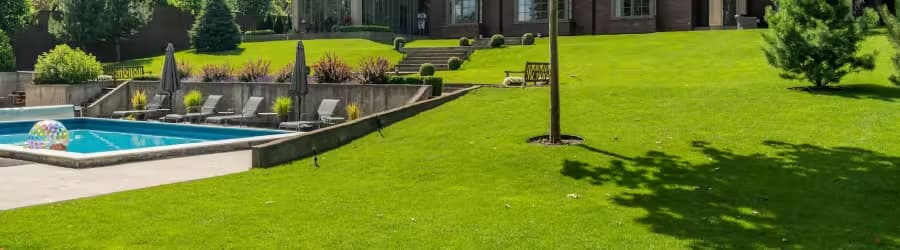
Summer (Jun-Aug)
Mowing Off The Endless Seedheads
Summer is when carpetgrass earns its reputation for being more work than the label suggests. From June onward it throws seed stalks continuously, and they reach 12 to 30 inches if left alone. Mow weekly at 1.5 to 2 inches — not because the leaves grow that fast, but because the seed stalks do. Never take more than a third of the height at once, and never scalp: with no rhizomes underground, scalping removes the growing points outright.
Feed once, around mid-June — 1 pound of actual nitrogen per 1,000 square feet, or up to 2 pounds on very sandy, leached soil. That is the whole fertilizer program for the year. Near the coast you can add an optional half-pound in mid-August.
Water is the real summer job. Carpetgrass needs about an inch a week, or half an inch every three days on sand, and it has no dormancy fallback. If a drought sets in and you cannot keep it green, keep it alive instead: half an inch every three weeks will hold the crowns even though the lawn stays brown. Water before dawn, always.
Hold off on spraying. Do not apply herbicides above about 85 to 90°F or to a drought-stressed lawn — that combination is where most carpetgrass herbicide injury actually happens. Watch for tropical sod webworm, which prefers this grass over its neighbors, and check with a soap flush if the blades start looking chewed and ragged. Grub prevention, if you use it, goes down from spring into early summer.
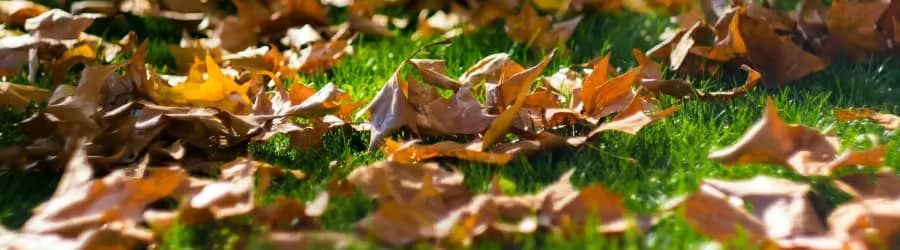
Fall (Sep-Nov)
Large Patch Weather Arrives Again
Fall is Large Patch season, and it arrives on a schedule you can watch for — nights dropping below 70°F while dew sits on the leaves for 10 to 12 hours. That is the trigger. Circular tan-to-brown patches with a darker edge and rotted leaf sheaths follow within a couple of weeks.
Three things prevent most of it. Keep nitrogen off completely: the optional half-pound near the coast in mid-August is the last feeding of the year, and anything later feeds the disease and strips the cold-hardiness the plant needs going into winter. Water only before sunrise, never in the evening, so the leaves are not wet all night on top of the dew. And aerate wet, compacted ground so the surface dries faster. If your lawn has a Large Patch history, this is the season for a preventive fungicide watered down into the crown rather than sprayed onto the leaves.
Expect the lawn to brown out at the first hard cold spell and stay that way. Resist the temptation to overseed with ryegrass for winter color: it starves the carpetgrass in spring, and it locks you out of most winter weed control, since the herbicides that would manage the overseed are unsafe here.
Keep mowing until growth stops, and take a hard look at drainage while you can still see where water stands. Where it stands in fall, it will freeze in winter, and that is what kills crowns.
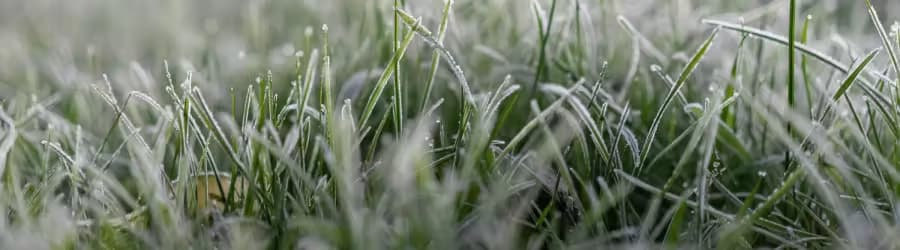
Winter (Dec-Feb)
Why Wet Winter Ground Kills Crowns
Expect a fully brown lawn with no green in it at all, and do not read that as failure — carpetgrass carries no winter color anywhere frost reaches. Only in frost-free South Florida does it stay green year-round.
The winter risk is not cold by itself. It is cold plus water. Carpetgrass keeps its crowns at the soil surface, and when temperatures fall to around the mid-20s°F, the water inside those crowns freezes and bursts the cells. Wet ground makes this worse in a specific way: during a winter warm spell, dormant crowns take up water from saturated soil, and the next hard freeze ruptures them. That is why the most useful winter protection for this grass is not a cover or a product — it is drainage. If water stands in a low spot through December, that low spot is where you will be reseeding in April.
Stay off the dormant turf as much as you can. Carpetgrass has no ability to repair winter traffic damage until it greens up months later, so the ruts and worn lines you make now will still be there in spring.
Winter is the one safe window for atrazine, and only on turf that is fully dormant and at least a year old. Once green-up starts, that window closes.
Carpetgrass Against Centipede And Bahia
Carpetgrass is not really competing with other lawn grasses. On a normal site it loses to all of them. It is competing with bare mud. Once you frame the choice that way, the comparisons get simple.
Centipedegrass is the closest match and the honest default. It wants the same acid soil and the same tiny fertilizer program, it looks similar from a distance, and it beats carpetgrass on nearly everything that matters day to day — better color, better wear, far fewer seedheads, and a much longer list of herbicides you can safely use on it. What it will not do is sit in saturated ground. Choose carpetgrass only where the site is wetter than centipede will tolerate. If the ground drains at all, choose centipede.
Bahiagrass is the other low-input Southern option, and a close relative — same subtribe, same V-shaped branched seedhead, same tolerance for poor soil. The difference is roots. Bahiagrass roots deeply and survives drought that kills carpetgrass outright, but it prefers sun and does not want to sit in standing water. The split is clean: bahiagrass for dry, infertile sand; carpetgrass for wet, sour, low ground.
St. Augustinegrass gives you much better shade tolerance and a far better-looking lawn, but it wants more water and more fertilizer, it is chinch bug prone, and it will not sit in saturated soil as long as carpetgrass will.
Bermudagrass and zoysiagrass beat carpetgrass on every performance measure there is — wear, recovery, density, drought, cold — and lose on exactly one: they drown. That single exception is worth thinking about carefully. If your wet spot is small, installing drainage and then planting bermudagrass or zoysiagrass usually produces a better lawn for less ongoing work than planting carpetgrass and accepting its limits forever. Carpetgrass is the right answer when the wet area is large, permanent, or not worth the cost of fixing.
Find Your Precision Match
Choosing between species requires balancing your specific soil profile, local micro-climate, and maintenance goals. Use our Turf Match Tool to generate a data-backed recommendation for your specific yard.
Start Your MatchTechnical Specifications
Scientific Name: Axonopus fissifolius (Raddi) Kuhlm. Accepted synonym: Axonopus affinis Chase. Basionym: Paspalum fissifolium Raddi. Related species covered on this page: Axonopus compressus (Sw.) P. Beauv., tropical or broadleaf carpetgrass.
Common Names: Common carpetgrass, carpetgrass, carpet grass, narrowleaf carpetgrass, Louisiana grass, mat grass, caratao grass. Tropical carpetgrass and broadleaf carpetgrass refer to the separate species A. compressus.
Family: Poaceae, the grass family. Subfamily Panicoideae, tribe Paspaleae, subtribe Paspalinae — the same subtribe as Paspalum, which makes bahiagrass and seashore paspalum its nearest turf relatives.
Origin: Native. USDA-NRCS and NC State Extension list common carpetgrass as native to the warm parts of the Americas — Virginia south to Florida, west to Texas and Oklahoma, and on through Central and South America to Argentina. Older extension material describing carpetgrass as a West Indian introduction of the early 1800s covers both carpetgrass species under one heading; the introduced one is A. compressus.
Season Type: Warm-Season
Growth Habit: Stoloniferous
Growth Rate: Slow
Texture: Coarse
Root System Depth: Shallow. Clemson describes the root system as very shallow, and no land-grant source publishes a measured depth for the species — treat that absence as real rather than estimating one. Roots form at stolon nodes at the soil surface, which is why a dry spell reaches the crown so quickly. Federal wetland status is FACW, facultative wetland.
Spread Mechanism Intensity: Stolons only, rooting at the nodes; rhizomes are absent, confirmed independently by NC State species data. Spread is steady rather than aggressive and forms a dense mat, but every growing point the plant owns sits at or above the soil surface, so anything that strips the surface strips the plant.
Typical Lifespan & Invasiveness Risk: Perennial. Within its native Southeastern range it is not an ecological invader, but it seeds heavily and escapes readily from wet ground onto neighboring sites, and it travels as undisclosed filler in cheap seed mixes. Once it is in a centipedegrass or St. Augustinegrass lawn no selective herbicide will remove it. Outside its native range it is a documented weed: University of Hawaii CTAHR lists it in Weeds of Hawaii’s Pastures and Natural Areas, it is naturalized on all main Hawaiian islands along trails, stream banks, wet forest and bog margins, and it has been introduced through Asia, Africa, Australia and the Pacific.
Hardiness Zone Min: Zone 8
Hardiness Zone Max: Zone 10
Hardiness Zone Notes: Ideal Zone 8b to 10; stretch and winterkill-prone through Zone 7a to 8a. Plant references list the species as hardy 7a to 10b, but that is a survival range rather than a lawn range — reliable managed turf starts at Zone 8b, and in Zone 7 winter damage should be expected most years. The limiting mechanism is physical, not metabolic: the crowns sit at the soil surface with no insulating rhizome layer and node LT50 is roughly 25 to 28°F, so water inside the crowns freezes and ruptures the cells at around the mid-20s°F. Saturated winter soil makes it markedly worse, because dormant crowns take up water during a warm spell and then rupture on the next hard freeze; winter drainage matters more here than any temperature number. Tropical carpetgrass (A. compressus) is a separate, more frost-sensitive species limited to roughly Zone 9b to 11.
Cold Tolerance Rating: Very Low
Winter Color Profile: Dormant
Climate Cool Humid: Unsuitable
Climate Cool Arid: Unsuitable
Climate Warm Humid: Excellent
Climate Warm Arid: Unsuitable
Climate Transition: Poor
Sun Requirement: Tolerates Partial Shade
Shade Tolerance: Moderate
Water Requirement: High
Drought Survival Strategy: No Safe Dormancy (declines/dies)
Soil Texture Fit:
Sand
Loamy Sand
Sandy Loam
Loam
Silt Loam
Clay Loam
Clay
pH Survival Min: 4
pH Optimal Min: 5
pH Optimal Max: 5.5
pH Stress Max: 7
Wet Feet Tolerance: Very High
Compaction Tolerance: Moderate
Salinity Tolerance: Very Low
Wear Tolerance: Low
Recovery: Low
Recovery Mechanism: Stolons
Input Intensity: Very Low
Labor Intensity: High
Thatch Production: Low
Annual N Figure: 1 lb actual nitrogen per 1,000 sq ft per year; up to 2 lb on very sandy, leached soil. Applied once in early summer around mid-June, with an optional second half-pound in mid-August near the coast. Never more than 1 lb in a single application.
Establishment Methods:
Seed
Sprigs
Plugs
Germination Speed: Moderate (7–14 days)
Establishment Speed: Moderate
Seeding Rate: 1 lb per 1,000 sq ft for a new lawn; 2 lb per 1,000 sq ft when patching a thin or weedy stand. No overseeding rate applies — winter overseeding with ryegrass is specifically discouraged. Plugs set 12 inches apart take one to two years to close in.
Improved Cultivar Availability: None documented
NTEP Note: NTEP runs no carpetgrass evaluation program at all, so there is no trial data, no cultivar rankings, and nothing to shop by name; the species is sold as unnamed common seed. Match carpetgrass on two trait axes instead. First, cold hardiness as a hard exclusion gate — common carpetgrass is reliable only at Zone 8b and warmer, and the frost-sensitive tropical type is excluded at Zone 8 and colder. Second, shade as the tipping axis — the genuinely shade-tolerant type is tropical carpetgrass, which rivals St. Augustinegrass in shade but is limited to roughly Zone 9b to 11, is not sold as seed, and must be plugged from specialty South Florida sources. Surface the tropical type only for a Zone 9b to 11 site with deep, wet shade, and default all of its unrated traits, drought and wear in particular, to the common-carpetgrass values, because they are undocumented for the tropical type. Everywhere else, carpetgrass means common carpetgrass.
Deep Dives & Practical Guides
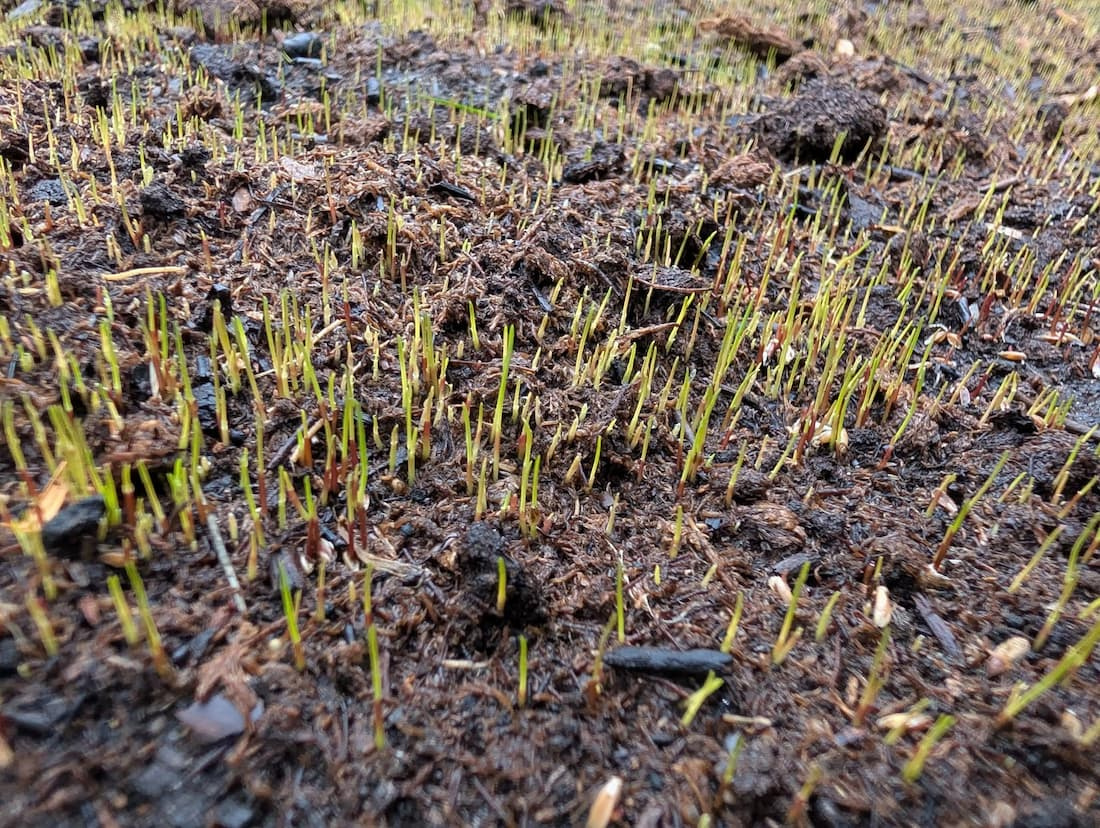
How to Establish a New Lawn From Bare Soil to First Mow
Bare soil doesn't turn into a lawn just because you scattered seed or rolled out sod — it becomes one based on a handful of specific steps done in the right order, matched to your specific grass. This guide walks through soil prep, seeding or planting method, starter fertilizer, watering as the grass grows, and knowing when it's actually safe to mow, for both cool-season and warm-season lawns.
Read Article
Cool Season vs Warm Season Lawn and Landscape Guide
Your lawn and your flower beds don't follow the same calendar — one runs on a cool-season engine, the other on a warm-season one, and using the wrong playbook on either can do real damage. This guide helps you figure out which system you actually have and how to care for it correctly, plus how the same cool/warm split applies to your ornamental beds.
Read Article
The Hole You Dug Is Killing Your New Plants
A shrub that looked fine all summer and stalled the next year usually didn't fail because of the plant, the weather, or the nursery. It failed because the hole it went into was a container — smooth-walled, water-holding, and impossible to root out of.
Read Article
What You Can Actually Change About Bad Soil
Heavy clay and loose sand feel like permanent sentences, and half of that is true. What your soil is made of will not change. How those particles are arranged will — and that is the half that decides whether anything grows.
Read Article
Why Your Plants Survive Winter and Die in July
Your hardiness zone is built from one number — the coldest night of an average year. It says nothing about the hottest afternoon, which is what actually kills most plants people lose. Here's how to read the other half of the map.
Read Article
Why Poa Annua Keeps Coming Back — and the 3-Year Plan That Finally Ends the Cycle
You've pulled it. You've sprayed it. You've watched the little white seedheads mock you every single spring. And every fall, like clockwork, it's back — in the lawn, in the beds, in the cracks you didn't know you had. Here's the hard truth nobody at the big-box store will tell you: you're not losing because you're doing it wrong — you're losing because you're fighting the wrong enemy on the wrong timeline. Poa annua isn't a one-season problem, and once you understand why, the three-year plan below stops feeling like a chore and starts feeling like a countdown.
Read Article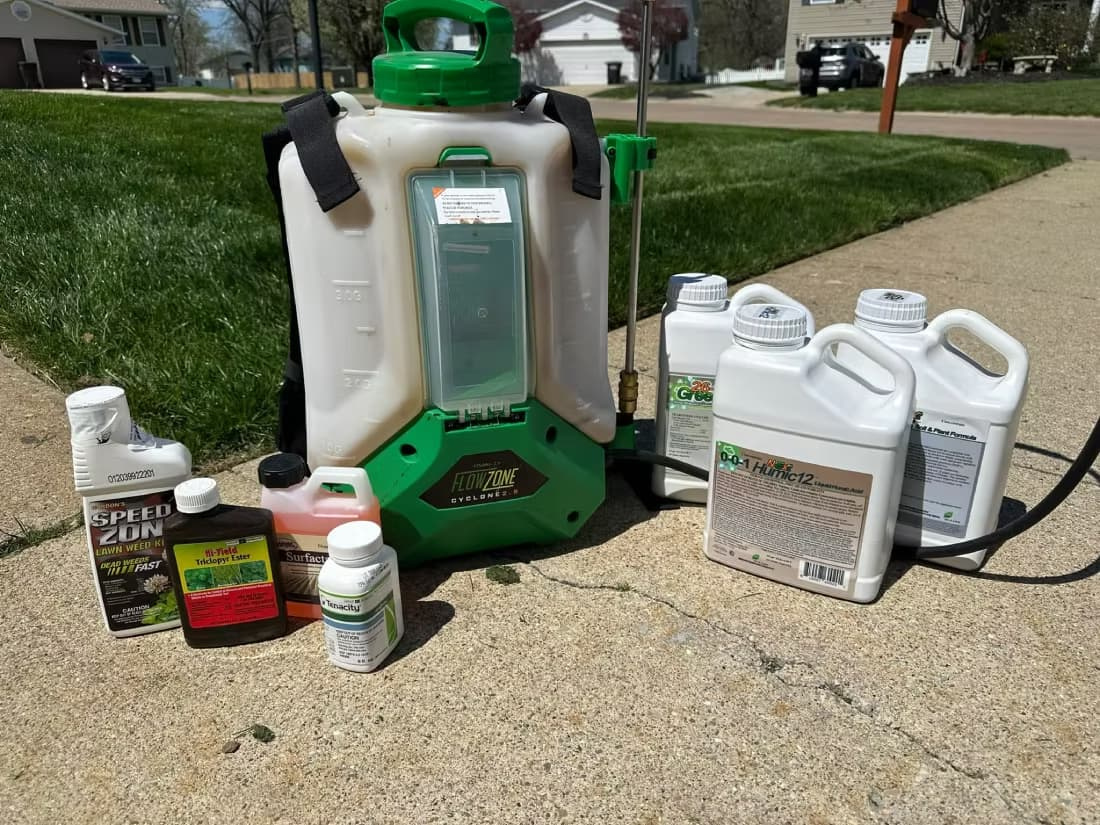
How to Apply Herbicides Correctly in Your Lawn and Garden Beds
Getting real results from a weed product has almost nothing to do with the brand on the bottle and everything to do with matching the method to the moment — the right chemistry, in the right place, at the right time. Learn how to apply herbicides correctly across both your lawn and your garden beds, whether you’re stopping weeds before they sprout or killing the ones already growing, without wasting product or harming the plants you want to keep.
Read Article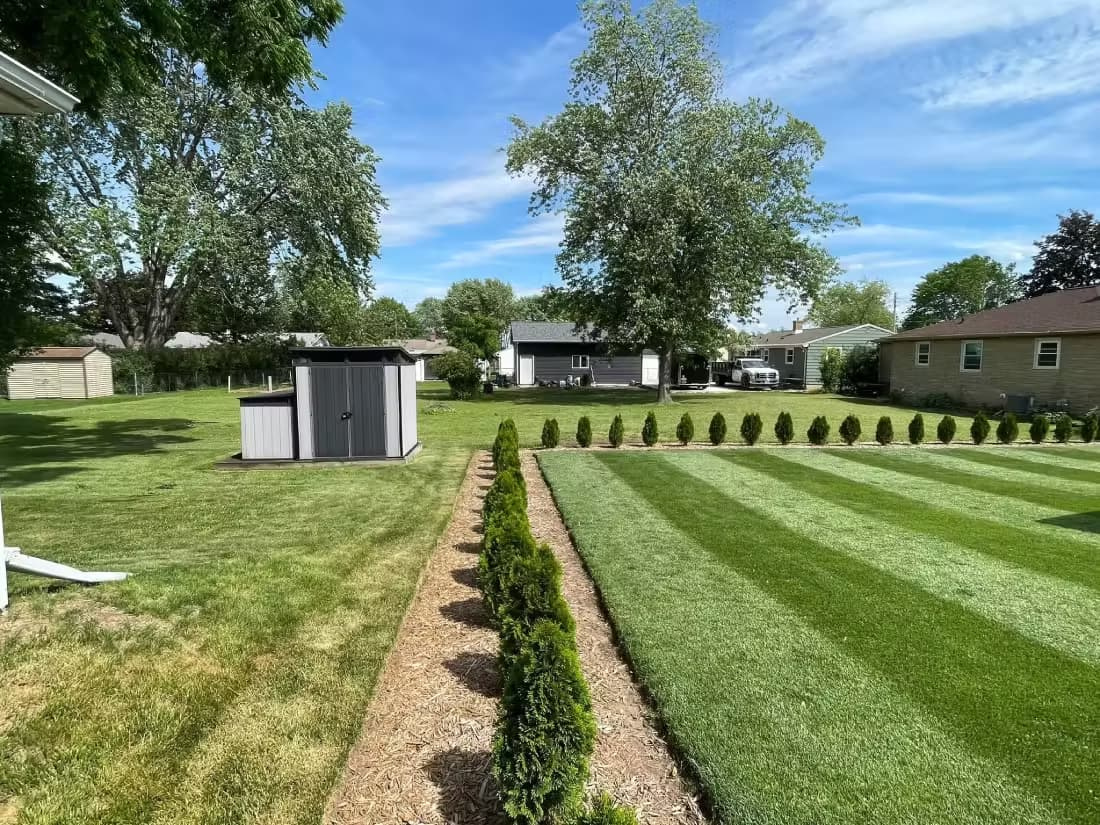
How to Kill Weeds Where Two Lawns Meet Without Harming Your Neighbor’s Grass
Controlling weeds along a shared property line is where good intentions quietly backfire—the season that's safe for your own lawn is often the season the lawn next door is most easily harmed. Learn the seasonal timing collision behind most fence-line damage, and the two habits that prevent it—reading what's actually in the bottle and spraying directed instead of broadcast—so you can clear the weeds without hurting your grass, your neighbor's, or the peace between you.
Read Article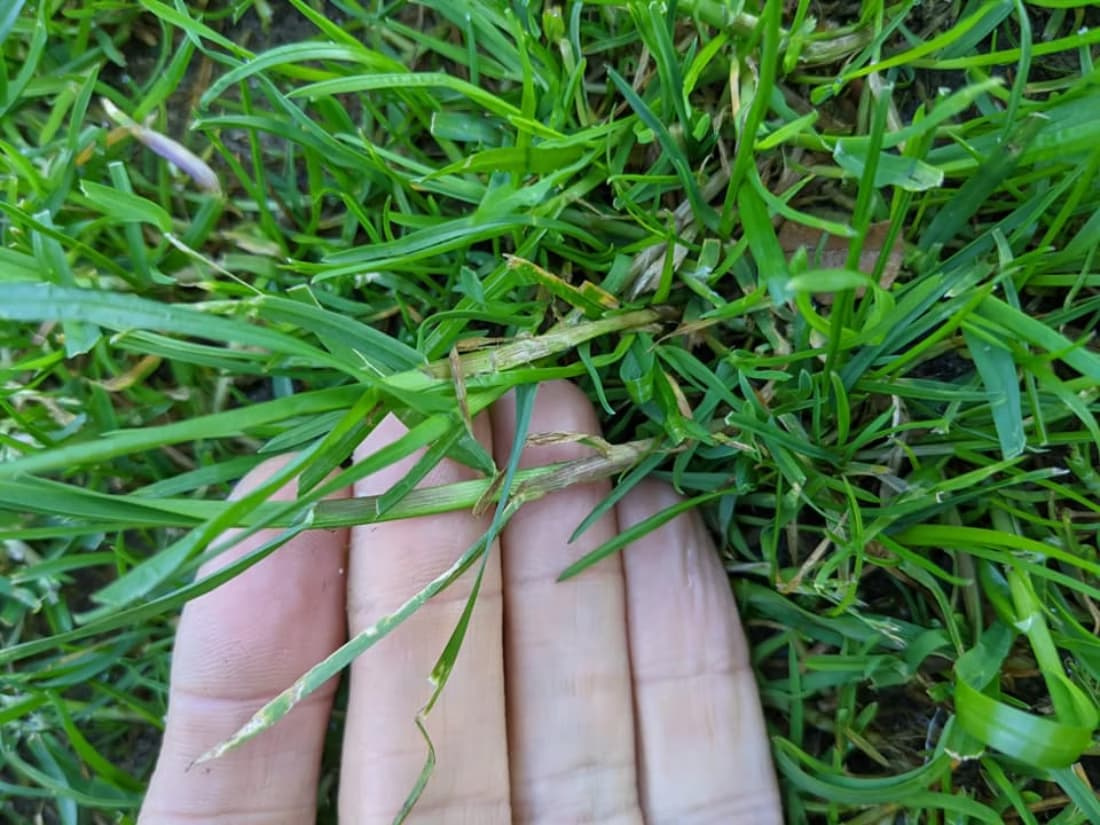
The Truth About One-and-Done Weed Control
Most homeowners lose the fight against weeds not because they work too little, but because they act before they understand. One-and-done weed control is real — but it only works when identification, timing, and the right tool all line up. This guide explains how that sequence works across your lawn and your ornamental beds, and how each weed page in the MFY hub puts it into practice for your specific invader.
Read Article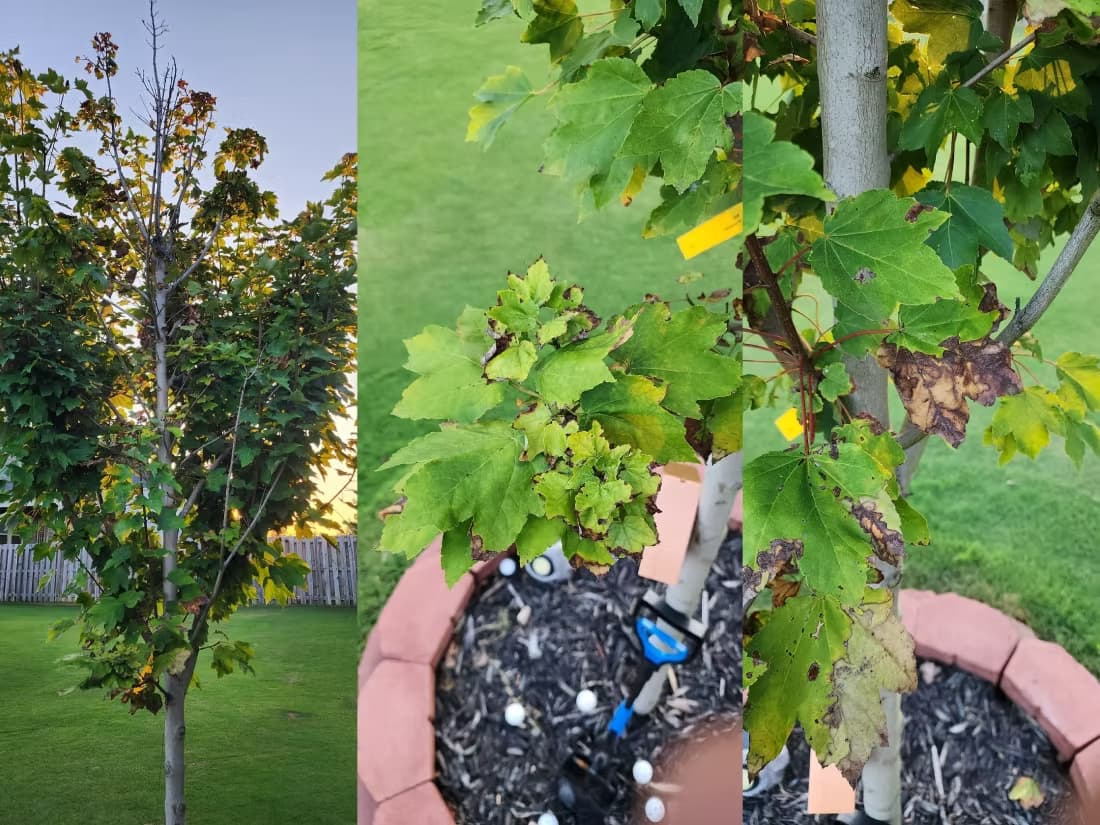
Solving the Mystery of the False Evidence in Your Lawn and Landscape
A brown leaf or a yellowing lawn is rarely what it seems. When symptoms act as decoys, a calm, forensic approach brings clarity to the confusion. Learn how to look past the surface to find the quiet truth of what your plants are truly asking for.
Read Article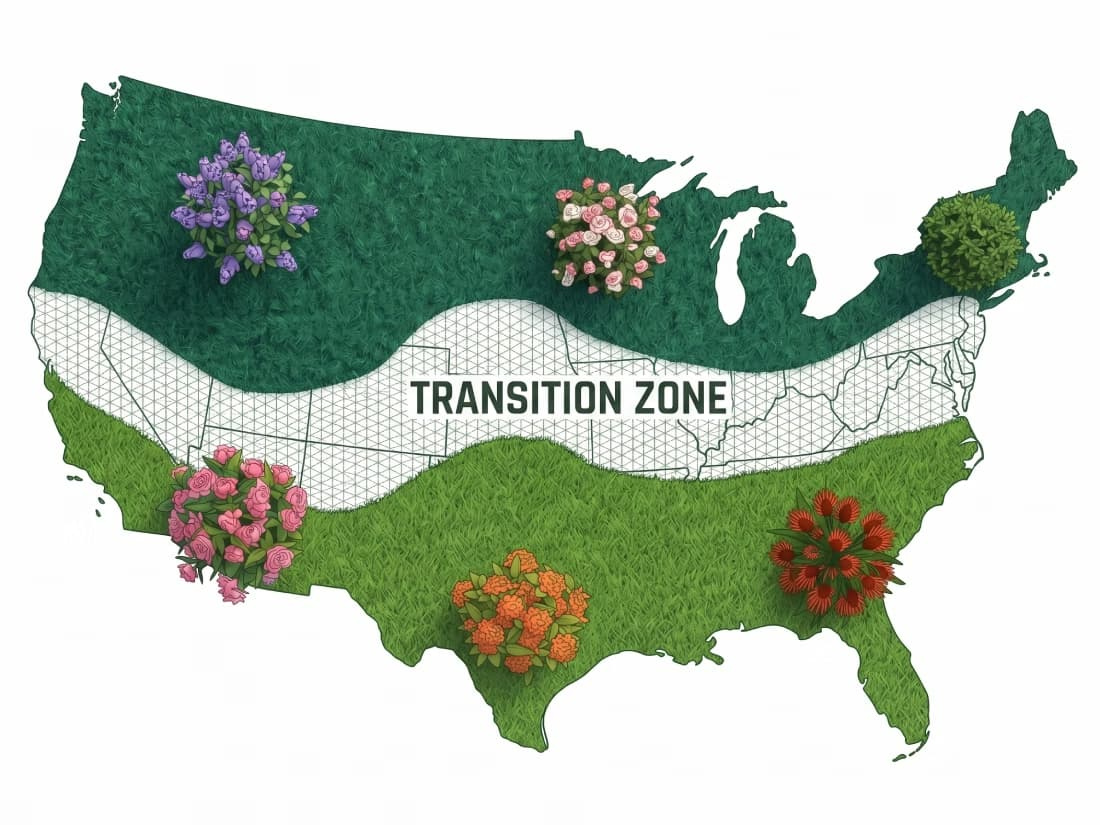
Living in the Middle: The Deep-Dive Guide to Transition Zone Lawns and Landscapes
The Transition Zone is a biological tug-of-war where neither northern nor southern species perfectly adapt. By using resilient "bridge" species and mastering maintenance levers like the Mowing Pivot, you can transform a struggling yard into a healthy landscape.
Read Article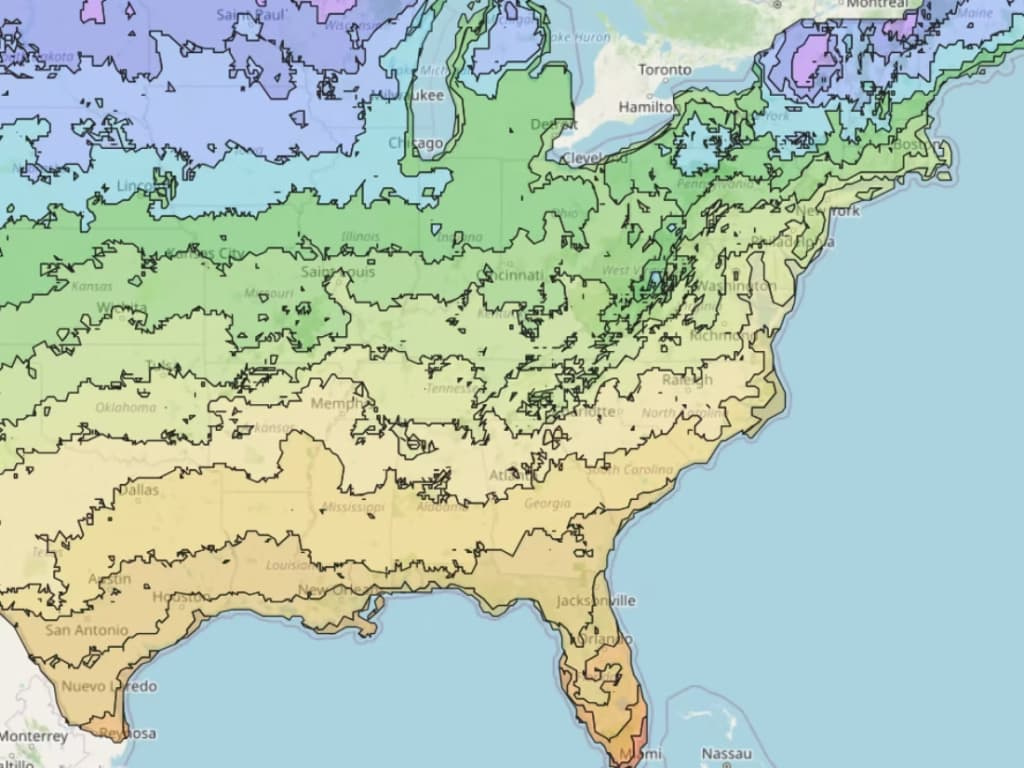
What Your Hardiness Zone Really Means for Your Lawn and Plants
Uncover the foundation of a resilient landscape by mastering the science of hardiness zones. Learn how these climate boundaries are calculated and why understanding your local temperature limits is the first step toward choosing plants that thrive year after year.
Read ArticleFrequently Asked Questions
Our maintenance and establishment guidance is derived from long-term agronomic field studies and turfgrass performance data from top research institutions.
Half of it is. Carpetgrass is genuinely cheap to feed — 1 pound of nitrogen per 1,000 square feet a year, applied once — and it needs no lime on the acid soils it prefers. But it is not low-effort. Summer seedheads force weekly mowing from June into fall, and shallow roots force regular watering. It is a low-cost grass and a high-attention one, and most low-maintenance write-ups only count the first half.
Probably not, and this is the most important thing to know about the grass. Bermudagrass and zoysiagrass go dormant in drought and come back when the water returns. Carpetgrass cannot do that — its roots are too shallow to reach stored water and it has no true dormancy, so drought kills the crown rather than resting it. If you cannot keep it green, keep it alive: half an inch of water every three weeks will hold the crowns through a dry spell even though the color stays brown.
Assume not until you have checked the label for carpetgrass by name. This grass is far more herbicide-sensitive than bermudagrass or zoysiagrass, and products that are routine on other Southern lawns will burn, stunt or kill it. 2,4-D has to be cut to half the normal rate. Pre-emergents cannot go down at all until the stand is over a year old. And a weed-and-feed applied in spring breaks two rules at once, because the nitrogen timing is wrong as well.
No. Ryegrass shades and starves carpetgrass exactly when it is trying to green up in spring, and carpetgrass is already the slowest grass in the neighborhood to wake up. On top of that, most of the herbicides used to clean up a winter overseed are unsafe on carpetgrass. Plan on a brown lawn from the first hard cold spell until late spring.
Because there are two carpetgrasses and only one of them is sold as seed. Bagged carpetgrass seed is common carpetgrass (Axonopus fissifolius), which needs roughly a half day of sun. The genuinely shade-tolerant one is tropical carpetgrass (Axonopus compressus), which rivals St. Augustinegrass in shade — but it is frost-sensitive, limited to roughly Zone 9b to 11, and moves as vegetative plugs through specialty South Florida sources rather than as seed. If you are north of that, tropical carpetgrass is not an option no matter how shady the yard is.
Check your soil pH before you reach for nitrogen. Uniform yellow-to-ivory leaves with green veins on soil above pH 7.0 is iron chlorosis — the alkaline soil is locking up iron, and adding nitrogen only makes the plant hungrier for iron it still cannot reach. Treat it with a chelated iron product or ferrous sulfate. No carpetgrass-specific rate has been published; the common practice borrows the centipedegrass rate of about 2 ounces of ferrous sulfate in 5 gallons of water per 1,000 square feet.
You generally cannot. Carpetgrass is not commercially sodded, which is unusual among Southern lawn grasses and is one reason seed is the standard route here. If you need cover on a slope, the alternative is plugs or sprigs, usually dug from an existing stand — and plugs set a foot apart take one to two years to close in.
You cannot. There is no selective herbicide that removes carpetgrass from centipedegrass or St. Augustinegrass, because the three grasses are too closely matched in tolerance. Your options are to accept it, spot-treat with a non-selective herbicide and reseed or plug those areas, or renovate the whole lawn. If you go non-selective, read the active-ingredient panel rather than the brand name — a familiar brand no longer reliably tells you what is in the jug, and some products sold under names people associate with non-selective control are now selective blends that will not do the job. And check your drainage while you are at it, because carpetgrass moved in for a reason.
Scientific Authority
This profile is grounded in turfgrass agronomy and soil science. Every recommendation—from irrigation requirements to nutrient management—is verified against agricultural research data to ensure optimal plant health and environmental sustainability in the Transition Zone.
Primary Resources
- NC State Extension TurfFiles: Carpetgrass Profile
- NC State Extension TurfFiles: Carpetgrass Lawn Maintenance Calendar (AG-541)
- Clemson Cooperative Extension: Carpetgrass (HGIC 1213)
- Clemson Cooperative Extension: Southern Lawns: Best Management Practices (EC 707 / HGIC 1214)
- LSU AgCenter: Carpetgrass for Lawns (Publications 3917 & 3624-PP)
- Mississippi State University Extension: Selecting & Managing Turfgrass for Shade (Publication 2892)
- UF/IFAS Extension: Axonopus Species & Carpetgrass Selection (LH005)
- USDA-NRCS Plant Materials: Plant Fact Sheet: Carpetgrass, Axonopus fissifolius (symbol AXFI)
- NC State Extension Gardener Plant Toolbox: Axonopus fissifolius Profile
- University of North Carolina Herbarium: Flora of the Southeastern United States
- University of Hawaii CTAHR: Weeds of Hawaii’s Pastures and Natural Areas
- Texas A&M AgriLife Extension: Turfgrass Identification & Morphology Guides
- National Turfgrass Evaluation Program (NTEP): Pure-Stand Evaluation Data