
Scientific Name: Elymus repens (also written Agropyron repens or Elytrigia repens on older extension pages — same plant)
Quackgrass
Chop it, spread it
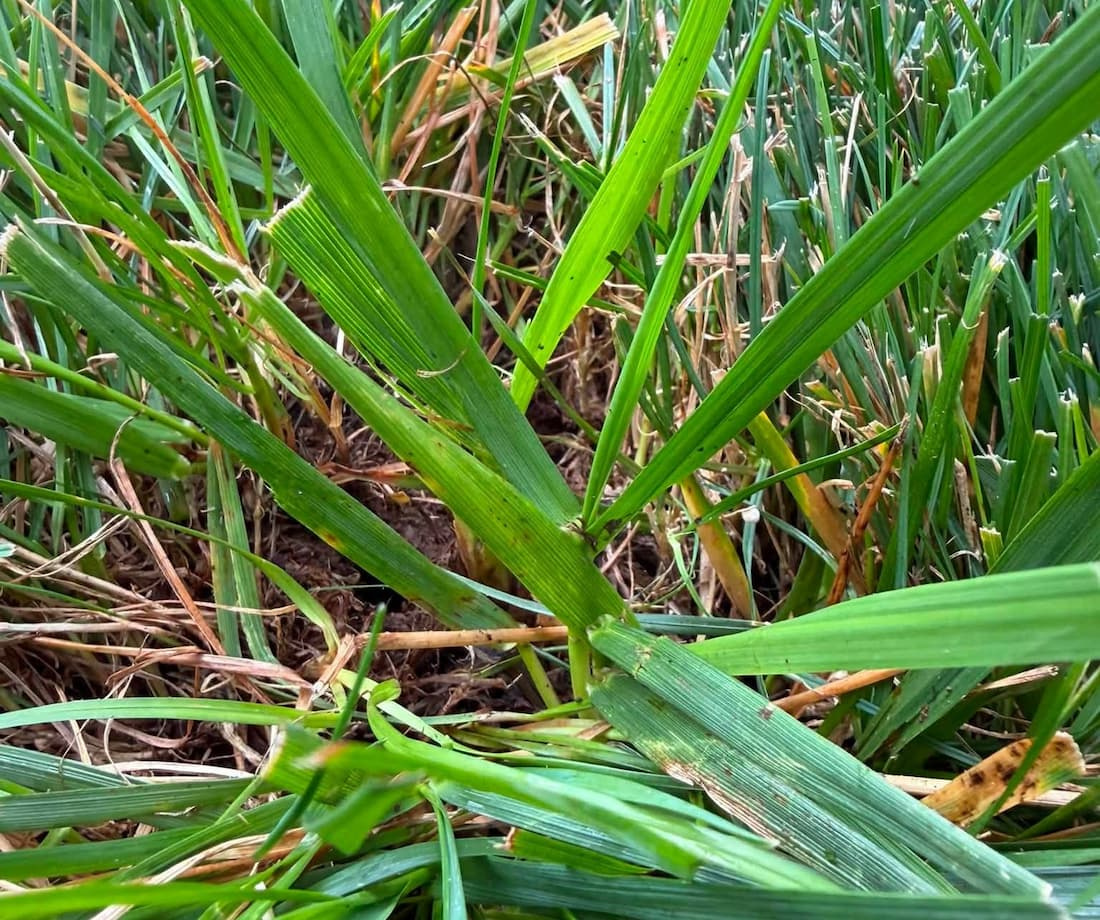
Quackgrass At-a-Glance
Weed Type
Grass
Life Cycle
Rhizomatous perennial
Growth Habit
Erect, spreading into coarse creeping patches
Root Type
Rhizome (creeping underground stems)
Spreading Risk
High — by rhizome
Pull
No — pulling and digging multiply it
Identity & Diagnostics
Visual Fingerprint
Quackgrass shows up as a coarse, dull grayish-green to ashy blue-green patch that stands out against finer, darker lawn grass. The blades are noticeably wider and rougher than turf, and the patch grows fast — it often overtops the rest of the lawn within days of mowing. In an unmowed spot it stands 1 to 4 feet tall and sends up a stiff, narrow, wheat-like seed spike. The color and the coarse texture are usually what make a homeowner stop and ask what they’re looking at.
Structural Anatomy
Up close, one feature settles the identification more than any other: the auricles. Where the leaf blade meets the stem, quackgrass has a pair of narrow, claw-like clasps that wrap around the stem like tiny fingernails. They’re whitish-green, sometimes tinged brown or purple. Almost no other lawn grass has auricles this long and grasping.
But auricles alone aren’t enough, because a few lawn grasses have smaller ones. The confirmation is underground: sharp-tipped, white, creeping rhizomes. The rule to remember is simple — clasping claw-like auricles plus creeping white rhizomes means quackgrass. Clasping auricles but no creeping rhizomes means it is not quackgrass.
Supporting features that back up the call: the young leaf is rolled in the bud (not folded); the leaf blade is thin, flat, finely ribbed, and often shows a slight twist plus a small “chevron” pinch an inch or two behind the tip; the stem is round, smooth, and hollow with swollen joints; and the sheaths low on the stem are often softly hairy in spring (smoothing out by mid-summer).
Grass-Specific Anatomy
| Feature | Quackgrass |
| Auricles | Long, slender, claw-like, clasping the stem |
| Vernation | Rolled in the bud |
| Ligule | Membranous, very short (0.5–1.0 mm), fine-fringed |
| Collar | Broad, continuous, paler than the blade |
| Sheath | Round, open, overlapping; hairy low on the stem in spring |
| Rhizome | Slender, white, sharp-pointed, horizontal — the confirmer |
Growth Patterns & Life Stages
Seedling (early spring): a single thin, upright shoot, only a couple of inches tall, with very narrow flat leaves. The clasping auricles haven’t formed yet — which is exactly why seedlings get misidentified. By the six-to-eight-leaf stage the plant is already sending out its first underground rhizomes.
Vegetative (the stage that matters most for control): shoots that came from rhizomes are more vigorous than shoots from seed, and they start their own creeping rhizomes as early as the three-to-four-leaf stage. The plant spreads outward into a coarse, ashy patch. This is the window for chemical control — but timing within it is everything (see the Zone Timing tabs and Post-Emergent in Lawn).
Flowering / seed set (late May through September): a stiff, narrow, unbranched spike 2 to 10 inches long, like a slim head of wheat, with flattened spikelets set edgewise along the stalk. Once you see the spike, the plant is putting energy into seed and its underground reserves are recharging — the “too late for easy answers” signal.
Gallery
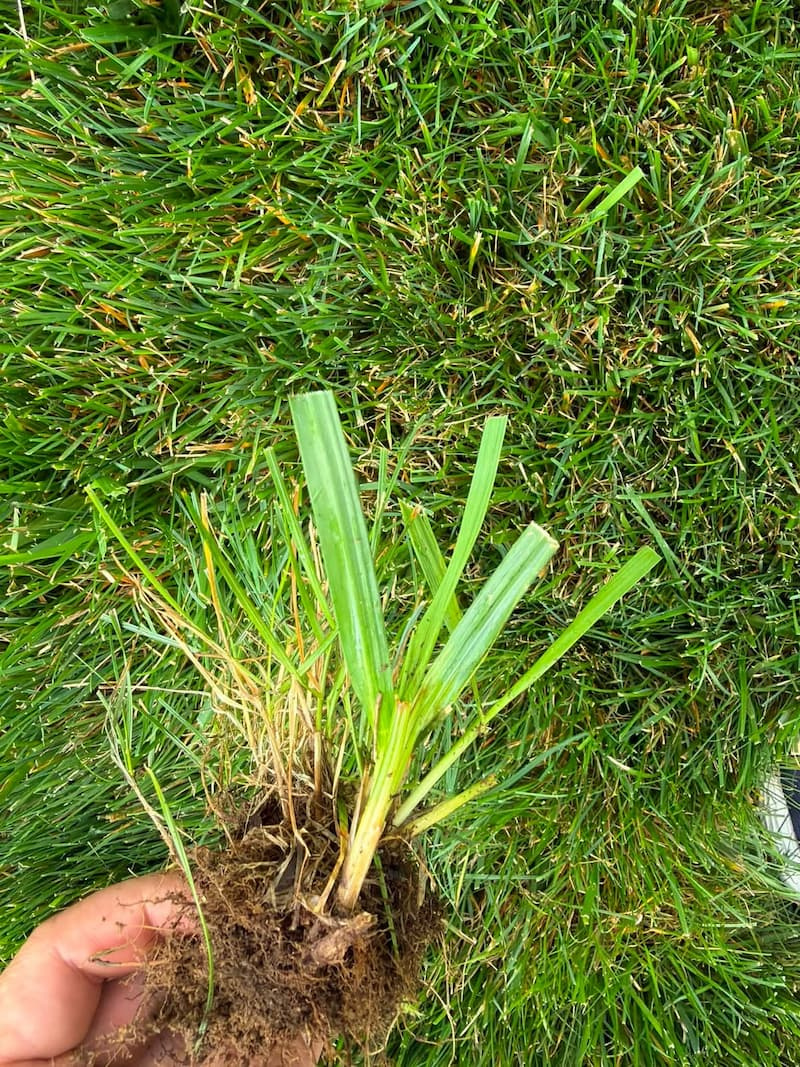
Uprooted quackgrass plant displaying coarse, upright tillers and fibrous root connections.
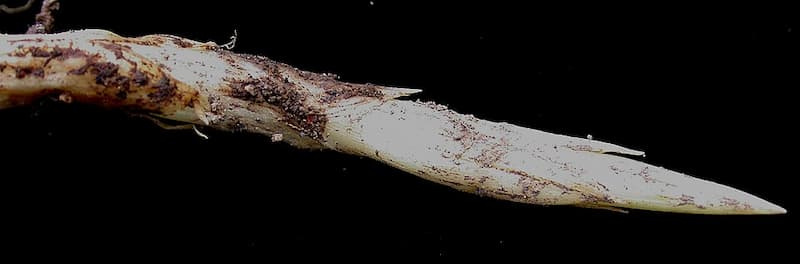
Diagnostic Feature: Quackgrass spreads through long, pale rhizomes with sharp, needle-like tips — leave even a small piece in the soil and it can regrow, which is why hand-pulling rarely gets rid of it for good.
“<div class=’fn’> <i>Elymus repens</i></div>” by Ayotte, Gilles, 1948- is licensed under CC BY-SA 4.0.
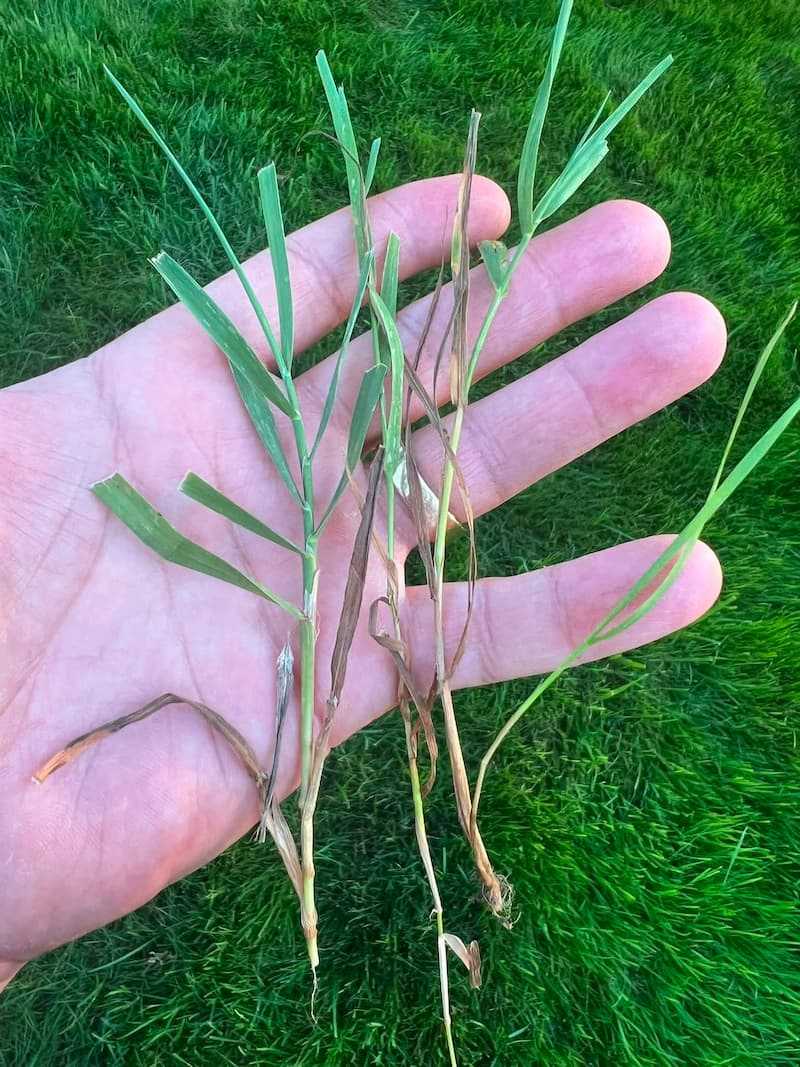
Individual quackgrass tillers removed from turf, displaying slender stems, distinct node collar joints, and narrow leaf blades.
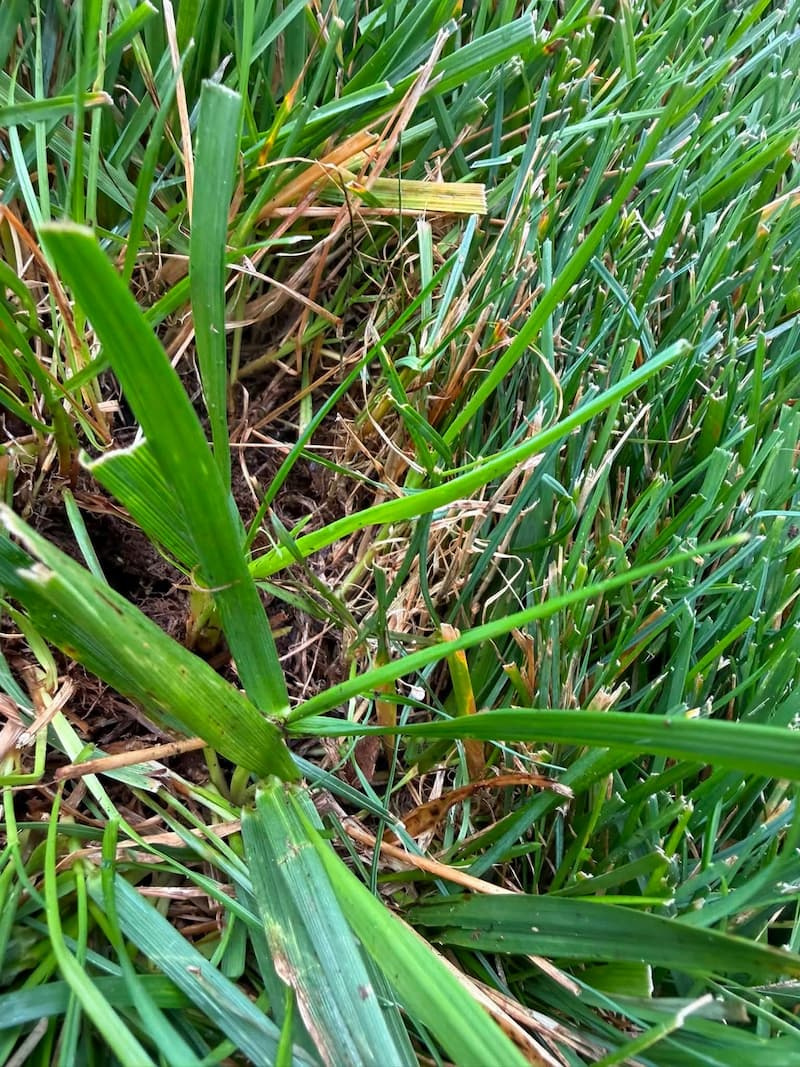
In-lawn view of quackgrass tillers overtopping desirable cool-season turfgrasses.
The Identity Trap
Common Lookalikes
- Tall fescue — also a coarse, cool-season lawn grass, and it also has auricles, so people constantly mix the two up.
- Perennial ryegrass — common in lawn seed mixes and also has small auricles, so a ryegrass clump gets mistaken for a quackgrass invasion.
Identification Differentiators: How to Tell Them Apart
The single test resolves both: tug the plant and look underground. Tall fescue and perennial ryegrass are bunch grasses — they grow in clumps with fibrous roots and no creeping rhizomes, so they lift out as a discrete tuft. Quackgrass is anchored to a network of long, white, sharp-tipped horizontal rhizomes that snap and stay behind. If you find creeping white underground stems running sideways from the plant, it’s quackgrass. If you find only a fibrous clump, it isn’t.
Growing Conditions
Host Grasses
Quackgrass invades both lawn types, but for different reasons. In the North it’s a persistent weed of Kentucky bluegrass, perennial ryegrass, and fine fescue lawns, growing right alongside them since it shares their cool-season rhythm. In the transition zone and warmer areas it invades Bermudagrass, zoysiagrass, and centipedegrass — not by outcompeting them head-on, but by staying green and growing through fall, winter, and early spring while those warm-season grasses are dormant and can’t fight back. Thin, low-density turf is the entry point in either case.
Host Environment/Area
Quackgrass establishes in both lawns and beds, but it is markedly more aggressive in cultivated bed soil — this is a real difference, not an even split. In loose, tilled ground (garden beds, nursery beds, vegetable plots) the rhizomes meet almost no resistance and can push more than an inch a day, and every pass of a tiller chops and scatters them into new plants. In a lawn, the soil is compact and undisturbed, so the plant can’t be chopped and spread — instead it creeps slowly outward into the tell-tale coarse, circular patches. New lawn infestations usually arrive in contaminated topsoil brought in during grading, or in cheap, low-quality grass seed mixes.
Soil Indicators: What the Presence of This Weed Reveals About Your Yard
Quackgrass is a fairly reliable signal of moist, nutrient-rich, neutral-to-alkaline soil. It thrives in damp ground — wet meadows, river banks, low spots — and has little tolerance for chronically dry, sandy sites, so it rarely signals arid soil. Chemically, heavy infestations tend to sit on soil high in potassium and manganese but low in phosphorus and calcium, often with an iron-to-manganese imbalance. It tolerates saline and alkaline conditions and hits peak vigor between pH 6.5 and 8.0. (Note the common myth that quackgrass signals acidic soil — the ecology research shows the opposite; it merely survives acidity, it prefers neutral-to-alkaline.)
Lifecycle and Season
Lifecycle Category and Management Implications
Quackgrass does not die at the end of the season. Its underground rhizome network overwinters and drives new shoots every spring, which changes everything about control. Pre-emergent herbicide is nearly pointless against an established stand, because pre-emergents only stop germinating seeds — and new quackgrass shoots come up from rhizome buds sitting below the treated soil layer, sailing right past the barrier. The only levers that reach the rhizome are a properly timed systemic herbicide and, slowly, repeated starvation. Everything on this page flows from that one fact.
Germination Trigger
For the small role that seeds play, germination begins in early spring when soil temperature at the surface (0–2 in) holds around 50–55°F, roughly when forsythia blooms. But the more important “start” is vegetative: dormant rhizome buds push new shoots as soil warms in early spring, and again during cool, moist fall conditions. Those two cool windows — spring and fall — are when the plant is most active and most treatable.
This is quackgrass’s stronghold. It grows fastest in the cool, moist stretches of spring (April–May) and fall (September–October) and slows in summer heat. In spring it briefly outruns Kentucky bluegrass, fescue, and ryegrass, standing up coarse and ashy above the turf. The one high-value treatment window is late summer into fall, ideally right after the first hard frost, when the plant is pumping sugars down into its rhizomes and a systemic herbicide rides along (see Post-Emergent in Lawn). Spring treatment works only once shoots are 6–10 inches of actively growing tissue — spray them younger and the herbicide won’t travel down.
Quackgrass is not a major problem across most of the warm-season South — it’s held to cooler microclimates, higher elevations, and the northern edge of the zone, roughly down into North Carolina. Where it does appear, warm-season turf hands you a tool cool-season lawns don’t have: the dormant-season window. In mid-winter, Bermudagrass and zoysiagrass go completely brown and dormant while quackgrass stays green and active. A non-selective systemic herbicide applied then hits the weed and spares the sleeping turf — but only if the desirable grass is fully dormant. The critical caution: apply too close to spring green-up (typically late April) and the waking turf will absorb the chemical and suffer severe injury or death. Zoysiagrass is the exception — it keeps green stems below a brown canopy all winter and is easily injured, so many programs discourage dormant sprays on it entirely.
The transition zone is the hardest, because both timing problems exist at once and collide. In cool-season turf here you face the grass-in-grass dead end (no selective option). In warm-season turf you get the dormant-winter window — but transition-zone winters are erratic, and an unseasonably warm spell can trigger early green-up before you’ve finished, turning a safe dormant spray into turf injury. Three specific conflicts define this zone:
- Fall pre-emergent vs. overseeding: the cool-season seeding window is tight (about August 25–October 10), and any fall pre-emergent that would block quackgrass seed will also block your desirable grass seed. You can’t do both.
- Spray-wait vs. winter freeze: you must wait ~7 days after glyphosate (5 after glufosinate) before seeding; stack that delay onto a late-summer spray and you can miss the October 10 seeding deadline, leaving young seedlings to die over winter.
Property-line drift: where a cool-season lawn borders a warm-season lawn, the correct spray timings are opposite (late-summer for the cool-season side, mid-winter for the warm-season side) — and each time, the other lawn is actively growing and vulnerable to drift.
Herbicide Control
Pre-emergent herbicide does not control established quackgrass — skip it as a primary tool. Established plants come back from rhizome buds, not from seed, so a surface barrier does nothing to them. Standard lawn pre-emergents (pendimethalin, prodiamine, dithiopyr) are built for annual grasses like crabgrass and have no effect here. Pre-emergent has only one narrow use against quackgrass — stopping new seedlings from introduced seed — and even that collides with lawn renovation, since the same chemical that blocks weed seed also blocks the desirable grass seed you’d sow after killing a patch.
In a cool-season lawn, there is no selective herbicide that removes quackgrass without killing the surrounding grass. This is the hard truth of the page. Quackgrass and cool-season turf are both C3 grasses with nearly identical physiology, so any grass-killing chemistry that hits one hits the other. A product (sulfosulfuron) once offered partial cool-season selectivity, but its cool-season turf uses were pulled from the label in 2011. Nothing has replaced it.
That leaves one effective option: spot-treat with glyphosate (a Group 9 systemic) and renovate. Glyphosate is non-selective — it kills the quackgrass and whatever desirable grass it touches — so you treat the patch, then reseed the dead area. To make it work:
- Timing is the whole game. Apply in late summer to fall, ideally the day after the first hard frost, when the plant is moving sugars down into its rhizomes and the herbicide travels down with them. Spring applications only work once shoots are 6–10 inches of actively growing tissue; sprayed younger, the sugar flow is still upward and the chemical never reaches the rhizome.
- Don’t mow for several days before and after, and add ammonium sulfate to the tank to improve uptake.
- Never spray drought-stressed plants — a stressed plant barely moves the chemical, and control fails.
This is a multi-season job, not one-and-done. Plan on 2 to 4 applications spaced 3–4 weeks apart, letting the patch fully regreen between sprays so each new flush of shoots carries another dose downward, until the rhizome’s reserves are exhausted.
The only cultural defense that works is a dense, vigorous turf canopy that never gives quackgrass seed a bare, sunlit spot to start. Mow on the high side (2.5–3.5 inches for most cool-season turf, up to 3–4 for tall fescue) to shade the soil. Feed the lawn in fall, not early spring — spring nitrogen lands right on quackgrass’s peak growth and feeds the weed as much as the grass. Overseed thin spots in late summer to close gaps, and keep soil pH near 6.5 for turf health. One honest limit: once a rhizome network is established, no amount of good mowing and feeding will remove it — dense turf prevents quackgrass, it doesn’t cure it. At that point the chemical-and-renovation program is your tool.
Pre-emergents in beds have the same limit as in lawns — they stop seedlings, not established rhizomes — so they’re a maintenance layer, not a cure. Products such as pendimethalin, napropamide, or trifluralin can be worked into a bed program to suppress new seedlings around established ornamentals; follow the label for which ornamental species tolerate each. One specialty note from the research: dichlobenil, used in beds with woody perennials, is unusual in suppressing newly emerging shoots from rhizomes as well as seedlings — but it’s volatile in heat.
Beds hand you the selective option that lawns can’t: grass-only herbicides. Because your ornamentals are broadleaf (dicots) and quackgrass is a grass (monocot), Group 1 graminicides (“grass killers”) can be sprayed over or around broadleaf ornamentals to kill the quackgrass and leave the ornamentals unharmed. Better still, these are systemic — they travel down into the rhizome nodes, so they attack the underground network, not just the visible leaves. Options by active ingredient:
- Fluazifop-P-butyl — highly systemic, reaches deep into rhizomes, the strongest of the group on quackgrass; apply at the 3-to-5-leaf stage, repeat ~14 days later.
- Clethodim — systemic and highly effective on perennial grasses; apply at 4–12 inches, repeat every 2–4 weeks.
- Quizalofop-P-ethyl — strong systemic control; expect multiple applications.
- Sethoxydim — the weakest of the four on quackgrass (suppression more than kill); useful but not your first pick.
Where quackgrass grows in among dense plantings and spray drift is a risk, go directed instead of broadcast: paint concentrated glyphosate on the leaves with a brush, or use the “glove of death” — a cotton glove worn over a chemical-resistant glove, soaked in herbicide, wiped directly onto the weed. Verdict for beds: multi-season, like lawns — plan on repeat applications across the season to drain the rhizome, timed to the same fall/downward-sugar window that makes any systemic work best.
Mulch stops quackgrass seed by blocking light, but it does not stop an established rhizome network. Apply coarse organic mulch 2 to 4 inches deep on weed-free soil — thinner lets light through, thicker starts to smother ornamental roots and can grow weeds inside the mulch itself. The hard limit: quackgrass rhizomes have sharp, tough tips that push straight up through mulch of any depth, and they run sideways under landscape fabric to surface at seams, edges, and planting holes — the tips can even pierce the fabric directly. Mulch is a seedling barrier, not a rhizome barrier.
Herbicide Application Reference
- Glyphosate contacts nothing you want to keep. It kills any green tissue, exposed root, or wounded bark it touches. Around ornamentals, keep it off the root zone and dripline of shrubs and trees, not just the foliage.
- Dichlobenil and ester-formulated herbicides volatilize above ~80–85°F, drifting as vapor onto non-target plants — don’t apply them near ornamentals in heat.
- Drift runs both ways at lawn/bed borders. A grass-selective spray in a bed can injure lawn turf a few feet away; a glyphosate spot-spray in the lawn can kill a bordering ornamental.
- Adjuvant caution with sethoxydim (Segment) in beds: follow the product label on adjuvants. Some sethoxydim products call for crop oil concentrate and some don’t, and adding oil where the label doesn’t call for it can burn sensitive ornamentals.
Leaching risk: high-mobility pre-emergents (e.g., indaziflam) shouldn’t go on sandy or gravelly soils; withhold irrigation ~48 hours after application per label.
Herbicide Application Guide
New to spraying, or want to get it right? Our Herbicide Application Guide covers the practical steps this page assumes — mixing, calibration, protective gear, and the wind and temperature limits that decide whether a treatment works or drifts. Read it before you spray.
See Guide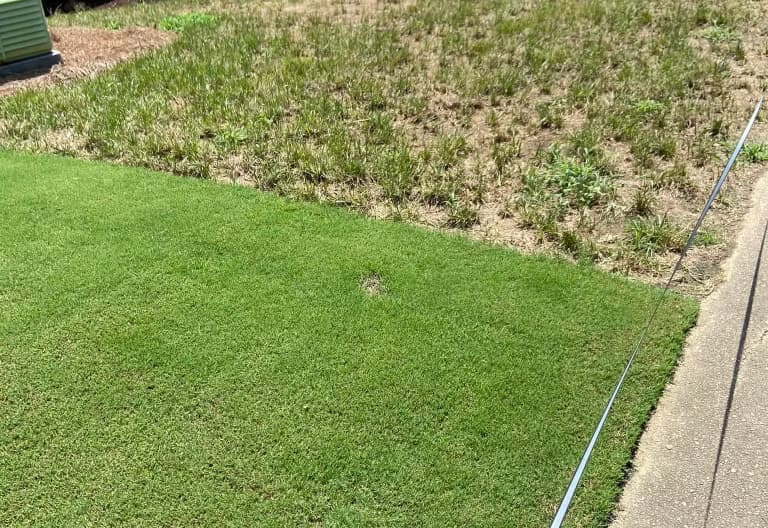
Where Two Lawns Meet
Does your lawn border a neighbor’s — or meet a different type of grass? Spraying near that line can quietly damage the yard next door, sometimes weeks later. Where Two Lawns Meet shows you how to treat safely without harming either side.
Read ArticlePulling
Don't pull it, and above all don't till it. For quackgrass, pulling is ineffective and cultivation is actively counterproductive — both leave rhizome pieces behind, and each piece becomes a new plant.
The Biological Reason
Here’s the part that catches most people out. A quackgrass rhizome carries a live growth bud roughly every ¾ to 1 inch along its length. When you tug the plant from the top, the leaves snap off at the soil line and the entire rhizome network stays in the ground, untouched, ready to resprout within weeks. Digging is barely better, because the network is wide and deep and fragments as you work.
Tilling is the worst thing you can do. As long as the rhizome is intact, the mother plant keeps most of those buds asleep through apical dominance — a chemical “stay dormant” signal. Cut the rhizome and you cancel that signal. Every severed piece is released to sprout from its own buds. A fragment as short as 1 inch with a single node can grow a complete new plant — one study found even 1/8-inch pieces succeeded about 30% of the time. So a rototiller doesn’t kill a quackgrass patch; it slices it into hundreds of pieces and plants every one of them. Field trials have measured this as roughly a tenfold jump in shoot density after a single tillage pass.
To grasp the scale of what’s underground: a single plant can push a rhizome more than 10 feet sideways in one season, producing over 440 feet of total rhizome, more than 200 new shoots, and a patch 11 feet across. That’s why hand-removal almost never wins.
If you must remove a small, isolated clump by hand, do it as excavation, not pulling: dig a hole wider than the visible patch and at least 8–10 inches deep, lift the whole root-and-rhizome mass out intact, then hand-sift the loose soil for stray white fragments. Bag everything and put it in the trash — never compost it. Rhizomes survive normal compost piles and will re-infest wherever that compost is spread.
Lawn vs. Bed Pulling Difference
The loose soil of a bed makes pulling feel easier, but that’s a trap: it fragments and scatters rhizomes even more freely than compacted lawn soil does, so aggressive pulling or hoeing in a bed spreads quackgrass faster than in turf. Same verdict in both places — don’t fragment it — but the risk is higher in the bed.
Quick Reference Summary
| Lifecycle | Rhizomatous perennial (cool-season grass) |
| Active Zones | Cool-season (primary); transition; cool pockets of warm-season only |
| Germination / Emergence Trigger | Seed at 50–55°F soil; rhizome shoots as soil warms in spring & cools in fall |
| Pre-Emergent | No — ineffective on established rhizomes |
| Post-Emergent Timing | Late summer/fall, best right after first frost (downward sugar flow); or spring at 6–10 in of active growth |
| Pull | No — pulling and tilling multiply it |
| Lawn Primary Tool | Non-selective glyphosate spot-treatment + reseed (no selective option in cool-season turf) |
| Bed Primary Tool | Group 1 grass-selective herbicide (fluazifop, clethodim) over broadleaf ornamentals |
| One-and-Done or Multi-Season | Multi-season — 2–4 sprays per patch to exhaust rhizome reserves |
Frequently Asked Questions
These answers are synthesized from botanical morphology studies and herbicide efficacy trials conducted by leading university agricultural extensions.
Because pulling only removes the leaves. The plant lives in a network of underground stems (rhizomes) that carry a growth bud roughly every inch, and any piece left behind resprouts. You’re pruning it, not removing it.
Tilling is the one thing guaranteed to make quackgrass worse. It chops the rhizome into dozens of pieces and each piece grows a new plant — a single pass can multiply the stand roughly tenfold. Never till a quackgrass patch.
Not in a cool-season lawn — quackgrass is too physiologically similar to your turf grass, so no selective product exists. The working method is to spot-kill the patch with glyphosate and reseed. In garden beds it’s different: because your ornamentals are broadleaf, grass-selective herbicides can be used there.
Late summer into fall, ideally the day after the first hard frost. That’s when the plant sends its sugars down into the rhizomes for winter, and the herbicide travels down with them to reach the parts that matter. Spring works only once the shoots are 6–10 inches of actively growing green tissue.
No. Expect a multi-season effort — two to four treatments spaced weeks apart to drain the rhizome’s stored energy, plus watching for regrowth the following season. One-and-done doesn’t work on this weed.
Most often in contaminated topsoil brought in during grading, or in a cheap grass-seed mix. It also creeps in along rhizomes from a neighboring lawn, fence line, or field edge.
Scientific Authority
This profile is constructed using forensic botanical data and Integrated Pest Management (IPM) research. We prioritize scientifically-vetted identification and control methods that protect the broader ecosystem while ensuring successful eradication based on peer-reviewed agricultural studies.
Primary Resources
- Penn State Extension — Orchardgrass and Quackgrass
- Purdue University Turf — Identification and Control of Perennial Grassy Weeds (AY-11-W)
- Ohio State University Extension — Ohio Perennial and Biennial Weed Guide: Quackgrass
- Michigan State University Extension — Perennial grass weed control in cool-season lawns; Quackgrass (Turf)
- University of Minnesota Extension — Quackgrass; Strand Memorial Herbarium / Minnesota Biodiversity Atlas
- UMass Amherst Landscape, Nursery & Urban Forestry Program — Elytrigia repens
- University of Wisconsin Horticulture / Extension — Perennial Grass Weeds in Lawns
- University of Illinois Extension — Managing Weeds in Lawns
- Cornell University CALS / Cornell Weed Identification — Quackgrass
- Rutgers NJAES Plant & Pest Advisory — Perennial Weed Control Using Cultural/Mechanical Techniques
- NC State Extension — Postemergence, Non-Selective Herbicides for Landscapes and Nurseries
- Clemson Cooperative Extension — Weeds
- Virginia Tech Extension — Viticulture Notes (graminicide use in broadleaf systems)
- Louisiana State University AgCenter — Weed Biology and Ecology
- University of California ANR (UC IPM) — The Devil’s Grass
- Purdue University Turf — Quackgrass (Patton & Law), turf.purdue.edu/quackgrass