
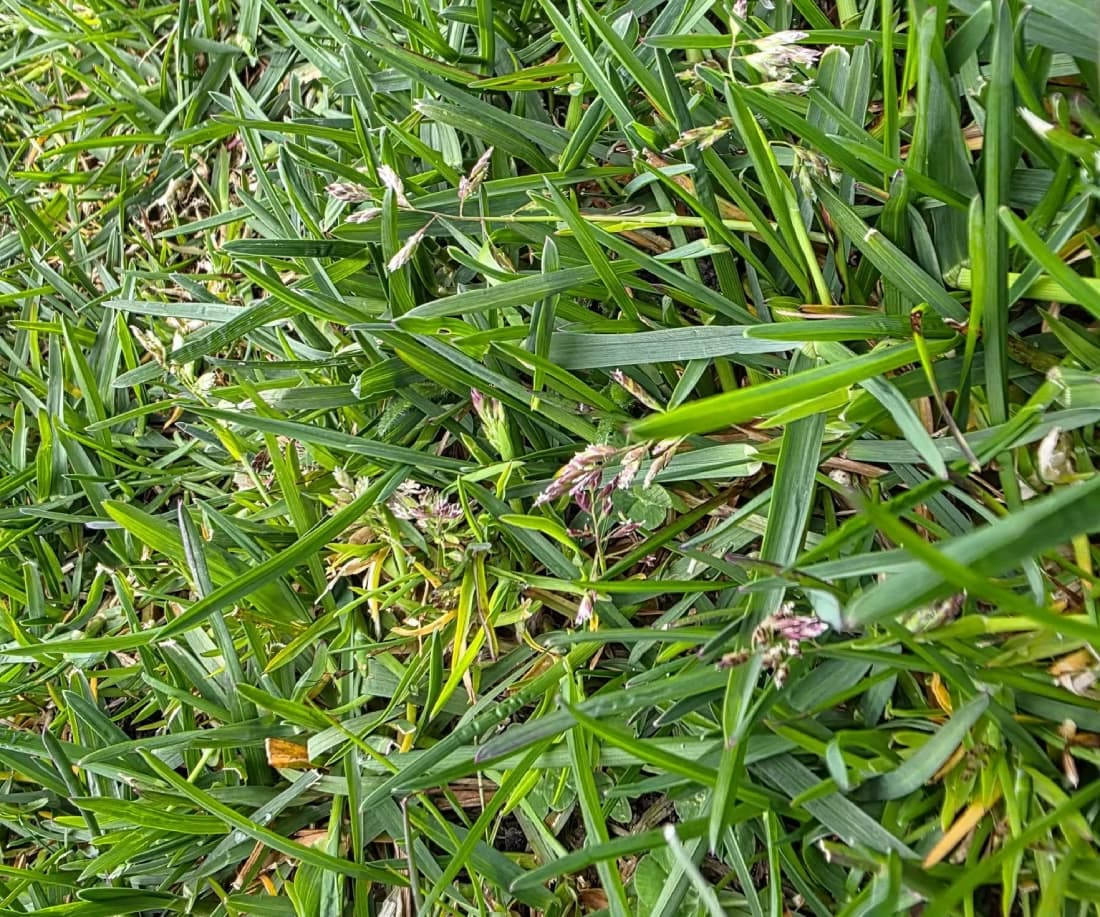
Annual Bluegrass (Poa Annua) At-a-Glance
Weed Type
Grass
Life Cycle
Winter annual (a creeping perennial form exists, but only on golf greens)
Growth Habit
Clumping, low tufts
Root Type
Shallow, fibrous
Spreading Risk
High — by seed
Pull
With Caution
Identity & Diagnostics
Visual Fingerprint
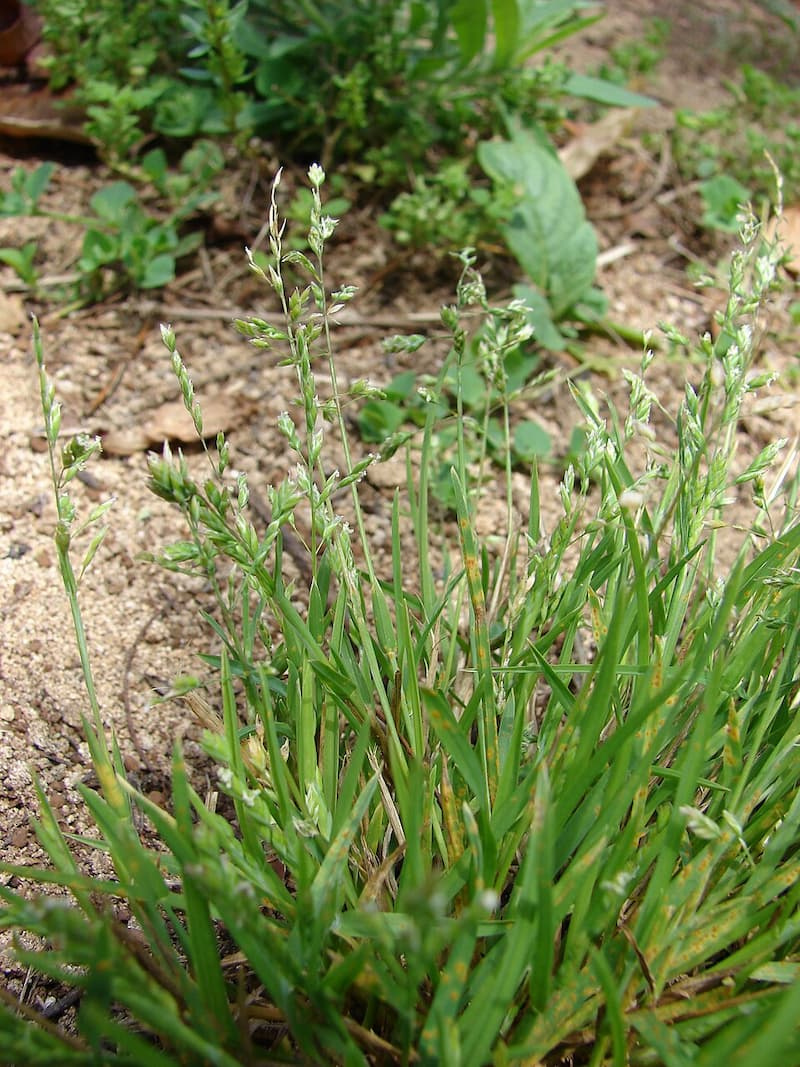
Look for a patch that’s a shade too light — a soft, apple-green to yellow-green clump sitting in a darker lawn. It grows in low, dense tufts rather than spreading out in runners. The giveaway is the seedhead: even when you mow it, it throws up short, whitish, branched seed clusters that look like tiny pale feathers held just above the blades. In winter and early spring it’s often the greenest, most actively growing thing in the yard while everything else is slow or brown.
Structural Anatomy
Get down close and a few features lock the ID. Each leaf tip is pinched into a little boat shape — it curves up like the bow of a canoe, a trait shared by everything in the Poa family. Run the blade between your fingers and you’ll see two clear parallel lines flanking the midrib, often called “tramlines” or “railroad tracks,” and frequently the blade is crinkled or wrinkled partway down, like it was briefly folded. New leaves are folded flat in the bud, not rolled. There are no auricles — no little claw-like arms clasping the stem at the base. The sheath is flattened and smooth and pulls away from the stem easily. And the ligule — the small papery flap where the blade meets the sheath — is tall (about 2 to 5 mm) and ragged-edged, which turns out to be one of the most reliable single features for separating it from its look-alikes.
Grass-Specific Anatomy
| Feature | Poa annua |
| Leaf tip | Boat-shaped (keeled), curves up like a canoe bow |
| Vernation (new leaf in bud) | Folded flat, not rolled |
| Ligule | Membranous, tall (2–5 mm), rounded with a jagged edge |
| Auricles | Absent |
| Collar | Broad, light green, hairless |
| Sheath | Strongly flattened, smooth, splits easily from the stem |
| Blade | Smooth, dull (not glossy), twin “tramline” veins beside the midrib, often crinkled partway down |
Growth Patterns & Life Stages
The first seedling leaf comes up thin and upright, soft, and pale — noticeably lighter than the grass around it. From there it tillers hard from the crown, fanning out into a dense low clump that fills any thin spot or bare edge. Through winter it mostly holds as a vegetative clump, quietly growing whenever the soil isn’t frozen. Then, as days lengthen in spring, it shifts into overdrive and pushes seedheads — peaking around May and June — before summer heat and drought kill it outright, usually by late spring or early summer, leaving open gaps behind. For control decisions, the stages that matter are the young seedling (the window when a pre-emergent barrier should already be in place), the winter clump (the last easy window for spot removal), and the moment seedheads appear — because once you see white, seed is already being made and the pulling window has essentially closed.
Gallery
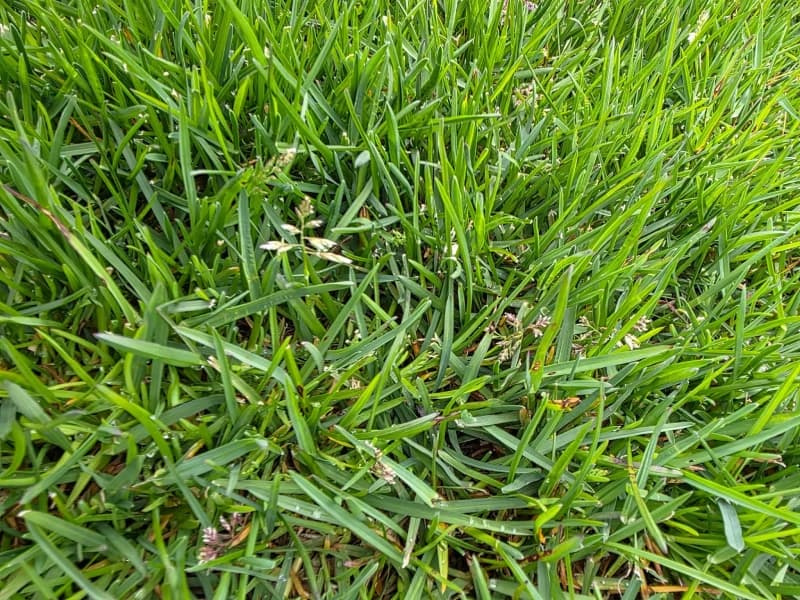
Those pale, feathery seedheads are the tell — and by the time you can see them, the plant has already dropped viable seed into your soil.
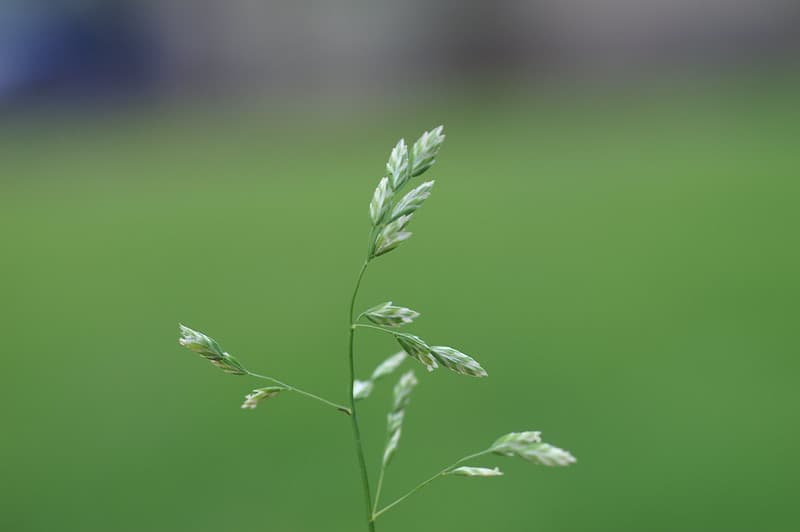
Diagnostic Feature: Annual bluegrass produces an open, airy seedhead even at very low mowing heights — most other lawn grasses can't flower that short, which is what makes this one stand out.
“Poa annua flowerhead NC2” by Macleay Grass Man is licensed under CC BY 2.0.
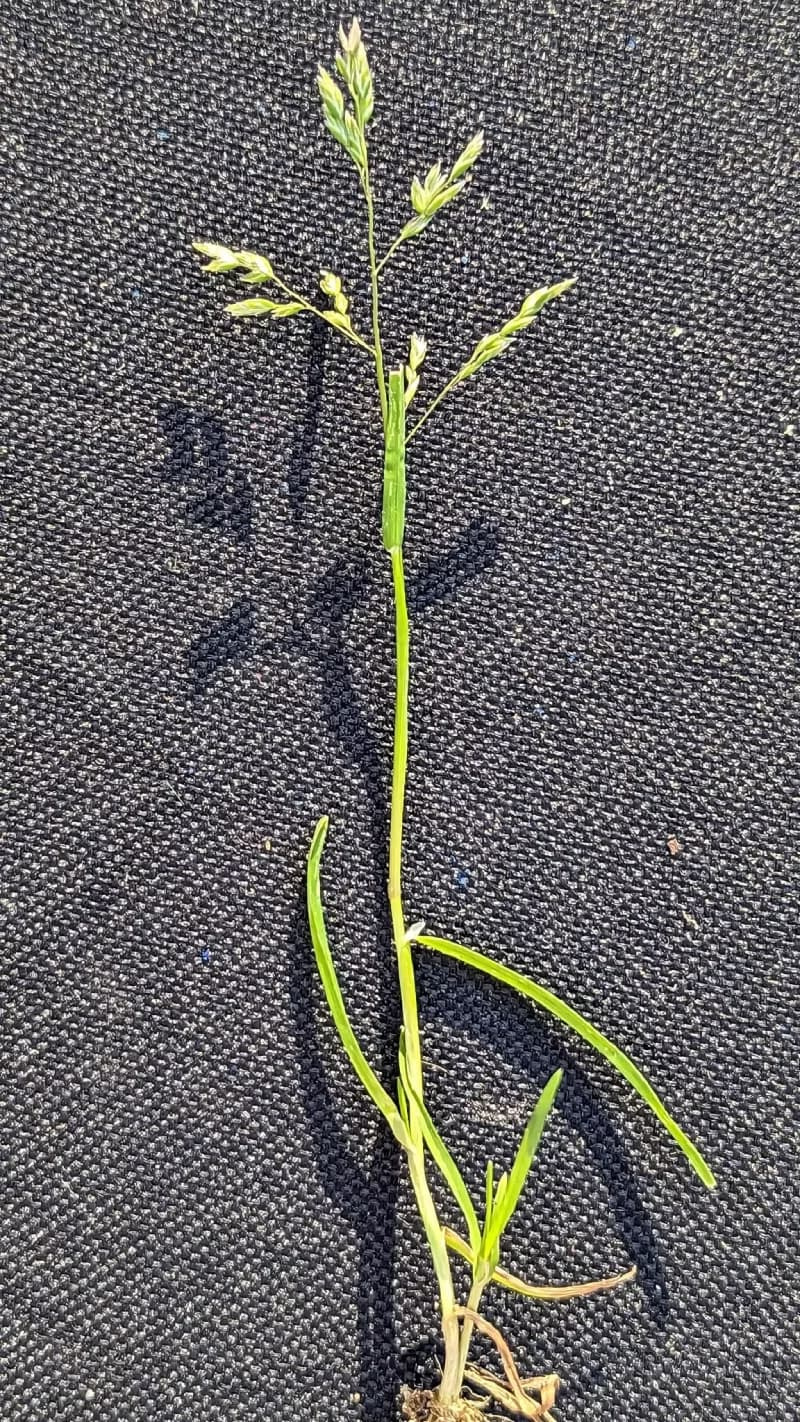
An isolated Poa annua plant showing its open, pyramidal seedhead structure and shallow root profile.
Growth Habit: It grows in low, light green bunches — noticeably paler than surrounding turf — and can flower and seed almost continuously through cool weather.
“Starr 080415-3995 Poa annua” by Forest & Kim Starr is licensed under CC BY 3.0.
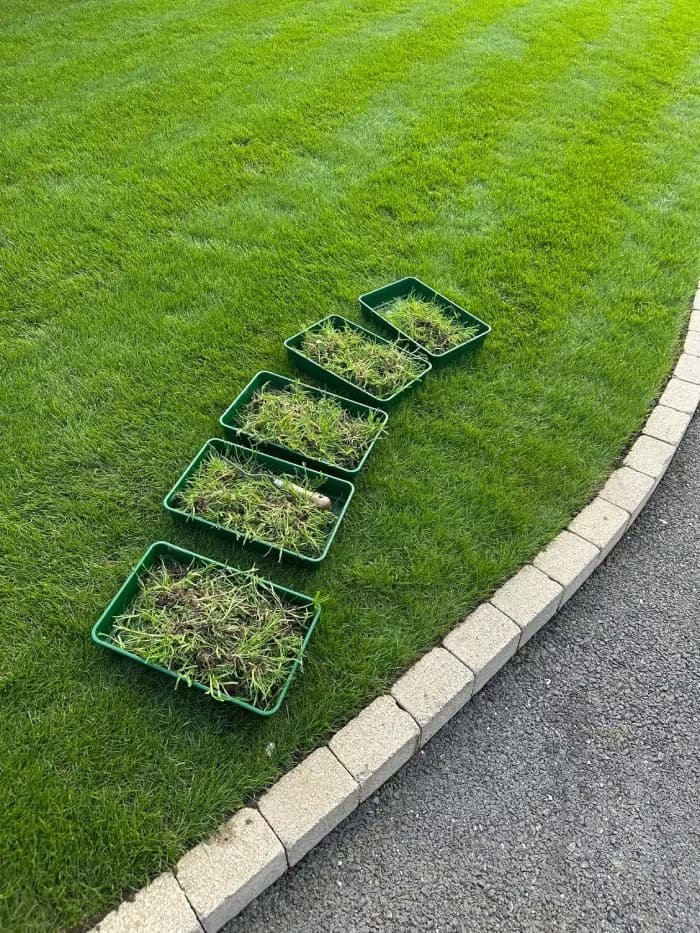
Hand-pulled annual bluegrass, roots and all. Notice how little root there is — shallow and fibrous, holding to just the top inch of soil. That's the whole reason it thrives on light, frequent watering and collapses once summer heat dries the surface out.
The Identity Trap
Common Lookalikes
Rough bluegrass (Poa trivialis) fools people constantly: it’s also light green, also patch-forming, and also loves the same damp, shady spots. Kentucky bluegrass (Poa pratensis) trips up the other direction — it shares the same boat-shaped leaf tip, so homeowners sometimes worry their good lawn grass is the weed.
Identification Differentiators: How to Tell Them Apart
vs. Rough bluegrass: Flip a blade over. Rough bluegrass has a distinctly glossy, shiny underside; annual bluegrass is dull. Rough bluegrass also spreads by above-ground runners (stolons) and often shows a reddish base in early spring, and it rarely makes seedheads when mowed — the opposite of annual bluegrass, which seeds relentlessly under mowing.
vs. Kentucky bluegrass: Check the ligule — that papery flap at the leaf base. Kentucky bluegrass’s ligule is very short or nearly absent (under 1 mm); annual bluegrass’s is tall and jagged (2 to 5 mm). Kentucky bluegrass is also darker green and spreads by underground rhizomes into a tight sod, and it won’t throw whitish seedheads up through a mowed lawn.
Growing Conditions
Host Grasses
It shows up in nearly every lawn type, but two situations are classic. In warm-season lawns (bermudagrass, zoysiagrass, centipedegrass, St. Augustinegrass), it invades in fall and winter — exactly when those grasses go dormant and stop competing, so the weed grows green and unopposed against a straw-brown backdrop. In cool-season lawns (tall fescue, perennial ryegrass, Kentucky bluegrass), it’s most aggressive in new fall seedings, where its fast seedlings outrun the desirable grass, and in any turf that’s mowed low. It’s equally at home in landscape beds, so this isn’t a lawn-only problem.
Host Environment/Area
Follow the water and the wear. Annual bluegrass thrives in compacted soil (paths, play areas, anywhere feet or tires pack the ground), in chronically moist or poorly drained spots (low areas, over-watered zones, heavy clay), and in thin or shaded turf where light reaches the soil. Its roots are shallow and weak, so it needs moisture right at the surface — which is why light, frequent watering suits it perfectly. In landscape beds, the draw is the same steady surface moisture from irrigation, plus the constant soil disturbance from weeding, planting, and dividing, which keeps exposing buried seed to light.
Soil Indicators: What the Presence of This Weed Reveals About Your Yard
A patch of annual bluegrass is a useful diagnostic, not just a nuisance. It reliably signals some mix of compaction, poor drainage or chronic surface wetness, and often a thin or low-mowed canopy letting light hit the soil. Frequent shallow watering and heavy spring feeding push it further. If you’re seeing it spread, the soil and the mowing/watering routine are telling you something — and fixing those conditions is the part of control that actually lasts.
Lifecycle and Season
Lifecycle Category and Management Implications
Annual bluegrass is a winter annual: it sprouts in fall, grows through winter, seeds in spring, and dies in summer heat. That sounds convenient — the plant kills itself every year — but it’s the trap. Because it reproduces entirely by seed and drops enormous, long-lived seed loads before it dies, killing this year’s plants does almost nothing about next year’s. The real target isn’t the plant, it’s the seed bank. That’s why the primary tool is a pre-emergent barrier timed to stop germination, why post-emergent rescue is a distant second, and why no single season ever finishes the job.
Germination Trigger
Germination kicks off in late summer to early fall, once soil temperatures fall below 70°F (21°C) in the top 1 to 3 inches for several days running. On the calendar that lines up with daytime highs cooling to about 75°F or lower for four days in a row. One more lever matters: the seeds need light to germinate, so a thinning turf canopy in fall is itself part of the trigger. About 80% of the year’s seedlings come up in one big fall flush, with smaller flushes through mild spells in winter and again in early spring.
In the cool-season zone (the northern states), the main flush comes with fall soil cooling, roughly late August into autumn, with a smaller flush in early spring. The pre-emergent window opens in late summer — apply before soil drops below 70°F, generally late August to early September, and most programs add a second application in late fall or early spring to catch stragglers. The hard complication here is the selective post-emergent gap: because annual bluegrass is a close relative of Kentucky bluegrass, there’s essentially no post-emergent a homeowner can spray over a cool-season lawn without hurting the lawn. Prevention does the heavy lifting in this zone.
In the warm-season zone (the South), the weed’s fall germination lines up almost perfectly with warm-season turf going dormant, so timing the pre-emergent is everything. Windows run earlier as you go south: roughly August 15 in Arkansas, September 1–15 across north Georgia, North Carolina, and the Carolina Piedmont, and October 1–15 in the coastal/lower South. The upside of this zone is a real one: once bermudagrass is fully dormant and completely brown, you can use non-selective and other post-emergent chemistry that would be off-limits on green turf. The matching caution: applying those to turf that has started to green up causes serious green-up delays or injury — full dormancy is not optional.
The transition zone is the hardest, because cool- and warm-season grasses share the yard and the weed exploits both. Pre-emergent timing targets soil cooling below 70°F, generally by mid-September across most of the zone, and as early as mid-August in milder coastal microclimates. Three timing conflicts are unique here and recur every year:
- Fall pre-emergent vs. overseeding. A pre-emergent that stops annual bluegrass seed also stops your desirable grass seed. If you’re overseeding — cool-season renovation, or ryegrass over dormant bermuda for winter color — you can’t do both at once. Either skip the pre-emergent on seeded areas and lean on dense seeding, then apply a light pre-emergent only after the new grass has been mowed twice; or, for ryegrass overseeding, seed first and clean up with a selective post-emergent once the ryegrass is established.
- Volatile spring soil temperatures. Spring warm-ups here stop and start, so the small spring germination flush is unpredictable — a second, well-timed pre-emergent matters more than in steadier climates.
Green-up injury. Late-winter post-emergent sprays aimed at the weed can catch warm-season turf just as it breaks dormancy. Keep high-activity products to the fully dormant window.
Herbicide Control
Yes — this is the primary tool in the lawn. A pre-emergent lays down a chemical barrier in the top inch of soil that stops the seed as it germinates, which is why timing is tied directly to the fall germination trigger: get it down and watered in before soil drops below 70°F (see the Zone Timing tabs for your zone’s calendar). The barrier needs 0.1 to 0.5 inch of rain or irrigation soon after application to move into the soil, or it degrades on the surface before it can work.
The workhorse active ingredients are the dinitroanilines — prodiamine, pendimethalin — plus dithiopyr (all mitosis inhibitors that block root cell division in the germinating seed), along with indaziflam (a cellulose-synthesis inhibitor) and, in the warm-season zone, the triazines simazine and atrazine. All are safe on established, healthy turf at labeled rates; none should go on weak, stressed, or newly seeded grass.
The recurring headache is the overseeding conflict: the same barrier that blocks weed seed blocks your grass seed. If you use a standard pre-emergent, delay seeding for the label’s residual window — anywhere from 6 weeks to about 4 months depending on the product and rate. The main way around it in cool-season lawns is mesotrione, which can go down at seeding on bare soil without stopping your new grass from coming up. Expect it to suppress annual bluegrass rather than reliably control it, so treat any reduction as a bonus (not for use where creeping bentgrass is the desired turf).
Annual bluegrass is one of the most resistance-prone weeds in the world, and the practical bite for homeowners lands right here on pre-emergents. Populations resistant to the Group 3 dinitroanilines — prodiamine and pendimethalin, with cross-resistance to dithiopyr — are confirmed across the Southeast (Georgia, Alabama, Tennessee, Virginia, the Carolinas), including on home lawns; triazine (simazine/atrazine) and glyphosate resistance are widespread too. If your fall pre-emergent seems to work less well every year, resistance is a real possibility, not just bad timing. Don’t run the same product every season — rotate to a different mode of action (for example, an indaziflam-based pre-emergent in place of a Group 3), and lean hard on the cultural practices under Cultural Prevention in Lawn, which no weed can evolve around.
One-and-done doesn’t exist here — plan on multiple seasons — and your options depend heavily on your grass type. See our 3 year plan to find out how to end the cycle.
In cool-season lawns, there is essentially no homeowner-safe selective spray. Because annual bluegrass is a cousin of Kentucky bluegrass, the products that hit the weed also injure the lawn. The few selective materials that exist (ethofumesate, mesotrione, and golf-course-only products) are marginal on Kentucky bluegrass, suppress rather than kill, or aren’t labeled for home lawns. In this zone, if you missed the pre-emergent window, the honest answer is usually to wait, tighten up cultural control, and get the pre-emergent right next fall.
In warm-season lawns you have more room — but mostly on dormant turf. On fully dormant, completely brown bermudagrass, a low rate of glyphosate cleans up winter weeds effectively (with green-up delay if any green tissue is present). On actively growing bermuda and zoysia, several selective sulfonylureas (Group 2) — trifloxysulfuron (Monument) and foramsulfuron (Revolver) — give good control of both young and tillered plants, and atrazine or simazine work well on small, un-tillered seedlings in late fall and winter. Apply while plants are young; mature, seeding plants shrug off most of these.
This is the part that actually holds, because it removes the conditions the weed needs instead of chasing the plant. Three levers do most of the work:
- Mow high. Keep cool-season lawns at 2.5 to 3 inches or taller (mow warm-season grasses at their proper height and never scalp them). A tall, dense canopy shades the soil, and since the seeds need light to germinate, shade alone cuts germination sharply.
- Water deep and infrequent. Let the surface dry between waterings. This starves the weed’s shallow roots while feeding your lawn’s deep ones. In lightly infested lawns, deliberately withholding summer water to let the lawn go drought-dormant will kill the shallow-rooted weed outright — then get a pre-emergent down before the rains return.
- Fix compaction — but time it right. Core-aerate to relieve the packed, wet soil the weed loves, and only when your desirable grass is actively growing so it fills the holes. Never aerate or dethatch in early fall — you’d be exposing buried seed to light right at the peak germination window.
Also: keep spring nitrogen and phosphorus modest (heavy spring feeding fuels the weed), feed in fall instead, and bag clippings whenever seedheads are showing.
Several pre-emergents are labeled around established ornamentals: trifluralin, dithiopyr, prodiamine, oryzalin, pendimethalin, indaziflam, pronamide, bensulide, and the combination product trifluralin + isoxaben (Snapshot). Apply in late summer, before soil cools below 70°F, and water in with about 0.25 to 0.5 inch within a few days.
Two bed-specific rules matter. First, apply on top of the mulch, not under it — incoming weed seed lands and germinates in the mulch layer, so that’s where the barrier needs to be. Second, watch the ornamentals: deep-rooted trees and shrubs are very safe, but shallow-rooted perennials, new transplants, and groundcovers can be stunted by strong root-inhibitors like oryzalin and pendimethalin. Wait until new plantings are well rooted and the soil has settled before treating.
Beds have one selective tool that lawns don’t. Clethodim (Envoy Plus, Select Max) is a grass-killer you can spray over the top of broadleaf shrubs, trees, perennials, and flowers — it hits the weed while leaving the ornamentals alone, best on young, actively growing plants. One critical warning: it will kill ornamental grasses, lilies, sedges, and rushes, so keep it away from those. And a common, expensive mistake to head off — two other grass-killers on the shelf, sethoxydim (Poast) and fluazifop (Fusilade, Ornamec), do not control annual bluegrass. Reaching for those wastes a season.
For non-selective cleanup, a directed glyphosate spot-spray (shielded from desirable foliage) or diquat (fast contact, no soil residual) both work; keep either off green leaves and bark. Near ornamentals, keep dicamba out of the root zone and dripline of trees and shrubs — it leaches and gets taken up through roots.
Verdict for beds: still multi-season, not one-and-done — the seed bank and repeated soil disturbance guarantee return flushes — but clethodim at least gives beds a selective option the cool-season lawn never has. Our 3 year plan can help you end the cycle.
Keep mulch at a uniform 2 to 4 inches (about 3 is the sweet spot), ideally medium-textured (around ¾-inch particles). Mulch works by blocking the light the seed needs to germinate. But it’s only a partial fix for this weed: as mulch breaks down into a moist, loose layer, incoming seed germinates right in the decomposing mulch without ever touching soil — and landscape fabric doesn’t stop it, since roots grow straight through the weave. That’s exactly why the pre-emergent goes on top of the mulch: the two together intercept the seed where it actually lands.
Herbicide Application Reference
- Dormant means fully brown. Glyphosate, glufosinate, flumioxazin, and atrazine on warm-season lawns are safe only on completely dormant turf. Any green tissue means green-up delay or injury — atrazine in particular must go on bermudagrass only when it’s fully dormant, never at spring green-up.
- Dicamba and driplines. Near beds, keep dicamba out of the root zone of trees and shrubs — it’s mobile in soil and taken up through roots, causing systemic damage.
- Granular burn. Granular products can scorch ornamental foliage if granules lodge in wet leaves; apply to dry foliage and brush stray granules to the ground.
- Pronamide is a Restricted-Use Pesticide — not available for general homeowner purchase.
- Resistance is covered in the O.4 module above; rotate modes of action rather than repeating one product.
Herbicide Application Guide
New to spraying, or want to get it right? Our Herbicide Application Guide covers the practical steps this page assumes — mixing, calibration, protective gear, and the wind and temperature limits that decide whether a treatment works or drifts. Read it before you spray.
See Guide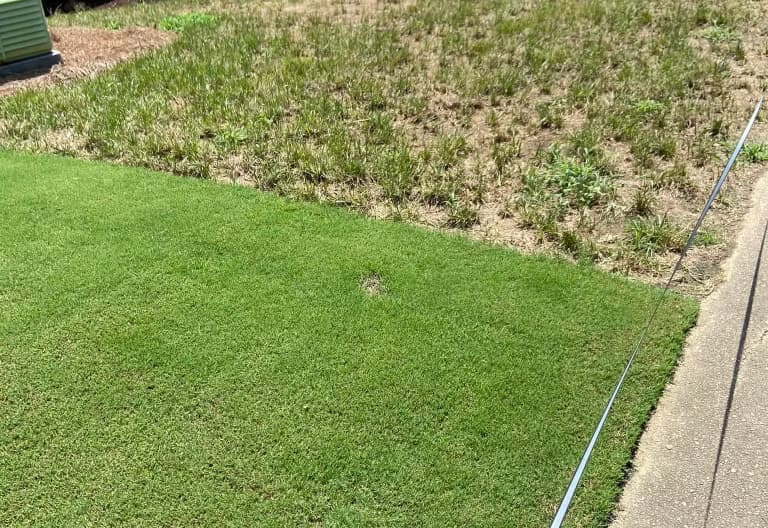
Where Two Lawns Meet
Does your lawn border a neighbor’s — or meet a different type of grass? Spraying near that line can quietly damage the yard next door, sometimes weeks later. Where Two Lawns Meet shows you how to treat safely without harming either side.
Read ArticlePulling
You can pull it, and it won't grow back from the roots — but pulling is only worth doing on small, young, scattered infestations, and only before seedheads form. Past that point it stops helping and starts spreading the problem.
The Biological Reason
The good news first: the common lawn-and-bed biotype has a shallow, fibrous, annual root system with no rhizomes, tubers, or bulbs. Snap a root and nothing regrows from the fragment — unlike a dandelion or nutsedge, there’s no underground structure waiting to resprout. When the soil is moist, whole clumps lift out easily.
Here’s the catch that changes the whole calculation. Annual bluegrass makes seed almost impossibly fast: a flower can produce viable seed within about a day of pollination, and a seedhead will keep ripening viable seed even after you’ve cut or pulled the plant. It can go from sprout to seed in six to eight weeks, and it flowers and seeds even when scalped below an eighth of an inch. So the moment you see those white seedheads, seed is already dropping — and yanking a seeding plant, or shaking the soil off its roots on the spot, flings viable seed straight into the lawn. On top of that, disturbing the soil to pull one plant exposes buried seed to light and triggers a fresh germination flush. That’s why the window for useful pulling is narrow (young plants, before seedheads) and why, once a patch is more than about a tenth of the lawn, pulling is a losing trade.
Whatever you pull, bag it and take it away — don’t compost it warm, don’t leave it on the lawn, and bag your clippings when seedheads are present, because the seeds survive the mower.
(One edge case: the creeping golf-green biotype can re-root from stem pieces left lying on wet soil. It’s not a factor in a normal yard, but if you’re pulling on a very closely mowed surface, don’t leave the debris behind.)
Lawn vs. Bed Pulling Difference
Pulling is cleaner and more complete in a loose, cultivated bed than in compacted turf, where roots are more likely to break off — a genuine, satisfying difference in the moment. But it doesn’t translate into a strategic advantage, because in beds every pull disturbs the soil and triggers a new flush from the seed bank. So beds let you pull more completely; they don’t let you pull your way out of the problem.
Quick Reference Summary
| Lifecycle | Winter annual (seed only; golf-green perennial form aside) |
| Active Zones | Cool, warm, and transition — active fall through spring |
| Germination Trigger | Soil below 70°F (21°C) at 1–3 in., several days, with light |
| Pre-Emergent | Yes — the primary tool |
| Post-Emergent Window | Young plants, fall–winter; almost no selective option in cool-season lawns |
| Pull | With caution — young plants only, before seedheads |
| Lawn Primary Tool | Fall pre-emergent + cultural control (mow high, water deep) |
| Bed Primary Tool | Pre-emergent on top of mulch + clethodim (selective) or directed glyphosate |
| One-and-Done or Multi-Season | Multi-season, always |
Frequently Asked Questions
These answers are synthesized from botanical morphology studies and herbicide efficacy trials conducted by leading university agricultural extensions.
Because you’re not fighting the plant, you’re fighting its seed bank. One plant drops anywhere from a hundred to well over two thousand seeds, and about a tenth of them stay alive in the soil for six years or more. Pulling this year’s plants leaves that reservoir untouched — and disturbing the soil to pull them actually wakes up more seed.
Not right after a standard pre-emergent — the barrier that stops weed seed stops grass seed too. Depending on the product, you’ll wait six weeks to about four months before seeding. The exception in cool-season lawns is mesotrione, which can go down at seeding time, though it only suppresses annual bluegrass rather than reliably controlling it.
No. Annual bluegrass flowers and sets seed even when mowed below an eighth of an inch — it just pushes the seedheads out flat, below the blade. Mowing won’t stop seed, but bagging your clippings when seedheads are present does keep you from spreading them, since the seeds survive the mower.
It’s usually the wrong move. Heavy spring nitrogen feeds the weed right when it’s seeding, and weed-and-feed timing rarely lines up with this weed’s fall germination window anyway. Feed in fall, keep spring feeding light, and put your effort into the pre-emergent timing instead.
Because it’s a winter grass growing on winter’s schedule. While your warm-season lawn is dormant and brown — or your cool-season lawn is barely moving — annual bluegrass is actively growing, which is exactly why those light-green patches stand out so sharply that time of year.
Scientific Authority
This profile is constructed using forensic botanical data and Integrated Pest Management (IPM) research. We prioritize scientifically-vetted identification and control methods that protect the broader ecosystem while ensuring successful eradication based on peer-reviewed agricultural studies.
Primary Resources
- Michigan State University — Annual Bluegrass, MSU Turf (canr.msu.edu); metabolic-resistance research (CYP81A91), Dept. of Plant, Soil & Microbial SciencesPurdue University — ID and Control of Annual Bluegrass (extension.purdue.edu); Annual Bluegrass, Purdue Turf (turf.purdue.edu); Ethofumesate-resistant annual bluegrass in grass-seed production (docs.lib.purdue.edu)
- NC State University — Annual Bluegrass, NC State Extension Publications (content.ces.ncsu.edu); Spring Invasion and Fall Weed Control Options, TurfFiles (turffiles.ncsu.edu); Rogers, R.R., “Characterization of Herbicide Resistance and Herbicide Efficacy in Turfgrass Systems,” NC State Repository (repository.lib.ncsu.edu)
- University of Georgia — Annual Bluegrass Control in Residential Turfgrass, CAES Field Report (fieldreport.caes.uga.edu); Research Update on Herbicide-Resistant Poa annua in Georgia, GeorgiaTurf (turf.caes.uga.edu); ACCase-inhibitor resistance characterization, UGA Open Scholar (openscholar.uga.edu)
- Clemson University — Annual Bluegrass Control; Grassy Weeds; Controlling Weeds in Landscaped Beds; Weed Control in Landscapes, Home & Garden Information Center (hgic.clemson.edu); Preemergence Herbicides / Pest Control Guidelines for Professional Turfgrass Managers (media.clemson.edu)
- Texas A&M AgriLife — Preemergence Herbicides for the Home Lawn, Aggie Turf (aggieturf.tamu.edu); Preemergence Herbicides for Warm-Season Turfgrass Lawns (mytexas.ag.tamu.edu); How to Manage Herbicide Resistance in Annual Bluegrass
- University of Tennessee — Annual Bluegrass Control, UT Institute of Agriculture (utia.tennessee.edu); Modeling Emergence of Annual Bluegrass in Hybrid Bermudagrass; A Bioassay to Determine Poa annua Responses to Indaziflam, Tennessee Research and Creative Exchange (voljournals.utk.edu)
- Virginia Tech — Annual Bluegrass Weed Profile (weedid.cals.vt.edu); Fall Lawn Care; Maintenance Calendars for Cool- and Warm-Season Turfgrasses; Selecting Pesticides for Sports Fields, VCE Publications (pubs.ext.vt.edu, sites.ext.vt.edu)
- Oklahoma State University — Controlling Weeds in Home Lawns; Treating Winter Weeds; Timely Action to Control Winter Annual Weeds, OSU Extension (extension.okstate.edu)
- LSU AgCenter — Louisiana Home Lawn Series: Annual Bluegrass; Lawn and Turf Weed Management (lsuagcenter.com)
- University of Missouri — Managing Lawns and Turfgrass, MU Extension (extension.missouri.edu)
- Penn State Extension — Roughstalk Bluegrass; Kentucky Bluegrass; Controlling Weeds in Nursery and Landscape Plantings (extension.psu.edu)
- Cornell University / Cornell Cooperative Extension — Annual Bluegrass; Herbicide-resistant weed species by MOA, Cornell CALS (cals.cornell.edu); CCE Nassau County (ccenassau.org)
- Rutgers University — Annual Bluegrass Control in Kentucky Bluegrass; Roughstalk Bluegrass, Center for Turfgrass Science (turf.rutgers.edu)
- University of Florida / IFAS — Weed Management Guide for Florida Lawns (sfyl.ifas.ufl.edu); Weeds as Indicators of Soil Conditions in Lawns and Landscapes (ask.ifas.ufl.edu)
- Ohio State University — Grass Identification, Buckeye Turf (buckeyeturf.osu.edu)
- University of Illinois Extension — Annual Bluegrass, Illinois Grasses (extension.illinois.edu)
- UMass Amherst — A Guide to Weed Life Cycles; Characteristics of Turf Herbicides, UMass Turf / CAFE (umass.edu)
- University of Arizona — Annual bluegrass control in non-overseeded and overseeded bermudagrass, UA Cooperative Extension (extension.arizona.edu)
- UC IPM (UC ANR) — Annual Bluegrass, Home and Landscape; Weed Management in Landscapes (ipm.ucanr.edu)
- University of Arkansas — Lawn Weeds, Control of Common (MP44), UADA (uaex.uada.edu)
- Kansas State University — Weed Control in Home Lawns (MF2385), KSRE (bookstore.ksre.ksu.edu)
- Peer-reviewed & databases — Weed Science (Cambridge Core); Poa annua: An annual species? (PubMed Central); bioassay for indaziflam response (Frontiers); International Herbicide-Resistant Weed Database (weedscience.org); Weed Science Society of America (wssa.net)