
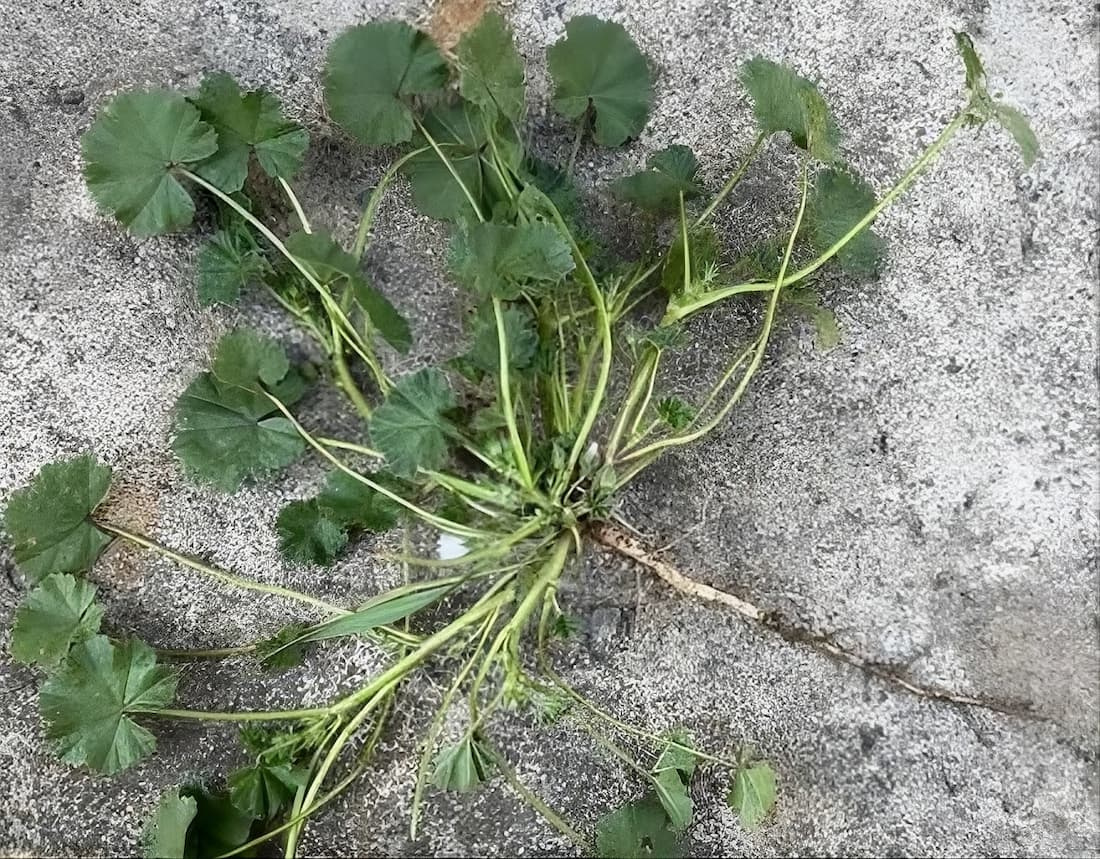
Common Mallow At-a-Glance
Weed Type
Broadleaf
Life Cycle
Winter annual / biennial / short-lived perennial (highly plastic — behaves perennial in the warm South)
Growth Habit
Prostrate, mat-forming (turns erect, up to 2 ft, if left unmowed)
Root Type
Taproot
Spreading Risk
High — by seed
Pull
With Caution
Identity & Diagnostics
Visual Fingerprint
From standing height, common mallow reads as a low, spreading mat of round, scalloped, slightly crinkled leaves held up on unusually long stalks. The leaves are a plain medium green and look a little like tiny geranium or ground-ivy leaves. The giveaway you can sometimes spot without bending down is the flower — small, five-petaled, white to pale pink or lavender with darker veins — tucked where the leaf stalks meet the stem.
Structural Anatomy
Get down close and four features confirm it together. First, the leaves are nearly circular to kidney-shaped with five to nine shallow, rounded lobes and round-toothed (crenate) edges, and they sit alternately along the stem (one leaf per node, not two facing each other). Second, the leaf stalk (petiole) is about twice as long as the leaf itself — a distinctive, almost comical proportion — and there’s often a pinkish-to-purple tinge right at the center where the stalk joins the blade. Third, the stems are round in cross-section and covered in short white hairs, and they do not root where they touch the ground. Fourth, everything — leaves, stalks, stems — is covered in fine stiff hairs, giving the plant a rough, velvety, puckered feel.
The confirming feature, when present, is the fruit: a flat, round, button-shaped capsule that breaks into roughly 10 to 15 wedge-shaped segments and looks exactly like a miniature wheel of cheese or a tiny flattened pumpkin. This is where the names “cheeseweed” and “cheese plant” come from. Below ground, the plant runs on a deep, straight taproot with coarse secondary branching.
Growth Patterns & Life Stages
The seedling shows two smooth, heart-shaped seed leaves (cotyledons) with three veins fanning out from the base; the first true leaves are round, puckered, and shallowly lobed. This is the stage that matters for control — see Pulling. The plant then builds a low basal rosette while it drives its taproot down. From there it branches from the base into the sprawling mature mat, stems trailing along the soil with the tips turning up. Flowering runs roughly May into October, and because the plant flowers continuously, it is setting seed the whole time it’s blooming — by the time you see a plant full of little cheese-wheel fruits, it has already been seeding your soil for weeks. That’s the “too late for easy control” signal.
Gallery
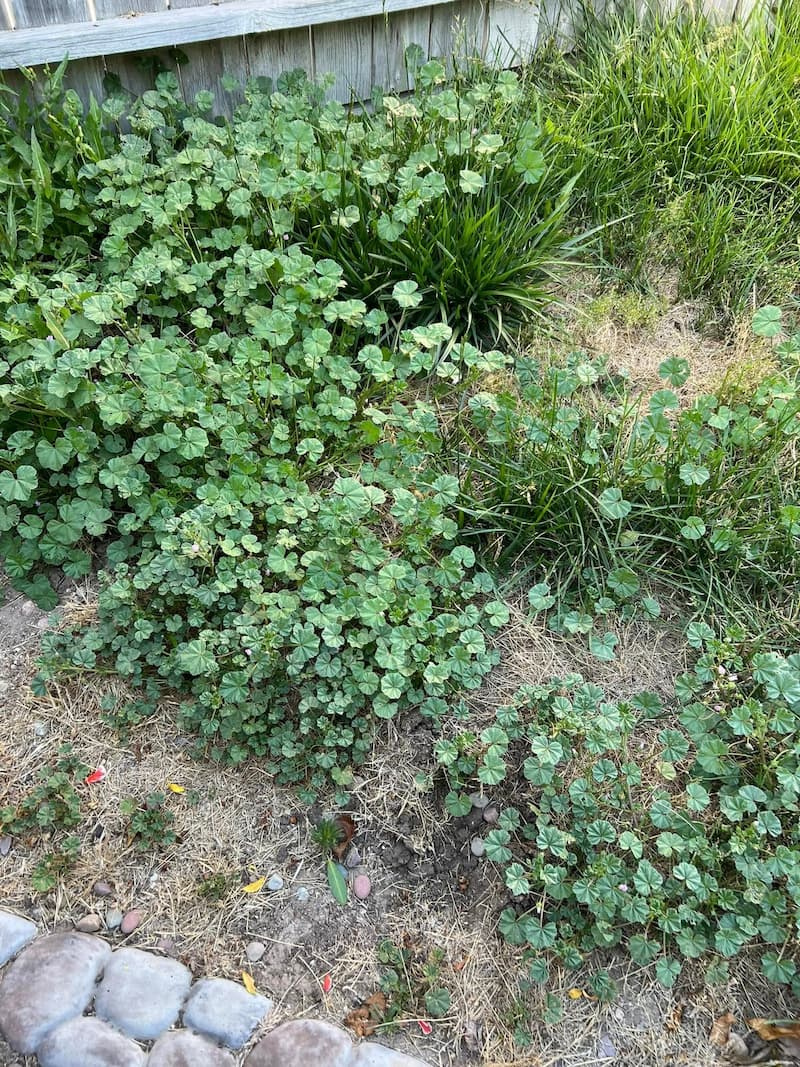
A mature, unmanaged common mallow infestation covering ungrassed soil along a landscape boundary.
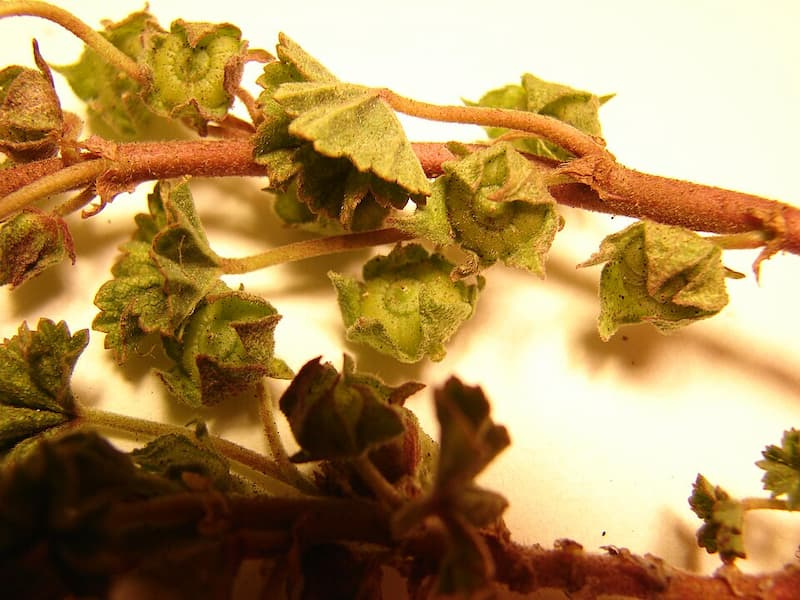
Diagnostic Feature: The seed pods split into wedge-shaped segments that look just like a tiny wheel of cheese — the trait that gave this weed its common nickname, "cheeseweed."
“File:Starr-090504-7365-Malva neglecta-fruit-Science City-Maui (24861088431).jpg” by Forest and Kim Starr is licensed under CC BY 3.0.
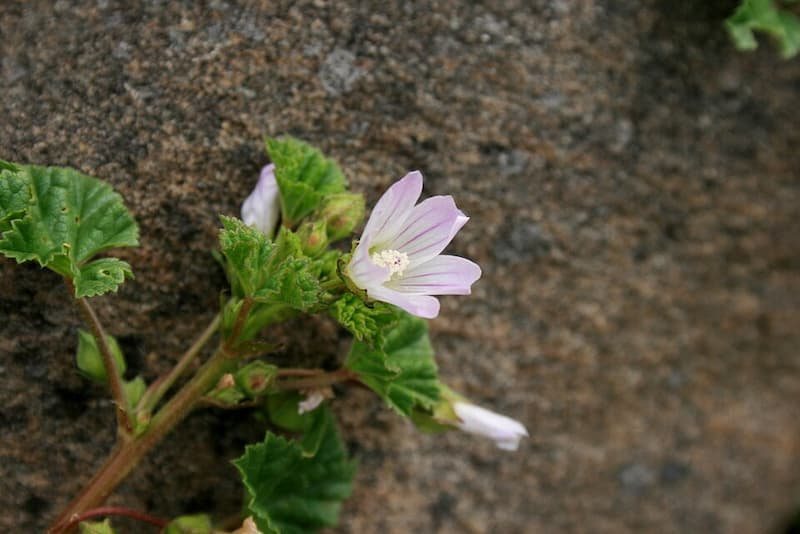
Diagnostic Feature: The small, pale lilac flowers are easy to overlook, but each of the five petals has a distinct notch at the tip.
“Malva-neglecta-flower” by Sten Porse is licensed under CC BY-SA 3.0.
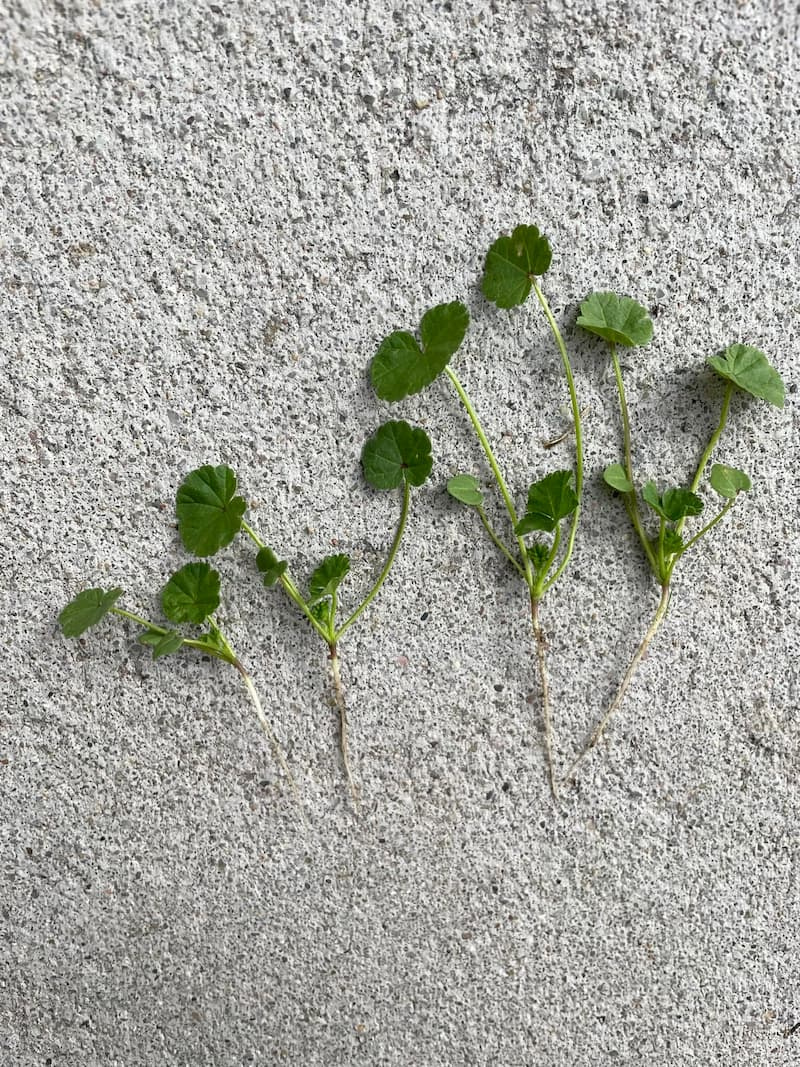
Young common mallow seedlings displaying early orbicular leaf growth and slender developing taproots.
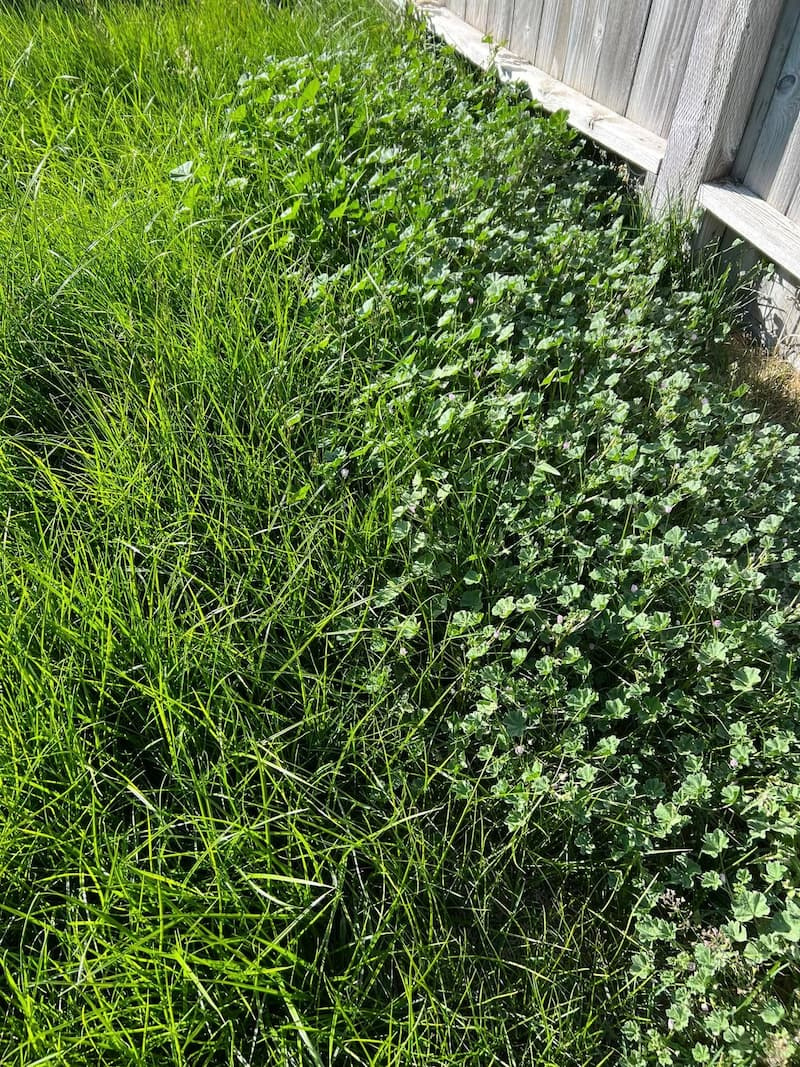
Dense common mallow growth invading the border between a lawn edge and a fence line.
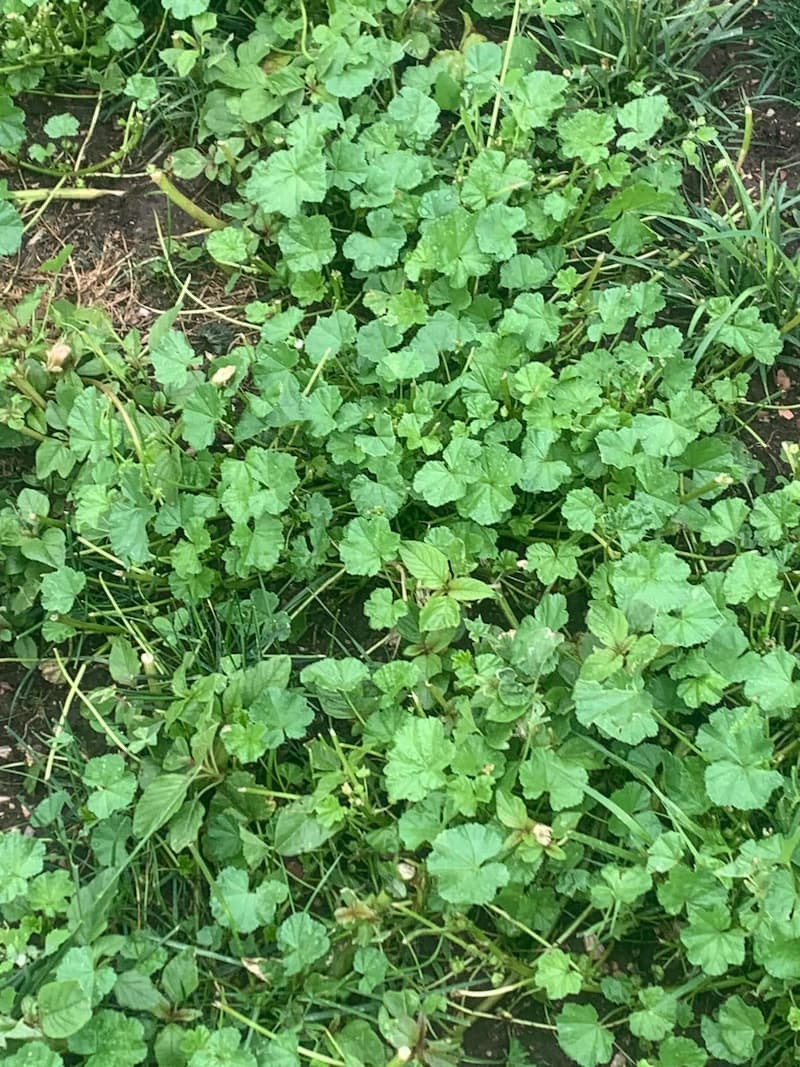
Active common mallow spreading through turf, forming a dense canopy via tough, low-growing stems.
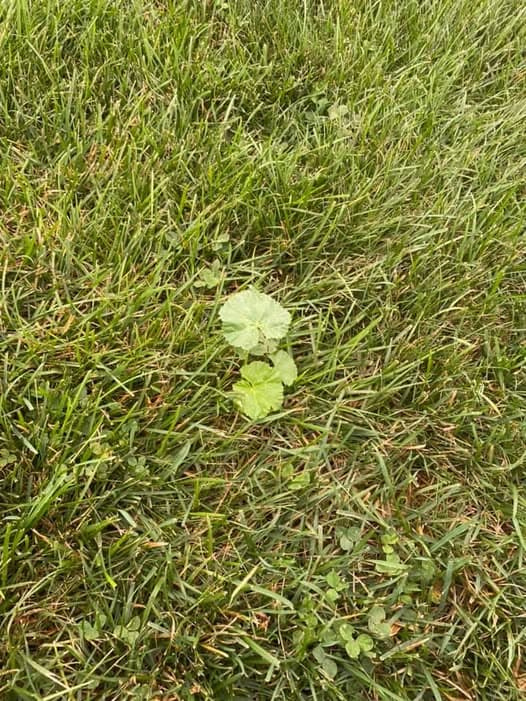
A young common mallow rosette establishing within maintained turfgrass.
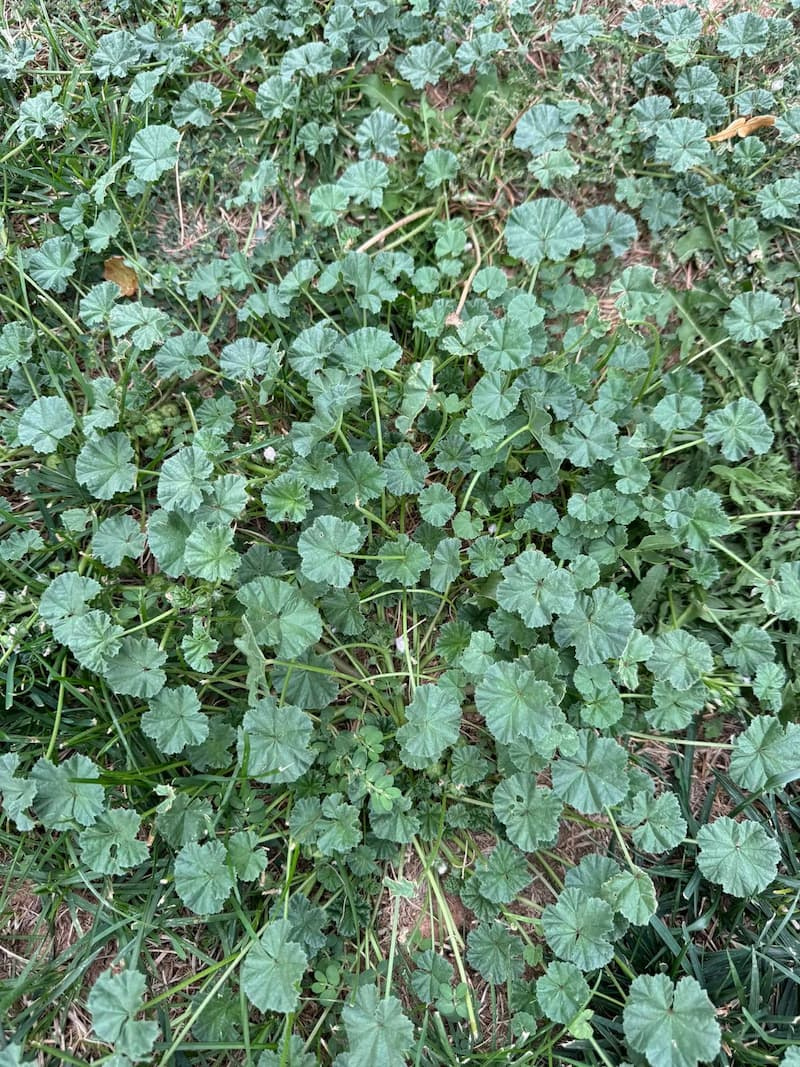
Close-up of common mallow foliage highlighting its crinkled leaf margins and radiating palmate venation.
The Identity Trap
Common Lookalikes
- Ground Ivy / Creeping Charlie (Glechoma hederacea) — the big one. Same low mat, same rounded scalloped leaves, so it’s constantly mistaken for mallow, and the two are managed very differently.
- Carolina Geranium (Geranium carolinianum) — shares the rounded leaf outline at a glance and grows in the same thin turf and beds.
Identification Differentiators: How to Tell Them Apart
- vs. Ground Ivy: Crush a leaf. Ground ivy smells strongly of mint; mallow has no odor. Confirm it with three more tells — ground ivy leaves are opposite (mallow’s are alternate), its stems are square (mallow’s are round), and it roots at every node as it creeps (mallow’s stems trail but don’t root). Getting this right matters: ground ivy is a stoloniferous perennial, so pulling spreads it — the opposite of the advice for young mallow.
- vs. Carolina Geranium: Look at how deeply the leaf is cut. Mallow’s leaves are shallowly lobed and stay basically round; Carolina geranium’s leaves are deeply dissected into narrow, finger-like divisions and look shredded. Its fruit is a long, pointed “cranesbill” beak, nothing like mallow’s flat cheese wheel.
Growing Conditions
Host Grasses
Mallow is not a weed of thick, healthy lawns — it can’t muscle into a dense canopy. It shows up in thin, low-maintenance, under-fertilized, or worn turf, and in any grass type when the stand is weak. Its presence is a symptom of a struggling lawn more than an aggressive invader of a good one. It is equally at home — arguably more at home — in ornamental beds, covered next.
Host Environment/Area
Look for it where turf competition is naturally thin: along fence lines, right against foundations and walls, at driveway and path edges, on gravel and waste ground, and near drainage channels. In the landscape it strongly prefers cultivated, fertile, irrigated bed soil, where the open ground lets its stems sprawl into mats several feet across. The recurring theme is bare or disturbed soil with light reaching it.
Soil Indicators: What the Presence of This Weed Reveals About Your Yard
Mallow is a genuinely useful indicator weed. In turf, it flags compaction, low fertility, and dry stress — its deep taproot pulls water from compacted layers where shallow-rooted grass gives up, so it thrives exactly where the lawn is thinning out. A sudden dense flush of mallow seedlings anywhere is a reliable sign of recent soil disturbance — digging or tilling that surfaced and scratched buried seed. One caveat that looks like a contradiction but isn’t: mallow survives poor dry soil (that’s why it indicates it), but it grows most lushly in rich, moist bed soil, so a vigorous stand can also just mean fertile ground.
Lifecycle and Season
Lifecycle Category and Management Implications
Common mallow has one of the most flexible life cycles of any lawn weed. In the North and the transition zone it acts as a winter annual or biennial; in the warm-season South it stays cold-hardy and vegetatively active year-round, effectively a short-lived perennial. For control, three consequences follow, and they hold everywhere. One: it reproduces only by seed, but the seed has a hard, waterproof coat, so seeds germinate a few at a time across the whole season and stay viable in the soil for years to decades — which is why this is a multi-season fight, not a one-summer fix. Two: the young plant is easy to kill and the mature plant is not, because the taproot turns woody fast. Three: because it establishes in thin turf, dense healthy grass is a real control tool, not just background advice.
Germination Trigger
There is no single germination date, and that’s the whole problem — the waterproof seed coat lets seed germinate in staggered flushes from spring through fall. As a working guide: the spring/summer cohort starts when soil warms to about 50–55°F at a 2-inch depth (a bit warmer, around 65°F at 4 inches, drives the main spring flush in the warm South). The winter-annual cohort is triggered instead by cooling soils in late summer and fall. Anything that nicks the seed coat — tilling, freezing, abrasion — lets a seed germinate immediately, even the same season it dropped.
Mallow is active here as a winter annual or biennial, with seedlings emerging April through November. The best post-emergent window is fall — October into November — while the plant is pulling sugars down into its taproot for winter; the herbicide rides down with the sugars and kills the root. Spring (late March–April) is the fallback, but plants are more mature by then and need higher rates. Pre-emergent is partial at best and can’t be the whole plan: to cover both cohorts you’d split it — before soils hit 50–55°F in spring, and again in late summer/early fall. Never apply these pre-emergents to newly seeded turf.
This is the zone that flips the calendar. Mallow is strongly cold-tolerant — it keeps photosynthesizing and growing through winter — so when bermuda, zoysia, St. Augustine, and centipede go dormant and thin in fall and winter, mallow colonizes the open canopy and builds its woody taproot while the grass sleeps. So the fight here is a fall-and-winter fight. Reliable pre-emergent means triazines (simazine or atrazine), typically split across the fall — for example simazine around Oct 15–30 and again Dec 15–30, or atrazine Nov 15–Dec 31. Isoxaben is weak here (under 70% control) because warm soils burn through its residual. Post-emergent goes on the young winter seedlings. Two hard cautions: do not put phenoxy “trimec-type” broadleaf herbicides (2,4-D, dicamba, MCPP) on St. Augustine or centipede as temperatures climb past 85°F near green-up, and atrazine/simazine are lethal to any cool-season grass — critical in mixed or overseeded lawns.
The transition zone is the hardest, because both cohorts run and both cool- and warm-season grasses spend part of the year stressed and thin. Best post-emergent window is again fall (Oct–Nov) for the sugars-down reason. The spring pre-emergent window has been creeping earlier with warming winters — the old “redbud full bloom / March 15” rule is now often late February in the southern part of the zone. The signature conflict here is fall pre-emergent vs. fall overseeding: the ideal window to overseed cool-season turf overlaps the winter-annual mallow flush, but a broadleaf pre-emergent like isoxaben will also kill your new grass seed. Skip the pre-emergent to save the seedlings and you then can’t spray a selective post-emergent until the new grass has been mowed three or four times — a 4-to-6-week gap where mallow moves in. Layered on top: warm-season chemistry (atrazine, simazine) will kill cool-season turf and vice versa within the same yard, and saturated warm winters break down pre-emergent barriers early.
Herbicide Control
Pre-emergent is a supporting player for mallow, never a standalone fix, and the reason is the seed coat. Because seed germinates a few at a time across the whole season, no single pre-emergent barrier lasts long enough to catch every flush. Where you do use it: in cool-season turf, isoxaben (Group 21), or oxadiazon and flumioxazin (Group 14), split between spring (before soils reach 50–55°F) and late summer/fall. In warm-season turf, the effective pre-emergents are the triazines — simazine and atrazine (Group 5) — split across the fall; isoxaben underperforms in warm soils. In the transition zone, prodiamine or dithiopyr (Group 3) plus isoxaben are options, but mind the overseeding conflict described under Transition Zone Timing. Never apply any of these to newly seeded or renovating turf — they’ll kill the grass seedlings too.
This is your main tool in a lawn, and timing plus growth stage decide everything. Young rosettes are easy; mature woody plants are stubborn. On young mallow in cool-season and transition turf, standard three-way broadleaf products (2,4-D + dicamba + MCPP, Group 4) work well. For mature, woody, or flowering plants, step up to products with triclopyr, fluroxypyr, or quinclorac — these translocate deep into the woody taproot instead of just burning the top; bispyribac-sodium (Group 2) is a selective alternative in some cool-season grasses. In warm-season turf, use atrazine, Celsius, MSM (metsulfuron), or Monument on young winter seedlings, respecting the St. Augustine/centipede and green-up cautions under Warm-Season Zone Timing and the Herbicide Application Reference.
Two things make or break the spray. First, always add a surfactant — a non-ionic surfactant at 0.25% or a methylated seed oil. Mallow’s leaves are so hairy that spray droplets bead up and roll off before they can absorb; the surfactant is what lets the herbicide actually wet the leaf. Second, time it for fall whenever you can, because the plant is moving sugars down to the root and drags the herbicide down with them. Verdict: this is multi-season, not one-and-done. Expect mature plants to partly regrow from the crown after one hit; plan a second application 10–14 days later, and expect new seedlings for years regardless.
For this weed, cultural control is not filler — it removes the exact opening mallow needs. Because it only establishes in thin turf, the goal is a dense canopy that keeps light off the soil, which starves light-triggered mallow seed. Four practices do that: feed nitrogen so the grass fills in (mallow is a low-fertility opportunist and loses badly to well-fed turf); mow tall — 3–4 inches for cool-season grasses, the upper end of the range for warm-season — so the canopy shades the soil and mallow can’t sneak flowers under the blade; core-aerate to relieve the compaction mallow’s taproot exploits; and water deep and infrequently to keep the lawn from going thin and dormant in summer heat.
Several pre-emergents are labeled for ornamental beds, but the woody-vs-herbaceous split is the thing that will save or kill your plants. Around established woody shrubs and trees, flumioxazin, oxadiazon, and oxyfluorfen (Group 14) are generally safe. Those same products will burn or kill soft herbaceous perennials (foxglove, sedum, dianthus, veronica, lamb’s ear and the like). For herbaceous and bedding beds, trifluralin (Group 3) is the safest broad option. Isoxaben is safe around many ornamentals but only partially controls mallow and injures winged euonymus. Two application rules: use granular formulations, not liquid sprays, in mixed beds — granules roll off foliage and land on the soil where they belong — and wait at least four weeks after transplanting before applying anything. One honest limitation: mallow can germinate from 1–2 inches deep, but a pre-emergent barrier only sits in the top half-inch to inch, so some seed germinates underneath it and escapes.
Here’s the hard truth for beds: there is no selective spray that kills mallow and spares your broadleaf ornamentals — mallow is a broadleaf sitting among broadleaves. Everything is directed or shielded non-selective application: glufosinate (Finale — non-volatile, works well in heat), oxyfluorfen or flumioxazin as a directed burn around woody or dormant plants, organic capric/caprylic fatty-acid contact sprays, or directed liquid nitrogen fertilizer as a desiccant on seedlings at the cotyledon-to-two-leaf stage. Use coarse, low-pressure sprays to keep drift off nearby leaves.
Skip glyphosate as your mallow plan. The research splits on it — one eastern extension lists it as a directed-spray option, but western extensions document mallow as one of the few weeds that shrugs glyphosate off, because its waxy, hairy leaf surface and fast-building taproot block the herbicide from moving through the plant. Reconciling the two: glyphosate might knock down a tiny, actively growing seedling with good coverage and surfactant, but it fails reliably on anything semi-mature or older. Don’t build your bed program around it. Verdict for beds: multi-season, and hand-pulling young plants plus mulch will do more of the real work here than chemistry.
Mulch is one of your best bed tools against mallow because mallow seed is light-triggered and germinates near the surface. A maintained organic layer blocks that light and physically exhausts the seedling’s energy before it reaches daylight. Depth by material: about 2 inches of fine mulch (shredded bark, compost), 3–4 inches of medium chips, 4–6 inches of coarse nuggets. The limitation to respect: a nicked, scarified seed germinates vigorously and will punch through thin spots, and deep-germinating seed can still slip under — so the mulch only works if you keep it at depth and don’t let it wear thin.
Herbicide Application Reference
Mallow’s control chemistry carries a few specific hazards worth calling out. Phenoxy volatility and turf phytotoxicity: on warm-season lawns, 2,4-D / dicamba / MCPP “trimec-type” products can severely injure St. Augustine and centipedegrass as temperatures rise above 85°F near green-up — use amine (not ester) formulations in warm weather. Zone chemistry is not interchangeable: atrazine and simazine are lethal to cool-season grasses; Monument is prohibited on St. Augustine and centipede; mesotrione is incompatible with warm-season turf. Ornamental drift: keep directed sprays and granular (not liquid) pre-emergents away from bed foliage. Surfactant is mandatory — the hairy leaf surface sheds un-amended spray. Resistance: no confirmed evolved resistance exists for mallow; the glyphosate problem is natural tolerance, not resistance, so no rotation strategy applies — just don’t rely on glyphosate.
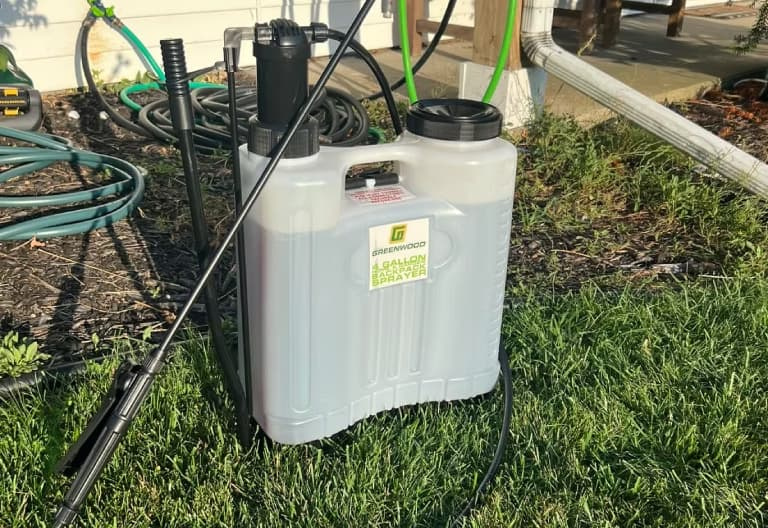
Herbicide Application Guide
New to spraying, or want to get it right? Our Herbicide Application Guide covers the practical steps this page assumes — mixing, calibration, protective gear, and the wind and temperature limits that decide whether a treatment works or drifts. Read it before you spray.
See Guide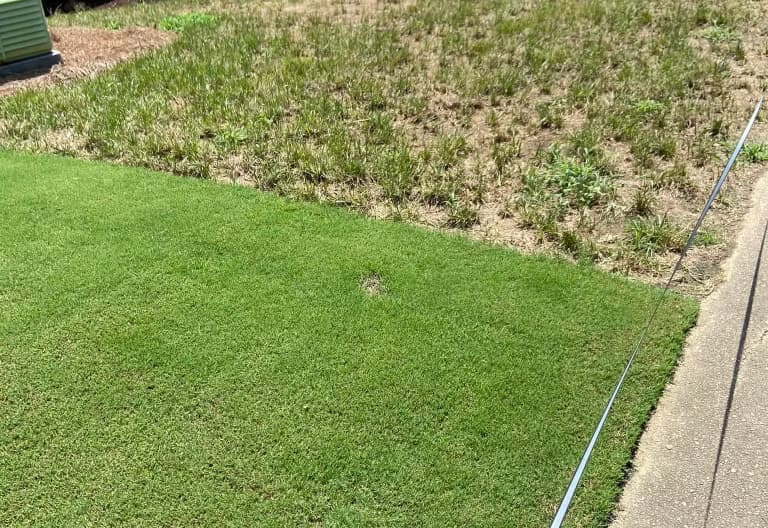
Where Two Lawns Meet
Does your lawn border a neighbor’s — or meet a different type of grass? Spraying near that line can quietly damage the yard next door, sometimes weeks later. Where Two Lawns Meet shows you how to treat safely without harming either side.
Read ArticlePulling
Pull it only while it's young — four true leaves or fewer, when the taproot is still soft. Past that stage, pulling fails, and you either dig the entire taproot out below the crown or switch to a systemic herbicide.
The Biological Reason
The four-leaf line is a real biological threshold, not a rule of thumb. Before it, the taproot is short, soft, and easy to lift whole from moist soil. After it, the taproot lignifies — literally turns woody — and anchors hard. Yank a mature plant and the top snaps off at the crown, leaving the living root crown in the ground. That crown is studded with active buds and simply resprouts new shoots, so you’ve mowed it, not killed it. To remove a mature plant you have to cut below the crown with a dandelion knife or similar tool and take the whole taproot.
Here’s the part worth understanding, because it changes what you should worry about. Mallow is not a rhizome or tuber weed — it does not multiply from every scrap of root left in the ground. Deep taproot fragments that break off don’t sprout into new plants. Regrowth comes from the crown you left anchored in place, and secondarily from broken stem pieces that can root at their nodes if they’re left lying on wet soil. So the fix is straightforward: take the whole taproot, and don’t leave chopped-up stems lying on damp ground. And above all, don’t till around established mallow — because the real engine of re-infestation isn’t fragments, it’s the seed bank, and tilling wakes it. One more: mowing and string-trimming do nothing. The plant’s buds sit flat against the soil, below the blade, and it just seeds sideways under the mower.
Lawn vs. Bed Pulling Difference
In loose, moist, cultivated bed soil, young mallow pulls cleanly and completely — a genuine advantage over turf, where compacted soil makes even seedlings resist and mature roots snap. But beds carry the opposite trap: routine cultivation is exactly what keeps the weed coming back. Every time you turn or aggressively hoe bed soil you scratch the hard seed coats (triggering instant germination), lift buried seed into the light, and — in bed soil specifically — vent the gases that were keeping deep seed dormant. The result is a fresh dense flush. So in beds: pull them young and by hand, and keep cultivation shallow (under an inch).
Quick Reference Summary
| Lifecycle | Winter annual / biennial / short-lived perennial (perennial-like in the warm South) |
| Active Zones | Cool-season, transition, and warm-season |
| Germination Trigger | ~50–55°F at 2 in. (spring/summer); cooling soils (winter cohort); staggered all season |
| Pre-Emergent | Partial only — never standalone |
| Post-Emergent Timing | Fall (Oct–Nov) best; target young rosettes; spring is second-best |
| Pull | With Caution — only at 4 true leaves or fewer |
| Lawn Primary Tool | Selective systemic post-emergent (fall) + dense-canopy culture |
| Bed Primary Tool | Hand-pull young + mulch + directed non-selective spray |
| One-and-Done or Multi-Season | Multi-season (3–5 years in the South) |
Frequently Asked Questions
These answers are synthesized from botanical morphology studies and herbicide efficacy trials conducted by leading university agricultural extensions.
Two reasons. If it was past the seedling stage, pulling snapped the top off and left the living root crown in the ground, and that crown resprouts. And even perfect removal doesn’t touch the seed bank — mallow seed stays viable in soil for years to decades, so new seedlings keep appearing. Dig the whole taproot below the crown on mature plants, and plan for a multi-year effort.
Usually not with reliable results. Mallow is one of the few weeds that resists glyphosate well — its waxy, hairy leaves and fast-building taproot block the chemical from moving through the plant. It might kill a very young, actively growing seedling with good coverage and a surfactant, but it routinely fails on older plants. Use a directed selective approach in lawns and hand-removal or mulch in beds instead. And note that today’s consumer “Roundup” is often not glyphosate at all — it has been reformulated with other active ingredients — so the name on the bottle no longer tells you what is inside.
No. Mallow grows flat, with its buds and stems pressed against the soil below the height of the blade. Mowing just keeps it low and lets it flower and set seed sideways, out of reach. It’s one of the few weeds mowing barely touches.
Tilling is the single best way to increase mallow. Disturbing the soil scratches the hard seed coats (which triggers immediate germination), lifts buried dormant seed up into the light, and in bed soil vents the gases that were keeping deep seed asleep. The result is a dense flush. Keep bed cultivation shallower than an inch, and lean on mulch instead.
Not immediately after most treatments. Pre-emergents used against mallow also stop grass seed from establishing, and after a selective post-emergent you generally need to wait before seeding — often until the herbicide has cleared and, for new grass, until it’s been mowed several times. In the transition zone this timing clash between fall pre-emergent and fall overseeding is the core headache; check the specific product’s reseeding interval before you sow.
The documented harm in the research is to plants, not people or pets — mallow is a known reservoir for crop viruses and a refuge for whiteflies, thrips, and hollyhock rust that can spread to nearby ornamentals and vegetables. The sources here don’t cover toxicity to pets or children, so for a definitive safety answer check a veterinary or poison-control resource rather than relying on this page.
Scientific Authority
This profile is constructed using forensic botanical data and Integrated Pest Management (IPM) research. We prioritize scientifically-vetted identification and control methods that protect the broader ecosystem while ensuring successful eradication based on peer-reviewed agricultural studies.
Primary Resources
- Purdue University Turfgrass Science — Common Mallow; Weed of the Month
- The Ohio State University — Ohio Perennial and Biennial Weed Guide, Common Mallow (Malva neglecta); Weed of the Week — Common Mallow
- Michigan State University Extension / Plant & Pest Diagnostics — Common Mallow – Malva neglecta; Common Mallow (Turf)
- Penn State Extension — Landscape Management: Common Mallow; Controlling Weeds in Nursery and Landscape Plantings
- University of California IPM / UC ANR — Mallows (Home and Landscape); Weed Management in Landscapes; Little Mallow (Cheeseweed) Identification
- Virginia Tech (VCE / Weed ID) — Common Mallow Weed Profile; Turfgrass and Fall Lawn Care publications; Plant Injury From Herbicide Residue
- NC State Extension (TurfFiles / CES) — Fall Weed Control Options for Home Lawns; When to Apply Preemergent Herbicides; Effect of Waterlogged Soil on Preemergence Herbicides; Weed Management in Perennial Production; NC Agricultural Chemicals Manual
- University of Missouri Extension / Mizzou WeedID — Common Mallow; Managing Annual Weeds in Lawns; Fall control of perennial broadleaf weeds
- Oklahoma State University Extension — Controlling Weeds in Home Lawns; Controlling Broadleaf Weeds in Home Lawns; Guide to Effective Weed Control
- Kansas State University (KSRE) — Weed Control in Home Lawns (MF2385); Tall Fescue Lawns
- West Virginia University Extension — Weed of the Week series (Ground Ivy; Broadleaf Plantain)
- Clemson University (HGIC / McCarty turf weed-control publications) — turf weed control; pre-plant nonselective weed control; seed-coat resistance to soil fumigants
- University of Arkansas Cooperative Extension (UAEX) — turfgrass weed response to preemergence herbicides; MP44 Recommended Chemicals for Weed and Brush Control
- Texas A&M AgriLife / AggieTurf — Common Mallow
- LSU AgCenter — winter broadleaf weed control in warm-season turf (metsulfuron, Celsius)
- University of Georgia Extension (CAES) — Turfgrass Pest Control Recommendations for Professionals
- University of Illinois Extension (Crop Sciences) — Common Mallow
- Iowa State University Integrated Crop Management — Common Mallow
- Colorado State University (Ag Biology / Grow & Give) — Common Mallow
- North Carolina Extension Gardener Plant Toolbox — Malva neglecta
- University of Florida / IFAS — pathogen reservoir and warm-season germination references
- Cornell CALS — Velvetleaf (Abutilon theophrasti) seed-longevity comparison
- Weed Science Society of America (WSSA) — weed flora references
- Peer-reviewed physiology: BYU ScholarsArchive (RuBP carboxylase in cold-resistant Malva neglecta); Oxford Academic BioScience (Photoprotective Strategies of Overwintering Evergreens)