
Scientific Name: Glechoma hederacea
Creeping Charlie (Ground Ivy)
Every node a new plant
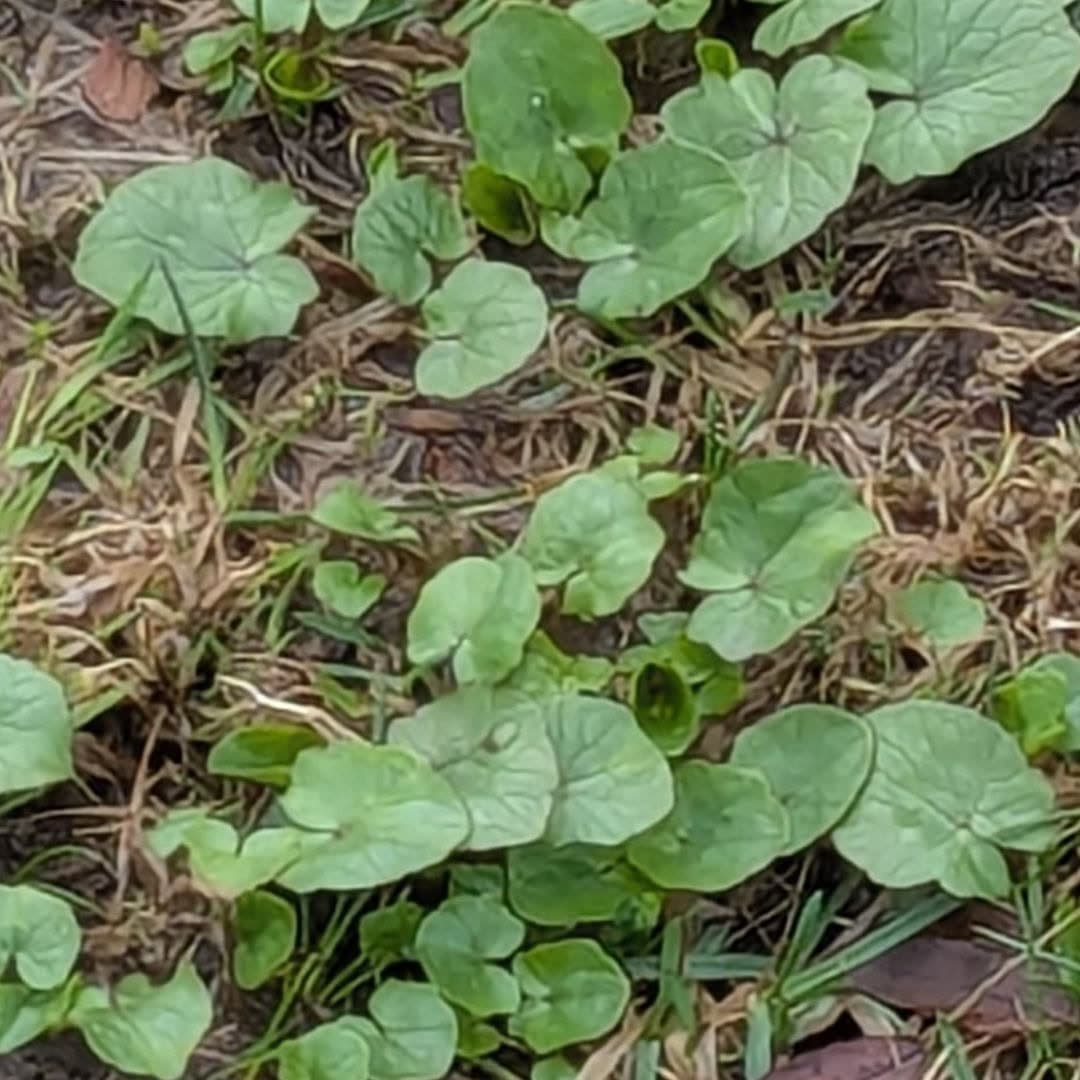
Creeping Charlie (Ground Ivy) At-a-Glance
Weed Type
Broadleaf
Life Cycle
Stoloniferous perennial
Growth Habit
Prostrate, mat-forming
Root Type
Stolon — roots at every node (shallow rhizomes and fibrous roots also documented)
Spreading Risk
High — by creeping stolons
Pull
With Caution
Identity & Diagnostics
Visual Fingerprint
Ground ivy shows up as a low, dense, dark-green mat that hugs the ground and clearly isn’t grass. The giveaway is the leaf: round to kidney-shaped, about the size of a coin, with scalloped, rounded-tooth edges, held up on its own little stalk. In spring the mat lights up with small funnel-shaped flowers in blue-purple to lavender. In full sun the leaves often turn a reddish-purple; in shade they stay deep green.
Structural Anatomy
Five features together confirm ground ivy — no single one is enough, but all five is a lock.
Square stems. Roll a stem between your fingers and you’ll feel four distinct ridges. Like all mint-family plants, ground ivy has square stems, not round ones. This one test rules out several common look-alikes on the spot.
Opposite leaves in crossed pairs. Leaves come two to a joint, directly across from each other, and each pair is turned at a right angle to the pair above and below it — a stacking pattern that helps it grab light in shade.
Round, scalloped leaves. The leaves are rounded or kidney-shaped, roughly half an inch to an inch and a half across, with blunt, scalloped teeth around the edge. Veins fan out from the point where the leaf meets its stalk, giving the surface a slightly puckered, textured look.
Long leaf stalks. Each leaf sits on a stalk as long as — or longer than — the leaf itself, lifting the leaves up above the creeping stem to compete with the grass for light.
A minty smell. Crush or mow the foliage and it releases a strong, musky-mint, slightly spicy scent. This is the fastest field check there is: no mint smell means it’s not ground ivy.
And the feature that drives everything else about this weed: the stems creep flat along the ground and put down roots at nearly every joint. That’s the “plant Velcro” habit, and it’s why this weed is so hard to remove.
Growth Patterns & Life Stages
Seedlings are rare — the plant almost always spreads by creeping, not by seed — so most people never see one. When they do appear, in cool, damp spring or fall weather, the first true leaves are already the tell: kidney-shaped, scalloped, in opposite pairs.
Runner stage is what you’ll actually encounter. Slender square stems creep outward, reaching anywhere from about two and a half up to seven feet long, rooting down at each joint as they go and knitting into a mat.
Established mat is an interlocking carpet that can blanket large patches of lawn or bed and stays green year-round in mild or shaded spots. This is the “too established to pull” stage.
Flowering runs from roughly March into July, peaking in April and May, with small blue-purple two-lipped funnel flowers clustered in the leaf joints on short upright stalks. Flowering is your cue that the plant is spending energy upward — which, as the timing sections explain, is exactly the wrong moment to spray for a lasting kill.
Gallery
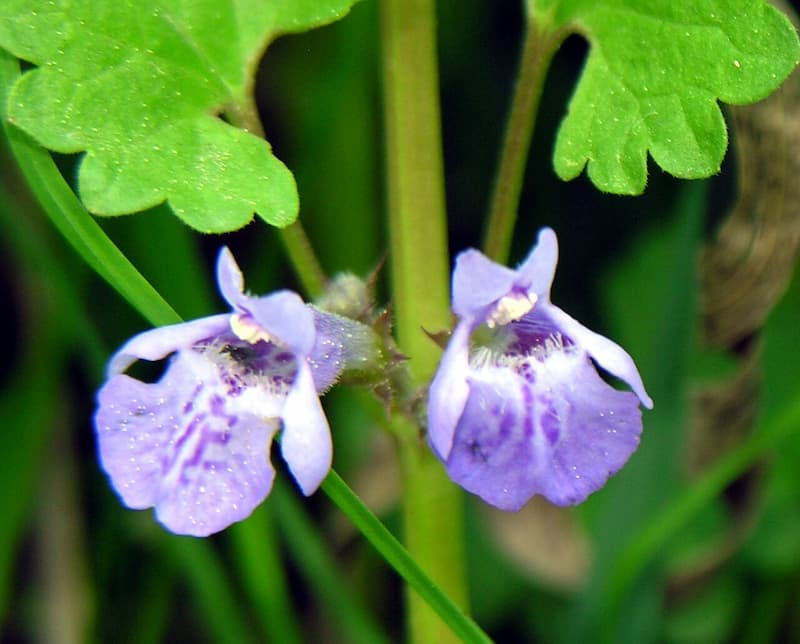
Diagnostic Feature: the small lavender, funnel-shaped flowers with darker purple spotting on the lower lip confirm creeping charlie versus henbit or purple deadnettle — though it's only visible for a few weeks each spring.
“Glechoma hederacea ziedai” by Original uploader was Algirdas at lt.wikipedia is licensed under CC BY-SA 3.0.
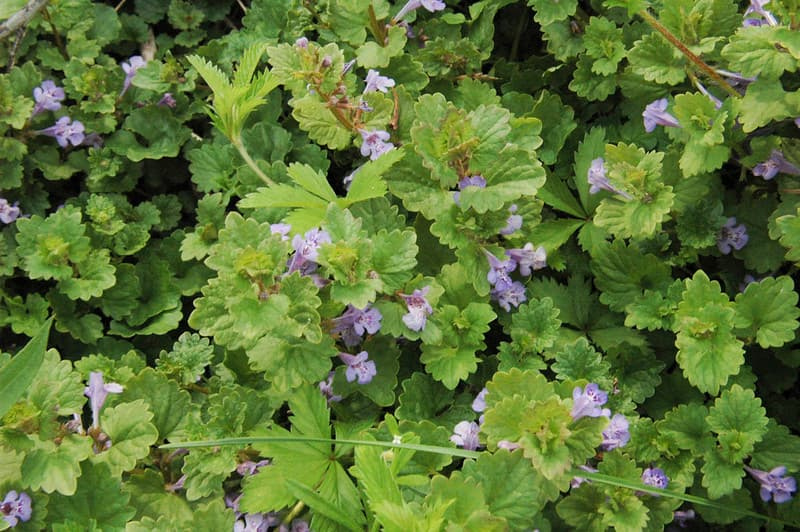
Growth Habit: creeping charlie forms a low, dense mat that roots at every leaf node as it spreads, letting it carpet bare or thin turf areas quickly.
“Glechoma hederacea CREEPING CHARLIE” by gmayfield10 is licensed under CC BY-SA 2.0.
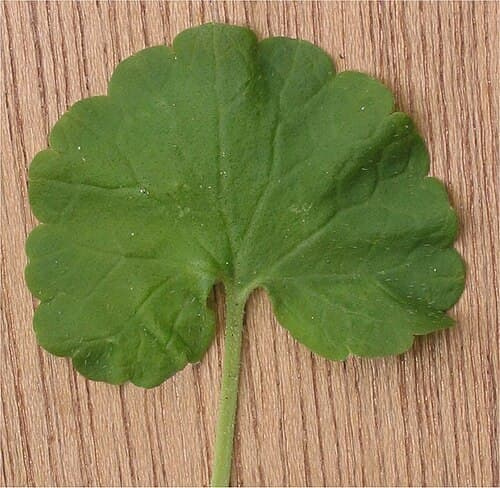
Diagnostic Feature: leaves are round to kidney-shaped with deeply scalloped edges — a trait you can check year-round, unlike the flowers.
“Hondsdraf blad Glechoma hederacea” by Rasbak is licensed under CC BY-SA 3.0.
The Identity Trap
Common Lookalikes
Two weeds fool people most often in a real yard: common mallow, whose rounded, scalloped, long-stalked leaves look almost identical to ground ivy’s, and henbit, a mint-family cousin that shares the square stem and the minty smell.
Identification Differentiators: How to Tell Them Apart
Ground ivy vs. common mallow. The leaves look like twins, so use the stem and the smell. Ground ivy’s stem is square and its crushed leaves smell minty; mallow’s stem is round and its leaves have no scent. Mallow also grows from a single deep taproot and does not root along its stems, while ground ivy roots at every joint.
Ground ivy vs. henbit. Here the mint smell won’t save you — henbit is also square-stemmed and minty. Use habit instead. Ground ivy creeps flat and roots at its nodes; henbit stands upright and roots only at its base. Henbit’s upper leaves clasp the stem directly with no stalk, while every ground ivy leaf has a long stalk. And henbit is a winter annual that dies off on its own by early summer, whereas ground ivy is a perennial that never leaves.
Growing Conditions
Host Grasses
Ground ivy invades cool-season lawns most heavily — Kentucky bluegrass, perennial ryegrass, and fescues — and Kentucky bluegrass is especially vulnerable because it thins badly in shade and leaves gaps the weed walks right into. It’s far less of a problem in warm-season lawns: in full sun, vigorous grasses like bermudagrass and zoysiagrass generally outcompete it, and it’s largely restricted to shaded, wet corners where those grasses thin out. It doesn’t respect any particular grass so much as it exploits thin grass — whatever the species, a weak or shaded stand is the opening.
Host Environment/Area
This is a shade-and-moisture weed. It gets its first foothold in damp, shaded, poorly drained spots — under tree canopies, along the north sides of buildings, in low areas that hold water — then sends runners out from there into sunnier open lawn. It’s just as at home in landscape beds, where rich, moist, mulched, sheltered soil matches its native woodland-floor habitat almost perfectly. In beds, freed from mowing, it can even mound up a foot or more instead of staying flat. Very often it establishes first in a bed or tree ring and uses that as a launch pad into the lawn.
Soil Indicators: What the Presence of This Weed Reveals About Your Yard
Ground ivy is a reliable read on the ground it’s growing in. A thriving patch usually signals some mix of shade, wet or poorly drained soil, and compaction — often a low spot, heavy clay, or an overwatered zone. It also tends to flag turf that’s short on nitrogen: the soil may be rich in organic matter, but if little of that nitrogen is available to the grass, the grass thins and the weed moves in. It leans toward neutral-to-alkaline soil and dislikes strongly acidic ground. Treat a ground ivy takeover as a message: the site is too shady, too wet, or too compacted for grass to win there, and fixing that is part of the fix.
Lifecycle and Season
Lifecycle Category and Management Implications
Ground ivy is a stoloniferous perennial — it does not die at the end of the season. Its crowns, rooted nodes, and shallow underground stems live through winter and push new growth every spring, which means two things for control. First, pre-emergent herbicides — which only stop sprouting seeds — are close to useless against an established patch, because this weed spreads by rooting stems, not seed. Second, the only tools that actually work are systemic post-emergent herbicides timed to when the plant is moving food down into its roots, plus mechanical removal careful enough to leave nothing behind. It’s a multi-season job, not a weekend one.
Germination Trigger
For an established patch, seed germination isn’t the issue — regrowth from crowns and rooted nodes is. That growth reawakens as soil warms in early spring: vegetative shoots begin around 40°F, and rapid lateral spread kicks in once soil settles at 55°F and above. Seedlings, when they occur at all, come up in the cool, moist conditions of spring or fall.
This is where ground ivy is worst. It grows nearly all season, with surges in spring and fall, and stays green through much of winter — with partial topgrowth dieback after a hard frost in the colder states, though the crown always survives. There’s no pre-emergent window worth targeting against an established stand. The window that matters is fall, from late September through November, after the first frost — that’s the high-value time to spray, for the reason explained under Post-Emergent in Lawn. Spring, during the April–May bloom, is a distant second choice.
Ground ivy is a minor, localized problem in the warm-season zone — its range runs south only to the Piedmont, and it’s largely absent from the hot, acidic, sandy soils of the lower coastal plains. Where it does appear, it’s confined to shaded, wet pockets where warm-season grass has thinned. It’s active in the cooler months and goes semi-dormant in summer heat, exactly when bermudagrass and its relatives are strongest. Its spring surge collides with green-up, when it can crowd and shade slowly-waking C4 turf. Target it in fall (late September into October), or in early spring before green-up. Do not spray systemic broadleaf herbicides on warm-season turf that’s in the middle of greening up — that’s how you get chlorosis and stalled growth (see Post-Emergent in Lawn for the C4 chemistry, which differs sharply from the cool-season chemistry).
The transition zone is the most complicated of the three, because the fall spray window collides head-on with the fall seeding window. Ground ivy grows all season here, surging in spring and fall and often staying evergreen through winter. The best time to spray is mid-to-late fall, right after the first frost. But that’s the same stretch when cool-season lawns are overseeded and renovated — and most broadleaf herbicides require a 3-to-4-week gap between spraying and seeding. So you have to choose: spray first and push seeding later (risking grass that’s too young to face winter), or seed first and wait about four weeks (until the new grass has been mowed twice) before spraying — which shoves the spray into cold weather that weakens it. In spring, the mirror problem appears: a broadleaf spray can injure bermudagrass or zoysiagrass that’s greening up, and some products (like quinclorac blends) are only safe on zoysiagrass while it’s fully dormant.
Herbicide Control
Pre-emergents are not a primary tool for ground ivy, because this weed spreads by rooting stems, not by germinating seed, and pre-emergents do nothing to established plants. Seedlings are rare in a maintained lawn, so there’s little seedling recruitment to intercept either. There is one worthwhile secondary use: isoxaben (Gallery) is documented to reduce the ability of creeping stolons to root at their nodes, which slows the mat’s lateral spread and catches any stray seedlings — a supporting move alongside post-emergent control, not a substitute for it. Isoxaben is safe on established cool-season and warm-season turf, but don’t apply it right before seeding or sodding.
This is the primary lawn tool — and the two things that decide whether it works are the product and the timing.
Product. 2,4-D on its own does not control ground ivy. It browns the tops and the plant comes right back, because it doesn’t move well through the stem network down to the crowns. This is the single most common reason a homeowner’s spray “didn’t work.” What does work depends on your grass:
- Cool-season and transition-zone lawns (bluegrass, ryegrass, fescue): the effective chemistry is triclopyr or fluroxypyr, which perform best as standalones (they carry a higher dose of the active ingredient) or in combination products — triclopyr plus clopyralid, triclopyr plus a PPO-inhibitor like sulfentrazone, or three-way blends of 2,4-D, mecoprop (MCPP), and dicamba, sometimes with quinclorac added. The standalones and triclopyr blends give excellent control; plain three-way blends are only fair and usually need repeating.
- Warm-season lawns (bermudagrass, St. Augustinegrass, centipedegrass, zoysiagrass): this is critical — triclopyr is prohibited from broadcast use on bermuda, St. Augustine, and centipede because it badly injures them. Instead, warm-season lawns need ALS-inhibitor chemistry: metsulfuron-methyl (Manor, Mansion, Blade) or Celsius WG (which is specifically safe across warm-season grasses, including sensitive St. Augustine and centipede). Fluroxypyr (Spotlight) can be used too, but only within strict rate limits on centipede, St. Augustine, and zoysia. These need a nonionic surfactant or methylated seed oil to stick and absorb, and a repeat application three to four weeks later.
Timing, and the reason behind it. Spray in fall, after the first frost. In fall the plant stops pushing growth upward and starts hauling sugars down into its crowns, nodes, and roots to store for winter — and a systemic herbicide sprayed onto the leaves rides that downward sugar flow straight into the roots, killing the whole plant instead of just the tops. Spray in spring, while the plant is moving energy up to flower, and the chemical mostly stays in the leaves; you get browning, not death. That single fact — fall beats spring because the plant carries the herbicide down for you — is why timing matters more than almost anything else here.
One-and-done? No. Established ground ivy is a two-to-three-year project. Plan on repeat fall applications, holding the line with the cultural changes below, until the surviving fragments and the seed bank are exhausted.
Chemicals knock it back; a dense lawn keeps it out. Because ground ivy only wins where grass is thin, the cultural fixes all aim at thickening the turf and removing the shade-and-moisture conditions it needs:
- Mow high. Keep cool-season grass at 3 to 4 inches (warm-season grass at the top of its range). A taller, denser canopy shades the soil and starves the low-creeping stolons of light. Mowing short is one of the strongest predictors of a ground ivy takeover.
- Feed the grass. Since ground ivy flags low available nitrogen, a proper fertility program — timed to each grass type’s active growth — thickens the stand and takes away the weed’s opening.
- Fix the shade. Prune tree canopies to let light in, and reseed thin shaded areas with the grasses that tolerate shade best (fine or tall fescue rather than Kentucky bluegrass). Where it’s too shady for any grass, switch to a shade groundcover or mulch rather than fighting a losing battle.
- Dry out the surface. Improve drainage, core-aerate to relieve compaction, and water deeply but infrequently. The constant surface dampness from shallow, frequent watering is exactly what the stolon nodes need to root — deep, spaced-out watering denies them that.
As in the lawn, pre-emergents won’t touch an established patch or an encroaching runner — they only stop new seedlings and can somewhat slow node rooting. If you use one, apply it to clean, weed-free soil beneath the mulch so it contacts the soil directly, and water it in. The bed-labeled options come with real plant sensitivities you have to respect: isoxaben (Gallery) can severely stunt compact burning bush, hydrangea, hybrid lilac, ajuga, yucca, foxglove, lamb’s ear, and some speedwells, and shouldn’t go into beds with annual bedding plants. Flumioxazin (Broadstar, SureGuard) must only hit dry foliage — droplets on wet leaves cause bad contact burns — and injures hosta, daylily, hydrangea, and privet. Dithiopyr (Dimension) is another labeled option around established ornamentals. Match the product to what’s actually planted in the bed before you buy.
The core problem in a bed is that ground ivy and your flowers, shrubs, and trees are all broadleaf plants — so anything that kills the weed will kill the ornamentals if it touches them. That rules out broadcast spraying and makes precision everything.
Hand-removal is often the right first move in a bed. Do it when the soil is loose and soaked, trace each runner back to its mother crown, and dig out the whole root ball with its radiating runners. Then inspect the bare soil and pick out every leftover stem piece and loose node — in loose bed soil, anything you miss re-roots fast. Bag it all for the trash. Never leave pulled ground ivy on the soil or mulch, and never compost it; the fragments survive and re-root.
Directed chemical control is for when the patch is too big to dig. Keep the chemical off everything you want to keep, using one of three methods:
- Shielded spraying — a cone or flat-fan shield over the nozzle, held low, at low pressure, sprayed only to wet.
- Wick or wipe — wiping concentrated herbicide directly onto the ground ivy leaves with a sponge or wick applicator. Slow, but zero drift, which makes it the safest choice in a crowded bed.
- Glyphosate spot-treatment around the root zones of mature woody shrubs and trees — glyphosate is chosen here precisely because it binds to soil and is not taken up through roots, so it won’t move into the tree the way a soil-active herbicide would. Keep it off green bark, suckers, and low foliage, since it kills any green tissue it lands on. (Buying tip: not every product labeled “Roundup” is glyphosate anymore — check the active-ingredient panel.)
The synthetic-auxin herbicides (triclopyr, 2,4-D, dicamba, fluroxypyr) work by mimicking a natural plant growth hormone and sending susceptible broadleaf plants into a fatal growth overdose — stems twist, leaves cup, the plumbing collapses, and the plant starves over two to three weeks. That’s the intended fate for the ground ivy; it’s also exactly what happens to a hydrangea that catches the overspray, which is why directed application isn’t optional.
Timing. Fall (mid-September through early November, after the first frost) is best on two counts: the weed is carrying herbicide down to its roots, and most ornamentals are going dormant and are far less likely to be hurt by a stray drop. Spring works on the weed but is high-risk for beds, because ornamentals are pushing tender new growth — restrict spring work to tight spot-treatments or wick application. Like the lawn, beds are a multi-season effort, and the usual reason it keeps returning is re-invasion from an untreated edge or the adjacent lawn.
A settled 2-to-4-inch layer of organic mulch suppresses weed seedlings by blocking light — but it does not stop ground ivy. This weed creeps right over the top of mulch and roots its nodes straight down through the loose particles into the soil below; the moist, airy mulch is if anything an ideal rooting bed for it. So mulch is a supporting player only. To actually keep ground ivy out of a bed, pair mulch with a clean, spade-cut edge or hard border between bed and lawn, and stay on top of removal along that seam — because the runners come in from the lawn side.
Herbicide Application Reference
The lawn chemistry for ground ivy is mostly synthetic-auxin (growth-regulator) herbicides, and they carry specific hazards. Don’t spray triclopyr, dicamba, or other auxins when temperatures top 85°F — they can vaporize and drift onto plants you never sprayed, including a neighbor’s beds nearby. Even on a cool day, these herbicides are readily taken up by the roots of trees and shrubs: spray only to wet the ground ivy’s leaves and avoid soaking the soil, especially under a tree canopy, or you risk injuring the very plants you’re gardening around. In beds, never apply dicamba within the root zone or dripline of woody ornamentals — it leaches through soil and is absorbed by roots — and keep triclopyr and fluroxypyr off exposed roots, root collars, and suckers, since they move through bark. On warm-season lawns, remember that triclopyr is off-limits on bermuda, St. Augustine, and centipede; use the ALS chemistry instead. Give sprays 24 to 48 hours of rain-free time to work.
A product note that’s easy to miss: the consumer “Roundup” brand no longer reliably means glyphosate. Bayer began reformulating its consumer lawn-and-garden Roundup line starting in 2023, and several current versions use different active ingredients — including imazapic, which stays active in the soil, where nearby ornamental roots can take it up. That’s the exact behavior you’re choosing glyphosate to avoid when you spot-treat around a shrub or tree. Before you buy, read the active-ingredient panel and pick a product whose only active ingredient is glyphosate.
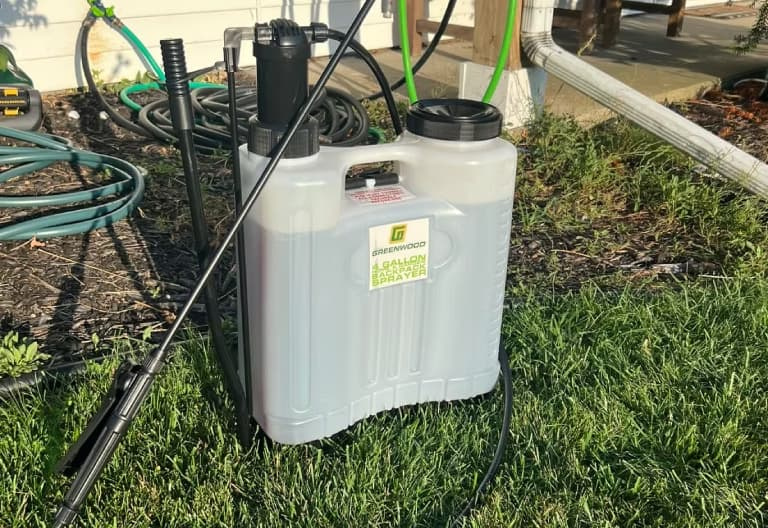
Herbicide Application Guide
New to spraying, or want to get it right? Our Herbicide Application Guide covers the practical steps this page assumes — mixing, calibration, protective gear, and the wind and temperature limits that decide whether a treatment works or drifts. Read it before you spray.
See Guide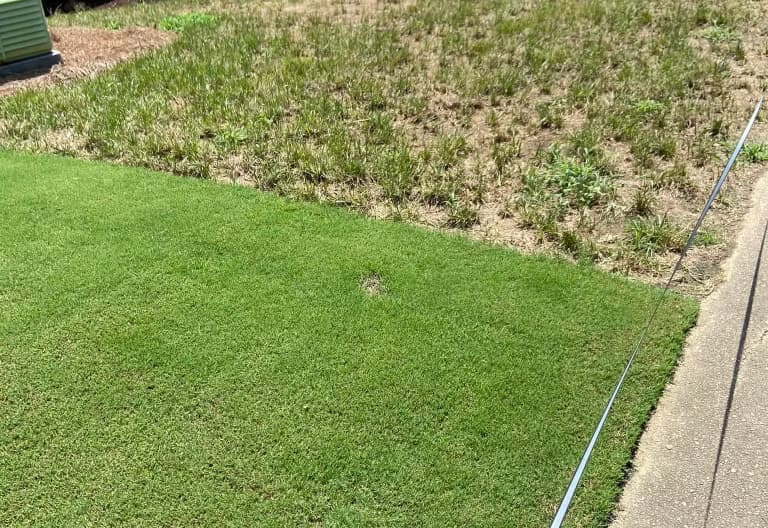
Where Two Lawns Meet
Does your lawn border a neighbor’s — or meet a different type of grass? Spraying near that line can quietly damage the yard next door, sometimes weeks later. Where Two Lawns Meet shows you how to treat safely without harming either side.
Read ArticlePulling
In a lawn, don't count on pulling — it almost always fails and can make things worse. In a loose, moist bed you can remove it by hand, but only if you recover every last fragment.
The Biological Reason
Here’s the part that catches most people out. Ground ivy’s creeping stems root down at nearly every joint — every few inches along runners that can stretch up to seven feet. That means the plant isn’t one root system you can lift out; it’s dozens of independent anchor points woven through the turf like Velcro. The smallest piece that can rebuild the whole plant is a single node — one joint of stem with its bud and a bit of root. Leave one behind and, in moist soil, it re-roots and starts a new mat.
That’s why the usual reactions backfire. If you rake, till, power-rake, or run a string trimmer through a patch, you don’t remove the weed — you chop it into hundreds of rooting fragments and scatter them across the lawn, turning one patch into many. Snapping the brittle stems while hand-pulling does the same thing on a smaller scale, leaving the rooted nodes in the ground to bounce right back.
If you do pull, do it only when the soil is thoroughly soaked, so the roots slide out instead of snapping, and trace each runner back to its parent crown rather than grabbing handfuls. Bag everything you pull — never leave it lying on soil or mulch, and never compost it, because the fragments will simply root wherever they land.
Underground Structure Explainer
Ground ivy anchors itself with more than one structure. Above ground, its square stolons creep along the surface and root at each node — this is the dominant, visible spread mechanism, and it’s what every extension program agrees on. Below ground, most sources also document shallow rhizomes (horizontal underground stems) and a fibrous taproot that store energy and help the plant survive frost and drought. A few programs describe it as purely a surface-stolon plant with no rhizomes at all; the sources genuinely disagree on this point. For your purposes it doesn’t matter which is right, because the practical rule is the same under either description: the plant roots at many points, any one of them can regenerate, and disturbing the network spreads it. Whole-plant removal is what fails; whole-fragment removal is the only mechanical approach that works.
Lawn vs. Bed Pulling Difference
The verdict flips with the soil. In compacted lawn turf the stems snap under tension and leave nodes behind, so pulling is a losing game and you’re better off spraying. In loose, cultivated bed soil you can sometimes lift entire chains of runners intact — a real advantage — but that same loose, moist soil is also the perfect nursery for any fragment you miss. So hand-removal is a genuine option in beds, but only paired with obsessive fragment recovery.
Quick Reference Summary
| Lifecycle | Stoloniferous perennial (broadleaf, mint family) |
| Active Zones | Severe in cool-season & transition; minor/localized in warm-season |
| Emergence Trigger | Regrowth from crowns/nodes as soil warms (~40°F shoots, 55°F+ spread) |
| Pre-Emergent | No (secondary only — isoxaben slows node rooting) |
| Post-Emergent Timing | Fall, after first frost (best); spring bloom (second) |
| Pull | With Caution — fails in turf; possible in moist beds with full fragment recovery |
| Lawn Primary Tool | Cool-season: triclopyr/fluroxypyr. Warm-season: metsulfuron or Celsius WG |
| Bed Primary Tool | Hand-removal or directed/wick application; glyphosate spot-treatment near woody plants |
| One-and-Done? | No — 2–3 year program |
Frequently Asked Questions
These answers are synthesized from botanical morphology studies and herbicide efficacy trials conducted by leading university agricultural extensions.
Because you almost certainly left nodes behind. Ground ivy roots at every joint, and a single joint with a bud and a bit of root rebuilds the whole plant. Unless you removed every fragment — or it crept back in from an untreated bed or the neighbor’s yard — a few weeks later you’re looking at a fresh patch.
No. Ground ivy grows flat, below the mower blade, so mowing barely touches it — and if it chops the runners into pieces and flings them across the lawn, mowing can actually help it spread. Mowing high still matters, but as a way to thicken the grass and shade the weed out, not as removal.
Usually one of two things: the wrong product or the wrong season. A weed-and-feed or a 2,4-D-only spray browns ground ivy but doesn’t kill it. Use a triclopyr- or fluroxypyr-based product (or the right warm-season chemistry), and spray in fall after the first frost, when the plant carries the herbicide down into its roots. Spring sprays tend to disappoint.
Not immediately. Most broadleaf herbicides need a 3-to-4-week gap before you seed. In fall that gap collides with prime overseeding time, so you have to pick an order: spray first and seed later, or seed first and wait about four weeks (until the new grass has been mowed twice) before spraying.
Start with the bed and the edge, not just the lawn. Ground ivy often sets up in a bed or tree ring first and launches runners into the lawn from there, so if you only treat the lawn it just re-invades. Clean up the bed, cut a hard edge between bed and grass, and treat both sides.
Scientific Authority
This profile is constructed using forensic botanical data and Integrated Pest Management (IPM) research. We prioritize scientifically-vetted identification and control methods that protect the broader ecosystem while ensuring successful eradication based on peer-reviewed agricultural studies.
Primary Resources
- Penn State Extension — Lawn and Turfgrass Weeds: Ground Ivy (Glechoma hederacea L.): https://extension.psu.edu/lawn-and-turfgrass-weeds-ground-ivy-glechoma-hederacea-l
- Penn State Extension (Master Gardener, Chester County) — What to Do About Ground Ivy: https://extension.psu.edu/programs/master-gardener/counties/chester/how-to-gardening-brochures/what-to-do-about-ground-ivy
- University of Minnesota Extension — Ground Ivy (Creeping Charlie): https://extension.umn.edu/weeds/ground-ivy
- NC State Extension (TurfFiles) — Ground Ivy: https://www.turffiles.ncsu.edu/weeds-in-turf/ground-ivy/
- NC State Extension (Plant Toolbox) — Glechoma hederacea: https://plants.ces.ncsu.edu
- NC State Extension Publications — Ground Ivy: https://content.ces.ncsu.edu
- Texas A&M AgriLife Extension (AggieTurf) — Ground Ivy: https://aggieturf.tamu.edu/turfgrass-weeds/ground-ivy/
- University of Georgia CAES (GeorgiaTurf) — Ground Ivy: https://turf.caes.uga.edu/pest-management/weeds/broadleaf-weeds/ground-ivy.html
- Clemson Cooperative Extension (HGIC) — Weeds as Indicators: https://hgic.clemson.edu/hot-topic/weeds-as-indicators/
- LSU AgCenter — Homeowner ground ivy / Roundup reformulation: https://www.lsuagcenter.com
- West Virginia University Extension — Ground Ivy: https://extension.wvu.edu/lawn-gardening-pests/weeds/ground-ivy
- University of Tennessee Extension — Ground Ivy (Glechoma hederacea), Publication W266: https://utia.tennessee.edu
- University of Missouri Extension (Mizzou WeedID) — Ground Ivy: https://weedid.missouri.edu/weedinfo.cfm?weed_id=124
Additional institutions cited in the research text: Purdue University Extension; Ohio State University Extension; Rutgers Cooperative Extension; University of Wisconsin Extension; University of Illinois Extension; University of Maryland Extension; Michigan State University Extension; UMass Amherst Turfgrass Program; Cornell Cooperative Extension; Iowa State University Extension; University of Florida IFAS Extension; Auburn University Extension; University of Arkansas Cooperative Extension; Virginia Tech Extension; Kansas State Research and Extension; University of Kentucky Extension; UC IPM; The Morton Arboretum; Weed Science Society of America.