
Pathogen: Blumeria graminis (formerly Erysiphe graminis)
Also called: powdery mildew, turf powdery mildew, grass powdery mildew, mildew
Lawn Powdery Mildew
The shade lawn's flour dusting
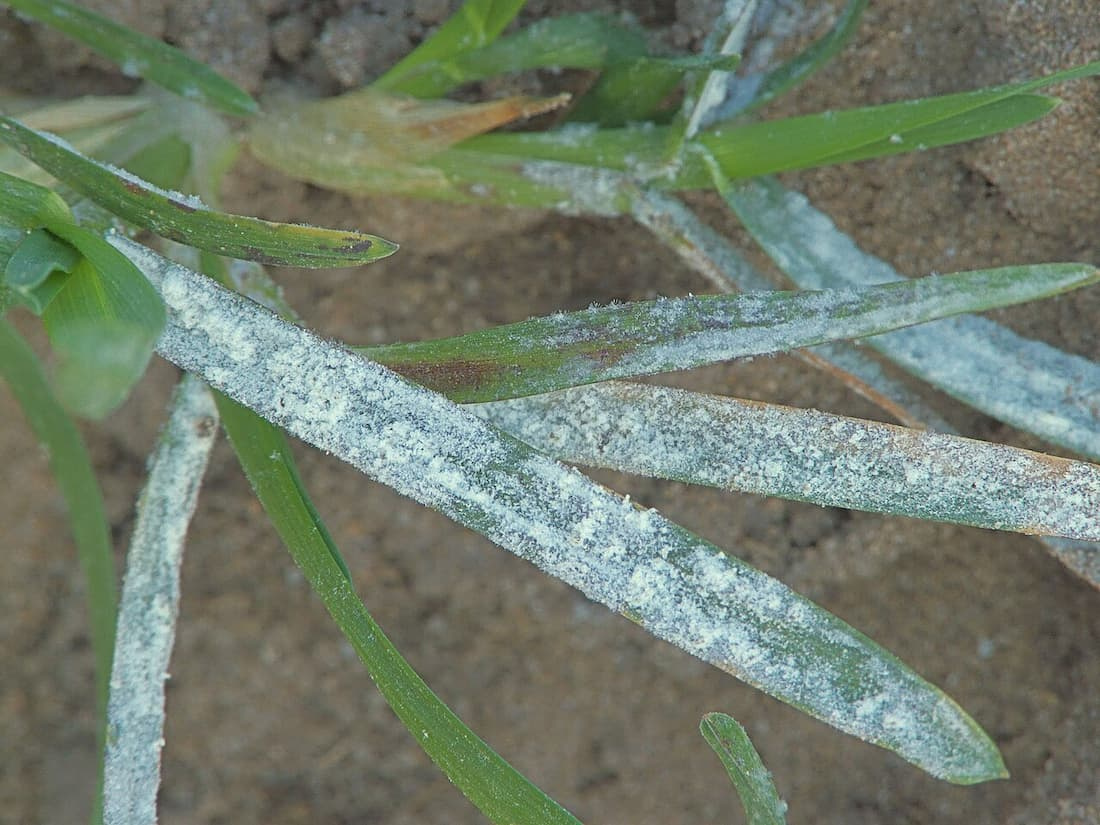
Featured Image Credit: Rasbak, via Wikimedia Commons, CC BY-SA 3.0
Lawn Powdery Mildew At-a-Glance
Grass Type Affected
Cool-Season Grasses
Recovers on Its Own?
Yes, Slowly
Is Spraying Worth It?
Rarely Worth It
Disease Type
Fungal
Active Season
Late Spring & Early Summer
Mid to Late Summer
Fall
Damage Potential
Cosmetic Only
Weakens Over Time
Lawn Powdery Mildew Quick Answers
What Lawn Powdery Mildew Looks Like
From Standing Height
From a standing position, the shaded part of the lawn looks dull white, light gray or pale green, as if someone dusted it with flour. It starts as scattered whitish areas in the shadiest, stillest spots and spreads over days to weeks until whole sections under a tree or along a building share the cast. The edges follow the shade, not a circle. In time the affected grass turns yellow and looks thin.
Up Close: Blades, Crowns and Roots
Up close, the white is on the upper surface of the blade. It begins as small, isolated white tufts about 1/16 inch across, which merge into a flat, powdery film covering the whole blade. The fungus grows only into the outermost layer of leaf cells to feed, so the blade under the coating keeps its shape and has no lesions, dark borders, bands or streaks.
The damage shows as color loss. Older and heavily coated blades turn pale yellow, sometimes reddish, then wither and die back, while younger blades stay greener. On a badly infected blade you may spot tiny dark brown or black dots inside the white film.
The crowns, sheaths and roots stay firm, white and healthy, because the fungus never reaches them. That’s why the lawn can regrow, and it’s the quickest way to rule out rot diseases.
Signs of the Organism
The white dust is the fungus itself: a thin film of fungal threads covered in masses of spores, lying on the upper surface of the blade. It starts as small white tufts about 1/16 inch across and spreads until the whole blade looks dusted with flour or talc. Look closely at an older, heavily coated blade and you may see tiny dark brown or black specks inside the white film. These are the fungus’s overwintering structures. Because this fungus doesn’t need dew, you can see the coating at any time of day, not just in early morning.
Identification Photos
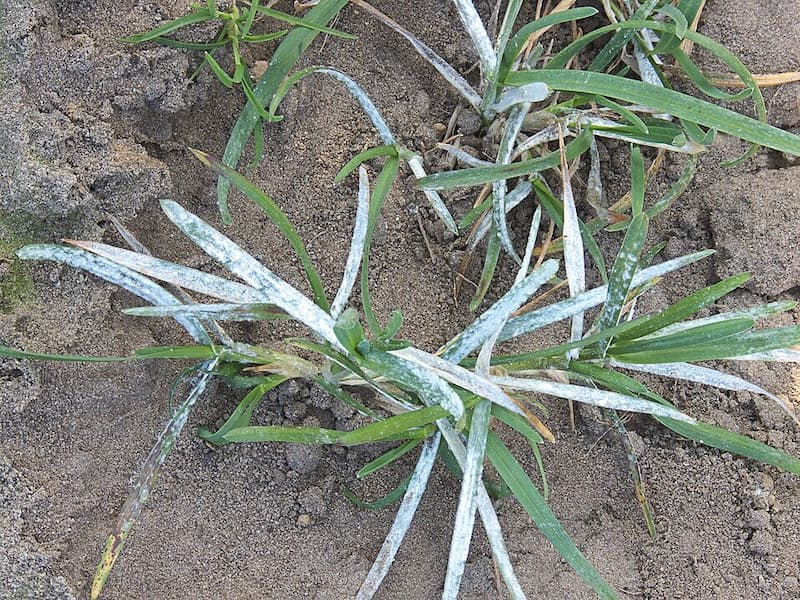
Looks Dusted With Flour: Infected blades look like they’ve been sprinkled with flour or chalk. The coating rubs off easily between your fingers.
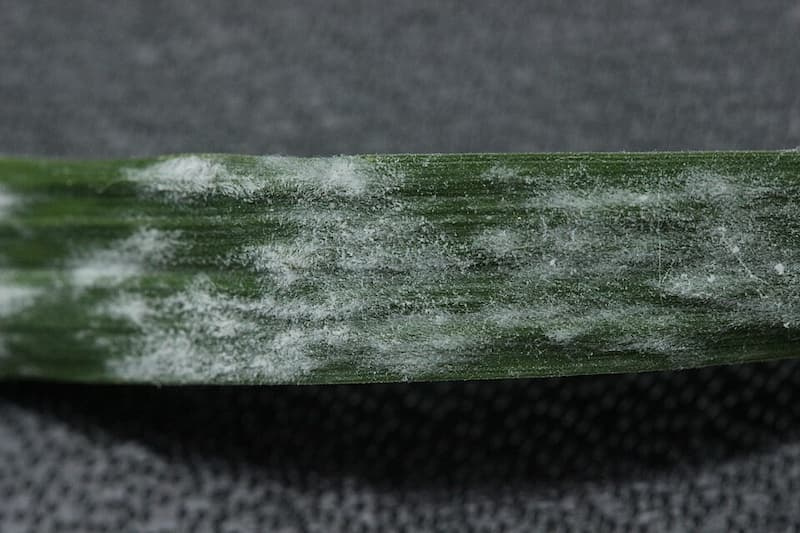
Starts as Patches: The fungus first forms small, fluffy white patches on the upper side of the blade, which spread and merge until the whole leaf looks gray-white.
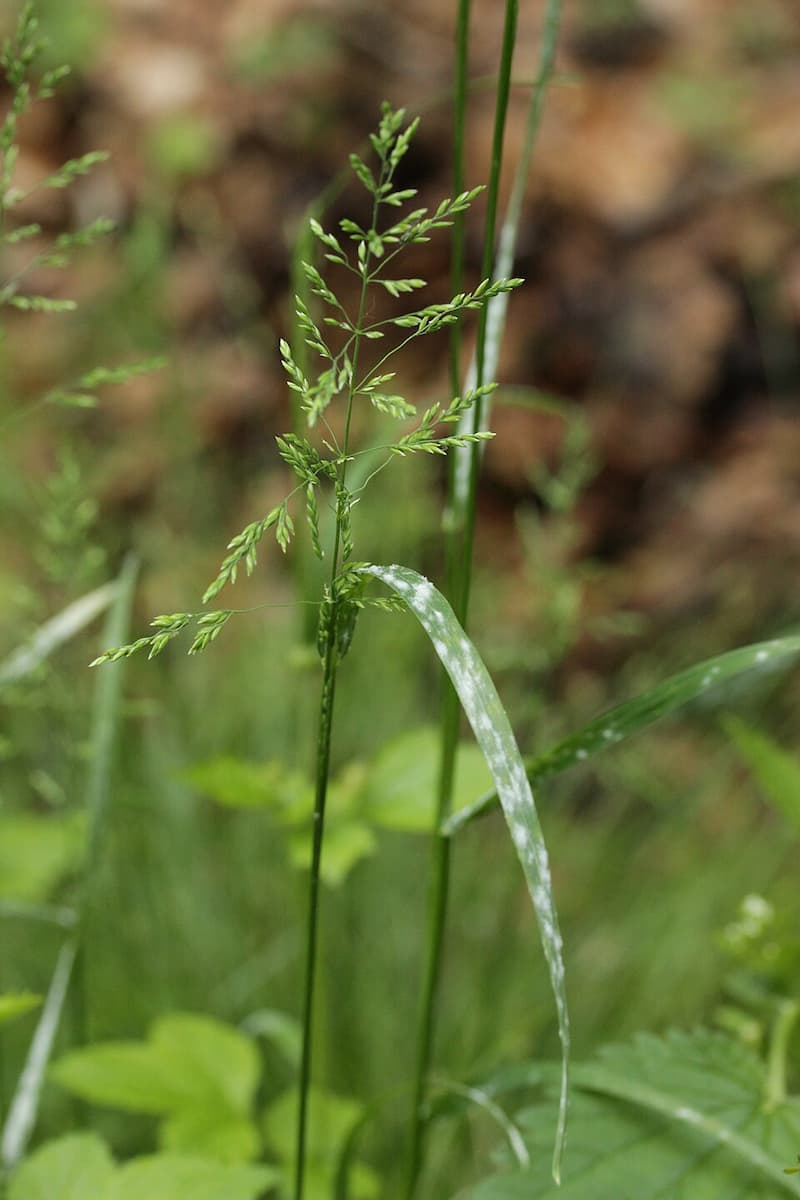
A Shade Problem: Powdery mildew thrives in shaded spots with poor air movement and mild, cloudy weather, which is why it often shows up under trees and along north walls.
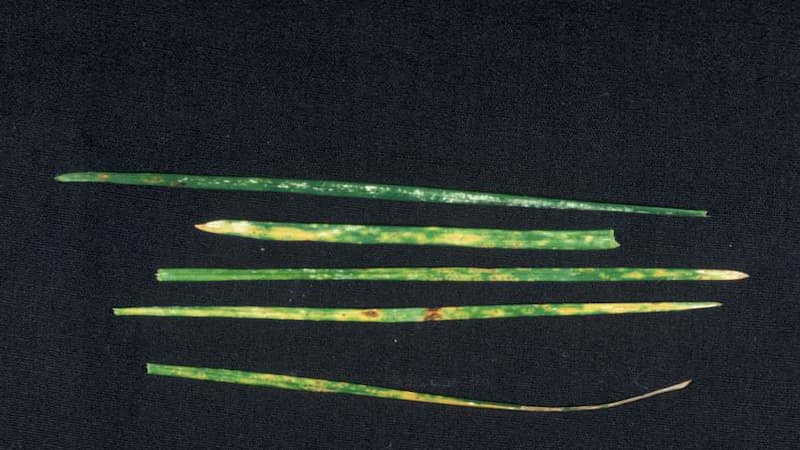
Later Stage: Heavily infected blades turn yellow and weak, and over time the shaded turf thins out if nothing changes.
NC State University, used with permission
Could It Be Something Else?
Common Lookalikes
Slime Mold is the most common mix-up because it also coats grass blades with a gray or white powder. It begins as a bright, slimy mass after wet weather, then dries within a few days into a crust of pinhead-sized balls sitting on top of the blades. It feeds on dead organic matter, not on the grass, and leaves the blades green underneath.
Lawn Rust also shows up on shaded Kentucky Bluegrass and yellows and thins it, so the two get confused at the patch level. Up close, rust is orange to reddish-brown, not white, and its spores rub off as colored dust on fingers or shoes.
Shade decline is the non-disease look-alike. Kentucky bluegrass that gets too little sun turns thin, pale and weak under trees on its own, and it often has mildew at the same time. If the grass is thin but the blades carry no white coating, the problem is the shade alone.
Field Checks Before You Treat
- Look at the setting. Powdery mildew sits in shade with still air: under tree canopies, beside shrubs, along the north side of a house or fence. A white coating out in full sun is almost certainly something else, because sunlight stops this fungus.
- Kneel and check the upper blade surface. Mildew forms a flat, flour-like film or small white tufts on the top of the blade, which stays upright and dry. There are no bordered spots, no slime and no cottony webbing strung between blades.
- Rub a coated blade between your fingers. Mildew leaves at most a faint white smudge, and the blade under it is green or yellowing. Orange or rusty-brown dust on your fingers means rust.
- Try to lift the coating off. Slime mold comes away as a crust of tiny balls when you brush or hose it, leaving clean green grass behind. Mildew is grown onto the blade and covers the same blades again within days.
- Compare grass types. If the white is heavy on Kentucky bluegrass or ryegrass while nearby fine fescue stays clean, that pattern points strongly to powdery mildew.
- Part the grass and check the base. Crowns, sheaths and roots should look firm and healthy, because this fungus stays on the leaves. Brown, rotted crowns mean a different disease.
Grasses at Risk
Host Grasses
Which Grasses Suffer Most
Kentucky Bluegrass is by far the most affected lawn grass, because it is both highly susceptible and poorly suited to shade. Older varieties such as Midnight, Merion and Windsor are especially prone, while shade-tolerant varieties are hit less. Perennial Ryegrass is rated just as susceptible in California, and annual ryegrass used for winter overseeding in shade gets it often in Texas.
Fine Fescue and improved Tall Fescue are rarely a problem in the North and make the best replacements for shade there. In shaded Southeastern lawns, Clemson reports outbreaks on tall fescue and Bermudagrass, so regional cultivar choice matters. The National Turfgrass Evaluation Program (ntep.org) rates powdery mildew on Kentucky bluegrass and fine fescue varieties, which helps when choosing seed.
Why It Shows Up
Conditions That Trigger It
Powdery mildew breaks the usual rule for lawn diseases: it doesn’t need wet grass. It infects dry blades as long as the air around them is humid, and it is most active when air temperatures run about 55–70°F, best around 65–70°F, in cloudy weather with damp, cool nights. Once a spore lands under those conditions, it can infect the leaf in about 2 hours, and the new infection makes fresh spores within a week. That’s why it shows up mostly in spring and from late summer into fall.
What turns those weather conditions into an outbreak is the site and how it’s cared for:
- Shade. The single biggest factor. Direct sunlight stops the fungus, and shade also slows the grass so infected blades aren’t replaced quickly.
- Still air. Dense trees, shrubs, fences and buildings trap humid air around the blades. Outbreaks start where air circulation is poorest.
- Too much nitrogen. Heavy feeding makes soft, lush blades that the fungus infects easily. Shaded grass needs less fertilizer than grass in sun.
- Light, frequent or evening watering. Shaded turf uses less water, and watering near sunset or sunrise keeps the canopy humid for hours.
- Susceptible grass. Kentucky bluegrass, especially older varieties such as Midnight, Merion and Windsor, planted where it doesn’t get enough sun.
How It Survives and Spreads
The fungus can only live on living grass. It gets through winter mainly as dormant threads inside infected grass plants, and in cold-winter regions also as tiny dark spore cases in dead leaves and thatch. When mild, humid weather returns, the surviving fungus releases fresh spores.
Wind carries those spores to new blades, and mowers and foot traffic knock them from plant to plant. Each infection produces a new crop of spores within about a week, so in a shady, still-air pocket the disease builds on itself all season. It spreads well between nearby lawns on the breeze, but it only takes hold where the grass is shaded and susceptible.
Where It Hits Hardest: Regional Notes
Powdery mildew is a common, recurring shade problem across the cool-season North and the Transition Zone, wherever Kentucky Bluegrass grows under trees or beside buildings. It also turns up in California lawns of bluegrass and Perennial Ryegrass during cool, humid spells. In the Southeast it appears in shaded, airless spots on bluegrass, Tall Fescue and Bermudagrass. In Texas it is most common on ryegrass used to overseed warm-season lawns for winter. In open, sunny lawns anywhere, and in most Deep South warm-season lawns, it is rare.
Lawn Powdery Mildew Diagnostic Profile
Check what you see against the full set of signs. The more that match, the more likely this is your problem.
What You’ll See
Symptom Color
Yellow
White or Gray
Visible Signs
White Powdery Coating
Lawn Pattern
Irregular Patches
Overall Thinning
Patch Size
1 to 3 Feet
Over 3 Feet
Blade Symptoms
Powdery Coating
When and Where
Weather Triggers
Cool & Wet
Where in the Lawn
Shade
Controlling Lawn Powdery Mildew
Every lasting fix works the same way: more light, more moving air and less humidity around the blades. Without those changes, the disease returns every year whatever else you do.
- Let in light and air. Prune low tree limbs, thin dense canopies and cut back shrubs crowding the lawn. This is the most effective step, because sunlight directly stops the fungus and moving air carries off the humidity it needs.
- Grow the right grass for the shade. Overseed or replace shaded Kentucky bluegrass with fine fescue, a shade mix of fine fescue, tall fescue and bluegrass, or shade-tolerant bluegrass varieties. Avoid Midnight, Merion and Windsor bluegrass in shade.
- Feed shade lightly. Use moderate fertility and never more than 1 pound of nitrogen per 1,000 square feet at one time. Shaded grass grows slowly and can’t use more, and the extra makes soft blades the fungus infects easily.
- Water deeply and seldom. Water only when the grass needs it, and do it in the morning, not late afternoon or evening. Shade dries slowly, and evening watering keeps the canopy humid overnight.
- Mow high. Keep shaded grass at about 3 to 4 inches. The taller blades catch more of the little light available, which keeps the grass strong enough to outgrow infected leaves.
- Rake fallen leaves promptly. A leaf layer on shaded grass blocks the light and air it already lacks.
- Know when to stop growing grass. Turf generally won’t do well with less than about 4 hours of direct sun a day. In permanent shade from a house or a tree you want to keep, mulch or a shade ground cover will look better than mildewed grass.
Spraying is rarely worth it for powdery mildew in a home lawn. The disease seldom causes lasting damage, it returns as long as the shade does, and a fungicide cannot clean or green up blades that are already infected. It only protects healthy leaves and the new ones that grow afterward.
Spraying makes sense only where the shade truly can’t be changed and the white look is unacceptable, for example a prominent front-yard strip on the north side of the house. Then treat preventively, as mild, humid weather returns and before the coating spreads, and expect to repeat it each season. K-State suggests having a professional lawn care service make the application.
| Active ingredient | FRAC group | Notes |
|---|---|---|
| Propiconazole | 3 (DMI) | Listed by Clemson for home-lawn powdery mildew. |
| Myclobutanil | 3 (DMI) | Listed by Clemson for home-lawn powdery mildew. |
| Triadimefon | 3 (DMI) | Listed by Clemson for home-lawn powdery mildew. |
| Azoxystrobin | 11 (QoI) | Listed by UC IPM for turf powdery mildew. Clemson rates this class at about 28 days of control per application. |
| Metconazole, tebuconazole, triticonazole | 3 (DMI) | Rated effective by Purdue, but check that the label lists residential lawns before buying. |
Clemson rates its DMI-type lawn fungicides at about 14 days of control. Powdery mildew fungi readily adapt to fungicides that are used repeatedly, so alternate between FRAC group 3 and group 11 products, and don’t use the same group back to back. Product names don’t reliably tell you what’s inside, so check the active-ingredient panel on the label.
Recovery and Repair
Recovery depends on the shade. Because crowns and roots survive, the grass replaces infected blades with new growth, but shaded grass grows slowly, so expect several weeks. Lasting recovery only comes once there is more light and air. Where the site stays dark, the cycle of infection and thinning repeats each year.
If the lawn has thinned:
- Fix the light first. Prune or thin trees before reseeding. New grass under the same dense shade will thin out again.
- Seed in fall, after the leaves drop. That is when the most sunlight reaches the ground. Use a shade grass such as fine fescue or a fine fescue blend, at about half the normal seeding rate, because crowded seedlings in shade trap humidity and weaken one another.
- Keep leaves off the new grass. Rake fallen leaves promptly so the seedlings get light and air.
- Use sod for spring repairs. Spring seedlings in shade rarely mature before summer stress, so sod is the better option then.
- Switch to mulch or ground cover where grass gets less than about 4 hours of sun. Reseeding those spots only repeats the problem.
When to Call a Pro
Most homeowners won’t need a lab, because the flour-like coating on shaded grass is easy to recognize. Send a sample to your state’s extension diagnostic lab if the grass is thinning in shade with no white coating, or if the coating is on grass in full sun. For a lab sample, dig a 6-inch-wide plug with roots from the edge where healthy grass meets affected grass. Wrap it in foil, not plastic, and mail it early in the week so it doesn’t sit over a weekend.
The call most worth making is to a certified arborist. Raising and thinning the canopies of large trees is the real cure, and it’s work that should be done from a ladder or bucket truck by a professional.
Frequently Asked Questions
These answers are synthesized from plant pathology research and diagnostic guidance published by university extension services and plant disease clinics.
No. A fungicide only protects healthy blades and new growth, and blades that are already coated or yellowed stay that way until they are mowed off and replaced. That’s why fungicides are only useful applied preventively, before the coating spreads.
They are the fungus’s overwintering spore cases. They form as infected leaves age and die, then sit in dead grass over winter and release spores after fall rain. They confirm powdery mildew rather than signaling anything more serious.
Change the grass, or stop growing grass there. Fine fescue tolerates shade far better than Kentucky bluegrass and rarely gets mildew. If the strip gets less than about 4 hours of direct sun a day, mulch or a shade ground cover will look better year after year than any lawn grass.
Not with extra nitrogen. Heavy feeding makes soft, lush blades that the fungus infects more easily, and shaded grass can’t use much nitrogen anyway. Keep to moderate rates and no more than 1 pound of nitrogen per 1,000 square feet at a time.
Scientific Authority
This profile is built on plant pathology research and diagnostic guidance from university extension services and plant disease clinics. We prioritize accurate identification and cultural control first, recommending fungicides only where research shows they are justified, and naming them by active ingredient rather than brand.
Primary Resources
- Penn State Extension — Turfgrass Diseases: Powdery Mildew
- Penn State Turfgrass Pest Lab — Powdery Mildew
- Purdue Extension — Turfgrass Disease Profiles: Powdery Mildew (BP-111-W)
- Purdue Extension — Turfgrass Disease Profiles: Slime Molds (BP-112-W)
- Ohio State University Extension — Powdery Mildew on Turfgrass (HYG-3081)
- NC State Extension — Powdery Mildew in Turf
- Clemson Cooperative Extension HGIC — Leaf Diseases of Lawns (HGIC 2152)
- University of California IPM — Healthy Lawns: Powdery Mildew
- University of California IPM — Turfgrass Pest Management Guidelines: Powdery Mildew
- University of Missouri Extension — Turfgrass Disease Control (G6756)
- Kansas State Research and Extension — Lawn Problem Solver: Powdery Mildew
- Kansas State Research and Extension — Shade-Tolerant Grasses (MF2128)
- University of Wisconsin–Madison Turfgrass Diagnostic Lab — Powdery Mildew
- Texas A&M AgriLife Extension — Texas Plant Disease Handbook: Powdery Mildew (Lawn and Turf)