
Pathogen: Typhula incarnata and Typhula ishikariensis
Also called: Gray Snow Mold, Typhula Blight, Speckled Snow Mold
Gray Snow Mold
What the snowbank leaves behind
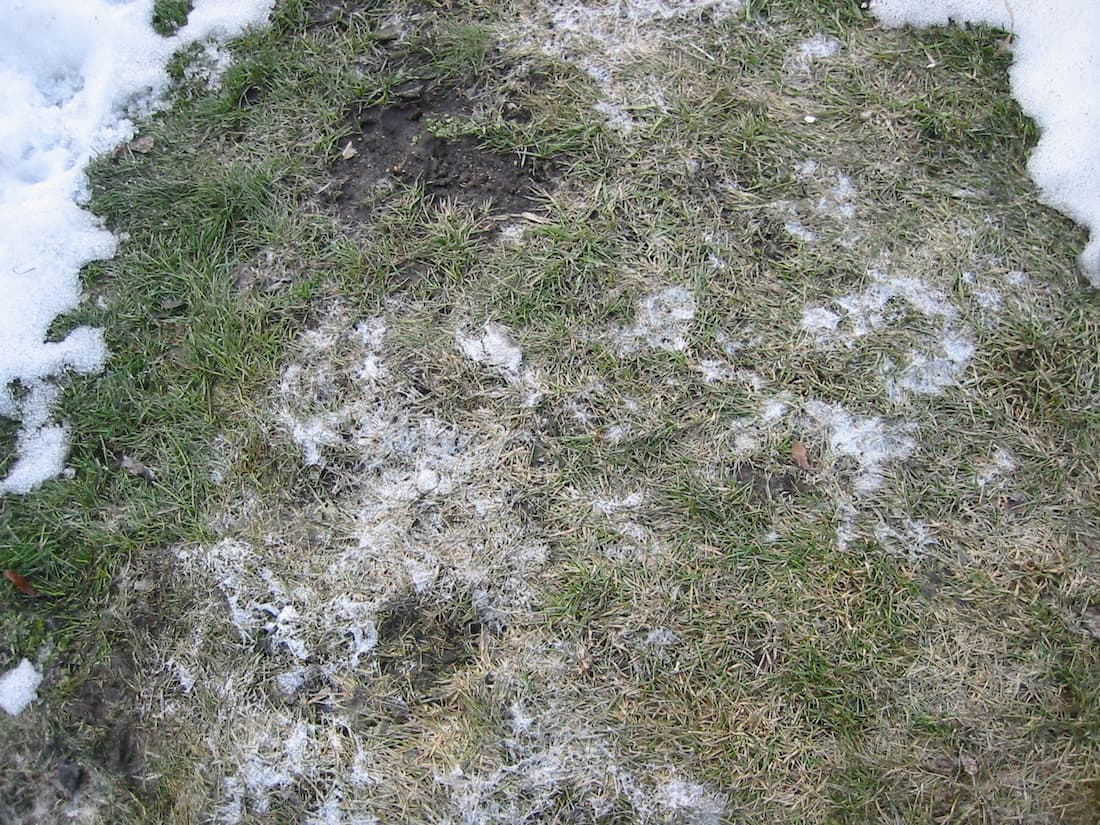
Featured Image Credit: noricum, via Wikimedia Commons, CC BY-SA 2.0
Gray Snow Mold At-a-Glance
Grass Type Affected
Cool-Season Grasses
Recovers on Its Own?
Yes, Quickly
Is Spraying Worth It?
Rarely Worth It
Disease Type
Fungal
Active Season
Early Spring
Winter
Damage Potential
Cosmetic Only
Can Be Fatal
Gray Snow Mold Quick Answers
What Gray Snow Mold Looks Like
From Standing Height
Gray snow mold shows up the moment the snow melts: roughly circular, bleached patches of straw-colored to grayish-white grass, from a few inches to about 3 feet across, clustered where the snow sat deepest and longest along driveways, sidewalks and shoveled piles. The grass inside each patch is pressed flat into a stiff, crusted mat that looks like wet papier-mâché, often with a gray cobwebby fringe at the edge for the first day or two. Within days the fringe dries up and the patches fade to light tan, and after a long winter neighboring patches can merge into large, irregular blighted areas.
Up Close: Blades, Crowns and Roots
Up close, whole leaf blades are dead, not spotted. Each blade turns uniformly bleached white, straw or gray-tan from the tip down, with no lesions, no dark borders and no banding. That alone rules out spring leaf spot diseases. Fresh from the snow, the blades look water-soaked and are glued together in layers; as they dry, they turn brittle and papery.
Part the mat and look at the lower leaf sheaths, just above the soil. This is where the sclerotia sit: reddish-brown beads or black pepper-like specks embedded in or stuck to the dead tissue.
The part that decides recovery is the crown, the growing point at the soil line. With the common species, Typhula incarnata, the crowns and roots stay alive, firm and whitish inside, and new green blades push up through the dead ones in spring. Speckled snow mold (Typhula ishikariensis), found mainly where snow lasts three months or more, can kill the crowns, as can either species on seedlings that went into winter immature. Roots are not rotted in either case.
Signs of the Fungus
Two signs prove it’s gray snow mold. The first is the fungus itself: a gray to grayish-white, cobweb-like fuzz on the patches and along their edges. Look for it on the first mornings after melt, right where the snowbank is pulling back, while the grass is still wet. It dries up and disappears within a few days of sun.
The second sign lasts longer and settles the diagnosis: sclerotia, tiny hard round bodies stuck to or inside the dead leaves and lower leaf sheaths. They start out soft and white, pink or orange, then harden. Typhula incarnata makes reddish-brown ones from pinhead to BB size (about 1/16 to 3/16 inch). Typhula ishikariensis, the cause of speckled snow mold, makes black specks no bigger than 1/16 inch that look like flakes of ground black pepper. Both can be seen with the naked eye or, more easily, with a 10x hand lens.
Identification Photos
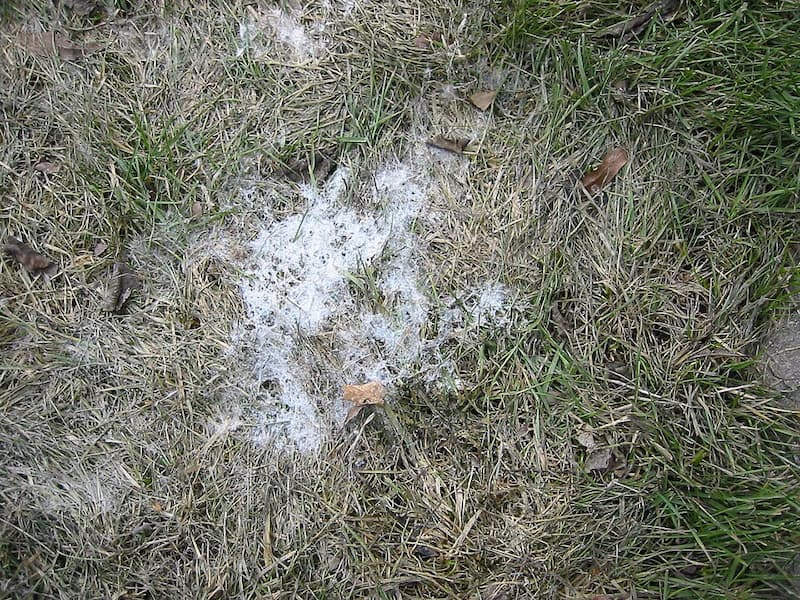
Diagnostic Feature: Grayish-white, cobweb-like growth mats the grass together in patches as the snow recedes.
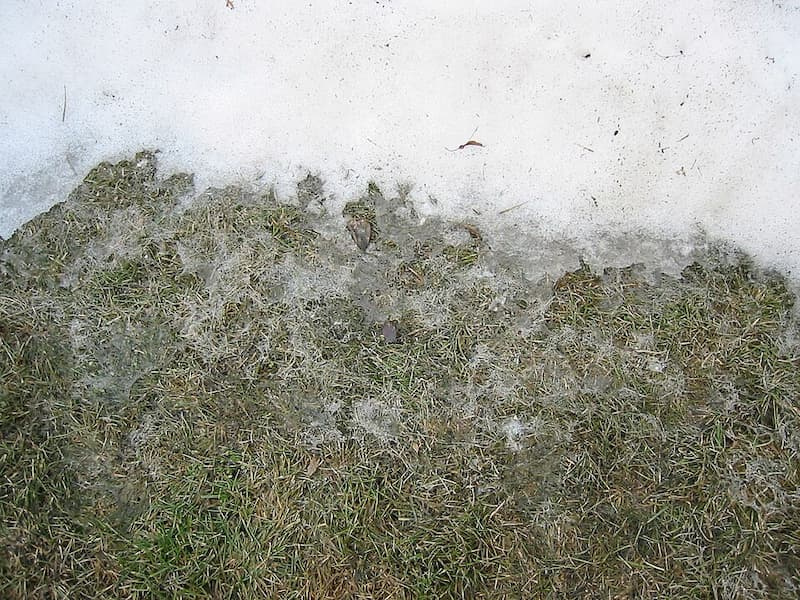
At the Snow Line: The growth is most obvious right where the snow is melting back, where the grass sat longest under cover.
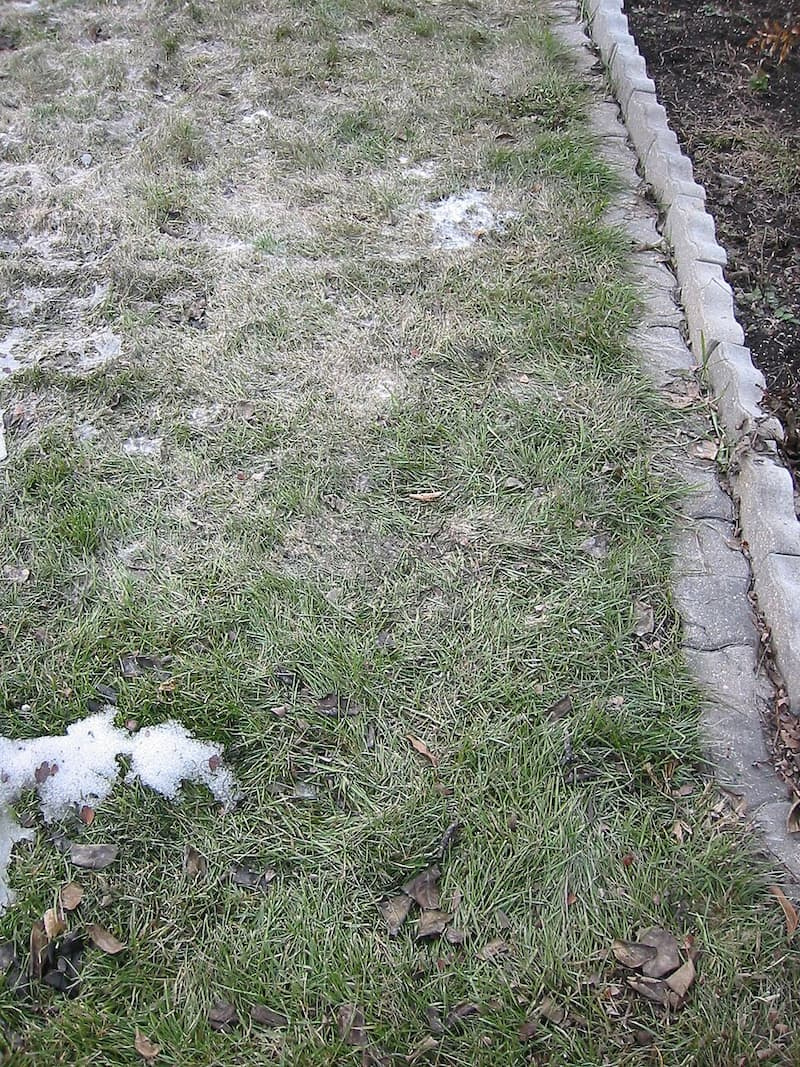
After the Melt: Once the growth dries, the patches are left matted and straw-colored. Light raking helps the grass recover.
Could It Be Something Else?
Common Lookalikes
Pink Snow Mold (Microdochium nivale) is the disease most often mistaken for gray snow mold, and the two often show up in the same lawn at the same time. Both leave circular, matted, bleached patches at snowmelt. The differences: pink snow mold never makes sclerotia, its fuzz and patch edges often turn pinkish or salmon once exposed to light, and it doesn’t need snow, so it can also appear during cool, rainy weather in fall and spring.
Winter injury (dead grass from ice sheets, wind-dried grass on exposed spots, or grass smothered under heavy snow piles) also turns up as straw-colored areas right after melt. It’s confused with snow mold because of the timing and location. Winter-injured areas have no gray fuzz and no sclerotia, they usually follow low spots where ice sat or high spots blasted by wind instead of forming neat circles, and the crowns are often dead.
Field Checks Before You Treat
- Check the timing. Gray snow mold appears only as snow melts after a long, snowy winter. Patches that show up in summer, or after a winter with little lasting snow, are something else.
- Look at the patch edges on the first mornings after melt. A gray or grayish-white cobwebby fringe points to gray snow mold. A pink or salmon tint at the edge points to pink snow mold. Both diseases can be in the same lawn.
- Hunt for sclerotia. Pull apart the matted leaves at a patch edge and look closely at the dead blades and the lower sheaths near the soil, ideally with a 10x hand lens. Reddish-brown beads or black pepper-like specks confirm gray snow mold. Finding none, after checking several patches, points to pink snow mold or winter injury.
- Run a regrowth test. Dig two or three small plugs from the center of a patch, set them in a pot or tray indoors in a warm, bright spot, and keep them moist. Green shoots within a week or two mean the crowns are alive and the lawn will recover on its own. No regrowth means crown death from speckled snow mold or winter injury, and that spot will need reseeding.
Grasses at Risk
Host Grasses
Which Grasses Suffer Most
Every cool-season lawn grass can get gray snow mold, but they don’t suffer equally. Perennial Ryegrass, Tall Fescue and creeping Bentgrass take the most leaf damage, and so does Annual Bluegrass, the weedy grass common in lawns. Kentucky Bluegrass and Fine Fescue are the least susceptible, and Kentucky bluegrass also fills in damaged spots quickly with its spreading underground stems. That makes Kentucky bluegrass and fine fescue blends the best choice for lawns that see heavy snow every year. Cultivars also differ: when buying seed, check regional NTEP trial results for snow mold ratings where they’re available. Warm-season grasses are not affected in practice, because they’re dormant and grown where snow doesn’t last.
Why It Shows Up
Conditions That Trigger It
Gray snow mold needs snow lying on unfrozen ground for a long time, roughly two months. Snow insulates the soil, holding the grass surface at about 32 to 40°F (soil surface temperature) in constant darkness and near-100% humidity, exactly where this cold-loving fungus grows best. Damage can begin after about a month of continuous snow, and the longer the snow lasts, the bigger the patches. Speckled snow mold needs even longer, about 75 to 90 days. If the ground freezes hard before the first lasting snow, or a midwinter thaw melts the snow and exposes the grass, the disease usually doesn’t develop.
Site and care factors that make it worse:
- Piled and drifted snow. Snow shoveled or plowed onto the lawn along driveways and sidewalks, and drifts against buildings and fences, lasts weeks longer than the rest of the snow cover. Those are the spots that get hit first and worst.
- Lush fall growth. Heavy or fast-release nitrogen in late fall keeps the grass soft and leafy going into winter, giving the fungus more tender tissue to colonize.
- Tall grass going into winter. Stopping mowing too early leaves long blades that fold over under the snow into a damp mat the fungus spreads through.
- Leaves and debris left on the lawn. Fallen leaves under snow trap moisture against the grass.
- New seedings. Grass seeded in late fall goes into winter immature, and the fungus can kill young plants outright.
- Shade and poor drainage. Shaded areas hold snow longer in spring, and low, wet spots keep the grass soaked during melt.
- Thick thatch. The fungus survives the summer in the thatch, so a heavy thatch layer means more of it is waiting.
How It Survives and Spreads
The fungus spends spring, summer and early fall as sclerotia, the hard survival bodies lying dormant in the thatch and top layer of soil. They shrug off heat and drought, which is why the disease comes back to the same lawns.
In late fall, cool, wet weather with air temperatures around 50 to 65°F wakes the sclerotia. Some grow fungal threads directly; others send up tiny fruiting bodies that release spores onto dying leaves nearby. Once lasting snow falls on unfrozen ground, the fungus spreads outward from each starting point through the wet, matted grass under the snow, which is why patches are round. It works all winter, unseen.
When the snow melts, sun and dry air stop the fungus within days. Before it shuts down, it packs itself into new sclerotia inside the dying leaves, and these drop into the thatch to wait for next winter. The fungus can also move between lawns in soil, thatch and debris carried on equipment or in infected sod, but in snowy regions it’s already present in most lawns. Snow cover, not spread from a neighbor, decides whether you see it.
Where It Hits Hardest: Regional Notes
Gray snow mold is a problem wherever snow reliably covers lawns for two months or more: the Upper Midwest, the Great Lakes states, New York and New England, and the snowy mountain areas of the West. In the northernmost parts of that range, where snow lasts three months or longer, the more damaging speckled snow mold (Typhula ishikariensis) takes over. In Wisconsin, for example, the reddish-sclerotia species dominates the south of the state and the speckled species the north.
In the transition zone, from Missouri and southern Illinois east through Ohio and into Virginia, it appears only after unusually snowy winters and is usually cosmetic. Across the South and the warm-season lawn zone, where snow never lasts, it essentially doesn’t occur.
Gray Snow Mold Diagnostic Profile
Check what you see against the full set of signs. The more that match, the more likely this is your problem.
What You’ll See
Symptom Color
Tan or Straw
Yellow
Brown
White or Gray
Visible Signs
Cottony White Webbing
Fuzzy Gray Mold
Slimy or Crusty Layer
Hard Seed-Like Bodies (Sclerotia)
Lawn Pattern
Circular Patches
Irregular Patches
Patch Size
2 to 6 Inches
6 to 12 Inches
1 to 3 Feet
Over 3 Feet
Blade Symptoms
Tip Dieback
Rotted Leaf Base or Crown
When and Where
Weather Triggers
Cool & Wet
Snow Cover
Where in the Lawn
Shade
Low or Wet Spots
New Seedings
Open, Sunny Lawn
Controlling Gray Snow Mold
Prevention is all about how the lawn goes into winter and where the snow ends up. These steps do most of the work that a fungicide would.
- Keep mowing until the grass stops growing. Mow at your normal height right up to the last growth of the season. Short, upright grass doesn’t fold into the damp mat the fungus needs to spread under snow.
- Go easy on fall nitrogen. Use a slow-release fertilizer for any fall feeding, keep the rate moderate, and stop once the first frost arrives. Fast, late nitrogen keeps the grass soft and leafy, which is just what the fungus feeds on.
- Clear leaves before the snow. Rake or mulch-mow fallen leaves so they don’t trap moisture against the grass all winter.
- Don’t pile snow on the lawn. Throw shoveled and plowed snow onto beds or other non-lawn areas. Big piles melt weeks after the rest of the snow and are where the worst patches form. In windy, open yards, a snow fence or a row of shrubs can keep deep drifts off the lawn.
- Fix the spots that stay wet. Where the disease is severe every year, improve surface drainage, core aerate, and keep thatch thin. All three help the lawn dry out after melt and reduce the fungus’s summer hiding place.
- Let in sun and air. Pruning low branches and clearing brush around the lawn speeds snowmelt and drying in spring.
- Seed by late summer. Grass seeded in late summer to early fall is mature by winter. Seed sown in late fall goes under the snow as tender seedlings that the fungus can kill.
- Rake the patches in spring. Once the lawn is dry enough to walk on without leaving footprints, lightly rake the matted areas to break up the crust, let in light and air, and help new blades come through. Send the raked debris to yard-waste pickup or the trash, not the home compost pile, because it’s full of sclerotia.
Spraying is rarely worth it for gray snow mold on an established home lawn, because the grass usually grows back on its own. Fungicides can only prevent this disease: they must be on the grass before lasting snow arrives. Sprays applied in spring, after the patches appear, do nothing at all, because the fungus has already stopped working and the damage is done.
A fall preventive spray makes sense in only two situations: a lawn seeded in late summer or fall that will go into winter young, and a lawn with a history of severe damage in a place where snow regularly covers unfrozen ground for three months or more (speckled snow mold country). In those cases, apply after the last mowing of the season and as close to the first lasting snow as possible, usually in late October or November. One application lasts the winter.
| Active ingredient | FRAC group | Availability | Notes |
|---|---|---|---|
| Propiconazole | 3 | Homeowner and professional products | Good against the reddish-sclerotia species; less reliable alone against speckled snow mold |
| Tebuconazole | 3 | Mainly professional products | Same class as propiconazole; often sold in mixtures |
| Azoxystrobin | 11 | Homeowner and professional products | Different mode of action; a good partner or rotation for a group 3 product |
| Pyraclostrobin | 11 | Mainly professional products | Same class as azoxystrobin; don’t rely on group 11 alone year after year |
Combining two different FRAC groups works better than any single product and slows fungicide resistance. That’s why lawn care professionals use mixtures where snow mold is severe. Chlorothalonil, iprodione and fludioxonil also appear in snow mold research, but those products are labeled for golf and other professional turf, not home lawns. If you need one of them, hire a licensed applicator.
Recovery and Repair
Most lawns recover on their own within a few weeks once the grass starts actively growing in spring, because only the leaves were killed. Speed it up in three steps: lightly rake the matted patches as soon as the lawn is dry enough to walk on, so light and air reach the crowns; give a light feeding of nitrogen once the rest of the lawn is greening and growing (not before, when the grass can’t use it); and then give it time.
If a patch is still bare by mid-spring while the lawn around it is growing, or the regrowth test showed no shoots, the crowns are dead and the spot needs reseeding. Rake out the dead grass to expose soil, spread a thin layer of topsoil mixed with seed of the same grass as the rest of your lawn, and keep it lightly moist every day until it sprouts. Seed as early in spring as the soil can be worked, so the new grass establishes before summer heat. For large dead areas, or when spring seeding fails, overseed again in late summer, which is the best time to seed cool-season grass. For an instant fix on small spots, cut out the dead turf and lay sod level with the surrounding lawn, then keep it watered until it roots.
When to Call a Pro
Most gray snow mold needs no professional help. Call your county extension office or send a sample to a university plant diagnostic lab when:
- Patches stay brown past mid-spring. If the surrounding lawn is green and growing but the patches show no new shoots (or the regrowth test fails), crowns may be dead, and a lab can tell you whether that’s speckled snow mold, pink snow mold or winter injury.
- It’s severe every year. Confirming which Typhula species you have decides whether a fall preventive program is worth it and which ingredients it needs.
- Large areas are dead. A lawn professional with a slit seeder can renovate big areas faster and more evenly than hand seeding.
Most labs prefer clear photos first: the whole patch, the edge where diseased meets healthy grass, and a close-up of the dead leaves with a coin for scale. If they ask for a physical sample, dig a plug from the edge of a patch, half diseased and half healthy, with 2 to 3 inches of soil attached, and mail it early in the week.
Frequently Asked Questions
These answers are synthesized from plant pathology research and diagnostic guidance published by university extension services and plant disease clinics.
They’re sclerotia, the fungus’s survival bodies, and they’re the surest sign you have gray snow mold rather than pink snow mold. Reddish-brown beads from pinhead to BB size come from Typhula incarnata, the common species, which usually leaves crowns alive. Black specks like ground pepper come from Typhula ishikariensis (speckled snow mold), which can kill crowns, so watch those patches closely for regrowth.
No. The fungus stopped working when the snow melted, and fungicides applied after snowmelt don’t reduce damage or speed recovery. Rake the patches, feed lightly once the lawn is growing, and save any fungicide decision for next fall, and only if your lawn fits one of the two situations where a preventive spray makes sense.
Possibly, but only by over-feeding late. Too little fertilizer doesn’t cause gray snow mold. Heavy or fast-release nitrogen in late fall, though, keeps the grass lush going into winter and makes the damage worse. Long snow cover on unfrozen ground is the main cause, and no fertilizer schedule changes that.
The fungus will still be there; the damage depends on the snow. Sclerotia from this year drop into the thatch and survive the summer, so the fungus stays in your lawn. Whether you see patches again depends mostly on how long snow sits on unfrozen ground next winter. Fall mowing, moderate nitrogen and keeping snow piles off the lawn reduce how bad it gets.
Scientific Authority
This profile is built on plant pathology research and diagnostic guidance from university extension services and plant disease clinics. We prioritize accurate identification and cultural control first, recommending fungicides only where research shows they are justified, and naming them by active ingredient rather than brand.
Primary Resources
- Penn State Extension — Turfgrass Diseases: Gray Snow Mold (Causal Fungus: Typhula incarnata)
- University of Wisconsin–Madison Extension — Typhula Blight
- University of Wisconsin–Madison Turfgrass Diagnostic Lab — Gray Snow Mold (Typhula incarnata and T. ishikariensis)
- UMass Amherst — Snow Mold on Lawns
- UMass Amherst — The Snow Molds
- UMass Amherst — Weird Gray Circles in Your Yard After the Snow Melts?
- University of Missouri Extension — Identification and Management of Turfgrass Diseases: Gray Snow Mold (IPM1029)
- NC State Extension — Gray Snow Mold in Turf
- The Ohio State University — Snow Mold Damage: How Bad Is It and What Can Be Done?