
Pathogen: Magnaporthiopsis poae (formerly Magnaporthe poae)
Also called: Frog-eye patch, frogeye, Fusarium blight (outdated name)
Summer Patch
The root rot summer exposes
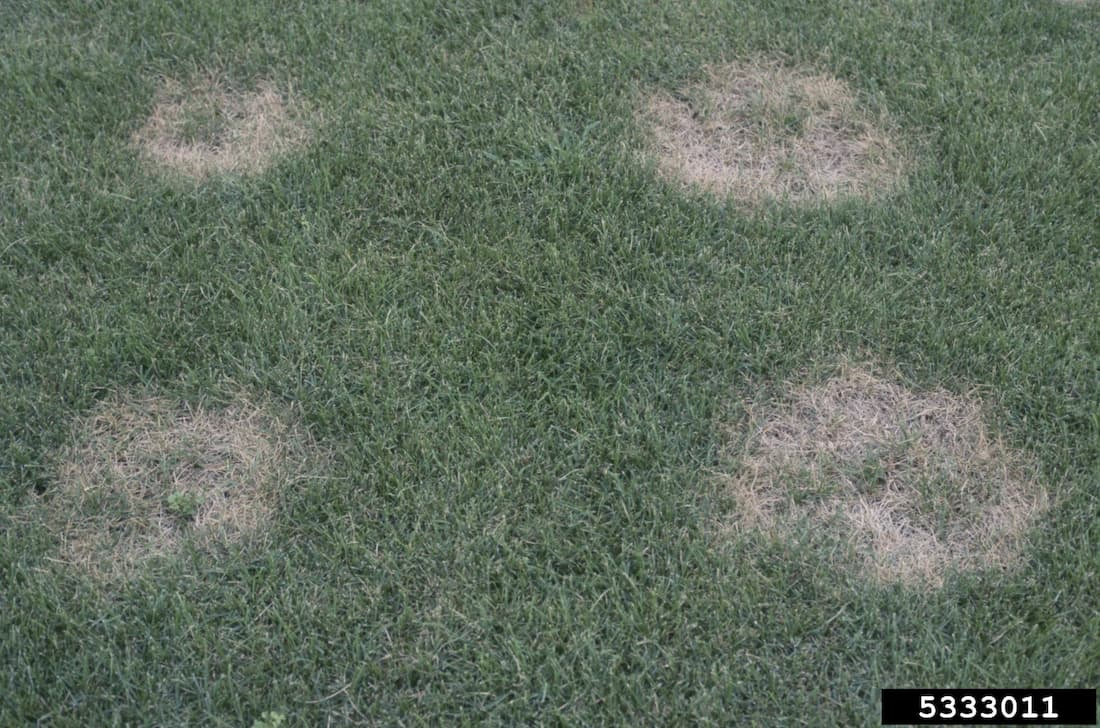
Featured Image Credit: Mary Ann Hansen, Virginia Polytechnic Institute and State University, Bugwood.org, CC BY 3.0 US
Summer Patch At-a-Glance
Grass Type Affected
Cool-Season Grasses
Recovers on Its Own?
Usually Not
Is Spraying Worth It?
Rarely Worth It
Disease Type
Fungal
Active Season
Late Spring & Early Summer
Mid to Late Summer
Damage Potential
Weakens Over Time
Can Be Fatal
Summer Patch Quick Answers
What Summer Patch Looks Like
From Standing Height
It starts in midsummer as small, round spots of dull, wilted grass a few inches across that look like drought stress. Over the next week or so they turn yellow, then tan to straw-colored, and sink slightly as the dead grass collapses to the soil. Patches widen to anywhere from 6 inches to 3 feet across, often as rings or crescents with a tuft of green grass in the middle (the “frog-eye”). In a bad year the patches merge into large, irregular dead areas.
Up Close: Blades, Crowns and Roots
Summer patch is a root disease, so the leaves are only showing what’s happening underground. Blades at the patch edge wilt and roll first, then die back from the tip toward the base. They turn yellow, then bronze or light brown, and finally straw-colored. The color change is even along the blade, with no spots, lesions or bands. Leaf spots with dark borders point to a different disease.
The real damage is below the leaves. The lower leaf sheaths and crowns turn dark brown to black and go soft, so the plant pulls out of the soil with almost no effort. Washed roots tell the story clearly: instead of a deep mass of white roots, an infected plant has a few short, dark brown to black roots. The fungus has grown into the center of each root and plugged its water-carrying core, which is why the grass dies of thirst in wet soil.
Signs of the Organism
You won’t see the fungus itself. Summer patch makes no webbing, powder, threads or spore dust on the grass. Its only sign is dark brown to black fungal strands that run along the outside of roots and crowns underground, and they’re too fine to identify without a microscope. That’s why a lab exam is the only way to confirm it for certain.
Identification Photos
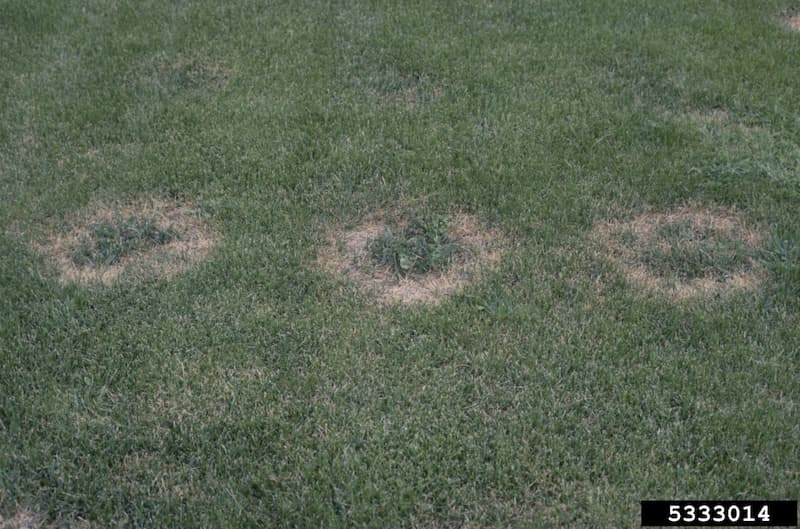
Frog-Eye Rings: Patches often keep a tuft of green grass in the center, leaving a tan ring that looks almost identical to necrotic ring spot.
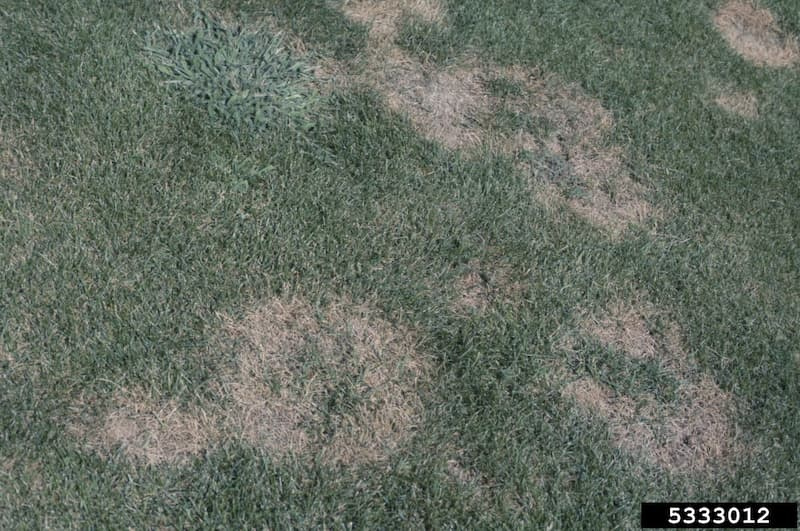
Arcs and Crescents: As patches grow and overlap they break into rings, arcs and crescent shapes rather than solid circles.
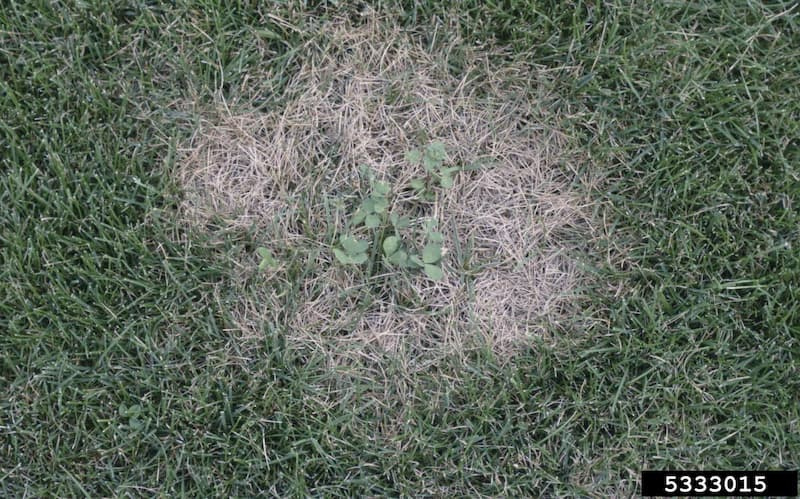
Up Close: Blades in the patch fade from dull green to straw, and the roots underneath turn dark and rot, so the dead grass pulls up easily.
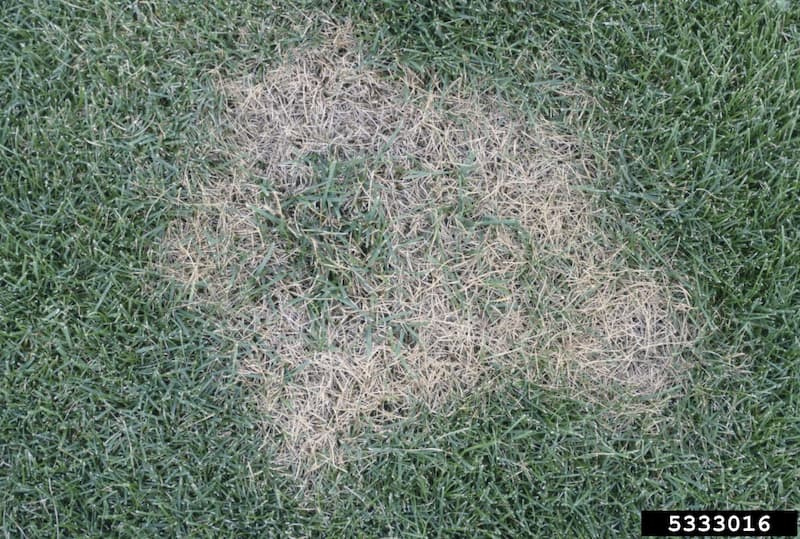
Midsummer Damage: Patches show up during hot, humid stretches in July and August, after the fungus has been attacking the roots since late spring.
Could It Be Something Else?
Common Lookalikes
Necrotic ring spot is the closest match. It makes the same rings, frog-eyes and rotted roots on the same Kentucky bluegrass lawns, and even trained eyes can’t always tell the two apart in the field. The best clue is timing: necrotic ring spot does its damage in cool, wet spring and fall weather, while summer patch shows up only in midsummer heat.
Brown patch appears in the same hot, humid stretch of summer, so the timing alone won’t separate them. Brown patch attacks the leaves, though, not the roots. It is often worst on tall fescue, which summer patch doesn’t infect.
Drought and heat stress turns grass the same dull, wilted tan. The difference is shape and recovery: drought browns broad areas evenly and greens up within a few days of a good soaking, while summer patch forms distinct round patches that don’t respond to water.
White grubs also kill roots in summer and leave patches that look drought-stressed. Grubs chew the roots off, so the dead turf peels back like a carpet with C-shaped larvae underneath. Summer patch roots rot in place instead, and there are no insects.
Field Checks Before You Treat
- Check the calendar. Patches that appear in July or August heat, often after a stretch of heavy rain, point to summer patch. Similar rings in cool spring or fall weather point to necrotic ring spot.
- Look at what's still green. Stand back and check the centers and edges of the patches. If tufts of coarser grass (tall fescue or ryegrass) or weeds stay green inside rings of dead bluegrass, that frog-eye pattern fits summer patch.
- Read the leaves at the patch edge. Pick a few yellowing blades where green turf meets dead turf. Summer patch blades die back evenly from the tip with no spots. Tan spots with dark brown borders mean brown patch or another leaf disease.
- Do the tug test. Grab a small handful of dying grass inside the patch at the soil line and pull straight up. Summer patch plants come out with little effort, with dark, rotted crowns at the base.
- Wash the roots. Dig a plug 3 to 4 inches deep from the patch edge and swish it in a bucket of water until the soil falls away. Healthy roots are long and white. Summer patch roots are short, sparse and dark brown to black.
- Peel back the turf. Cut three sides of a small square of sod about 3 inches deep and fold it back. Roots sheared off cleanly with C-shaped grubs in the top inch of soil mean grub damage. Roots still in the soil with no insects point back to disease.
- Give it a soaking. Water the area deeply and watch for 3 or 4 days. Drought-stressed grass greens up. Grass killed by summer patch doesn't.
Grasses at Risk
Host Grasses
Which Grasses Suffer Most
Kentucky bluegrass is the main target, and lawns that are all bluegrass suffer the most. Newer, compact-type bluegrass varieties hold up far better than older common types. Check National Turfgrass Evaluation Program (NTEP) ratings at ntep.org before buying seed. Among the fine fescues, hard fescue is the most severely damaged, often worse than bluegrass, while Chewings fescue is noticeably more tolerant. Perennial ryegrass and tall fescue are highly resistant, which is why they often stay green in the middle of a dead ring. Warm-season grasses such as bermudagrass, zoysiagrass and St. Augustinegrass are never infected. Annual bluegrass, a common lawn weed, is also very susceptible.
Why It Shows Up
Conditions That Trigger It
Summer patch is a two-step disease, and the first step is invisible. The fungus starts infecting roots in mid-to-late spring, once soil 2 to 4 inches deep reaches 65°F for 3 days in a row. The lawn still looks fine at that point because the weather is mild and the grass doesn’t need much water.
The damage shows weeks later, in midsummer, when daytime air highs climb above about 82–85°F and run into the 90s. Hot weather right after heavy rain is the classic trigger. Waterlogged soil pushes out the oxygen roots need, which weakens them and lets the fungus move into the roots’ water-carrying core. Then the heat drives water demand past what the rotted roots can supply, and the grass wilts and dies.
What makes a lawn more likely to get it:
- A pure stand of a susceptible grass. Lawns of all Kentucky bluegrass or fine fescue take the worst damage because there’s no resistant grass to hold the ground.
- Short mowing. Grass cut low grows shallow roots, so it has less root to lose before it runs out of water.
- Compacted, poorly drained soil. Hard or soggy soil starves roots of oxygen and makes them easier to invade. The disease is worst on sunny, compacted, poorly drained sites in hot, wet years.
- Too much spring nitrogen. Heavy spring feeding pushes leaf growth at the expense of roots, right before roots are needed most.
- Nitrate fertilizers and high soil pH. Nitrate forms of nitrogen raise the pH around the roots, and the fungus does best in neutral to alkaline soil.
- Frequent shallow watering. Daily sprinkling keeps the surface wet and the roots shallow.
How It Survives and Spreads
The fungus never leaves the lawn. It spends winter resting in infected roots, crowns and thatch, and starts growing again when the soil warms to 65°F in spring. From there it grows along roots and rhizomes from one plant to the next, which is why patches widen from their edges year after year.
Summer patch makes no spores in the lawn, so wind, rain splash and sprinklers don’t spread it. It moves to new ground only in pieces of infected root and soil, usually on aerator tines, dethatching blades and digging equipment, or in soil and sod hauled from an infected site.
Where It Hits Hardest: Regional Notes
Summer patch is a problem wherever Kentucky bluegrass and fine fescue lawns meet hot summers. It’s worst across the Northeast, Mid-Atlantic and Midwest, and in the transition zone (Missouri, Kansas and their neighbors), where cool-season lawns go through long stretches above 85°F. It also occurs on bluegrass lawns in California. It’s rare where summers stay mild, and absent in the South and Southwest, where lawns are warm-season grasses that the fungus can’t infect.
Summer Patch Diagnostic Profile
Check what you see against the full set of signs. The more that match, the more likely this is your problem.
What You’ll See
Symptom Color
Tan or Straw
Yellow
Brown
Black or Dark
Visible Signs
None Usually Visible
Lawn Pattern
Circular Patches
Rings or Frog-Eyes
Irregular Patches
Patch Size
2 to 6 Inches
6 to 12 Inches
1 to 3 Feet
Over 3 Feet
Blade Symptoms
Tip Dieback
Rotted Leaf Base or Crown
Rotted Roots
When and Where
Weather Triggers
Hot & Humid
Wet or Poorly Drained Soil
Drought or Heat Stress
Where in the Lawn
Low or Wet Spots
Compacted or High-Traffic Areas
Open, Sunny Lawn
Controlling Summer Patch
Most lawns can get summer patch under control without fungicide. The goal is deeper, healthier roots and less favorable soil for the fungus, and the biggest long-term step is a grass it can’t infect.
- Mow at 3 inches or higher. Taller grass grows deeper roots, so it has more root to spare when the fungus takes some. Bluegrass lawns do best at 3 to 3.5 inches through summer.
- Water deeply and infrequently. Soak the root zone, then let the surface dry before watering again. Deep watering grows deep roots, while daily sprinkling keeps roots shallow and the soil short on oxygen.
- Cool the grass on hot afternoons once patches appear. A few minutes of light sprinkling in the hottest part of the day cools the grass and replaces some of the water rotted roots can’t take up. Keep it light, because the goal is to wet the grass, not the soil.
- Switch to an acidifying nitrogen. Use ammonium sulfate or another ammonium-based fertilizer instead of nitrate forms. Ammonium lowers the pH right around the roots, which slows the fungus, while nitrate raises it.
- Feed lightly in spring and more in fall. Keep any single feeding to 1 lb of nitrogen per 1,000 sq ft or less, and keep spring feeding light so the grass builds roots instead of leaves before the heat.
- Keep pH slightly acidic. Aim for a soil pH of 5.5 to 6.0, and don’t lime unless a soil test shows pH has dropped into the mid-to-low 5s. Lime raises pH and helps the fungus.
- Core aerate in spring or fall. Pulling cores relieves compaction, lets oxygen reach roots and helps drainage. Aerate healthy areas first and the patches last, then hose the tines off, because infected root bits ride along on them.
- Keep thatch thin. The fungus overwinters in thatch, and a thick layer holds water and roots. Aeration and dethatching keep it under about half an inch.
- Overseed with a resistant grass. Adding perennial ryegrass or tall fescue reduces or eliminates the problem, because the fungus can’t infect them and they keep the lawn covered even if the bluegrass struggles. This is the only fix that lasts.
Fungicide is rarely worth it on a home lawn. It only makes sense for a high-value bluegrass lawn with a confirmed, recurring summer patch problem that cultural changes haven’t fixed, and Purdue Extension advises hiring a professional applicator even then.
The reason is timing. Fungicide can’t repair roots that have already rotted, so sprays made after patches appear in July or August do very little. To work, a fungicide has to go down in spring, when soil 2 to 4 inches deep reaches 65°F for 3 days in a row. That’s usually late April to mid-May, 3 to 4 weeks before symptoms would show. It then has to be repeated every 3 to 4 weeks into summer.
Only penetrant (systemic) fungicides work, because the product has to soak down to the roots. Surface-only contact fungicides don’t reach the fungus, and some have been linked to worse summer patch. The active ingredients with the best record are:
| Active ingredient | FRAC group | Notes |
|---|---|---|
| Azoxystrobin | 11 | Found in some homeowner granular lawn fungicides. Check that summer patch is on the label. |
| Propiconazole | 3 | Found in some homeowner lawn products. High rates in summer heat can stunt or discolor grass. |
| Thiophanate-methyl | 1 | Mostly sold in professional products. |
Getting the product to the roots is the hard part for a homeowner. Professionals spray it in 2 to 5 gallons of water per 1,000 sq ft, aerate beforehand and water it in right after, which hose-end sprayers and granular spreaders can’t match. Rotate between FRAC groups from one application to the next. Repeating the same group can breed resistant strains of dollar spot and anthracnose, other lawn diseases that are active at the same time. Brand names don’t reliably tell you what’s inside, so check the active-ingredient panel on the label.
Recovery and Repair
Don’t expect dead patches to fill in during summer. Hot soil stops grass from growing new roots, so the plants can’t replace what the fungus destroyed. Some recovery starts in fall, when the soil cools and nearby bluegrass sends rhizomes into small patches. Larger patches usually need help, or crabgrass and other weeds will move in first.
To nudge lightly damaged grass along, apply a very small dose of ammonium sulfate (about 0.1 to 0.2 lb of nitrogen per 1,000 sq ft) during peak symptoms, then water it off the leaves right away so it doesn’t burn them in the heat. This greens up surviving plants and masks the damage. It doesn’t stop the disease.
Overseed dead patches from mid-August to mid-September in the North, when warm soil speeds germination and fall weather favors young grass:
- Clear the patch. Rake out the dead grass and loose thatch. Bag it for trash or yard-waste pickup, never the home compost pile, because it carries the soil-borne fungus.
- Loosen the soil. Core aerate or rough up the surface so seed can reach soil. Do the patches last and hose off the tines.
- Choose resistant seed. Perennial ryegrass or tall fescue, or a mix of either with top-rated bluegrass varieties. Avoid hard fescue where summer patch has struck.
- Seed and press it in. Spread at the bag’s rate for bare soil, then rake lightly or walk over it so seed is in firm contact with the soil.
- Keep it moist. Water lightly once or twice a day until the seed sprouts, then switch gradually to deep, infrequent watering as roots grow.
When to Call a Pro
Send a sample to your state’s extension plant diagnostic lab if rings come back in the same lawn every summer, if patches are spreading fast and merging, or before you spend money on a fungicide program. Summer patch and necrotic ring spot can only be told apart for certain under a microscope. Dig a plug about 6 inches across and 2 to 3 inches deep from the edge of an active patch, so it’s half dying grass and half healthy grass, because fully dead turf is overrun by decay fungi that hide the real cause. Wrap the soil in foil or newspaper, pack it in a sturdy box and mail it early in the week so it doesn’t sit in a warehouse over the weekend. If the lab confirms summer patch and you decide to treat, hire a licensed lawn professional who can time spring applications and water them in properly.
Frequently Asked Questions
These answers are synthesized from plant pathology research and diagnostic guidance published by university extension services and plant disease clinics.
Because the heat exposes damage that was already done. The fungus starts rotting roots in spring, when the weather is mild and the grass gets by on a smaller root system. When July heat arrives, the grass needs far more water than those damaged roots can deliver, and it collapses within days. The patches look sudden, but the roots have been failing for weeks.
It won’t help much. Fungicide can protect healthy roots but can’t revive rotted ones, so sprays made after symptoms appear give poor results. Put the money toward overseeding with a resistant grass instead. If the lawn is worth a fungicide program, it has to start next spring when the soil reaches 65°F.
Usually, yes. The fungus stays in the roots and thatch over winter, and patches often reappear in the same spots, a little wider each year. Raising the mowing height, switching to ammonium-based fertilizer and fixing compaction lower the odds. Overseeding with tall fescue or perennial ryegrass is what breaks the cycle for good.
The grass type is usually the difference. Summer patch only infects Kentucky bluegrass and fine fescues, so a neighbor with mostly tall fescue or ryegrass won’t get it. Shorter mowing, compacted soil, heavy spring fertilizing or frequent light watering can also tip one bluegrass lawn into trouble while the next one stays healthy.
Scientific Authority
This profile is built on plant pathology research and diagnostic guidance from university extension services and plant disease clinics. We prioritize accurate identification and cultural control first, recommending fungicides only where research shows they are justified, and naming them by active ingredient rather than brand.
Primary Resources
- Penn State Extension — Turfgrass Diseases: Summer Patch (Causal Fungus: Magnaporthiopsis poae)
- Purdue University Extension — Summer Patch (BP-115-W)
- Purdue University Turfgrass Science — Common Diseases on Cool-Season Lawns (BP-218-W)
- UMass Amherst Extension Turf Program — Summer Patch of Bluegrasses
- University of Missouri Extension — Turfgrass Disease Profiles: Summer Patch
- Ohio State University Extension — Summer Patch on Turfgrass (HYG-3082)
- University of California IPM — Healthy Lawns: Summer Patch
- University of California IPM — Turfgrass: Summer Patch (Pest Management Guidelines)
- Rutgers Cooperative Extension — Tough Year for Summer Patch Disease
- University of Wisconsin–Madison Turfgrass Diagnostic Lab — Summer Patch