
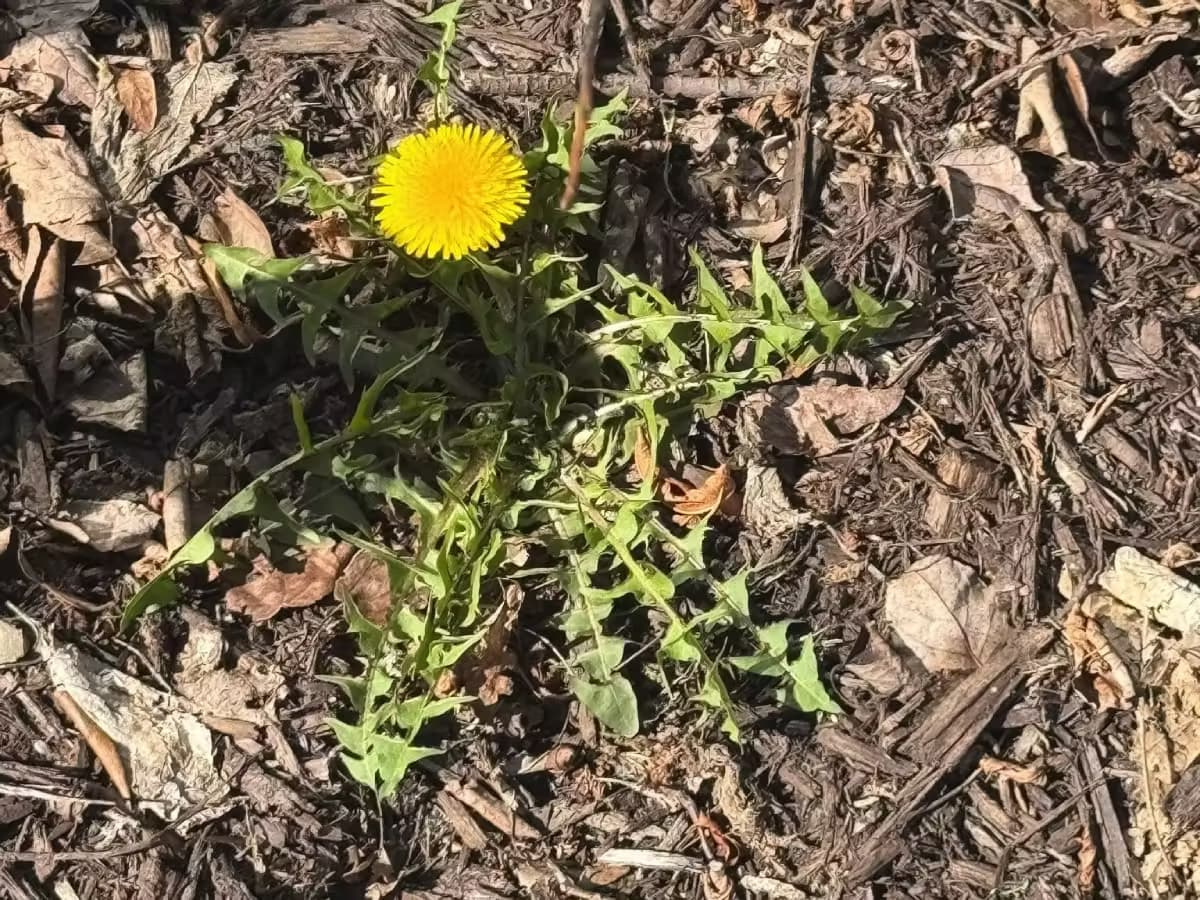
Dandelion At-a-Glance
Weed Type
Broadleaf
Life Cycle
Simple Perennial
Growth Habit
Basal Rosette
Root Type
Taproot
Spreading Risk
High — by wind-blown seed (up to 20,000 seeds per plant per year, carried for miles)
Pull
Yes, With Caution
Identity & Diagnostics
Visual Fingerprint
Dandelion grows as a flat rosette of leaves pressed close to the ground, with no upright stem carrying the leaves. The leaves are deeply notched along both edges, with pointed teeth that all angle backward toward the center of the plant, giving them a jagged, almost torn look. From the center of that rosette rises a smooth, hollow, leafless stalk topped with a single bright yellow flower. Break any part of the plant — a leaf, the stalk, the root — and it bleeds a bitter white, milky sap.
Structural Anatomy
Three features together confirm a dandelion with confidence, even with no flower present. First, the leaf margins: each lobe is a sharp triangle pointing back toward the crown, a pattern botanists call runcinate — think of a saw blade aimed inward. Second, the flower stalk itself: it’s completely hollow, never branches, never carries a leaf along its length, and holds exactly one flower. This single detail rules out most look-alikes on its own, since many similar rosette weeds branch their stems or carry small leaves partway up. Third, the milky sap — cut any part of the plant and it exudes immediately.
If you get a look at the flower up close, one more detail seals it: the flower head sits on two rows of small green bracts underneath it, and the outer row curls sharply backward and downward against the stem, almost like a cuff folded down. That reflexed outer row is close to unique to dandelion among common lawn weeds.
Growth Patterns & Life Stages
A dandelion seedling starts as two tiny, smooth, pale green seed leaves, followed by the first true leaves — also smooth, without the deep notches yet. By the third leaf, the wavy, shallow-toothed edges that will become the mature leaf shape start to appear. This early stage can last two to four months in cool weather before the plant moves into a juvenile rosette, where the leaves lengthen and the backward-pointing lobes become more distinct.
The mature rosette is what most homeowners actually recognize: a dense mat of dark green, deeply toothed leaves lying flat against the soil, often with a purple tinge at the base. From that rosette, the plant sends up its flower stalk — anywhere from a couple inches to well over two feet tall depending on how much light competition it’s dealing with — topped with the familiar yellow bloom. Within about ten days the flower dries and the seed head expands into the round, gray-white “puffball” everyone knows, packed with feathery seeds ready to catch the wind.
One detail worth knowing if you mow weekly: dandelion adapts to it. Under regular mowing, the rosette grows flatter and the flower stalks shorten dramatically, letting the plant bloom and set seed just above ground level, below where your mower blade ever reaches. Mowing keeps it looking tidy — it doesn’t stop it from reproducing.
Gallery
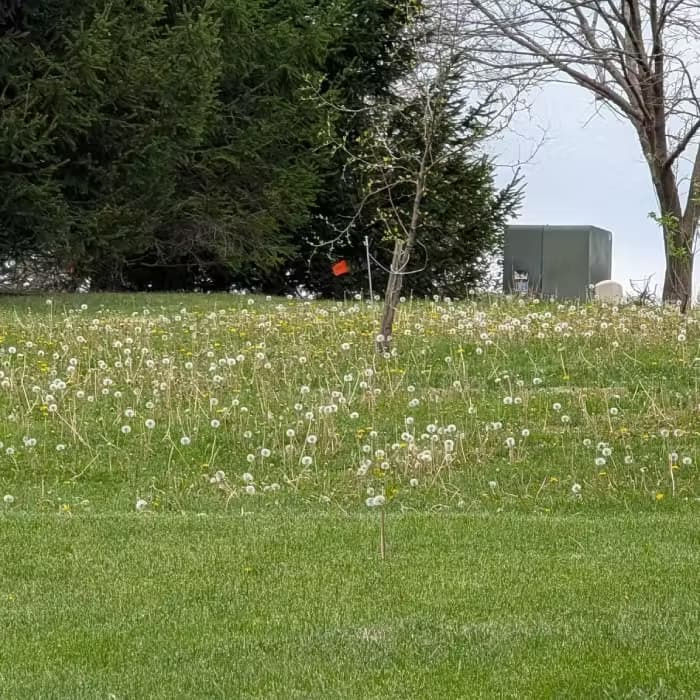
A single dandelion "clock" can contain over 200 seeds, each equipped with a parachute-like Pappus for long-distance wind dispersal.
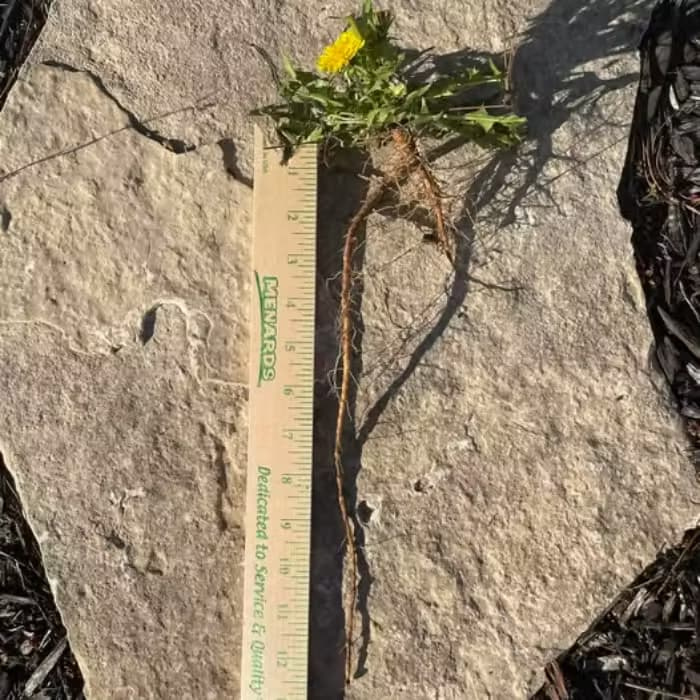
Taproot Resilience: A dandelion's deep Taproot serves as a nutrient reservoir for Regeneration. For a permanent DIY fix, you must achieve total root extraction or use systemic control; even a small fragment left in the soil can trigger a new growth cycle.
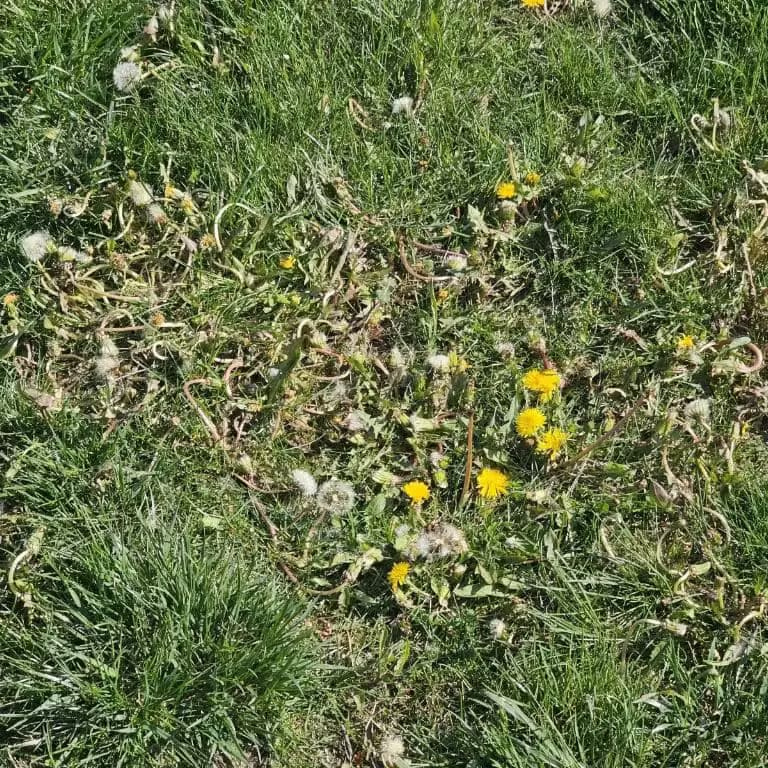
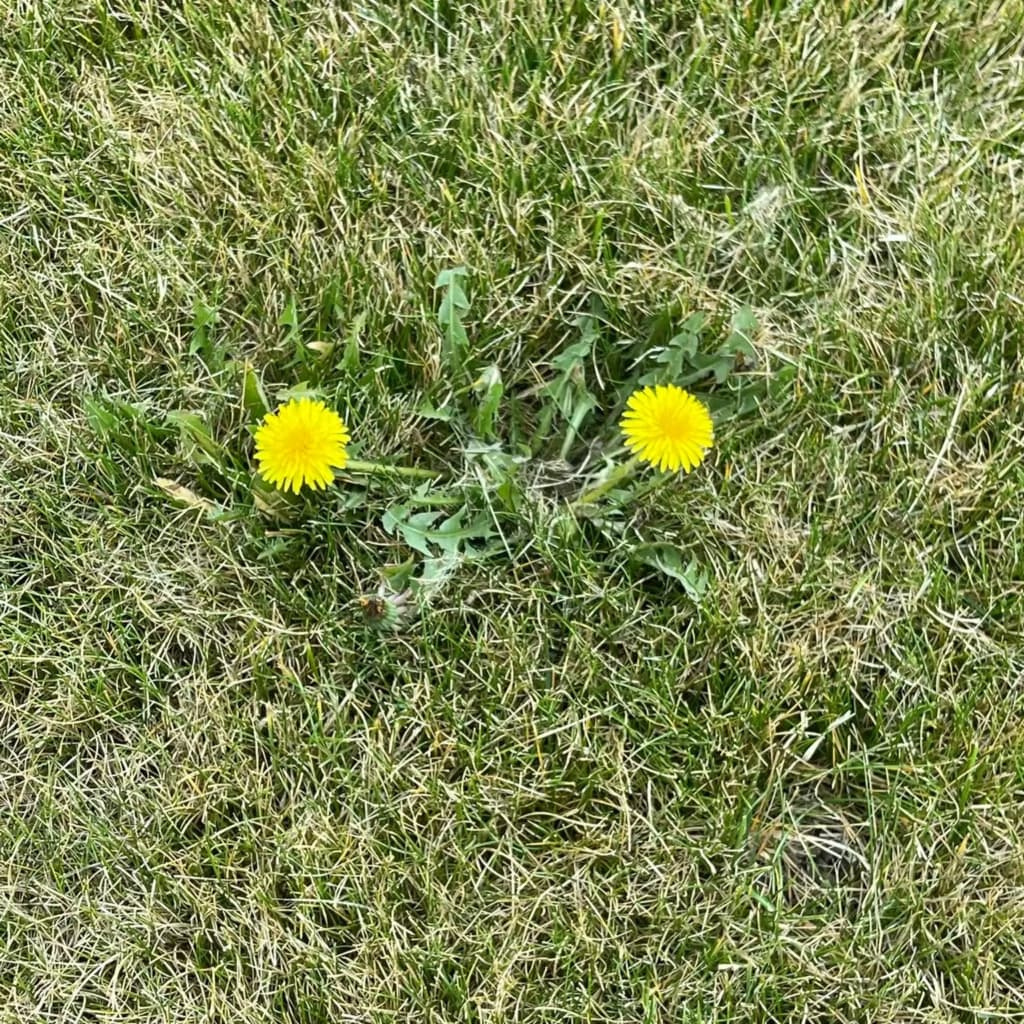
Systemic Epinasty: The characteristic twisting (known as Epinasty) confirms that the herbicide is successfully moving through the plant. Do not mow or pull these weeds prematurely; they must remain intact to complete the chemical Translocation to the root tips.
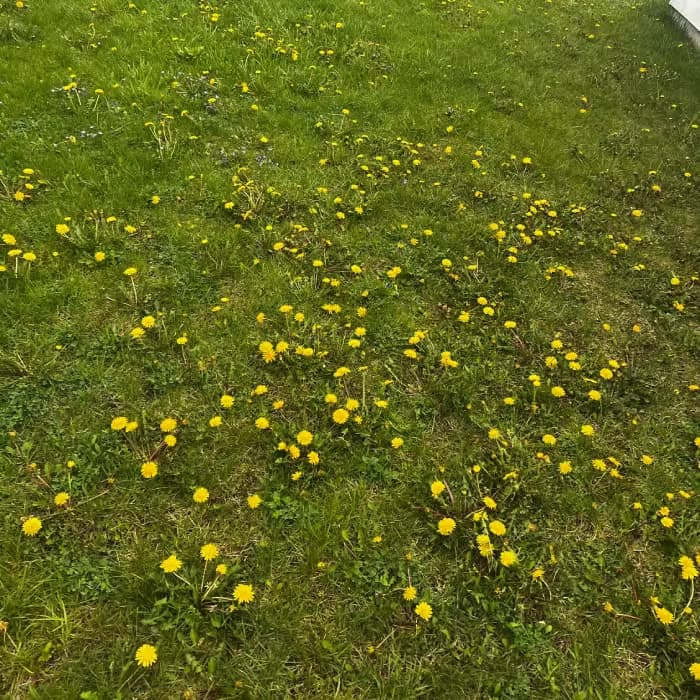
Seed Bank Saturation: Extreme weed density indicates a massive Soil Seed Bank of dormant seeds. Regaining control requires a two-pronged strategy: eliminating visible growth now and applying a Pre-emergent to block the thousands of seeds waiting to germinate.
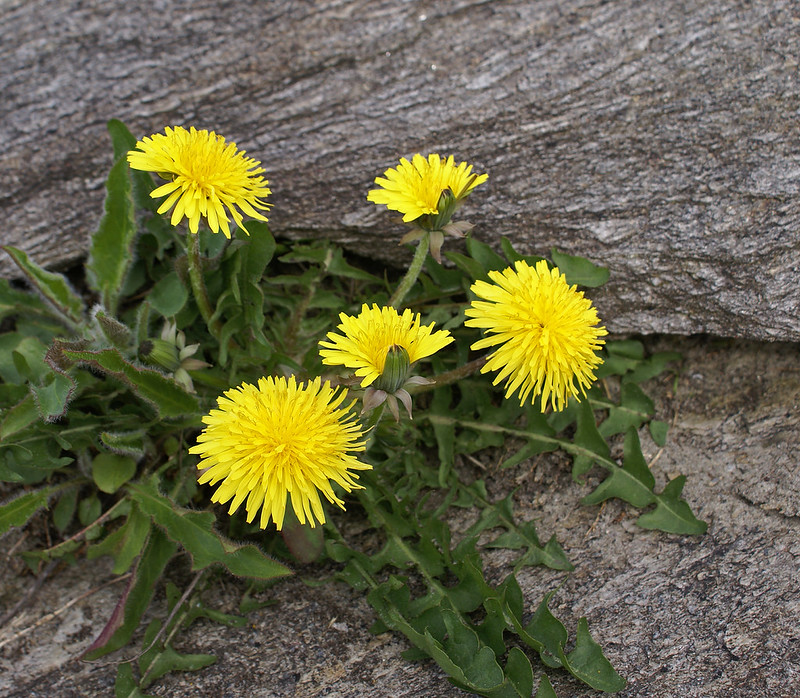
“Dandelion” by randihausken is licensed under CC BY-SA 2.0.
The Identity Trap
Common Lookalikes
The weed most often mistaken for dandelion is Cat’s Ear (Hypochoeris radicata), also called hairy cat’s ear or flatweed — it shares the rosette shape and yellow flower almost exactly. False Dandelion (Pyrrhopappus carolinianus) is the second most common source of confusion, especially in disturbed soil and thin turf.
Identification Differentiators: How to Tell Them Apart
Cat’s ear leaves are covered in coarse, stiff hairs on both sides — true dandelion leaves are hairless. Cat’s ear also branches its flower stems and carries several flowers per stem, while dandelion holds exactly one flower on a single unbranched stalk. False dandelion gives itself away the same way: its flowering stems branch and carry small leaves along their length, where a true dandelion’s stalk is bare and unbranched from base to bloom.
Growing Conditions
Host Grasses
In cool-season lawns, dandelion moves into Kentucky bluegrass when nitrogen levels are inconsistent or when summer heat thins the stand, into tall fescue and perennial ryegrass wherever a bare patch opens up (both are bunch-type grasses that don’t spread sideways to self-heal), and into fine fescue lawns under heavy foot traffic or compaction. In warm-season lawns, it targets bermudagrass and zoysiagrass primarily during their winter dormancy window, and St. Augustinegrass, centipedegrass, and bahiagrass wherever irrigation is uneven or drainage is poor. The common thread across every one of these grasses is the same: dandelion doesn’t out-compete healthy turf, it moves into turf that’s already thin.
Host Environment/Area
Dandelion wants full sun and consistently moist soil, and it gets both in most irrigated lawns and garden beds — which is exactly why it’s so common in maintained landscapes rather than wild areas. It shows no real preference between lawn and ornamental bed; wind-carried seed lands in both equally. It also has an unusually high tolerance for compacted, heavily trafficked soil, which is why you’ll often find it thriving in worn paths, park strips, and the narrow cracks along sidewalks and driveways — edge spots that collect runoff moisture and see almost no competition from turfgrass.
Soil Indicators: What the Presence of This Weed Reveals About Your Yard
A heavy dandelion population is telling you something specific about your soil, and it’s worth listening to. Dense stands are a strong signal of compaction — the taproot is built to punch through packed, clay-heavy soil that most turfgrass roots can’t penetrate, which is also why a thriving dandelion patch is, in an odd way, quietly improving drainage in that exact spot as it grows. Dandelion also tends to show up where calcium is low and where nitrogen and potassium are relatively high but phosphorus is low. And it’s a genuine indicator of alkaline, high-pH soil — if your dandelion population seems to be increasing after a lime application, that’s not a coincidence; excess lime pushes pH into the range dandelion actively prefers.
Lifecycle and Season
Lifecycle Category and Management Implications
Dandelion is a simple perennial — one plant, one taproot, living for years in the same spot rather than dying off each season like an annual. That single fact shapes almost every control decision on this page. Because established plants aren’t growing from a fresh seed each year, pre-emergent herbicides — which only work by intercepting germinating seeds — have essentially no effect on a dandelion that’s already established. The real fight happens in two places: killing the existing taproot with the right herbicide at the right time of year, or physically removing it whole. Everything below is built around getting one of those two things right.
Germination Trigger
Dandelion seed needs no rest period before it can sprout — it can germinate the moment it lands on moist, sunlit soil, any time from late spring through early autumn. The minimum soil temperature for germination is around 50°F, with the fastest germination happening near 77°F. Because there’s no dormancy requirement holding it back, you’re not dealing with one clean germination window like you would with a true annual — you’re dealing with a slow, continuous trickle of new seedlings across half the year.
Established plants green up early, often before the turf itself has fully broken winter dormancy, and hit peak bloom from mid-April through mid-May across most of the Midwest and Mid-Atlantic, with a smaller second bloom in early autumn. The best window to actually kill an established plant is late September through October — more on exactly why under Post-Emergent in Lawn. If you’re trying to stop new seedlings from wind-blown seed rather than kill existing plants, a pre-emergent barrier applied once soil temperature in the top inch holds steady between 50°F and 55°F for several consecutive days (typically landing in the March–April window across this zone) is the tool, though it comes with real trade-offs covered under Pre-Emergent in Lawn.
Dandelion in warm-season lawns runs on a different clock, timed to your turf’s dormancy rather than its own. It flowers in early-to-mid spring while bermudagrass, zoysiagrass, St. Augustinegrass, and centipedegrass are still waking up, and it germinates in two separate flushes — a primary one in late spring to early summer, and a second, often heavier flush starting in late September as the turf begins heading back into dormancy. That second flush is the one that does the most damage, since it establishes through the entire winter while your lawn offers zero competition.
For new seedling prevention, pre-emergent applications need to hit both windows: fall, once nighttime lows drop to 55–60°F for four consecutive days (roughly September 1–15 in the northern part of this zone, September 15–October 15 along the southern coast), and again in spring once air temperature holds at 65–70°F for four consecutive days (mid-February to early March in southern areas, mid-to-late March further north). For killing established plants, the best window is the same fall period, mid-September through mid-November, for the same physiological reason covered under Post-Emergent in Lawn — with a secondary, less reliable window from late winter into spring once the turf has fully greened up.
This is the zone where dandelion’s clock and your turf’s clock are most likely to work against each other. Dandelion here is a short-day plant, meaning it blooms twice — March through May, and again September through November — and its dominant germination flush lands in late September, with a smaller flush in spring. A pre-emergent applied in late summer to intercept that September flush is agronomically sound on its own, but it collides directly with the fact that late summer through mid-October is also the correct window to overseed cool-season turf in this zone. No pre-emergent can tell dandelion seed apart from grass seed — so applying one shuts down your overseeding at the same time it’s blocking the weed. Pre-Emergent in Lawn covers exactly how to make that call.
For established plants, late October through November is the strongest kill window, for the same downward-sap-flow reason detailed under Post-Emergent in Lawn. Application temperature matters here more than in either neighboring zone, given how much this region’s weather swings: stay in the 50–85°F range, lean on carfentrazone-based products if you’re forced to treat below 50°F, and stop entirely above 85°F to avoid both turf injury and chemical drift.
Herbicide Control
Be clear-eyed about what this tool actually does here: pre-emergent herbicide has no effect on a dandelion that’s already growing in your lawn. It only works against a seed that hasn’t germinated yet, so its entire job is stopping new plants from wind-blown seed — not touching the ones you already have.
If preventing new seedlings is worth it to you, isoxaben (sold as Gallery) is the main product built for broadleaf seedlings specifically, and standard crabgrass preventers containing prodiamine, dithiopyr, or pendimethalin offer some secondary suppression as a side effect. But there’s a real cost to this choice: any pre-emergent barrier you lay down will also block your own grass seed from germinating for months afterward. That means a spring pre-emergent application can rule out spring or even early-fall overseeding of bare patches — which matters, because a thicker lawn is your single best long-term defense against dandelion in the first place. Weigh that trade-off before reaching for this tool.
This is where dandelion actually gets controlled. Once a plant is established, a systemic herbicide — one absorbed through the leaf and carried down through the plant’s own internal plumbing into the root — is the only chemical tool that reaches the taproot. The standard active ingredients are 2,4-D, dicamba, and triclopyr, usually combined in a three-way mix, with florasulam and metsulfuron-methyl as newer alternatives that work through a different internal mechanism.
Timing is everything here, and it comes down to which direction the plant is moving sugar. In fall, as days shorten, a dandelion pulls sugar down out of its leaves and stores it in the taproot to survive winter — and a systemic herbicide sprayed on the leaves during that window gets pulled down right along with it, all the way to the bottom of the root. That’s why late September through October (or October–November in the transition zone) is consistently the best kill window in every region. Spray the same plant in spring instead, and the sugar is moving the opposite direction — upward, to fuel new leaves and the flower stalk — so the herbicide struggles to reach the lower root at all. A spring application often looks like it worked because the visible rosette dies back, but the bottom of the taproot frequently survives and sends up a new plant later in the season.
A few conditions matter beyond the season itself. Treat young, actively growing rosettes rather than mature, flowering plants — older growth has a thicker waxy coating that blocks absorption. Stay in a daytime temperature range of roughly 50–69°F with nights staying above 40°F; skip it entirely above 85°F, which raises both the risk of turf injury and the risk of the chemical vaporizing and drifting. Hold off mowing for a day or two before spraying and two to three days after, so the plant has maximum leaf area to absorb through and time to move the chemical internally before you cut it away. If you’re treating late in the season when growth has slowed with the cold, adding a spray additive (a crop oil concentrate or similar) helps the chemical penetrate the leaf more effectively.
One turf-safety note that matters more than almost anything else in this section: St. Augustinegrass and centipedegrass cannot tolerate standard 2,4-D — it will injure or kill the lawn, not just the weed. If you have either of these grasses, use a product specifically formulated for them, such as one built around Celsius, rather than a generic three-way broadleaf mix.
Don’t expect one treatment to be the end of it. Even a perfectly timed, perfectly executed fall application that kills every visible plant won’t end dandelion pressure on its own, for reasons that have nothing to do with how well you sprayed. A single plant can produce up to 20,000 seeds a year that drift in from neighboring untreated yards, roadsides, and vacant lots regardless of what you do on your own property. And dandelion seed can sit viable in your soil for up to six years, waiting for the right disturbance — aerating, dethatching, even heavy foot traffic — to bring it back to the surface and into the light it needs to sprout. Treating existing plants and maintaining a dense lawn are both permanent habits here, not one-time fixes.
A dense, well-fed lawn is the actual long-term defense — everything chemical is just cleanup for the gaps a thin lawn leaves open. Mow on the higher end of your grass type’s range, around 3 to 3.5 inches for most cool-season lawns; taller grass shades the soil surface and blocks the light dandelion seed needs to germinate in the first place. Concentrate nitrogen fertilizer in fall rather than spring — for cool-season lawns, that’s roughly 1 pound of actual nitrogen per 1,000 square feet in September and a slightly heavier dose in November — since fall feeding builds thickness and root depth without triggering the soft, weak spring growth that thins out under summer stress.
On soil pH: get a real test before adding lime, and treat 6.0 to 7.0 as the target range, not a floor to build past. This is a genuine two-sided issue — acidic soil below that range does favor dandelion, but so does an overcorrection into high alkaline territory. Match lime to what the test actually shows rather than applying it on a schedule. If you’re renovating bare or thin patches, overseed in late August through mid-September for cool-season lawns, using a slice-seeder for real seed-to-soil contact rather than scattering seed over unbroken turf — and lean toward Kentucky bluegrass where conditions allow, since it spreads sideways through rhizomes and self-heals bare spots in a way that bunch-type fescue and ryegrass simply can’t.
As in lawns, a pre-emergent in a bed does nothing to a dandelion that’s already growing there — it only blocks new seed from establishing. Isoxaben remains the safest, most broadly labeled option around established ornamentals. A few bed-only products exist too, but they carry real plant-specific restrictions: dichlobenil (Casoron) must never go near firs, hemlocks, or spruce, and injures viburnum, lilac, and potentilla if applied too early in their first season; flumioxazin (SureGuard) damages philodendron and bird-of-paradise on contact.
Application method matters as much as the product choice. These need to sit on bare soil beneath the mulch layer, or go down before you mulch — laid on top of finished mulch, they’re far less effective, and drip irrigation can’t activate them at all since it never wets the surface evenly. Overhead water is required, roughly a quarter to half an inch, within a day or two of application. Time it for late summer to early fall (daytime temps holding around 75°F for several days), or in spring by mid-to-late March.
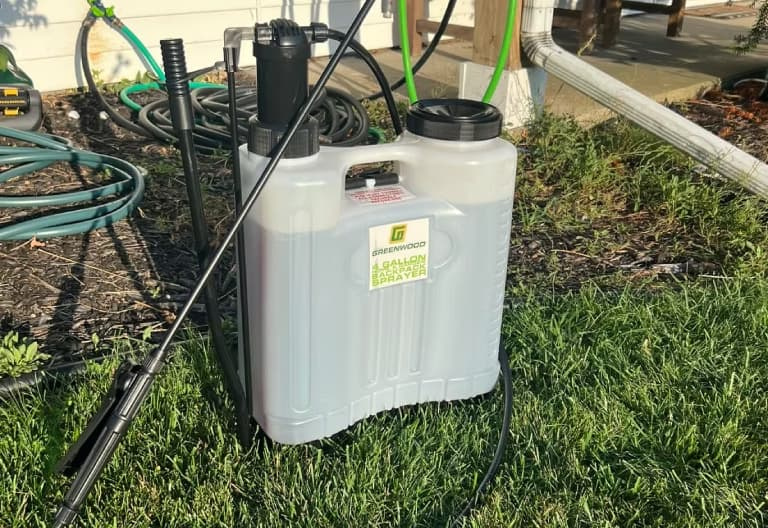
Broadcast spraying is off the table entirely once you’re working around ornamentals — everything here has to be a directed application that keeps the chemical off anything but the dandelion itself. Three methods do this: a low-pressure sprayer fitted with a shield or hood around the nozzle so only the target plant gets hit; a wiper or sponge applicator that physically paints the herbicide onto the dandelion’s leaves with zero spray at all; or, for a single tough plant surrounded by dense planting, cutting the crown and applying concentrated herbicide directly to the fresh cut.
Glyphosate is the standard choice here for one specific reason: it leaves no residue in the soil, so there’s no risk of a nearby ornamental’s roots absorbing it later — but it will kill or badly injure any green leaf, stem, or young bark it actually touches, so precision in the application method above isn’t optional. Clopyralid is selective enough to spare grasses, but it’s genuinely dangerous to keep near legume or aster-family plants — redbud, honey locust, mimosa, sunflowers, daisies — so it’s not a safe pick in a mixed ornamental bed. The same fall timing that makes lawn treatments effective applies here too: cooler weather means the plant is pulling energy down into the root, and that’s when a systemic herbicide gets carried furthest. (Buying tip: not every product labeled “Roundup” is glyphosate anymore — check the active-ingredient panel.)
Bed control has one real advantage over lawn control: because bed soil is usually loose and cultivated, hand-pulling succeeds far more often here (see Lawn vs. Bed Pulling Difference), which means a combination of careful pulling plus a directed spray on anything that resists tends to close out most of a season’s population — though, same as in turf, ongoing wind-blown seed means this isn’t a permanent one-time fix either.
Mulch works against dandelion the same way it works against most weed seed: by blocking the light that triggers germination. In beds with established woody shrubs, 3 to 4 inches of organic mulch is the effective depth; around tender perennials and annuals, back that off to 1 to 2 inches so you’re not smothering the crowns. A layer of landscape fabric under a lighter mulch topping adds real durability if you’re dealing with heavy pressure.
One detail most people get backward: coarse, chunky mulch actually outperforms fine mulch here. Coarse material drains fast and dries out on the surface, which starves any seed that lands on top of the moisture it needs. Fine mulch — sawdust, compost, finely shredded bark — holds water at the surface and, ironically, creates close to ideal germination conditions for whatever seed lands there. And mulch only ever stops new seedlings. A dandelion that’s already got an established taproot has more than enough stored energy to push a new shoot straight up through 3 to 4 inches of mulch without slowing down — mulch is prevention, not a cure for what’s already there.
Herbicide Application Reference
Ester-formulated herbicides volatilize into a gas once temperatures climb past 85°F and can drift well beyond your yard — switch to an amine formulation for anything applied in warm weather to protect your own beds and your neighbor’s. St. Augustinegrass and centipedegrass cannot handle standard 2,4-D; use a formulation built for sensitive southern turf instead, or you risk losing the lawn along with the weed. Keep clopyralid completely away from redbud, honey locust, mimosa, sunflowers, daisies, and other legume- or aster-family ornamentals — it’s highly damaging to that entire plant group. And if you use glyphosate near a woody ornamental and it makes contact with green bark, don’t assume a clean-looking result a few weeks later means no harm was done — injury to woody plants can take weeks to appear, sometimes not showing until the following spring.
A product note that is easy to miss: the consumer “Roundup” brand no longer reliably means glyphosate. Several reformulated versions now use different active ingredients, and some of them — imazapic is one — stay active in the soil, where nearby ornamental roots can take them up. That is the exact problem glyphosate is chosen to avoid here. Before you buy, read the active-ingredient panel and pick a product whose only active ingredient is glyphosate.
Herbicide Application Guide
New to spraying, or want to get it right? Our Herbicide Application Guide covers the practical steps this page assumes — mixing, calibration, protective gear, and the wind and temperature limits that decide whether a treatment works or drifts. Read it before you spray.
See Guide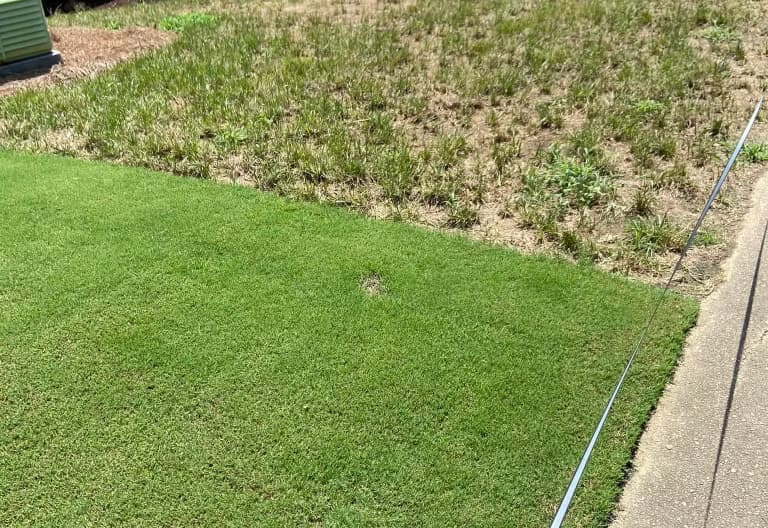
Where Two Lawns Meet
Does your lawn border a neighbor’s — or meet a different type of grass? Spraying near that line can quietly damage the yard next door, sometimes weeks later. Where Two Lawns Meet shows you how to treat safely without harming either side.
Read ArticlePulling
Pulling works — but only when it's done right, and getting it wrong doesn't just fail, it can make things worse.
The Biological Reason
Here’s the part that surprises most homeowners: a dandelion taproot commonly runs 6 to 18 inches deep in lawn soil, sometimes far deeper, and the top of that root is packed with dormant buds. If you pull and the root snaps rather than coming out whole, the piece left behind doesn’t just sit there — it can send up two to five new shoots from that single broken fragment. Pull one dandelion badly, and a few weeks later you may be looking at a small cluster where there used to be one plant. Even a root fragment as short as one inch has enough stored energy to regenerate a full new rosette.
The fix is almost entirely about soil moisture and technique, not strength. Never attempt to pull from dry or compacted soil — the root will snap near the surface almost every time. Pull only after rain or a deep watering, when the soil has loosened its grip on the root. Use a narrow tool built for this — a dandelion knife or V-notched weeder — rather than just gripping and yanking. A technique documented by extension master gardener programs works well: insert the tool straight down right next to the crown, then repeat that same straight insertion at three more points spaced evenly around the plant, loosening the soil on all sides before you pull. Once it’s loosened all the way around, lift slowly and steadily rather than jerking — that’s what lets the whole root slide out intact instead of breaking partway down.
Lawn vs. Bed Pulling Difference
This is one of the clearer lawn-versus-bed splits on this page. Loose, cultivated bed soil lets a taproot slide out cleanly far more often than compacted lawn soil does, which is why pulling is genuinely more reliable as your main tool in beds. In turf — especially anything with clay content or heavy foot traffic — the odds of a clean pull drop, and the odds of a snap-and-multiply outcome go up.
Quick Reference Summary
| Lifecycle Category | Simple Perennial |
| Active Zones | Cool-Season, Warm-Season, Transition (all three) |
| Germination Trigger | Soil temp ≥ 50°F; no dormancy — germinates continuously spring through fall |
| Pre-Emergent | New seedlings only — no effect on established plants |
| Best Post-Emergent Window | Late September–November (fall, all zones) |
| Pull | Yes, With Caution — moist soil + full taproot extraction only |
| Lawn Primary Tool | Fall systemic post-emergent + dense turf culture |
| Bed Primary Tool | Hand-pulling (loose soil) + directed glyphosate + mulch |
| One-and-Done? | No — multi-season program required in every zone |
Frequently Asked Questions
These answers are synthesized from botanical morphology studies and herbicide efficacy trials conducted by leading university agricultural extensions.
Two reasons, and neither is about your technique. Dandelion seed stays viable in your soil for up to six years, waiting for the right disturbance to bring it to the surface. And a single plant can release up to 20,000 seeds a year that drift in from neighboring yards, roadsides, and vacant lots regardless of what you do on your own property. Treating what’s visible now is only half the job — a dense lawn that blocks new germination is the other half.
The taproot almost certainly snapped during the pull, and the fragment left behind regenerated — a broken piece can send up two to five new shoots instead of just one plant regrowing. This is common when the soil is dry or compacted. Wait for the soil to be genuinely moist before trying again, and use a narrow tool built for full-depth extraction rather than gripping and pulling straight up.
It depends which product you used. If you used a post-emergent spray on existing plants, yes — overseed on your normal schedule. If you used a pre-emergent to stop new seedlings, no — that same barrier will block your grass seed from germinating too, often for months. Check your product label for the exact waiting period before you seed.
A bit of both, honestly. A heavy stand does compete with turf for light, water, and nutrients, and it’s a genuine signal that something underneath — usually compaction or thin turf — needs attention. But the same deep taproot that makes it a nuisance is also quietly breaking up compacted soil and pulling calcium up from deeper layers as it grows. It’s not purely a villain; it’s mostly a symptom of a lawn with an opening to fill.
Not with a standard broadcast lawn spray — drift and soil movement can injure or kill nearby ornamentals, and the damage sometimes doesn’t show up for weeks. Anything within several feet of a bed is safer handled with a directed, spot-specific method, or just pulled by hand if the soil is moist enough for a clean extraction.
Scientific Authority
This profile is constructed using forensic botanical data and Integrated Pest Management (IPM) research. We prioritize scientifically-vetted identification and control methods that protect the broader ecosystem while ensuring successful eradication based on peer-reviewed agricultural studies.
Primary Resources
- Penn State Extension
- Purdue University Turfgrass Science (turf.purdue.edu)
- Michigan State University Extension (canr.msu.edu)
- University of Minnesota Extension
- Rutgers Cooperative Extension (NJAES)
- University of Wisconsin Horticulture Extension
- Cornell Cooperative Extension / Cornell Turfgrass Program
- University of Illinois Extension
- Ohio State University Extension / Ohio Perennial and Biennial Weed Guide (CFAES)
- University of Florida IFAS Extension
- University of Georgia CAES
- Clemson University HGIC
- NC State Extension (TurfFiles / Extension Publications)
- Texas A&M AgriLife Extension
- University of California IPM (UC ANR)
- Virginia Tech Weed Identification Program
- Mississippi State University Extension
- Oklahoma State University Extension
- University of Arkansas Cooperative Extension
- Iowa State University Integrated Crop Management
- University of Missouri Weed ID
- American Society for Horticultural Science (ASHS Journals, peer-reviewed)