
Canada Thistle At-a-Glance
Weed Type
Broadleaf (thistle, sunflower family)
Life Cycle
Rhizomatous perennial (creeping-root)
Growth Habit
Erect, colony-forming
Root Type
Creeping horizontal roots (rhizome-type)
Spreading Risk
High — by creeping roots and by seed
Pull
No — pulling an established patch makes it denser
Identity & Diagnostics
Visual Fingerprint
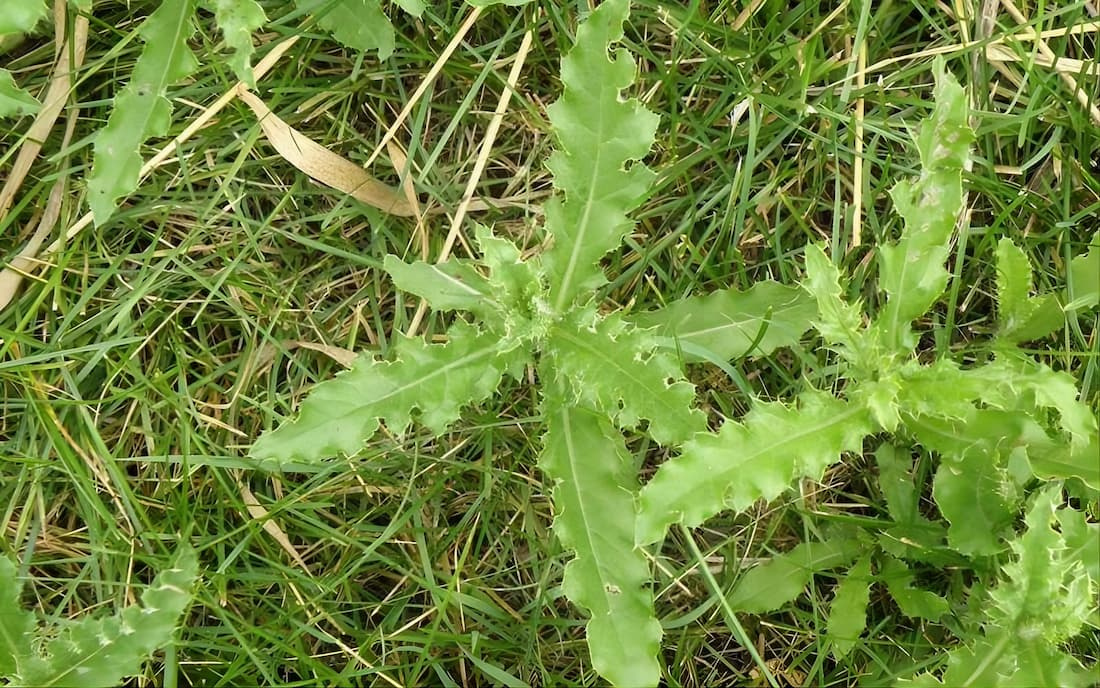
Canada thistle almost never shows up as one plant. It rises as a patch of many upright, identical green stems, one to five feet tall, all connected below ground. The leaves are long, deeply lobed, and edged with sharp little spines that scratch. In summer the tops carry clusters of small, pinkish-purple, brush-like flower heads — much smaller than the big showy flowers most people picture on a thistle. If you’re looking at a spreading colony of prickly-leaved plants with small purple tufts, this is your weed.
Structural Anatomy
The one feature that confirms Canada thistle — and rules out nearly every other thistle — is the stem: it is smooth, grooved, and completely spineless and wingless. Run your fingers down it (carefully) and there are no spiny flanges of tissue, unlike the prickly-winged stems of bull and musk thistle.
The leaves are simple, arranged one per node (alternate), and attach directly to the stem with no leaf-stalk. Their edges are wavy and deeply lobed, and every point ends in a fine, sharp spine. The top of the leaf is dark green and smooth; the underside is paler and ranges from nearly hairless to soft and woolly depending on the plant.
Two more confirmers. Cut a stem or leaf and the sap runs clear and watery — not milky. And look at the little scale-like bracts wrapping the base of each flower head: on Canada thistle they are flat and spineless, where most thistles arm those bracts with stiff yellow spines. Small flower heads, spineless stem, spineless bracts, clear sap — that combination is Canada thistle and nothing else.
Growth Patterns & Life Stages
New shoots come up two ways: from seed, and — far more often — straight up from the creeping roots of an existing colony. Root-fed shoots skip the tidy flat rosette stage and just bolt upward.
- Seedling: thick, oval seed-leaves joined at the base; first true leaves are wavy-edged and prickle-tipped. A seedling is only vulnerable for a short time — see the pulling section.
- Rosette: a low cluster of lobed, spiny leaves close to the ground in early spring. This is your best window to act, before the plant stands up.
- Bolting: in late spring the stem shoots up fast, smooth and hollow and spineless.
- Flowering: June through September, small pink-to-purple heads in clusters at the branch tips.
Seedhead: heads open into white fluff (“thistledown”). Once you see purple color in the heads, viable seed can form within about a week — that’s your “too late to mow” signal.
Gallery
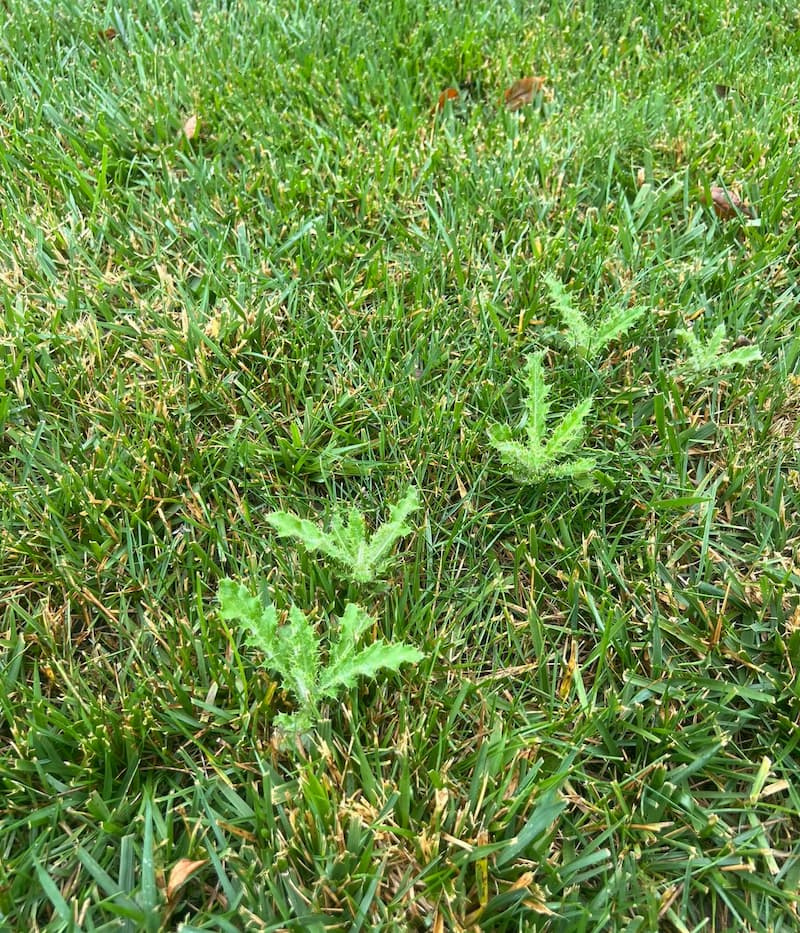
Textbook linear emergence showing new shoots popping up along a single creeping underground rhizome.
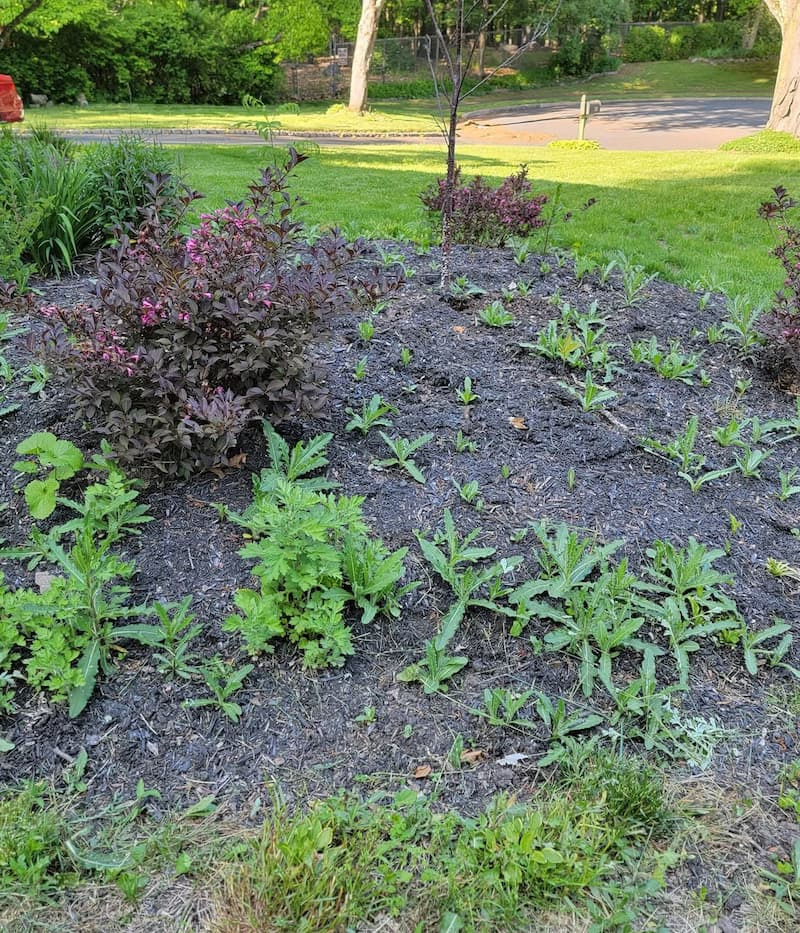
Canada thistle shoots pushing up through landscape mulch, competing directly with ornamental shrubs.
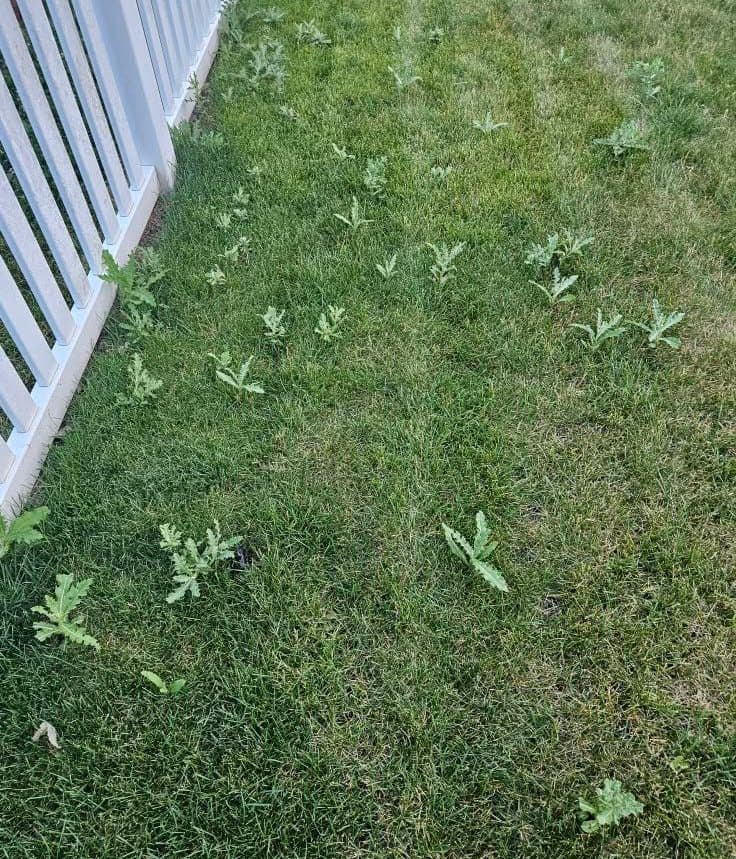
Canada thistle running along a fence line, using protected borders to establish extensive underground root networks.
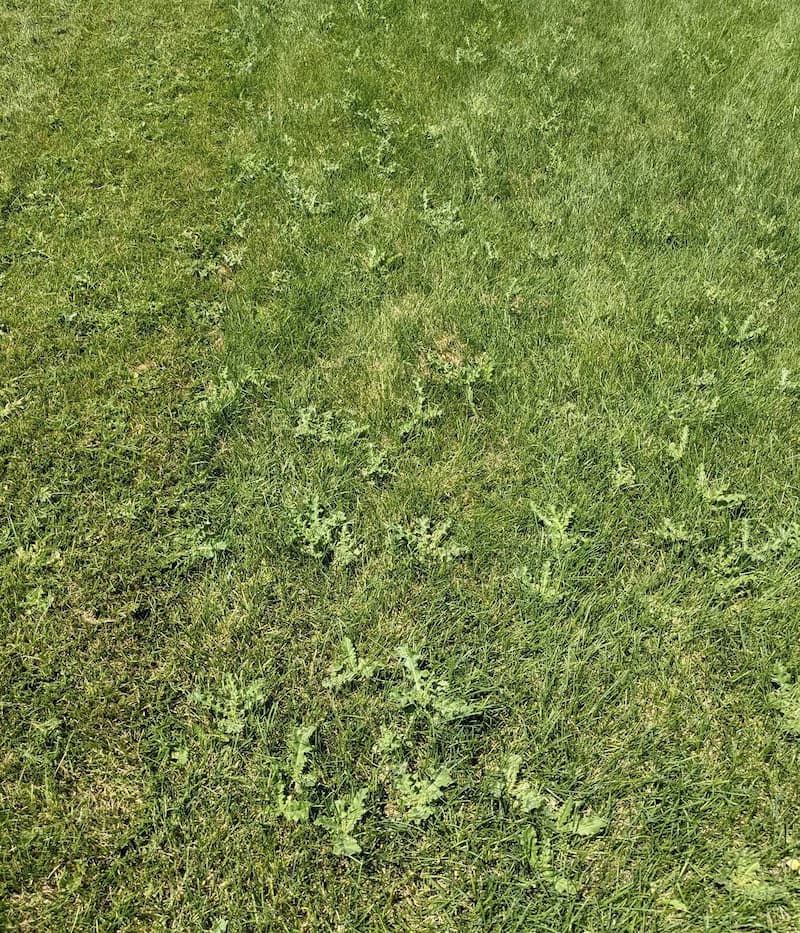
A severe turfgrass infestation where mowing alone fails to stop rhizomatous underground expansion.
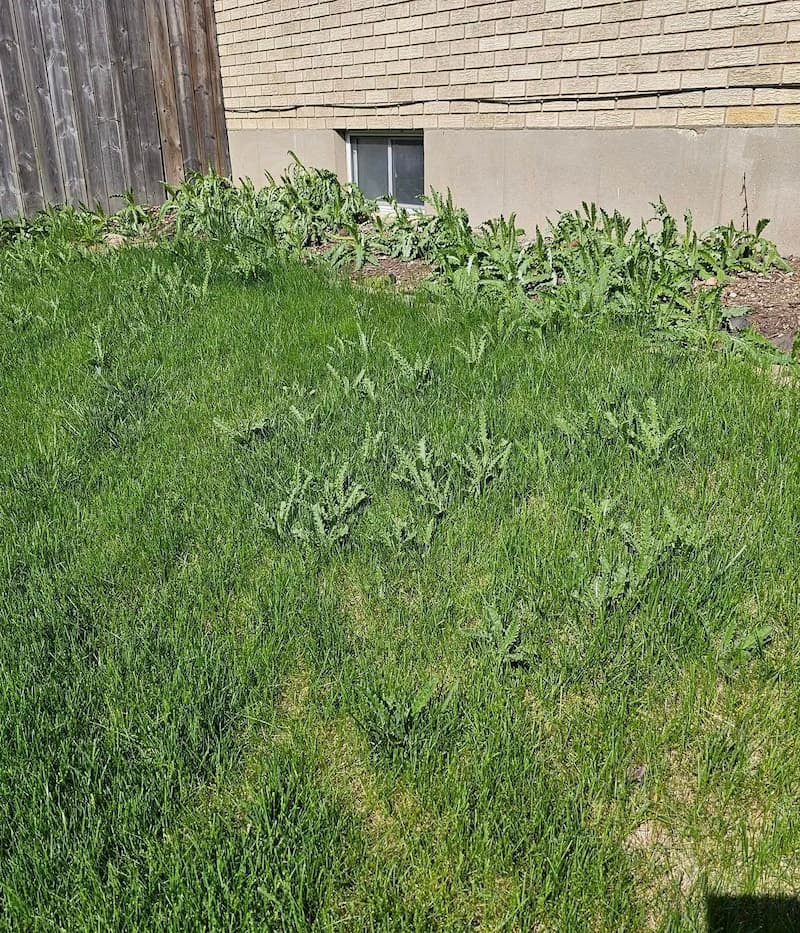
An established Canada thistle colony creeping outward from an unmaintained building border into turf.
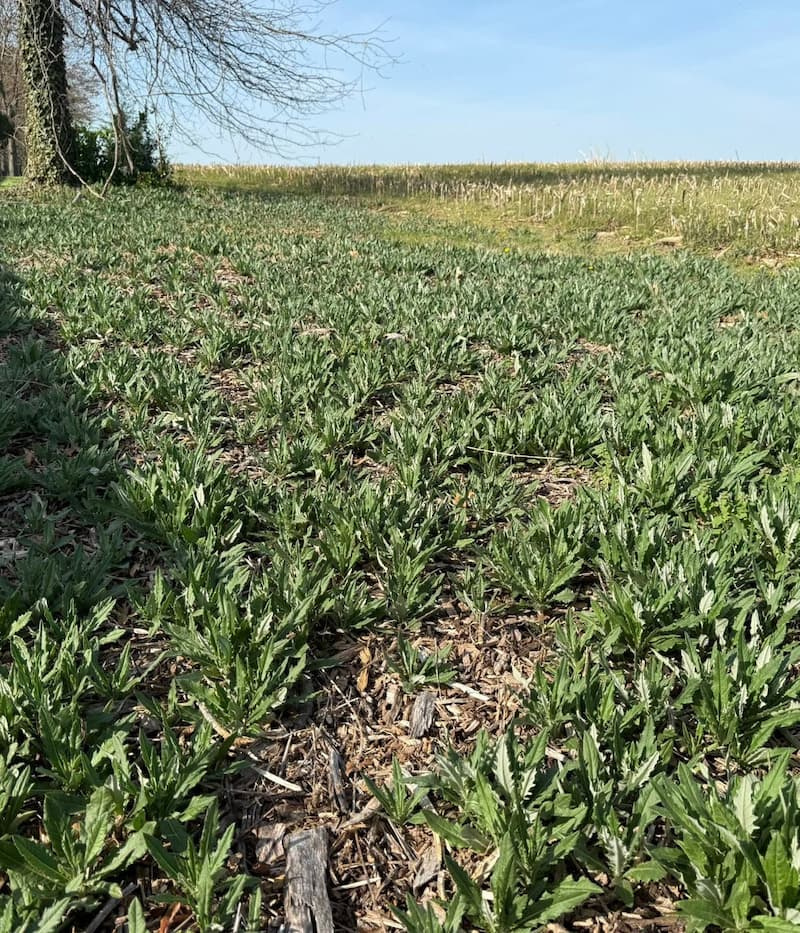
An unchecked field-edge infestation demonstrating rapid vegetative takeover via deep horizontal root systems.
The Identity Trap
Common Lookalikes
Bull thistle (Cirsium vulgare) is the thistle most people mix it up with, because both are big, prickly, and purple-flowered. Sowthistle (Sonchus species) also gets confused with it early, sharing the spiny-toothed leaf edges.
Identification Differentiators: How to Tell Them Apart
Canada thistle vs. bull thistle: feel the stem. Bull thistle has broad, spiny wings running the whole length of the stem and rough, bristly leaf tops; Canada thistle’s stem is smooth and spineless and its leaf tops are smooth. And bull thistle grows as one lone plant on a single fat taproot — Canada thistle grows as a connected patch of many stems.
Canada thistle vs. sowthistle: cut it. Sowthistle bleeds milky white sap and opens yellow, dandelion-like flowers; Canada thistle bleeds clear sap and flowers purple. The sap test settles it in one snap.
Growing Conditions
Host Grasses
Canada thistle is a weed of thin, open, under-mowed turf. Seedlings need light at the soil surface to establish, so any grass that leaves gaps invites it in. Research on fine fescues makes the point cleanly: open, bunch-type sheep fescue let thistle move in, while dense creeping red fescue shaded it out. It’s a major weed of low-maintenance lawns and rough, infrequently mowed areas, and much less a problem in a thick, regularly mowed stand of Kentucky bluegrass or turf-type tall fescue.
Host Environment/Area
This weed shows a clear preference for full sun and moist ground — stream banks, low wet spots, ditches, roadsides, pasture edges, and disturbed or neglected margins. It does not spread evenly across a property; it favors edges, fence lines, and rights-of-way over a well-kept lawn. Beds are a different story: loose, cultivated bed soil is ideal for it, and it invades beds readily — often arriving as root fragments hidden in soil, mulch, compost, or the root balls of new plants. Note for readers in several states: Canada thistle is a legally listed noxious weed, which in some places makes control a landowner’s legal responsibility.
Soil Indicators: What the Presence of This Weed Reveals About Your Yard
A dense stand of Canada thistle is a soil signal. It most reliably points to consistent moisture — low depressions, drained marshy ground, or a fluctuating water table. Its strongest colonies favor deep, fertile, fine-textured clay-loam soils, and it’s associated with neutral-to-alkaline pH. Fresh patches also flag recent soil disturbance — construction, excavation, tillage, or overgrazing that stripped the competing cover. In short: wet, disturbed, or heavy ground that’s been opened up.
Lifecycle and Season
Lifecycle Category and Management Implications
Canada thistle is a creeping-root perennial, and that one fact drives everything. It does not die at season’s end and it does not depend on seed to hold ground. An established patch is a single connected plant with most of its body underground — a network of roots carrying huge sugar reserves and hundreds of buds, each of which can launch a new shoot. Pre-emergent chemistry is beside the point, because there’s no yearly germination event to intercept. Pulling and tilling backfire, because breaking the roots just makes more plants. The only thing that works is a systemic herbicide timed to travel down into that root system — applied over several seasons, not once.
Germination Trigger
Seeds germinate mostly in spring once soils warm and moisture is present, and can keep germinating into summer and fall. But for an established patch, germination isn’t the trigger to watch — shoot emergence from the roots is. Overwintered root buds send up new shoots as soils warm in mid-spring across the North, and remarkably early — as soon as January — in warm and transition zones where winters are mild.
Shoots emerge from the roots in mid-spring (roughly mid-April to mid-May), bolt as days lengthen, and flower from June onward. There are two windows that matter, and they’re set by which way the plant is moving sugar:
- Spring bud-to-bloom (late May–early June): root reserves hit their lowest point of the year, so the plant is stressed. Good for a knock-down and for mechanical timing, but systemic herbicide moves up now, not down, so it doesn’t reach the roots well.
- Fall (best window): as days shorten, the plant reverses course and pulls sugar down into the roots for winter. A systemic herbicide applied now rides that sugar stream straight into the root buds. Fall is the single most effective time to treat.
Canada thistle is mainly a northern, cool-climate weed and gets scarce in the deep South — Auburn reports it as rare to absent in Alabama, and it’s largely confined to cooler, higher, or transition-zone pockets. Where it does occur in warm-season turf, shoots can emerge in mid-winter while the lawn is still dormant, and the thistle’s early leaf canopy shades and delays green-up. The same rule holds: spring flow is upward, fall flow is downward, so fall is the treatment window. The hard constraint here is the turf, not the weed — see the warm-season cautions in the herbicide sections.
This is the most complicated zone, because it overseeds and renovates on the same calendar it needs for weed control, and it grows both cool- and warm-season grasses. The core windows are unchanged — spring bud-to-bloom for a knock-down, fall for the real root kill. The conflicts:
- Fall herbicide vs. fall overseeding: the best time to treat (September–October) is also prime time to seed cool-season grass, and growth-regulator herbicides will kill young seedlings. You generally can’t do both at once — treat, then delay seeding until labels allow, or seed and postpone the spray.
- Spring herbicide vs. spring seeding: the late-May bud-stage window collides with spring renovation the same way; young grass can’t tolerate the chemistry.
- Warm-season green-up: never apply growth-regulator herbicides to bermuda or zoysia as it’s greening up or going dormant — injury risk is high.
- Soil carryover: the strongest products (clopyralid, aminopyralid) linger in soil and clippings for months to years and restrict what you can plant or compost afterward — another reason they’re not a casual home tool.
Herbicide Control
Pre-emergent herbicides don’t control established Canada thistle, full stop. They form a shallow barrier that stops germinating seeds — but this weed’s shoots come up from deep roots that sit far below that barrier, untouched. The only value a pre-emergent has here is catching new wind-blown seedlings before they root, in a lawn that doesn’t already have a patch. Against a patch you can see, it does nothing.
Selective broadleaf herbicide is the main lawn tool — but you need to know an honest limitation up front. The products extension trials rate best at killing thistle roots, clopyralid and aminopyralid, are professional and non-crop products: clopyralid lost its home-lawn registration and aminopyralid is prohibited in residential landscapes, both because they survive composting and can injure garden plants at tiny doses. That’s why a lawn service can use something you can’t buy. What a homeowner can buy over the counter are three-way broadleaf products — 2,4-D plus dicamba plus MCPA, sometimes with triclopyr (sold under many brand names). These reliably kill top growth and move into the roots to a degree, but less completely than the professional chemistry — which is the real reason this becomes a multi-season job.
Timing is what makes these products actually reach the roots:
- Fall is the best window, and later is better. Extension trials found 2,4-D and dicamba work noticeably better applied 1 to 10 days after the first fall frost than before it. Two things are happening: the plant is already pulling sugar (and the herbicide with it) down to the roots for winter, and the herbicide burns off the root’s stored sugars, leaving it too weak to survive the cold. As long as the leaves are still green and undamaged, a late-October or November hit is your strongest move.
- Spring bud-to-bloom (late May–early June) is the secondary window — a good knock-down that weakens the plant when its reserves are lowest.
- Don’t mow for about 10 days after spraying, so the chemical has time to travel down.
Verdict: not one-and-done. Plan on two applications a year (spring bud stage and late fall after frost), every year, for two to three years — up to five for an old, dense patch, combined with the cultural steps below.
(Boundary note — Tier 2: 2,4-D, dicamba, and triclopyr can vaporize and drift onto a neighbor’s lawn, beds, or garden in hot weather, so watch temperature and wind near any property line. And because this weed’s roots creep 10–15 feet a year, a neighbor’s untreated patch will keep tunneling back under the line — coordinated, neighborly timing beats spraying your side alone. This boundary article covers this in full.)
A dense lawn is your cheapest, most durable defense, because thistle seedlings can’t establish without light at the soil. Three levers do the work:
- Mow tall. Keep cool-season turf at 2–3 inches (or higher). A tall canopy shades the soil and starves emerging thistle shoots of the light they need to recharge their roots. Low mowing opens the door.
- Feed the grass. Consistent nitrogen keeps the turf thick and closes the bare voids where wind-blown seed lands.
- Overseed bare spots fast. Any thin patch is a landing pad; fill it before the thistle does, and pick dense, competitive species (turf-type tall fescue, Kentucky bluegrass, creeping red fescue).
In beds, a pre-emergent again only stops new seedlings, not the established root system — but seedling pressure is real here, so it has a place. Isoxaben (Gallery), pendimethalin, and dichlobenil (Casoron) all have documented activity against germinating thistle seedlings, with important cautions: dichlobenil is highly toxic to young plantings and several conifers, and must go down in cold weather; pendimethalin can’t be used where you’re growing ornamentals from seed. Mulch changes how these work — most of a broadcast pre-emergent is caught by the mulch layer, so products like oxadiazon and oxyfluorfen must be applied to bare soil beneath the mulch, while granular isoxaben or pendimethalin go on top but must be watered in to move the chemical down to the soil where seeds germinate.
Because clopyralid and aminopyralid are off-limits around ornamentals — they’re absorbed by shrub and tree roots and cause lasting damage — the realistic bed tool for an established patch is directed glyphosate, applied so it only touches the thistle. Glyphosate is chosen here for a specific reason: it grabs onto soil particles so tightly that nearby woody-plant roots don’t take it up, so a careful application won’t poison the shrub next to it. (Buying tip: not every product labeled “Roundup” is glyphosate anymore — check the active-ingredient panel; see Chemistry-Specific Safety Notes.)
Two directed methods keep it off your ornamentals:
- Spot spray with a shielded or low-pressure nozzle, ideally on a calm day, so no drift reaches green leaves.
- Cut-stem for thistle growing up inside a desirable plant: snip the stem near the ground and immediately dab concentrated systemic herbicide on the cut surface with a foam brush.
Apply in fall for the same reason as the lawn — the chemical rides the sugar stream down to the roots. Any green tissue glyphosate touches, it kills, so treat desirable plants as if one drop will hurt them (because it will).
Verdict: not one-and-done in beds either — expect repeat treatments across two to three years, watching for shoots that creep in from outside the bed.
Mulch stops seeds, not roots. A continuous 5–6 inch layer of wood chips, clean bark, or pine straw blocks the light that wind-blown thistle seed needs to sprout — genuinely effective against new colonization. But it does nothing to an established patch: shoots rising from those deep, sugar-loaded roots simply push straight up through several inches of mulch and keep going. Worse, mulch holds soil moisture, which the underlying roots enjoy. Mulch to keep new seedlings out; don’t expect it to smother a patch that’s already rooted.
Herbicide Application Reference
The lawn products for this weed — 2,4-D, dicamba, and triclopyr — are volatile growth regulators. Above about 85°F, the ester forms turn to vapor and drift onto whatever is downwind: a neighbor’s lawn, your own beds, or nearby ornamentals and vegetables, which are extremely sensitive to them. Spray in cool, calm conditions and never in the heat of a summer afternoon, especially near a property line or garden.
The professional-only chemistry (clopyralid, aminopyralid) carries a hazard worth knowing even though you won’t be buying it: it survives composting and stays active in clippings, soil, and finished compost for up to two years (longer in dry soil), damaging tomatoes, beans, and other broadleaf plants at doses as low as 1 part per billion. Never compost or mulch with clippings from turf a lawn service has treated with these products.
Any dug-up thistle roots must never go in a compost pile — they survive the heat and re-sprout. Bag them, seal them, and let them cook in the sun for a few weeks (or send them to the trash), and clean your tools before moving to a clean part of the yard so you don’t carry viable fragments with you.
A product note that is easy to miss: the consumer “Roundup” brand no longer reliably means glyphosate. Several reformulated versions now use different active ingredients, and one of them — imazapic — stays active in the soil, where nearby ornamental roots can take it up. That is the exact problem glyphosate is chosen to avoid in a bed, where its tight soil-binding is the whole reason it’s safe next to shrubs. Before you buy, read the active-ingredient panel and pick a product whose only active ingredient is glyphosate.
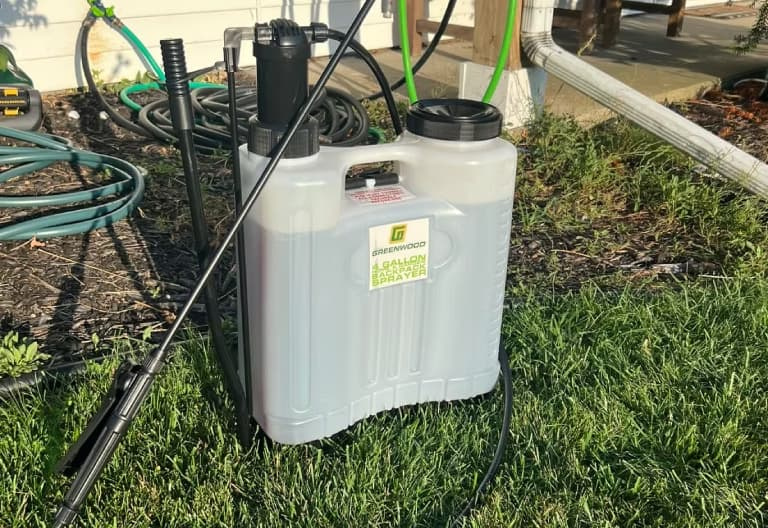
Herbicide Application Guide
New to spraying, or want to get it right? Our Herbicide Application Guide covers the practical steps this page assumes — mixing, calibration, protective gear, and the wind and temperature limits that decide whether a treatment works or drifts. Read it before you spray.
See Guide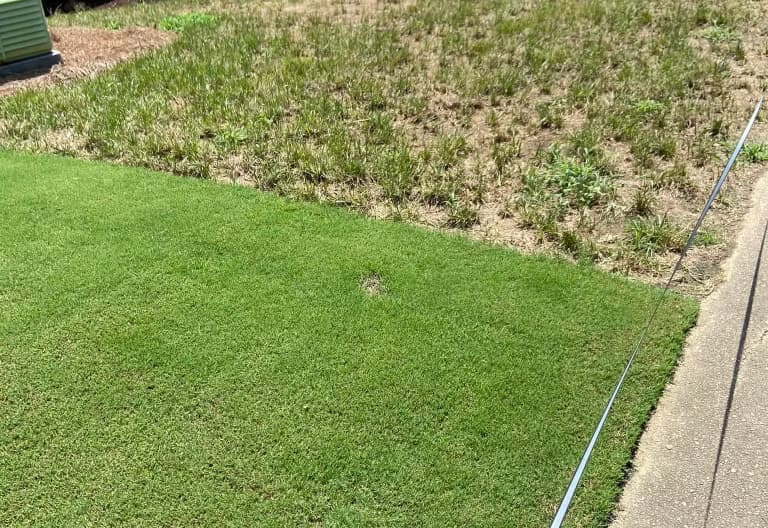
Where Two Lawns Meet
Does your lawn border a neighbor’s — or meet a different type of grass? Spraying near that line can quietly damage the yard next door, sometimes weeks later. Where Two Lawns Meet shows you how to treat safely without harming either side.
Read ArticlePulling
Don't pull an established patch. It won't work, and it makes the problem worse.
The Biological Reason
Pulling only removes what’s above ground — and above ground is the small part of this plant. Below the surface is a creeping root network that a single mature plant can grow into hundreds of feet of root, spreading 10 to 15 feet outward in one season and studded with more than 200 buds waiting to sprout. When you pull, the roots snap and stay put. Worse, snapping them breaks the chemical signal that was keeping most of those buds asleep — so the pieces you left behind wake up and send up a denser stand than before. You wanted one plant gone; you pruned an underground factory into producing more.
Digging and tilling are even worse, because the roots are brittle and every broken piece is a new plant. A fragment as small as half an inch — even a few millimeters — has enough stored energy and buds to grow a complete plant. Run a tiller through a patch and you don’t kill it, you plant a thousand new ones across the whole area. Hand-pulling only makes sense for a young seedling caught within its first couple of months, before it has built creeping roots — after that, leave the shovel in the shed.
Underground Structure Explainer
The network. Canada thistle grows two kinds of root: deep vertical roots that plunge several feet down (typically 3–6 feet, far deeper — past 15 feet — in loose soil) to reach water, and shallow horizontal roots that creep sideways 10–15 feet a season. Along those horizontal roots, buds sprout new shoots every 8 to 12 inches. What looks like a stand of separate weeds is usually one plant.
Why it beats you. Those roots are a sugar bank. Cut, pull, mow, or burn the tops, and the bank simply funds a new set of shoots. The reserves are so deep that even a good herbicide hit often can’t push a lethal dose all the way to the farthest buds in one try — which is why one treatment is never enough.
The fragment trap. Because any half-inch of root regrows, mechanical disturbance is the one thing guaranteed to spread it. This is the mechanism behind every “I dug it out and now it’s everywhere” story.
Root, not true rhizome — a small honest note. Many extension pages call these structures “rhizomes,” and that’s the common usage. Strictly, weed scientists classify them as creeping perennial roots that grow adventitious shoot buds, not true rhizomes (which are modified stems). For a homeowner it makes no practical difference — either way, the underground network is the enemy.
Lawn vs. Bed Pulling Difference
Loose bed soil makes everything worse. In compacted lawn soil, the roots meet some resistance and fragments struggle to sprout. In fluffy, cultivated bed soil there’s nothing holding them back — hoeing or tilling scatters fragments freely and they all take. If pulling an established patch is a bad idea in a lawn, it’s a genuinely destructive one in a bed.
Quick Reference Summary
| Lifecycle | Creeping-root (rhizomatous) perennial |
| Active Zones | Cool-season and transition; scarce in the deep South |
| Emergence Trigger | Shoots from roots as soils warm (mid-spring North; as early as January in mild zones) |
| Pre-Emergent | No — doesn’t touch established roots; catches new seedlings only |
| Post-Emergent Timing | Fall after first frost (best); spring bud-to-bloom (secondary) |
| Pull | No — pulling and tilling multiply it |
| Lawn Primary Tool | Three-way broadleaf (2,4-D + dicamba + MCPA), fall-timed, multi-year |
| Bed Primary Tool | Directed glyphosate (spot-spray or cut-stem), fall-timed |
| One-and-Done? | No — 2–3 years, up to 5 for old patches |
Frequently Asked Questions
These answers are synthesized from botanical morphology studies and herbicide efficacy trials conducted by leading university agricultural extensions.
Because you didn’t remove the plant — you pruned it. Most of a Canada thistle is an underground root network covered in buds, held dormant by a chemical signal from the tops. Pull the tops and you break that signal, so the buds you left behind wake up and send up more shoots than you started with. The same thing happens, worse, if you till.
Mowing can slowly starve it, but only if you’re relentless: every 2–3 weeks, all season, for three to five years, so the plant keeps spending root energy on regrowth and never banks it back. Always mow before the flowers open — once you see purple color, seed can form within about a week and mowing then just spreads it.
For this year’s knock-down, roughly yes, but your real chance is coming. Fall is the best treatment window anyway, so let the patch photosynthesize into autumn, then hit it after the first frost while the leaves are still green. Also, take some comfort: much of that floating “thistledown” is actually empty fluff — the seed often stays behind in the flower head while the bare plume drifts off.
That’s the roots, not the seed — they creep 10 to 15 feet a season and tunnel right under a fence or bed edge. Treating only your side rarely holds, because the parent plant across the line keeps pushing shoots back through. The most effective fix is coordinated timing on both sides; this boundary guide walks through how to do that without harming either yard.
No. The roots survive normal composting and will sprout in whatever you spread that compost on. Double-bag dug material, seal it, and leave it in direct sun for a few weeks to cook, then trash it — and clean your tools before working elsewhere so you don’t carry root fragments to a clean bed.
Scientific Authority
This profile is constructed using forensic botanical data and Integrated Pest Management (IPM) research. We prioritize scientifically-vetted identification and control methods that protect the broader ecosystem while ensuring successful eradication based on peer-reviewed agricultural studies.
Primary Resources
- Cornell University (CALS / Cooperative Extension) — Canada thistle, Cornell Weed Science weed profiles; Banvel/dicamba herbicide reference; Strategies for Dealing with Pesky Perennial Weeds (regional vegetable program).
- Penn State Extension — Lawn and Turfgrass Weeds: Canada Thistle [Cirsium arvense (L.) Scop.]; Removing Canada Thistle from the Home Garden; Integrated Pest Management of Canada Thistle (Cirsium arvense); Controlling Weeds in Nursery and Landscape Plantings.
- Purdue University (Botany & Plant Pathology / Turf) — Control Practices for Canada Thistle; Purdue Turf, How Late Is Too Late to Control Broadleaf Weeds? and related fall-application articles; What the Fluff?! — Purdue Landscape Report.
- Rutgers NJAES Cooperative Extension — FS1344: Canada Thistle Life Cycle Disruptions for Effective Control.
- Michigan State University Extension — Canada thistle (Weeds / Turf); Canada thistle: how to kick this creep out of your landscape.
- University of Minnesota Extension — Canada thistle; Controlling weeds in home gardens.
- University of Wisconsin–Madison (Renz Weed Science / Extension) — Canada thistle (A3924) and Canada thistle management in pastures.
- Iowa State University Extension and Outreach — Canada thistle (Integrated Crop Management encyclopedia); Control of Canada Thistle (Yard and Garden); Spring Control of Canada Thistle — Now Is the Time!
- University of Illinois Extension — Pasture Thistle; Weed Now, or Forever Hold Your Peace.
- NC State Extension — Cirsium arvense, Extension Gardener Plant Toolbox; Herbicide Carryover in Hay, Manure, Compost, and Grass Clippings; Manage Compost and Soil Contaminated with Broadleaf Herbicides; Casoron (dichlobenil) and Lontrel (clopyralid) labels; Weed Management in Annual Color Beds.
- University of Florida IFAS Extension — Invasive Plants in Southern Forests (APIRS); invasion-risk assessment for Cirsium arvense.
- Auburn University Extension — Alabama thistle occurrence and warm-season turf weed guidance.
- Clemson Cooperative Extension — Weed Control / Postemergence Herbicides and Pest Control Guidelines for Professional Turfgrass Managers (McCarty).
- LSU AgCenter — Lawn and Turf Weed Management; Management Options for Common Weeds Infesting Home Lawns.
- Virginia Tech Extension — Plant Injury from Herbicide Residue; transition-zone turf and warm-season timing guidance.
- Oklahoma State University Extension — Integrated Management of Invasive Thistles in Oklahoma.
- University of Kentucky Extension — Spindletop Research Farm trials comparing broadcast vs. rope-wick clopyralid/aminopyralid on Canada thistle.
- University of California (UC IPM / UC ANR) — Lontrel (Clopyralid): A New Post-Emergence Herbicide for Control of Certain Broadleaf Weeds in Turf and Nursery Stock.