
Pathogen: Pyricularia oryzae (formerly Pyricularia grisea)
Also called: Grey leaf spot, blast, turfgrass blast, Pyricularia leaf spot
Gray Leaf Spot
The muggy-summer leaf blight
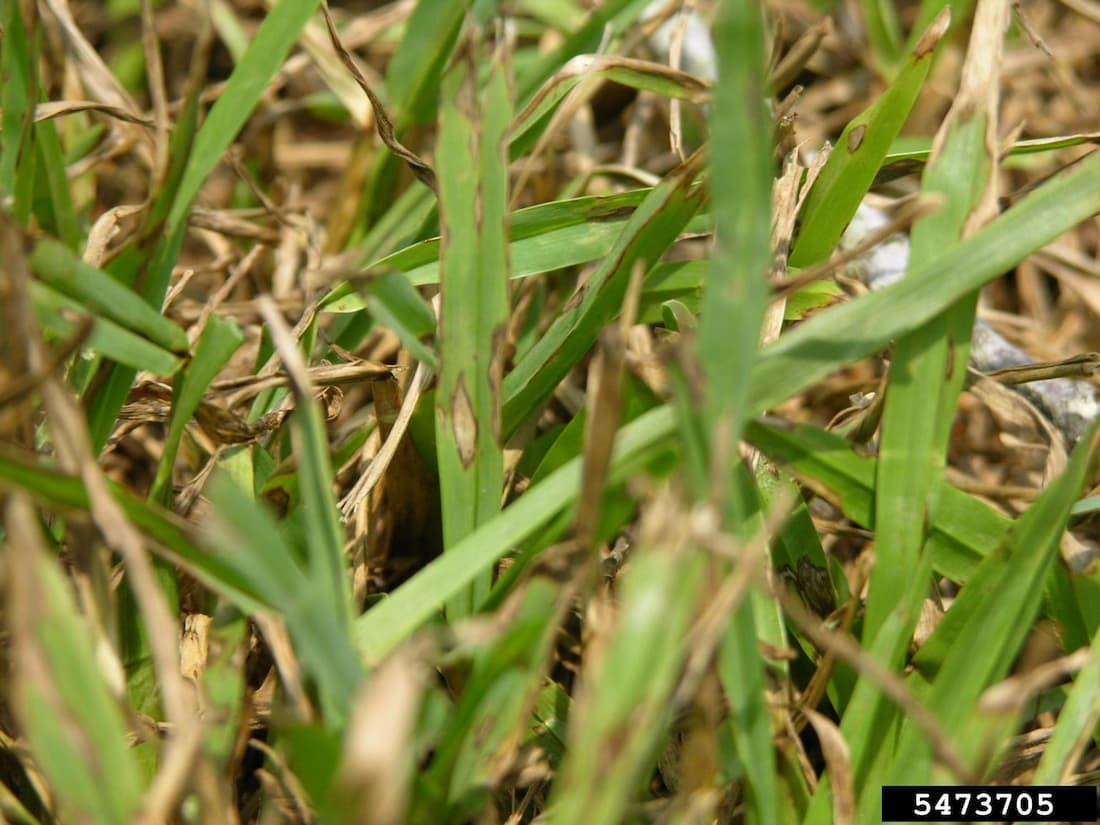
Featured Image Credit: Don Ferrin, Louisiana State University Agricultural Center, Bugwood.org, CC BY 3.0
Gray Leaf Spot At-a-Glance
Grass Type Affected
Cool & Warm Season
Recovers on Its Own?
Yes, Slowly
Is Spraying Worth It?
Sometimes Worth It
Disease Type
Fungal
Active Season
Late Spring & Early Summer
Mid to Late Summer
Fall
Damage Potential
Weakens Over Time
Can Be Fatal
Gray Leaf Spot Quick Answers
What Gray Leaf Spot Looks Like
From Standing Height
On St. Augustinegrass there are usually no neat patches. The whole lawn or large parts of it take on a dull, brownish, scorched cast that looks like drought, even when the soil is moist. On tall fescue and perennial ryegrass, yellow-to-tan patches 4 to 12 inches across appear, often first on mounds and slopes. In a few muggy days they merge into large, irregular areas of matted, withered grass. Perennial ryegrass can collapse across whole sections of the lawn within days.
Up Close: Blades, Crowns and Roots
Spots start as tiny olive-to-chocolate-brown flecks and quickly grow into oval, oblong or diamond-shaped spots with tan-to-gray centers and dark purple-to-brown borders. A yellow halo often rings the border. In humid weather the centers turn gray and fuzzy as the fungus produces spores.
As spots grow and merge, they circle the blade and cut it off, so the leaf dies back from the tip. On perennial ryegrass the dying tip often twists or hooks, which is a handy field mark. On mature tall fescue the spots stay smaller and rarely kill the whole leaf, which is why fescue thins instead of collapsing.
The fungus attacks leaves and sheaths, not roots. On St. Augustinegrass the stolons stay alive, which is why established lawns grow back. On perennial ryegrass and young seedlings, though, the infection can move down into the crown and kill the plant outright.
Signs of the Organism
The fungus shows itself as a gray, fuzzy or velvety coating in the center of the leaf spots. That fuzz is a dense mass of spores, and it only forms when the grass stays damp. Look early in the morning while dew is still on the lawn, or after a few days of rain or cloudy, sticky weather, and use a 10x hand lens if you have one. On dry afternoons the spots just look tan, with no fuzz at all.
Identification Photos
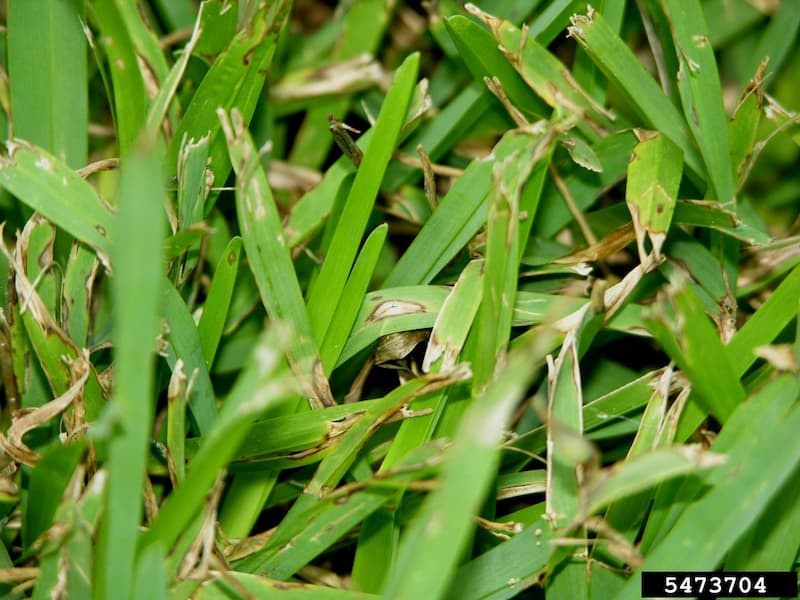
Diagnostic Feature: Oval, gray-tan spots with dark brown borders cover the blades and merge until whole leaves wither.
Could It Be Something Else?
Common Lookalikes
Brown Patch hits tall fescue and perennial ryegrass in the same hot, humid stretch of summer and also makes tan, irregular patches. The difference is on the blade: gray leaf spot makes small, neat oval spots with gray centers, and on ryegrass the dying tips twist. Brown patch makes larger, irregular tan blotches with no gray fuzz.
Cercospora Leaf Spot is the true twin on St. Augustinegrass: same purple-bordered, tan-centered spots, same summer timing. It matters which one you have because the fixes are opposites. Cercospora is driven by low fertility and gets better with a feeding, while gray leaf spot gets worse with extra nitrogen.
Drought stress is the most common mistake from a distance, because a lawn full of gray leaf spot looks scorched and dry even when the soil is moist. Drought-stressed blades fold lengthwise and turn dull blue-gray but have no spots with borders.
Chinch Bugs cause yellow-to-brown patches in sunny St. Augustinegrass in the same hot months, often along driveways and sidewalks. Their damage shows no leaf spots, and the insects are at the soil line.
Field Checks Before You Treat
- Look at the blades. Pick a dozen blades from the edge where green grass meets damaged grass and look at them in good light. Oval or diamond-shaped spots with tan-to-gray centers, purple-brown borders and sometimes a yellow halo mean gray leaf spot. Blades that are evenly tan or folded, with no bordered spots, point to drought.
- Check in the morning. While dew is still on the grass, look at the spot centers with a hand lens. A gray, velvety fuzz confirms gray leaf spot.
- Do the bag test. Seal a handful of spotted blades in a plastic bag with a damp (not dripping) paper towel and leave it at room temperature overnight. Gray fuzz on the spots by morning confirms gray leaf spot. Fluffy white, cobweb-like growth points to a different disease, such as Pythium blight.
- Check the tips on ryegrass. On perennial ryegrass, dying blades that twist or curl at the tip are a classic gray leaf spot sign that brown patch and Pythium blight don't show.
- Look for chinch bugs. At the edge of a yellowing St. Augustinegrass patch, part the grass down to the soil and look for small black-and-white insects. For a surer check, push a can with both ends cut out into the soil, fill it with water and watch for 5 minutes. Bugs that float up mean the damage is insect feeding, not disease.
Grasses at Risk
Host Grasses
Which Grasses Suffer Most
Perennial Ryegrass suffers most: no cultivar is fully resistant, and first-year stands can be wiped out in days. Tall Fescue sits in the middle. Mature lawns thin in patches but rarely die, while young stands are highly susceptible. St. Augustinegrass gets it every summer in the South, but established lawns usually only thin and brown. The real damage comes on new sprigs and overfed, lush growth. Among St. Augustinegrass cultivars, Raleigh is highly susceptible, Floratam is susceptible, and CitraBlue is less affected by disease. Bermudagrass and Centipedegrass are occasional, minor hosts. Kentucky Bluegrass, Creeping Bentgrass and Annual Bluegrass are not affected, which makes Kentucky bluegrass the go-to replacement for ryegrass that keeps dying. When buying ryegrass or tall fescue seed, check the cultivar’s gray leaf spot rating in National Turfgrass Evaluation Program (NTEP) trials.
Why It Shows Up
Conditions That Trigger It
Gray leaf spot needs two things at once: heat and leaves that stay wet for a long time. On St. Augustinegrass it takes off when daytime air temperatures run 77–86°F and nights stay above 65°F. On tall fescue and perennial ryegrass, outbreaks hit when daytime air temperatures reach the 80s to around 90°F in muggy weather. The fungus can work anywhere from about 70°F to 95°F.
Wet leaves are the real switch. The fungus generally needs 12 to 14 hours of continuous leaf wetness to infect. In hot weather (82–90°F) it can get in with as little as 9 hours, because heat speeds everything up. That’s why outbreaks follow rainy, cloudy spells and, in the Midwest and mid-Atlantic, the remnants of tropical storms.
Things you do that raise the risk:
- Evening watering. It stacks on top of the night’s dew and keeps blades wet past the infection threshold.
- Summer nitrogen. Heavy or quick-release feeding pushes soft, lush leaves the fungus gets into easily. Fresh seedlings and new sprigs are soft for the same reason.
- Shade and still air. Trees, hedges and fences slow drying, so dew lingers into late morning.
- Drought and heat stress. On cool-season lawns it often starts on mound tops, slopes and other spots that dry out first.
- Weed killers in hot weather. Post-emergent herbicides stress the grass, and atrazine on St. Augustinegrass is a known trigger above 85°F.
- Thatch and compaction. Thatch shelters the fungus, and compacted soil keeps the grass stressed.
How It Survives and Spreads
In the South, the fungus survives the off-season in dead leaves and thatch, then wakes up when nights turn warm and wet. Farther north, very little of it survives winter. Most Midwest outbreaks start from spores blown up from the South on summer storm systems, then spread locally from lawn to lawn.
Once a spot forms, its gray center releases huge numbers of spores whenever the air is humid. Wind carries them, rain and sprinklers splash them onto nearby blades, and mowers, shoes and pet paws track them across wet grass. New spots show up within a few days, which is why a lawn can go from a few flecks to a scorched look in under a week of muggy weather.
Where It Hits Hardest: Regional Notes
Gray leaf spot is a regular summer problem on St. Augustinegrass across the Gulf Coast, Florida and the coastal Southeast, from June through August (May through September in Florida). It is also a serious late-summer disease on Perennial Ryegrass and Tall Fescue lawns in the transition zone, the mid-Atlantic and the lower Midwest, mostly from late July into September. It is sporadic in the central Midwest and rarely reported in the upper Midwest and northern states, where cool summers and cold winters keep it in check.
Gray Leaf Spot Diagnostic Profile
Check what you see against the full set of signs. The more that match, the more likely this is your problem.
What You’ll See
Symptom Color
Tan or Straw
Yellow
Brown
Red, Pink or Purple
White or Gray
Visible Signs
Fuzzy Gray Mold
Lawn Pattern
Irregular Patches
Overall Thinning
Patch Size
2 to 6 Inches
6 to 12 Inches
1 to 3 Feet
Over 3 Feet
Blade Symptoms
Lesions with Dark Borders
Tip Dieback
When and Where
Weather Triggers
Warm & Humid
Hot & Humid
Long Leaf Wetness (Dew or Rain)
Drought or Heat Stress
Where in the Lawn
Shade
New Seedings
Open, Sunny Lawn
Controlling Gray Leaf Spot
- Water before sunrise. Water only between 2 and 8 a.m., deeply (about 1 inch) and about once a week rather than a little every day. Early watering lands on grass that’s already wet with dew, and the sun dries it all at once. Evening or frequent shallow watering adds hours of wet leaves the fungus needs.
- Hold summer nitrogen. On tall fescue and perennial ryegrass, don’t fertilize in late spring or summer; feed in fall instead. On St. Augustinegrass, keep feeding at low-to-moderate rates and skip heavy or quick-release doses before and during muggy weather, because they push the soft growth the fungus prefers.
- Mow dry, and bag while it’s active. Mow only when the grass is dry, so the mower doesn’t smear sticky spores across the lawn. Bag clippings while spots are present and send them out with yard waste or trash. Mow affected areas last and hose off the mower deck afterward.
- Mow at the right height and often. Keep the grass at its recommended height (3.5–4 inches for standard St. Augustinegrass) and never cut more than a third of the blade at once. Frequent summer mowing on St. Augustinegrass removes spotted tips and opens the canopy to drying.
- Let in sun and air. Limb up low tree branches and thin dense shrubs next to the lawn so dew burns off sooner.
- Skip weed killers while it’s active. Hold off on post-emergent herbicides during outbreaks and hot spells, since stressed grass gets hit harder.
- Reduce thatch and compaction. Dethatch when thatch gets thick and core-aerate compacted soil, so the fungus has less shelter and the grass less stress.
- Plant the right grass. When seeding tall fescue or ryegrass, pick cultivars with good gray leaf spot ratings and seed at the recommended rate so the stand fills in and matures quickly. Where ryegrass keeps dying, switching to Kentucky bluegrass solves the problem for good.
Spraying is sometimes worth it, but only in three situations: new seedings of tall fescue or perennial ryegrass, perennial ryegrass lawns that get it most summers, and newly sprigged or sodded St. Augustinegrass during the summer rainy season. An established St. Augustinegrass or mature tall fescue lawn will outgrow it once the weather breaks, so spraying there rarely pays.
Fungicides work as protection, not as a cure. They stop new infections but don’t heal spotted leaves, and Purdue reports that sprays started after an outbreak is well underway usually fail. Start before the risk window (early to mid-August for cool-season lawns, or when hot, wet weather sets in on new St. Augustinegrass) and repeat on the label interval.
| Active ingredient | FRAC group | How well it works | Protection lasts | Notes |
|---|---|---|---|---|
| Azoxystrobin | 11 | Good | About 28 days | Resistance is documented; don’t use it back to back |
| Pyraclostrobin | 11 | Good | About 28 days | Same group as azoxystrobin; don’t alternate the two |
| Thiophanate-methyl | 1 | Good | About 14 days | Resistance risk; limit to one or two uses a season |
| Propiconazole | 3 | Fair | About 14 days | Weaker on cool-season lawns; best as a rotation or combination partner |
| Myclobutanil | 3 | Fair | About 14 days | Same group as propiconazole; a rotation partner only |
The fungus has already developed resistance to group 11 products in the Midwest. Rotate groups between applications (for example, group 11, then group 3 or 1), or use a product that combines two groups, such as azoxystrobin plus propiconazole. Make sure the label lists home lawns, because many turf products are sold for golf and commercial sites only. Chlorothalonil is now labeled for commercial turf only and can’t be used on home lawns.
Recovery and Repair
Established St. Augustinegrass and tall fescue recover slowly, over several weeks of good growing weather after the hot, wet spell ends, as new leaves replace spotted ones. Raising the mowing height speeds this up by leaving more green leaf. On St. Augustinegrass, keep up moderate feeding to support regrowth. On tall fescue or ryegrass, don’t push recovery with summer fertilizer, because the soft new growth just feeds the fungus.
Repair St. Augustinegrass bare spots with sod or plugs during the warm growing season. If you lay sprigs or sod during the summer rainy season, protect them with a preventive fungicide, since gray leaf spot slows new growth from filling in.
On cool-season lawns, don’t overseed during late-summer outbreaks. Spores in the air will infect the seedlings as they emerge. Wait until cool fall nights end the disease season, or dormant-seed tall fescue in late fall or winter. Where perennial ryegrass has died, overseeding or sodding with Kentucky bluegrass prevents a repeat.
When to Call a Pro
- Fast collapse on a cool-season lawn. If tall fescue or ryegrass turns matted, greasy and brown over large areas in a couple of days, send a sample. Pythium blight looks the same and needs different products.
- Spots you can’t sort out on St. Augustinegrass. Gray leaf spot and Cercospora leaf spot look nearly identical, and one needs less nitrogen while the other needs more. A lab can tell them apart.
- It keeps getting worse. If the lawn declines after you’ve fixed watering and nitrogen and applied a labeled fungicide, it’s time for a diagnosis.
- A ryegrass lawn with a history. If a perennial ryegrass lawn in the transition zone gets hit most summers, a lawn professional can run a preventive program on schedule.
To sample, cut a section from the edge of a damaged area that includes both declining and still-green grass, with roots and soil attached. Dead, brown grass is useless to a lab. Wrap the soil end in plastic, leave the blades loose and mail it early in the week through your county extension office.
Frequently Asked Questions
These answers are synthesized from plant pathology research and diagnostic guidance published by university extension services and plant disease clinics.
Gray leaf spot is the likely cause. Young tall fescue and perennial ryegrass are at their most vulnerable in their first year, and late-summer seedings come up right when spores are thickest in the air. The fungus can kill a fresh stand in days. Seed after cool fall nights arrive, use a resistant cultivar, and seed at the full recommended rate so the stand matures fast.
Not on tall fescue or ryegrass in summer. Extra nitrogen grows soft leaves that the fungus infects even faster, so wait and feed in fall. St. Augustinegrass can stay on a moderate feeding schedule, just without heavy or quick-release doses. The one exception is if a lab confirms Cercospora leaf spot instead, because that disease is driven by low fertility and improves with a feeding.
No. Label changes now restrict chlorothalonil to commercial turf, and it can’t be used on home lawns, even though older guides still list it. For a home lawn, look for azoxystrobin, pyraclostrobin or thiophanate-methyl on the active-ingredient panel, and check that home lawns are listed on the label.
Yes, hold off. Post-emergent weed killers stress the grass, and stressed grass gets infected more easily. On St. Augustinegrass, atrazine is a known trigger when temperatures top 85°F. Spot-treat weeds after the disease and the heat have passed.
It depends on where you live. In the South, the fungus survives the off-season in dead leaves and thatch, so it’s waiting each year when warm, wet nights return. In the Midwest, it rarely survives winter and instead blows in on summer storms from the South. Either way, it returns with the weather, so the lasting fixes are morning-only watering, no summer nitrogen and a less susceptible grass.
Scientific Authority
This profile is built on plant pathology research and diagnostic guidance from university extension services and plant disease clinics. We prioritize accurate identification and cultural control first, recommending fungicides only where research shows they are justified, and naming them by active ingredient rather than brand.
Primary Resources
- Clemson Cooperative Extension HGIC — Gray Leaf Spot on St. Augustinegrass
- Clemson Cooperative Extension HGIC — Leaf Diseases of Lawns
- Clemson Cooperative Extension HGIC — Chinch Bugs
- NC State Extension — Gray Leaf Spot in Turf
- Purdue University Extension — Turfgrass Disease Profiles: Gray Leaf Spot (BP-107-W)
- University of Missouri Extension — Identification and Management of Turfgrass Diseases: Gray Leaf Spot (IPM1029)
- Ohio State University Extension — Gray Leaf Spot on Turfgrass (HYG-3083)
- University of Florida IFAS Extension — Gray Leaf Spot of St. Augustinegrass
- University of Florida IFAS Extension — Cercospora Leaf Spot
- University of Florida IFAS Extension — St. Augustinegrass for Florida Lawns
- LSU AgCenter — Gray Leaf Spot
- University of Georgia Extension — Turfgrass Disease Control Recommendations (2024)