
Pathogen: Ophiosphaerella korrae (formerly Leptosphaeria korrae)
Also called: NRS, frog-eye patch, frog-eye disease, Fusarium blight (older name)
Necrotic Ring Spot
The spring damage summer reveals
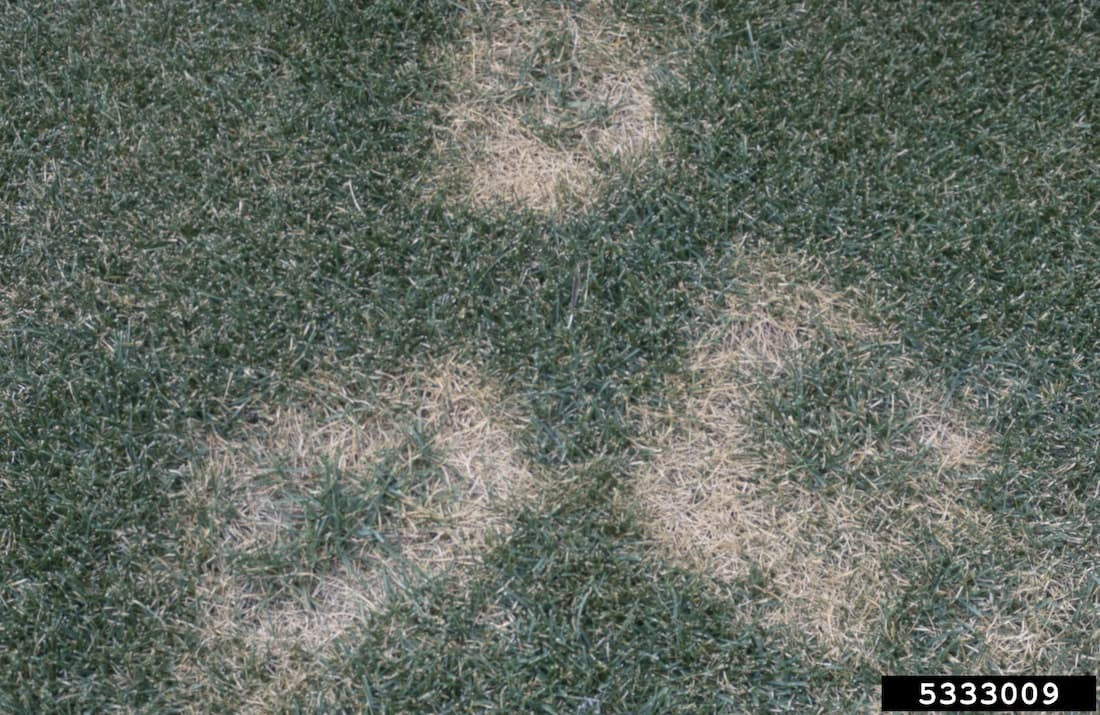
Featured Image Credit: Mary Ann Hansen, Virginia Polytechnic Institute and State University, Bugwood.org, CC BY 3.0 US
Necrotic Ring Spot At-a-Glance
Grass Type Affected
Cool-Season Grasses
Recovers on Its Own?
Yes, Slowly
Is Spraying Worth It?
Rarely Worth It
Disease Type
Fungal
Active Season
Late Spring & Early Summer
Mid to Late Summer
Fall
Damage Potential
Weakens Over Time
Can Be Fatal
Necrotic Ring Spot Quick Answers
What Necrotic Ring Spot Looks Like
From Standing Height
It starts as scattered light green to straw-colored patches, a few inches to a foot across, in late spring or early fall, looking like dry spots that watering doesn’t fix. With the first summer heat the patches collapse into matted, slightly sunken rings of tan, straw-colored grass, often with green grass surviving in the middle: the classic frog-eye. Over the years the rings widen to a foot or several feet, and neighboring rings merge into arcs, crescents and streaks of dead turf, often invaded by weeds. They come back in the same spots season after season.
Up Close: Blades, Crowns and Roots
The blades show no spots, bands or lesions, because the fungus never attacks the leaf. Instead, leaves die back from the tip, twist and collapse, fading from green to yellow, tan and then straw. In spring and fall, when the fungus is most active, dying blades often turn reddish to purple before they dry out, which is a useful clue.
The real damage is at the base. Crowns and lower leaf sheaths turn dark brown to black and rot, and underground stems (rhizomes) decay. Roots are short, sparse, brittle and dark brown to black instead of white, which is why affected grass lifts out of the soil with almost no pull. Under a 10x hand lens, washed roots show dark fungal threads running along their surface.
Signs of the Organism
You won’t see the fungus on the grass blades. No webbing, spore dust or fruiting bodies form above ground. The fungus lives below, as dark brown to black threads that run along the outside of the roots, crowns and underground stems. Dig a plug from the edge of a ring, wash the soil off the roots, and look under a 10x hand lens: dark threads lying along the root surface are the sign. Tiny black, pear-shaped fruiting bodies can form on rotting roots, but they rarely appear in a home lawn.
Identification Photos
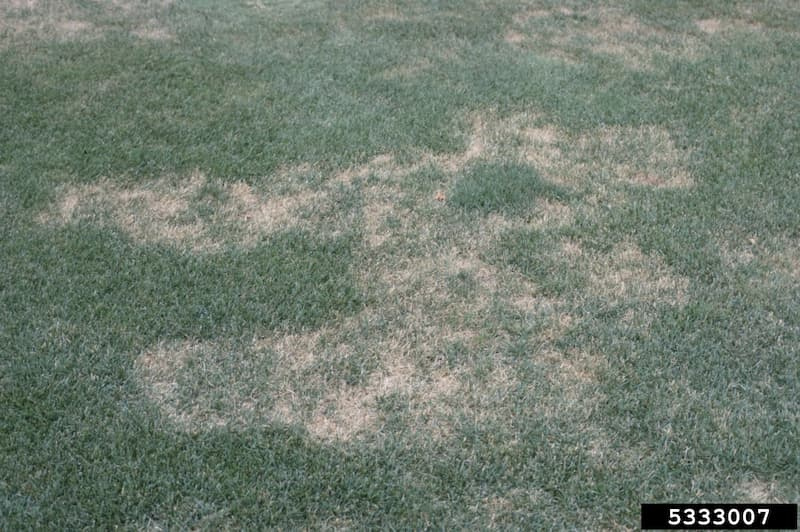
Patches Merging: As the disease advances, individual rings run together into large, irregular bleached areas that can take over much of the lawn.
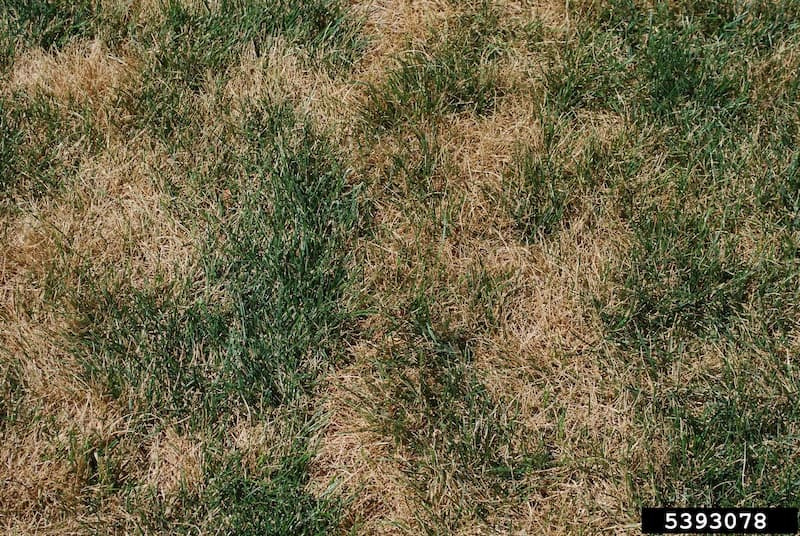
Green Centers: Grass often survives in the middle of each patch, leaving the tan ring with a green center that gives the disease its frog-eye look.
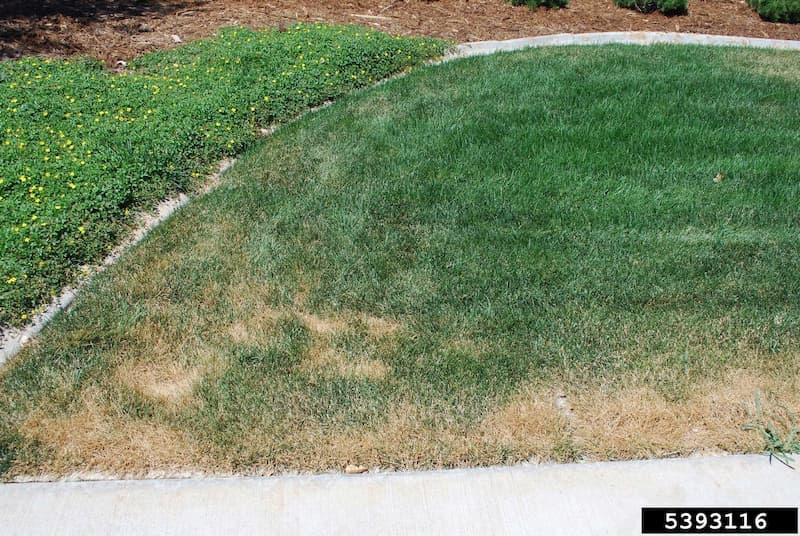
Hot Edges First: Damage often shows first along sidewalks and driveways, where pavement adds heat and drought stress to roots the fungus has already weakened.
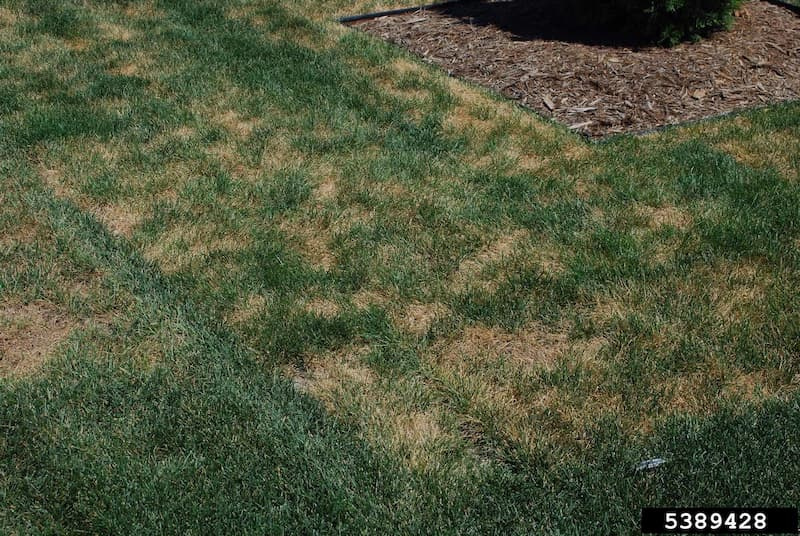
Summer Decline: Patches usually appear from late spring through summer, often in lawns three to four years after sod was laid.
Could It Be Something Else?
Common Lookalikes
Summer Patch is the closest match, close enough that extension labs say only a lab test can reliably tell them apart. Both rot the roots of Kentucky Bluegrass, both leave straw-colored frog-eye rings, and both carry the same dark threads on the roots. The best homeowner clue is timing: summer patch shows up from late June through August and fades as fall cools off, while necrotic ring spot can appear in late spring or early fall and hangs on into fall and even winter. Summer patch rings also tend to stay smaller.
Fairy Ring gets confused because it also makes rings. A fairy ring usually starts as a band of darker green, faster-growing grass, sometimes with mushrooms or puffballs along the edge. Necrotic ring spot never has that dark green band.
White Grubs cause wilting, dying patches where the turf pulls up easily, which is the same result as the tug test below. The difference is under the sod: grubs chew the roots off and leave C-shaped white larvae in the top few inches of soil, while necrotic ring spot leaves short, black, rotted roots still attached to the plant.
Dog urine spots make a round, straw-colored dead spot about 3 to 6 inches across. The giveaway is a ring of dark green, lush grass around the dead center, the opposite of a frog-eye, where the green grass is in the middle.
Field Checks Before You Treat
- Do the tug test. Grab a tuft of dying grass at the outer edge of a ring and pull straight up. Grass that comes up with almost no resistance has lost its roots. Grass that holds firm points to drought or another above-ground problem instead.
- Wash the roots. Dig a plug 2 to 3 inches deep from the edge where green grass meets dying grass, and swish it in a bucket of water until the soil falls away. Healthy roots are long and white to light tan. Necrotic ring spot roots are short, brittle and dark brown to black, with darkened crowns.
- Look for grubs while the sod is open. Peel back a square of turf at the edge of the damage and check the top 2 to 3 inches of soil. C-shaped white larvae, with roots chewed off rather than blackened, mean grubs, not disease.
- Check the ring's edge. A band of extra-dark green grass or mushrooms along the outside means fairy ring. A dark green ring around a small dead center means dog urine. Straw-colored dead grass at the edge and green grass in the middle fits necrotic ring spot or summer patch.
- Note the calendar. Rings that first show up in late spring or early fall and are still there in October point to necrotic ring spot. Rings that appear only in the heat of July and August and fade by fall point to summer patch.
Grasses at Risk
Host Grasses
Which Grasses Suffer Most
Kentucky Bluegrass is the main victim, and older common types suffer most. Fine Fescue (red fescue in particular), along with annual and rough bluegrass, also gets the disease. Bentgrass is susceptible, but it is rarely the main grass in a home lawn. Perennial Ryegrass and Tall Fescue are not affected, which makes them the go-to choices for repairing damaged lawns. Bluegrass cultivars vary a lot: university trials rate several as moderately resistant, with Midnight appearing on every list. Because those trials are old, check current National Turfgrass Evaluation Program (NTEP) ratings before buying seed, and plant a blend of several resistant bluegrass cultivars rather than one.
Why It Shows Up
Conditions That Trigger It
Necrotic ring spot works in two stages, and the weather for each is different. The fungus infects roots in cool, moist soil, roughly the mid-50s to upper 70s °F at root depth, which in most of the North means spring and fall. The grass still looks fine at that point because it doesn’t need much water. Symptoms appear later, with the first heat and drought stress of summer, when rotted roots can no longer keep up with the water the leaves lose.
Lawn care and site conditions decide how bad it gets:
- Sod, especially over poor soil. It is most common on sodded lawns 2 to 10 years old, and worst where sod went down on compacted or barely tilled soil that roots can’t get into.
- Compaction and poor drainage. Hard, wet soil keeps roots shallow and stressed, and wet springs leave those shallow roots sitting in waterlogged soil.
- Thick thatch. Over 1/2 inch of thatch means many roots grow in the thatch, which dries out fast in summer. Purdue finds lawns with 3/4 inch or more hit hardest.
- Too much nitrogen, or too little. Heavy spring doses of fast-release nitrogen push leaf growth at the expense of roots. A starved lawn can’t regrow roots either.
- Low mowing. Short grass means short roots and fewer reserves going into summer.
- Frequent shallow watering. Daily light watering through spring and fall keeps roots near the surface and the soil wet when the fungus is infecting.
- High soil pH. Alkaline soil favors the disease, and extension labs list lowering pH as a way to suppress it.
How It Survives and Spreads
The fungus survives year-round in dead roots and crowns, in thatch, and on the surface of living roots, so once it’s in a lawn it stays there. When the soil turns cool and moist in spring, dark fungal threads grow along the roots and then into them, rotting the outer root tissue. The same thing happens again in fall. Each season the fungus moves outward into neighboring roots, which is why rings grow wider year after year and come back in the same places.
Between lawns it moves in soil. The main routes are infested sod and plugs of soil and roots carried on core aeration equipment, though Colorado State considers aeration a minor route. Mowers don’t spread it, because the fungus doesn’t live on the leaves. Its fruiting bodies are rare in lawns, so airborne spores aren’t a meaningful route.
Where It Hits Hardest: Regional Notes
Necrotic ring spot is a problem wherever Kentucky Bluegrass lawns grow: the Upper Midwest and Great Lakes, the Northeast, the Pacific Northwest, and the irrigated lawns of the Rockies and High Plains. Along Colorado’s Front Range, soil stays in the infection range from about mid-May to mid-September, so the risk window is longer there than in the Midwest, where it splits into a spring and a fall window. It is rare in the South, where lawns are warm-season grasses. In the transition zone and the South, the same fungus attacks Bermudagrass, where it causes a different disease, Spring Dead Spot.
Necrotic Ring Spot Diagnostic Profile
Check what you see against the full set of signs. The more that match, the more likely this is your problem.
What You’ll See
Symptom Color
Tan or Straw
Yellow
Brown
Red, Pink or Purple
Visible Signs
None Usually Visible
Lawn Pattern
Circular Patches
Rings or Frog-Eyes
Irregular Patches
Streaks or Stripes
Patch Size
2 to 6 Inches
6 to 12 Inches
1 to 3 Feet
Over 3 Feet
Blade Symptoms
Tip Dieback
Rotted Leaf Base or Crown
Rotted Roots
When and Where
Weather Triggers
Cool & Wet
Wet or Poorly Drained Soil
Drought or Heat Stress
Where in the Lawn
Shade
Low or Wet Spots
Compacted or High-Traffic Areas
Open, Sunny Lawn
Controlling Necrotic Ring Spot
Every practice here does one of two things: it grows deeper roots before summer, or it keeps the soil from staying wet while the fungus is infecting. Expect results over seasons, not weeks.
- Mow high. Keep bluegrass at about 3 inches, never below 2 1/2, and remove no more than a third of the blade at a time. Taller grass grows deeper roots, which buy time when summer stress arrives.
- Water deeply and seldom. In spring and fall, water early in the morning to wet the soil 6 to 8 inches deep, no more than twice a week. Deep, spaced-out watering draws roots down and keeps the soil from staying wet while the fungus is infecting.
- Rescue-water in summer heat. Once rings appear in hot weather, sprinkle the affected areas lightly every day, about 0.1 to 0.2 inch between noon and 4 p.m., and double it in long droughts. This cools grass whose roots can’t keep up. Stop when the weather cools, because daily watering as a long-term habit makes the disease worse.
- Feed mostly in fall. Keep the total at or under 4 lb of nitrogen per 1,000 sq ft per year, put most of it down in fall, use slow-release nitrogen if you feed in spring, and never apply more than 1 lb of fast-release nitrogen per 1,000 sq ft at once. Fall feeding builds roots, while heavy spring feeding builds leaves at the roots’ expense.
- Core aerate every year. Pull cores in spring or fall to relieve compaction, thin thatch and help water and roots move down. If you hire it out, ask that the machine be cleaned of soil before it rolls onto your lawn.
- Keep thatch under 1/2 inch. Roots growing in thatch dry out first in summer, and thatch also shelters the fungus.
- Test, then lower pH if it’s high. If a soil test shows alkaline soil, elemental sulfur can bring it down. Colorado State suggests about 1 to 1.5 lb per 1,000 sq ft per year, split into several applications and watered in, stopping once pH falls below 6.0. Don’t add sulfur without a soil test.
- Leave the clippings. They don’t carry this root disease and they return nutrients. Raked-out dead turf and thatch from the rings is different: send it to yard-waste pickup, not the compost pile.
- Plant resistant grass when you repair. Overseeding with grasses the fungus doesn’t attack is the most reliable long-term fix. See Recovery and Repair.
Spraying is rarely worth it on a home lawn. Fungicides only work if they go down in spring, before you can see anything, and they suppress the fungus without eliminating it. Results in university trials are inconsistent. Spraying the rings you see in summer doesn’t help, because the roots were already rotted weeks earlier and no fungicide brings dead roots back. Purdue’s advice is to consider fungicides only after cultural fixes have been exhausted, and to have a professional apply them.
If a high-value lawn keeps getting hit despite good care, preventive treatment works like this:
- Timing. Make the first application in spring when soil at a 2-inch depth reaches about 65°F, typically mid-May in the North, and a second 30 to 60 days later. Some programs add a fall application. Badly damaged lawns may need several years of treatment.
- Getting it to the roots. Water the lawn deeply the day before, then drench the product in with 0.5 to 1 inch of water right after applying. A fungicide left on the leaves never reaches the roots where the disease is.
- Rotation. Alternate FRAC groups from one application to the next to slow fungicide resistance.
| Active ingredient | FRAC group | Effectiveness on NRS (Colorado State trials) |
|---|---|---|
| Propiconazole | 3 | Fair to good |
| Myclobutanil | 3 | Fair to good |
| Tebuconazole | 3 | Good for fall applications |
| Thiophanate-methyl | 1 | Fair to good |
| Azoxystrobin + propiconazole | 11 + 3 | Fair to good |
| Azoxystrobin (alone) | 11 | Limited |
Some of these ingredients are sold in homeowner lawn fungicides, but product lines often reuse one brand name across different formulas. Check the active-ingredient panel, not the brand. The most consistent results come from professional products applied with proper equipment and timing.
Recovery and Repair
Recovery is real but slow. Grass that survives an outbreak fills in from the center of each ring, and rings may keep returning for several years. They often fade on their own as a lawn passes 8 to 10 years old. Summer rescue watering, fall feeding and yearly aeration speed things up by giving surviving plants the roots to spread. Recovery stalls where compaction, thick thatch or weeds take over the dead rings.
Repair in late August to early September. Seed sprouts well in warm soil then, and new grass has fall and spring to root before the next summer stress. Rake the dead grass out of the rings, loosen the soil with a core aerator or by hand, and seed so the seed touches bare soil. Slit-seeding works well for larger areas. Use a grass the fungus doesn’t attack: perennial ryegrass, turf-type tall fescue, or a blend of resistant bluegrass cultivars. A mix of about 20% perennial ryegrass and 80% resistant bluegrass by weight also suppresses the disease. The trade-offs: ryegrass hides the rings but brings its own diseases (dollar spot, red thread, brown patch), and tall fescue patches look coarser than the bluegrass around them. If you’re renovating a whole lawn on poor soil, working 3 to 6 cubic yards of compost per 1,000 sq ft into the soil before planting deals with the root-restricting soil that sets up the disease.
When to Call a Pro
Send a sample to your state’s extension diagnostic lab if rings keep spreading after a season of better mowing, watering and aeration, or if you’re about to spend money on fungicides or renovation. The lab test is also the only reliable way to tell necrotic ring spot from summer patch. Cut a plug about 6 inches across from the edge where healthy grass meets dying grass, with roots and soil intact, at least 2 inches deep. Wrap it in foil (not plastic), and mail it early in the week so it doesn’t sit in a warm warehouse over the weekend. Follow your own lab’s form, because instructions vary. Don’t send only dead grass from the middle of a ring, because by then other fungi have moved in and hide the real cause. If a lawn with a confirmed, severe history needs preventive fungicides, hire a licensed lawn care professional to apply them.
Frequently Asked Questions
These answers are synthesized from plant pathology research and diagnostic guidance published by university extension services and plant disease clinics.
Because the damage stays hidden until the grass needs more water than its roots can supply. The fungus rots roots in cool, moist spring soil, but the grass needs little water then, so it stays green. When the first hot, dry spell hits, the weakened roots can’t keep up, and the grass wilts and collapses in rings. What you see in July was set up weeks earlier.
Not much for what you do. Both are root diseases of bluegrass, and the fixes are the same: mow higher, water deeply and seldom, feed mostly in fall, aerate, and reseed with resistant grass. The difference matters mainly if you’re paying for fungicides, because the spray timing differs. Then it’s worth a lab test.
Sod is the most common setup for this disease. Sodded bluegrass usually shows it 2 to 3 years after installation, while seeded lawns often take 4 or more years, if they get it at all. Sod laid over compacted or barely tilled soil keeps its roots in a shallow mat that dries out fast, and the sod itself can bring the fungus in.
No. By the time rings are visible, the roots under them are already dead, and a fungicide can’t regrow roots. Fungicides only help when applied in spring, before root infection, and even then they suppress the disease rather than cure it. Rescue watering and fall repair do more for rings already in the lawn.
In chronic spots, overseeding with a grass the fungus can’t infect is the most reliable fix. Perennial ryegrass and tall fescue aren’t affected, and blending at least 20% ryegrass into resistant bluegrass suppresses the disease. Each has trade-offs: ryegrass brings other diseases, and tall fescue is coarser. If you love bluegrass, a blend of resistant cultivars chosen from current NTEP ratings keeps the look with far less risk.
Scientific Authority
This profile is built on plant pathology research and diagnostic guidance from university extension services and plant disease clinics. We prioritize accurate identification and cultural control first, recommending fungicides only where research shows they are justified, and naming them by active ingredient rather than brand.
Primary Resources
- Purdue University Extension — Turfgrass Disease Profiles: Necrotic Ring Spot (BP-116-W)
- Purdue University Turfgrass Science — Patch Disease Symptoms Starting to Show in Dry Kentucky Bluegrass Lawns
- Michigan State University Extension — Necrotic Ring Spot
- University of Wisconsin–Madison Turfgrass Diagnostic Lab — Necrotic Ring Spot
- University of Wisconsin–Madison Extension — Lawn Disease Quick Reference
- University of Wisconsin–Madison Extension, Kenosha County — Turf Diseases and Disorders
- University of Missouri Extension — Identification and Management of Turfgrass Diseases (IPM1029): Necrotic Ring Spot
- University of Missouri Extension — Identification and Management of Turfgrass Diseases (IPM1029): Summer Patch
- University of Missouri Extension — Identification and Management of Turfgrass Diseases (IPM1029): Fairy Ring
- Colorado State University Extension — Necrotic Ring Spot of Kentucky Bluegrass (Fact Sheet 2.900)
- University of California Statewide IPM Program — Turfgrass: Necrotic Ring Spot
- University of Illinois Extension — Summer Patch and Necrotic Ring Spot
- University of Illinois Extension — Managing Patch Disease in Lawns
- Ohio State University Extension — Summer Patch on Turfgrass (HYG-3082)
- Purdue University Extension — Animal Urine Damage in Turf (AY-327-W)
- Purdue University Extension — Managing White Grubs in Turfgrass (E-271-W)