
Pathogen: Colletotrichum cereale (formerly Colletotrichum graminicola)
Also called: Anthracnose, Turf Anthracnose, Anthracnose Foliar Blight, Anthracnose Basal Rot, Basal Rot Anthracnose
Lawn Anthracnose
The summer stress blight
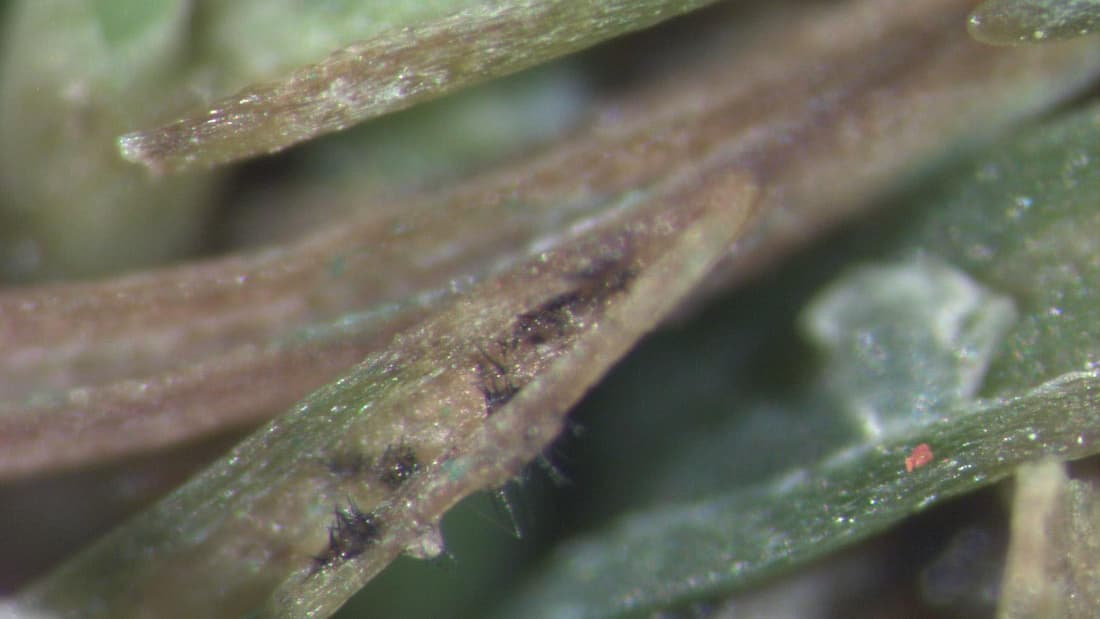
Featured Image Credit: NC State University, used with permission
Lawn Anthracnose At-a-Glance
Grass Type Affected
Cool & Warm Season
Recovers on Its Own?
Yes, Slowly
Is Spraying Worth It?
Rarely Worth It
Disease Type
Fungal
Active Season
Late Spring & Early Summer
Mid to Late Summer
Damage Potential
Weakens Over Time
Can Be Fatal
Lawn Anthracnose Quick Answers
What Lawn Anthracnose Looks Like
From Standing Height
From a standing view, the lawn takes on a yellow-orange or bronze cast in mid to late summer and loses its usual vigor. Irregular patches from a few inches to a foot or more across fade from yellow to bronze, then to tan or straw, with fuzzy edges that blend into the surrounding grass rather than forming neat circles. Over a week or two, patches can merge into larger thin, scorched-looking areas, often where the lawn is shaded, compacted or full of annual bluegrass.
Up Close: Blades, Crowns and Roots
Up close, the oldest leaves go first: each blade yellows from the tip downward, often starting at a freshly mown cut end, while the youngest leaf in the shoot may still be green. Leaves can carry irregular tan to reddish-brown blotches or elongated lesions, but without the dark border that brown patch and leaf spot leave. On the yellowed and dead blades, look for the black pepper specks of the fungus’s fruiting bodies.
The base of the plant tells you how serious it is. In the common leaf-blight form, the crown stays firm and white, so the plant regrows. In the basal rot form, the lower leaf sheaths and crown turn water-soaked, then brown, then black, and the shoot pulls away from the crown with almost no resistance. That plant is dead and won’t recover. Basal rot is mostly a putting-green problem, but it does occur in lawns, most often in annual bluegrass.
Signs of the Organism
The fungus makes tiny black fruiting bodies called acervuli on yellowed and dead blades and on the stem bases. To the naked eye they look like scattered black pepper specks, easy to mistake for soil or thatch. Under a 10x hand lens each speck shows stiff black bristles sticking out of it, like a tiny pincushion. That bristly look is what confirms anthracnose.
Look on the oldest, most yellowed leaves at the edge of a patch, not on the green ones. The specks often show up late in an infection, so not finding them doesn’t rule it out. Check again in a week, or send a sample.
Identification Photos
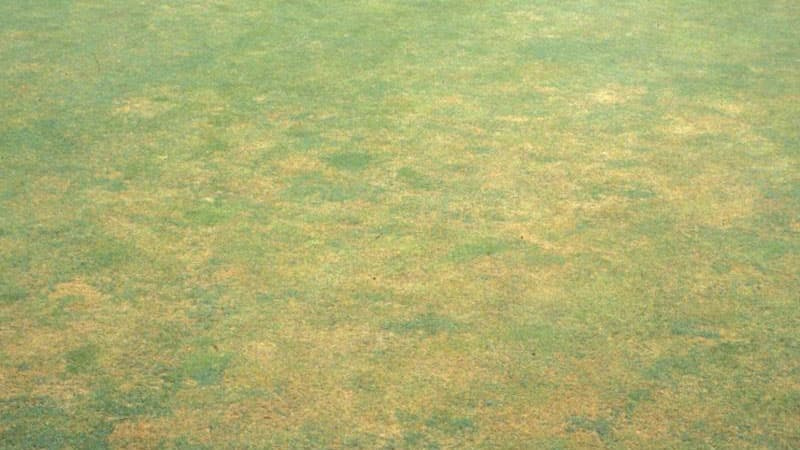
Yellow to Bronze Patches: Affected turf yellows, then turns orange-bronze in irregular patches, usually during summer heat when the grass is already stressed.
NC State University, used with permission
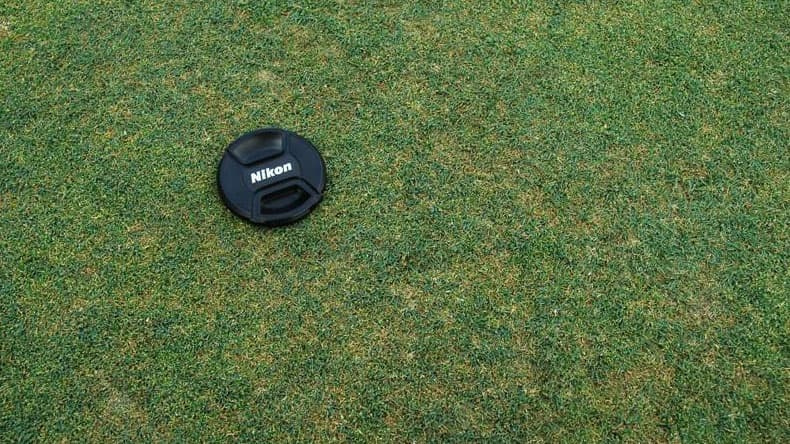
Up Close: Individual plants yellow and die scattered through the turf, so the area looks thin and mottled rather than forming a clean-edged patch.
NC State University, used with permission
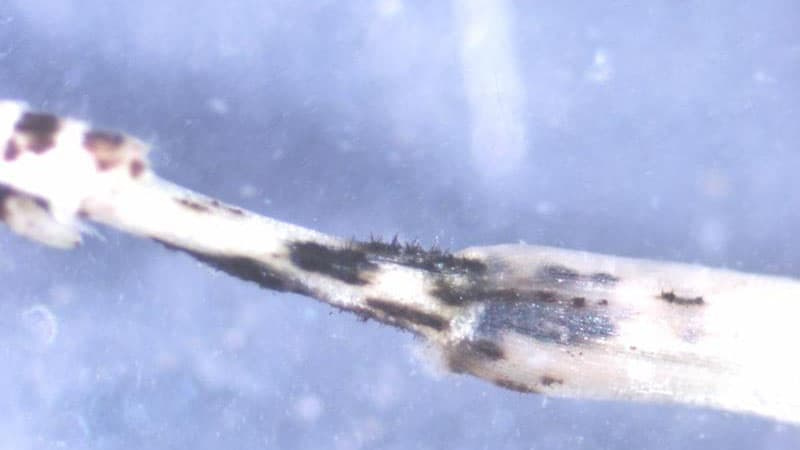
Basal Rot: The fungus can also rot the base of the stem, turning it black and water-soaked so the plant pulls out easily.
NC State University, used with permission
Could It Be Something Else?
Common Lookalikes
Summer Patch hits the same Kentucky bluegrass lawns in the same hot weeks, and both leave yellow-to-straw patches. The difference is shape and roots: summer patch makes rounded patches or rings with green grass in the middle, often on sunny slopes and along pavement, and its roots are dark brown and rotted. Anthracnose patches are irregular, with no ring.
Brown Patch shows up in the same hot, humid stretch with warm nights, so the timing overlaps. Its leaves carry tan spots with a dark brown border, and on dewy mornings the patch edge can show a dark “smoke ring.” Anthracnose blades yellow from the tip down with no bordered spots.
Drought stress is the most common mix-up, because anthracnose itself flares up in drought-stressed grass. Thirsty grass turns blue-gray before it goes straw-colored, holds footprints after you walk on it, and appears first on slopes, sunny spots and strips along driveways. It has no black specks.
Billbugs thin Kentucky bluegrass lawns in midsummer and leave irregular dead patches that look a lot like this disease. Billbug-damaged stems snap off at the soil line and are packed with fine sawdust-like debris.
Field Checks Before You Treat
- Look at the leaf. Pull a few yellowing shoots from the patch edge and lay them flat. Anthracnose yellows the oldest leaves first, from the tip down, while the youngest leaf often stays green. Tan spots with a dark brown border point to brown patch instead.
- Use a hand lens. Check the yellowed blades and stem bases under a 10x lens in good light. Black specks with bristles sticking out confirm anthracnose. No specks doesn't rule it out, because they often appear late.
- Check the base. Tug gently on yellow shoots at the patch edge. If they slide out easily and the base is black and soft, the crowns are rotted and those plants are dead. If they hold firm and the base is white, the damage is still leaf-only and the grass can regrow.
- Dig and look at the roots. Lift a small section with a trowel. Dark brown, rotted roots under a ring-shaped patch point to summer patch. Anthracnose in lawns usually leaves the roots looking normal.
- Snap a stem. If stems break off cleanly at the soil line and you see fine sawdust-like debris, it's billbugs, not a disease.
- Do the footprint test. Walk across the patch. If your footprints stay pressed in for more than a few minutes and the grass is blue-gray, the lawn is short on water, not (or not only) diseased.
Grasses at Risk
Host Grasses
Which Grasses Suffer Most
Annual bluegrass is by far the most susceptible grass, and in home lawns, where it’s a weed, it’s usually the grass you see dying. Kentucky bluegrass is the main lawn grass affected, though it rates as low susceptibility in Midwest trials, and modern cultivars vary widely. Perennial ryegrass and fine fescue are also low-susceptibility hosts. Creeping bentgrass is rarely affected outside golf greens. Tall fescue isn’t listed as a host in Midwest ratings, which makes it a good choice where anthracnose keeps returning.
In the Southeast, centipedegrass gets it during long rainy spells but recovers quickly. When you overseed, choose cultivars with strong disease ratings from the National Turfgrass Evaluation Program (NTEP) and plant a blend of three or more rather than a single cultivar.
Why It Shows Up
Conditions That Trigger It
Lawn anthracnose is driven by stressed grass, not by perfect weather for the fungus. The fungus itself grows best around 70–82°F, but the disease peaks when daytime air temperatures run 80–95°F, because that’s when cool-season grass is struggling most and can’t fight it off. That’s why the same fungus barely touches a well-kept lawn next door.
Moisture on the leaves matters too: the spores need wet blades to germinate and get in, so long dew periods, humid nights and evening watering all raise the risk. The less common basal rot form is favored instead by cool, wet weather around 50–60°F, mostly on putting greens.
The stresses that set it up:
- Low nitrogen. An underfed lawn ages its leaves fast and grows too slowly to replace them, and aging leaves are exactly what the fungus attacks.
- Mowing too short. A low cut shrinks the leaf area that feeds the plant, drains its energy reserves and heats up the crowns.
- Drought stress. Grass that wilts repeatedly in summer heat is primed for infection.
- Compaction and heavy traffic. Packed soil keeps roots shallow and short of air, so the plant has less to fall back on.
- Wet, poorly drained soil. Soggy soil weakens roots and keeps the lawn surface damp.
- Shade and poor air movement. Both slow drying after dew or rain and cut the light the grass needs.
- Annual bluegrass in the lawn. This weedy grass is by far the most susceptible host, and it’s often what you’re seeing die.
- Thatch, low potassium and salty soil. Each adds stress; thatch also shelters the fungus between seasons.
How It Survives and Spreads
The fungus lives on dead and decaying grass, so it spends the winter in thatch and old infected leaves. As the weather warms in late spring, it forms its black fruiting bodies there and fills them with spores in a sticky coating.
Water spreads it. Rain and sprinkler drops wash the spores loose and splash them onto nearby blades, and mowers and shoes move wet clippings and spores around the lawn. A spore that lands on a wet, aging leaf germinates and grows straight into it. Healthy, fast-growing grass replaces infected leaves faster than the fungus can kill them, which is why stress decides how bad it gets. Infected sod or plugs can bring it into a new lawn. Activity slows as fall temperatures drop, and the fungus waits out the winter in the thatch again.
Where It Hits Hardest: Regional Notes
Lawn anthracnose is mainly a problem in cool-season lawns of the Northeast, Midwest, Great Lakes and Pacific Northwest, especially in late summer during hot, humid spells. In California it shows up only as the leaf-blight form; the basal rot form hasn’t been reported there. In the Southeast, it turns up on centipedegrass lawns during long rainy periods in spring and summer. It’s rarely an issue on bermudagrass, zoysiagrass or St. Augustinegrass lawns in the Deep South and Southwest.
Lawn Anthracnose Diagnostic Profile
Check what you see against the full set of signs. The more that match, the more likely this is your problem.
What You’ll See
Symptom Color
Tan or Straw
Yellow
Brown
Red, Pink or Purple
Orange or Rust
Black or Dark
Visible Signs
Black Spots or Pustules
Lawn Pattern
Irregular Patches
Overall Thinning
Patch Size
2 to 6 Inches
6 to 12 Inches
1 to 3 Feet
Blade Symptoms
Tip Dieback
Rotted Leaf Base or Crown
When and Where
Weather Triggers
Warm & Humid
Hot & Humid
Long Leaf Wetness (Dew or Rain)
Wet or Poorly Drained Soil
Drought or Heat Stress
Where in the Lawn
Shade
Low or Wet Spots
Compacted or High-Traffic Areas
Open, Sunny Lawn
Controlling Lawn Anthracnose
Lawn anthracnose goes away when the stress does, so these care changes are the treatment, not just prevention.
- Feed the lawn properly. Underfed lawns get it worst, because slow-growing grass can’t replace infected leaves. Stick to a normal fertilizer program for your grass. If the lawn heads into summer pale and thin, give it a light feeding of slow-release fertilizer (about half a pound of nitrogen per 1,000 sq ft) before the heat arrives. Don’t apply a heavy, quick-release dose once days top 80°F: soft, fast growth in heat brings on other diseases, such as brown patch.
- Raise the mower. Mow at the top of the recommended range for your grass (about 3 to 4 inches for Kentucky bluegrass, ryegrass and fescue lawns). Taller grass has more leaf to feed itself and keeps the crowns cooler. Never scalp, and keep the blade sharp, because a dull blade shreds leaf tips and leaves open wounds.
- Water deeply, in the early morning. Water before sunrise so the sun dries blades that are already wet with dew. Evening watering keeps them wet all night, which is when spores infect. Water deeply and less often, but don’t let the lawn go into repeated drought wilt, since that stress sets the disease off.
- Bag clippings during an outbreak. Send them to yard-waste pickup or the trash. Compost them at home only if your pile reliably runs above 140°F.
- Relieve compaction. If a screwdriver won’t push easily into moist soil, core aerate. Do it in early fall for cool-season lawns, or late spring to early summer for centipedegrass, when the grass is growing strongly enough to recover.
- Keep thatch in check. Thatch deeper than about half an inch shelters the fungus over winter and holds moisture. Aerating and dethatching help, but wait until fall: cutting into a lawn during an outbreak wounds the grass and makes the disease worse.
- Let in light and air. Prune low tree limbs and thin crowded shrubs around shady areas so the grass dries faster and gets more light.
- Test the soil. Low potassium adds stress; a soil test tells you whether to add it.
- Deal with annual bluegrass. If the dying grass is annual bluegrass, the long-term fix is reducing that weed and overseeding with a better grass, not treating the disease.
Spraying is rarely worth it on a home lawn. University of California experts state plainly that fungicides are generally not warranted in home lawns, because a lawn that’s fed, watered and mowed properly outgrows the leaf-blight form on its own.
The exception is a lawn where anthracnose kills grass in the same areas every summer even after the care problems are fixed. Even then, fungicides only work as prevention: start two to four weeks before symptoms usually appear, which in practice means when soil temperatures climb past 65°F. Spraying after grass bases have turned black does nothing, because the rotted crowns can’t take up the product and are already dead.
| Active ingredient | FRAC group | Notes |
|---|---|---|
| Propiconazole | 3 | Sold in homeowner lawn fungicides. Moves into the leaf. |
| Tebuconazole | 3 | Sold in homeowner lawn fungicides. Same group as propiconazole, so don’t rotate between them. |
| Myclobutanil | 3 | Sold in homeowner products; check that the label lists lawns. |
| Azoxystrobin | 11 | Sold in some homeowner lawn granules and in professional products. |
| Thiophanate-methyl | 1 | Sold in homeowner granules; resistance in this fungus is common. |
| Chlorothalonil | M5 | Effective, but labels prohibit use on home lawns. Golf and professional sites only. |
This fungus builds resistance quickly to groups 1, 3 and 11. Never make two applications in a row from the same group; switch groups each time, and reapply only at the label interval (usually 14 to 28 days). For leaf blight, let liquid sprays dry on the leaves rather than watering them in.
Recovery and Repair
Where the crowns stayed white and firm, the lawn regrows on its own, usually within a few weeks of cooler weather once it’s fed, watered and mowed properly. Light feeding and regular mowing with a sharp blade speed this up by replacing damaged blades with new ones.
Where the bases turned black, those plants are dead and the spots need reseeding. For cool-season lawns, wait until late August through September: warm soil speeds germination, cooler air means less disease and heat stress, and seedlings sown in midsummer usually die. Rake out the dead grass, core aerate or slit-seed for good seed-to-soil contact, and sow a resistant blend (turf-type tall fescue or improved Kentucky bluegrass cultivars). Keep the seedbed lightly moist until seedlings are up, then switch to deep, early-morning watering. Centipedegrass usually fills back in by itself; if it doesn’t, plug or sod in late spring or early summer while it’s actively growing.
When to Call a Pro
Send a sample to your state’s extension diagnostic lab if the patches keep spreading three to four weeks after you’ve raised the mower, fixed the watering and fed the lawn, if grass dies in the same spots every summer (only a lab can reliably separate anthracnose from summer patch), or before you spend money on a fungicide program.
Dig a plug about 4 inches across with a few inches of soil, taken from the edge of a patch so it includes both sick and healthy grass. Fully dead grass is useless, because other fungi take it over. Bag the soil and roots, wrap the leaves in a dry paper towel, don’t add water, and mail it early in the week. Many labs also accept photos by email first.
Frequently Asked Questions
These answers are synthesized from plant pathology research and diagnostic guidance published by university extension services and plant disease clinics.
No. “Anthracnose” is a name for a type of symptom, and the tree, shrub and vegetable versions are caused by different fungi that can’t infect grass. Shade trees can still make lawn anthracnose worse indirectly, by shading the grass and keeping it wet longer.
They’re often annual bluegrass. This weedy grass is the most susceptible host by far, and it grows in lighter-green clumps scattered through the lawn, so it dies in patches while the bluegrass or fescue around it holds on. Spraying won’t fix that; reducing the annual bluegrass and overseeding with a better grass will.
Not during an outbreak. Cutting into the lawn while the disease is active wounds the grass and gives the fungus more places to get in. Schedule aeration and dethatching for early fall, when cool-season grass is growing strongly enough to heal.
Too little is the bigger problem. Underfed lawns get this disease far more than well-fed ones. Still, a heavy dose of quick-release nitrogen in midsummer heat produces soft growth that invites other diseases such as brown patch, so feed lightly and on schedule instead.
Scientific Authority
This profile is built on plant pathology research and diagnostic guidance from university extension services and plant disease clinics. We prioritize accurate identification and cultural control first, recommending fungicides only where research shows they are justified, and naming them by active ingredient rather than brand.
Primary Resources
- University of California Statewide IPM Program — Anthracnose (UC Guide to Healthy Lawns)
- University of California Statewide IPM Program — Anthracnose, Turfgrass Pest Management Guidelines
- Purdue University Extension — Turfgrass Disease Profiles: Anthracnose (BP-108-W)
- Penn State Extension — Turfgrass Diseases: Anthracnose (Causal Fungus: Colletotrichum cereale)
- Clemson Cooperative Extension Home & Garden Information Center — Leaf Diseases of Lawns
- University of Wisconsin–Madison Extension — Turf Diseases of the Great Lakes Region (A3187)
- University of Wisconsin–Madison Turfgrass Diagnostic Lab — Anthracnose
- University of Nebraska–Lincoln Extension — Anthracnose of Turfgrass (G1918)
- Oregon State University, Washington State University and University of Idaho — Pacific Northwest Plant Disease Management Handbook: Lawn and Turf — Anthracnose
- Penn State Extension — Your Plants Look Sick? Now What?