
Common Chickweed At-a-Glance
Weed Type
Broadleaf
Life Cycle
Winter annual (occasionally a short-lived perennial in cool, humid, coastal areas)
Growth Habit
Prostrate, mat-forming (mounds 3–15+ inches tall where nothing mows it)
Root Type
Shallow, fibrous, from a thin weak taproot
Spreading Risk
High — by seed, and by stems rooting at the nodes
Pull
With Caution
Identity & Diagnostics
Visual Fingerprint
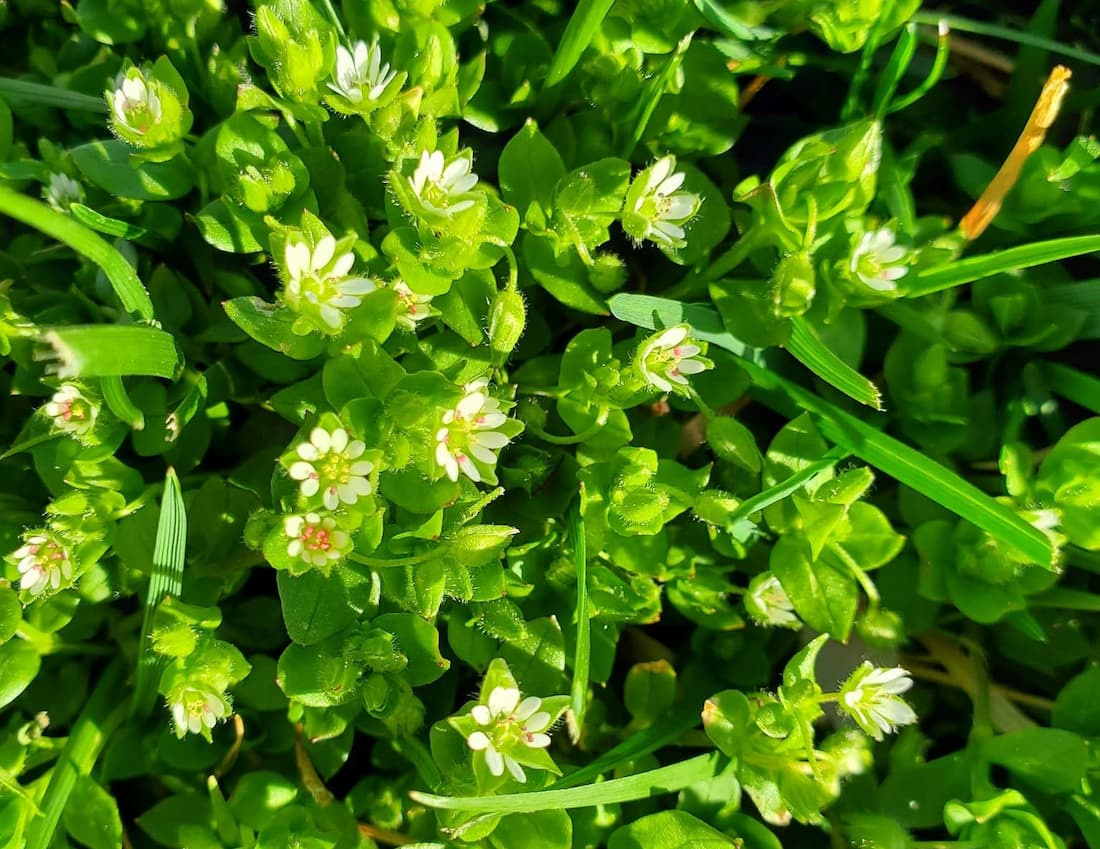
Chickweed shows up as a low, bright to light-green mat of small, pointed, egg-shaped leaves lying flat against the ground. In a lawn it stays under two inches tall and spreads sideways into a dense patch; in a mulch bed with nothing to mow it, it mounds up into a loose, sprawling clump. The giveaway from standing height is the timing and the color — a fresh, soft green mat thriving in late fall, winter, and early spring, exactly when the lawn around it looks tired, thin, or brown. Tiny white star-shaped flowers appear at the stem tips as spring warms.
Structural Anatomy
Get down to the plant and look at a single stem, because chickweed carries one of the most reliable field markers of any lawn weed: a single vertical line of fine hairs running up just one side of the round stem — and at each node, where a pair of leaves attaches, that line jumps to the opposite side and keeps going. The rest of the round stem is smooth. No other common lawn weed does this.
The leaves back it up. They are strictly opposite (a matched pair at each node), broadly egg-shaped with a sharp point, and smooth and hairless on top with plain, un-toothed edges. There’s also a tidy transition along the stem: the lower leaves sit on short stalks with a fringe of fine hairs, while the leaves near the growing tip are smaller and stalkless, clamping directly onto the stem.
When flowers are present, they seal it: small white stars under a quarter-inch across, with five petals split so deeply they look like ten, cupped by five green hairy sepals that are actually a bit longer than the white petals. With no flower, the combination of the switching hairline, the smooth opposite pointed leaves, and the stalked-to-stalkless leaf transition is enough to be certain.
Growth Patterns & Life Stages
Chickweed germinates in cool weather, not warm. Seedlings emerge from late summer through fall (and, in mild spells, through winter), starting as a pair of slender, hairless, football-shaped seed leaves with a pointed tip. The plant branches after about five leaf pairs and spreads into the flat, interlocking mat that most people first notice. As spring warms, it flowers fast and sets seed faster — this is the stage the control calendar is built around, because once you can see flowers, the too-late line has usually already been crossed. Straw-colored seed capsules follow, split into segments, and scatter minute reddish-brown seeds at the soil surface. Summer heat kills the plant outright, leaving brown dead patches behind.
Gallery
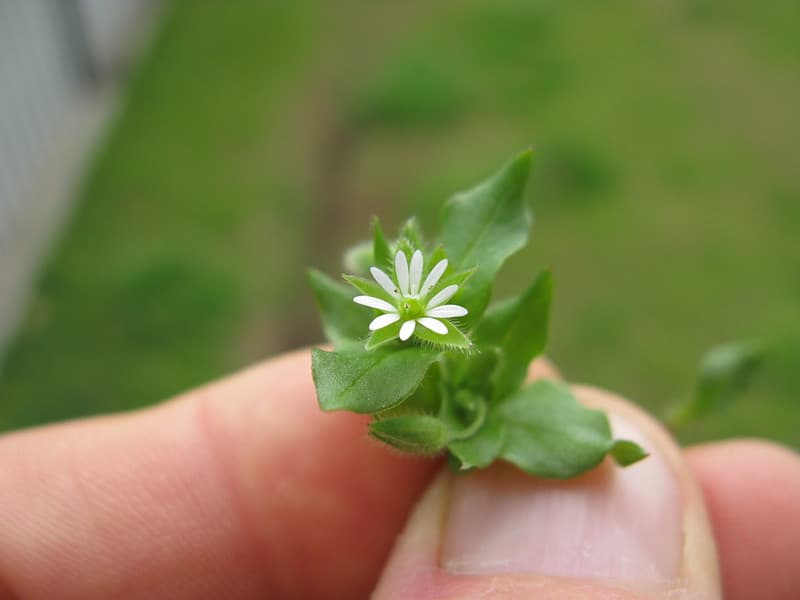
Diagnostic Feature: Chickweed's tiny white flower has just five petals, but each is so deeply notched it appears to have ten.
“Stellaria media flower NC5” by Macleay Grass Man is licensed under CC BY 2.0.
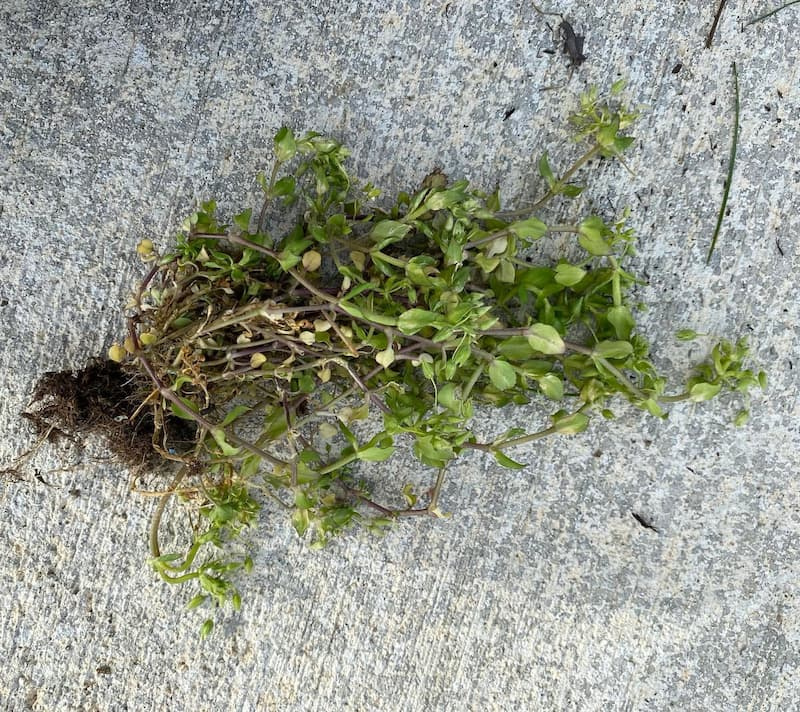
Uprooted common chickweed (Stellaria media) showing its delicate, shallow fibrous root system and sprawling stem architecture.
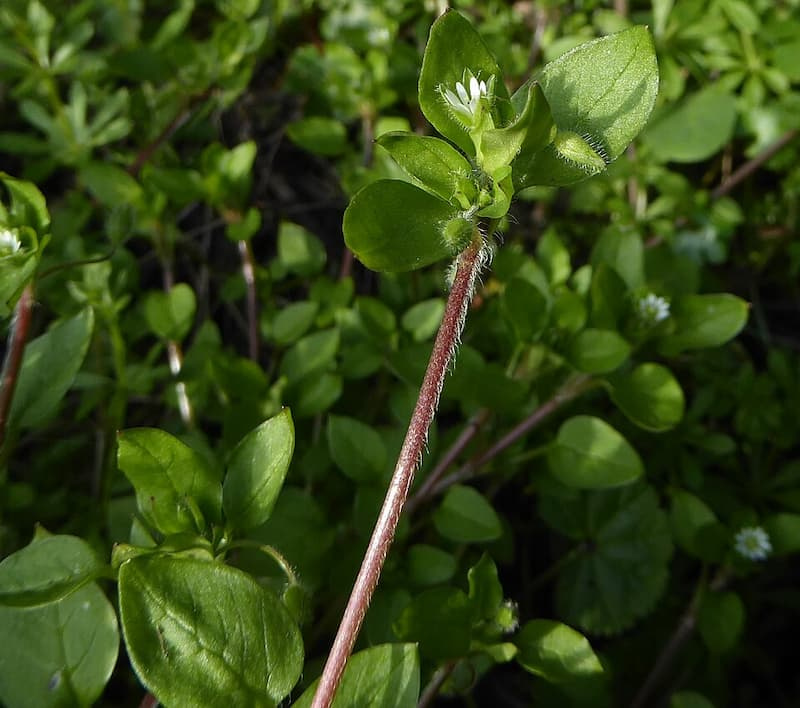
Growth Habit: A single line of hairs runs down one side of the stem, switching sides at each leaf node — a reliable ID trick even without flowers.
“Stellaria media stem hairs” by Alex Lockton is licensed under CC BY-SA 4.0.
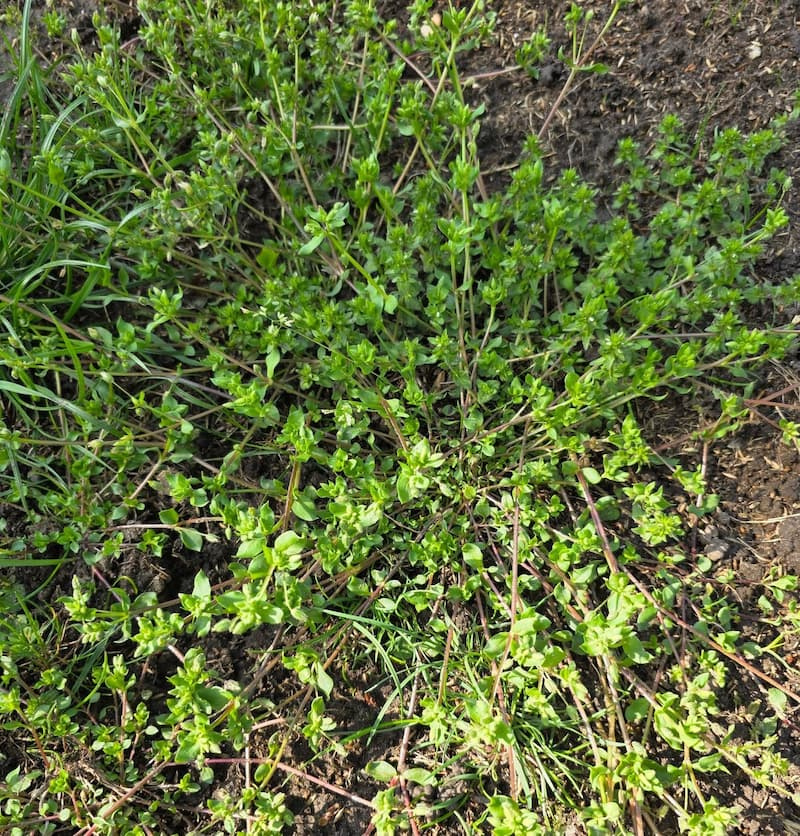
Prostrate growth habit of common chickweed spreading radially across exposed soil prior to turf competition.
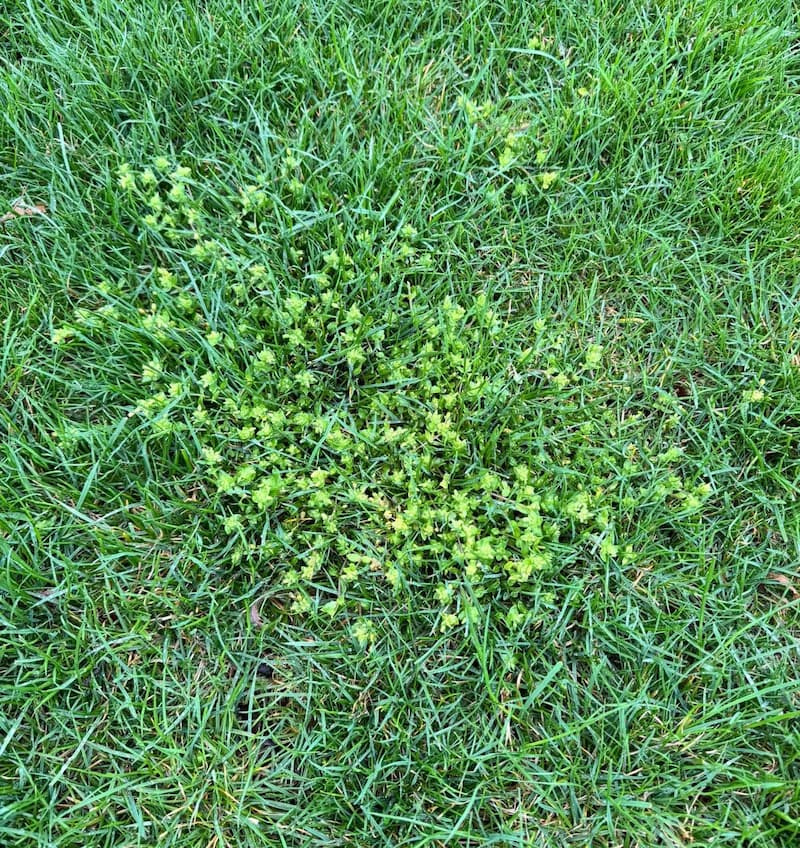
Typical circular patch of common chickweed establishing within a cool-season turfgrass lawn.
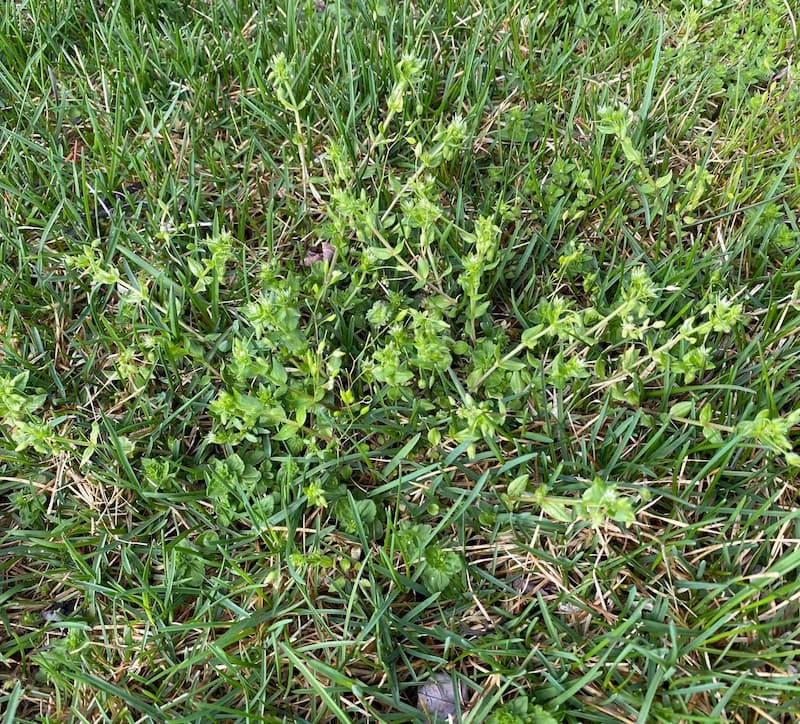
Detail view of chickweed branching stems illustrating the characteristic opposite leaf pairing and emerging flowers.
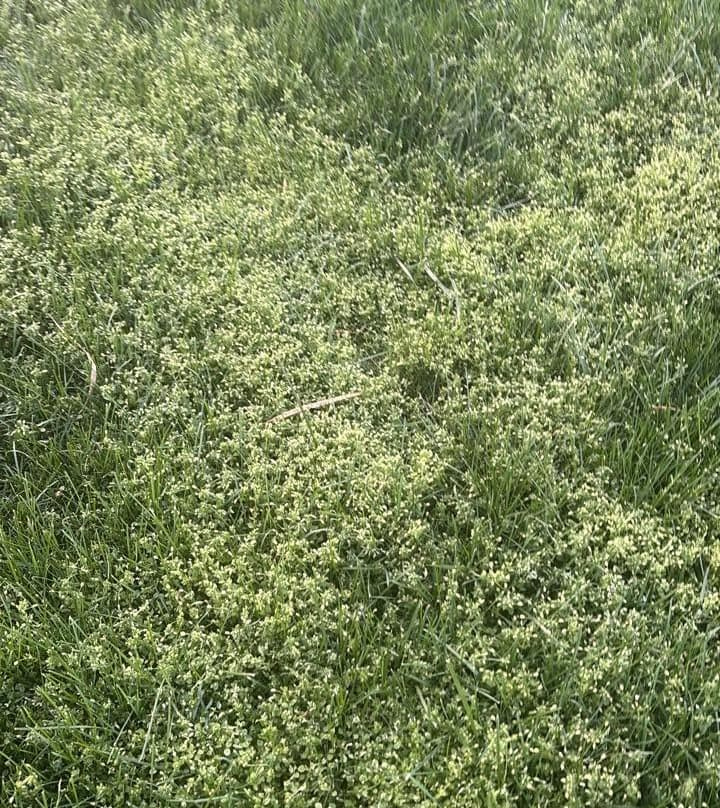
Severe common chickweed infestation forming a dense, tangled mat that smothers underlying turfgrass.
The Identity Trap
Common Lookalikes
Mouseear chickweed is the one that matters, because it shares the name, the mat habit, and the lawn — but it’s a perennial, so it won’t die on its own in summer and it laughs off the pre-emergent timing that works on common chickweed. Scarlet pimpernel (sometimes called “red chickweed”) sprawls with the same low, opposite-leaved look and gets mistaken for it early, before it flowers.
Identification Differentiators: How to Tell Them Apart
Common vs. mouseear chickweed: rub the leaves and stems. Common chickweed is mostly smooth with that single switching hairline; mouseear chickweed is fuzzy all over — densely coated in soft, sticky hairs on every surface — and its leaves clamp the stem with no stalk. If it’s hairy everywhere, treat it as the perennial and expect a longer fight.
Common chickweed vs. scarlet pimpernel: roll the stem between your fingers. Chickweed’s stem is round with one line of hairs; scarlet pimpernel’s stem is square and completely hairless, its leaves carry small dark spots on the underside, and its flowers (when they come) are salmon-to-brick-red, not white. Worth telling apart for another reason — scarlet pimpernel is toxic, and chickweed is not.
Growing Conditions
Host Grasses
Chickweed isn’t picky about which grass it invades — it shows up in cool-season stands of Kentucky bluegrass, perennial ryegrass, and fine fescue, and in warm-season lawns like bermudagrass once they go brown and dormant for winter. What it actually needs is a gap. It can only get going where the turf canopy is thin enough to let light reach the soil, so anything that opens the stand invites it: scalping-low mowing, insect or disease damage, winter injury, summer drought thinning, or worn edges. On a golf green it will survive and seed at an eighth of an inch, which tells you mowing alone won’t beat it.
Host Environment/Area
This is a cool, damp, shade-tolerant plant. It thrives in moist, fertile, shaded ground and struggles in heat and drought — which is why it politely dies off each summer unless it’s sitting in an irrigated, shady pocket. Expect it under tree canopies, along the damp mulch skirts of shrubs, in low spots that stay wet, and anywhere irrigation keeps the surface soil constantly moist. It has no real preference for lawn versus bed; it goes wherever the microclimate suits it. The difference is only in form: mowed flat and tight in turf, loose and mounding to a foot or more in an unmowed bed.
Soil Indicators: What the Presence of This Weed Reveals About Your Yard
Chickweed is one of the more honest indicator weeds in the yard — a thriving patch is usually telling you three things at once. It signals compaction (its shallow fibrous roots exploit dense soil that starves the grass of air), excess moisture or poor drainage (it loves consistently wet surface soil and chronic over-irrigation), and high fertility, especially leftover nitrogen (big lush mounds mean the soil is nitrogen-rich, because chickweed is a ravenous nitrogen scavenger). It also prefers neutral soil around pH 7 and does poorly in strongly acidic ground, so a heavy stand quietly rules out an acidity problem in that spot. Read the patch as a soil report, not just a weed.
Lifecycle and Season
Lifecycle Category and Management Implications
Chickweed is a winter annual: it lives its whole life on seed, from a fall germination through a winter of low growth to a spring burst of flowering and seed set, then dies in summer heat. (In cool, foggy coastal areas it can linger as a short-lived perennial, but for most lawns it’s a true annual.) Because it carries nothing over underground — no rhizome, tuber, or persistent taproot — the whole strategy is built on the seed. That’s the good news: a pre-emergent barrier laid down at the right time is a primary, highly effective tool here, unlike with perennial weeds. The bad news is the seed bank, which is deep and long-lived, so one good season doesn’t finish the job.
Germination Trigger
Chickweed germinates on falling temperatures, not rising ones. The flush begins as soil cools through about 70°F and peaks when soil settles into the mid-50s to upper-60s°F; above roughly 86°F, germination shuts off. The seeds need light to sprout and come up right at the surface — almost all within the top half-inch, very few below an inch deep. Wet surface soil can push germination even at warmer temperatures. That light requirement and shallow depth are the levers for control: shade the soil and you switch a lot of the seed bank off.
In cool-season lawns the main germination flush comes in late summer and early fall, right when the turf is thin and recovering from summer stress. Lay the pre-emergent down before that flush — in late summer as soils begin to cool below the upper limit, generally several weeks ahead of the steady autumn rains. The best post-emergent window is also fall (think October), while the seedlings are small and tender; by spring the plants are big mats that shrug off a single spray. Expect a second, smaller germination flush in spring in shaded, moist spots, so fall cleanup alone won’t cover the whole year.
In warm-season lawns chickweed is a winter problem that exploits dormant turf. As bermudagrass, zoysia, centipede, and St. Augustine slow down and brown out, chickweed germinates into the gap and builds a green mat over the sleeping lawn — which then shades and cools the soil and can delay spring green-up, leaving bare patches behind. Time the fall pre-emergent to the same cooling trigger (soil around 70°F): roughly late August through mid-September in North Carolina, Virginia, and north Georgia, and early-to-mid October along the Gulf and in central-to-south Florida. Because southern winters stay mild and wet, one application often won’t hold all season, so a second split application 8–10 weeks later (mid-November into January) is commonly needed. Every pre-emergent needs a half-inch of water within a day or two to activate.
The transition zone is the hardest to schedule because it stacks two problems on one calendar. First, the fall pre-emergent that blocks chickweed also blocks grass seed — so if you’re overseeding or renovating a cool-season lawn in fall, a standard pre-emergent and your new grass seed collide, and one has to give. (Mesotrione is the usual escape hatch, since it can be used at seeding; otherwise you separate the jobs in time and lean on post-emergent cleanup.) Second, on warm-season lawns here, the same barrier conflicts with any fall ryegrass overseeding, and spring broadleaf sprays have to wait until the warm-season grass has fully greened up — spraying into green-up injures the recovering turf. Fluctuating winter temperatures also drive multiple germination flushes, which is what pushes most transition-zone programs toward split pre-emergent timing rather than a single date.
Herbicide Control
Pre-emergent is a primary, effective tool against chickweed in turf, because the plant depends entirely on seed. The whole game is timing it to the fall germination flush, not the spring — put it down in late summer to early fall as soils cool toward 70°F, then water it in with about a half-inch within a day or two so it forms its barrier. Effective active ingredients include isoxaben (especially strong on broadleaves like chickweed), prodiamine, pendimethalin, dithiopyr, and oxadiazon; on warm-season lawns, atrazine and simazine add pre- and post-emergent activity where they’re labeled for the turf species.
The catch that trips people up is seeding. Most of these chemistries also stop grass seed from germinating, and the waiting period before you can safely overseed varies a lot — from around 60 days for isoxaben to as long as four to six months for prodiamine. If you plan to seed this fall, either use mesotrione (which is labeled for use at seeding) or separate the two jobs in time. Match the product to your turf species and your seeding calendar before you buy.
Spray chickweed while it’s small and actively growing — mid-to-late fall is the sweet spot, when seedlings are one to a few inches and tender. By spring you’re fighting established mats that need stronger chemistry and often more than one pass.
Two physical traits fight your spray. The mature mat is layered, so droplets sit on top and never reach the lower leaves and crown; and the upper leaves have a slightly waxy, water-repelling surface. Beat both by adding a non-ionic surfactant at 0.25% and spraying a higher water volume with coarse droplets at lower pressure, so the solution drives down into the canopy instead of beading on top. Temperature matters too: systemic herbicides need the plant actively growing (daytime highs around 50°F or better) to move through it, and applications stall below 50°F. On cool-season turf, don’t spray above about 85°F or you’ll scorch the lawn; on warm-season turf, don’t spray broadleaf products during spring green-up.
For products, the workhorses are the synthetic-auxin three-way mixes (2,4-D + MCPP + dicamba), with ester formulations penetrating that waxy cuticle better in cool spring weather, and versions that add a fast contact partner (carfentrazone or sulfentrazone) to knock down thick mats. ALS-inhibitor products (florasulam, metsulfuron, or the warm-season-safe combination product Celsius) are effective — but resistance is real here: ALS-resistant chickweed biotypes are confirmed in Pennsylvania and Delaware, so use full label rates and tank-mix or rotate a second mode of action rather than leaning on ALS chemistry alone. Mesotrione gives selective control on cool-season turf. On fully dormant bermudagrass, a broadcast of glyphosate is a low-cost way to clear actively growing chickweed off the sleeping lawn — but only while the bermuda is 100% dormant, because any green-up means the glyphosate injures the turf. (Buying tip: not every product labeled “Roundup” is glyphosate anymore — check the active-ingredient panel.)
Verdict: multi-season. A well-timed fall pre-emergent plus prompt spring cleanup will crush a single year’s crop, but it won’t empty the seed bank — plan on a consistent three-to-five-year program to grind the reservoir down.
Cultural control is the foundation, and it works through one lever above all: shade the soil. Chickweed seed needs light to germinate, so a dense, tall canopy switches much of the seed bank off before it starts. Mow cool-season grass high (3–4 inches) and keep the stand thick. Feed carefully in fall to build turf density through the germination window — but don’t overdo nitrogen, because chickweed is a nitrogen scavenger that feasts on excess and will out-grow a lawn you over-fertilize; match rates to a soil test. Water deeply and infrequently so the surface dries between cycles instead of staying constantly moist, since wet surface soil is a direct germination trigger. Relieve compaction and fix drainage in the chronic damp spots (but aerate in the growing season, not fall, so you don’t open bare, light-exposed soil right as chickweed germinates). Overseed thin patches in late summer, ahead of the flush, so grass — not chickweed — fills the gaps.
In ornamental beds, a fall pre-emergent laid down as soils cool (early-to-mid September in most areas) is the primary chemical defense; spring applications are useless against a winter annual that’s already up. Choose the product for ornamental safety, not just weed control. Trifluralin and napropamide are among the gentlest on sensitive herbaceous plants; pendimethalin is broadly safe, especially in granular form; isoxaben is excellent on chickweed and safe around woody plants but can injure some herbaceous species (foxglove, snapdragon, speedwell) and pansies; oryzalin is for woody beds only and can girdle young azaleas. Granular formulations are far safer over the top of ornamentals than liquid concentrates — just apply them to dry foliage and water them in afterward, so nothing sticks and burns.
Mulch changes how these work. The common approach is to mulch first, then apply a granular pre-emergent on top and water it down to the soil-mulch line where seeds germinate — but if the mulch is thicker than 3–4 inches or made of fine, spongy material, it binds the herbicide and control fails. A few products (oxadiazon, oxyfluorfen) instead need to go on the bare soil surface beneath the mulch, and lose their barrier entirely if you cultivate afterward. Know which type you’ve bought.
Once chickweed is up in a bed, broadcast broadleaf sprays are off the table — they’ll damage your ornamentals. This is directed-spot-spray territory. Glyphosate gives clean, broad-spectrum control aimed straight at the chickweed foliage, applied in a low water volume for better uptake, with a shield or careful nozzle work so not a drop of spray touches green ornamental tissue. For a non-systemic option around established woody plants, contact products — pelargonic acid, ammonium nonanoate, diquat, glufosinate, or 20% acetic acid — burn down young seedlings under two inches; they’re safe against mature brown bark but will kill the green, tender stems of young plants, so keep them off anything not yet woody.
Verdict: multi-season, but a small bed you can actually keep mulched and hand-weeded before flowering can get ahead of chickweed faster than a lawn can. The seed bank still sets the timeline.
Mulch is the backbone of chickweed prevention in beds, and it works by blocking the light the seeds need to sprout. Keep a consistent 2–4 inches of coarse-to-medium organic mulch (3–4 inches under shrubs and trees, a lighter ~2 inches over herbaceous crowns so you don’t smother them). Skip fine mulches like sawdust or fresh compost — they hold surface moisture and become a seedbed on top of the mulch — and skip oversized chunks that leave gaps for light to slip through. Chickweed is opportunistic, so refresh thin and worn spots; in high-pressure beds, a sheet of black plastic or heavy paper under the mulch shuts the light out completely.
Herbicide Application Reference
On cool-season turf, do not apply synthetic-auxin (2,4-D / MCPP / dicamba) products above about 85°F — heat drives phytotoxic injury to the lawn — and note that ester formulations, chosen here for pushing through chickweed’s waxy cuticle in cool weather, are more prone to vapor movement than amine forms. On warm-season turf, keep broadleaf post-emergents off the grass during spring green-up, and remember atrazine is safe on bermudagrass only when it’s fully dormant. ALS-inhibitor resistance in chickweed is confirmed in parts of the mid-Atlantic (Pennsylvania, Delaware), so don’t build a program on ALS chemistry alone — rotate or tank-mix modes of action. In beds, any glyphosate or contact spray that touches green ornamental tissue will injure it, so use shields, low pressure, and calm-day timing.
A product note that is easy to miss: the consumer “Roundup” brand no longer reliably means glyphosate. Several reformulated versions now use different active ingredients, and some of them — imazapic is one — stay active in the soil, where nearby ornamental and tree roots can take them up. That soil-residual behavior is exactly what you’re trying to avoid when you reach for glyphosate here, whether you’re clearing a dormant lawn or spot-spraying a bed. Before you buy, read the active-ingredient panel and pick a product whose only active ingredient is glyphosate.
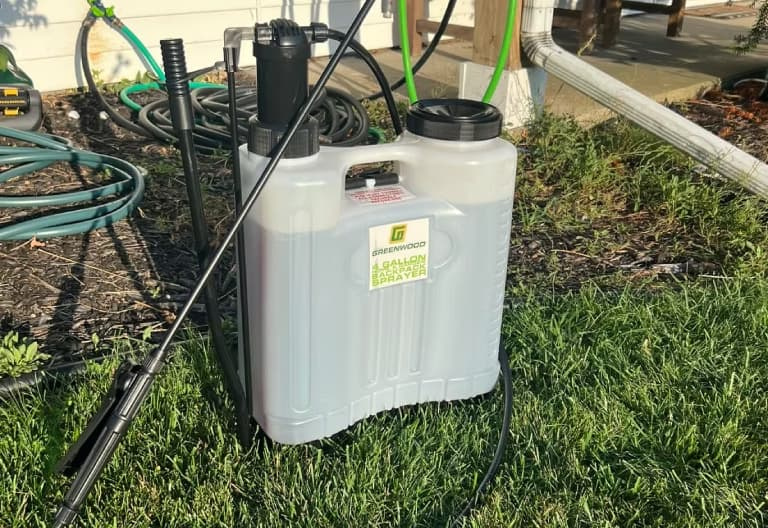
Herbicide Application Guide
New to spraying, or want to get it right? Our Herbicide Application Guide covers the practical steps this page assumes — mixing, calibration, protective gear, and the wind and temperature limits that decide whether a treatment works or drifts. Read it before you spray.
See Guide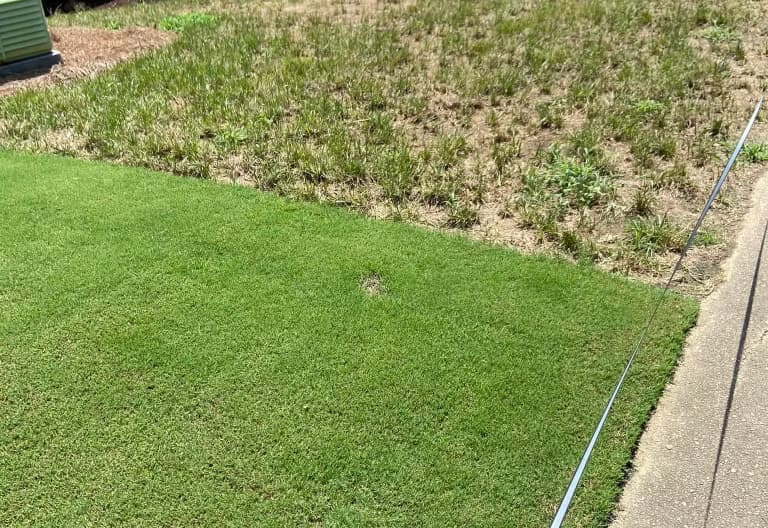
Where Two Lawns Meet
Does your lawn border a neighbor’s — or meet a different type of grass? Spraying near that line can quietly damage the yard next door, sometimes weeks later. Where Two Lawns Meet shows you how to treat safely without harming either side.
Read ArticlePulling
Pull chickweed only if you can do it early, cleanly, and completely — otherwise leave it, because a sloppy pull spreads it.
The Biological Reason
Here’s the part that catches most people out: pulling chickweed badly doesn’t just fail, it multiplies the plant — in two different ways at the same time.
First, the stems root as they go. Chickweed’s prostrate stems put down fresh roots at the nodes — the joints where leaves attach — wherever they lie against moist soil. The root system itself is shallow and fragile, so when you grab a handful of trailing stems and yank, they snap at the nodes and leave the crown behind, and every severed fragment left on damp ground can re-root at its nodes and grow into a new plant. (A few extension programs note the nodes don’t always root in dry turf, but the weight of the research, and the cool damp conditions where you actually find chickweed, say plan for rooting.)
Second, a pulled plant isn’t a dead plant. Toss an uprooted chickweed onto the bed and, if the soil’s moist, it keeps drawing on the water in its own succulent stems long enough to finish ripening and dropping viable seed. It literally reseeds the spot you just weeded.
And the clock is brutal. Chickweed goes from seedling to flowering in about four to five weeks and can set mature seed within two to three months, so the safe removal window closes roughly three to four weeks after a seedling appears — usually before you can even see a flower. Once capsules have formed, the act of pulling shakes them open and shatters thousands of seeds straight into the soil.
So the technique, when you do pull: go early (small seedlings, no flowers), pull when the soil is moist, reach under the mat to the central root point instead of grabbing the outer stems, lift the whole thing, and — this part is non-negotiable — bag every scrap and haul it off-site. Don’t shake soil off into the bed, don’t leave pulled plants lying as mulch, don’t compost them where they touch damp ground.
Lawn vs. Bed Pulling Difference
Loose, cultivated bed soil cuts both ways. It makes a clean, complete pull easier than in compacted turf — a real advantage if you’re early and careful. But that same loose, moist soil is exactly what stray stem fragments need to re-root, so a careless pull, or any wet-soil hoeing or tilling, spreads chickweed faster in a bed than in a lawn. In beds, the sanitation step matters even more: collect everything.
Quick Reference Summary
| Lifecycle Category | Winter annual (seed only; occasionally short-lived perennial in cool coastal areas) |
| Active Zone(s) | Cool-season, transition, and warm-season — a fall-through-spring weed everywhere |
| Germination Trigger | Soil cooling through ~70°F, peaking mid-50s–upper-60s°F; needs light; sprouts in top ½ inch |
| Pre-Emergent | Yes — apply in fall as soils cool (not spring) |
| Post-Emergent Timing | Best on small seedlings in mid-to-late fall; spring mats are harder and need surfactant |
| Pull | With caution — only early, clean, complete, and bagged |
| Lawn Primary Tool | Fall pre-emergent + a dense, high-mown canopy that shades the soil |
| Bed Primary Tool | 2–4 inches of coarse mulch + fall pre-emergent + hand-pull before flowering |
| One-and-Done or Multi-Season | Multi-season — plan a 3–5 year program to draw down the seed bank |
Frequently Asked Questions
These answers are synthesized from botanical morphology studies and herbicide efficacy trials conducted by leading university agricultural extensions.
Because a rough pull spreads it two ways. The stems break at the nodes and any fragment left on moist soil re-roots into a new plant, and a whole pulled plant left lying in the bed keeps ripening and dropping seed from the moisture in its own stems. Pull only small, pre-flower plants, lift from under the mat, and bag every piece.
No. Chickweed adapts to the mower — it simply flowers and sets viable seed below the cutting height, and it survives mowing as low as an eighth of an inch. Mowing keeps it flat but doesn’t stop it seeding, so it’s not a control method on its own.
Usually one of three things. The mat is layered, so spray sits on top and never reaches the lower leaves; the upper leaves are waxy and shed water-based sprays; or it was too cold for the plant to move the herbicide. Add a non-ionic surfactant at 0.25%, spray a higher water volume in coarse droplets, treat small plants in fall, and make sure the weed is actively growing. In the mid-Atlantic, resistant biotypes can also be the culprit — rotate to a different mode of action.
Generally no — most chickweed pre-emergents also stop grass seed from sprouting, and the waiting periods run from about two months to as long as six. Either use mesotrione, which is labeled for use at seeding, or separate the two jobs and lean on post-emergent cleanup for the weeds.
It’s telling you something about that spot. A thriving patch usually signals compacted soil, poor drainage or over-watering, and often leftover nitrogen — all in cool shade. Fixing the underlying condition (aerate, improve drainage, water less often, ease off the fertilizer, let in light) does more long-term than any spray.
Scientific Authority
This profile is constructed using forensic botanical data and Integrated Pest Management (IPM) research. We prioritize scientifically-vetted identification and control methods that protect the broader ecosystem while ensuring successful eradication based on peer-reviewed agricultural studies.
Primary Resources
- Penn State Extension — Lawn and Turfgrass Weeds: Common Chickweed; Perennial Weeds: Mouseear Chickweed; Indicator Weeds Provide Insight into Growing a Better Lawn (extension.psu.edu)
- Purdue University Turfgrass Science / Extension — Common Chickweed; Henbit and Chickweed in Lawns; Control of Broadleaf Weeds in Home Lawns (turf.purdue.edu, extension.purdue.edu)
- Rutgers Cooperative Extension (NJAES) — Common Chickweed; Broadleaf Weed Control in Cool Season Lawns (FS385); Weeds of Early Spring (rutgers.edu)
- Cornell Cooperative Extension — Common Chickweed, Turfgrass and Landscape Weed ID; Cornell Weed Identification (cals.cornell.edu, cornell.edu)
- Ohio State University Extension (Ohioline / Buckeye Turf) — Weed of the Week: Common Chickweed; Broadleaf Weed Identification; Worst Weeds in Landscape Beds (osu.edu)
- Michigan State University Extension — Common Chickweed (Turf); Getting a Start on Weed Control in the Fall; Weed Management in Greenhouses (canr.msu.edu)
- University of Minnesota / Iowa State University Extension — How to Manage Annual Weeds; annual weed life-cycle guidance (extension.iastate.edu)
- UMass Amherst Turf Program — A Guide to Weed Life Cycles (umass.edu)
- NC State Extension (TurfFiles / Plant Toolbox) — Common Chickweed; Mouseear Chickweed; Fall Weed Control Options for Home Lawns; Weed Management in Annual Color Beds (ncsu.edu)
- Clemson Cooperative Extension (HGIC) — Common Chickweed; Plan Winter Weed Control Now; Controlling Weeds in Landscaped Beds Without Glyphosate; Weeds as Indicators (clemson.edu)
- University of Georgia CAES — Weed Control in Home Lawns; Winter Weed Identification and Control (uga.edu)
- University of Florida IFAS Extension — Biology and Management of Common Chickweed in Ornamental Crop Production (ENH1313); Weed Management Guide for Florida Lawns (ENH884) (ifas.ufl.edu)
- Texas A&M AgriLife Extension — Preemergence Herbicides for the Home Lawn; Bermudagrass Home Lawn Management Calendar (tamu.edu)
- Virginia Tech Extension — Common Chickweed Weed Profile; Maintenance Calendar for Warm-Season Turfgrasses (vt.edu)
- LSU AgCenter — Common Chickweed; Landscape Weeds: Common Chickweed; winter weed control guidance (lsuagcenter.com)
- University of Arkansas Cooperative Extension — Common Chickweed; Home Lawn Weed Control (uada.edu)
- Auburn University — Warm-Season Turfgrass Response to Aminocyclopyrachlor (auburn.edu)
- UC IPM / UC ANR — Chickweeds (Home and Landscape); Scarlet Pimpernel; Weeds in Landscapes herbicide tables (ucanr.edu)
- Kansas State / Oklahoma State / University of Missouri / University of Tennessee Extension — transition-zone lawn weed control and calendar publications
- University of Alaska Anchorage, Alaska Center for Conservation Science — Common Chickweed (seed-longevity data under cold conditions)