
Pathogen: Rhizoctonia solani
Also called: Rhizoctonia blight, Rhizoctonia brown patch, summer brown patch
Brown Patch
The fungus that strikes on hot, muggy nights
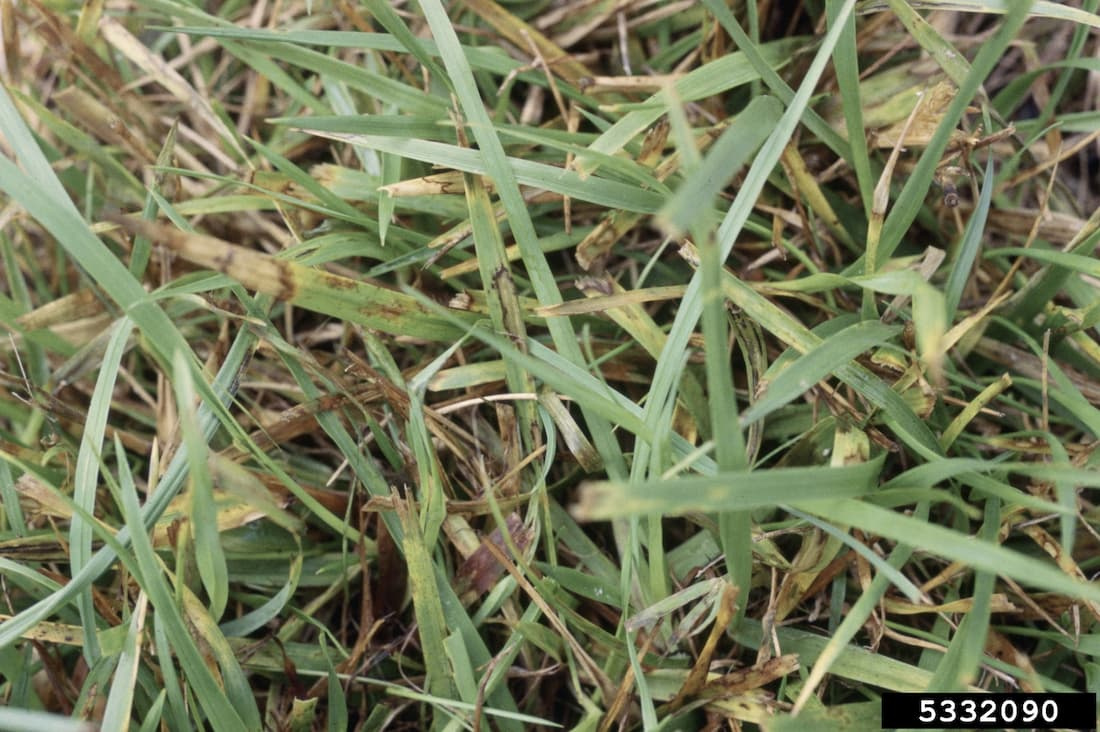
Featured Image Credit: Mary Ann Hansen, Virginia Polytechnic Institute and State University, Bugwood.org, CC BY 3.0
Brown Patch At-a-Glance
Grass Type Affected
Cool-Season Grasses
Recovers on Its Own?
Yes, Slowly
Is Spraying Worth It?
Sometimes Worth It
Disease Type
Fungal
Active Season
Late Spring & Early Summer
Mid to Late Summer
Fall
Damage Potential
Cosmetic Only
Can Be Fatal
Brown Patch Quick Answers
What Brown Patch Looks Like
From Standing Height
In early summer heat, areas of the lawn first look dull and purplish to gray-green, as if they need water. Within days they fade to tan or straw-colored patches from about 6 inches to 3 feet across, and on tall fescue lawns they often blend into large, irregular brown areas many feet wide. As the patches age, the center often greens back up, leaving a tan ring around a green middle — the classic “frog-eye.”
Up Close: Blades, Crowns and Roots
Up close, brown patch leaves its clearest evidence on individual blades, especially on tall fescue and perennial ryegrass. Look for irregular, oval or elongated spots with a bleached tan or straw-colored center and a distinct dark brown, reddish-brown or purplish border. The spots can stretch across the full width of the blade. Once a spot circles the blade, everything above it withers and turns tan, so many blades look dead from the tip down to the spot.
Below the spots, the grass is usually fine. Brown patch is a leaf disease: the crowns at the soil line and the roots stay alive and white, which is why the lawn can recover. The exceptions are grass seedlings, which have no tough crown yet, and established grass during extreme stretches of heat (nights above 75°F) on soggy soil, when the fungus can move down into the crowns and kill plants.
You may read about a dark, smoky “smoke ring” around the edge of each patch. It’s real, but it shows up mostly on golf greens. On a home lawn mowed at normal height, it’s rare and lasts only until the morning dew dries.
Signs of the Organism
On hot, humid mornings, look closely at the edge of a patch before the dew dries. You may see fine, white-to-gray threads, like loose cobwebs, stretching from blade to blade. That’s the fungus itself, growing outward into healthy grass. By mid-morning, as the grass dries, the threads shrivel and disappear — so if you check at noon, you’ll see nothing. The fungus also leaves tiny, hard, dark resting bodies in the thatch, but they’re too small to spot without a magnifier.
Identification Photos
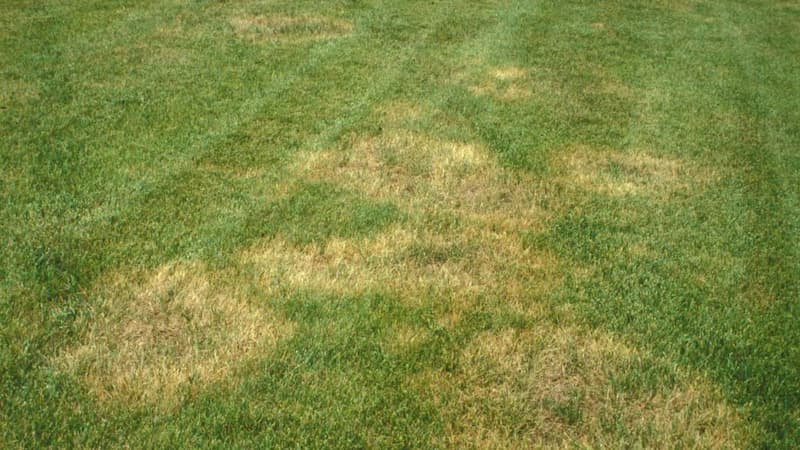
In the Lawn: At normal lawn height, brown patch shows up as roughly circular brown, tan or yellow patches from 6 inches to several feet across.
NC State University, used with permission
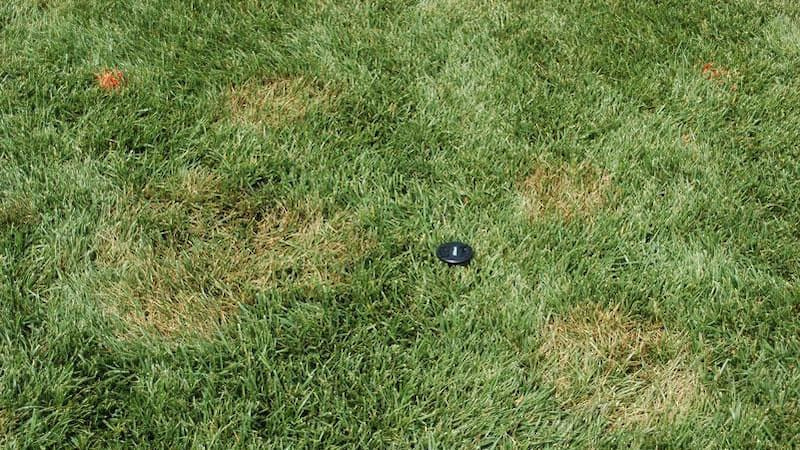
Up Close: The blades inside a patch usually stay upright rather than matting down, which helps set brown patch apart from Pythium blight.
NC State University, used with permission
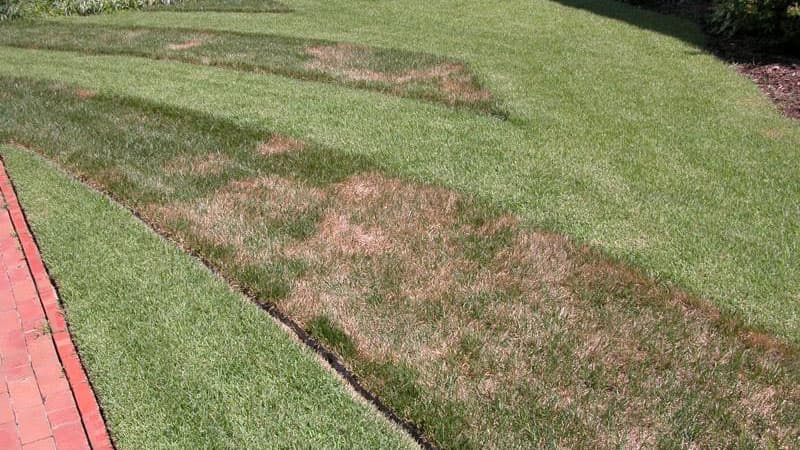
Grass Type Matters: Here brown patch has hit the tall fescue but left the neighboring zoysiagrass untouched.
NC State University, used with permission
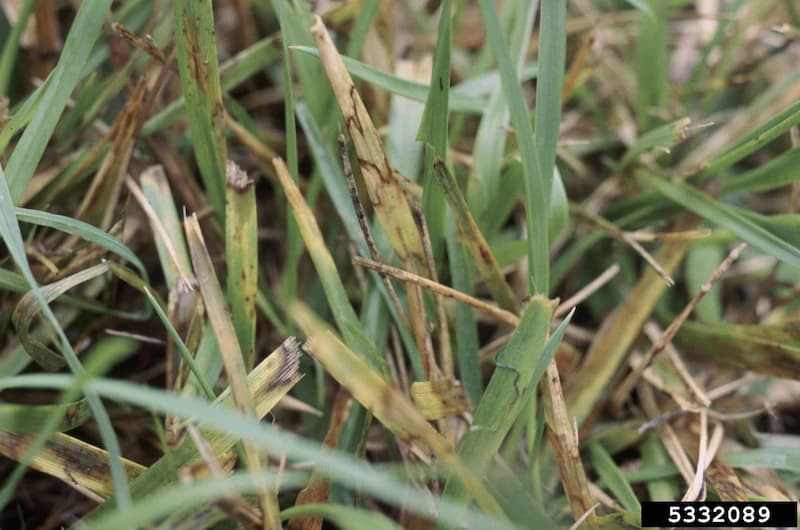
Diagnostic Feature: Irregular tan spots with a dark brown border, often wide enough to circle the whole blade.
Could It Be Something Else?
Common Lookalikes
Drought stress is the most common mix-up. In midsummer heat, a thirsty lawn also turns gray-green and then tan in large areas — but drought doesn’t leave spots on individual blades.
White grub damage shows up in the same late-summer window as large, irregular brown areas. The difference is underground: grubs eat the roots, and brown patch doesn’t touch them.
Dollar spot can produce the same white morning webbing. Its patches stay small — about the size of a silver dollar to a few inches — and its blade lesions have a pinched, hourglass shape.
Pythium blight hits in the same hot, humid weather but moves faster and looks different: the grass turns dark and greasy, mats down, and often runs in streaks along low, wet drainage paths.
Field Checks Before You Treat
- Check the blades. Pull 10 to 15 blades from the edge where green meets brown. Brown patch leaves irregular tan spots with a dark brown or reddish-brown border, often wide enough to circle the whole blade. Drought-stressed blades are folded or rolled but spotless. Blades torn by a dull mower have frayed, whitish tips but no bordered spots below them.
- Do the morning dew check. Walk the lawn at sunrise in hot, humid weather. White cobwebby threads between blades at the patch edge confirm active fungus. (Dollar spot also shows webbing, so check patch size too.)
- Tug the grass. Grab a handful at the soil line and pull. Brown patch grass stays firmly rooted. If the turf peels back like a carpet, look for C-shaped white grubs in the top inch of soil.
- Feel the leaves. Brown patch leaves are dry and papery. Dark, slimy leaves that feel greasy and mat together point to Pythium blight — which needs different treatment.
- Check the soil moisture. Push a screwdriver 6 inches into the soil inside and outside a patch. If the soil is dry and hard and the grass perks up within a day of watering, it was drought, not disease.
Grasses at Risk
Host Grasses
Which Grasses Suffer Most
Tall fescue is brown patch’s main target, and young tall fescue lawns — less than a year old — suffer the worst. Perennial ryegrass and bentgrass are also highly susceptible. Kentucky bluegrass rarely shows brown patch except during long stretches of heat and humidity, and fine fescues are less likely to show symptoms. Warm-season grasses don’t get brown patch at all; their Rhizoctonia disease is large patch.
No tall fescue variety is truly resistant — NC State’s turf team is clear that the species itself is susceptible and varieties differ only somewhat. Still, choosing well helps. When you seed, pick a blend of three or four turf-type tall fescues rated in the top group for brown patch in National Turfgrass Evaluation Program (NTEP) trials, and consider adding about 10 percent Kentucky bluegrass by seed weight. The bluegrass rarely gets brown patch and fills in if the fescue is damaged.
Old-fashioned Kentucky-31 tall fescue shows less brown patch than modern turf types, but its coarse, light-green, open look disappoints most homeowners.
Why It Shows Up
Conditions That Trigger It
Brown patch is driven by warm nights, not hot days. It starts when nighttime air temperatures stay above about 60–65°F and becomes severe when nights stay above 68–70°F while days run in the 80s and 90s. High humidity matters because it keeps the grass wet: the fungus needs more than 10 hours of continuous leaf wetness to infect. Muggy, overcast stretches with rain or heavy dew are the classic setup.
Several lawn conditions make it worse, each by keeping leaves wet longer or making them easier to infect:
- Evening or late-afternoon watering stretches overnight leaf wetness to 12 to 14 hours or more — well past what the fungus needs.
- Heavy, fast-release nitrogen in late spring and summer pushes soft, lush leaf growth that the fungus penetrates easily.
- Mowing too short (below about 2.5 inches on tall fescue) weakens the grass right when it’s under heat stress.
- Shade and poor air movement from trees, fences and dense shrubs slow morning drying.
- Poor drainage, low spots and compacted soil keep the surface wet and humid.
- Thatch thicker than ½ inch holds moisture and shelters the fungus’s resting bodies.
- Seeding too heavily creates a crowded, humid stand of young grass that the fungus sweeps through.
How It Survives and Spreads
The fungus lives in your lawn year-round. It survives winter as tough resting bodies and dormant threads in the thatch and top layer of soil, and those can stay alive for years. When summer nights warm up and the grass stays wet, they wake up and grow onto the leaves, entering through natural openings and fresh mowing cuts.
From there it spreads outward from plant to plant across wet grass, which is why patches grow in rings. It doesn’t produce airborne spores, so it moves between areas mainly by hitching a ride: on mower blades and wheels, on shoes and paws in the morning dew, in water running downhill, and in infected sod. Because the resting bodies stay put in the soil, brown patch often comes back in the same spots year after year.
Where It Hits Hardest: Regional Notes
Brown patch is the defining summer lawn disease of the transition zone and upper South — roughly Virginia, North Carolina, Kentucky, Tennessee, Missouri, Kansas, and the southern parts of Pennsylvania, Indiana and Illinois — where tall fescue is the main lawn grass and summer nights stay warm and humid. In the northern cool-season states it’s occasional, usually showing up during a short midsummer heat wave on overwatered, shaded or compacted lawns.
In Florida, the Gulf Coast and southern Texas, cool-season lawns aren’t grown, so true brown patch doesn’t occur there. When people in the South say “brown patch,” they usually mean large patch, a different disease of warm-season grasses that strikes in spring and fall.
Brown Patch Diagnostic Profile
Check what you see against the full set of signs. The more that match, the more likely this is your problem.
What You’ll See
Symptom Color
Tan or Straw
Brown
Red, Pink or Purple
White or Gray
Visible Signs
Cottony White Webbing
Lawn Pattern
Circular Patches
Rings or Frog-Eyes
Irregular Patches
Overall Thinning
Patch Size
2 to 6 Inches
6 to 12 Inches
1 to 3 Feet
Over 3 Feet
Blade Symptoms
Lesions with Dark Borders
Tip Dieback
When and Where
Weather Triggers
Warm & Humid
Hot & Humid
Long Leaf Wetness (Dew or Rain)
Wet or Poorly Drained Soil
Where in the Lawn
Shade
Low or Wet Spots
Compacted or High-Traffic Areas
New Seedings
Open, Sunny Lawn
Controlling Brown Patch
Most home lawns can keep brown patch in check without spraying. The two changes with the strongest evidence are watering time and nitrogen.
- Water only in the early morning hours, before sunrise. The grass is already wet from dew; watering then adds no extra wet hours, and the morning sun dries everything. Evening watering does the opposite — it extends leaf wetness well past the 10-hour mark the fungus needs.
- Water deeply and infrequently. Aim for about 1 inch per week, wetting the soil 4 to 6 inches deep. Light daily watering keeps the base of the lawn constantly damp.
- Feed mostly in fall. Fall is when cool-season grasses build roots and disease pressure is low. In late spring and summer, skip heavy, fast-release nitrogen; if you feed at all, use a light, slow-release product. Keep total yearly nitrogen at 4 lb per 1,000 sq ft or less, and never fertilize during an active outbreak — it feeds the fungus.
- Mow tall and dry. Keep tall fescue at 3 to 3½ inches, raising it to 3½ to 4 inches in summer heat. Mow only when the grass is dry, keep blades sharp (torn tips are easy entry points), mow diseased areas last, and hose off the mower deck afterward.
- Let in light and air. Limb up low tree branches and thin dense shrubs around the lawn so dew dries sooner.
- Fix wet, compacted spots. Core aerate compacted lawns in fall, regrade low spots where water sits, and keep thatch under ½ inch.
- Don’t overseed. For tall fescue, stick to 6 to 8 lb of seed per 1,000 sq ft. Thicker seeding creates a humid carpet of seedlings the fungus loves.
Sometimes worth it — but most established home lawns don’t need fungicide. Purdue’s guidance is that fungicides shouldn’t be necessary for residential lawns, because cultural changes control most outbreaks and the grass recovers on its own. Spraying makes sense in a few situations: a tall fescue lawn less than a year old facing its first summer, a lawn with a history of severe brown patch every year, or a long forecast of hot, muggy nights.
Homeowner products. Look for these active ingredients on the label:
| Active ingredient | FRAC group | How well it works on brown patch | Protection per application |
|---|---|---|---|
| Azoxystrobin | 11 | Excellent | Up to about 28 days |
| Azoxystrobin + propiconazole | 11 + 3 | Excellent | About 21–28 days |
| Pyraclostrobin + triticonazole | 11 + 3 | Excellent | Up to about 28 days |
| Propiconazole | 3 | Fair | About 14 days |
| Myclobutanil | 3 | Poor | About 14 days |
Several other brown patch fungicides, including chlorothalonil and iprodione, are not labeled for use on home lawns.
Timing. Fungicides work far better as prevention. Start just before the risk period — when nights begin staying above about 65–68°F with humid weather — and reapply at the interval on the label. Spraying after damage appears stops the spread, but it can’t bring dead leaves back; the lawn still won’t green up until the weather cools.
Rotate. Don’t use the same FRAC group twice in a row. Alternate a group 11 product with a group 3 product so the fungus doesn’t build resistance.
Granular products must be watered in right away with about ½ inch of water to move the fungicide down to where the grass absorbs it. Liquid sprays should dry on the leaves first unless the label says otherwise.
Recovery and Repair
An established lawn usually repairs itself. Once nights cool and humidity drops in late summer or early fall, the living crowns push out new leaves, and the patches fill in within 2 to 4 weeks. You can help: after the outbreak has completely stopped, apply a light feeding of less than ¼ lb of nitrogen per 1,000 sq ft, keep watering deeply in the early morning during dry spells, and keep mowing at 3 to 3½ inches with a sharp blade.
Recovery fails where the fungus killed the crowns — in new seedings and after extreme heat on soggy soil. Those areas stay thin or bare and need reseeding.
Reseed in late summer to early fall (late August through mid-September in most cool-season and transition areas). The seedlings sprout in warm soil, root in cool fall weather when brown patch is inactive, and are mature before next summer. Avoid spring seeding when you can: young grass facing its first summer is the most vulnerable grass there is. Rough up or core aerate the bare areas, apply a starter fertilizer, and sow a brown patch–tolerant tall fescue blend at 6 to 8 lb per 1,000 sq ft. Keep the surface lightly moist until the seed sprouts.
When to Call a Pro
Send a sample to your state’s extension diagnostic lab if the patches keep spreading after you’ve fixed watering, mowing and fertilizing; if you can’t tell brown patch from Pythium blight, summer patch or drought (they need different treatment); or if large areas of grass are dying outright.
Dig a plug about 6 inches across, with 1 to 2 inches of roots and soil, from the edge of an active patch — about half green, half brown. Completely dead grass is useless to a lab. Keep it cool, send it fresh by a fast carrier early in the week so it doesn’t sit in a hot warehouse over a weekend, and include your grass type, lawn age, watering schedule and recent fertilizer or pesticide use. Check your state lab’s own instructions before mailing.
Frequently Asked Questions
These answers are synthesized from plant pathology research and diagnostic guidance published by university extension services and plant disease clinics.
The fungus survives in the thatch and top layer of soil as tiny, tough resting bodies that last for years. Every summer, when nights warm up, the ones in those spots wake up first. Fixing what keeps those areas wet — shade, poor drainage, compaction or evening watering — is how you break the cycle.
Not during an outbreak. Nitrogen pushes soft new leaves, and that’s exactly what the fungus feeds on, so the patches can spread faster. Wait until the disease has stopped, then use only a light feeding, and save the main fertilizing for fall.
Most likely you have different grass. Tall fescue is highly susceptible to brown patch, while Kentucky bluegrass rarely gets it. Watering time matters too: a lawn watered in the evening stays wet all night, while one watered before sunrise doesn’t.
Not in summer. Seedlings that sprout in July or August walk straight into the conditions brown patch loves. Wait until late August to mid-September, and first give the existing grass a few weeks — most patches fill back in on their own.
Scientific Authority
This profile is built on plant pathology research and diagnostic guidance from university extension services and plant disease clinics. We prioritize accurate identification and cultural control first, recommending fungicides only where research shows they are justified, and naming them by active ingredient rather than brand.
Primary Resources
- Penn State Extension — Turfgrass Diseases: Brown Patch (Causal Fungus: Rhizoctonia solani)
- Purdue Extension — Turfgrass Disease Profiles: Brown Patch (BP-106-W)
- Purdue Turfgrass Science — Common Diseases on Cool-Season Lawns (BP-218-W)
- University of Missouri Extension — Identification and Management of Turfgrass Diseases: Brown Patch (IPM1029)
- Clemson Cooperative Extension HGIC — Brown Patch & Large Patch Diseases of Lawns (HGIC 2151)
- NC State Extension — Brown Patch in Turf
- NC State TurfFiles — What Brands of Tall Fescue Are the Most Resistant to Brown Patch? https://www.turffiles.ncsu.edu/news/what-brands-of-tall-fescue-are-the-most-resistant-to-brown-patch/
- NC State Turf Pathology — Does Nitrogen Increase Brown Patch Severity in Tall Fescue? https://turfpathology.ces.ncsu.edu/news/does-nitrogen-increase-brown-patch-severity-in-tall-fescue/
- UC IPM — Rhizoctonia Blight (Brown Patch, Large Patch, Yellow Patch)
- University of Wisconsin–Madison Turfgrass Diagnostic Lab — Homeowner Services