
Pathogen: Puccinia spp.
Also called: rust, lawn rust, turf rust, grass rust, leaf rust, stem rust, crown rust, stripe rust
Lawn Rust
The hungry lawn's orange dust
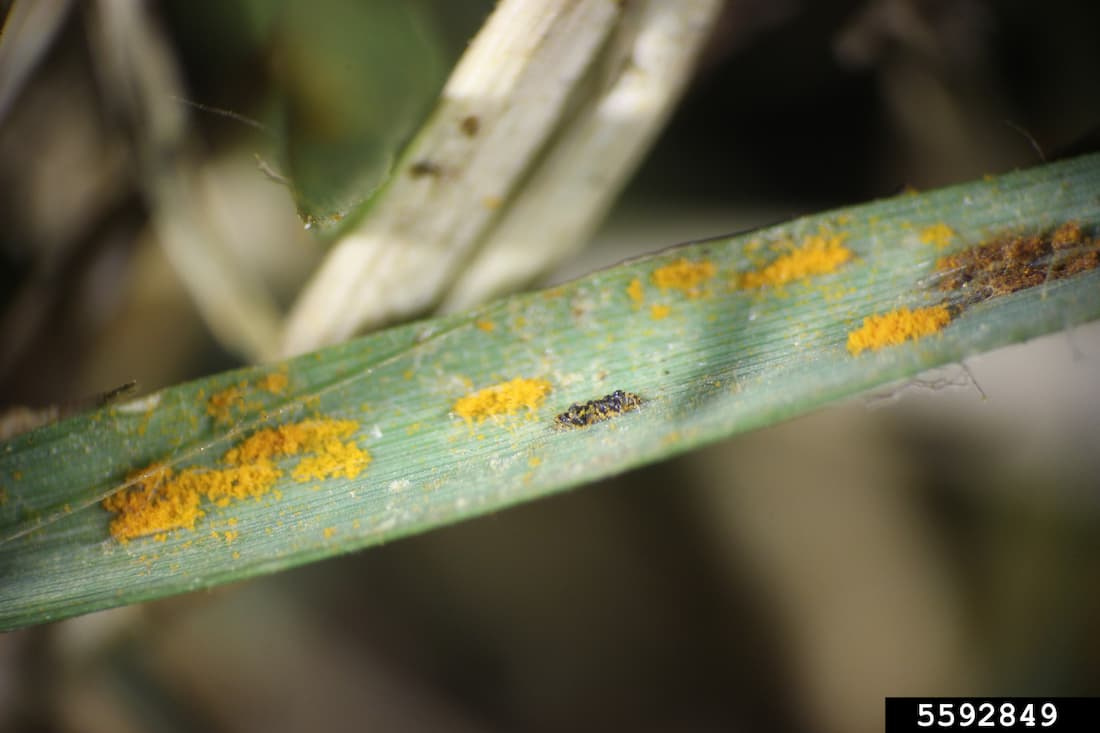
Featured Image Credit: Clarissa Balbalian, Mississippi State University, Bugwood.org, CC BY 3.0
Lawn Rust At-a-Glance
Grass Type Affected
Cool & Warm Season
Recovers on Its Own?
Yes, Quickly
Is Spraying Worth It?
Rarely Worth It
Disease Type
Fungal
Active Season
Early Spring
Late Spring & Early Summer
Mid to Late Summer
Fall
Winter
Damage Potential
Cosmetic Only
Weakens Over Time
Can Be Fatal
Lawn Rust Quick Answers
What Lawn Rust Looks Like
From Standing Height
From a standing position, rust doesn’t make neat spots or rings. The lawn takes on a dull yellow cast that turns orange to reddish-brown as the spore pustules mature, as if the grass had been dusted with rusty iron. The color is diffuse and irregular and worst in shade, under trees, and in thin, dry or underfed areas. In a bad year it covers whole sections of lawn, which then look thin and weak.
Up Close: Blades, Crowns and Roots
Pull a few discolored blades and look at them in good light. Rust starts as tiny pale-yellow flecks on the leaves and stems. The flecks enlarge and line up in rows along the leaf veins, then break open into small raised blisters called pustules. The pustules are orange to reddish-brown, packed with powdery spores, and have no dark border around them.
As the pustules multiply, the blade yellows from the tip down, then withers and dries out. Stem rust also puts pustules on the leaf sheaths and stems. In fall the pustules may turn dark brown or black. All the damage stays above ground. The crowns and roots stay firm and off-white, which is why established grass grows back once it’s fed and watered.
Signs of the Organism
You can see the fungus itself without a magnifier. It shows up as small orange to reddish-brown pustules on the blades, filled with powdery orange spores. When you walk through an infected lawn or run the mower, the spores rub off as orange dust on shoes, pant legs, mower decks, pet fur and fingers. Late in the season the pustules turn dark brown to black as the fungus makes its overwintering spores. You can check any time of day. A white tissue wiped across the blades shows the dust best.
Identification Photos
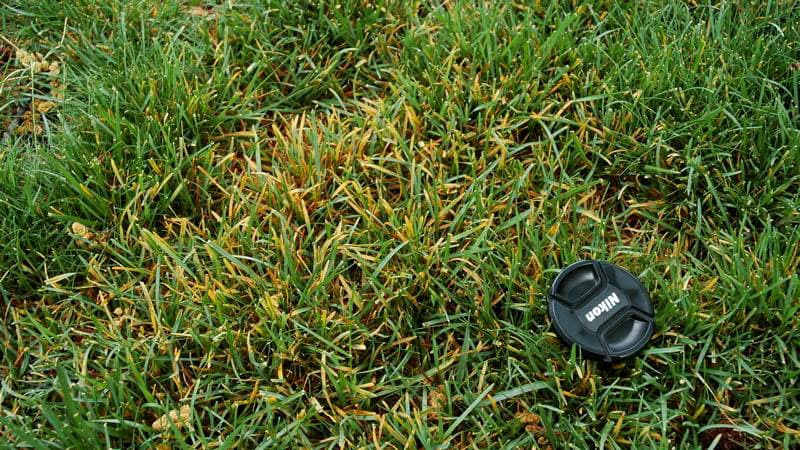
From a Distance: A rusted lawn takes on a yellow to orange cast, especially in late summer and fall when growth slows.
NC State University, used with permission
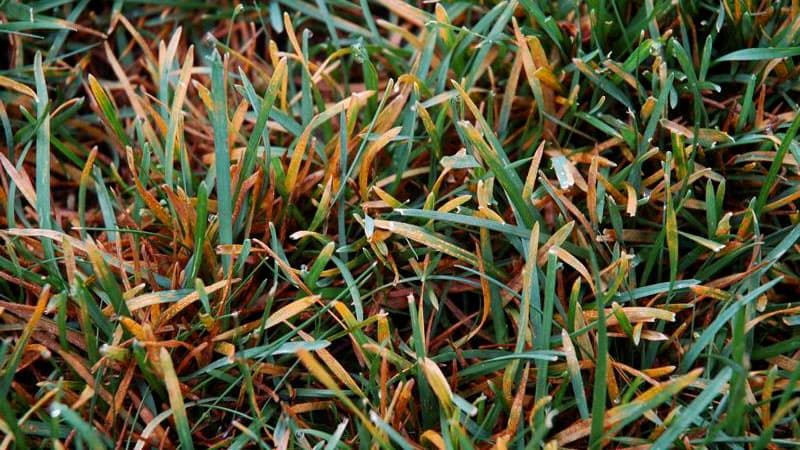
Heavy Infection: Badly rusted blades turn orange to reddish-brown and can thin the lawn if rust lingers.
NC State University, used with permission
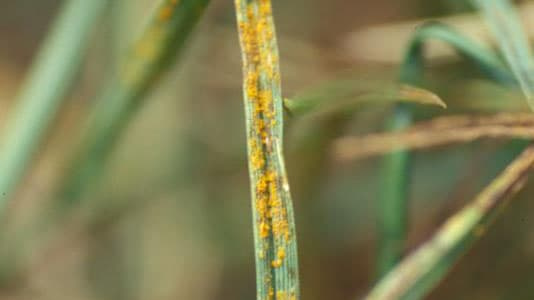
On Tall Fescue: Cool-season lawns get rust too. The pustules line up along the blades in late summer and fall, when slow growth and heavy dew give the fungus time to spread.
NC State University, used with permission
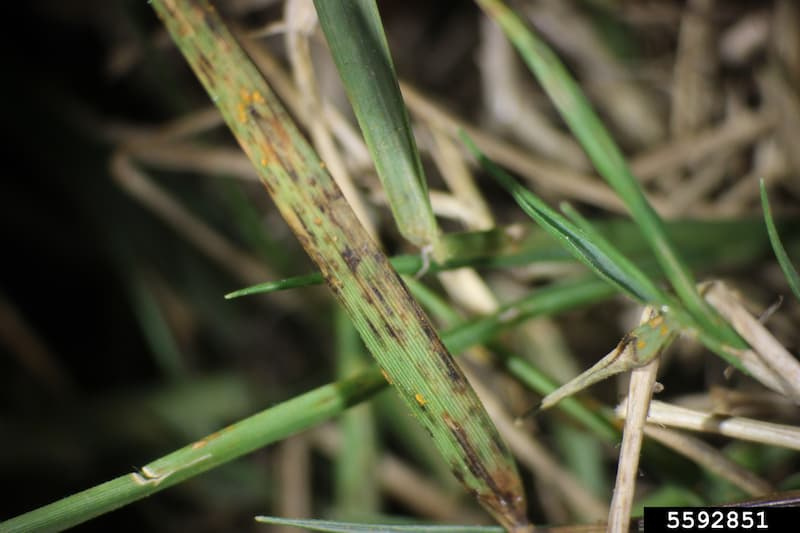
In the Lawn: From standing height, infected areas look thin and yellowish, with an orange cast in heavy outbreaks.
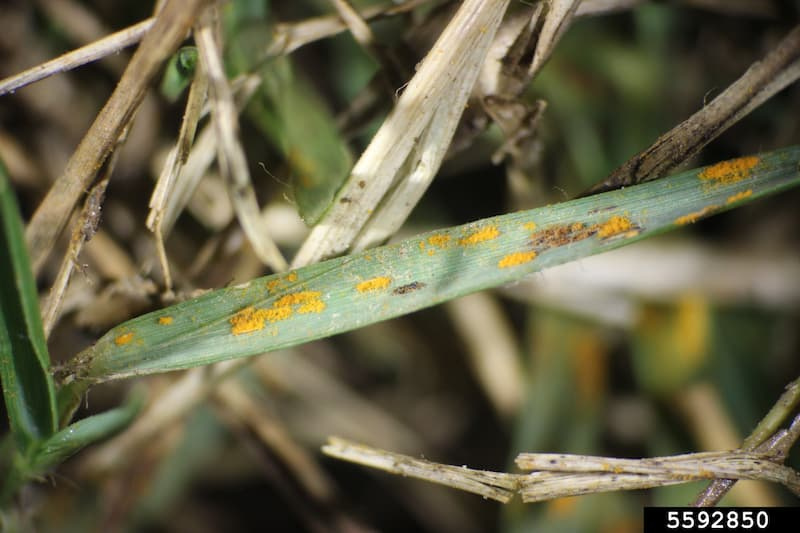
Diagnostic Feature: Raised orange pustules full of powdery spores that rub off on your fingers, shoes and mower.
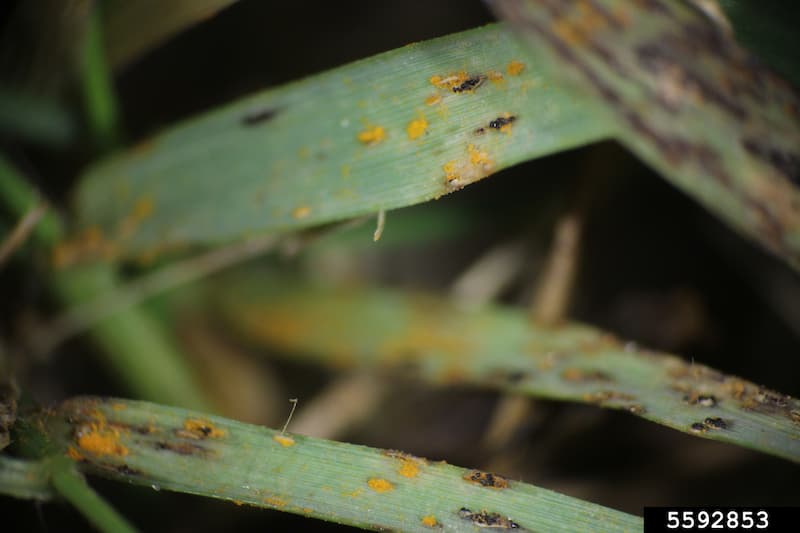
Later in the Season: As the weather cools, some pustules turn dark brown to black. These are the rust’s overwintering spores.
Could It Be Something Else?
Common Lookalikes
Red thread gives a lawn a pink to reddish cast, often on the same underfed lawns rust likes. But red thread grows bright red or pink threads, about 1/16 to 1/4 inch long, out of the blade tips, and it leaves no orange powder on your hand. It is also mainly a disease of rainy late spring and early summer, while rust peaks in late summer and fall.
Slime mold rubs off on shoes and mowers too, which is why people mistake it for rust. It is a gray, white or purplish crust sitting on top of the blades. Wipe it off and the leaf underneath is green and unbroken. Rust comes from inside the leaf and leaves the blade yellow and pocked.
A lawn that is simply dry or underfed can look like early rust: a tired, yellowish cast in late summer. The difference is the dust. Plain stress leaves your shoes clean. If they come up orange, it’s rust, and the stress you suspected is what let it in.
Field Checks Before You Treat
- Do the tissue wipe. Wipe a white paper towel firmly across several discolored blades, or walk across the area in light-colored shoes. Orange to rusty-orange powder means rust. No residue means it isn't rust. A gray, white or purplish smudge points to slime mold.
- Look at a blade in sunlight. Pull 5 to 10 discolored blades. Rust shows raised orange to reddish-brown blisters lined up along the veins with no dark border, and your fingernail catches on them. Flat tan spots with dark purple or brown borders mean a leaf-spot disease instead.
- Check the leaf tips. Bright red or pink threads sticking out of the tips mean red thread, not rust.
- Rub the coating. If it wipes off cleanly and leaves green, unbroken leaf underneath, it's slime mold resting on the surface. Rust leaves the blade yellow, with broken blisters.
- Check the crowns. Pull up a few plants at the base. With rust, the crowns and roots stay firm and off-white. Brown, mushy crowns mean a crown or root rot is involved, and the lawn needs a lab diagnosis.
Grasses at Risk
Which Grasses Suffer Most
Kentucky bluegrass and perennial ryegrass are hit most often and hardest, and young stands of both are especially vulnerable. Tall fescue gets rust mostly in early to mid fall, and in Missouri it ranks with bluegrass as the most damaged lawn grass. Zoysiagrass is the warm-season grass rust hits most often, especially in shaded, underfed lawns. In Florida, St. Augustinegrass gets rust in the cool months, but there it is only cosmetic. Bermudagrass and fine fescue are occasional hosts. Extension sources rarely report rust on centipedegrass or bahiagrass.
Cultivars within a species differ a lot. The National Turfgrass Evaluation Program (NTEP, at ntep.org) rates named cultivars for rust resistance on a 1-to-9 scale, with 9 the most resistant. Use those ratings to pick seed for your region. Most Kentucky bluegrass and tall fescue varieties sold in California are already fairly resistant.
Why It Shows Up
Conditions That Trigger It
Rust is a slow-growth disease. It takes hold when grass stops growing fast enough for mowing to cut the infected leaves away. That’s why it shows up on hungry, dry or shaded lawns and rarely on a well-fed lawn that’s growing hard.
The weather pattern is warm days and dewy nights: daytime air temperatures of roughly 70–85°F, and cool, humid nights with air in the 50s and 60s°F that keep the grass wet with dew. The spores need 10 to 12 hours of continuous leaf wetness to infect. Unlike most lawn diseases, rust is often worse in a dry spell. Drought stops the grass from growing, while heavy night dew still gives the fungus the moisture it needs.
- Low nitrogen. This is the biggest single factor. Underfed grass grows slowly, so infected leaf tips stay on the plant long enough for the fungus to produce its next crop of spores.
- Drought stress. Dry soil stalls growth the same way.
- Shade and still air. Grass in shade is weaker and slower, and dew lasts hours longer under trees and beside buildings and fences.
- Evening watering. Watering after sunset stretches the night’s wet period past the 10-hour mark.
- Mowing too short or too seldom. Scalping weakens the grass, and mowing too seldom leaves infected leaves in place.
- Compacted soil. Roots in hard soil can’t take up enough water and nitrogen, so the grass above grows slowly.
- New seedings. Young grass has no reserves to regrow from when rust strips its leaves.
How It Survives and Spreads
Rust fungi live only on living grass. They survive the winter inside green leaves and start producing spores again when the grass greens up. In fall, the orange pustules turn dark brown to black as the fungus switches to tough overwintering spores. Some rust species spend part of their life cycle on shrubs or garden flowers, but the lawn itself carries the fungus from one season to the next, so those plants don’t have to be nearby.
During the season, each pustule releases huge numbers of powdery spores. Wind carries them across the yard and from yard to yard. Mowers, shoes, pets and splashing rain or sprinkler water move them from blade to blade. A spore that lands on a leaf that stays wet long enough grows into the leaf through its natural breathing pores, and a new pustule later breaks through the surface. The cycle repeats as long as nights stay dewy and the grass stays slow.
Where It Hits Hardest: Regional Notes
Rust is most common on cool-season lawns of Kentucky bluegrass, perennial ryegrass and tall fescue across the Midwest, Northeast, Mid-Atlantic, transition zone and California. In these areas it is mainly a late-summer and fall problem. In Pennsylvania and Kansas it usually appears in August or early September and can last into fall, though poorly fed lawns can show it in spring. In the Southeast it appears on zoysiagrass and other lawns in spring and fall: North Carolina sees it from March to June and from September to November. In Florida it shows up on St. Augustinegrass, zoysiagrass and winter-overseeded ryegrass from late fall to early spring, when cool weather slows the grass, and it fades once warm weather returns. It is least common in dry climates, where leaves rarely stay wet long enough for spores to infect. The exception there is shaded or evening-watered spots.
Lawn Rust Diagnostic Profile
Check what you see against the full set of signs. The more that match, the more likely this is your problem.
What You’ll See
Symptom Color
Yellow
Brown
Red, Pink or Purple
Orange or Rust
Visible Signs
Orange Spore Dust
Black Spots or Pustules
Lawn Pattern
Irregular Patches
Overall Thinning
Patch Size
1 to 3 Feet
Over 3 Feet
Blade Symptoms
Tip Dieback
Rust Pustules
Stripes
When and Where
Weather Triggers
Warm & Humid
Warm Days, Cool Humid Nights
Long Leaf Wetness (Dew or Rain)
Drought or Heat Stress
Where in the Lawn
Shade
Compacted or High-Traffic Areas
New Seedings
Open, Sunny Lawn
Controlling Lawn Rust
Rust is beaten by growth. When grass grows steadily, it pushes out new leaves fast enough that mowing removes the infected ones before the fungus can produce its next round of spores.
- Feed the lawn. On cool-season lawns, apply a light dose of nitrogen when rust appears in late summer: 0.25 to 0.5 lb of nitrogen per 1,000 sq ft. With a fertilizer whose first number is 25, that’s about 1 to 2 lb of product per 1,000 sq ft. Water it in. If August highs are forecast in the low 80s°F or cooler, feed now. If it’s hotter, wait until early September, which is the start of normal fall feeding anyway. On warm-season lawns, stick to the normal feeding program for your grass rather than pushing extra nitrogen late in fall as the grass slows toward dormancy.
- Water deeply, before sunrise. In dry spells, water deeply and infrequently so the grass keeps growing. Water in the hours before sunrise, when the grass is already wet with dew and the morning sun will dry it. Evening watering adds hours to the night’s wet period, and those hours are what the spores need.
- Mow regularly at the right height. Every mowing removes infected tips and the spores on them. Keep to the recommended height for your grass and never take off more than one-third of the blade at once. Scalping weakens the grass and slows regrowth. In heavy shade, raise the mowing height.
- Bag clippings while rust is active. Collecting clippings from infected areas takes spores out of the lawn. Put them in yard-waste pickup or the trash. Compost them at home only if your pile reliably heats above 140°F. Go back to mulching clippings once the orange dust is gone.
- Let in light and air. Limb up trees and cut back shrubs that shade the lawn, so the grass grows stronger and the dew burns off sooner. In deep shade, grow a shade-tolerant grass.
- Relieve compaction. Core aerate compacted, high-traffic spots so the roots can take up water and nitrogen again.
- Plant resistant grass. When seeding or overseeding, choose rust-resistant cultivars of Kentucky bluegrass and perennial ryegrass, and use a blend or mixture rather than a single variety.
Spraying is rarely worth it on an established lawn. Feeding, watering and mowing clear rust on their own, and the grass isn’t dying. There are two exceptions. The first is a newly seeded lawn showing rust: one or two sprays at the first sign protect seedlings that can’t outgrow it. The second is a high-visibility lawn where rust keeps spreading after you’ve corrected feeding and watering.
If you do spray, the most effective fungicides are the DMIs (FRAC group 3) and the strobilurins, also called QoIs (FRAC group 11). On established grass, treat them as a rescue, not a routine. One spray combined with feeding usually stops an outbreak. If a second spray is needed, labels typically space applications 14 to 28 days apart. Switch to the other FRAC group for the second spray so the fungus doesn’t build resistance. Product names rarely tell you what’s inside, so check the active-ingredient panel.
| Active ingredient | FRAC group | Availability |
|---|---|---|
| Propiconazole | 3 | Found in homeowner lawn fungicides |
| Myclobutanil | 3 | Found in some homeowner products |
| Azoxystrobin | 11 | Found in homeowner and professional products |
| Metconazole, flutriafol, fluoxastrobin, pyraclostrobin, trifloxystrobin | 3 or 11 | Mostly professional products |
| Chlorothalonil, mancozeb | M5, M3 | Professional products not labeled for home lawns |
Recovery and Repair
An established lawn recovers fully. Rust strips leaves but never kills the crowns or roots, so once the grass is fed, watered and growing, new healthy blades replace the rusted ones and mowing removes the old ones. In late summer this usually takes a few weeks. Rust that appears in October in northern lawns may linger until cold weather stops it and clear only when the lawn greens up in spring. That leaves no lasting damage either.
The damage becomes real in two situations. Heavily rusted lawns go into winter weakened, so they are more prone to winterkill, drought injury and other diseases. New seedings can be thinned or killed, especially spring-seeded bluegrass and ryegrass that hit summer heat and drought, because seedlings have no reserves to regrow from.
If an area has thinned out, overseed cool-season lawns in late summer to early fall, the normal seeding window, using a rust-resistant cultivar. Watch the new seedlings and treat at the first sign of pustules. On warm-season lawns, let the grass fill in during the next growing season. Zoysiagrass and St. Augustinegrass spread by runners, and rust leaves those intact.
When to Call a Pro
Most rust needs no professional help. Get a diagnosis or a pro when:
- New grass is thinning out. A new seeding that keeps losing plants after treatment needs a closer look, because seedlings can be killed.
- Feeding didn’t work. If the lawn keeps declining several weeks after you fed it, fixed the watering and kept mowing, something else is likely going on.
- The checks don’t fit. Yellowing with no orange dust, or brown, rotted crowns, points to a different disease. Send a sample to your state’s extension diagnostic lab.
- It returns every year over a large area. A lawn professional can help plan overseeding with resistant cultivars.
Many labs accept photos as well as samples. Send a wide shot showing the shade and surroundings, a mid-range shot of the affected area and close-ups of the blades. Add the grass type, the lawn’s age and its recent care.
Frequently Asked Questions
These answers are synthesized from plant pathology research and diagnostic guidance published by university extension services and plant disease clinics.
Because rust is a symptom of slow growth. Rust’s infection cycle is relatively slow, so grass that’s growing well outpaces it, and every mowing removes infected tips before they release more spores. A fungicide stops the fungus for a few weeks but leaves behind the hungry, stalled lawn that let it in. Feeding fixes the cause.
Shade gives rust two advantages at once. Grass in shade gets less light, so it’s weaker and grows more slowly. Dew also lasts hours longer under trees and beside buildings, which pushes leaf wetness past the 10 to 12 hours the spores need. Limbing up trees and switching to a shade-tolerant grass help on both counts.
No. Rose rust, cedar-apple rust on junipers and crabapples, and lawn rust are caused by different fungi with different host plants. The orange dust from your lawn infects grass. Treating one problem does nothing for the others.
It often does if nothing changes. Rust survives the winter in living grass leaves, so a lawn that goes hungry or dry every late summer, or a shady spot that stays dewy, tends to get it again. Correct the feeding, watering and light, and choose rust-resistant seed the next time you overseed.
Scientific Authority
This profile is built on plant pathology research and diagnostic guidance from university extension services and plant disease clinics. We prioritize accurate identification and cultural control first, recommending fungicides only where research shows they are justified, and naming them by active ingredient rather than brand.
Primary Resources
- Penn State Extension — Turfgrass Diseases: Rust Diseases (Causal fungi: Puccinia spp.)
- Penn State Extension — Turfgrass Diseases: Red Thread (Causal Fungus: Laetisaria fuciformis)
- Purdue University Turfgrass Science — Rust Diseases
- Purdue University Turfgrass Science — Rust in Turf
- Purdue Extension — Common Diseases on Cool-Season Lawns (BP-218-W)
- UC Statewide IPM Program — The UC Guide to Healthy Lawns: Rust
- UC Statewide IPM Program — Turfgrass Pest Management Guidelines: Rust
- University of Missouri Extension — Turfgrass Disease Profiles: Rust
- University of Missouri Extension — Turfgrass Disease Control (G6756)
- Clemson Cooperative Extension HGIC — Leaf Diseases of Lawns (HGIC 2152)
- NC State Extension — Rust in Turf
- Kansas State Research and Extension — Rust Diseases of Turfgrass (EP163)
- University of Florida IFAS Extension — Rust (EDIS LH051)
- University of Wisconsin–Madison Extension — Lawn Disease Quick Reference