
Pathogen: Microdochium nivale (formerly Fusarium nivale)
Also called: Pink snow mold, Microdochium patch, Fusarium patch, snow mold
Pink Snow Mold
Snow optional, cold required
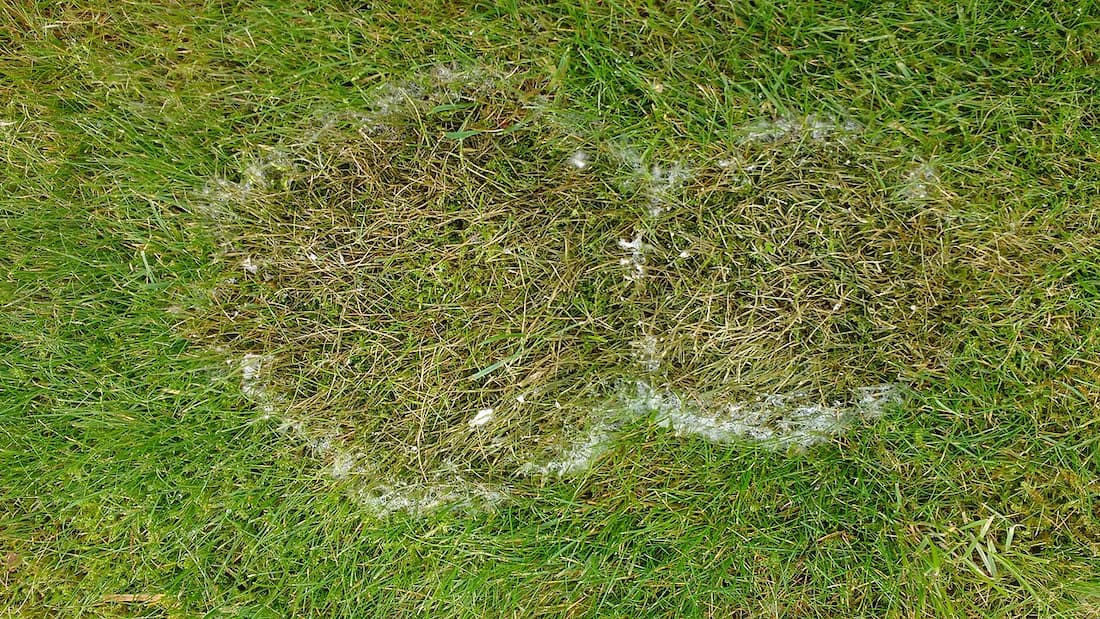
Featured Image Credit: Kris Lord, via Wikimedia Commons, CC BY 2.0
Pink Snow Mold At-a-Glance
Grass Type Affected
Cool-Season Grasses
Recovers on Its Own?
Yes, Slowly
Is Spraying Worth It?
Rarely Worth It
Disease Type
Fungal
Active Season
Early Spring
Fall
Winter
Damage Potential
Cosmetic Only
Can Be Fatal
Pink Snow Mold Quick Answers
What Pink Snow Mold Looks Like
From Standing Height
As the snow melts, you’ll see round patches of flattened, matted grass, usually 2 to 10 inches across, bleached white, tan or pinkish in the middle. Active patches have a copper, salmon or reddish-brown ring around the edge, sometimes with white-to-pink fuzz on it in the morning. Without snow the patches start as small, dark, wet-looking reddish-brown spots that fade to tan. On lawns mowed at normal height they often look less perfectly round and more like irregular, bronzy matted areas, and many patches can run together into larger dead areas.
Up Close: Blades, Crowns and Roots
Up close, infected leaves first look dark and water-soaked, as if they were frozen and thawed, then turn reddish-brown and finally fade to straw-tan or bleached white. Whole leaves die rather than showing neat spots with borders, and the dead blades lie flat and stick together in a mat, often glued by the fungus’s threads. Leaves at the active edge of a patch can have a pink cast from the spores on them. On tall grass, over about 6 inches, the patches can look yellow instead, with fuzzy, poorly defined edges.
The part that decides whether the lawn comes back is the crown, the growing point at the base of the plant just above the soil. Split open a plant from a patch and look at the crown: a firm, white-to-light-tan crown is alive and will push new leaves in spring. In severe cases, such as long snow on unfrozen ground, very lush fall growth or new seedlings, the crown itself can turn brown and soft, and that plant won’t recover. Roots are normally left alone.
Signs of the Organism
The fungus itself shows up as fluffy threads (mycelium) on the edges of the patches: white, often turning pink, and thick enough to bind the dead leaves together. Look right after the snow melts, or early in the morning during cold, foggy, drizzly or dewy weather. Once the sun dries the grass, the threads collapse and disappear, so an afternoon look often shows nothing but matted, bleached grass.
In wet weather, dead leaves can also carry tiny pink-to-white specks, which are clusters of spores. A 10x hand lens makes them easy to see. These pink spore cushions, and the pink tint they give the patch edge, are what give the disease its name.
Identification Photos
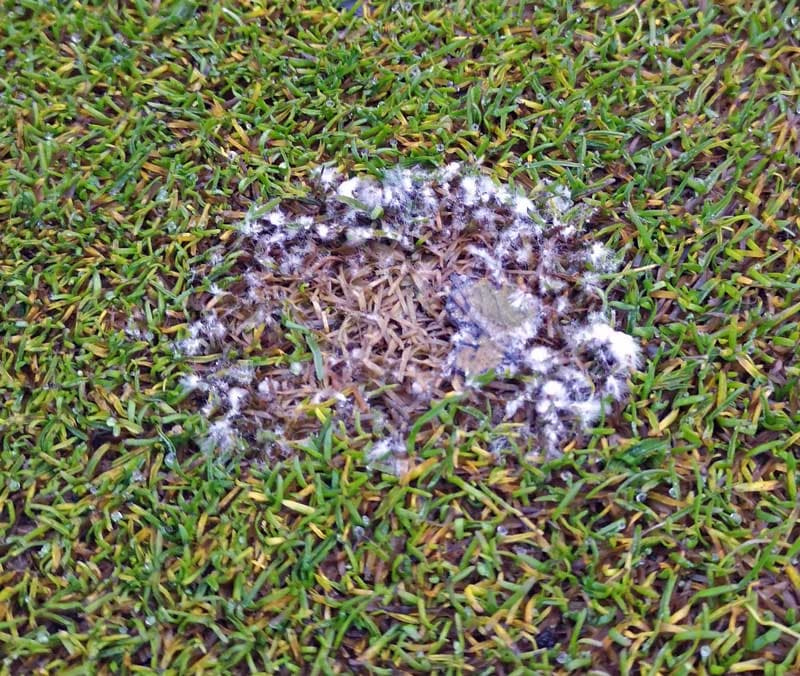
Active Fungus: In cool, wet weather the patch fills with white to pale pink fungal growth that mats the blades together, the clearest sign that the disease is still spreading.
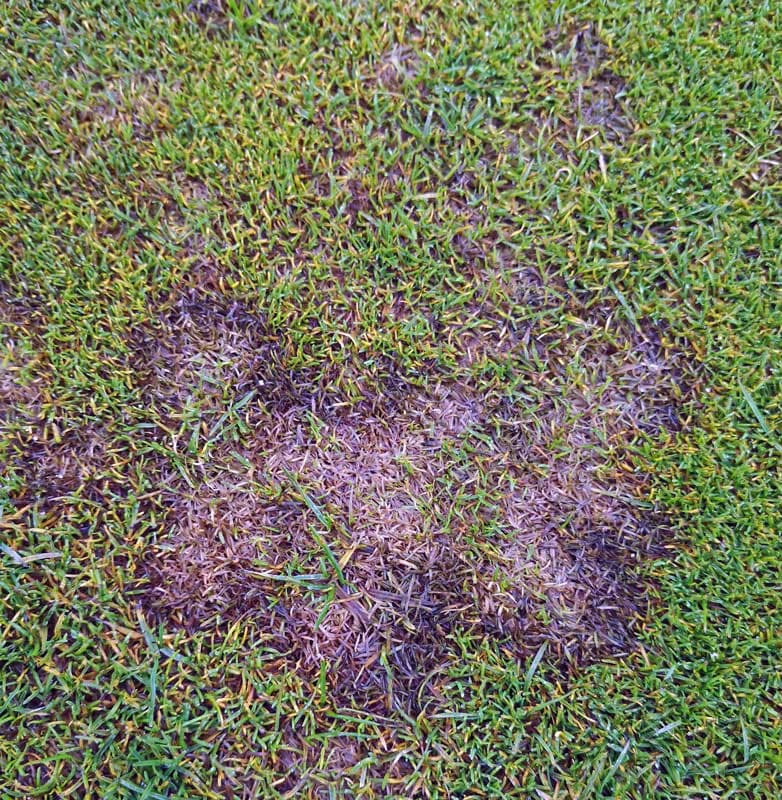
Pink Tint: Patches in annual bluegrass can take on a distinct pink to purplish cast, the color that gives the disease its name.
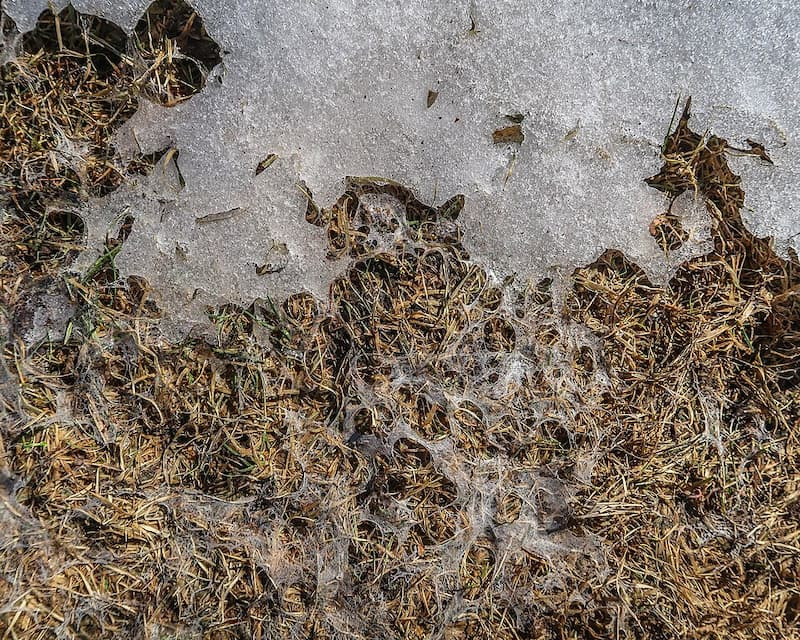
Under the Snow: The fungus works beneath lingering snow, so damaged turf often appears matted and brown the moment the snow melts in spring.
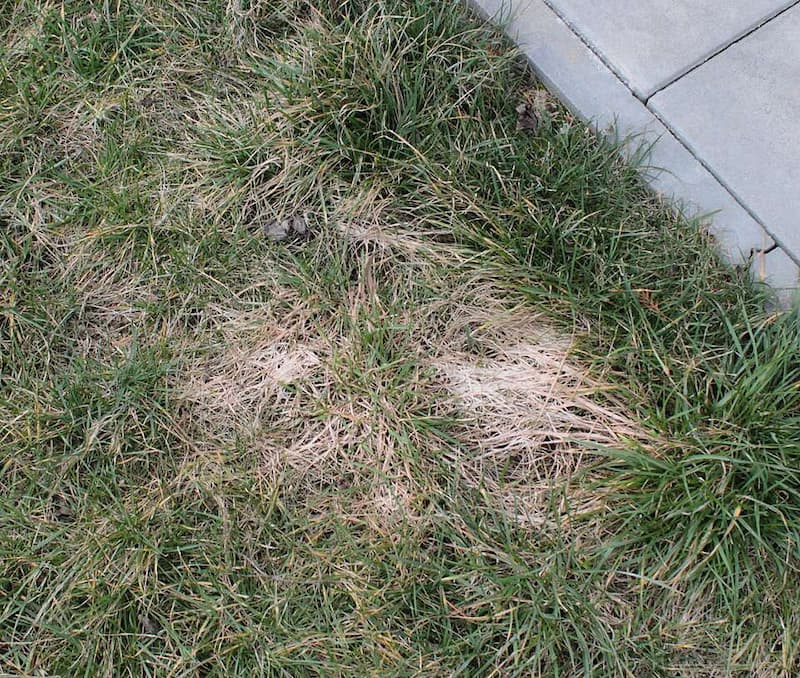
Spring Recovery: Once the weather warms and dries, patches turn bleached tan and the grass usually fills back in from the crowns and surrounding turf.
Could It Be Something Else?
Common Lookalikes
Gray Snow Mold is the one most people mix it up with. Both show up as matted, bleached circles as the snow melts, often in the same lawn and the same spots. Gray snow mold patches tend to be larger and grayer, with no pink or copper edge, and the fungus forms small seed-like bodies on the dead leaves that pink snow mold never makes.
Red Thread gives a lawn a pink or reddish cast in cool, damp spring weather, so the color alone can mislead you. It shows up later, in milder weather after the grass is growing again, and its pink growth sticks out from the leaf tips as stiff threads instead of a cottony mat on flattened grass.
Dog urine spots appear as round straw-colored patches in late winter and early spring, just as snow mold does. They have no fungal threads and no pink edge, and they don’t grow during cool, wet weather the way an active snow mold patch can.
Field Checks Before You Treat
- Check the edge at dawn. Look at the outer rim of a patch right after snowmelt or on a dewy morning. White-to-pink cottony threads or a copper-to-salmon ring mean pink snow mold is active; a dry, plain tan patch is old damage, either finished disease or something else.
- Search the dead leaves for "seeds." Pull up a pinch of matted leaves from inside the patch and look closely at the blades and the thatch below. Tiny hard tan, reddish-brown or black bodies, like pepper or seed, mean gray snow mold; no seed-like bodies plus a pink or copper edge points to pink snow mold.
- Use a hand lens. Look at a dead leaf from the patch edge with a 10x lens in good light. Small pink-to-white cushion-like specks on the leaf are the fungus's spore clusters and confirm pink snow mold.
- Look at the leaf tips. Check a few pink-looking blades in milder spring weather. Stiff pink-red threads growing from the tips mean red thread, not snow mold.
- Look for a green ring. Check the grass just outside a straw-colored spot. A ring of extra-dark, lush green grass and no fungal threads at all point to dog urine.
Grasses at Risk
Host Grasses
Which Grasses Suffer Most
All cool-season lawn grasses can get it, but not equally. Perennial Ryegrass and Bentgrass are hit hardest, and the weed Annual Bluegrass (Poa annua) is the most susceptible of all, often dying outright in the patches. Kentucky Bluegrass commonly shows patches, especially when kept at 3 inches or taller going into winter, but it’s among the least susceptible species and its underground stems help it fill back in. Fine Fescue is the most resistant lawn grass, with Tall Fescue in between. Warm-season lawn grasses aren’t a concern for home lawns.
Cultivars within a species differ too. The National Turfgrass Evaluation Program (NTEP) rates cultivars for snow mold in some of its trials, on a 1 to 9 scale where 9 means no disease. If snow mold is a yearly problem, check those ratings before buying seed.
Why It Shows Up
Conditions That Trigger It
Pink snow mold is a cold-weather fungus that doesn’t need snow. It grows when air temperatures stay between about 30°F and 60°F and the grass stays wet, and it does the most damage in the 30s and low 40s. Snow makes it worse because a blanket of snow over unfrozen ground holds the grass right at the perfect temperature, just above freezing and soaking wet, for weeks. Without snow, cold rain, fog, drizzle and heavy dew do the same job, more slowly. It shuts down during warm, sunny, dry spells and stops completely once air temperatures climb above about 70°F.
These conditions in the yard make it worse:
- Late or heavy fall nitrogen. Fertilizer late in the season, especially fast-release types like urea, pushes soft new leaves into winter that the fungus breaks into easily.
- Grass left tall going into winter. Long blades flop over under snow and mat into a damp layer where the fungus spreads leaf to leaf.
- Deep or lingering snow. Drifts, snow piled from driveways and walks, and the north side of buildings keep grass covered longest.
- Shade and still air. Leaves under trees or beside fences and buildings stay wet hours longer each day.
- Poor drainage and compaction. Low spots and packed soil hold water at the surface and keep the grass wet.
- Thick thatch. More than ½ inch of thatch holds moisture and gives the fungus a place to survive between seasons.
- Soil pH above 7 or low potassium. Alkaline soil favors the fungus, and late-fall lime raises the surface pH right when it matters most.
- Young grass. Lawns seeded in late summer or fall that haven’t matured before winter are the most easily killed.
How It Survives and Spreads
The fungus never really leaves. Through summer it rests as threads and spores in thatch, dead grass and other plant debris, waiting for cool, wet weather. It makes no hard survival structures, so it depends on that layer of dead organic matter to get through the warm months.
When fall turns cold and wet, it starts growing again and moves into living leaves. Infected leaves then produce sticky spores that splash onto nearby grass in rain or drip, and new infections start within a patch and along its edges. Spores and infected leaf bits also ride on mower wheels, shoes and paws, which is why a lawn can show patches lined up along a walking path or mowing route, and runoff can carry them downhill. Under snow the fungus keeps spreading quietly all winter, and the result shows up all at once at melt.
Where It Hits Hardest: Regional Notes
It’s a problem anywhere cool-season lawns sit under long snow or through long, cold, wet springs: New England, New York, Pennsylvania and the Upper Midwest, including Wisconsin, Michigan and Minnesota. It’s also common without any snow in the Pacific Northwest and coastal Northern California, where months of mild, rainy, foggy winter weather keep the fungus active from fall to spring. In the transition zone it’s mainly an issue for Kentucky Bluegrass lawns in the cooler northern areas, such as northern Missouri. It’s rare to absent in the Deep South, the Gulf Coast and the desert Southwest, where winters are too warm or dry and lawns are warm-season grasses.
Pink Snow Mold Diagnostic Profile
Check what you see against the full set of signs. The more that match, the more likely this is your problem.
What You’ll See
Symptom Color
Tan or Straw
Yellow
Brown
Red, Pink or Purple
Orange or Rust
White or Gray
Visible Signs
Cottony White Webbing
Pink or Red Threads
None Usually Visible
Lawn Pattern
Circular Patches
Irregular Patches
Small Spots
Streaks or Stripes
Patch Size
Under 2 Inches
2 to 6 Inches
6 to 12 Inches
1 to 3 Feet
Blade Symptoms
Rotted Leaf Base or Crown
When and Where
Weather Triggers
Cool & Wet
Long Leaf Wetness (Dew or Rain)
Snow Cover
Wet or Poorly Drained Soil
Where in the Lawn
Shade
Low or Wet Spots
Compacted or High-Traffic Areas
New Seedings
Controlling Pink Snow Mold
Almost all of the prevention happens in the fall, before the snow comes.
- Time fall feeding. Finish fall fertilizing about six weeks before your usual first hard frost, and use slow-release nitrogen at that last feeding. Late, fast-release nitrogen grows soft leaves that go into winter unhardened and get infected easily.
- Keep mowing until the grass stops growing. Stay at your normal height, about 2½ to 3 inches, right up to the last cut. Tall grass mats under snow; grass scalped short is weakened, so don’t drop the height either.
- Clear leaves before snow. Rake or mulch-mow fallen tree leaves so no wet layer sits on the grass all winter.
- Spread out the snow. Don’t keep piling shoveled or plowed snow on the same patch of lawn. Snow fences or wind barriers can keep drifts off favorite areas, and spreading snow out helps it melt sooner.
- Dry out wet spots. Fix low spots and poor drainage, and limb up or thin trees and shrubs to let in sun and air. Every hour the grass dries sooner takes time away from the fungus.
- Water in the morning. If you irrigate in fall, water early in the day and only when the grass needs it, so it doesn’t sit wet overnight.
- Manage thatch and compaction. Dethatch in September or May if thatch is thicker than ½ inch, and core-aerate packed soil. This removes the fungus’s hiding place and helps water drain.
- Keep pH and potassium in line. Aim for soil pH of about 6.5 to 7.0, with adequate potassium, and test before you lime. Alkaline soil helps the fungus, and lime added in late fall raises the surface pH right before winter.
- Rake patches in spring. As soon as the snow is gone and the surface dries, lightly rake the matted spots. Breaking up the mat lets the crowns dry and warm so new leaves come in faster.
- Stay off active patches when wet. Don’t mow or walk through patches while they’re wet and showing threads, because shoes and mowers carry spores to healthy grass.
- Seed the right grass. When you reseed, favor Kentucky bluegrass and fine fescue, and seed early enough in late summer that the grass is mature before winter.
Spraying is rarely worth it on a home lawn. An established lawn grows out of pink snow mold on its own, and fungicide only works if it’s on the grass before the disease starts, in late fall. Spraying after the snow melts does nothing: the damage is already done, and the warming weather is about to stop the fungus anyway.
A preventive fall spray can make sense in two situations: a lawn seeded in late summer or fall that has to survive its first winter, or a lawn that loses large areas to snow mold year after year even after the fall care changes above. Apply it in October or November, after the last mowing but before the grass stops growing and before snow covers it for the season. In snow-free areas like the Pacific Northwest and coastal California, apply in fall before symptoms appear, and expect to repeat it through a wet winter.
| Active ingredient | FRAC group | Home lawn status |
|---|---|---|
| Propiconazole | 3 | Sold in homeowner lawn fungicides |
| Myclobutanil | 3 | Sold in homeowner lawn fungicides |
| Azoxystrobin | 11 | Sold in homeowner granular lawn products |
| Thiophanate-methyl | 1 | Limited retail availability |
| Fludioxonil, tebuconazole, metconazole, pyraclostrobin, trifloxystrobin | 12, 3, 3, 11, 11 | Professional products; use a licensed lawn care company |
| Chlorothalonil, iprodione | M5, 2 | Not allowed on home lawns |
Check that the product label lists pink snow mold, snow mold or Microdochium patch, since not every lawn fungicide with these ingredients does. Liquid sprays give better coverage than granules. Spray with enough water to wet the leaves thoroughly, and don’t water it in afterward, because the fungicide has to stay on the leaves where the infection happens. If you treat more than once, switch FRAC groups between applications, since the fungus has become resistant to some fungicides after repeated use of the same one.
Recovery and Repair
Most patches green up on their own once spring temperatures warm and the grass starts growing actively, because the crowns underneath survived. It’s slow, since the grass often doesn’t grow much until weeks after the snow is gone. To speed it up, rake the patches lightly as soon as the surface dries to break up the mat, then give the lawn a light nitrogen feeding once it’s actively growing. Don’t feed heavily in early spring, because a big flush of soft growth invites other leaf diseases.
If a patch shows no new green shoots by late spring, those plants are dead and the spot needs reseeding. Rake out the dead grass to expose soil, seed with a Kentucky bluegrass and fine fescue blend (keep perennial ryegrass to a small share of the mix), rake the seed in lightly and keep it moist until it sprouts. Spring seeding works once the soil has warmed, but late summer is the best time in the North, and seeding by early to mid-September gives seedlings time to mature before the next snow mold season.
When to Call a Pro
Send a sample to your state’s extension plant diagnostic lab if you can’t tell pink snow mold from gray snow mold or another disease, or if patches are still brown with no new green shoots by late spring. Cut a plug 4 to 6 inches across and about 2 inches deep from the edge of a patch, half damaged and half healthy grass. Don’t wet it, wrap only the soil end in plastic or foil, and mail it early in the week so it doesn’t sit in a warm truck over the weekend.
Call a licensed lawn care company if snow mold damages large areas every year despite good fall care, or if you need to protect a new fall seeding. The fungicides that work best against snow mold are professional products.
Frequently Asked Questions
These answers are synthesized from plant pathology research and diagnostic guidance published by university extension services and plant disease clinics.
Look for a pink or copper edge and the absence of “seeds.” Gray snow mold patches are usually larger and grayer, and the fungus forms tiny hard tan-to-black bodies on the dead leaves that pink snow mold never makes. Gray snow mold also needs at least about 60 days of snow cover, while pink snow mold can show up with no snow at all. The care to prevent both is the same, and lawns often have both.
Because the fungus doesn’t need snow. It grows any time it’s cold (about 30°F to 60°F) and the grass stays wet from rain, fog or dew. In that form it’s often called Microdochium patch or Fusarium patch. Snow only makes it worse by holding the grass cold and wet for weeks at a time.
Not with fast-release nitrogen. A late dose of quick nitrogen grows soft, tender leaves right before winter, and those are exactly what the fungus attacks under snow. Finish fall feeding about six weeks before your usual first hard frost, and use slow-release nitrogen for that last application.
No. By the time patches show after the snow melts, the fungus has done its damage, and warming spring weather is about to stop it. A fungicide can’t bring dead leaves back. Light raking and a light feeding once the grass is growing will speed recovery far more.
That’s where the snow piles up deepest and melts last. Shoveled and plowed snow keeps the grass covered, cold and wet longer than anywhere else, which gives the fungus the most time to work. Spreading snow around instead of always piling it in the same spot, and raking those areas first in spring, makes a clear difference.
Scientific Authority
This profile is built on plant pathology research and diagnostic guidance from university extension services and plant disease clinics. We prioritize accurate identification and cultural control first, recommending fungicides only where research shows they are justified, and naming them by active ingredient rather than brand.
Primary Resources
- Penn State Extension — Turfgrass Diseases: Pink Snow Mold (Causal Fungus: Microdochium nivale)
- Purdue Extension — Pink Snow Mold and Microdochium Patch (BP-102-W)
- University of Wisconsin–Madison Turfgrass Diagnostic Lab — Pink Snow Mold (Microdochium Patch)
- University of Wisconsin–Madison Extension — Microdochium Patch
- UMass Amherst Extension — Snow Mold on Lawns
- UC IPM — Microdochium Patch or Fusarium Patch (Pink Snow Mold)
- UC IPM — Microdochium Patch (Fusarium Patch, Pink Snow Mold) Pest Management Guidelines
- University of Missouri Extension — Turfgrass Disease Profiles: Microdochium Patch
- NC State Extension TurfFiles — Gray Snow Mold in Turf