
Rough Bluegrass At-a-Glance
Weed Type
Grass
Life Cycle
Cool-season perennial (spreads by stolons)
Growth Habit
Mat-forming (prostrate in lawns; can grow upright in unmown beds)
Root Type
Shallow, fibrous — spreads by above-ground stolons
Spreading Risk
High — by stolon and by seed
Pull
With Caution
Identity & Diagnostics
Visual Fingerprint
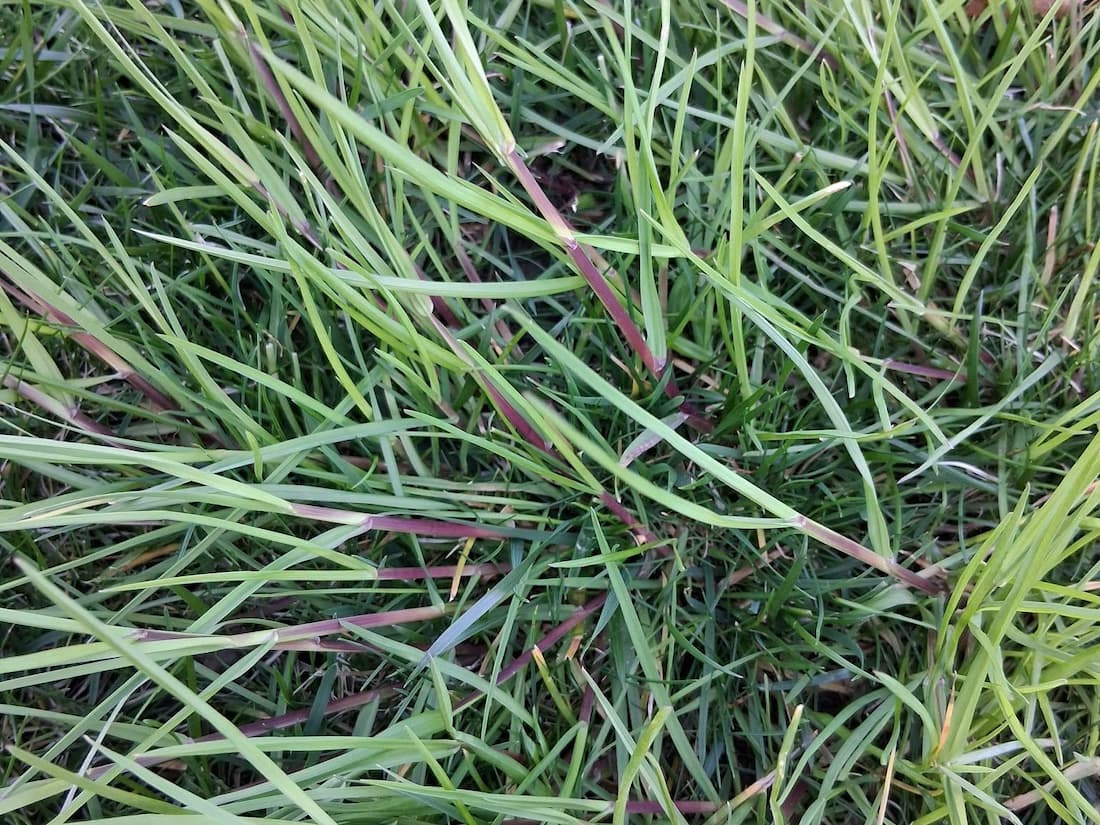
Rough bluegrass gives itself away by color and shape before you ever bend down. It forms roughly circular patches of a pale, yellow-green or “apple-green” grass that stands out sharply against the darker green of a normal cool-season lawn. In spring it grows faster than everything around it, so the patch also sits noticeably taller than the surrounding turf. Catch it in low sun and the patch glistens — the underside of each leaf is highly reflective, so the whole area looks glossy while the rest of the lawn looks dull.
Structural Anatomy
Up close, the confirming feature is that shine. Flip a blade over: the lower (underside) surface of rough bluegrass is glossy and reflective, where almost every desirable cool-season grass has a dull underside. The blades are narrow and flat, ending in a puckered, boat-shaped tip, and they feel rough when you run a finger down them because they’re covered in tiny stiff hairs — that roughness is where the name comes from. At the base of each patch you’ll find creeping surface runners called stolons that root wherever they touch soil, and in early spring those stems often show a distinct reddish to reddish-purple color at the base. There are no underground runners at all.
Grass-Specific Anatomy
The vegetative features that confirm rough bluegrass, at a glance:
| Feature | Rough Bluegrass |
| Vernation (new leaf in the bud) | Folded |
| Ligule (papery flap where blade meets stem) | Long, pointed, membranous (about 4–6 mm) |
| Auricles (clasping “ears” at the collar) | Absent |
| Collar | Broad, hairless, divided by the midrib |
| Sheath (the part wrapping the stem) | Flattened, sharply keeled, rough to the touch |
| Blade tip | Puckered, boat-shaped |
| Underside of blade | Glossy, reflective (the key tell) |
| How it spreads | Above-ground stolons — no rhizomes |
Growth Patterns & Life Stages
Rough bluegrass runs on a boom-and-bust cycle tied to temperature, and knowing where it is in that cycle tells you whether you can act on it. Seedlings are small and slow, easy to miss in a new lawn for most of the first year. Then in the cool, moist window of spring it surges — growing two to three times faster than Kentucky bluegrass — and the patch balloons outward on its stolons and overshoots the mowing height, which is usually when a homeowner first sees it. As summer heat and drought arrive, the foliage purples, then turns coppery-red, then straw-brown, mats down flat, and looks exactly like dead or diseased turf. Here’s the part that surprises most homeowners: that brown patch is not dead. The crown and the stolons survive the summer in a dormant state just at the soil surface, and when cool weather and moisture return in fall, the patch greens right back up from the surviving nodes. It fakes its own death every summer and comes back every fall — which is precisely why waiting it out never works.
Gallery
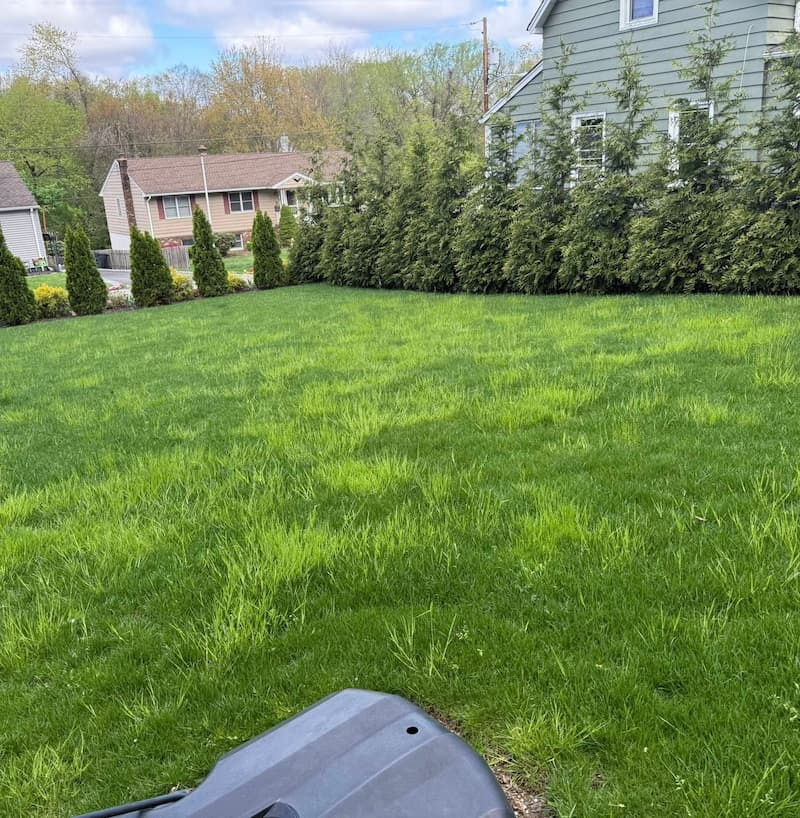
Wide landscape view of a lawn heavily infested with Poa trivialis, highlighting its characteristic rapid spring growth and light green patches.
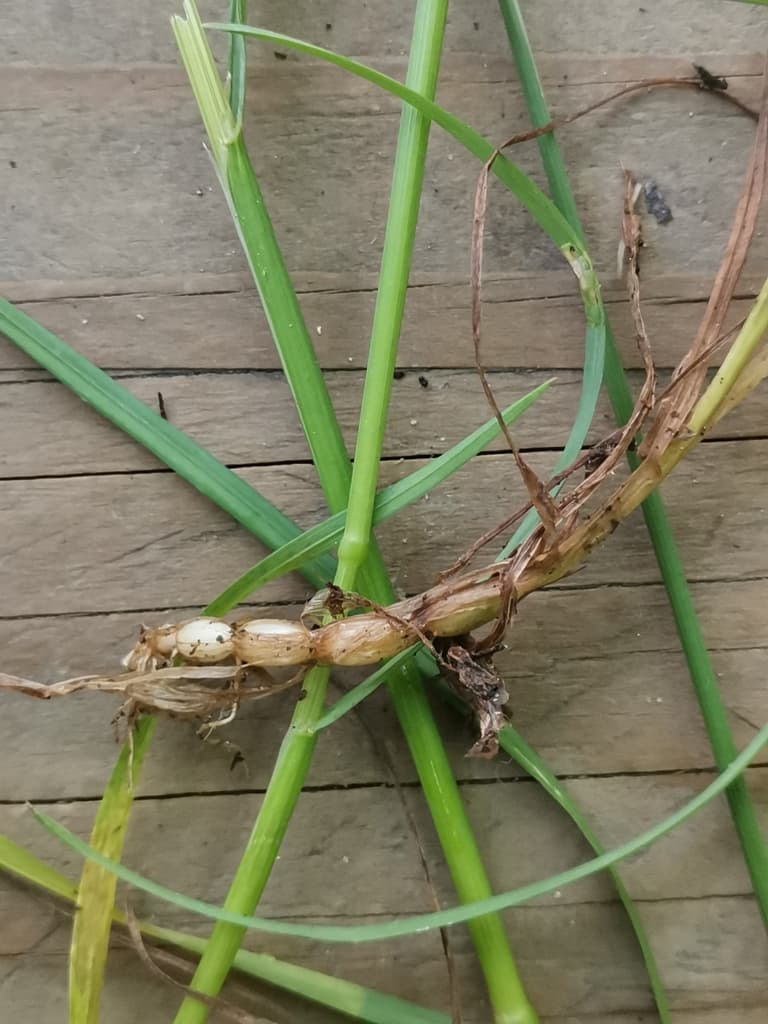
Look For: The horizontal, jointed stolon — with roots and new shoots forming at each node — is the single clearest way to tell Rough Bluegrass apart from the clump-forming Poa annua.
“Poa trivialis sylvicola” by Ljaž is licensed under CC BY 4.0.
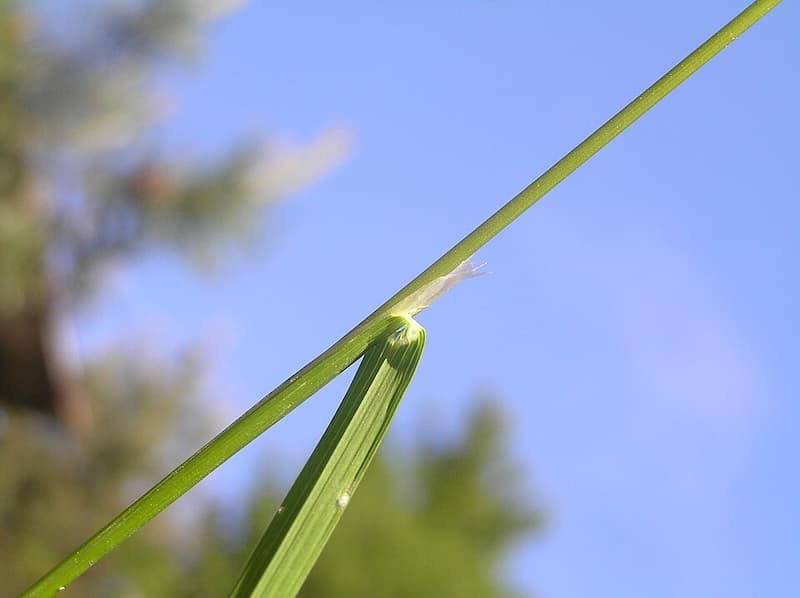
Key Identifier: The long, pointed, papery ligule at the base of each leaf blade is one of the clearest ways to tell rough bluegrass apart from other lawn grasses.
“Poa trivialis” by Don Pedro28 is licensed under CC BY-SA 3.0.
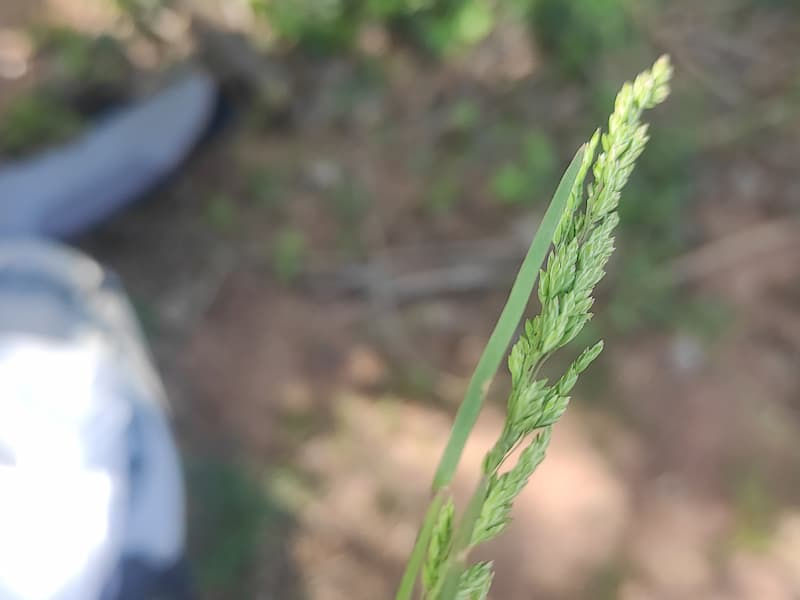
The airy, open panicle of Rough Bluegrass emerges on tall, wiry stems in late spring, holding small spikelets on slender branches.
“Poa trivialis sylvicola” by Augustin Soulard is licensed under CC BY 4.0.
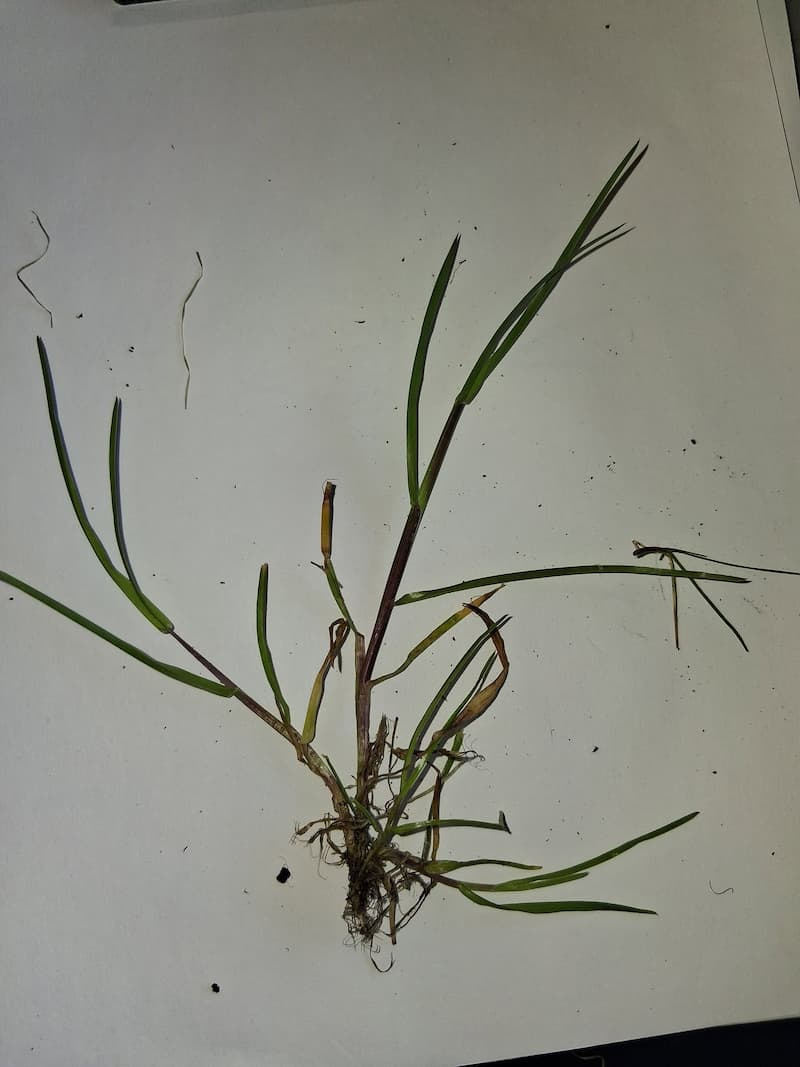
Anatomical breakdown of a single Poa trivialis plant showing its creeping horizontal stolon, node rooting, and purplish stem base.
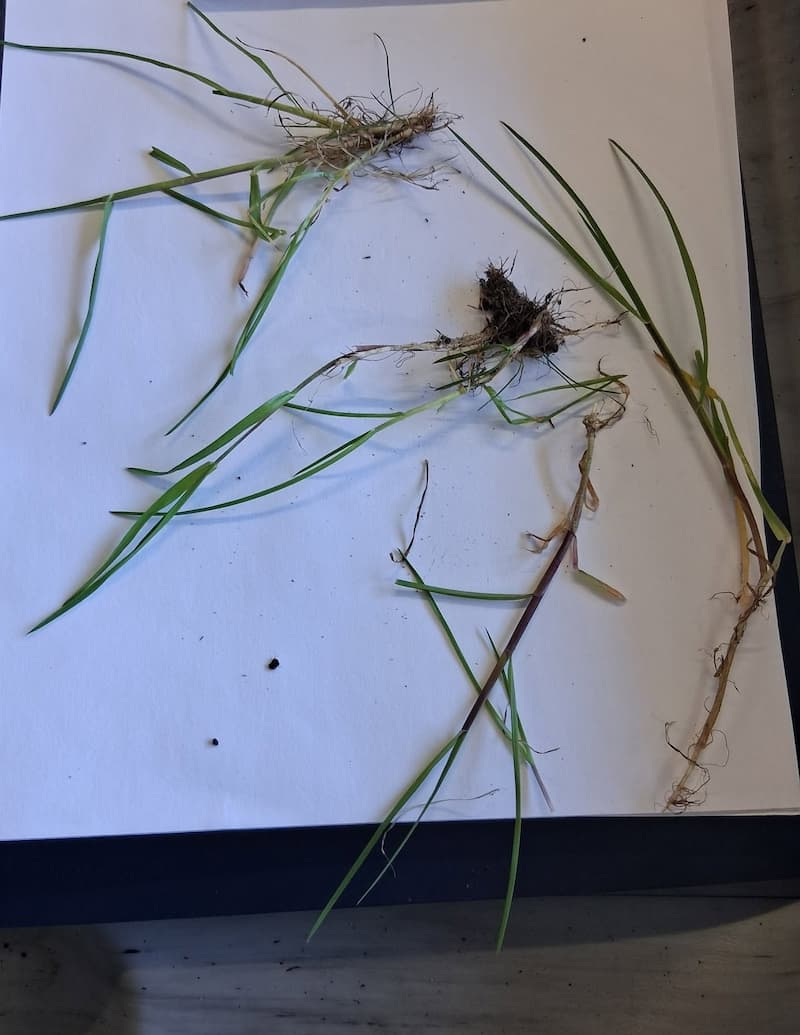
Key identification details of pulled Poa trivialis specimens, including long membranous ligules, slender stolons, and shallow root systems.
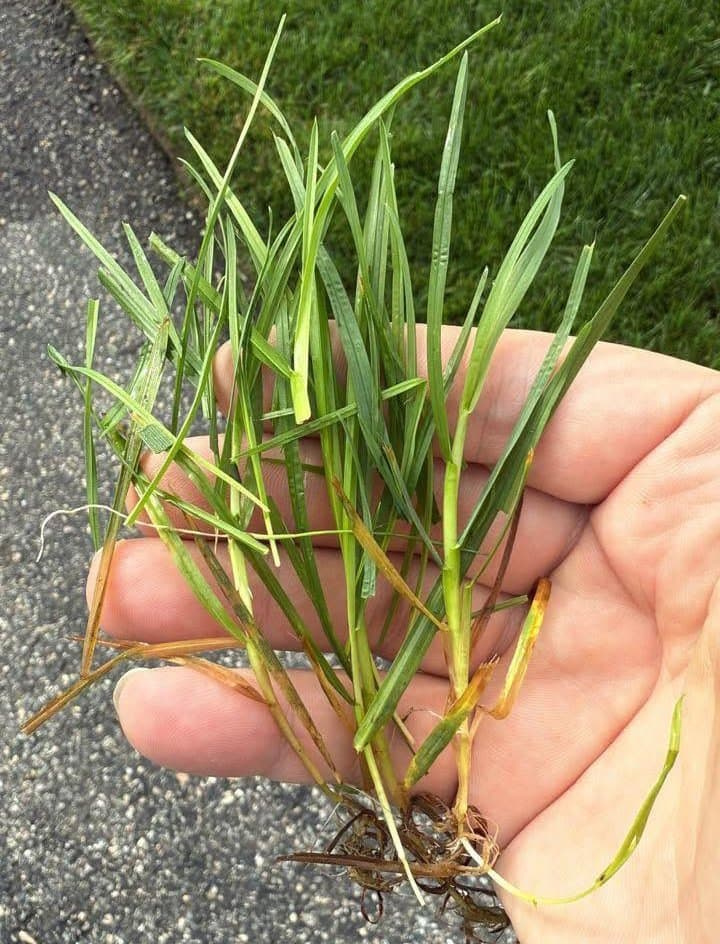
Close-up of a freshly pulled cluster showing the signature glossy leaf blades, folded vernation, and reddish lower sheaths.
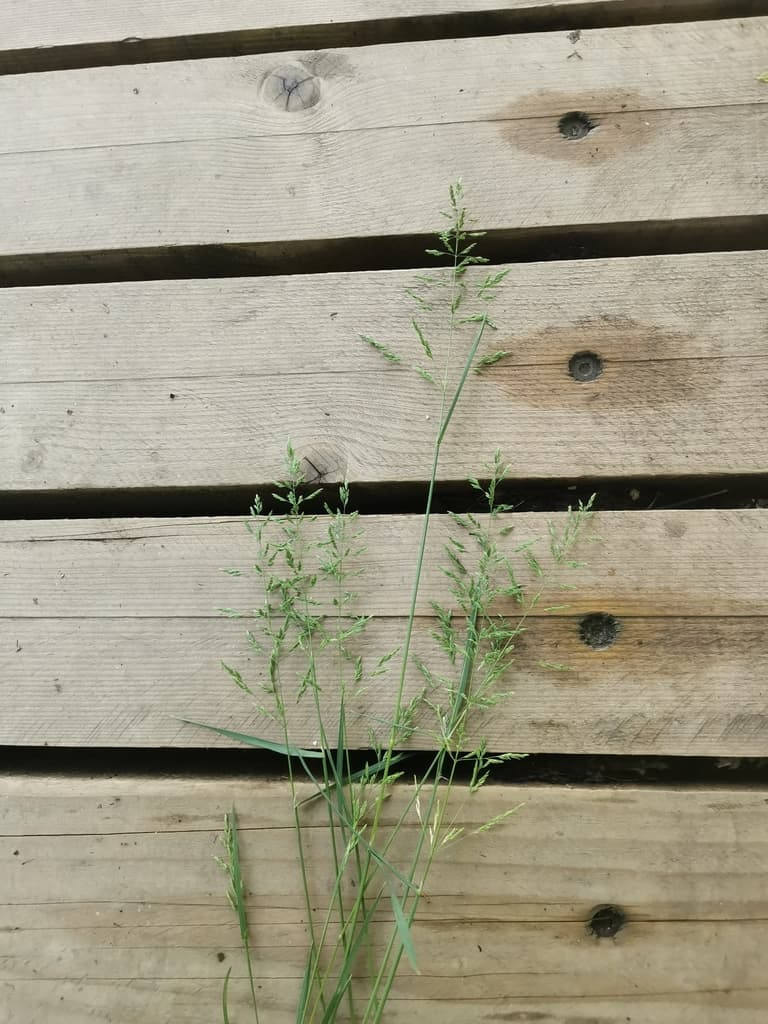
Rough Bluegrass favors shaded, consistently moist spots — like this gap beside a deck — where many other turf grasses struggle to compete.
“Poa trivialis sylvicola” by Ljaž is licensed under CC BY 4.0.
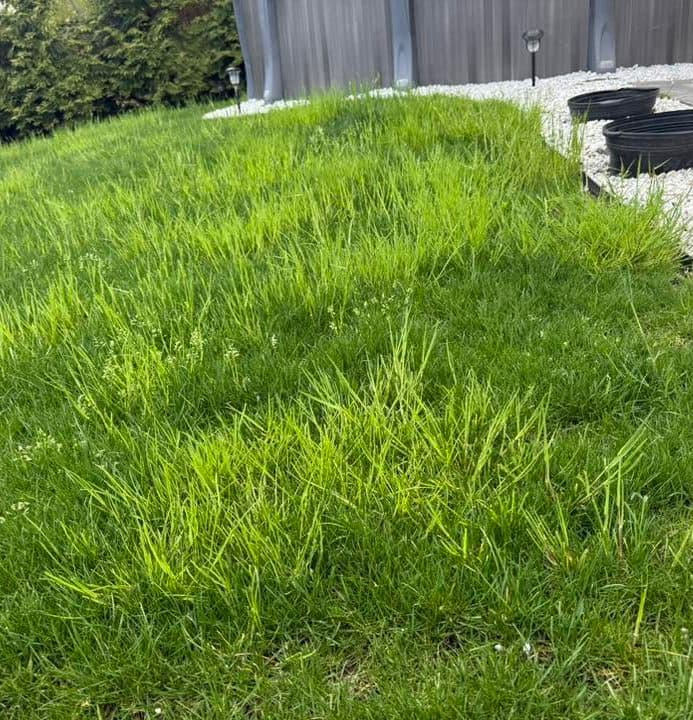
A matting patch of rough bluegrass invading turf along a landscape border, demonstrating its aggressive spreading habit near hardscapes.
The Identity Trap
Common Lookalikes
- Kentucky bluegrass (the grass most cool-season lawns are made of): shares the same folded new leaf, so at a glance a rough bluegrass patch can read as “just my lawn, a little off-color.”
- Annual bluegrass (Poa annua): the other weedy Poa homeowners are usually trying to identify at the same time, and it often shows up in the same damp, shaded, compacted spots.
Identification Differentiators: How to Tell Them Apart
- From Kentucky bluegrass: two features settle it. First, the underside sheen — rough bluegrass has a glossy, reflective underside; Kentucky bluegrass is dull. Second, how it travels — rough bluegrass creeps on above-ground stolons you can see and lift, while Kentucky bluegrass spreads by underground rhizomes. If it’s a distinct pale, glossy, circular patch creeping over the surface, it’s rough bluegrass.
- From annual bluegrass: look for seedheads and stolons. Annual bluegrass throws up abundant whitish seedheads even when it’s mowed short, and it grows in bunches with no runners. Rough bluegrass almost never makes seedheads in a mowed lawn and always spreads by visible surface stolons.
Growing Conditions
Host Grasses
Rough bluegrass is an invader of cool-season lawns, and it establishes most readily in Kentucky bluegrass, turf-type tall fescue, perennial ryegrass, and creeping bentgrass. It doesn’t out-muscle healthy, dense turf head-on; it moves into the spots where those grasses are already struggling — thin, shaded, chronically wet areas — and then expands from there on its stolons.
Host Environment/Area
This weed is a lawn specialist, and that’s a useful thing to understand. It needs the cool, humid microclimate that a continuous, regularly-watered turf canopy provides; its shallow stolons dry out and die on exposed, hot ground. So its strongholds are damp shade under trees, low swales that stay wet, and the saturated ground next to downspouts. In beds it behaves differently: it rarely survives an open, sunny, well-drained bed, but it readily invades irrigated, shaded, organic-soil beds — and it gets in mainly by creeping over the edge from an adjacent lawn on its stolons, not by blowing in as seed. Once inside loose bed soil, freed from mowing, it can even abandon its low mat habit and grow upright, one to three feet tall.
Soil Indicators: What the Presence of This Weed Reveals About Your Yard
A spreading rough bluegrass patch is a reliable signal that something about that spot stays too wet, too shaded, or too compacted for good turf. It flags poor drainage, high water tables, and — very commonly — light, frequent overwatering that keeps the surface soil constantly damp. It also points to dense shade and to compacted soil that holds water and starves roots of oxygen. One quieter tell: it holds its light-green color in alkaline, low-iron soils where other grasses would yellow, so a patch that stays green while nearby turf goes chlorotic can be a hint of high-pH ground. It is not a strong pH indicator on its own — moisture, shade, and compaction are the signals to trust.
Lifecycle and Season
Lifecycle Category and Management Implications
Rough bluegrass is a cool-season perennial, which sets the terms for everything. It does not die at the end of the year — it overwinters as living crowns and stolons and comes back on its own, so you can’t seed your way past it and you can’t wait it out. Because the established plant spreads vegetatively rather than starting fresh from seed each year, pre-emergent herbicide is irrelevant to a patch you already have — there’s no annual germination event to intercept. The only chemistry that touches the established plant is a non-selective, systemic one (glyphosate) applied when the plant is actively growing, followed by renovation. Pre-emergent matters only for a separate job: keeping new plants from starting from contaminated seed.
Germination Trigger
Rough bluegrass is a cool-season germinator, so its main trigger is a temperature drop, not a rise. Seeds begin germinating in late summer and early fall as soil temperature falls below 70°F, with peak germination around 50°F. Germination is cut by more than half once soil temperature drops below 40°F. A smaller cohort can germinate in early spring as soils warm back through the same cool range.
In the cool-season zone the plant is active in spring and fall and is usually the first grass to green up and surge in spring. That spring surge, and the second window in early fall, are the only times chemical control works, because the herbicide has to travel through actively growing tissue — more on that below. For the separate job of stopping new seedlings from contaminated seed, a pre-emergent goes down in late summer to early fall (before soil drops below 70°F) and again in late winter to early spring (before the top inch consistently reaches 50–55°F). Be aware this collides with fall overseeding, covered under Pre-Emergent Control in Lawn.
Rough bluegrass is a cool-season weed, so in warm-season lawns like bermudagrass and zoysiagrass it does its damage during the cool months, when the warm-season turf is dormant or semi-dormant and least able to compete. There’s an important upside here that cool-season lawns don’t get: selective control exists in established warm-season turf. Sulfosulfuron and flazasulfuron can selectively remove rough bluegrass from well-established bermudagrass and zoysiagrass without killing the desirable grass. Timing rule with a reason: don’t apply these — or a dormant-season glyphosate treatment — as the warm-season turf is greening up in spring, because a herbicide that’s safe on fully dormant turf can injure it and delay green-up once it starts to wake.
The transition zone is the hardest place to fight this weed, and the difficulty is a calendar problem. You can’t spray until the weed is actively growing, and rough bluegrass stays dormant through the hot months, so a glyphosate program can’t begin until it breaks dormancy in late summer or early fall. But a proper program needs two applications about three weeks apart, which burns four to six weeks — pushing your reseeding into late October or November. In the transition zone that’s often too late for tall fescue to build enough root before winter, leaving the young lawn to fail over winter or the following summer. The result is a genuine squeeze: treat properly and risk seeding too late, or seed on time and leave surviving weed behind. There’s no clean way around it, only trade-offs to weigh — and the transition zone’s volatile fall weather, with sudden winds and temperature swings, makes the spray timing harder still.
Herbicide Control
Pre-emergent herbicide will not touch an established rough bluegrass patch, and it’s important to be clear-eyed about that: pre-emergents only stop seeds from germinating, and your patch is already a living, creeping plant with no yearly germination step to block. Pre-emergent has exactly one role with this weed — keeping new plants from starting from contaminated seed in an otherwise clean lawn. If you want that protection, active ingredients that suppress bluegrass germination include prodiamine, pendimethalin, and dithiopyr (benefin, bensulide, oryzalin, and oxadiazon are also used), timed to the germination windows above. The catch: a pre-emergent barrier blocks your desirable grass seed too, so it directly conflicts with fall overseeding. Siduron is the only pre-emergent labeled to go down on newly seeded turf, but it’s weak on perennial bluegrasses, so it’s not a real answer here. Bottom line — for an infestation you already have, pre-emergent is not your tool.
Here is the fact the whole page turns on: there is no selective herbicide that removes rough bluegrass from a cool-season home lawn without killing the lawn with it. Because rough bluegrass is a Poa, closely related to Kentucky bluegrass and chemically similar to fescue and ryegrass, nothing on the homeowner market can tell them apart. The only effective approach is to treat the patch as something to remove and replace: spot-kill it with non-selective, systemic glyphosate, then renovate and reseed. (Buying tip: not every product labeled “Roundup” is glyphosate anymore — check the active-ingredient panel.)
The mechanism is what makes the timing non-negotiable. Glyphosate has to be absorbed by green tissue and carried down through the stolons to kill the crowns, so it only works when the plant is actively growing — early spring or early fall. Spraying a heat-dormant summer patch is wasted effort; the plant isn’t moving the herbicide anywhere. Two more rules follow from the stolon biology: spray at least 12 inches beyond the visible patch to hit the hidden advancing runners, and plan on two or more applications about three weeks apart, because stolons lying flat under the canopy escape the first pass and regrow. Don’t substitute a contact non-selective like glufosinate or diquat — they burn the tops but never reach the stolons, so the patch just comes back. And because glyphosate kills any grass it touches, flag the drift risk before you spray: a windy day can carry it onto the surrounding lawn, an adjacent bed, or the neighbor’s yard, and even a trace will brown desirable turf.
This is not a one-and-done job — it is a multi-season commitment. Surviving stolons, a long-lived seed bank, and re-contamination from new seed all conspire to bring it back, and a single-season effort reliably fails. (For completeness: a few selective or suppression-only products exist for professional turf — sulfosulfuron suppresses it in Kentucky bluegrass and bentgrass but wipes out tall fescue and injures ryegrass; bispyribac-sodium was golf-course-only and is no longer made; amicarbazone and methiozolin are professional-use products. None of them are options for a home lawn, which is why glyphosate-and-renovate is the homeowner’s real answer.)
This is where you actually get leverage, because rough bluegrass only wins where conditions favor it. Attack those conditions directly. Water deeply and infrequently so the surface dries between cycles — that starves the weed’s shallow roots while driving your desirable grass to root deeper. Fix drainage: correct low spots, grade to a 2–4% slope, and open up heavy clay. Relieve compaction with core aeration, but time it to your turf’s active growth and not during active rough bluegrass growth, or you’ll spread stolons doing it. Reduce shade by pruning low limbs and thinning dense canopies so the ground dries faster. Mow high — 3 to 4 inches — because close mowing favors the weed’s prostrate stolons and thins your good grass. And concentrate nitrogen in fall rather than pushing a lush spring flush that helps the weed and invites disease.
Then there’s the single most powerful prevention lever, and it happens at the store: buy only Blue Tag certified seed that lists rough bluegrass (Poa trivialis) at 0.0%. This weed’s number-one route into lawns is contaminated seed — as little as 0.5% “other crop” contamination can drop 20 to 25 viable rough bluegrass seeds into every square foot you plant. One cheap, uncertified bag can re-infest a lawn you just cleaned. When you overseed for density, use adapted cultivars, and in shade choose fine fescues rather than letting rough bluegrass fill the gap.
In beds, pre-emergent again works only on seeds, not on the creeping stolons that are this weed’s main way into a bed — so understand up front that it addresses the smaller half of the problem. Where new seedlings are a concern, several pre-emergents are labeled for landscape beds, including prodiamine, dithiopyr, pendimethalin, oryzalin, and dimethenamid-P, each applied under or over mulch according to its label. Two safety patterns are worth holding onto: granular formulations are generally safer than liquids around herbaceous plants (liquid pendimethalin, for instance, injures pansies where the granule is fine), and highly active products like indaziflam and isoxaben-plus-trifluralin blends are excellent around established trees and shrubs but can severely injure or kill tender bedding plants. Read the label for your specific ornamentals, and keep long-residual products well away from sensitive plant root zones.
Beds normally give you an escape hatch that lawns don’t — grass-specific herbicides you can spray right over broadleaf ornamentals — but for this weed that hatch is nailed shut, and it’s the most important thing to know here. The common grass-killers don’t work on rough bluegrass: sethoxydim and fluazifop don’t control Poa species at all, and clethodim, the one in that class that touches bluegrasses, only controls annual bluegrass — not rough bluegrass. So there is no selective spray-over option in beds either. That leaves two tools: directed non-selective glyphosate, or careful manual excavation. If you spray, apply glyphosate only when the weed is actively growing in spring or fall, and use a shielded nozzle or a hand-held wick applicator, because the stolons wind through your ornamentals’ root crowns and any glyphosate on desirable foliage, green stems, or exposed roots will injure or kill the plant. Keep the same drift discipline as in the lawn — don’t let it carry to nearby beds, turf seams, or a neighbor’s yard.
As in the lawn, this is a multi-season job in beds, with an added wrinkle: even a perfect kill inside the bed doesn’t stop the weed from creeping back in over the edge from the adjacent lawn. The durable fix is a physical border — a solid concrete mowing strip, a clean spade-cut V-trench 4 to 6 inches deep recut every year, or deep edging paired with regular surface edging — so the stolons have an air gap they can’t cross.
Mulch stops seeds, not stolons — keep that distinction front of mind. A uniform 3-to-4-inch layer of coarse bark or wood-chip mulch blocks the light that seeds need to germinate and dries fast at the surface, which discourages new seedlings. But it does nothing to stop encroachment: rough bluegrass stolons simply crawl across the top of the mulch and root down into the moisture the mulch is holding for them. Skip fine mulches like compost or leaf mold, which stay damp and rot into a fertile seedbed that actually helps new seedlings. For this weed, mulch is a seed screen; the real bed defense is the physical border at the lawn edge.
Herbicide Application Reference
Glyphosate is completely non-selective, so the core hazard on this page is drift and contact: any spray that reaches your surrounding lawn, an adjacent bed, or the neighbor’s yard will brown or kill desirable turf and can injure ornamentals down to the roots. Treat wind as a stop condition, especially in the volatile winds and temperature swings of transition-zone fall, when even trace drift will kill tall fescue or Kentucky bluegrass and open bare soil for reinfestation. One boundary case deserves its own caution: in warm-season regions, glyphosate is sometimes applied over dormant bermudagrass in winter — but a neighboring cool-season lawn is actively growing then and fully vulnerable to drift, so a treatment that’s safe on the dormant grass in front of you can damage the living lawn next door. If you use a selective product on warm-season turf (sulfosulfuron), don’t apply it as that turf breaks dormancy in spring, or you’ll injure it and delay green-up.
A product note that is easy to miss: the consumer “Roundup” brand no longer reliably means glyphosate. Several reformulated versions now use different active ingredients, and one of them — imazapic — stays active in the soil for months, where nearby ornamental roots can take it up and where it blocks new seed from establishing. On this page that’s the exact opposite of what you need. Glyphosate is chosen here for two reasons: it translocates through the stolons to kill the crowns, and it leaves no soil residual, so you can reseed the bare patch after the label interval. Grab a soil-residual reformulation by mistake and you’ll poison the very ground you’re trying to replant. Before you buy, read the active-ingredient panel and pick a product whose only active ingredient is glyphosate.
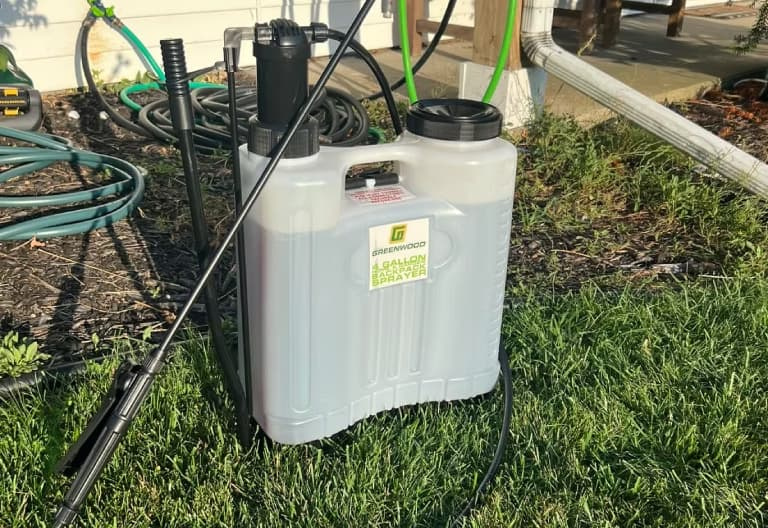
Herbicide Application Guide
New to spraying, or want to get it right? Our Herbicide Application Guide covers the practical steps this page assumes — mixing, calibration, protective gear, and the wind and temperature limits that decide whether a treatment works or drifts. Read it before you spray.
See Guide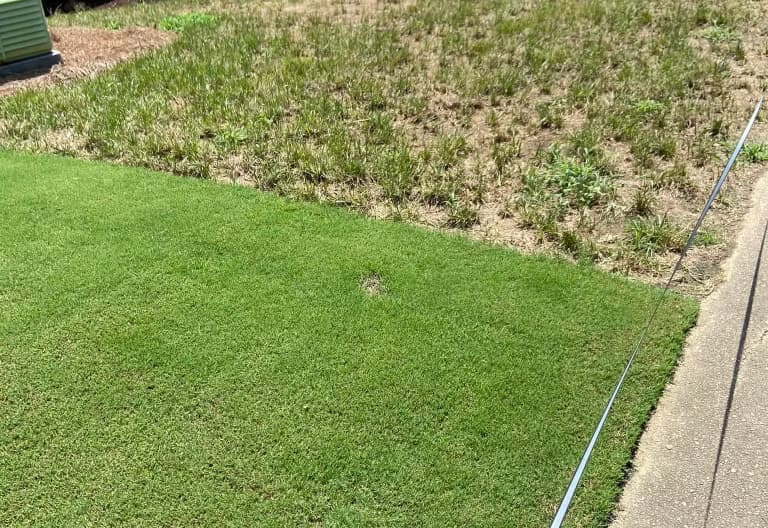
Where Two Lawns Meet
Does your lawn border a neighbor’s — or meet a different type of grass? Spraying near that line can quietly damage the yard next door, sometimes weeks later. Where Two Lawns Meet shows you how to treat safely without harming either side.
Read ArticlePulling
Don't rely on pulling, and never dethatch or power-rake a lawn that has it — both usually make the problem dramatically worse. Full excavation of a small, isolated patch is the only mechanical approach that works.
The Biological Reason
The trap is that rough bluegrass feels easy to pull. Its roots are shallow and weakly anchored, so a stressed summer patch lifts up readily — which fools people into thinking they’ve removed it. But the plant’s real body is its network of stolons, surface runners that root at nodes every inch or two and weave right through the crowns of your good grass. Hand-pulling tears those runners and leaves nodes behind in the thatch, and any single node in contact with moist soil re-roots into a whole new plant. This is why mechanical dethatching and power-raking are so destructive here: instead of removing the weed, they slice the stolons into hundreds of single-node fragments and fling them across the lawn, where they re-root and start satellite colonies. Even hollow-tine core aeration pulls up plugs full of live stolons and spreads them. You can turn one patch into fifty in an afternoon.
The Stolon Network — Why One Patch Becomes Many
Picture the patch not as a clump but as a web of horizontal stems lying on and just under the soil surface. Each stem roots down at regular nodes, and each rooted node is a complete, independent plant-in-waiting. Two things follow directly. First, the advancing tips of that web run ahead of the visible patch, hidden under the healthy canopy around it — which is why any removal, chemical or physical, has to reach a good 12 inches beyond the edge you can see. Second, because every node can regenerate, anything that chops the web into pieces doesn’t kill it — it multiplies it. There is no central root to dig out and no underground structure to reach; the whole survival strategy is many small, rootable pieces near the surface.
If you do excavate a small patch, do it completely: cut at least 12 inches outside the visible edge to catch the hidden runner tips, lift the whole mat, go at least half an inch deep for the surface stolons (3–4 inches where there are clumping crowns), and bag every scrap. Never shake soil off into the lawn, never compost it on-site, and never return the clippings — a single dropped node undoes the whole job.
Lawn vs. Bed Pulling Difference
Loose bed soil makes this worse, not better. For a taprooted weed, cultivated bed soil helps you pull cleanly — but rough bluegrass spreads by fragments, and loose soil lets tillage or aggressive pulling scatter stolon pieces farther and faster than dense turf does. The same action that’s merely risky in a lawn is more effective at spreading the weed in a bed.
Quick Reference Summary
| Lifecycle | Cool-season stoloniferous perennial |
| Active Zones | Cool-season and transition (invades warm-season turf during the cool season) |
| Germination Trigger | Seed germinates as soil falls below 70°F; peaks near 50°F |
| Pre-Emergent | No for existing patches — seed-prevention only |
| Post-Emergent Timing | Active growth only — early spring or early fall (never summer dormancy) |
| Pull | With Caution — full excavation of small patches only; never dethatch |
| Lawn Primary Tool | Non-selective glyphosate spot-treatment, then renovate and reseed |
| Bed Primary Tool | Directed glyphosate or excavation, plus a physical lawn–bed border |
| One-and-Done or Multi-Season | Multi-season |
Frequently Asked Questions
These answers are synthesized from botanical morphology studies and herbicide efficacy trials conducted by leading university agricultural extensions.
Almost certainly not. That collapse is heat dormancy, not death. The crown and stolons stay alive at the soil surface through summer and green back up when cool, moist weather returns in fall. This is the single biggest reason people think they’ve beaten it and then watch it reappear.
No — not for a cool-season home lawn. Rough bluegrass is so closely related to Kentucky bluegrass, fescue, and ryegrass that no selective product can separate them. The only effective route is to spot-kill the patch with non-selective glyphosate and then reseed. Selective options exist only for professional turf or for warm-season lawns.
Yes, after the label’s waiting interval — and that’s exactly why glyphosate is the right choice here, because it leaves no residue in the soil to block new seed. Watch two things. In the transition zone, the multi-week spray program can push seeding dangerously late in fall. And check your product: some reformulated “Roundup” bottles now contain imazapic, which lingers in the soil and prevents reseeding for months — the opposite of what you want. Buy a glyphosate-only product.
The number-one route is contaminated seed or sod. Rough bluegrass grows as a weed in grass-seed production fields, and its tiny seeds are almost impossible to screen out, so a cheap uncertified bag can carry 20 to 25 viable seeds per square foot into your lawn. Buy only Blue Tag certified seed that lists rough bluegrass at 0.0%.
No — it does the opposite. Those machines slice the stolons into hundreds of single-node fragments and scatter them, and each fragment re-roots into a new plant. In a lawn that has rough bluegrass, mechanical dethatching and power-raking are among the fastest ways to spread it. Skip them until the weed is gone.
Scientific Authority
This profile is constructed using forensic botanical data and Integrated Pest Management (IPM) research. We prioritize scientifically-vetted identification and control methods that protect the broader ecosystem while ensuring successful eradication based on peer-reviewed agricultural studies.
Primary Resources
- Penn State Extension — Lawn and Turfgrass Weeds: Roughstalk Bluegrass (Poa trivialis L.); Roughstalk Bluegrass: A Cool-Season Perennial Grass; The Cool-Season Turfgrasses: Identification; Growing Turf Under Shaded Conditions
- Purdue Turf / Purdue Extension — Roughstalk Bluegrass; Poa annua, Poa trivialis in Lawns and Athletic Fields; Controlling Poa trivialis in Sports Fields; Identification and Control of Perennial Grassy Weeds (AY-11); When Roundup Isn’t Roundup
- NC State Extension / TurfFiles — Rough Bluegrass (NC State Extension Publications); What Are the Yellow Patches of Grasses in Cool-Season Grasses in Spring?; Winter Glyphosate Applications to Bermudagrass; Chemical Weed Control (NC State Extension Publications)
- Michigan State University Extension — Rough Bluegrass (MSU IPM); Rough-stalk Bluegrass: A Weed in Legume-Grass Forages in Michigan; Not Your Mother’s Roundup; MSU Turfgrass Information Center archive (Poa trivialis; The Poa trivialis Challenge; Overseeding with Poa trivialis)
- University of California IPM — Roughstalk Bluegrass (Weeds Identification Gallery); Healthy Lawns — Rough Bluegrass; Annual Bluegrass
- University of Missouri Extension — Managing Lawns and Turfgrass; Identification and Management of Turfgrass Diseases; Mizzou WeedID, Roughstalk Bluegrass
- Virginia Tech — Rough Bluegrass Weed Profile (Weed ID); Virginia Cooperative Extension turf publications
- Kansas State University / KSRE — Roughstalk Bluegrass (Poa trivialis); Turfgrass Selection, Professional Series (MF2032)
- University of Tennessee Institute of Agriculture — Turfgrass Establishment — When to Plant; What’s in That Jug?; UT herbarium weed profile
- University of Kentucky (UKnowledge) — Chemical Control of Turfgrass Diseases
- Clemson University (HGIC) — turfgrass weed and perennial-grass identification resources
- University of Florida / IFAS, Cornell University, University of Illinois Extension, Washington State University (HortSense), Texas A&M AgriLife Extension, and The Morton Arboretum — landscape-bed weed management and ornamental herbicide-safety resources
- LSU AgCenter — consumer Roundup reformulation (active-ingredient change)