
Scientific Name: Cenchrus clandestinus (formerly Pennisetum clandestinum)
Kikuyugrass
One node, one new plant
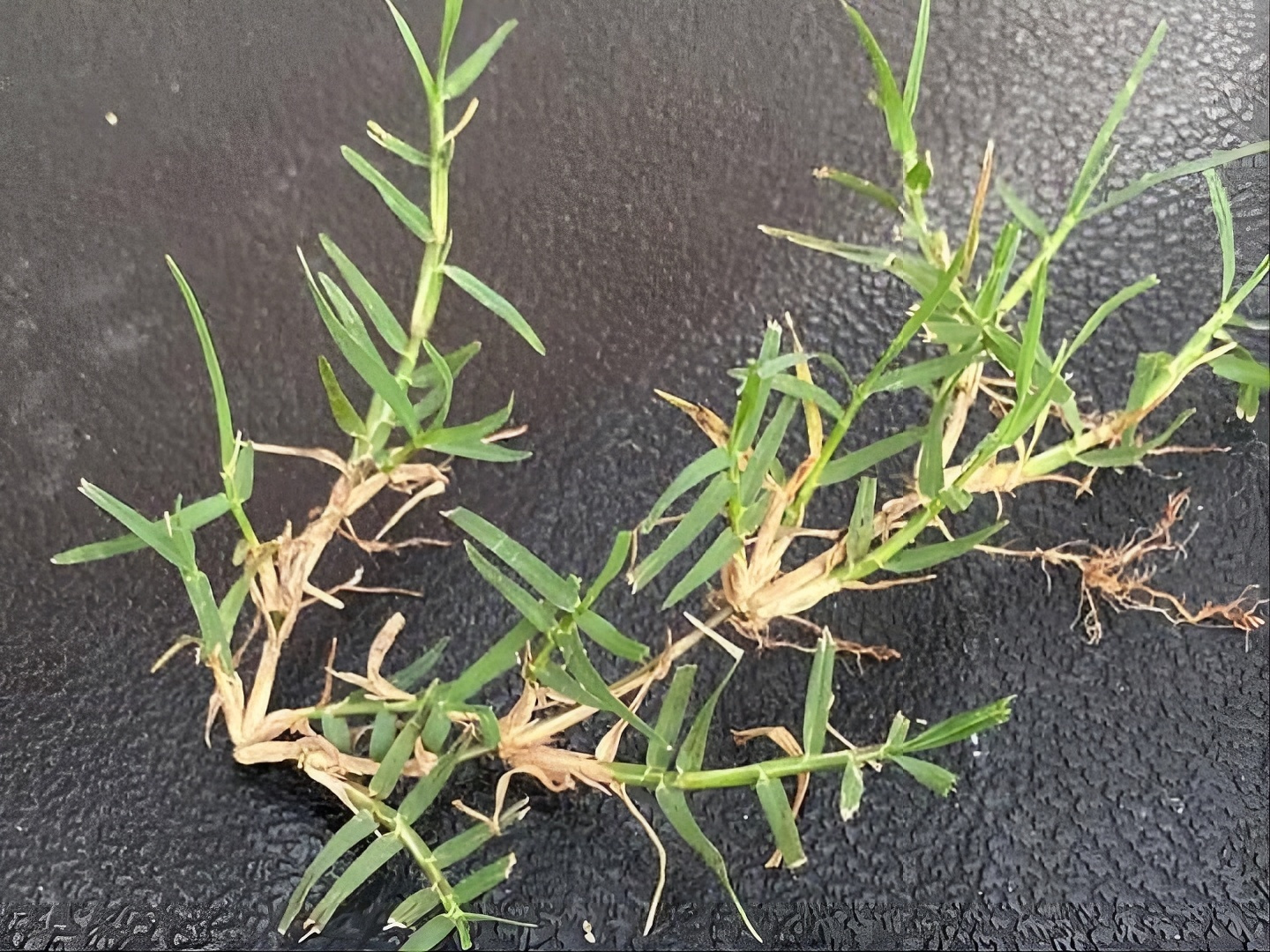
Kikuyugrass At-a-Glance
Weed Type
Grass
Life Cycle
Perennial — spreads by stolons and rhizomes
Growth Habit
Mat-forming (low, prostrate, spongy)
Root Type
Rhizomes and stolons (plus deep fibrous roots)
Spreading Risk
Explosive — by stolon, rhizome, and seed
Pull
With Caution
Identity & Diagnostics
Visual Fingerprint
Kikuyugrass reads as a coarse, pale grass that is the wrong color for your lawn — a light, almost apple-green that clashes with the darker turf around it. It grows low and dense into a thick, spongy, uneven mat rather than standing upright. Look for fat, flattened runners creeping across the surface, and leaf blades that come to a clear point and feel slightly hairy to the touch. In a mowed lawn, a stand can take on a silvery or whitish cast that people often mistake for a lawn disease — that’s actually the plant flowering, not fungus.
Structural Anatomy
Up close, a few features confirm it. The leaf blades are coarse and flat, about 1/8 to 1/4 inch wide, covered in soft short hairs, and marked by a pronounced ridge (the midvein) running down the underside. Each blade tapers to a pointed tip. The leaf sheaths — the part that wraps the stem — are flattened, hairy, and overlap at their bases. But the giveaway is below and along the ground: thick, fleshy, slightly flattened runners studded with swollen, jointed nodes wrapped in overlapping brown sheaths. The stretches of stem between those nodes are short and thick, which is why the mat weaves together so tightly.
Grass-Specific Anatomy
For readers matching this against a grass key, the diagnostic set is:
- Vernation (how the new leaf is arranged in the bud): folded. (Field manuals occasionally describe it looking rolled, but the botanical keys define kikuyugrass by folded vernation — so if you unroll a young shoot and it was creased flat rather than wrapped in a tube, that fits.)
- Ligule (where blade meets sheath): a dense fringe of fine white hairs of uneven length — not a papery membrane.
- Auricles (small clasping flaps at the collar): absent.
- Collar: pale to light green, with a long fringe of hairs running parallel to the stem and long white hairs along the collar’s edges.
- Sheath: flattened, compressed, distinctly hairy, overlapping at the base.
Runners: thick, fleshy stolons on the surface and a tough rhizome network below, both rooting and sending up shoots at every swollen node.
Growth Patterns & Life Stages
A seedling starts out deceptively ordinary — a delicate, upright young grass with narrow, light-green blades and a few fine hairs. That phase is brief. Within weeks the plant stops growing up and starts growing out, throwing horizontal runners across the soil that root as they go and turn a single plant into a spreading mat. At full size, an unmowed stand can reach 18 to 20 inches tall, and under favorable conditions a patch expands by roughly 4 square feet a month with shoot growth exceeding an inch a day. Flowering runs spring through fall, but the flower heads stay hidden inside the terminal leaf sheaths — the source of the name clandestinus, “hidden.” What you actually see are the fine white filaments that push out in cool, humid mornings and give the turf that silvery cast, most often triggered by mowing. By the time a stand is flowering and matting, the vegetative runners — not the seed — are already doing the real spreading.
Gallery
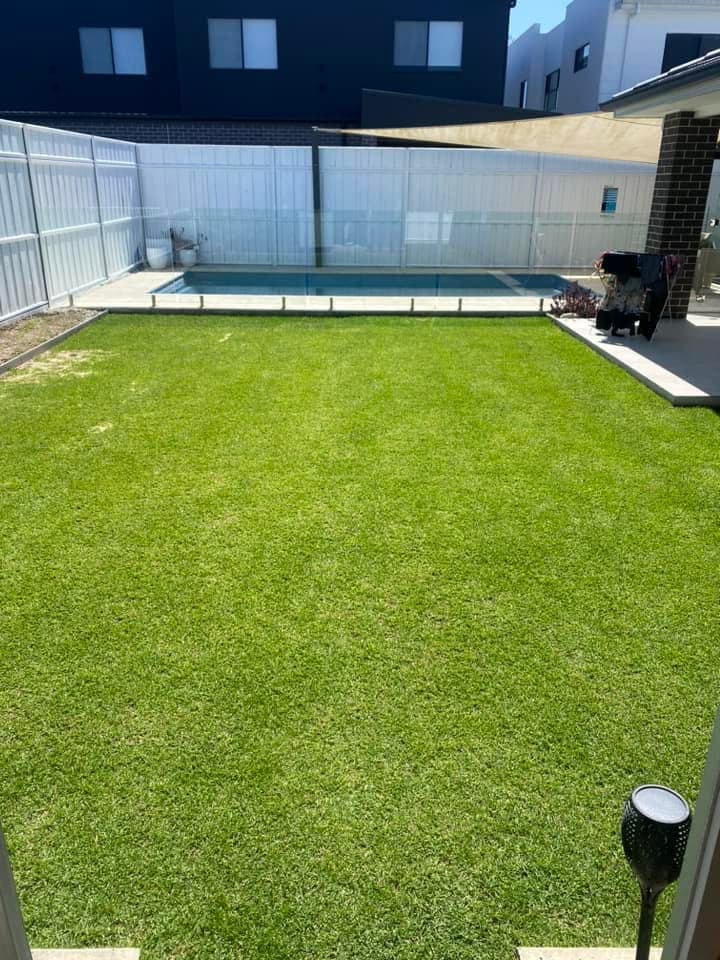
While classified as an invasive weed in many regions, Kikuyu grass is intentionally planted in areas like Southern California and Hawaii for its high heat tolerance and dense turf cover.
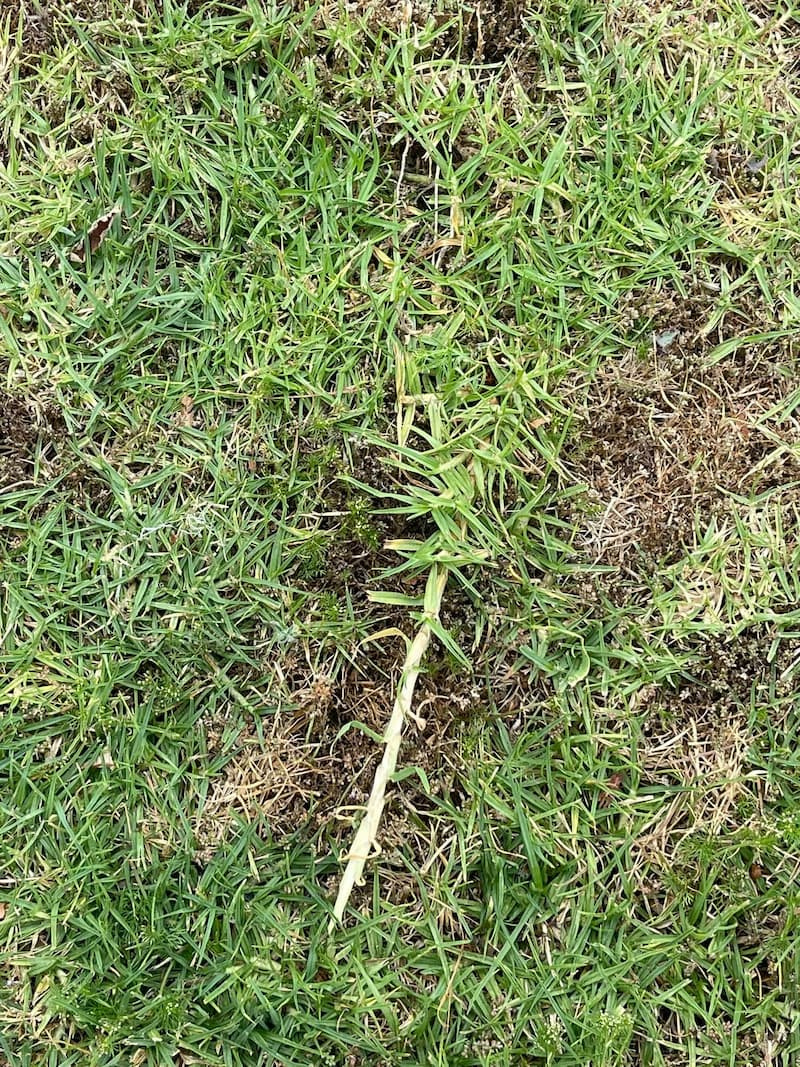
Invasive Growth Habit: Kikuyu spreads across yards using thick, coarse above-ground stolons that form heavy matted patches and smother desirable turfgrass.
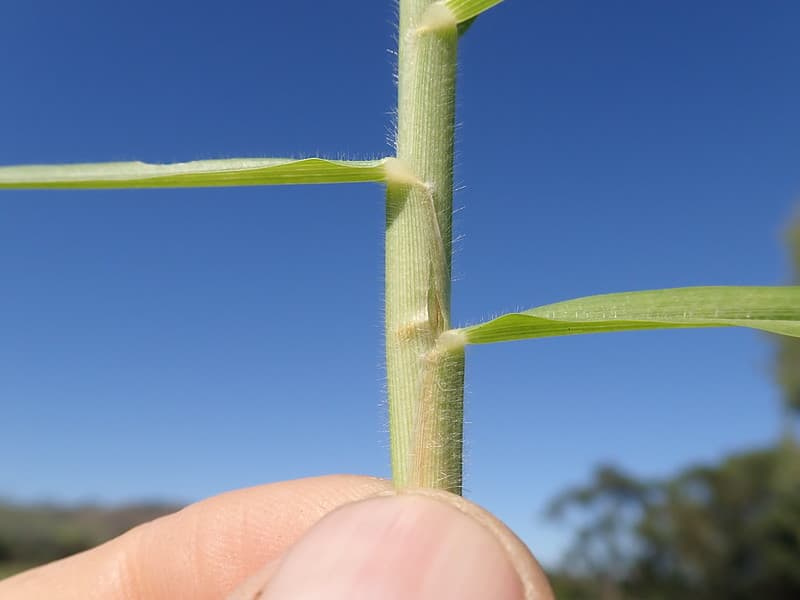
Look For: Kikuyugrass stems are covered in fine hairs, especially at the swollen nodes where leaves branch off — a texture smooth-stemmed grasses like Bermuda simply don't have.
“Cenchrus clandestinus sheath NC3” by Macleay Grass Man is licensed under CC BY 2.0.
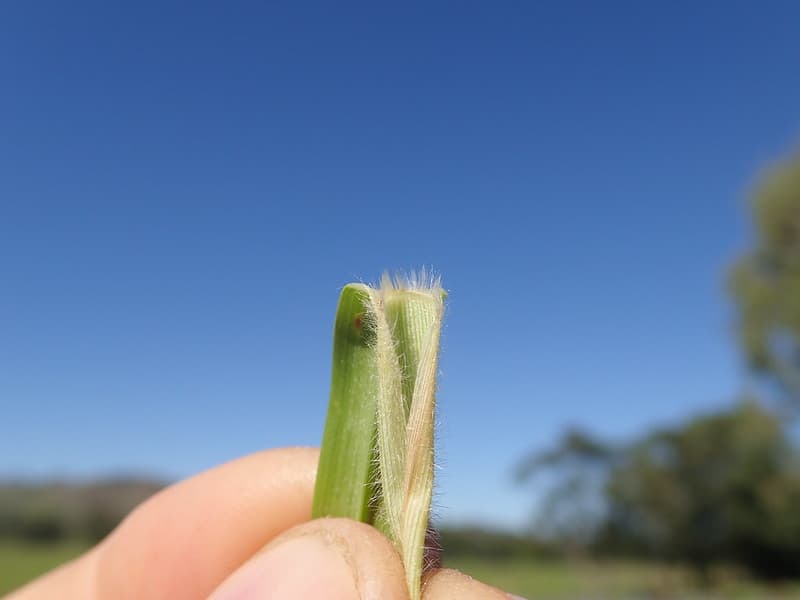
Key Identifier: New leaves emerge folded in half lengthwise, not rolled like Bermudagrass or St. Augustine — one of the most reliable ways to confirm you're looking at Kikuyugrass.
“Cenchrus clandestinus ligule NC1” by Macleay Grass Man is licensed under CC BY 2.0.
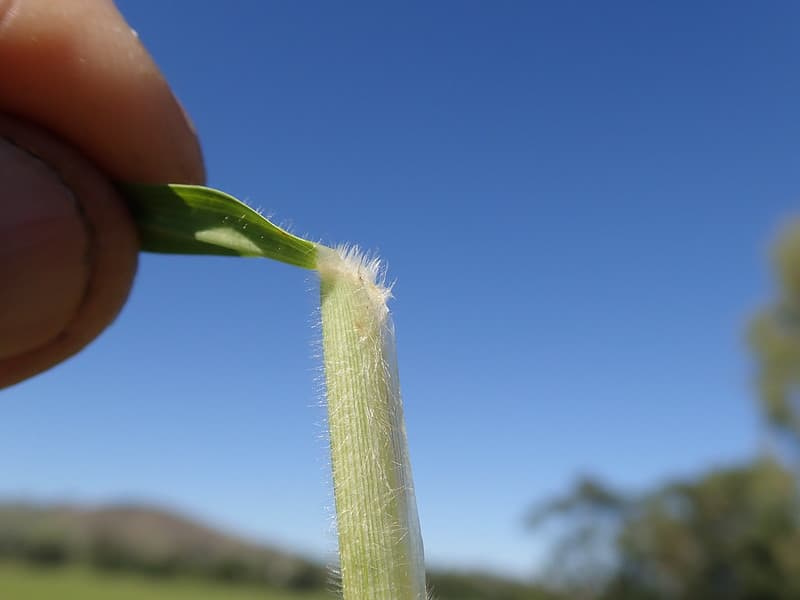
Diagnostic Feature: Peeling back a leaf exposes a sheath covered in soft, dense hairs — another texture cue that separates Kikuyugrass from smoother-sheathed lawn grasses.
“Cenchrus clandestinus collar NC2” by Macleay Grass Man is licensed under CC BY 2.0.
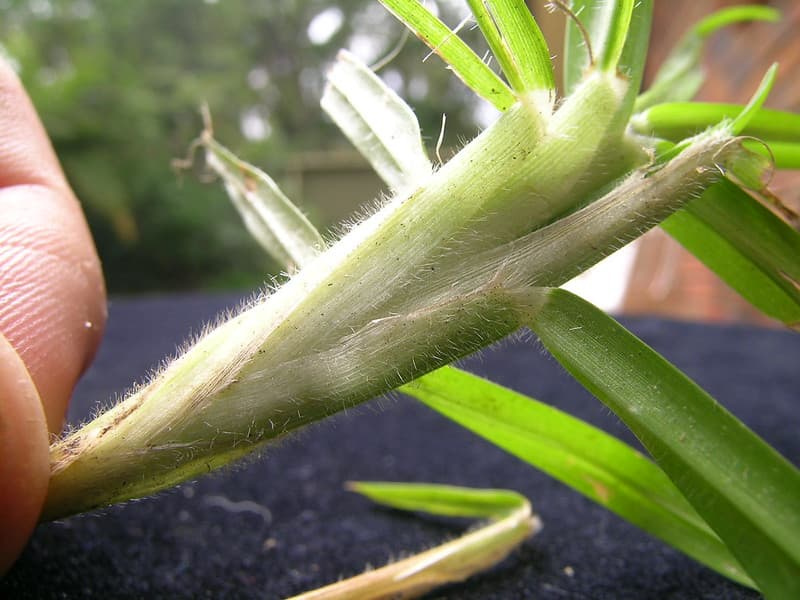
Another Angle: A brighter, closer view of the same hairy sheath texture — useful for confirming what you're feeling when you run a finger down the stem.
“Cenchrus clandestinus sheath NC2” by Macleay Grass Man is licensed under CC BY 2.0.
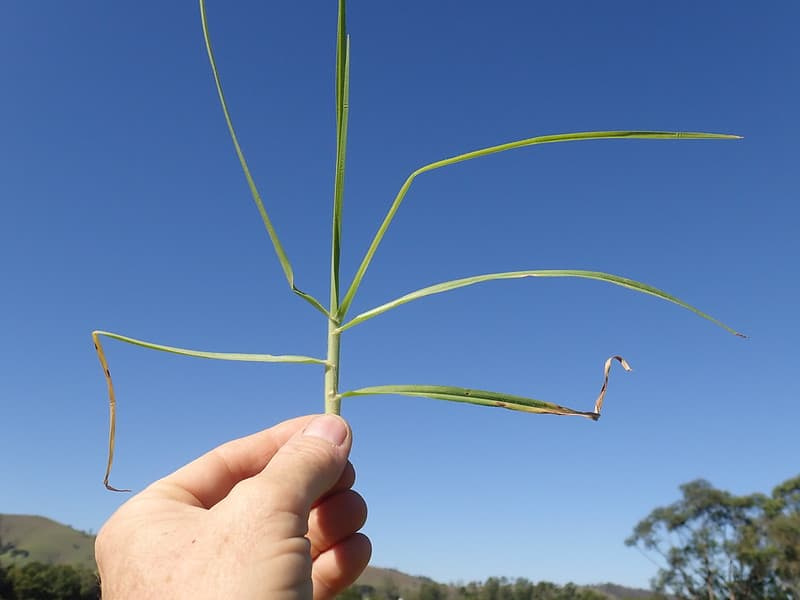
Growth Habit: Leaves branch outward from closely spaced nodes along the stem, giving Kikuyugrass its coarse, spreading growth pattern.
“Cenchrus clandestinus leaf NC2” by Macleay Grass Man is licensed under CC BY 2.0.
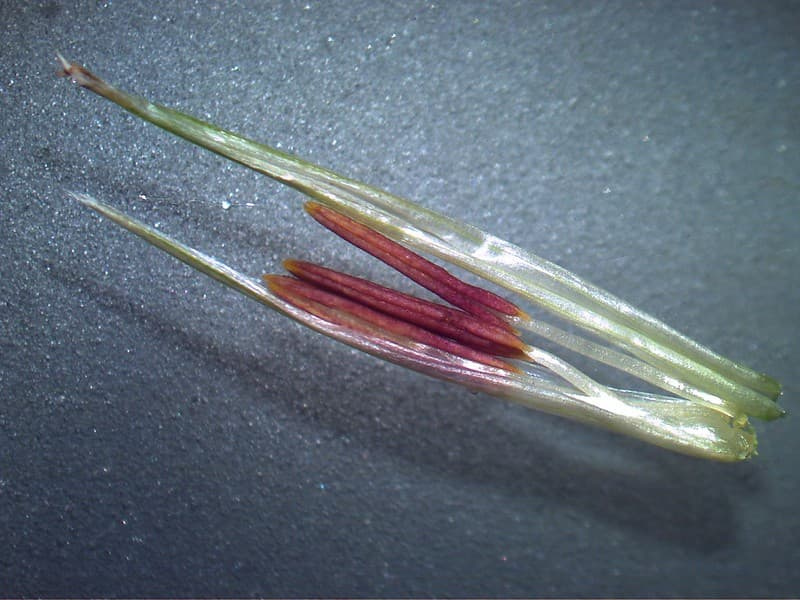
Fun Fact: Kikuyugrass rarely shows an obvious seed head — its scientific name, Cenchrus clandestinus, means 'hidden,' and these wispy reddish threads are usually the only visible sign of its flowers.
“Cenchrus clandestinus floret male NC11” by Macleay Grass Man is licensed under CC BY 2.0.
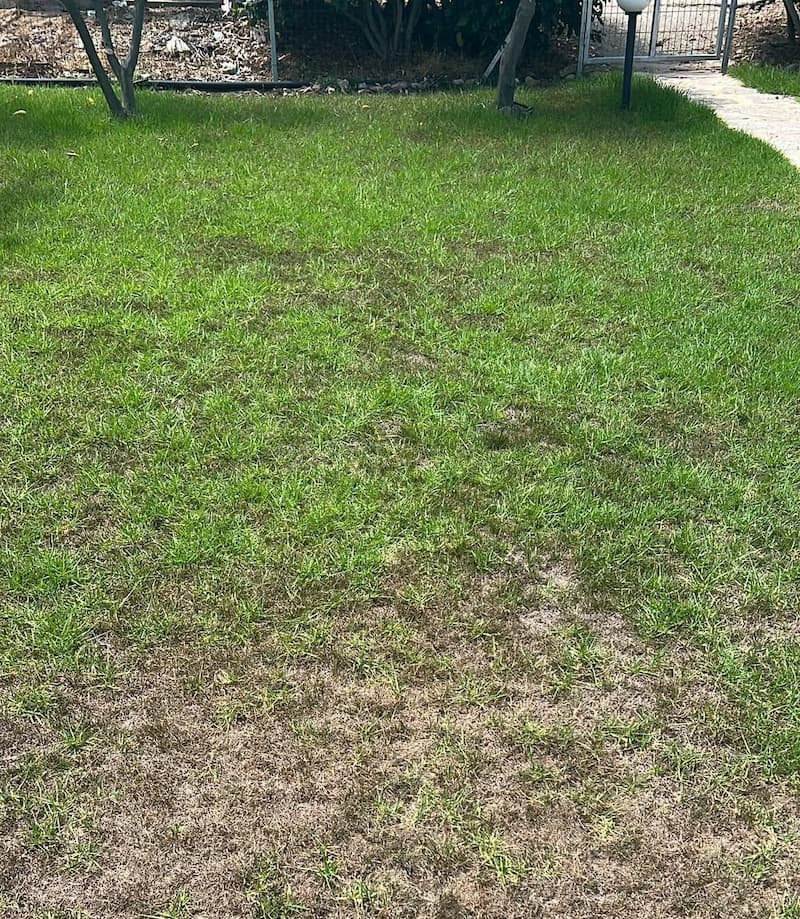
Winter Dormancy: As a warm-season species, Kikuyu goes dormant and turns brown during cooler months, often prompting homeowners to overseed with ryegrass for year-round green color.
The Identity Trap
Common Lookalikes
The two grasses homeowners most often confuse with kikuyugrass are bermudagrass and St. Augustinegrass — both coarse, warm-season grasses that also spread by surface runners, so at a glance the growth form looks similar.
Identification Differentiators: How to Tell Them Apart
Kikuyugrass vs. bermudagrass: texture is the fast tell. Bermudagrass is fine, with narrow gray-green blades and thin, wiry runners. Kikuyugrass is coarse, light apple-green, with thick, fleshy runners you can’t miss. If it flowers, it’s decisive — bermudagrass raises an open seedhead of three to seven finger-like spikes, while kikuyugrass hides its flowers and shows only white filaments.
Kikuyugrass vs. St. Augustinegrass: look at the leaf tip and feel the blade. St. Augustinegrass has rounded, boat-shaped tips and completely smooth, hairless blades and sheaths, and it lacks the fringe of hairs at the collar. Kikuyugrass blades taper to a point, feel slightly hairy, and carry that hairy collar. If the tip is blunt and the leaf is smooth, it’s St. Augustine, not kikuyu.
Growing Conditions
Host Grasses
Kikuyugrass isn’t picky about which lawn it invades — it outcompetes and smothers nearly all of them. In mild climates it pushes into cool-season lawns (tall fescue, perennial ryegrass, Kentucky bluegrass), and it also overruns warm-season lawns like bermudagrass and St. Augustinegrass. It thrives in the same conditions that weaken good turf: thin, under-fertilized, low-density stands leave open ground for it to colonize, and its dual runner system lets it creep in from any untreated edge. It’s equally at home in ornamental beds, so this is not a lawn-only problem.
Host Environment/Area
The strongest driver is moisture. Kikuyugrass establishes most aggressively where soil stays consistently wet — low spots with poor drainage, ground around sprinkler heads, and over-irrigated turf. It tolerates heavy foot traffic and compaction, so worn pathways and hard-used areas don’t slow it down. In lawns, it exploits wet, thin, or disturbed patches. In beds, the conditions we deliberately create — loose, fertile, regularly watered soil — are close to ideal for runners to root and rhizomes to spread, and the plant will climb up to 18 inches into fences and low shrubs to reach light. The one place it won’t go is deep shade: it has essentially no shade tolerance and can’t establish under a closed canopy.
Soil Indicators: What the Presence of This Weed Reveals About Your Yard
A thriving kikuyugrass patch is a reliable signal, and the clearest message is water. Dense growth in one area usually means that spot stays too wet — over-irrigated, poorly drained, or both — so the presence of the weed is telling you to check your irrigation coverage and drainage there before anything else. Its vigor also indicates soil that’s compacted-but-tolerated and adequately-to-well fed; it runs rampant where nitrogen is plentiful and only slows on severely depleted, strongly acidic soils. So a lush, dominant stand isn’t a sign of poor soil — it’s a sign of wet, fertile, workable soil that the weed is better than your lawn at using.
Lifecycle and Season
Lifecycle Category and Management Implications
Kikuyugrass is a warm-season perennial that does not die back to nothing each year. Its stolons and rhizomes overwinter (or, in frost-free areas, never stop growing) and carry large carbohydrate reserves, which means two things for control. First, pre-emergent herbicide — which only stops seeds — does nothing to an established stand; the plant isn’t germinating, it’s expanding by runner. Second, a single dose of any post-emergent just burns the foliage back, and the plant regrows from those reserves within weeks. Real control is a systemic, repeated, multi-season effort aimed at the underground network, not a one-time spray.
Germination Trigger
Seed matters mostly after the ground is disturbed or renovated, but the numbers are worth knowing. Kikuyugrass seed germinates once soil temperatures reach roughly 66°F, with germination peaking near 78°F. To get ahead of it, a pre-emergent barrier has to be down before that — in warmer regions, where the earliest warm-season flushes can start around 50 to 55°F, that means a late-winter application. For an established plant, though, germination is beside the point: the spread you’re seeing is vegetative.
Here’s an important distinction that trips people up. Kikuyugrass is not a weed of the true cool-season climate zone — it can’t survive prolonged hard freezes, so in regions with real winters it simply doesn’t persist outdoors. But “cool-season” also describes grass species, and that’s where the confusion lives: in mild climates like coastal California, kikuyugrass heavily invades cool-season lawns made of tall fescue, perennial ryegrass, and Kentucky bluegrass. So if you’re in a cold-winter part of the country, this isn’t your weed. If you have a fescue or rye lawn in a mild, frost-light climate, you are squarely in its range even though your grass is “cool-season.” Don’t let the grass type reassure you.
This is where kikuyugrass lives. In frost-free coastal areas (coastal California, Hawaii) it grows year-round with no dormancy. In inland and desert areas that get light winter frost, it browns and goes dormant from late November until it greens up again around February or March. Timing follows that rhythm: if you’re renovating or spot-treating with a systemic herbicide, do it during active summer growth, when the plant is moving sugars — and the herbicide with them — down into the runners. Pre-emergent (to hold back seedlings after a renovation, not to touch established plants) goes down in March across central and coastal California, and as early as mid-January to February in the warmer southern coastal and desert regions where seeds stir sooner. And the standard warm-season caution applies: don’t put broadleaf-type post-emergents on warm-season turf before it has fully greened up.
Kikuyugrass is not an established weed of the eastern transition zone — you won’t find it as a routine lawn problem in the mid-Atlantic or Tennessee Valley the way crabgrass or nutsedge show up there. Its transition-like behavior appears instead at the cold margin of its western range: inland valleys and higher elevations where winter frost forces it into dormancy from late fall to late winter. In those spots the practical rule is the same as the warm-season zone — treat only when the plant is actively growing after spring green-up, since a dormant stand won’t move a systemic herbicide, and hold broadleaf products until warm-season turf is fully out of dormancy.
Herbicide Control
Pre-emergent herbicides do not control established kikuyugrass — they stop seeds, and an established stand spreads by runner, not seed. Their only role in lawn management is to suppress seedlings after a renovation, holding back the seed bank while your new grass fills in. If you’re at that stage, extension-documented options (by active ingredient) include dithiopyr, pendimethalin, prodiamine, benefin, and bensulide, applied before soil warms into the germination range and watered in per the label so the barrier activates. Dithiopyr is worth noting because it’s unusually safe on most warm-season turf and also catches very young grass seedlings (through about the 3-to-5-leaf stage). But keep the expectation straight: pre-emergent is a follow-up tool that protects a renovation, not a way to remove the weed you already have.
There is no single selective spray that eradicates established kikuyugrass — expect a multi-season program, and match the tool to your grass.
For a heavy infestation, the honest answer is renovation with non-selective glyphosate. You broadcast glyphosate over the infested area to kill foliage, stolons, and rhizomes together, then remove the dead thatch and reseed or resod with competitive turf. One pass isn’t enough: extension trials show you need at least two applications spaced about 14 days apart, on healthy, actively growing grass, before you clear and replant — the second pass catches what regrows from reserves the first one didn’t reach. Because glyphosate kills any green plant it touches, this is a boundary-risk operation: drifting spray or overspray will kill your good turf, a neighbor’s lawn, or adjacent bed plants just as readily as the weed, so treat only on a still day and keep the spray inside your target. (Buying tip: not every product labeled “Roundup” is glyphosate anymore — check the active-ingredient panel before you buy.)
Where full renovation isn’t practical, you can suppress selectively — but the product depends entirely on your lawn:
- Cool-season lawns (tall fescue, perennial ryegrass, Kentucky bluegrass): triclopyr. Triclopyr is a synthetic-auxin growth regulator — it throws the weed into disorganized, unsustainable growth while your cool-season grass tolerates it. Plan on roughly three to four applications a year, spaced 21 to 30 days apart, applied each time new kikuyugrass growth appears. It won’t clear the stand in one season; it steadily weakens the weed so the desirable grass can crowd back in.
- Bermudagrass lawns: quinclorac. Quinclorac is taken up by both roots and foliage and moves through the plant. Applied in a short sequence (about two to three treatments at 14-to-21-day intervals), it suppresses kikuyugrass while letting bermudagrass grow back into the gaps within a few weeks. Note the turf limits: quinclorac is safe on bermuda but can injure cool-season grasses under some conditions, so it’s not a cool-season tool. (The old standby for bermuda, MSMA, is heavily restricted and not approved for residential lawns — it’s not an option you can buy, so don’t chase it.)
Whatever the tool, systemic herbicides only work on a plant that’s moving sugars, so spray healthy, actively growing kikuyugrass that isn’t stressed by drought or heat. Leave treated areas unwatered for at least 24 hours, and hold off mowing for 72 to 96 hours, so the chemical has time to travel down into the rhizomes before you remove the foliage.
Be clear-eyed about what cultural practices can and can’t do here: once kikuyugrass is established, no amount of mowing, fertilizing, or watering adjustment will remove it — it’s too vigorous and too drought- and low-fertility-tolerant for cultural half-measures to matter. Where cultural management earns its keep is prevention. A dense, vigorously growing lawn is your best defense against a new invasion: a thick canopy shades the soil so seeds can’t germinate and stray runner fragments can’t reach soil to root. Just as important is sanitation, because equipment is the main way this weed travels — wash mowers, aerators, and dethatchers before moving them from an infested area to a clean one; bag and discard clippings from an infested lawn rather than recycling them back into the turf; verify that any imported soil, compost, or sod is certified free of kikuyugrass; and keep irrigation inside the lawn so you’re not creating wet, rootable edges for escaping runners.
As in the lawn, pre-emergent only stops seedlings — it does nothing to established runners already in the bed. For beds that are currently free of kikuyugrass, several pre-emergents are labeled safe over the top of a wide range of ornamentals and can hold back seedling establishment: dithiopyr, pendimethalin, prodiamine, oryzalin, and napropamide among them. Apply them to the soil surface (typically under the mulch layer) in late winter to early spring, before soil warms into the germination range, and water in per the label. Watch the plant-specific cautions the labels carry — some ornamentals are sensitive, several products can stunt roots if they leach into the root zone of shallow-rooted trees and shrubs, and a few are volatile and need prompt incorporation. This is seed insurance for a clean bed, not a fix for an infested one.
The good news for beds is that grass-selective “grass killer” herbicides let you treat kikuyugrass without harming most broadleaf ornamentals. These ACCase-inhibitor graminicides — fluazifop, sethoxydim, and clethodim — are absorbed by the grass and translocated, killing grass while broadleaf shrubs, perennials, and trees shrug them off. Because they don’t have soil residual and can’t kill the whole rhizome network in one shot, plan on repeat treatments at roughly monthly intervals as regrowth appears, and apply while runners are still short (under about 6 inches) with the labeled crop-oil or surfactant for good uptake. Two cautions: these products will kill any desirable lawn grass they reach, so keep them off the turf edge; and even “over-the-top-safe” graminicides injure certain ornamentals (blue fescue and a few juniper and azalea cultivars are documented sensitivities), so check the label for your specific plants and use directed sprays near anything questionable.
For spot-killing kikuyugrass tangled into a desirable planting, non-selective glyphosate is highly effective — but only with a technique that keeps it off the ornamentals. Don’t broadcast it in a bed. Use a sponge, wick, or wiper applicator to paint the herbicide directly onto the kikuyugrass blades, since any drift or contact will chlorose, distort, or kill the ornamental foliage, green stems, or shallow roots it lands on. That contact risk extends past your own plants — near a bed edge or property line, wiped-on glyphosate is safer than any spray, but overspray still threatens a neighbor’s plantings.
The bed verdict, stated separately from the lawn: like the lawn, this is multi-season. Selective graminicides suppress and gradually wear the stand down over repeated treatments; a single application won’t finish it.
Mulch helps against kikuyugrass seedlings but won’t stop an established stand. A 3-to-4-inch settled layer of organic mulch shades the soil and blocks seed germination, which is real prevention in a clean bed. But an established plant sprouting from those energy-loaded rhizomes has no trouble pushing straight up through even a thick mulch layer — the shoots simply grow through it. For physical suppression of an existing stand you’d need a heavy, meticulously overlapped woven landscape fabric under a thin mulch cap, and even that is imperfect: runners creep under the edges and through any gap or tear. Mulch is a seedling barrier, not a solution to runners already in the ground.
Herbicide Application Reference
The chemistry on this page carries a few specific risks worth naming. Glyphosate is non-selective — during a lawn renovation or a bed spot-treatment it kills any green plant it reaches, which makes drift and overspray a direct threat to your own good turf, your ornamentals, and an adjacent or neighboring yard. Renovation happens in summer, when the kikuyugrass is actively growing — but so is every lawn around it, meaning a neighbor’s grass is fully green and fully vulnerable to any glyphosate that drifts across the line. Spray only on still days and, in beds and near edges, wipe the herbicide on rather than spraying it. Triclopyr, the cool-season-lawn tool here, is a growth-regulator herbicide; keep it off warm-season turf (it can injure it) and be mindful of drift toward nearby beds and ornamentals during repeated applications. Quinclorac is safe on bermudagrass but can injure cool-season grasses under some conditions and shouldn’t drift onto broadleaf ornamentals. And several of the pre-emergents used for seedling suppression can stunt the roots of shallow-rooted trees and shrubs if they leach into the root zone in light or sandy soils — follow label placement and buffer distances near desirable woody plants.
A product note that is easy to miss, and that matters more here than on most pages: the consumer “Roundup” brand no longer reliably means glyphosate. Several reformulated versions now use different active ingredients, and some of them — imazapic is one — stay active in the soil for months. On this weed, glyphosate is chosen specifically because it has essentially no soil residual, which is what lets you reseed or resod immediately after a renovation. Grab a reformulated “Roundup” with a soil-residual ingredient by mistake, and you can both fail to get the systemic kill you need and poison the ground against the new grass you’re trying to establish. Before you buy, read the active-ingredient panel and pick a product whose only active ingredient is glyphosate.
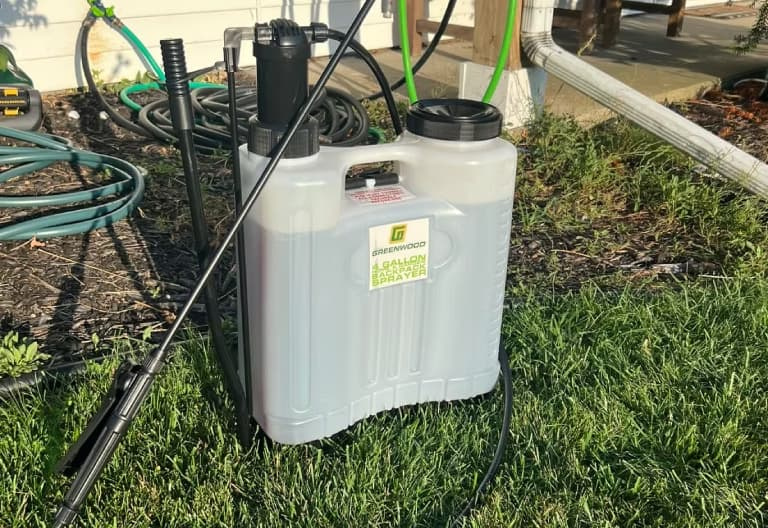
Herbicide Application Guide
New to spraying, or want to get it right? Our Herbicide Application Guide covers the practical steps this page assumes — mixing, calibration, protective gear, and the wind and temperature limits that decide whether a treatment works or drifts. Read it before you spray.
See Guide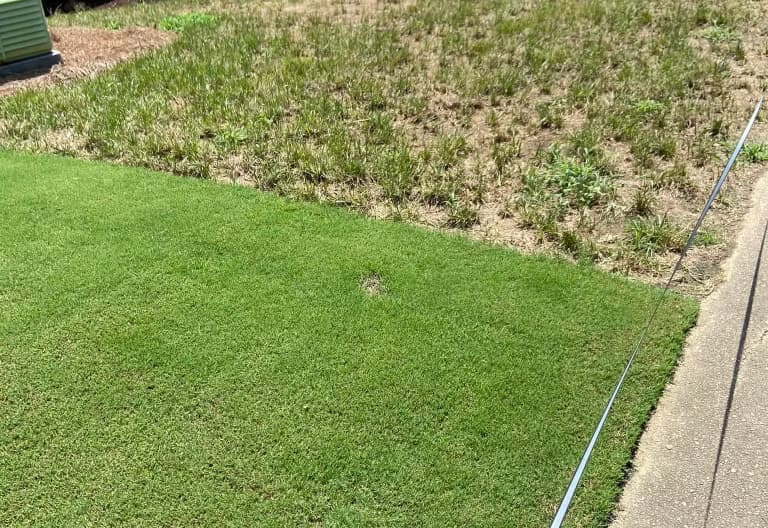
Where Two Lawns Meet
Does your lawn border a neighbor’s — or meet a different type of grass? Spraying near that line can quietly damage the yard next door, sometimes weeks later. Where Two Lawns Meet shows you how to treat safely without harming either side.
Read ArticlePulling
You can dig out a small, isolated, young patch — but only if you remove every scrap of the underground network — and you must never till, hoe, rototill, or dethatch an established stand, because that shreds it into fragments and turns one patch into dozens.
The Biological Reason
The reason cuts both ways, and it comes down to how this plant is built. Kikuyugrass spreads through a dual network: fleshy stolons running across the surface and tough rhizomes branching underground, and every stem segment that contains even a single node can grow a complete new plant — roots, shoots, and all. There is no minimum fragment size. That’s why hand weeding that only strips the surface runners fails: it leaves the rhizomes behind, and they resprout in weeks. It’s also why any tool that chops the plant — a tiller, a hoe, a dethatcher, even a mower moving through it — is a propagation machine. Slicing a stand into a hundred pieces and scattering them across moist soil is exactly how you’d deliberately grow more of it.
So the technique for a small patch is specific: dig, don’t pull, and excavate the whole footprint to a depth of at least 4 to 6 inches to lift the entire rhizome mat out intact. Then handle the debris as hazardous — bag every fragment and put it in the municipal trash, or seal it on a plastic tarp in full sun for at least 38 days until it’s fully dried and dead. Never toss it on open soil, and never add it to a home compost pile; backyard compost doesn’t get hot enough to kill the nodes, which will happily root into the pile or wherever the finished compost lands. (And because it’s a federally listed noxious weed, moving that contaminated material off your property isn’t just risky — it’s legally restricted.)
Underground Structure Explainer
It helps to picture the three layers, because they’re easy to lump together and they behave very differently:
- Stolons — on the surface. Thick, fleshy runners that creep 10+ feet in a season and root at every swollen node. These build the visible thatch mat.
- Rhizomes — shallow underground. A branched network living mostly in the top 4 inches of soil. This is the reproductive engine most people miss when they pull, and it’s what a 4-to-6-inch excavation is designed to reach.
- Roots — deep. Fibrous roots that can reach astonishing depths (well over 10 feet in favorable soil). These pull water and nutrients but do not sprout new plants — so “roots go 18 feet deep” does not mean you have to dig 18 feet. The part that regrows is the shallow rhizome layer.
The stolons and rhizomes together store the carbohydrate reserves that let the plant shrug off a single spray or a bad mowing. Cutting them scatters that stored energy into new plants instead of removing it. That’s the whole problem in one sentence: with kikuyugrass, cutting is planting.
[Diagram: a soil-profile cross-section showing surface stolons rooting at nodes, the shallow branched rhizome network in the top 4 inches, and deep fibrous roots below — with a callout on a single severed node sprouting a new shoot and root, captioned “any node = a new plant.”]
Lawn vs. Bed Pulling Difference
The tilling trap is worse in beds than in lawns. Loose, cultivated, well-watered bed soil lets a hoe or tiller scatter fragments farther and gives every one of them ideal conditions to root — so the same mistake that spreads kikuyugrass across a lawn spreads it faster through a bed. Diligent hand-digging of a small patch can still work in a bed, but power cultivation of an infested bed is the single most reliable way to make the problem permanent.
Quick Reference Summary
| Lifecycle Category | Warm-season perennial (stolons + rhizomes) |
| Active Zone(s) | Warm-season / mild-climate (coastal CA, Southwest, Hawaii); not the cold cool-season zone |
| Germination Trigger | Soil ~66°F (optimum 78°F); pre-emergent down before 50–55°F in warm regions |
| Pre-Emergent | Yes — but only for seedlings after renovation, not for established plants |
| Post-Emergent Timing Window | Active summer growth; not drought- or heat-stressed |
| Pull | With Caution — dig small isolated patches 4–6 in deep; never till an established stand |
| Lawn Primary Tool | Cool-season lawns: triclopyr (repeat). Bermuda: quinclorac (repeat). Heavy stands: glyphosate renovation |
| Bed Primary Tool | Grass-selective graminicides (fluazifop / sethoxydim / clethodim); wick-applied glyphosate for spot kills |
| One-and-Done or Multi-Season | Multi-season, often multi-year |
Frequently Asked Questions
These answers are synthesized from botanical morphology studies and herbicide efficacy trials conducted by leading university agricultural extensions.
Having an existing stand isn’t the violation. What’s restricted is spreading it: you can’t legally move soil, sod, or green waste contaminated with its runners or seeds off your property, and you can’t intentionally propagate it. Practically, that means bagging debris for the trash rather than putting it in green-waste or yard-compost collection, and cleaning equipment before it leaves the area.
No — this is the single most common and most damaging mistake. Every stem fragment with a node regrows into a new plant, so tilling chops the stand into hundreds of pieces and scatters them across loose, moist soil where they root fast. You’ll end up with far more kikuyugrass than you started with. Kill it in place with a systemic herbicide first, then remove the dead material.
Glyphosate does work, but only applied repeatedly to healthy, actively growing plants — a single spray just burns the top and the stand regrows from its reserves. One catch worth knowing: the “Roundup” brand no longer reliably means glyphosate. Several reformulated consumer versions contain different active ingredients, some of which linger in the soil and can block the reseeding you’ll want to do afterward. Read the active-ingredient panel and choose a product whose only active ingredient is glyphosate.
Kikuyugrass stolons creep 10 feet or more in a season and cross ordinary lawn edging easily, so a boundary stand will keep re-encroaching as long as it’s there. A deep physical edging barrier helps slow surface runners, but the durable fix is treating both sides of the line — which is a shared-care conversation with your neighbor, not a fight. (See this boundary guide for how to treat safely near a property line without harming either yard.)
Because its stolons and rhizomes store large carbohydrate reserves, and a single herbicide dose rarely reaches all of them — the deeper, shielded rhizomes survive and resprout using that stored energy. That’s why control is a repeated, multi-season program rather than a one-time treatment.
Extension guidance is blunt about this: once kikuyugrass makes up roughly 40% or more of a lawn, full eradication stops being practical or affordable, and the reasonable move is to stop fighting it and manage it as your lawn instead — mowing and watering it as the primary turf. Below that threshold, a committed multi-season program can still reclaim the lawn.
Scientific Authority
This profile is constructed using forensic botanical data and Integrated Pest Management (IPM) research. We prioritize scientifically-vetted identification and control methods that protect the broader ecosystem while ensuring successful eradication based on peer-reviewed agricultural studies.
Primary Resources
- University of California IPM — Kikuyugrass (Home & Landscape): https://ipm.ucanr.edu/home-and-landscape/kikuyugrass/
- University of California IPM — Kikuyugrass (Weed Gallery): https://ipm.ucanr.edu/PMG/WEEDS/kikuyugrass.html
- University of California IPM — Healthy Lawns: Kikuyugrass: https://ipm.ucanr.edu/TOOLS/TURF/TURFSPECIES/kikuyu.html
- University of California IPM — Herbicide Treatment Table, Turfgrass: https://ipm.ucanr.edu/agriculture/turfgrass/herbicide-treatment-table/
- University of California ANR — Weed Control Handbook: https://ucanr.edu/sites/default/files/2020-05/326257.pdf
- University of California ANR — Holt, J. S. & Cudney, D. W., Biology and Management of Kikuyugrass
- University of Hawaiʻi at Mānoa, CTAHR — Pennisetum clandestinum: Weeds of Hawaii’s Pastures and Natural Areas: https://www.ctahr.hawaii.edu/invweed/WeedsHI/W_Pennisetum_clandestinum.pdf
- University of Hawaiʻi at Mānoa, CTAHR — Kikuyugrass for Forage (LM-5): https://www.ctahr.hawaii.edu/oc/freepubs/pdf/lm-5.pdf
- University of Hawaiʻi at Mānoa, ScholarSpace — Kikuyu Grass in Hawaii
- University of Florida IFAS Assessment — Pennisetum clandestinum: https://assessment.ifas.ufl.edu/assessments/pennisetum-clandestinum/
- Michigan State University Turf — kikuyugrass management article (“Rodney Dangerfield of turf”)
- Clemson HGIC — Weed Control in Landscapes: Herbicides
- North Carolina State Extension — landscape and turf herbicide references
- Herbicide reformulation (glyphosate): Purdue, “When Roundup Isn’t Roundup”; Michigan State, “Not your mother’s Roundup”; LSU AgCenter homeowner Roundup reformulation; University of Tennessee, “What’s in that Jug?”