
Scientific Name: Yellow Woodsorrel / Creeping Woodsorrel (Oxalis stricta, Oxalis corniculata)
Oxalis (Wood Sorrel)
The weed that seeds itself when you pull it
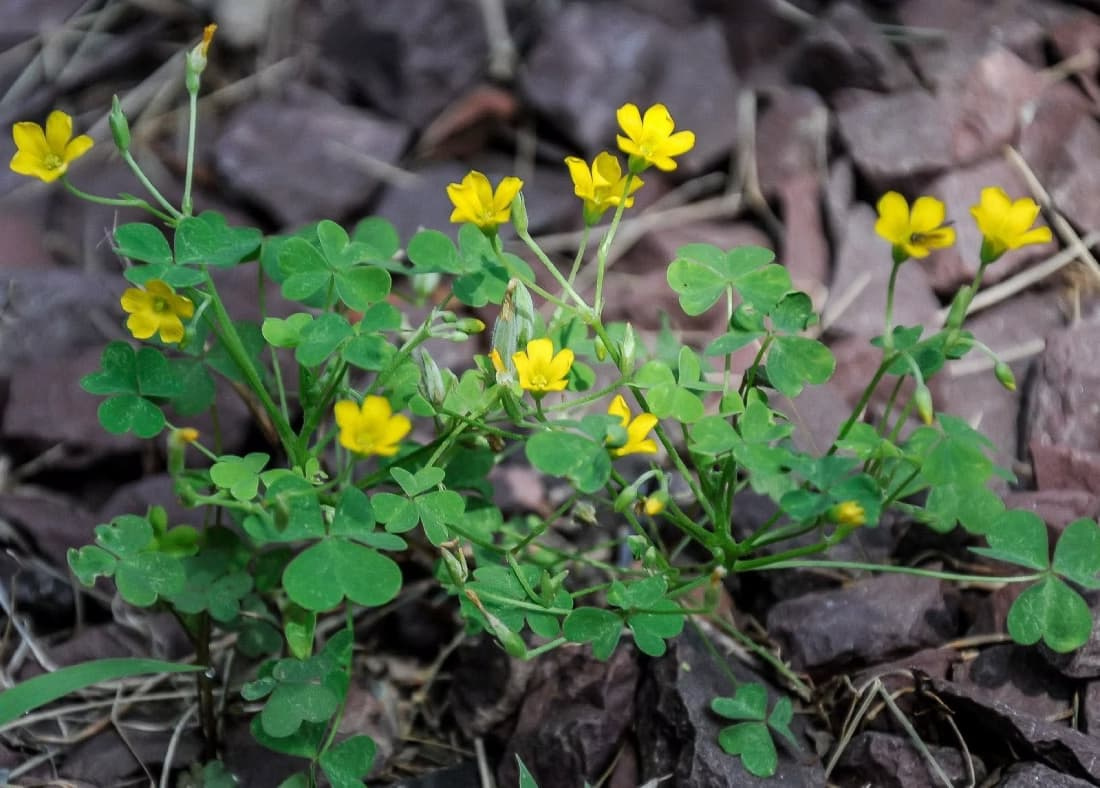
Oxalis (Wood Sorrel) At-a-Glance
Weed Type
Broadleaf
Life Cycle
Simple perennial (behaves like a summer annual in the coldest zones)
Growth Habit
Erect and bushy (yellow woodsorrel) or prostrate and mat-forming (creeping woodsorrel)
Root Type
Taproot, plus shallow rhizomes (yellow) or creeping stolons (creeping)
Spreading Risk
Explosive — by seed (also creeps by rhizome or stolon)
Pull
With Caution
Identity & Diagnostics
Visual Fingerprint
From standing height, oxalis looks like a small clover: three green, heart-shaped leaflets on a thin stalk. Two things separate it from clover at a glance. First, the leaflets are notched — each one dips inward at the tip like a tiny heart, where clover leaflets are rounded ovals. Second, once it flowers you’ll see a small, bright yellow, five-petaled flower, not the white puffball of clover. Watch for slim, upright pods that look like miniature okra standing up above the leaves — those are the seed capsules, and they’re the clearest sign you’re dealing with oxalis.
Structural Anatomy
Get down close and a few features confirm it. The leaves are alternate and trifoliate (three leaflets to a leaf), and each leaflet is obcordate — deeply notched into a heart shape and creased down the middle so it can fold. That crease matters: oxalis leaflets fold down and close at night, in the heat of midday, and under drought or stress. If you see three-part leaves that fold shut in strong sun, that’s oxalis. The leaf stalks are much longer than the leaflets — several times longer — which clover and black medic never do. The sap is clear and sour (it holds oxalic acid), not milky — useful for telling it apart from spurge, which bleeds white.
The two common species then split cleanly:
- Yellow woodsorrel (O. stricta) stands upright, 4 to 10 inches (occasionally taller), light green, with hairs on the stems that stick straight out. Below ground it has a shallow taproot and shallow, slender underground rhizomes. Its stems do not root where they touch the soil.
- Creeping woodsorrel (O. corniculata) lies flat and creeps, forming low mats. It’s often tinged purple or bronze, with denser hairs. It has a tough, fleshy taproot and spreads by aboveground stolons (runners) up to a foot long that root wherever a node touches damp soil.
Growth Patterns & Life Stages
Seedlings often show a pinkish tint on the first round seed-leaves, then produce the first true clover-like trifoliate leaf. The young plant builds either an upright little bush (stricta) or a spreading runner (corniculata). Flowering starts in late spring and runs all the way to fall — small yellow flowers in loose clusters from the leaf joints. After each flower comes the giveaway: a narrow, five-ridged, okra-shaped capsule that stands upright. This is the stage that changes your options. A green, firm capsule is still safe to handle; once it turns light tan or straw-colored and dries, it is spring-loaded and will fire on contact. When you see mature capsules, you are past the safe-to-pull window — see Pulling.
Gallery
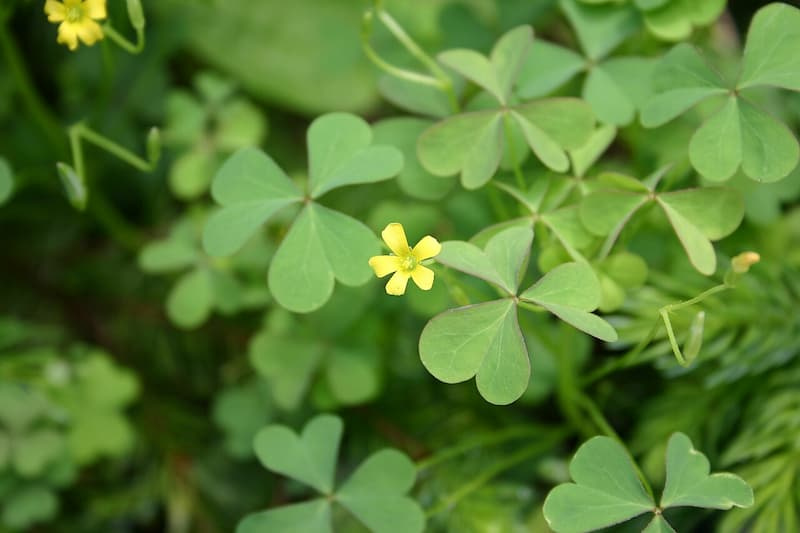
Growth Habit: yellow woodsorrel spreads into a dense, clover-like mat, but its heart-shaped, notched leaflets and small yellow flowers set it apart from true clover at a glance.
“Oxalis stricta flowers and foliage 001” by User:SB_Johnny is licensed under CC BY-SA 3.0.
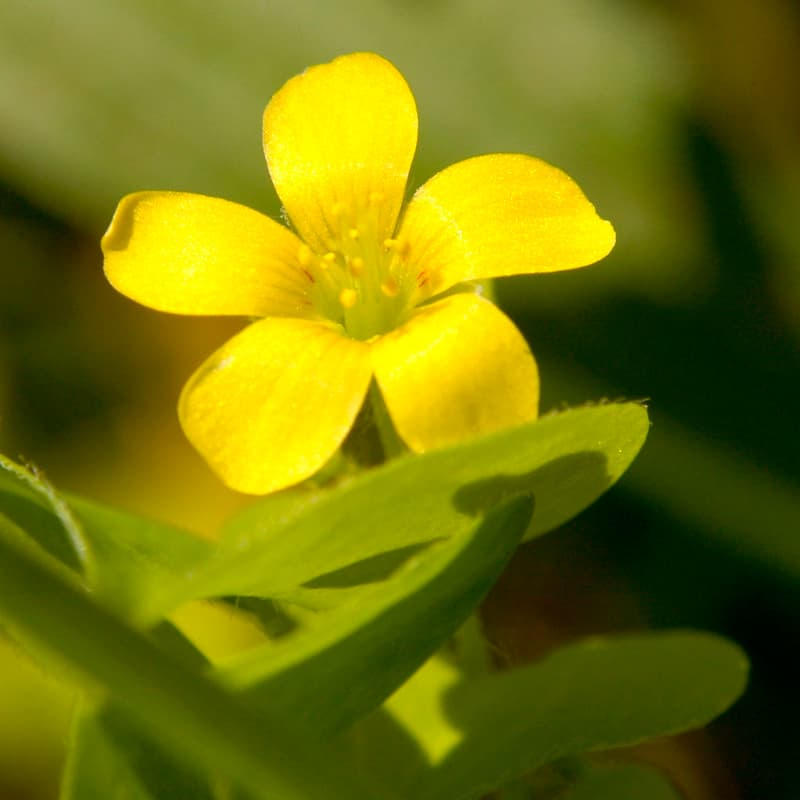
Diagnostic Feature: the small, five-petaled yellow flowers bloom nearly all season, making them one of the easiest ways to spot yellow woodsorrel before it seeds.
“Oxalis stricta COMMON WOOD SORREL” by gmayfield10 is licensed under CC BY-SA 2.0.
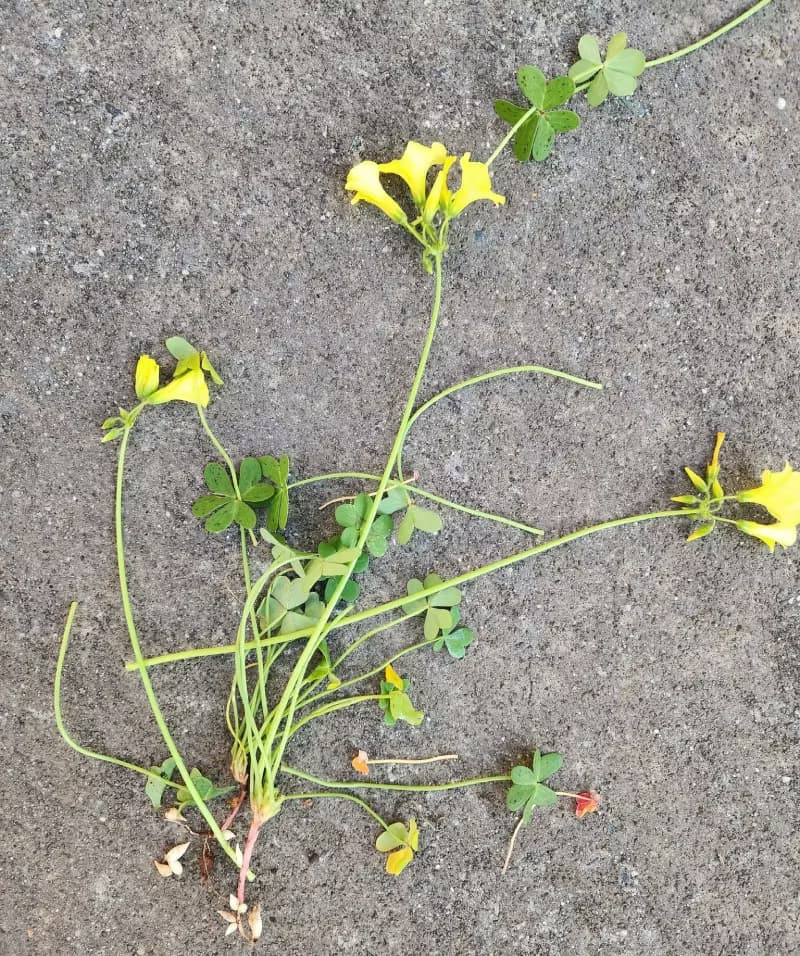
Uprooted specimen of Bermuda buttercup (Oxalis pes-caprae)—a common yellow wood sorrel species—showing long flower scapes, trifoliate leaves, and basal root structure.
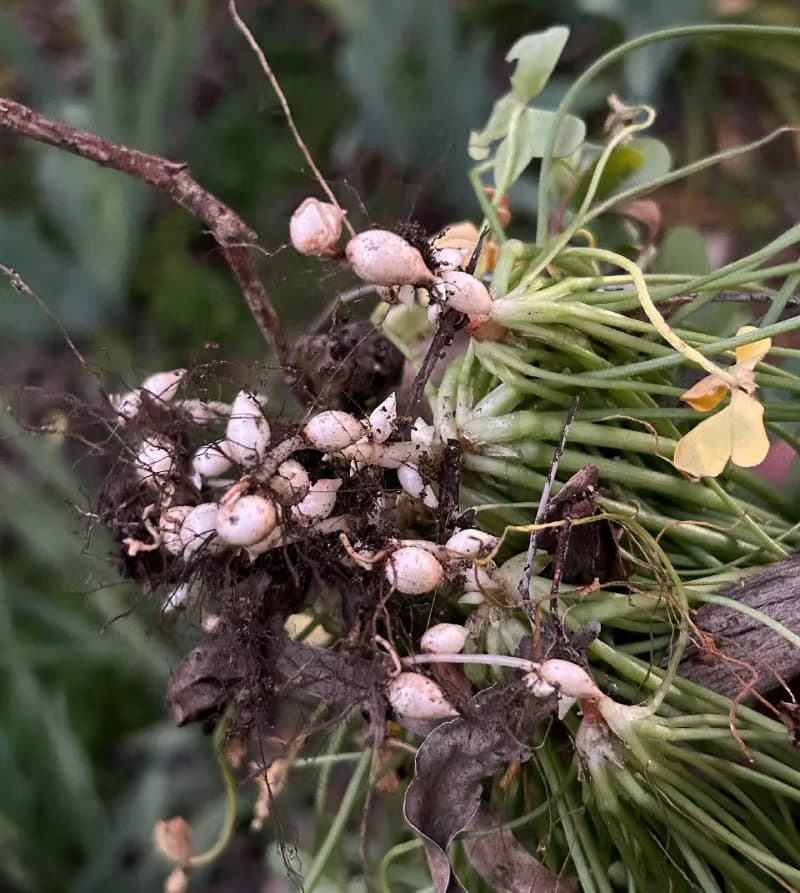
Prolific white underground bulbils of Oxalis, the key vegetative structure allowing rapid spread in lawns and beds.
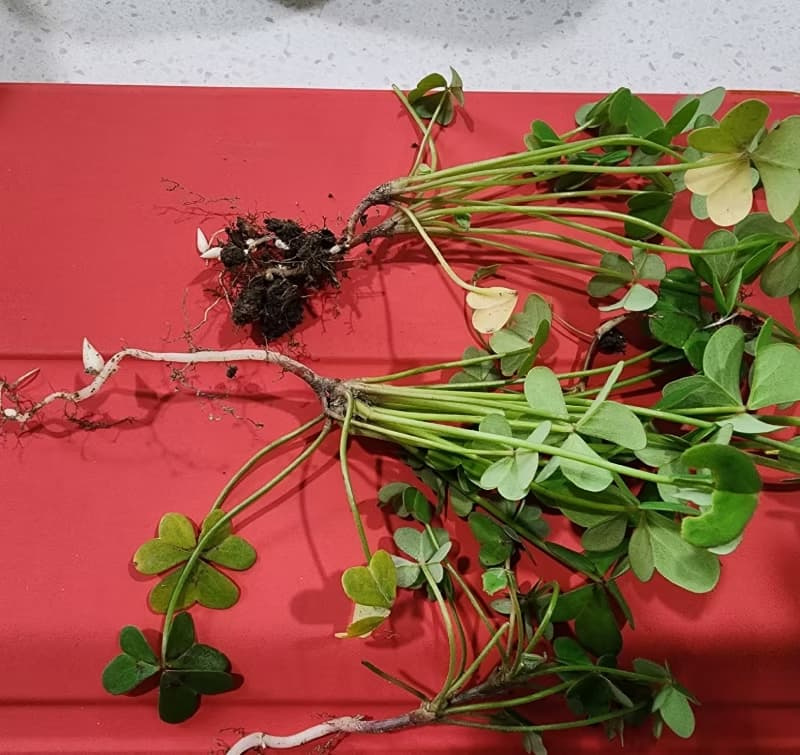
Side-by-side view of uprooted oxalis plants demonstrating long underground runners and bulbil development.
The Identity Trap
Common Lookalikes
Two weeds get mistaken for oxalis constantly because they also have three leaflets: white clover (the most common clover in lawns) and black medic (a low, yellow-flowered weed that fools people even more, because its flowers are yellow like oxalis’s).
Identification Differentiators: How to Tell Them Apart
The single feature that settles it is leaflet shape: oxalis leaflets are heart-shaped with a clear notch at the tip, while white clover and black medic leaflets are oval or egg-shaped with no notch (black medic often has a tiny point, not a notch). Two backups if you’re unsure: oxalis leaf stalks are far longer than its leaflets, and oxalis flowers are simple five-petaled yellow flowers, whereas white clover makes round white flower-heads and black medic makes a tight little cluster of many tiny yellow flowers. One more, if you dig: clover and medic are legumes and grow nitrogen-fixing nodules on their roots — oxalis never does.
Growing Conditions
Host Grasses
Oxalis isn’t picky about which lawn it invades — it shows up in Kentucky bluegrass, tall fescue, and perennial ryegrass in the North, and in bermudagrass, zoysiagrass, St. Augustinegrass, and centipedegrass in the South. What it actually needs is an opening. It’s a weak competitor against thick grass, so it colonizes thin spots, bare voids, and stressed turf rather than muscling into a dense stand. In warm-season lawns, creeping woodsorrel is especially good at spreading through the turf while it’s brown and dormant in winter, because the dormant grass offers no competition and lets light reach the soil.
Host Environment/Area
You’ll find oxalis in lawns, along sidewalk and driveway cracks, and heavily in landscape beds and containers. There’s a real lawn-versus-bed split worth knowing: yellow woodsorrel (O. stricta) is mostly the lawn form, while creeping woodsorrel (O. corniculata) is a major bed, nursery, and container weed — it rides into your yard in the pots of plants you buy, growing in the potting mix and out the drain holes, then escapes into the bed. Both are shade-tolerant, so they thrive under trees and shrubs where grass thins out, and both like moist, frequently watered ground — which is exactly what a flower bed provides.
Soil Indicators: What the Presence of This Weed Reveals About Your Yard
Oxalis is a weak soil indicator — treat its presence as a signal of opportunity more than of one specific soil problem. Mostly it’s telling you the turf is thin and light is reaching the soil. That said, a couple of patterns are documented: a heavy, dominant stand of yellow woodsorrel leans toward fertile or over-fertilized soil (it grabs excess nitrogen faster than the grass), and it’s separately associated with alkaline soils (pH above 8) and with wet, poorly drained, compacted spots when it clusters with weeds like henbit and dock. Note this doesn’t contradict keeping your lawn near pH 6.0–7.2 — that target is about keeping the grass vigorous; the alkaline preference is about the weed. If oxalis is taking over, a soil test is worth doing, but don’t read too much into a few plants.
Lifecycle and Season
Lifecycle Category and Management Implications
Oxalis is a simple perennial that acts like a summer annual in the coldest zones — and that split personality is the whole management problem. Where winters are hard, plants often die back and the fight is mostly against seed. Where winters are mild, plants live for years, holding on through shallow rhizomes (stricta) or rooted stolons (corniculata). Either way, two facts drive every decision: pre-emergent chemistry stops new seedlings but does nothing to established plants, and the plant produces seed almost non-stop with no dormancy — so it germinates in overlapping waves all season and can go from sprout to seed in about five weeks. There is no single spray date that catches it all.
Germination Trigger
Seeds need light to sprout (they won’t germinate buried under mulch or a thick canopy) and germinate as soil warms into roughly 50–85°F, best between 60 and 80°F, at a depth of half an inch or less. Because fresh seed has no dormancy, any warm, moist, sunlit patch triggers a new flush — so germination isn’t one event, it’s a season-long trickle with a main push in spring.
In the North, yellow woodsorrel is a late-germinating summer weed, emerging June through August. This timing is why it beats the standard playbook: homeowners spray broadleaf weeds in late spring, before oxalis has even sprouted, so it escapes completely — then it germinates in the bare voids those sprayed-out weeds left behind, right as summer heat thins the grass. Pre-emergent, if used, goes down in spring before soil passes ~50–55°F, with a second application possible in mid-summer to cover later flushes. The best post-emergent window is fall: the plant is pulling sugars down into its roots and rhizomes for winter, and a systemic herbicide rides down with them, killing the whole plant instead of just burning the top.
In the South the season is longer and the main germination flush comes earlier — late winter into early spring — with sporadic germination nearly year-round in Florida and the lower South. Oxalis exploits winter dormancy: while bermuda, zoysia, and the rest are brown and open, oxalis germinates and establishes, so it’s already ahead when the grass greens up. Pre-emergents need to go down before soil holds 50–55°F (late January to February on the Gulf Coast, mid-March in the Piedmont), and because the germination window is so long, a second application 5–8 weeks later is usually required. The hard rule here: do not apply broadleaf post-emergents to warm-season grass during spring green-up — the half-awake turf injures easily. Wait for full green-up, or treat in winter while the turf is fully dormant.
This is the most tangled zone, because lawns here hold both cool- and warm-season grasses and neither is ever fully comfortable — every seasonal handoff leaves an opening oxalis uses. It produces continuous flushes from mid-spring through fall. Three real timing conflicts show up here:
- Fall weed control vs. fall overseeding. A late-summer pre-emergent that stops oxalis will also stop your new fescue seed from germinating, and early-fall broadleaf sprays can injure young seedlings. Pick one: if the lawn is thin, prioritize overseeding and skip the pre-emergent (don’t apply pre-emergent after about July 1 if you’ll overseed in September); if you’re not overseeding, run the chemical program.
- Spring pre-emergent vs. spring seeding. The soil-temperature window for spring pre-emergent is the same window as spring seeding, and the pre-emergent will block your grass seed too. Spring seeding of cool-season grass is discouraged anyway; if you must, skip pre-emergent and rely on spot treatments later.
- Spring post-emergent vs. warm-season green-up. Broadleaf sprays during green-up injure warm-season turf. Treat during full winter dormancy (a dormant-turf application to brown bermuda) or wait for complete green-up.
Herbicide Control
Pre-emergent works against new seedlings only — it puts a chemical barrier in the top half-inch of soil that kills seeds as they sprout. It does nothing to established plants growing back from rhizomes, stolons, or crowns, which come up right through the barrier. But because oxalis is such a heavy seeder (a single plant makes anywhere from several hundred to a few thousand seeds, occasionally far more), stopping seedlings genuinely matters here — more than it does for a weed like dandelion that doesn’t reseed at oxalis’s scale. Effective active ingredients on established turf include prodiamine, pendimethalin, dithiopyr, and isoxaben (benefin + trifluralin also works but can injure fine fescues). Apply in spring before soil warms past ~50–55°F, water in with at least half an inch, and consider a second application in mid-summer to cover late flushes. Don’t apply pre-emergent to areas you plan to seed — it stops your grass seed too.
Expect this to take more than one try, and know going in that oxalis naturally tolerates 2,4-D — plain 2,4-D, and even standard three-way lawn weed-killers, often fail on it, especially on mature summer plants. This is natural tolerance, not evolved resistance; the plant defeats the spray physically. Its leaflets fold shut in heat, drought, and bright sun, shrinking the target the spray can land on, and its mature leaves carry a waxy coat that beads water off. Two habits beat those defenses: spray on a bright, sunny day when the leaflets are open and the plant is actively growing (not heat-stressed), and use an ester formulation or add a non-ionic surfactant so the droplet spreads and sticks instead of rolling off.
What actually works depends on your grass:
- Cool-season lawns: systemic synthetic auxin esters are the go-to — triclopyr (often as triclopyr ester), fluroxypyr, or combinations of the two, best applied in fall. The fall timing isn’t arbitrary: the plant is moving sugars down to its roots for winter and carries the herbicide down with them, killing the rhizomes instead of just scorching the leaves.
- Warm-season lawns: triclopyr is off the table — it severely injures St. Augustine, centipede, and bermuda. Here the most effective active ingredient is the ALS inhibitor metsulfuron-methyl (with a surfactant), documented as the single best post-emergent for oxalis in warm-season turf, or Celsius WG, which is safe on all four major warm-season grasses and can even be used during green-up. Both need a surfactant, and metsulfuron shouldn’t go on heat- or drought-stressed turf.
Either way, this is a multi-application job within the season and across seasons — a single spray suppresses the top growth, and the plant regrows from roots or the seed bank within about 30–45 days.
Cultural control is the real long-term answer, because oxalis is an opportunist that lives on openings and light. The single most effective lever is a tall, dense canopy that shades the soil — since the seeds need light, a thick lawn simply prevents most of them from ever germinating. Mow high (at least 2 inches, ideally 3+ for cool-season grass; at the top of the recommended range for your warm-season species). Mowing low backfires badly: oxalis just flattens out and keeps flowering and seeding below the blade, while the thin, scalped turf lets light through to the soil. Unlike clover, oxalis is not fixing its own nitrogen, so you can’t starve it out with fertilizer management the way you can clover — feed the grass on a normal schedule to keep it dense, and water deeply and infrequently rather than in frequent light sprinklings, which keep the surface wet and perfect for oxalis seed.
Pre-emergent is one of your most useful bed tools against oxalis, precisely because the seed bank is so large and long-lived — anything that stops the yearly wave of new seedlings is worth doing. Several active ingredients are labeled safe around established ornamentals, including isoxaben, oryzalin, pendimethalin, prodiamine, dithiopyr, trifluralin, and combination granules like isoxaben + trifluralin (Snapshot). The catch is that the herbicide has to reach the soil surface to work: if you apply it over existing mulch, you must water it in with half an inch to an inch to wash it through, or better, apply it to bare soil first and then mulch over it. Watch the ornamental restrictions closely — isoxaben can injure sensitive groundcovers like ajuga and burning bush; granular products should never be applied over plants with funnel-shaped or rosette leaves like hosta and daylily, because the granules slide into the crown and rot it. Read the label for your specific plants.
Here’s the hard constraint that makes beds different from lawns: the selective herbicides that work in turf — triclopyr and fluroxypyr — must never be sprayed near broadleaf ornamentals, because they move through the soil and the air and will damage shrubs, perennials, and trees through their roots or vapor. So bed control leans on non-selective, directed products — glyphosate, glufosinate, diquat, or pelargonic acid — applied with precision: a shielded spot spray, or a wick/sponge wiped directly onto the oxalis, never a broadcast spray. (Buying tip: not every product labeled “Roundup” is glyphosate anymore — check the active-ingredient panel.) Because these kill anything green they touch, keep them off your ornamentals entirely. As in the lawn, one treatment won’t finish it — new seedlings and regrowth will appear within weeks, so beds usually need repeated spot treatment across the season, paired with pre-emergent and mulch to be a multi-season program, not a one-time fix.
Mulch works by blocking the light oxalis seeds need to germinate, so apply organic mulch 2 to 3 inches deep and keep it that way. Use a material that knits into a solid light-proof layer — shredded bark or wood chips over a pinned landscape fabric (3–4 inches on top of fabric) is very effective. Two limits are specific to this weed: as mulch breaks down and dust settles on top, oxalis seed will germinate in that surface layer and root down through it, and creeping woodsorrel can run its stolons across the top of the mulch from a bed edge or lawn and root into it, bypassing the barrier entirely. So mulch is powerful but not permanent — refresh it, and watch the edges.
Herbicide Application Reference
The main chemistry warning for oxalis is ester volatility and drift. The triclopyr/fluroxypyr ester formulations that control it best in cool-season lawns can volatilize above roughly 85°F, turning into a vapor that drifts onto whatever’s downwind — including a neighbor’s beds, your own ornamentals, or an adjacent lawn. Spray esters in cool conditions (fall is ideal on both counts), and switch to a low-volatility amine formulation if you must treat in summer heat. In beds, don’t use these esters near ornamentals at all — root uptake and vapor will injure non-target plants even without direct contact.
A second, sneaky trap is product naming. A consumer bottle labeled as an “oxalis killer” may contain triclopyr, which is excellent on a cool-season lawn but will severely burn St. Augustine, centipede, and bermuda and damage ornamentals — so the same product that’s right for a fescue lawn is wrong for a Southern lawn or a flower bed. Match the chemistry to your grass and your beds, not to the weed named on the front.
A product note that is easy to miss: the consumer “Roundup” brand no longer reliably means glyphosate. Several reformulated versions now use different active ingredients, and some of them — imazapic is one — stay active in the soil, where nearby ornamental roots can take them up. That is the exact problem glyphosate is chosen to avoid here: in a bed, you want a non-selective that kills what you spray and then binds to the soil without lingering to poison the shrub next to it. Before you buy, read the active-ingredient panel and pick a product whose only active ingredient is glyphosate.
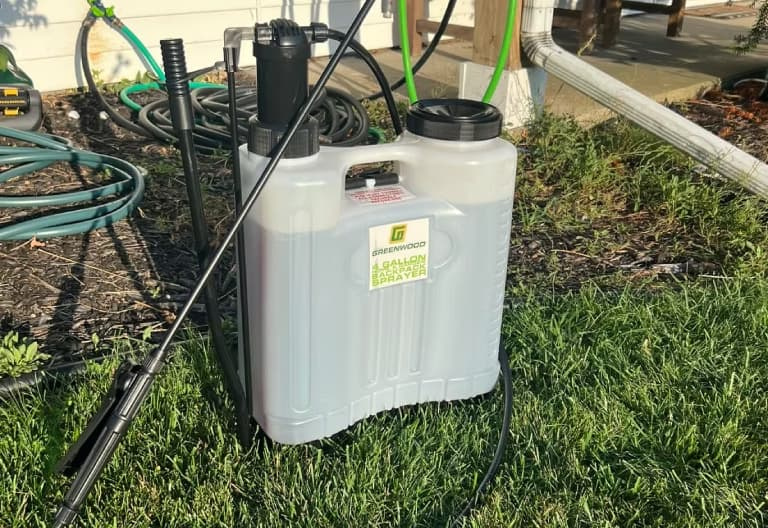
Herbicide Application Guide
New to spraying, or want to get it right? Our Herbicide Application Guide covers the practical steps this page assumes — mixing, calibration, protective gear, and the wind and temperature limits that decide whether a treatment works or drifts. Read it before you spray.
See Guide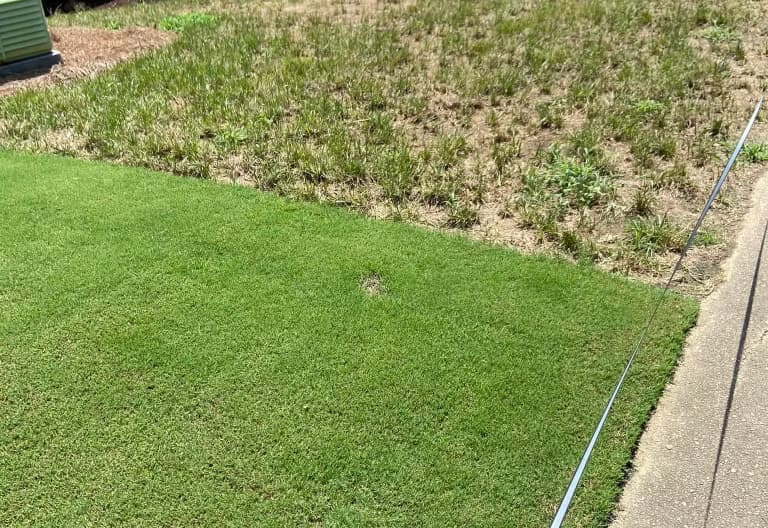
Where Two Lawns Meet
Does your lawn border a neighbor’s — or meet a different type of grass? Spraying near that line can quietly damage the yard next door, sometimes weeks later. Where Two Lawns Meet shows you how to treat safely without harming either side.
Read ArticlePulling
Pull with caution — only young plants, in moist soil, and only before any seed capsules have formed. Pulling a plant that's already carrying ripe capsules does more harm than good.
The Biological Reason
Two mechanisms decide this, and both work against careless pulling.
First, the seed. The ripe capsule is a spring under tension. As it dries it builds elastic pressure, and the lightest disturbance — your hand, a shoe, mower vibration — makes it burst and fling seed up to about 16 feet (creeping woodsorrel throws a bit less, ~10–13 feet; yellow woodsorrel up to ~16). Those seeds are viable immediately and sprout on contact with warm, moist, sunlit soil. So yanking a seeding plant isn’t weeding — it’s broadcasting seed across the part of your yard you were trying to clean.
Second, the roots. Yellow woodsorrel spreads by shallow underground rhizomes; creeping woodsorrel spreads by runners that root at every node. Both are brittle. If the plant snaps and leaves a rhizome or a rooted node behind, that fragment doesn’t just survive — cutting it breaks the plant’s apical dominance and triggers multiple new shoots, so one broken plant becomes several. This is why rototilling or hoeing a mature patch is the worst thing you can do: it chops the spreading structures into dozens of pieces and plants every one.
Done right, pulling still works. Pull when plants are young (about six weeks or less) and before capsules form, and only when the soil is thoroughly moist so the whole taproot and its shallow rhizomes or runners slide out intact instead of snapping. If mature capsules are already present and you must remove the plant, cover it with a bag before you uproot it to catch the seed explosion. Bag everything immediately and take it off the property. Never leave pulled plants lying on the lawn or toss them in an open compost pile — the pods keep ripening and firing after the plant is out of the ground, and the seeds shrug off normal compost heat.
Lawn vs. Bed Pulling Difference
The fragment problem is worse in beds than in lawns. Loose, moist, cultivated bed soil is exactly the medium in which broken rhizomes and stolon nodes re-root fastest, so a careless pull or a pass with a hoe multiplies creeping woodsorrel dramatically — far more than the same mistake in dense turf. The flip side: that same loose soil lets you extract a young plant completely and cleanly, which is harder in compacted lawn. So in beds, the rule tightens — get them young, or use a directed spray instead of disturbing the soil.
Quick Reference Summary
| Lifecycle Category | Simple perennial (summer-annual behavior in the coldest zones) |
| Active Zone(s) | Cool-season, warm-season, and transition |
| Germination Trigger | Soil ~50–85°F (best 60–80°F); light required |
| Pre-Emergent | Yes — for seedlings only, not established plants |
| Post-Emergent Timing | Young, actively growing plants; fall is best in cool-season turf; avoid heat/drought |
| Pull | With Caution — young plants only, moist soil, before capsules |
| Lawn Primary Tool | Cool-season: triclopyr/fluroxypyr ester (fall). Warm-season: metsulfuron or Celsius WG |
| Bed Primary Tool | Directed non-selective spray (e.g., glyphosate) + pre-emergent + 2–3″ mulch |
| One-and-Done or Multi-Season | Multi-season — plan on 3–6 years to drain the seed bank |
Frequently Asked Questions
These answers are synthesized from botanical morphology studies and herbicide efficacy trials conducted by leading university agricultural extensions.
Probably nothing you’d expect. Oxalis naturally tolerates 2,4-D and ordinary three-way weed-killers, and its leaves fold up and wax over in heat so the spray rolls off. Even when a spray works, it only kills the top — the plant regrows from its roots or from the seed bank within a month or so. Use a systemic product suited to your grass (triclopyr or fluroxypyr ester in cool-season lawns; metsulfuron or Celsius in warm-season lawns), spray on a sunny day with a surfactant when the leaves are open, and plan on repeat treatments.
Because it does two things at once. If the plant has ripe seed pods, the act of pulling detonates them and scatters seed up to 16 feet. And if the roots or runners snap and leave a piece behind, that fragment resprouts into several new plants. Pull only young plants, in moist soil, before any pods form — and bag them on the spot.
Two things. First, “Roundup” no longer reliably means glyphosate — the consumer brand has been reformulated into several different products, so check the active-ingredient panel before you buy. Second, glyphosate (and the reformulated versions) are non-selective and will kill or damage any plant they touch or, in some reformulated cases, linger in the soil and reach nearby roots — so near ornamentals you must spot-treat or wipe it directly onto the oxalis, never broadcast it.
No. Oxalis is highly mowing-tolerant — cut it low and it simply grows flat and keeps flowering and setting seed below the blade. Worse, the sticky seeds ride around on the mower deck and get spread to clean parts of the lawn. Bag your clippings when oxalis is seeding, and clean the deck before moving on.
Not in a normal backyard pile. Oxalis seeds are heat-resistant and survive typical composting temperatures, and stem or rhizome fragments can re-root in the moist compost. Bag pulled plants and send them out with yard waste instead, or you’ll reintroduce the weed wherever you spread the compost later.
Oxalis contains oxalic acid — that’s what gives the leaves their sour taste, and it’s why the plant is sometimes nibbled. A casual taste isn’t a crisis, but oxalates aren’t something to eat in quantity, and grazing animals eating large amounts can be affected, so it’s best to discourage kids and pets from making a snack of it. If a pet consumes a large amount, contact your veterinarian.
Scientific Authority
This profile is constructed using forensic botanical data and Integrated Pest Management (IPM) research. We prioritize scientifically-vetted identification and control methods that protect the broader ecosystem while ensuring successful eradication based on peer-reviewed agricultural studies.
Primary Resources
- Penn State Extension — Lawn and Turfgrass Weeds: Yellow Woodsorrel; Three Weeds with Three Leaflets: Trifoliate Look-Alikes; Indicator Weeds; Controlling Weeds in Nursery and Landscape Plantings (extension.psu.edu)
- Purdue Extension / Purdue Turf — Black Medic and turf weed publications (turf.purdue.edu)
- The Ohio State University Extension — Yellow Woodsorrel; Buckeye Yard & Garden onLine (bygl.osu.edu, u.osu.edu)
- University of Wisconsin Horticulture / Extension — Yellow Woodsorrel, Oxalis stricta (hort.extension.wisc.edu)
- University of Minnesota Extension — Yellow Wood Sorrel (extension.umn.edu)
- Michigan State University Extension — Yellow Woodsorrel – Oxalis stricta; Creeping Woodsorrel; Identifying and Managing Yellow Woodsorrel in Nurseries and Greenhouses (canr.msu.edu)
- Rutgers NJAES Cooperative Extension — FS385: Broadleaf Weed Control in Cool-Season Lawns (njaes.rutgers.edu)
- UMass Amherst Landscape, Nursery & Urban Forestry — Oxalis stricta; Oxalis corniculata (extension.umass.edu)
- Cornell CALS / Cooperative Extension — Yellow Woodsorrel (cals.cornell.edu)
- Iowa State University Extension and Outreach — Yellow Woodsorrel (crops.extension.iastate.edu)
- Clemson Cooperative Extension (HGIC) — Oxalis Control (hgic.clemson.edu)
- LSU AgCenter — A Guide to Maintaining a Healthy Louisiana Lawn: Yellow Woodsorrel (lsuagcenter.com)
- NC State Extension — Yellow Woodsorrel (TurfFiles); Oxalis corniculata (Plant Toolbox); Yellow Woodsorrel (Extension Publications) (turffiles.ncsu.edu, plants.ces.ncsu.edu, content.ces.ncsu.edu)
- University of Georgia CAES (GeorgiaTurf) — Yellow Woodsorrel (Oxalis) (turf.caes.uga.edu)
- University of Florida IFAS Extension — ENH1253/EP514: Biology and Management of Oxalis in Ornamental Crop Production; Oxalis corniculata (MREC); FOR388 (ask.ifas.ufl.edu, mrec.ifas.ufl.edu)
- University of Arkansas Cooperative Extension — Oxalis/shamrock publication (uaex.uada.edu)
- University of Missouri Extension (Mizzou WeedID) — Yellow Woodsorrel; Creeping Red Woodsorrel; Black Medic (weedid.missouri.edu)
- Oklahoma State University Extension — Controlling Weeds in Home Lawns (HLA-6421); Consumer Broadleaf Weed Control for Lawns (extension.okstate.edu)
- West Virginia University Extension — Yellow Woodsorrel (extension.wvu.edu)
- Virginia Tech Weed ID — Common Yellow Oxalis, Oxalis stricta (weedid.cals.vt.edu)
- Kansas State Research and Extension — Yellow Woodsorrel (k-state.edu)
- UC IPM / UC ANR — Creeping Woodsorrel and Bermuda Buttercup (ipm.ucanr.edu)