
White Clover At-a-Glance
Weed Type
Broadleaf
Life Cycle
Stoloniferous perennial (a legume)
Growth Habit
Prostrate, mat-forming
Root Type
Stolon — roots at the nodes (the seedling taproot is short-lived)
Spreading Risk
High — by creeping runners and by long-lived seed
Pull
With caution — only young, isolated plants
Identity & Diagnostics
Visual Fingerprint
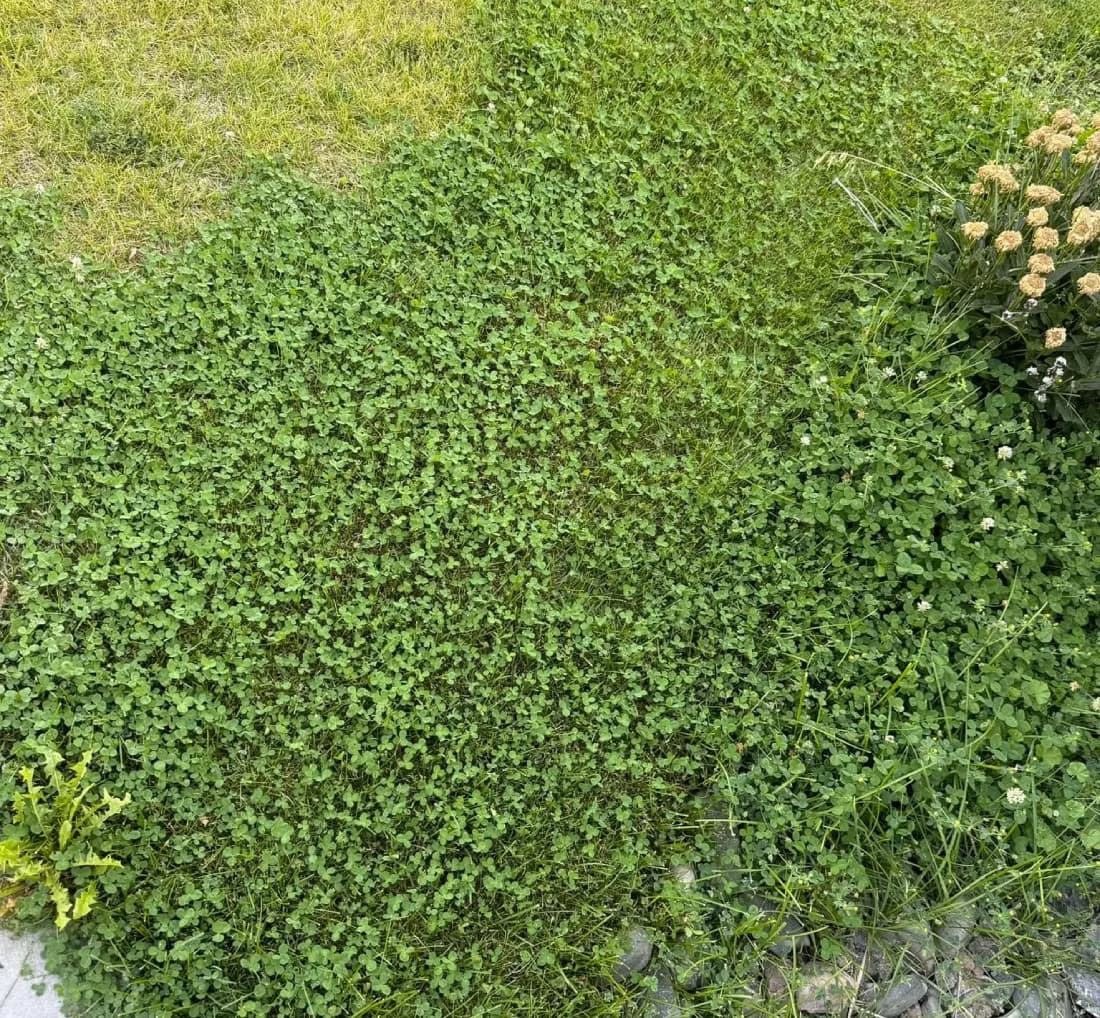
From standing height, white clover reads as a low, dark-green patch that looks lusher and greener than the grass around it — often the greenest thing in an otherwise thin, hungry lawn. Look for leaves made of three small rounded leaflets and, in late spring and summer, round white flower heads about the size of a marble held just above the foliage. The patch lies flat and spreads outward in a mat rather than standing up in clumps.
Structural Anatomy
Up close, the confirming feature is the leaf: three stalkless leaflets joined at one point, each one oval to egg-shaped, hairless and smooth, with very finely toothed edges and a tiny notch at the tip. Most leaflets carry a pale, whitish crescent — an upside-down “V” or watermark — across the middle. That watermark plus the smooth, hairless surface is what separates clover from its look-alikes. The stems are the other giveaway: instead of a single upright stalk, clover runs along the ground on smooth, round, solid runners called stolons, and small papery sheaths (stipules) wrap the stem where each leaf stalk attaches. Dig up a healthy plant and you’ll find small round nodules on the roots; slice one and an active, nitrogen-fixing nodule is pink or red inside. The flower heads are round clusters, half an inch to an inch and a half across, made of 20 to 85 tiny white (sometimes faintly pink) pea-type flowers on a bare, upright stalk.
Growth Patterns & Life Stages
A clover seedling starts upright and innocent: two smooth seed leaves, then a first simple round leaf, then the familiar three-part leaves — all supported, at this stage, by a single central taproot. Around six to eight weeks in, the plant changes strategy. Runners push out from the base and the plant flips from growing up to growing sideways, spreading flat across the soil at up to about 7 inches a year and rooting as it goes. This is the stage to catch it: a young single-crowned seedling can still be pulled. Once it has laced together into a mat wider than a foot, hand-removal stops working (see Pulling). Flowering runs from late spring into summer and sometimes again in fall; once the white heads turn brown and bend downward, seed has set and the plant has already restocked the soil’s seed bank.
Gallery
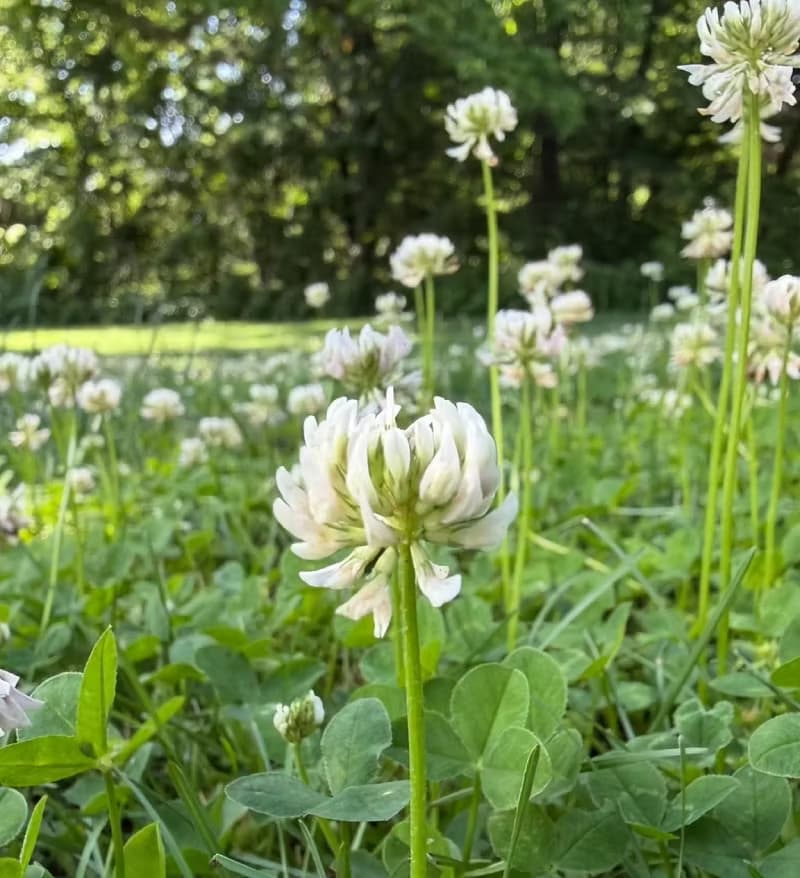
Close-up of a blooming white clover (Trifolium repens) flower head showing individual tubular florets.
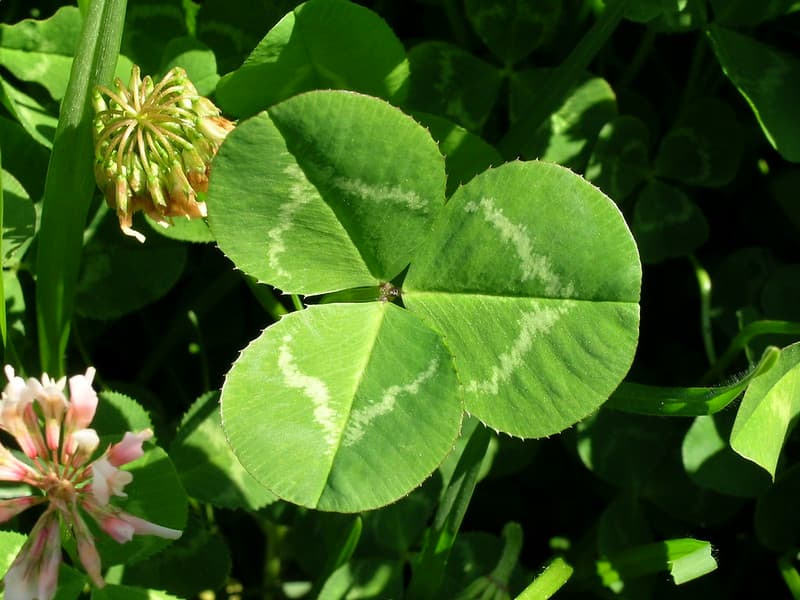
Diagnostic Feature: each leaflet carries a pale, zigzag "watermark" band and smooth margins — the trait that confirms white clover and rules out black medic or yellow woodsorrel look-alikes.
“Trifolium repens leaf NC1” by Macleay Grass Man is licensed under CC BY 2.0.
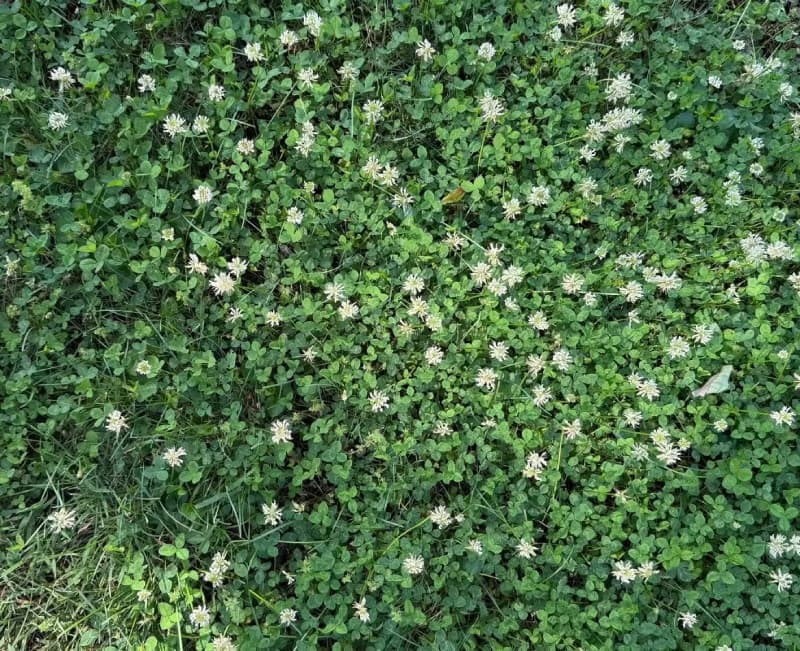
High-density white clover infestation flowering within a residential lawn.
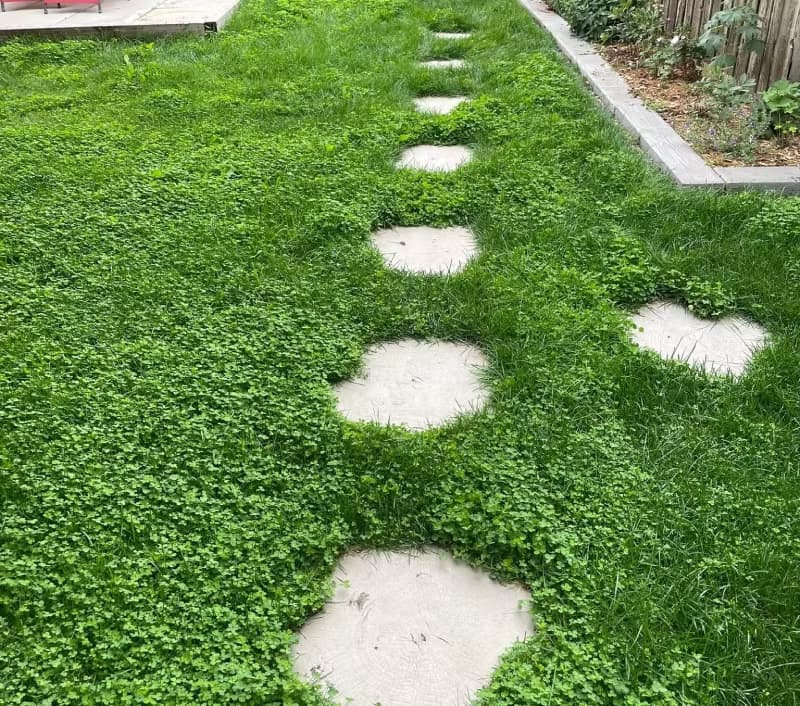
White clover stolons spreading across a lawn and encompassing backyard stepping stones.
The Identity Trap
Common Lookalikes
Two low, three-leaflet weeds get mistaken for white clover in home yards more than any others: black medic, a wiry green mat that looks almost identical to clover from a distance, and yellow woodsorrel (oxalis), whose three leaflets fool people who count leaves rather than look at their shape.
Identification Differentiators: How to Tell Them Apart
Black medic gives itself away at the middle leaflet: on black medic that center leaflet sits out on its own tiny stalk, noticeably farther from the leaf than the two side leaflets, and the leaflets end in a tiny point. Clover’s three leaflets all join at exactly the same point, and its leaves carry the pale watermark that black medic never has. When either is in flower it’s settled instantly — black medic’s flowers are tiny and yellow, clover’s are white. (Black medic also grows from a single taproot and never roots along its stems the way clover does.)
Yellow woodsorrel (oxalis) has heart-shaped leaflets with a clean notch at the tip and smooth edges, and they fold down at night; clover’s leaflets are rounded-to-oval with fine teeth and the whitish crescent. Oxalis flowers are small and yellow with five petals, versus clover’s round white heads.
Growing Conditions
Host Grasses
White clover invades both cool-season and warm-season lawns, so no grass type is safe from it. In the north it moves into Kentucky bluegrass, tall fescue, fine fescue, and perennial ryegrass, and it’s especially aggressive in thinned tall fescue. In the south it colonizes bermudagrass, zoysiagrass, centipedegrass, St. Augustinegrass, and bahiagrass — and it’s at its worst there in fall, winter, and early spring, when those grasses are dormant or off-color and the clover keeps growing while they can’t compete.
Host Environment/Area
Clover shows up wherever the grass has been let down: under-fed lawns, stands mowed too short (below about 2 inches), and thin, stressed, or compacted areas where the turf has already thinned out. It does not favor lawns over beds — it thrives in both and simply changes shape to fit. In a mowed lawn it stays low and flat, ducking under the mower blade; in an un-mowed bed it stands up 6 to 12 inches or more to reach light. What it wants everywhere is cool, moist soil in sun to part shade. Because its roots are shallow, it leans on steady moisture, so irrigated beds and lawns with leaky drip lines or frequent light watering suit it especially well.
Soil Indicators: What the Presence of This Weed Reveals About Your Yard
More than most weeds, white clover is a diagnostic sign, and its main message is nitrogen. A thriving, dark-green clover patch in a thin lawn is a reliable flag that the soil is low in nitrogen: the grass is starved and losing density, while the clover — which makes its own nitrogen — stays lush in the exact conditions that defeat the grass. Heavy clover can also point to consistently wet or poorly drained ground, since its shallow roots love moisture-holding clay and silty soils and resent drought. Persistent patches in walked-on areas often mark compaction, and clover’s presence generally tracks a soil pH in the mildly acidic-to-neutral range (about 5.5 to 7.0) where its root bacteria work best.
Lifecycle and Season
Lifecycle Category and Management Implications
White clover does not die at the end of the year. It’s a perennial that overwinters as crowns and rooted runners and comes back from that living network every spring, which means a pre-emergent — a product that only stops sprouting seeds — does nothing to the clover already in your lawn. The tools that actually work are systemic post-emergent herbicides that move through the whole runner system, correct timing so they travel down into the roots, and cultural changes (nitrogen, most of all) that take away the clover’s competitive edge. Because it also reproduces by seed, a small pre-emergent role exists for catching new seedlings, but that’s a side note, not the main event.
Germination Trigger
New clover seedlings emerge from seed when soil temperatures sit in the cool, moist 50–60°F range, which happens in both spring and fall. There’s a catch that stretches the problem over years: most clover seed has a hard, waterproof coat and won’t sprout until weather and freeze-thaw cycles slowly wear that coat down, so seedlings keep trickling out of the seed bank long after the parent plants are gone. Established plants don’t wait on soil temperature at all — they simply resume creeping from crowns and runners as the season warms.
In the north, clover grows actively in the cool, moist stretches of spring and fall but keeps going right through summer, which is exactly when Kentucky bluegrass, tall fescue, and ryegrass slow down or go dormant under heat — so clover fills the gaps the grass leaves. If you use a pre-emergent for new seedlings, the fall window is late September into early October (before soils cool to the germination range), with a spring option about 10 to 14 days ahead of spring warm-up. The far more important timing is for post-emergent sprays: fall (roughly late September through November) is dramatically more effective than spring, for the reason explained under Post-Emergent in Lawn. In hard northern winters the top growth dies back to the crown, which can leave bare patches that winter weeds move into come spring.
In the south the story flips: clover is most visible and most competitive in fall, winter, and early spring, taking over while dormant bermudagrass, zoysia, centipede, and St. Augustine are off-color and can’t fight back. Time any seedling pre-emergent to the cooling window — roughly mid-September to early October in the upper South, shifting to late October or November in the Deep South and Florida (apply when nighttime lows hold around 55–60°F for several nights). The critical caution is spring: do not spray broadleaf post-emergents on warm-season grass during green-up, when the tender new growth is easily injured — the one common exception is Celsius, which is labeled for spring transition. The best and safest spray window is early fall, when the turf is robust and the clover is coming out of summer stress. Note one regional twist: in the hottest parts of the Deep South (peninsular Florida, coastal Louisiana), clover often behaves as a winter annual — the plants die out in summer heat and the patch comes back from seed each fall.
The transition zone is the hardest case, because cool-season and warm-season grasses often share the same property and something is always stressed. Late summer to mid-fall is the single best window to control established clover — but it collides head-on with the fall window for overseeding or renovating cool-season turf, and the herbicides that kill clover carry seeding restrictions that can block new grass for weeks to many months (see the FAQ on overseeding). Spring is no clean fallback: spraying broadleaf products then risks injuring warm-season grass during green-up. Even a winter glyphosate clean-up on “dormant” bermuda is risky — if the bermuda has broken as little as 15% green, glyphosate can noticeably delay its recovery. On top of that, cool- and warm-season grasses want nitrogen on opposite calendars, so a single blanket feeding to fight clover will damage one grass or the other; fertility has to be handled zone by zone. Clover is especially stubborn right along the seam where two grass types meet, because that strip is always being mismanaged for one side to suit the other — and that constant thin, patchy, low-fertility band is a permanent foothold for it.
Herbicide Control
For clover you already have, pre-emergent is the wrong tool — it only interrupts sprouting seeds and does nothing to established plants or spreading runners. Its only real value is secondary: catching new seedlings coming up from the seed bank. If you choose to use it that way, isoxaben is the broadleaf-specific pre-emergent extension programs point to, applied ahead of the fall germination window. Just know the trade-offs that make it a minor tactic here: it won’t touch the clover that’s actually bothering you, it blocks desirable grass seed too (so you can’t overseed for about 60 days after applying it), and clover seed sprouts sporadically across the year anyway. Feeding the grass and treating the plants you can see will do far more.
Reach for a systemic broadleaf herbicide — but not just any one, because clover shrugs off some of the usual products. Straight 2,4-D on its own consistently underperforms on clover; it may burn the tops briefly, then the plant grows back. What works is either a combination product or one of the chemistries that clover can’t tolerate. On cool-season lawns, standard three-way broadleaf products (2,4-D + dicamba + MCPP) give good control because the dicamba and MCPP carry the load that 2,4-D can’t; products built on triclopyr, fluroxypyr, or clopyralid are especially strong on clover and other legumes; and florasulam applied in early spring can give better than 90% control before the plant flowers. Warm-season lawns lean on a different family: ALS-inhibitor products like metsulfuron and Celsius handle clover well across most warm-season grasses, and Celsius has the bonus of being safe during spring green-up. Whatever you spray, add the surfactant the label calls for — clover’s waxy leaf sheds herbicide otherwise — spray on a mild day (roughly 55–85°F) when the plant is actively growing, not drought-stressed, and don’t mow for a couple of days before and after so there’s leaf to absorb it and time for it to move.
Timing is the difference between success and a rerun, and the reason is worth knowing: in fall, perennials pull sugars down into their roots and runners to stock up for winter, and a systemic herbicide rides that downward flow straight into the growing points and kills them. In spring the flow runs the other way — up into new leaves and flowers — so a spring spray often just burns the top and the plant regrows from surviving nodes. Spray in fall (late September into November) whenever you can. One-and-done? No. Plan on a multi-season program: expect to repeat the spray on mature stands (often two applications about 4 to 6 weeks apart), and pair it with steady nitrogen, because surviving runner-nodes, decades of seed in the soil, and clover creeping back in from untreated edges all work against a single treatment.
And there’s a pollinator step that isn’t optional in spirit: clover flowers pull in honeybees and native bees, so mow the lawn right before you spray to knock off at least ninety percent of the open blooms (or simply don’t spray during peak bloom). That removes what draws the bees onto freshly treated plants.
This is the foundation, and it’s mostly one word: nitrogen. Clover wins precisely where the grass is starved, because it makes its own nitrogen and the grass can’t — so feeding the grass flips the whole contest. A well-fed lawn thickens, shades the soil, and crowds out the low clover, and higher soil nitrogen even quiets the clover’s own nitrogen-fixing bacteria, pushing the advantage further toward the grass. As a working target, most cool-season lawns want on the order of 2 to 4 pounds of actual nitrogen per 1,000 square feet a year, split across the season and never more than about 1 pound in a single feeding; warm-season lawns generally want less and it should go down during their summer growing months. Back that up by mowing tall (around 3 to 4 inches on cool-season turf) so the canopy shades out clover, overseeding thin spots in late summer or early fall, aerating to relieve compaction, and going easy on phosphorus unless a soil test calls for it — extra phosphorus actively favors clover.
In beds, pre-emergent again only stops new seedlings from the seed bank, not the mats you already have — but with clover’s decades-long seed reserve, that seedling-prevention role is worth more here than in lawns. Isoxaben (Gallery) is the go-to that’s labeled safe over the top of many established woody shrubs and trees, and combination granules like Snapshot pair it with trifluralin for a wider spectrum. Two placement rules matter: apply the granules to the soil surface under the mulch, not on top of a thick mulch layer (granules stranded on mulch break down in sunlight or never reach the sprouting zone), and water them in with about half an inch to an inch within a couple of days to set the barrier. Watch the plant list — isoxaben severely injures winged euonymus (burning bush), and granular blends shouldn’t be dropped onto whorled-leaf plants like daylilies, where they lodge in the crown and burn it.
You can’t broadcast a broadleaf spray in a bed full of broadleaf ornamentals, so clover control here is a directed, careful job. The most selective option is clopyralid (Lontrel T&O), which targets clover and other legumes (and asters) while being safe over the top of conifers and ornamental grasses — but it comes with strict off-limits plants and a serious carryover warning (below). For a directed knock-down of the foliage, a shielded or wick application of a non-selective herbicide works if you keep it off every green ornamental surface. Note that established clover is actually tolerant of glyphosate, so extension trials often find glufosinate (Finale, Cheetah Pro) more effective on clover in bed edges — and as a bonus, glufosinate moves less into the soil, lowering the risk to nearby ornamental roots. If you do reach for a glyphosate product for a directed touch-up, one buying note applies. (Buying tip: not every product labeled “Roundup” is glyphosate anymore — check the active-ingredient panel.) As in the lawn, cut and remove any open clover blooms before spraying to protect bees. In beds, one treatment won’t finish it either — the same runner-node survival and seed bank apply, so plan on directed follow-ups plus the physical measures below.
Mulch is a real help against seedlings but has a specific blind spot with clover. A 3-to-4-inch layer of coarse mulch on clean soil starves sprouting weed seeds of light and steady moisture, and coarse particles that dry fast at the surface work best; going deeper than about 4 inches backfires, harming ornamentals and letting windblown seed sprout in the mulch itself. The blind spot is that clover doesn’t have to push up through mulch the way a taprooted weed does — it creeps in sideways over the top, running in from lawn edges and bed margins and rooting wherever a runner reaches a moist pocket or a thin spot. So mulch alone can’t hold clover back; it only works paired with a clean edge, prompt removal of runners sneaking over the border, and a pre-emergent barrier underneath.
Herbicide Application Reference
The clover herbicides to watch are the growth regulators. Triclopyr and dicamba can turn into vapor and move off-target in heat — especially ester formulations sprayed above roughly 85°F — so keep them well away from vegetable gardens, flower beds, desirable trees and shrubs, and a neighbor’s yard or the beds next door, and spray only on calm days. Warm-season lawns need extra care on product choice: St. Augustinegrass and centipedegrass are easily injured by synthetic-auxin products, triclopyr can damage both, and quinclorac and trifloxysulfuron (Monument) must never be used on St. Augustine or centipede at all. In beds, clopyralid carries a serious carryover risk — it stays active in clippings, compost, and manure for a long time, so never compost or mulch with material from a treated area, and keep it out of the root zones of sensitive plants such as redbud, honey locust, and other legumes and daisy-family ornamentals.
A product note that is easy to miss: the consumer “Roundup” brand no longer reliably means glyphosate. Several reformulated versions now use different active ingredients, and some of them — imazapic is one — stay active in the soil, where nearby ornamental roots can take them up. That is the exact problem a directed, non-residual product is meant to avoid in a bed. Before you buy, read the active-ingredient panel and pick a product whose only active ingredient is glyphosate.
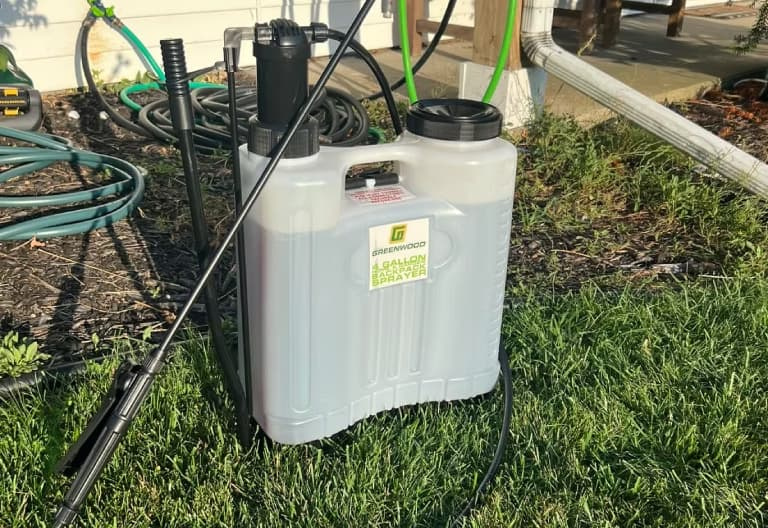
Herbicide Application Guide
New to spraying, or want to get it right? Our Herbicide Application Guide covers the practical steps this page assumes — mixing, calibration, protective gear, and the wind and temperature limits that decide whether a treatment works or drifts. Read it before you spray.
See Guide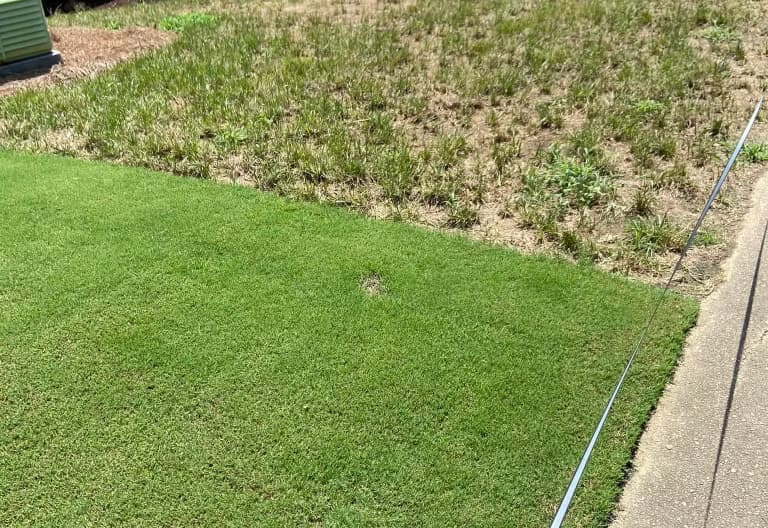
Where Two Lawns Meet
Does your lawn border a neighbor’s — or meet a different type of grass? Spraying near that line can quietly damage the yard next door, sometimes weeks later. Where Two Lawns Meet shows you how to treat safely without harming either side.
Read ArticlePulling
Pull only young, isolated seedlings; do not try to pull an established clover mat — it regrows worse than before.
The Biological Reason
Here’s the part that catches people out. White clover doesn’t hang from one root you can grab and extract. It runs across the ground on stolons — horizontal stems that sprout their own roots and their own new shoots at every joint (node) that touches moist soil, with those joints often just an inch or two apart. Each rooted joint is basically a self-sufficient little plant. So when you grab a mat and pull, the brittle runners snap at the joints and you lift some leaves while leaving a hidden lattice of rooted nodes behind in the soil. Freed from the parent plant, each of those nodes then sends up new shoots — so a bad pull doesn’t remove the clover, it multiplies it. The one thing that could have given you a clean pull, a deep anchoring taproot, is already gone: the seedling’s taproot dies in the plant’s second year, and after that the whole patch is held by shallow roots in the top few inches.
That’s why hand-weeding only makes sense on a young seedling that hasn’t started running yet, or on a small, brand-new patch. If you do go after a small patch, do it when the soil is soaked — right after heavy rain or a deep watering — so the roots slip out instead of tearing, lift the entire connected network of runners rather than yanking from the center, and dig out the whole root zone a few inches down. Then bag it and throw it out with the trash. Do not compost it: clover’s hard seed survives a backyard compost pile and rides right back into your yard.
Underground Structure Explainer
White clover’s spread lives almost entirely at the soil surface, not deep underground. A single runner creeps outward at up to about 7 inches a year, and everywhere it touches moist ground it drops roots and raises new leaves and flower stalks — turning one plant into a dense, interlocking mat more than a foot across. Those roots stay shallow, mostly in the top 8 inches, which is why the plant needs steady moisture and why it never develops a deep anchor once it’s mature. The runners are also its undoing when handled wrong: as they age they naturally rot apart into separate plants, and any piece carrying even one live node will re-root in moist soil. Tilling, aggressive raking, or core aeration chops the runners into more of those pieces and scatters them — spreading clover instead of removing it. Underneath it all, the roots carry nodules full of bacteria that pull nitrogen from the air (the pink-centered nodules are the ones actively working), which is the engine that lets clover thrive where the grass is starving.
Lawn vs. Bed Pulling Difference
The pulling problem is worse in beds than in lawns. Loose, cultivated, moist bed soil is the ideal environment for those cut runner-nodes to re-root fast, so incomplete weeding propagates clover even more readily there than in dense turf — and it’s easy to leave fragments behind when you’re working around ornamentals.
Quick Reference Summary
| Lifecycle | Stoloniferous perennial (legume) |
| Active Zones | Cool-season, warm-season, and transition — all three |
| Germination Trigger | Seed sprouts at 50–60°F soil temp (spring/fall); established plants spread by runners |
| Pre-Emergent | No — only a minor, seed-catching role |
| Post-Emergent Window | Fall (late Sept–Nov) is best; spring is weaker |
| Pull | With caution — young, isolated plants only |
| Lawn Primary Tool | Nitrogen fertility + a combination or clover-active broadleaf herbicide (triclopyr / fluroxypyr / clopyralid / three-way; ALS products on warm-season) |
| Bed Primary Tool | Directed clopyralid or glufosinate; isoxaben under mulch for seedlings |
| One-and-Done or Multi-Season | Multi-season |
Frequently Asked Questions
These answers are synthesized from botanical morphology studies and herbicide efficacy trials conducted by leading university agricultural extensions.
Because pulling usually leaves rooted pieces behind. Clover spreads on runners that root at every joint, and any joint left in the soil grows into a new plant — so tearing out a mat multiplies it. On top of that, the soil holds clover seed that can stay viable for up to 30 years, sprouting in waves long after the plants are gone. Removing the visible clover is only part of the job; changing the conditions that favor it is the rest.
That’s a real choice, not a wrong answer. Clover feeds itself nitrogen, stays green in heat, and its flowers are excellent for bees, which is why “clover lawns” and microclover blends are popular. The trade-offs are that those same flowers draw stinging bees right where bare feet walk, and in a grass lawn clover will keep spreading into the turf. If you like it, you can let it be; if you want grass, treat it as a weed. Just decide on purpose rather than fighting a losing half-battle.
In normal lawn contact it’s not a meaningful poisoning risk — clover is even grown as livestock forage. The practical hazard is the bees its flowers attract, which can sting a child or pet walking barefoot through a blooming patch. If you treat clover with herbicide, keep kids and pets off until the spray has dried and the label’s re-entry time has passed.
Usually not right away — most clover herbicides block new grass seed too, and the waiting period depends on the product. Isoxaben and common broadleaf mixes typically call for roughly 30 to 60 days, while some products (certain quinclorac and clopyralid formulations) can restrict seeding for many months up to a year or more. Check the specific label before you plan a seeding date, and in the transition zone especially, decide up front whether this fall is for spraying or for seeding — it usually can’t be both.
It can. Core aeration and hard raking chop the runners into pieces and scatter them, and any piece with a live joint can re-root — so doing it through an active clover mat can seed the whole area with new plants. Aeration is still worth doing for compaction (which favors clover in the first place), but time it when clover is dormant or knocked back, or treat the clover first.
Scientific Authority
This profile is constructed using forensic botanical data and Integrated Pest Management (IPM) research. We prioritize scientifically-vetted identification and control methods that protect the broader ecosystem while ensuring successful eradication based on peer-reviewed agricultural studies.
Primary Resources
- Penn State Extension — Lawn and Turfgrass Weeds: White Clover (extension.psu.edu/lawn-and-turfgrass-weeds-white-clover); Three Weeds with Three Leaflets: Trifoliate Look-Alikes (extension.psu.edu/three-weeds-with-three-leaflets-trifoliate-look-alikes); Indicator Weeds Provide Insight into Growing a Better Lawn (extension.psu.edu/indicator-weeds-provide-insight-into-growing-a-better-lawn)
- Purdue University Turfgrass Science / Extension — White Clover (turf.purdue.edu/white-clover/); Black Medic (turf.purdue.edu/black-medic/) Ohio State University Extension — Turfgrass Weed Control for Professionals / BuckeyeTurf weed management (buckeyeturf.osu.edu); Natural Organic Lawn Care (cfaes.osu.edu/fact-sheet/natural-organic-lawn-care)
- University of Minnesota Extension — Dutch White Clover (extension.umn.edu/weeds/dutch-white-clover)
- Michigan State University Extension — White Clover, Trifolium repens (canr.msu.edu/resources/white-clover-trifolium-repens); White Clover fact sheet (canr.msu.edu/uploads/files/White%20clover.pdf)
- Rutgers Cooperative Extension — Lawn weed fact sheet FS385 (njaes.rutgers.edu/fs385/)
- UMass Amherst (Center for Agriculture, Food & the Environment / Weed Herbarium) — White Clover in Lawns (umass.edu/agriculture-food-environment/home-lawn-garden/fact-sheets/white-clover-in-lawns); Trifolium repens (extension.umass.edu/weed-herbarium/weeds/trifolium-repens/index.html)
- University of Wisconsin Extension — Lawn Weed Control (barron.extension.wisc.edu/files/2021/09/Lawn-Weed-Control-GWQ013.pdf)
- University of Illinois Extension — Home, Yard & Garden clover articles (hyg.ipm.illinois.edu)
- Cornell Cooperative Extension — White Clover fact sheet (assets.cce.cornell.edu/attachments/4825/White_Clover.pdf)
- Iowa State University Extension and Outreach — Dutch White Clover (naturalresources.extension.iastate.edu/encyclopedia/dutch-white-clover)
- University of Maryland Extension / Maine DACF — regional turf broadleaf weed-control guidance (maine.gov/dacf/php/gotpests/weeds/factsheets/weed-control-turf-md.pdf)
- Clemson Cooperative Extension (HGIC) — White Clover (hgic.clemson.edu/factsheet/white-clover/); Managing Weeds in Warm-Season Lawns (hgic.clemson.edu/factsheet/managing-weeds-in-warm-season-lawns/)
- University of Georgia CAES — White Clover Establishment and Management Guide, Bulletin 1251 (fieldreport.caes.uga.edu/publications/B1251/white-clover-establishment-and-management-guide/)
- NC State Extension (TurfFiles / Extension Weed Science) — White Clover (turffiles.ncsu.edu/weeds-in-turf/white-clover/); Fall Weed Control Options for Home Lawns (turffiles.ncsu.edu/news/fall-weed-control-options-for-home-lawns/); Spraying Glyphosate on Slightly Greened-Up Bermudagrass in Winter (turffiles.ncsu.edu/news/spraying-glyphosate-on-slightly-greened-up-bermudagrass-in-winter/); Effect of Waterlogged Soil on Preemergence Herbicides (turffiles.ncsu.edu/news/effect-of-waterlogged-soil-on-preemergence-herbicides-in-turfgrass-systems/); Postemergence Broadleaf Weed Control in Landscapes (weeds.ces.ncsu.edu/weeds-teaching/landscape-weed-management/postemergence-broadleaf-weed-control-in-landscapes/)
- Texas A&M AgriLife Extension — Turfgrass herbicide selection guide (aggieturf.tamu.edu/wp-content/uploads/sites/24/HerbicideSelection_proof44-1.pdf)
- Auburn University / Alabama Extension — Alabama Forages Handbook, white/ladino clover chapter (aces.edu)
- LSU AgCenter — White Clover, turfgrass broadleaf weeds (lsuagcenter.com/topics/lawn_garden/commercial_horticulture/turfgrass/turfgrass-weeds/broadleaf-weeds/white-clover); Controlling Clover…Or Not? (lsuagcenter.com/articles/page1724702702210)
- University of Arkansas Cooperative Extension — Lawn Weeds (uaex.uada.edu/publications/pdf/mp44/lawn-weeds.pdf)
- University of Florida IFAS Extension — Clover and broadleaf weed management publications (ask.ifas.ufl.edu/publication/EP634; ask.ifas.ufl.edu/publication/AA198)
- Virginia Tech Extension — SMART Lawns and turf weed management (pubs.ext.vt.edu); Weed ID: White Clover (weedid.cals.vt.edu/profile/516/)
- University of Missouri Extension — White, Ladino and Sweet Clover, G4639 (extension.missouri.edu/publications/g4639); Mizzou WeedID: White Clover (weedid.missouri.edu/weedinfo.cfm?weed_id=292)
- Kansas State Research and Extension — Lawn Problem Solver: White Clover (k-state.edu/turf/resources/lawn-problem-solver/problem-solver/weeds/broadleaf/white-clover/)
- University of Kentucky Extension — White Clover, weed science (weedscience.mgcafe.uky.edu/content/white-clover); publication PR852 (publications.mgcafe.uky.edu)
- Oklahoma State University Extension — White Clover plant profile (extension.okstate.edu/programs/plant-id/plant-profiles/white-clover); Consumer Broadleaf Weed Control for Lawns in Oklahoma (extension.okstate.edu/fact-sheets/consumer-broadleaf-weed-control-for-lawns-in-oklahoma)
- West Virginia University Extension — Weed Management (extension.wvu.edu)
- University of Tennessee Extension — White Clover (Trifolium repens), W267 (utia.tennessee.edu/publications/…/W267.pdf)
- UC IPM / UC ANR — Clovers, Pest Notes (ipm.ucanr.edu/home-and-landscape/clovers/; ipm.ucanr.edu/legacy_assets/PDF/PESTNOTES/pnclovers.pdf); White Clover ID (ipm.ucanr.edu/PMG/WEEDS/white_clover.html)
- UC SAREP — White Clover cover-crop profile (sarep.ucdavis.edu/covercrop/whiteclover)
- Peer-reviewed — White Clover (Trifolium repens) Control and Flower Head Suppression in Apple Orchards, Weed Technology 2005, 19:219–223 (NC State IR-4); Canadian Journal of Plant Science white clover biology (cdnsciencepub.com, doi:10.4141/cjps83-024)