
Goosegrass At-a-Glance
Weed Type
Grass
Life Cycle
Summer annual (can act as a short-lived perennial only in frost-free areas like south Florida)
Growth Habit
Prostrate, mat-forming rosette — the classic "wagon-wheel"
Root Type
Fibrous
Spreading Risk
High — by seed (one plant makes 50,000–140,000 seeds)
Pull
With Caution
Identity & Diagnostics
Visual Fingerprint
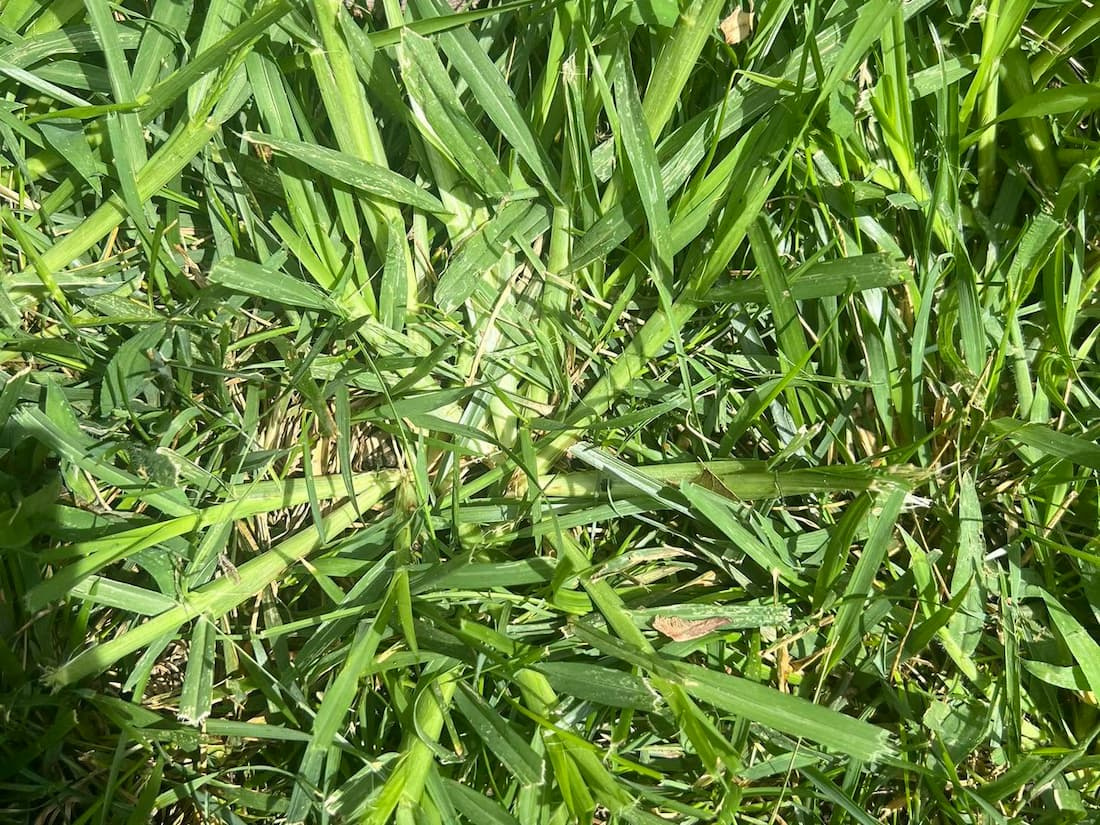
Goosegrass grows flat and low, with tough, dark-green, shiny leaves spreading out from a single center point in a pattern that looks like a wagon wheel or a plant that’s been stepped on. The dead giveaway is the center: the base of the plant is a distinct whitish-to-silvery color where the stems overlap and flatten together. From standing height, look for a dark-green, coarse grass clump growing flush with the ground in a worn or compacted spot — a driveway edge, a footpath, a thin patch in the lawn.
Structural Anatomy
Up close, a few features confirm goosegrass beyond doubt, and you can identify it with certainty even when there’s no seedhead present. The leaves are folded in the bud (not rolled), the base is that flattened silvery-white, and there are no auricles — no little clasping arms where the leaf wraps the stem. The ligule (a thin membrane where the leaf meets the stem) is short and split down the middle with a ragged top edge. The stems never root where they touch the ground. That combination — folded leaves, silver flat base, split ligule, no auricles, no rooting stems — belongs to no other common lawn grass.
Grass-Specific Anatomy
| Feature | Goosegrass |
| Vernation (leaf in the bud) | Folded |
| Ligule | Short (about 1 mm), membranous, ragged and split/cleft in the center |
| Auricles | Absent |
| Collar | Continuous, with fine crooked hairs on the margins |
| Sheath / base | Strongly flattened and keeled; distinct silvery-white; a few long hairs near the top of the sheath |
| Leaf blade | Dark green, tough, glossy; blunt tip; smooth underneath with a sharp midvein crease |
| Stem cross-section | Flattened, not round |
Growth Patterns & Life Stages
Goosegrass moves fast once it starts. The seedling appears in late spring as a small, hairless, light-green blade lying almost flat to the soil. Within a few weeks — after about six leaves — it begins tillering (sending out side shoots) and forms its flat rosette, and the base starts to whiten. This early stage, before tillering, is your entire window for easy chemical control. By midsummer it’s a tough, well-anchored mat, and from midsummer to the first frost it throws up flower spikes: 2 to 13 stiff, finger-like spikes radiating from one point, each carrying two rows of seeds packed in a distinctive zipper pattern. Once you see the zipper seedheads, the plant is winning — it’s making tens of thousands of seeds and it’s too late for the easy options.
Gallery
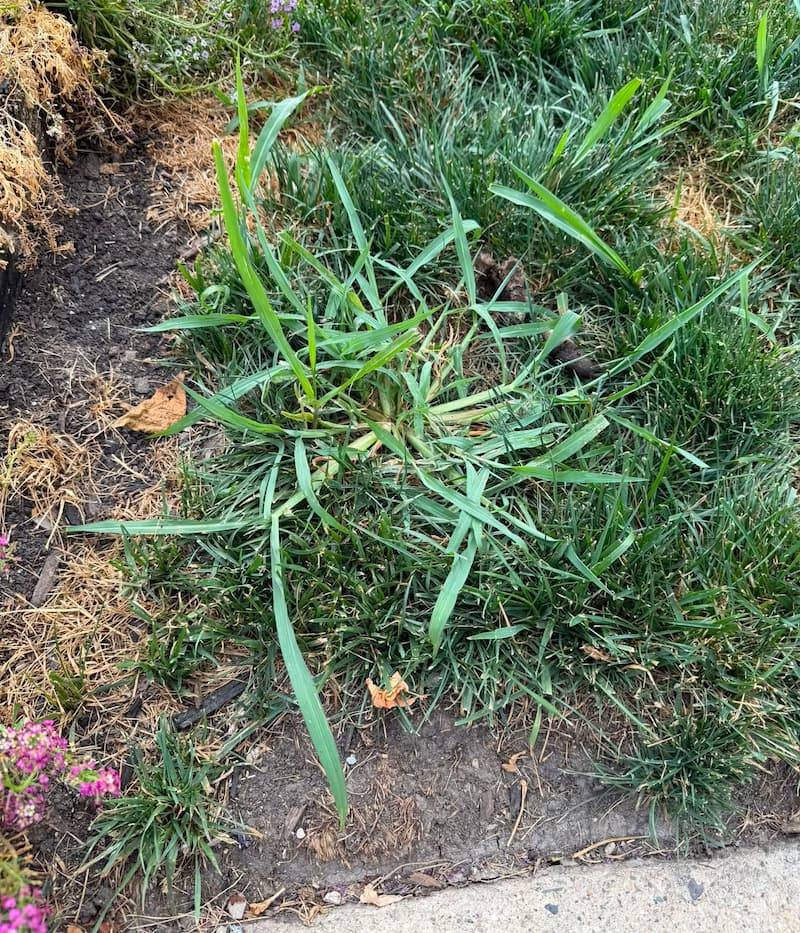
Goosegrass thrives in compacted soils and high-traffic areas, such as hardscape edges and bare turf patches.
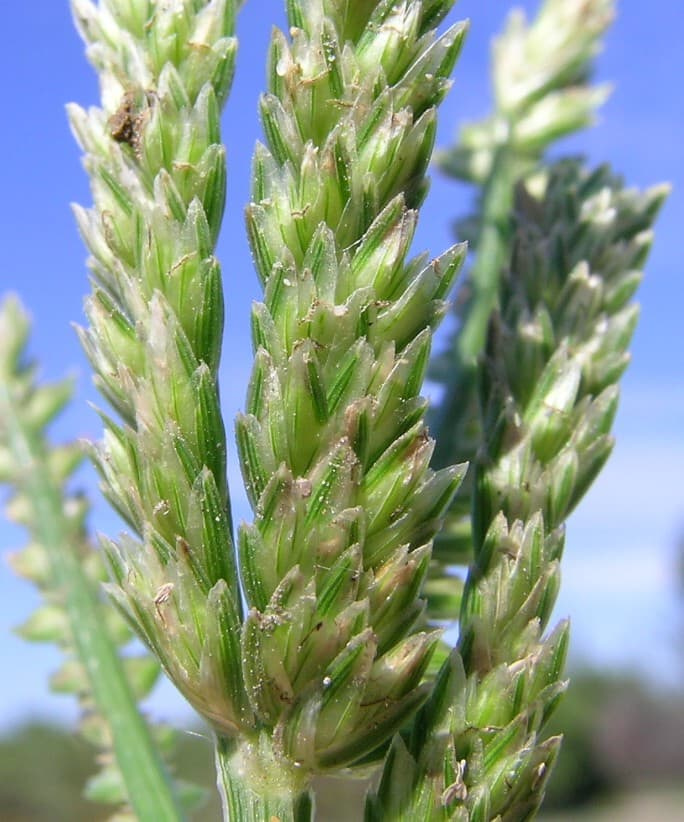
Diagnostic Feature: Goosegrass's finger-like seedhead spikes have a distinctive double, zipper-like row of spikelets — crabgrass's spikes, by comparison, look smoother and single-rowed.
“Eleusine indica spikelets1” by Macleay Grass Man is licensed under CC BY 2.0.
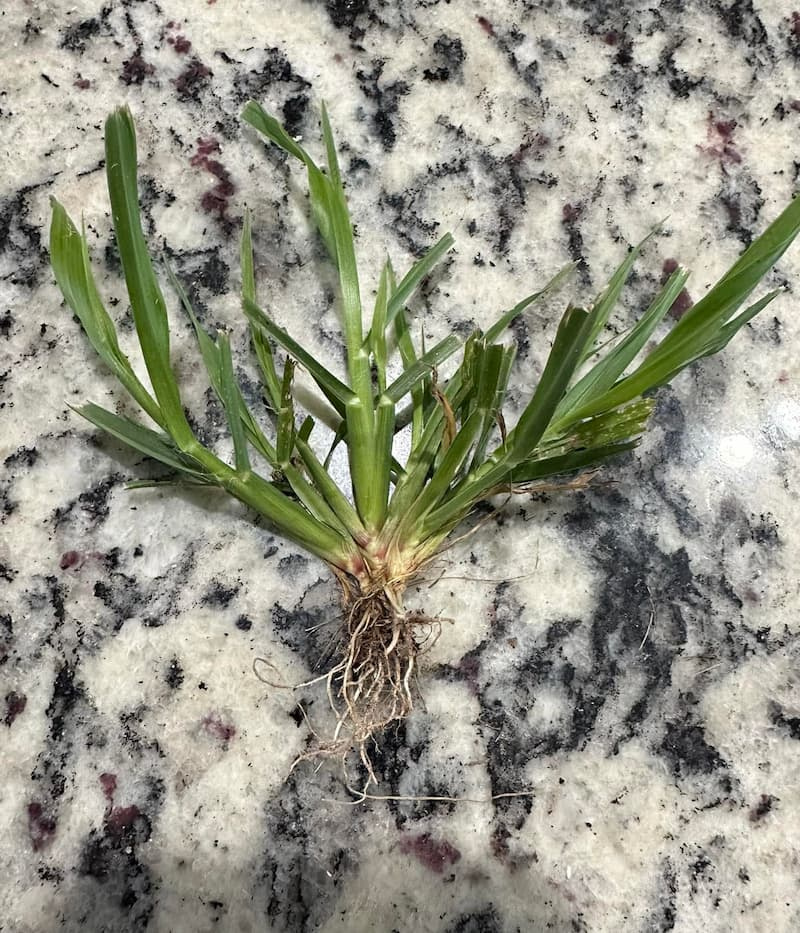
Dissecting an uprooted specimen reveals the compressed, V-shaped leaf sheaths and flattened crown typical of Eleusine indica.
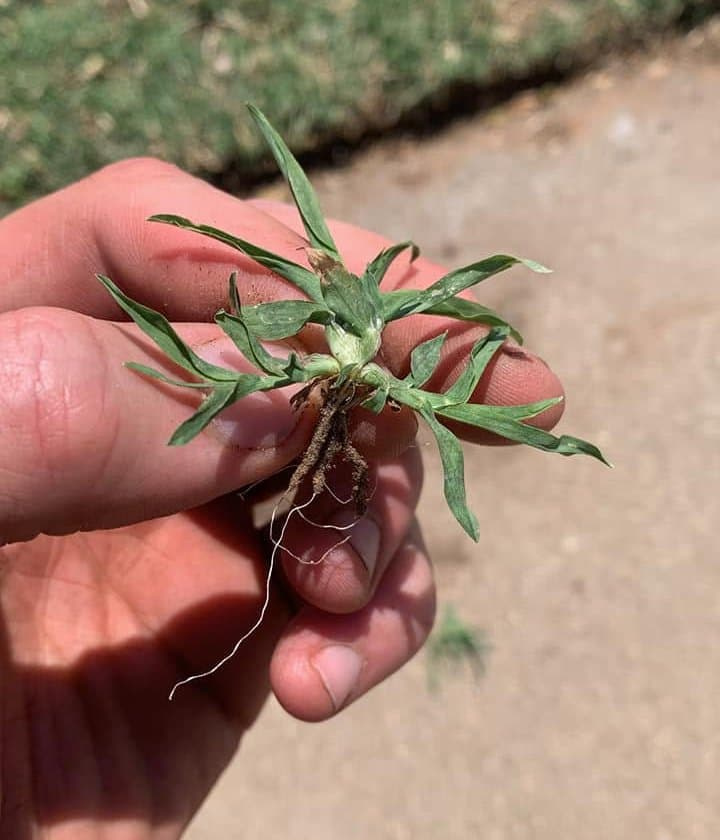
Manual removal is most effective when plants are young, exposing the characteristic pale, whitish central crown and shallow root structure.
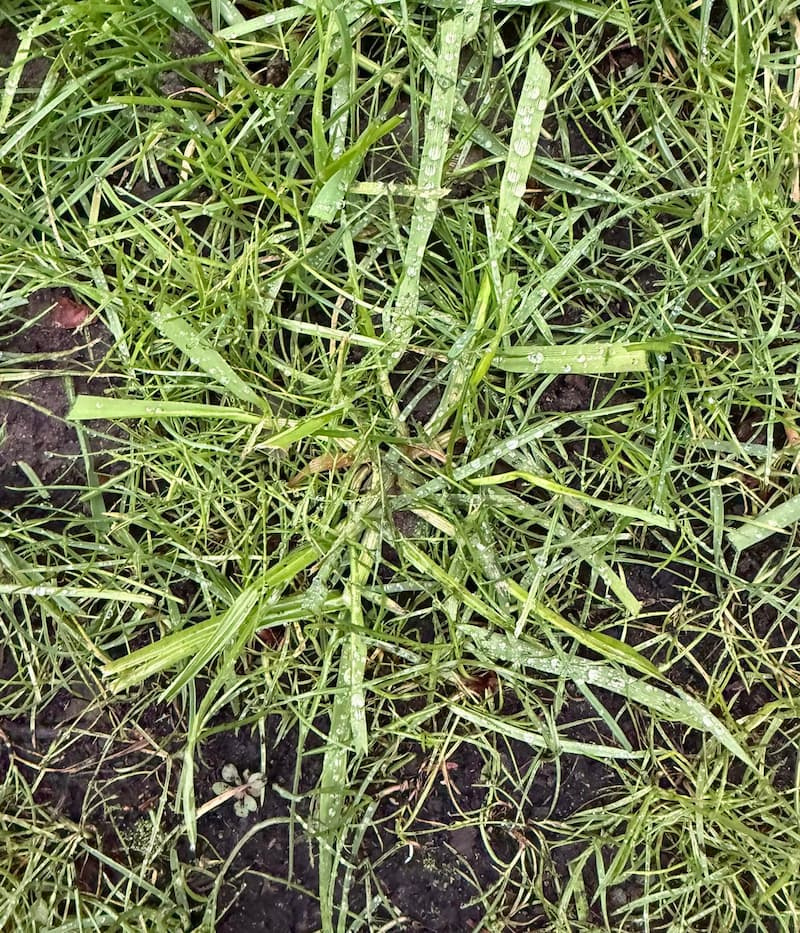
The strongly flattened stems and rosette growth pattern make goosegrass easy to spot in wet or early morning turf.
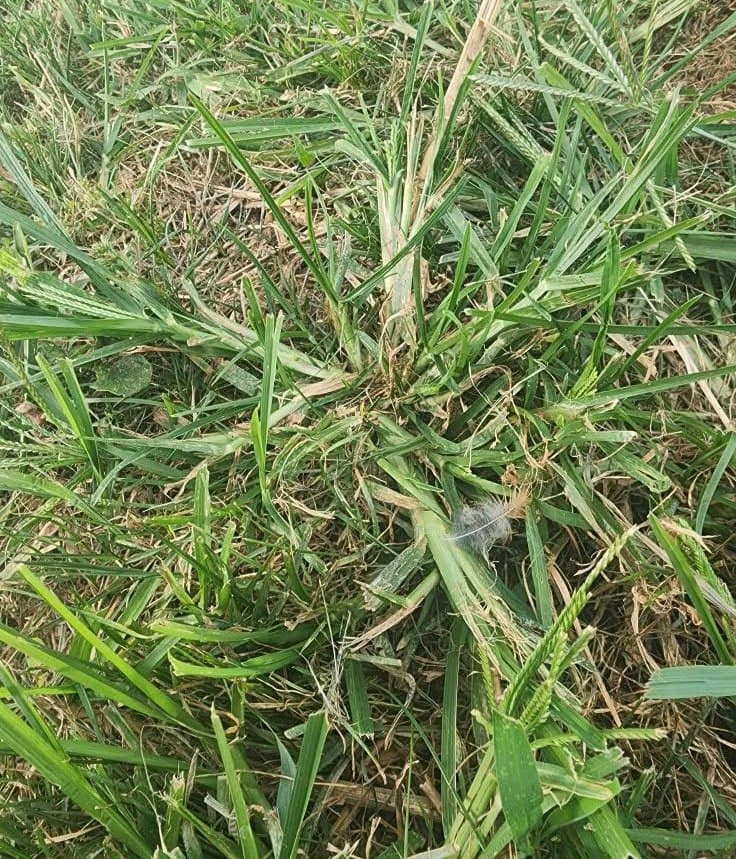
Mowing alone will not eliminate goosegrass, as its low growth habit allows seed heads to form below standard lawn mower blade heights.
The Identity Trap
Common Lookalikes
Crabgrass is the big one — goosegrass has literally been nicknamed “silver crabgrass” because they get mixed up so often, and they share the same low, spreading, grassy-mat look. Dallisgrass is a second, less common mix-up: it’s another coarse, clumpy grass, but it’s a perennial, which changes everything about how you’d control it.
Identification Differentiators: How to Tell Them Apart
Goosegrass vs. crabgrass: Look at the base and the stems. Goosegrass has that flattened silvery-white center; crabgrass has rounder stems that often turn reddish-purple at the base and never look silver. And crabgrass roots at its stems where they touch moist soil — goosegrass never does. If the leaves were rolled in the bud, it’s crabgrass; if folded, it’s goosegrass. (This one matters most: it decides which products will even work.)
Goosegrass vs. dallisgrass: Dig a little. Dallisgrass spreads by short, thick underground stems (rhizomes) and is a perennial that comes back from those roots; goosegrass is a summer annual with a plain fibrous root and no underground runners. If you find thick creeping underground stems, you’re dealing with dallisgrass, and the control plan is different.
Growing Conditions
Host Grasses
Goosegrass invades both cool-season lawns (Kentucky bluegrass, tall fescue, perennial ryegrass) and warm-season lawns (bermudagrass, zoysiagrass, St. Augustinegrass, centipedegrass). It isn’t picky about the grass — it’s picky about the gap. It moves into thin, worn, or heat-stressed turf where the canopy has already opened up. In cool-season lawns it strikes hardest in the heat of summer, exactly when those grasses go tired and thin. In warm-season lawns it exploits the slow spring green-up, before the turf closes back over bare soil.
Host Environment/Area
This weed loves the hard, packed, beaten-down parts of a property. Look for it along sidewalk and driveway edges, footpaths, gravel, athletic sidelines, and any high-traffic strip — places where the soil is compacted and the sun heats the bare ground. Hardscape edges are a favorite because concrete and asphalt soak up heat and raise the nearby soil temperature to exactly what goosegrass needs to sprout. It shows up in both lawns and landscape beds, but in beds it concentrates at the compacted edges and paths, not usually the loose, mulched interior — though a plant that does get into rich, watered bed soil will grow huge.
Soil Indicators: What the Presence of This Weed Reveals About Your Yard
Goosegrass is one of the most reliable compaction indicators in the yard. It thrives in packed, low-oxygen soil that chokes the roots of desirable grass, so a stand of goosegrass is a direct signal that the soil underneath is compacted and needs aeration. It also points to poor drainage or chronically wet spots, and to low fertility (thin, underfed turf). It tolerates a huge pH range (5 to 10), so it tells you nothing about acidity — but where it dominates, read it as “this soil is packed hard and/or staying too wet.”
Lifecycle and Season
Lifecycle Category and Management Implications
Goosegrass is a summer annual. It grows, seeds, and dies in a single season, killed completely by the first hard frost, and it has no underground survival structure — no rhizome, tuber, or bulb waiting to regrow next spring. That’s good news and bad news. The good news: kill the plant or catch the seed and you’re done with that individual, and a pre-emergent barrier is a genuinely powerful tool here. The bad news: everything rides on the seed. One plant drops tens of thousands of seeds that last for years, so the whole game is stopping seed production, season after season.
Germination Trigger
Goosegrass sprouts when the soil at a 2-inch depth holds a daily average of 60–65°F, along with moisture and direct light on the soil surface. That’s meaningfully warmer than crabgrass, which starts around 54–55°F. The practical result: goosegrass germinates 2 to 4 weeks later than crabgrass (up to 4–6 weeks later in cool northern microclimates). And it doesn’t come up all at once — it emerges in repeated flushes through the summer as heat and traffic keep opening the canopy.
In the cool-season zone (the Northeast, Midwest, upper Mid-Atlantic), goosegrass is active from late spring into fall. Here’s the trap: the pre-emergent window opens later than for crabgrass. A barrier laid down in mid-March to late April for crabgrass — at 50–55°F soil — is breaking down by the time goosegrass germinates at 62–65°F, often in late May or June, and it degrades even faster in a wet summer. Because of that gap, cool-season lawns almost always need a split application: the normal crabgrass timing, then a second dose about 60 days later to carry the barrier through the goosegrass flushes. Post-emergent control works only on young, pre-tillering plants, so scout from late spring on.
In the warm-season zone (the South), the longer, hotter season means more germination flushes and a longer fight. Goosegrass exploits the several-week window while bermudagrass and other warm-season grasses are slowly greening up from winter dormancy — bare, open soil is exactly what its seed needs. Apply the first pre-emergent in late winter/early spring at crabgrass timing, then a second application 50–75 days later; in a wet spring, waterlogged soil breaks the chemical down faster, so extension guidance is to bump the second dose up by about 25%. Critical caution: do not put broadleaf or triazine post-emergents (like atrazine) on warm-season turf during green-up or when it’s above 85°F — you’ll injure the lawn. In frost-free south Florida, note that goosegrass can survive the winter as a short-lived perennial, so mature plants are already present at spring’s start.
The transition zone is the hardest, because both cool- and warm-season grasses are grown here and neither is fully comfortable. Goosegrass hits cool-season turf in its summer heat-slump and warm-season turf during slow spring green-up or after winterkill. You get a two-humped weed season: crabgrass early (March/April) and goosegrass late (May/June), so a single March pre-emergent is long gone before goosegrass peaks. The fix is a split program — the first application at crabgrass timing, the second around mid-May aimed at goosegrass. The transition zone also carries a scheduling conflict serious enough to get its own note under Pre-Emergent in Lawn.
Herbicide Control
Pre-emergent is your primary and most effective chemical tool against goosegrass, because the weed comes only from seed. These products work by stopping the sprouting seed’s cells from dividing, so the seedling dies underground before it ever reaches the surface. Common homeowner active ingredients that work are pendimethalin, prodiamine, and dithiopyr (Group 3), and oxadiazon (Group 14) — the same “crabgrass preventer” chemistry you may already own.
The catch is timing, and it’s the whole ballgame. Because goosegrass germinates 2–4 weeks after crabgrass, a single early-spring application is fading right when you need it most. Apply on a split schedule: a first application at normal crabgrass timing, then a second one about 6–8 weeks later (often mid-to-late May) to hold the barrier through the summer flushes. One safety note: if you use oxadiazon on a cool-season lawn, use the granular form only — the liquid burns the grass.
(read this before you spray the same thing twice) Goosegrass is notorious for evolving herbicide resistance, and it’s already confirmed. Group 3 (dinitroanilines — prodiamine, pendimethalin, and cross-resistance to dithiopyr) resistance is documented from the Northeast (Rutgers-confirmed on golf courses) through the transition zone (especially North Carolina) and the South. Group 14 (oxadiazon, sulfentrazone) resistance is confirmed in New Jersey, Virginia, North Carolina, and Auburn’s lab screens. Glyphosate (Group 9) resistance shows up in New Jersey, Virginia, North Carolina, and Tennessee turf margins, and ACCase (Group 1), ALS (Group 2), triazine (Group 5), and even paraquat (Group 22) resistance are documented in warm-season regions. The rule: do not use the same mode-of-action group two years running. Rotate groups (for example, Group 3 one year, Group 14 the next), tank-mix different groups, and lean on aeration and overseeding to cut how much you have to spray at all.
Be honest with yourself here: selective post-emergent control of goosegrass is hard, and it only works on young plants. Once the plant tillers into its tough mat (past about 4 tillers), the leaf surface thickens and herbicides stop getting in — after that it takes repeated applications, if it works at all. So the window is small plants, roughly the 1-to-5-leaf stage, before tillering.
For cool-season lawns, the homeowner-accessible options that actually work are topramezone (Pylex) — effective even on older plants and it bleaches the weed white — and mesotrione (Tenacity) on plants with fewer than 4 tillers. Both need the right additive (methylated seed oil for topramezone, a surfactant for mesotrione), and neither can be used on fine fescue. Fenoxaprop (Acclaim Extra) also works but is more of a professional product.
For warm-season lawns, realistic homeowner options are thin and very grass-specific — St. Augustinegrass and centipedegrass in particular are so sensitive that most goosegrass herbicides will injure them. This is the situation where calling a licensed lawn-care professional is often the smart move rather than risking your turf.
Two things that trip up homeowners: the popular crabgrass killer quinclorac does not control goosegrass at any stage, and the pre-emergent dithiopyr kills young crabgrass after it’s up but does not touch emerged goosegrass. If your “crabgrass” products aren’t working, this is why.
Verdict: multi-season. You will not clear an established goosegrass lawn in one year. Plan on a program: split pre-emergent every season, spot post-emergent on young escapes, and cultural fixes — run for two to three seasons and the seed bank finally starts to empty.
Cultural control isn’t a footnote for this weed — it’s half the battle, because goosegrass only wins where the turf is already losing. Three levers matter most. Mow high: keep cool-season lawns at 2.5–4 inches (warm-season at the top of each species’ range) so the canopy shades the soil and blocks the light goosegrass seed needs to sprout. Aerate: relieve the compaction that goosegrass depends on — core aeration is the single most important cultural fix, but time it for late summer/early fall (cool-season) so you’re not opening the soil during the germination window, and overseed right after. Water and feed smart: water deeply and infrequently (frequent shallow watering keeps the surface wet and sprouts goosegrass), and avoid heavy nitrogen during the summer heat, when it feeds the weed more than the stressed turf.
The same logic applies in beds — pre-emergent is a primary tool because it’s a seed-only weed — and several active ingredients are labeled safe around established ornamentals: prodiamine, oryzalin, pendimethalin, dithiopyr (Group 3), oxadiazon (Group 14), and longer-lasting indaziflam (Group 29). Use the split-timing approach here too: first application early spring, second about 60–75 days later. In beds you usually apply on top of the mulch surface so seeds can’t germinate in the decomposing mulch layer, then water it in with about ¼–½ inch of irrigation within a day or two to activate it. Keep it off young, newly planted material — wait until new plants are well-rooted (at least a few weeks after planting), because tender transplants and herbaceous perennials can be injured even by “safe” products.
Beds actually give you a break here, and it’s a real lawn-vs-bed advantage: you can use grass-selective herbicides (graminicides) that kill grasses while leaving broadleaf shrubs, perennials, and flowers unharmed. Fluazifop (Fusilade / consumer “grass killer” products), sethoxydim (Poast/Segment), and clethodim (Envoy) are the go-to options, and clethodim has the bonus of also controlling annual bluegrass. Two cautions: these will kill or damage ornamental grasses too, so watch your drift near any decorative grass, and skip extra crop-oil additives on sensitive plants. For big mature plants, a directed, carefully shielded spot-spray of a non-selective like glyphosate works, but never let it touch green bark or leaves of your shrubs — peaches and brambles are especially sensitive, even in winter. (Buying tip: not every product labeled “Roundup” is glyphosate anymore — check the active-ingredient panel.)
Verdict: multi-season, same as the lawn — the seed bank doesn’t care which side of the bed edge you’re on.
Mulch is a genuinely effective goosegrass blocker because the seed needs light and warm surface soil to sprout, and mulch takes both away. Keep a uniform 2–4 inches of coarse organic mulch (wood chips, shredded or pine bark) — but no deeper than about 3 inches over shallow-rooted plants, and don’t exceed 4 inches anywhere. Here’s the catch that surprises people: pile it too deep and the top of the mulch becomes a loose, moist bed where wind-blown seed sprouts in the mulch itself, above your barrier. And mulch gets kicked and blown off the compacted edges and paths — which is exactly where goosegrass concentrates — so those bare strips are the ones to watch and re-cover.
Herbicide Application Reference
A few warnings specific to goosegrass control. Oxadiazon on cool-season turf must be the granular form — the liquid causes severe leaf burn — and it’s damaging to St. Augustinegrass and centipedegrass. Topramezone and mesotrione temporarily bleach treated foliage white and will injure creeping bentgrass and fine fescue, so keep them off those grasses. Fenoxaprop loses its grass-killing power if tank-mixed with broadleaf weed-killers like 2,4-D — don’t combine them. Atrazine and metribuzin injure turf badly above 85°F and during warm-season green-up. And near beds, remember any grass-selective spray drifts onto ornamental grasses, and glyphosate is absorbed through green bark — shield your desirable plants.
A product note that is easy to miss: the consumer “Roundup” brand no longer reliably means glyphosate. Several reformulated versions now use different active ingredients, and some of them — imazapic is one — stay active in the soil, where nearby ornamental roots can take them up. That is the exact problem glyphosate is chosen to avoid here. Before you buy, read the active-ingredient panel and pick a product whose only active ingredient is glyphosate.
Herbicide Application Guide
New to spraying, or want to get it right? Our Herbicide Application Guide covers the practical steps this page assumes — mixing, calibration, protective gear, and the wind and temperature limits that decide whether a treatment works or drifts. Read it before you spray.
See Guide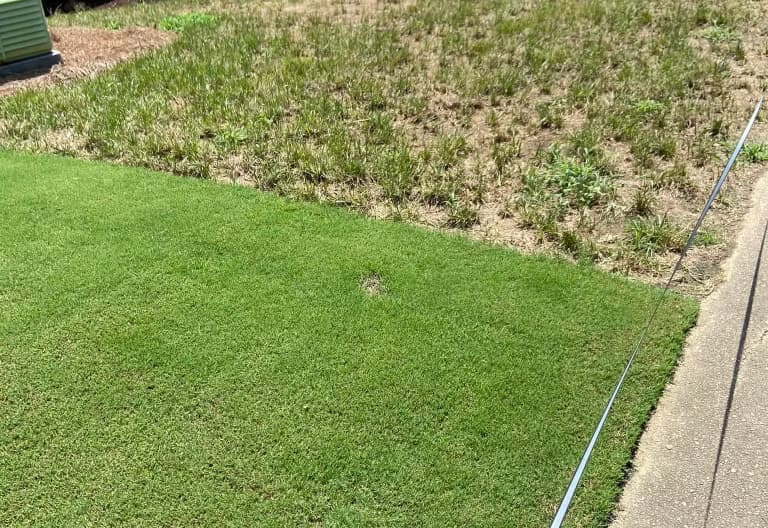
Where Two Lawns Meet
Does your lawn border a neighbor’s — or meet a different type of grass? Spraying near that line can quietly damage the yard next door, sometimes weeks later. Where Two Lawns Meet shows you how to treat safely without harming either side.
Read ArticlePulling
Yes — but with caution, and only before the seedheads form. Pulling works because goosegrass can't regrow from anything left behind; it fails when you disturb a plant that's already seeding.
The Biological Reason
Here’s the part that makes goosegrass different from the truly nasty pullers like nutsedge or quackgrass: it has no way to grow back from fragments. No rhizomes, no stolons, no rooting stems, no storage roots. Remove or sever the central crown — the single growing point at the base — and that plant is dead for good. There is no fragment-regrowth risk.
The real risk is seed shatter. A mature plant holds tens of thousands of seeds in those zipper seedheads, and yanking it flings them straight into the lawn or bed — you don’t remove the problem, you plant next year’s. So the safe window is before flowering, roughly May into June, while you still see rosettes but no flower spikes. Once the spikes appear, that window slams shut.
Two more practical points. First, mature goosegrass is genuinely hard to pull — that tough fibrous root anchors the crown so well that hand-pulling often just tears the leaves off and leaves the crown behind to regrow. Pull from moist soil (right after rain or watering), and for anything past the seedling stage use a trowel, weeding knife, or fork to get under the crown and lift it out whole. Second, don’t leave pulled plants lying on the lawn and never compost them — the seeds keep maturing on the pulled plant and survive a backyard compost pile easily. Bag them and throw them out.
Lawn vs. Bed Pulling Difference
Soil texture changes everything here. In loose, cultivated bed soil, young goosegrass slides out cleanly, root and all, by hand — pulling is genuinely easy and effective. In compacted turf, and along packed bed edges and paths, the crown holds fast and the plant tears; that’s where you need moist soil and a tool to sever below the crown. Same weed, very different pulling experience depending on how packed the ground is.
Quick Reference Summary
| Lifecycle | Summer annual (short-lived perennial only in frost-free subtropics) |
| Active Zones | Cool-season, warm-season, and transition — all three |
| Germination Trigger | Soil 60–65°F at 2″ + light + moisture (2–4 weeks after crabgrass) |
| Pre-Emergent | Yes — primary tool, but split-timed later than crabgrass |
| Post-Emergent Window | Small plants only, before tillering (1–5 leaf) |
| Pull | With caution — before seedheads, from moist soil, with a tool |
| Lawn Primary Tool | Split-timed pre-emergent + aeration and mowing height |
| Bed Primary Tool | Pre-emergent + grass-selective graminicide / directed removal |
| One-and-Done or Multi-Season | Multi-season (2–3 years) |
Frequently Asked Questions
These answers are synthesized from botanical morphology studies and herbicide efficacy trials conducted by leading university agricultural extensions.
Because it isn’t crabgrass, and your barrier was gone before this weed sprouted. Goosegrass germinates 2–4 weeks later than crabgrass, so a normal early-spring pre-emergent has already broken down by the time goosegrass comes up. The fix is a second application about 6–8 weeks after the first.
Nothing’s wrong with your sprayer — it’s the wrong product for this weed. The common crabgrass killer quinclorac does not control goosegrass at all, and dithiopyr won’t kill goosegrass once it’s up. You need a product that actually lists goosegrass, applied while the plants are still young.
Yes, if you catch it early. Goosegrass can’t regrow from anything left in the soil, so removing the crown kills it — but only pull before the zipper-like seedheads form, or you’ll fling thousands of seeds around. Pull from moist soil, and use a tool to get under the tough crown on bigger plants. Bag it; don’t compost it.
Probably two things. First, the seed bank: one plant leaves tens of thousands of seeds that stay alive in the soil for years, so it takes 2–3 seasons of stopping seed production to wear it down. Second, if you haven’t fixed the compaction, you’ve left the door open — goosegrass thrives in packed soil that your lawn can’t compete in.
Yes. It’s one of the most reliable signs of compacted soil, and often of poor drainage or a wet, low spot. Where it takes over, read it as a signal to aerate and improve drainage — spraying alone won’t fix the condition that invited it in.
No. The seeds are tough enough to survive a normal backyard compost pile and will spread when you use the compost. Bag pulled plants and put them in the trash.
Scientific Authority
This profile is constructed using forensic botanical data and Integrated Pest Management (IPM) research. We prioritize scientifically-vetted identification and control methods that protect the broader ecosystem while ensuring successful eradication based on peer-reviewed agricultural studies.
Primary Resources
- Penn State Extension — Goosegrass, a Summer Annual Grass / Lawn and Turfgrass Weeds: Goosegrass
- Rutgers NJAES — FS1309: Crabgrass and Goosegrass Identification and Control in Cool-Season Turfgrass
- Cornell CALS / Cornell Turfgrass — Goosegrass
- Purdue Turf — Goosegrass and Goosegrass Control in Sports and Golf Turf
- Ohio State University (Buckeye Turf / U.OSU) — Goosegrass; Annual Grassy Weed Control
- Michigan State University Extension — Goosegrass – Turf
- UMass Amherst — Compaction and Cultivation; Weed Management
- University of Illinois Extension — Goosegrass Gone Wild!
- NC State Extension (TurfFiles / Plant Toolbox / Publications) — Goosegrass; waterlogged-soil pre-emergent studies
- Clemson HGIC / Clemson OPEN — Grassy Weeds; Goosegrass Biology, Genetic Diversity and Innovative Control
- University of Georgia (GeorgiaTurf / CAES) — Goosegrass; ACCase-resistance in Georgia turf
- University of Florida IFAS — Identification, Biology, and Management of Goosegrass in Florida Turfgrasses; Goosegrass in Ornamental Plant Production
- Texas A&M AgriLife (AggieTurf) — Goosegrass
- LSU AgCenter — Goosegrass; Lawn and Turf Weed Management
- Virginia Tech — Indian Goosegrass Weed Profile; transition-zone turf publications
- University of Missouri, University of Kentucky, Oklahoma State, Kansas State, West Virginia University, University of Tennessee — transition-zone lawn and weed publications
- UC IPM / UC ANR — Goosegrass identification and management
- Auburn University (Herbicide Resistance Diagnostic Lab / Johnson thesis) — foramsulfuron- and sulfentrazone-resistant goosegrass
- Weed Science Society of America (WSSA) — herbicide mode-of-action group classifications