
Pathogen: Marasmius oreades, Chlorophyllum molybdites and more than 60 other soil fungi (basidiomycetes)
Also called: fairy rings, mushroom rings, toadstool rings, fairy ring mushrooms
Fairy Ring
The ring fed by buried wood
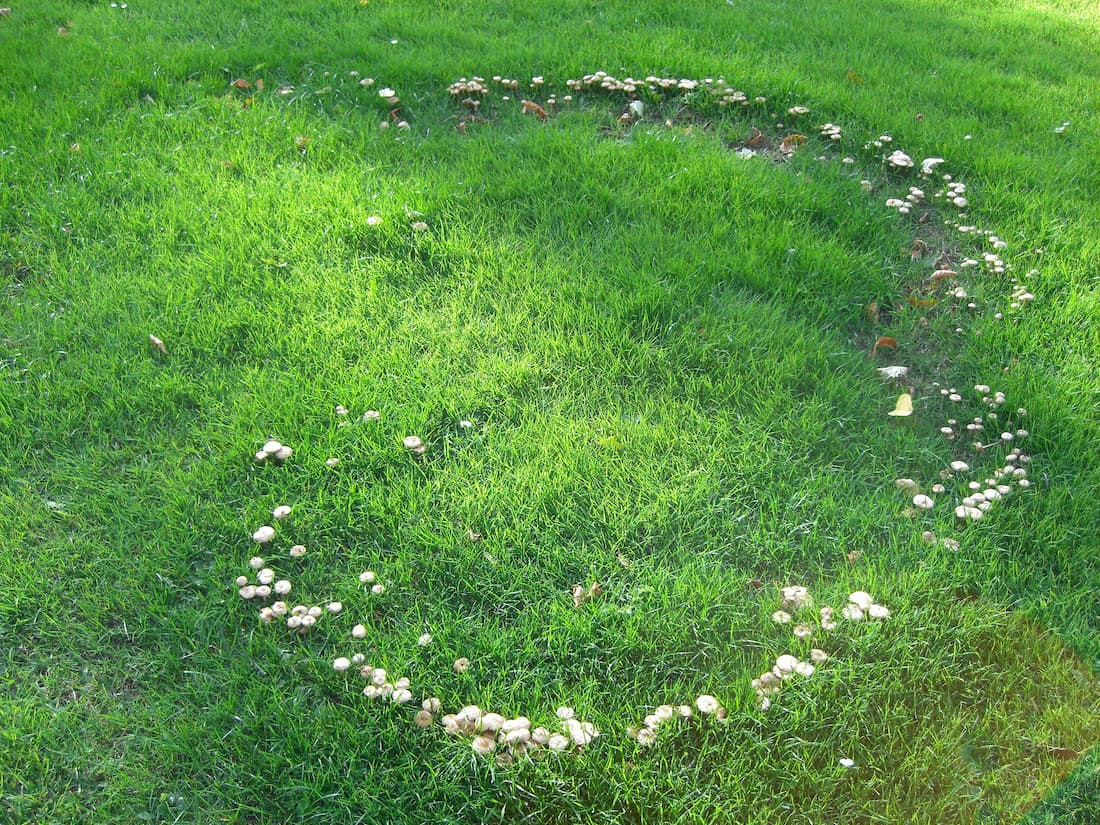
Featured Image Credit: "Fairy ring (Schloss Charlottenburg)" by Olivier Bruchez is licensed under CC BY-SA 2.0.
Fairy Ring At-a-Glance
Grass Type Affected
Cool & Warm Season
Recovers on Its Own?
Yes, Slowly
Is Spraying Worth It?
Rarely Worth It
Disease Type
Fungal
Active Season
Early Spring
Late Spring & Early Summer
Mid to Late Summer
Fall
Damage Potential
Cosmetic Only
Weakens Over Time
Can Be Fatal
Fairy Ring Quick Answers
What Fairy Ring Looks Like
From Standing Height
From standing height, fairy ring is a circle or arc in the lawn, from about a foot to many feet across, that shows up in one of three ways. You may see a band of darker green, faster-growing grass; a band of tan or brown dead grass, often with a green band just outside it; or a ring of mushrooms or puffballs with no change in the grass. The same ring can switch between these looks as the weather changes, and it comes back in the same spot, a little wider, every year.
Up Close: Blades, Crowns and Roots
Up close, fairy ring is defined by what’s missing. The fungus never invades the grass, so there are no leaf spots, no lesions and no rot on the blades, crowns or roots. In a green ring, the blades are simply darker and taller than the grass around them, because the fungus is releasing nitrogen beneath them. In a dead ring, the blades wilt, fold and turn tan or straw-colored the way drought-killed grass does, starting at the outer edge of the ring where the fungus is most active.
The evidence is in the soil. Pull back the turf and the thatch is laced with a white, cottony mat, and the soil underneath is powder-dry even when the lawn around it is moist. The roots of dying plants are dry and brittle but still white and whole. That intact root system is what separates fairy ring from the root-rotting ring diseases.
Signs of the Fungus
Fairy ring is one of the few lawn problems where you can see the organism without a magnifier. After rain, mushrooms or puffballs pop up overnight along the outer edge of the ring, often in a neat arc. Underground, the fungus itself is a dense white, cottony mat in the thatch and top few inches of soil. To see it, cut a slice of turf across the edge of the ring with a trowel or shovel and pull it apart. The mushrooms disappear when the weather turns dry or cold, but the mat underground keeps growing.
Identification Photos
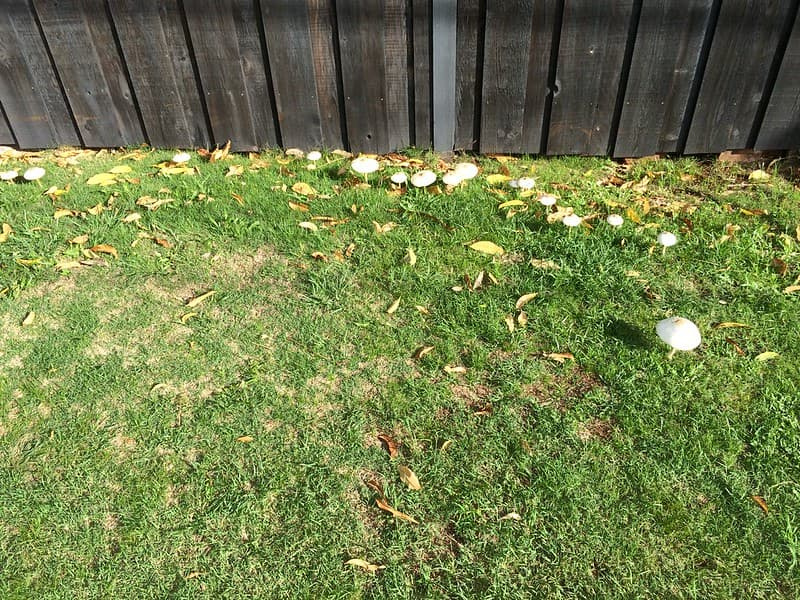
In the Lawn: Mushrooms come up in an arc along the outer edge of the ring, here following a fence line in a home lawn.
“Fairy ring in residential turf” by Plant pests and diseases is marked with CC0 1.0.
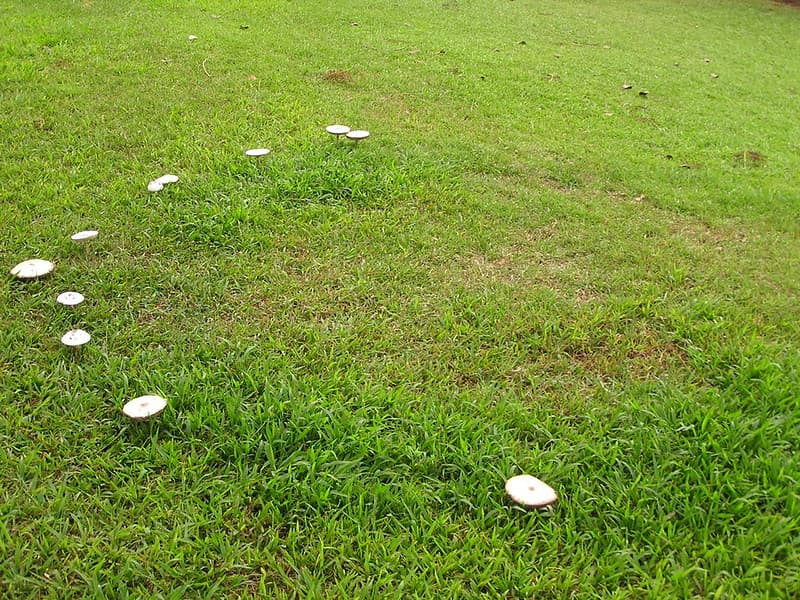
Partial Ring: Mushrooms often show up as an arc rather than a full circle, but they still mark the ring’s outer edge.
“Fairy ring” by Plant pests and diseases is marked with CC0 1.0.
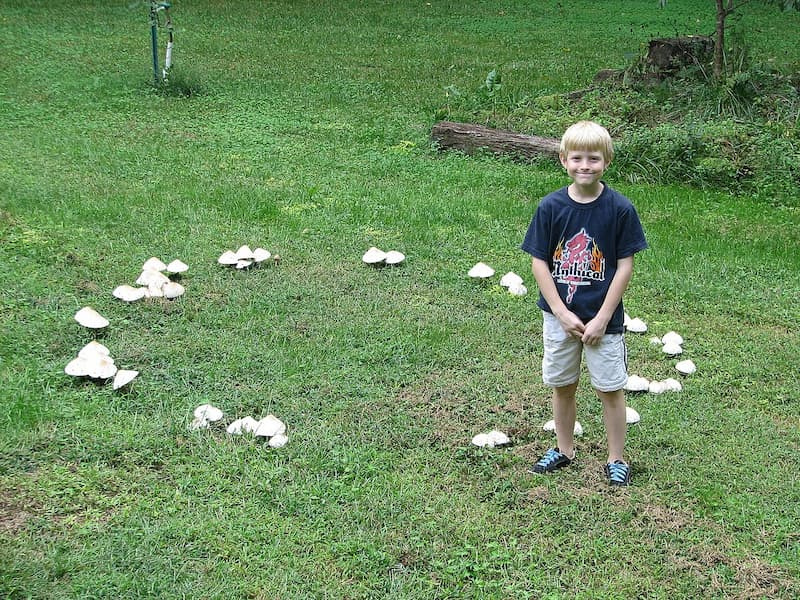
How Big They Get: Rings widen outward every year and can grow from a few feet to many feet across.
“Fairy Ring” by David Gough is licensed under CC BY 2.5.
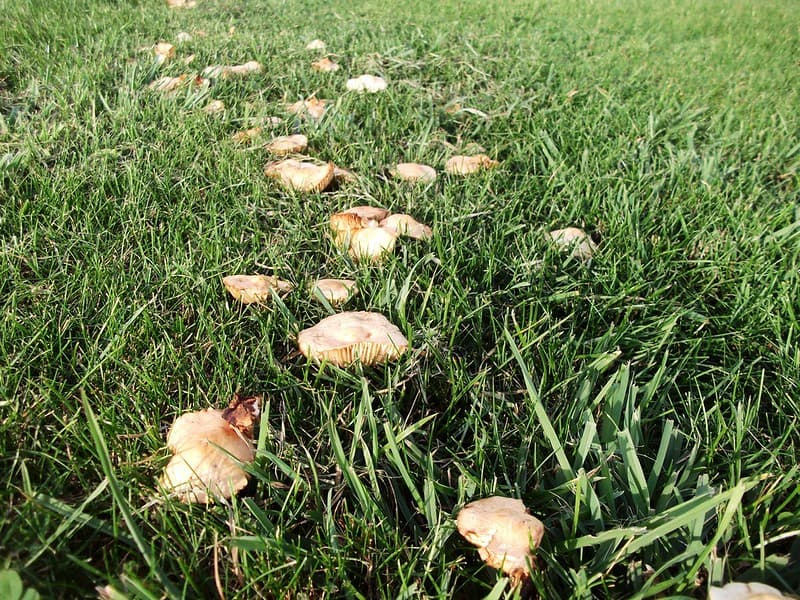
Diagnostic Feature: Mushrooms push up through the grass along the ring’s edge after rain, then fade within a few days.
“Fairy ring” by Elsie esq. is licensed under CC BY 2.0.
Could It Be Something Else?
Common Lookalikes
Necrotic Ring Spot makes the same kind of ring: dead grass around a living green center, mostly in Kentucky Bluegrass lawns. The difference is underground. Necrotic ring spot rots the roots dark brown to black, while fairy ring leaves the roots intact and coats the soil with a white mat.
Large Patch forms rings and arcs several feet across in Zoysiagrass and St. Augustinegrass during cool, wet spring and fall weather, often with a yellow-orange edge. Its leaves rot at the base and pull away easily, which fairy ring never causes.
Dog spots look like tiny fairy rings: a circle of dead grass with a dark green ring around it, where urine burned the center and fertilized the edge. Dog spots appear suddenly where a dog goes, stay small, and have no white mat or mushrooms. A fairy ring grows a little wider every year.
Field Checks Before You Treat
- Dig at the edge. Cut a slice of turf 4 to 6 inches deep across the line where the ring meets normal grass, and pull the thatch apart. A white, cottony mat in the thatch and top inches of soil means fairy ring. No mat points to another cause.
- Feel the soil. Compare the soil under the dead grass with the soil under healthy grass a foot away. Bone-dry soil under the ring and moist soil just outside it, even after rain or watering, means the fungus has made the soil water-repellent.
- Drip water on the slice. Put a few drops of water on the thatch and soil from the ring. Drops that bead up and sit there instead of soaking in confirm water-repellent soil.
- Pull a few plants. Tug on grass in the browning band and look at the roots. White, intact roots mean the grass is dying of thirst (fairy ring). Dark brown or black rotted roots point to necrotic ring spot. Leaves that slip off a rotted, dark base point to large patch.
- Watch after rain. Check the ring a day or two after a soaking rain. Mushrooms or puffballs lined up along the same arc confirm fairy ring.
Grasses at Risk
Which Grasses Suffer Most
Every lawn grass can get fairy ring, because the fungus feeds on the soil, not the grass. No grass or cultivar is resistant, and NTEP doesn’t rate grasses for it. What changes the risk is the lawn, not the species: heavy thatch, buried wood and dry, sandy soil matter far more than grass type. Grass type does decide how a dead ring heals. Creeping grasses like Bermudagrass, Zoysiagrass, St. Augustinegrass and Kentucky Bluegrass grow back into the bare band on their own. Bunch grasses like Tall Fescue and Perennial Ryegrass can’t spread sideways and usually need reseeding.
Why It Shows Up
Conditions That Trigger It
Fairy ring starts with food in the soil, not with weather. The fungi live on dead organic matter, such as buried stumps, old tree roots, scrap lumber left from construction, and thick thatch. Lawns built on cleared woodland or over construction debris are the classic setting. Underground growth becomes active in late spring or early summer, when soil temperature rises above 70°F. What you see then depends on moisture:
- Dry spells and heat. Dead rings show up in hot, dry summer weather, because the fungal mat makes the soil shed water and the grass above it runs out of moisture first. On windy, low-humidity days the edge of a ring can brown quickly, and once that soil dries it is hard to wet again.
- Heavy rain or wet soil. Mushroom rings appear after extended wet weather, heavy or frequent rain, poor drainage or overwatering, especially in warm, wet fall weather.
- Low fertility. Green rings stand out most in lawns short on nitrogen or iron. The fungus releases nitrogen as it breaks down organic matter, so the grass above it grows darker and faster than the hungry grass around it.
- Thick thatch. Thatch over 1/2 inch thick is extra food for the fungus and a place for its mat to spread.
- Too little water. Lawns that are underwatered or drought-stressed show far more dead grass than well-watered lawns with the same ring.
How It Survives and Spreads
A fairy ring starts at one point, usually a spore that landed near a buried food source, and grows outward in every direction through the soil. As the fungus uses up the food in the middle, the center dies out and only the expanding outer edge stays active, which is why you see a ring instead of a solid patch. Rings get wider every year, from under a foot at first to many feet across. Where two rings meet, or where the ring hits a sidewalk, a driveway or a change in soil, it stops and breaks into arcs. On a slope, the downhill side is usually open.
The fungus survives winter underground and comes back in the same place every year. Mushrooms release spores into the wind, so new rings can start anywhere there’s buried organic matter. Core aerators can carry infested soil, so wash coring tools before moving to healthy turf. A ring lasts until its food runs out, which can take up to five years. A large buried tree root can keep one going for more than ten.
Where It Hits Hardest: Regional Notes
Fairy ring occurs in lawns across the whole US, because the fungi live in almost any soil with organic matter in it. It’s worst in new lawns built over buried stumps, roots or construction debris, in heavily thatched lawns, and on sandy soils that dry out fast. In the North and the Transition Zone, mushrooms flush mostly in warm, wet fall weather, and dead rings appear in July and August dry spells. In Florida and the Gulf South, mushrooms come mostly in the summer rainy season, and rings stay active most of the year in St. Augustinegrass, Bermudagrass and Bahiagrass lawns.
Fairy Ring Diagnostic Profile
Check what you see against the full set of signs. The more that match, the more likely this is your problem.
What You’ll See
Symptom Color
Tan or Straw
Brown
Visible Signs
Cottony White Webbing
Mushrooms or Puffballs
Lawn Pattern
Circular Patches
Rings or Frog-Eyes
Patch Size
6 to 12 Inches
1 to 3 Feet
Over 3 Feet
When and Where
Weather Triggers
Warm & Humid
Wet or Poorly Drained Soil
Drought or Heat Stress
Where in the Lawn
Shade
Open, Sunny Lawn
Controlling Fairy Ring
For most home lawns, the best plan is to live with it. Green and mushroom rings are cosmetic, and they often fade on their own when the weather changes. When you want to act, match the fix to the type of ring:
- Mask green rings with light feeding. Spread a little extra nitrogen on the lawn around the rings, about 0.1 to 0.25 lb N per 1,000 sq ft, so the surrounding grass catches up to the green band. Light, repeated feedings work better than one heavy one. On cool-season lawns in summer, use iron instead, because it darkens the color without pushing heat-stressed growth.
- Punch through dead rings. Probe the ring with a trowel or long screwdriver to find how deep the white mat goes. Then core-aerate or probe slightly deeper than the mat, starting 2 feet outside the ring and working inward, so water has a path past the water-repellent layer. If the mat is more than about 3 inches thick, an aerator won’t reach it, so use a soil probe, a small auger or a shovel.
- Soak, slowly, and only the ring. After opening the soil, water the ring until it’s thoroughly wet, over several hours and repeated over several days. A soil wetting agent applied first helps water stick to the coated soil. A root-feeder attachment on a hose can push water deep into the ring. Hand-water the ring so you don’t overwater the healthy lawn.
- Cut the thatch. Dethatch when thatch is more than 1/2 inch thick, because thick thatch is food and shelter for the fungus.
- Remove the food when you can. Before seeding or sodding a new lawn, dig out stumps, large roots and scrap lumber. A ring can’t outlast its food supply.
- Pick up mushrooms. Remove them with a gloved hand or a trowel, or mow them off when they first appear, and put them in the trash, not the compost. This is about safety and looks. It doesn’t hurt the fungus underground.
- Wash your tools. Rinse aerator tines and shovels before using them in healthy parts of the lawn, so you don’t move infested soil.
Fungicides are rarely worth it for fairy ring in a home lawn. The fungus lives in the thatch and soil, often inches deep and inside a water-repellent layer, so a spray on the grass seldom reaches it. University of Missouri, UW–Madison and Illinois Extension all advise against fungicides for lawn fairy ring, and UC IPM notes they haven’t been seen to control it reliably. Even where they work, they only slow the fungus. They don’t green up a dead ring or fix dry soil.
The active ingredients extension sources list for fairy ring are mostly used on golf greens, with soil injection and repeated applications:
| Active ingredient | FRAC group | Cautions |
|---|---|---|
| Azoxystrobin | 11 | Hard to find in home-lawn products |
| Pyraclostrobin | 11 | Mostly professional products |
| Flutolanil | 7 | Not readily available to homeowners |
| Metconazole | 3 | Can injure bermudagrass; some products not labeled for home lawns |
| Triticonazole | 3 | Can injure bermudagrass; check the label for residential use |
If a ring kills grass year after year, a professional can apply one of these preventively in spring, once soil temperatures stay above about 55°F. It has to be watered in right away with about 1/8 to 1/4 inch of water, after core aerating and with a wetting agent, so it reaches the soil. Spraying after a ring is already brown does little, because the problem is the dry soil, not living grass. Household products like bleach and herbicides don’t work on these fungi and will damage the lawn.
Recovery and Repair
Green rings and mushroom rings need no repair. They fade when the weather shifts or when you feed the surrounding lawn lightly. Dead rings recover only once water can get back into the soil, so aerate or probe the ring and soak it first. Seeding into water-repellent soil fails because the seedlings dry out just like the old grass did. In creeping grasses, the bare band fills in from the edges over a growing season once the soil is wet again. In tall fescue and other bunch-type lawns, reseed the band after the soil is rewetted: early fall is best for cool-season grasses, and late spring to early summer is best for plugging or sodding warm-season grasses.
Digging the ring out is the only way to remove it completely. Take out the turf and soil at least 1 foot deep and 18 inches to 2 feet beyond the outer edge, refill with fresh soil low in organic matter, and reseed or sod, without spilling the old soil onto healthy lawn. It’s a lot of work, and the ring is likely to come back if buried food remains nearby, so it’s rarely worth it in a home lawn.
When to Call a Pro
Send a sample to your county extension office or a university diagnostic lab if you can’t tell a dead ring from necrotic ring spot or large patch. Those diseases need a different plan. Cut a plug from the edge where dead grass meets healthy grass, roots and soil included, and add a photo of the whole ring. Call a lawn professional if dead rings keep spreading after a season of aerating and soaking, or if you want a fungicide program, since the products that suppress fairy ring are mostly professional-use. Never eat a lawn mushroom based on a guess or a photo: there is no simple test that tells edible species from poisonous ones.
Frequently Asked Questions
These answers are synthesized from plant pathology research and diagnostic guidance published by university extension services and plant disease clinics.
Because it grows outward from one spot. The fungus starts at a single point, often near buried wood, and spreads evenly in every direction through the soil. The middle uses up its food and dies, so only the expanding outer edge stays active. That edge is where the green band, the dead grass and the mushrooms all show up.
The fungus never left. Mushrooms are only the fruit. The main body of the fungus lives underground and survives winter. It shows up again each year a little wider, and it keeps going until its buried food is gone. That can take up to five years, or more than ten years over a large old tree root.
Yes, but it’s rarely worth it. You’d have to remove the turf and soil at least 1 foot deep and 18 inches to 2 feet beyond the outer edge, then refill with fresh soil and replant. Even then, rings often return if there’s still buried organic matter nearby. Light feeding to hide the ring is far cheaper and usually works better.
No. Herbicides don’t work on fungi, and lawn fungicides seldom reach the fungus in the soil. Killing the mushrooms wouldn’t help anyway, because they’re only the fruit of a much larger fungus underground. Pick them up with a gloved hand or mow them off, and put them in the trash.
Scientific Authority
This profile is built on plant pathology research and diagnostic guidance from university extension services and plant disease clinics. We prioritize accurate identification and cultural control first, recommending fungicides only where research shows they are justified, and naming them by active ingredient rather than brand.
Primary Resources
- UC IPM — Pest Notes: Mushrooms and Other Nuisance Fungi in Lawns
- UC IPM — Healthy Lawns: Fairy Ring
- UC IPM — Healthy Lawns: Dog Spots
- Purdue University Turfgrass Science — Turfgrass Disease Profiles: Fairy Ring (BP-113-W)
- NC State Extension — Fairy Ring in Turf
- University of Missouri Extension — Turfgrass Disease Profiles: Fairy Ring
- University of Missouri Extension — Identification and Management of Turfgrass Diseases (IPM1029): Fairy Ring
- University of Wisconsin–Madison Extension — Fairy Rings
- Penn State Extension — Fall Fungus Among Us
- Clemson Cooperative Extension HGIC — Mushrooms in Lawns
- University of Florida IFAS Extension — Fairy Rings (LH046)
- University of Illinois Extension — Managing Fairy Rings and Mushrooms
- Texas A&M AgriLife Extension — Texas Plant Disease Handbook: Fairy Rings