
Scientific Name: Portulaca oleracea
Common Purslane
The weed that regrows from what you pull
Common Purslane At-a-Glance
Weed Type
Broadleaf
Life Cycle
Summer annual
Growth Habit
Prostrate, mat-forming
Root Type
Taproot (with fibrous secondary roots)
Spreading Risk
Explosive — by seed and by stem fragment
Pull
With Caution
Identity & Diagnostics
Visual Fingerprint
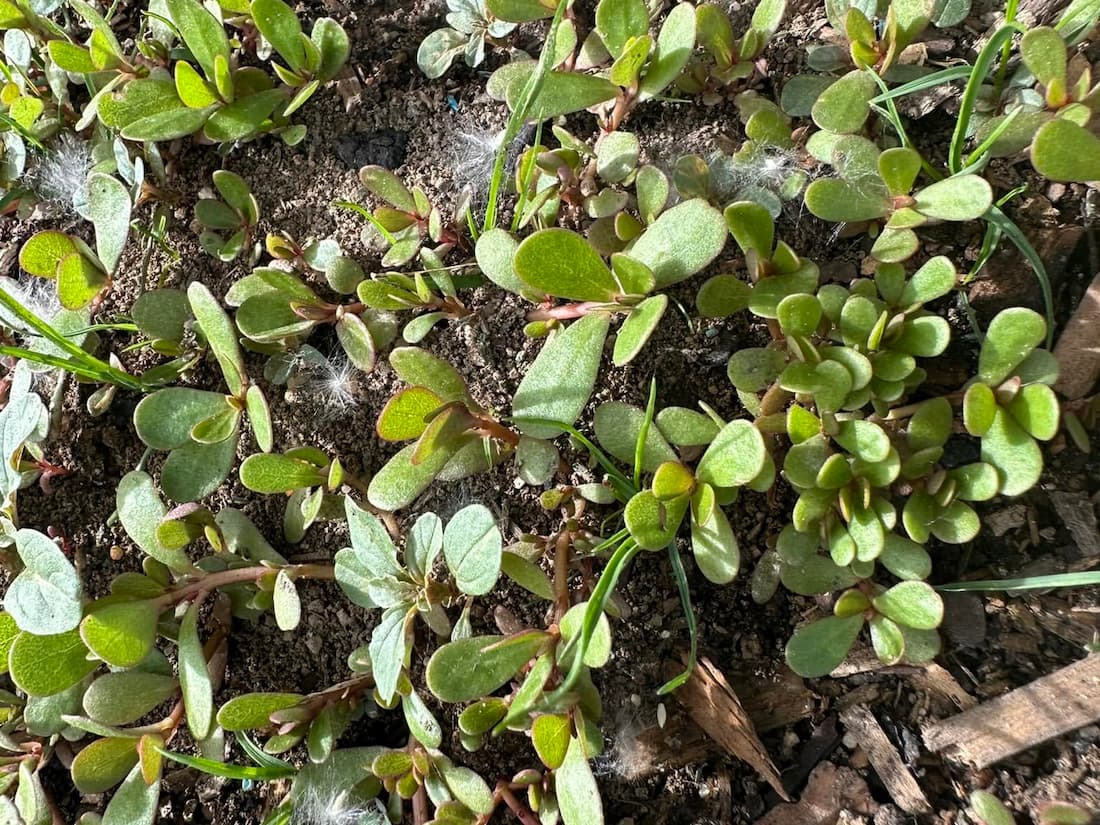
Look for a dense, ground-hugging mat of thick, glossy, jade-green leaves that looks almost succulent enough to belong in a cactus garden — because botanically, it’s built the same way. The stems are smooth, plump, and reddish to purplish where they’ve been in the sun, radiating outward from a central point like spokes on a wheel. Small, bright yellow, five-petaled flowers appear at the stem tips and leaf joints, but only on sunny mornings — if you check on a cloudy afternoon looking for the flowers, you won’t find them open.
Structural Anatomy
The stems are round in cross-section, completely hairless, and noticeably succulent — thick enough that they feel more like a houseplant stem than a typical weed. Leaves are spatulate (paddle- or wedge-shaped), smooth, shiny, and entirely stalkless, attaching directly to the stem with no leaf stem of their own. Near the base of the plant, leaves grow in an alternating pattern; toward the branch tips, they crowd into tight opposite or whorled clusters. The single most reliable confirmation test takes five seconds: snap a stem or leaf and look at the juice. Purslane bleeds a clear, watery, slightly slippery sap — never milky. If you ever see white, milky sap after breaking a stem, you’re not looking at purslane. Below ground, a single thick, branching taproot anchors the plant and is backed up by a network of fine fibrous roots, which is what lets it shrug off compacted, poor, and bone-dry soil that would stop most other weeds.
Growth Patterns & Life Stages
Seedlings come up upright before quickly flopping over into their signature flat, sprawling posture — the first true leaves are small, smooth, and egg-shaped, and each new pair emerges rotated 90 degrees from the last. Once established, growth is fast: the plant branches aggressively from its center and can spread to a 12-inch mat within weeks, with vigorous individuals reaching a full yard across. Flowering starts astonishingly early — often within four to six weeks of germination — and once the small yellow flowers are pollinated, the seed pods that follow split open like a popping lid, scattering seed directly onto the soil. That fast a turnaround means a patch you dismissed as small in early summer can be seeding itself by midsummer.
Gallery
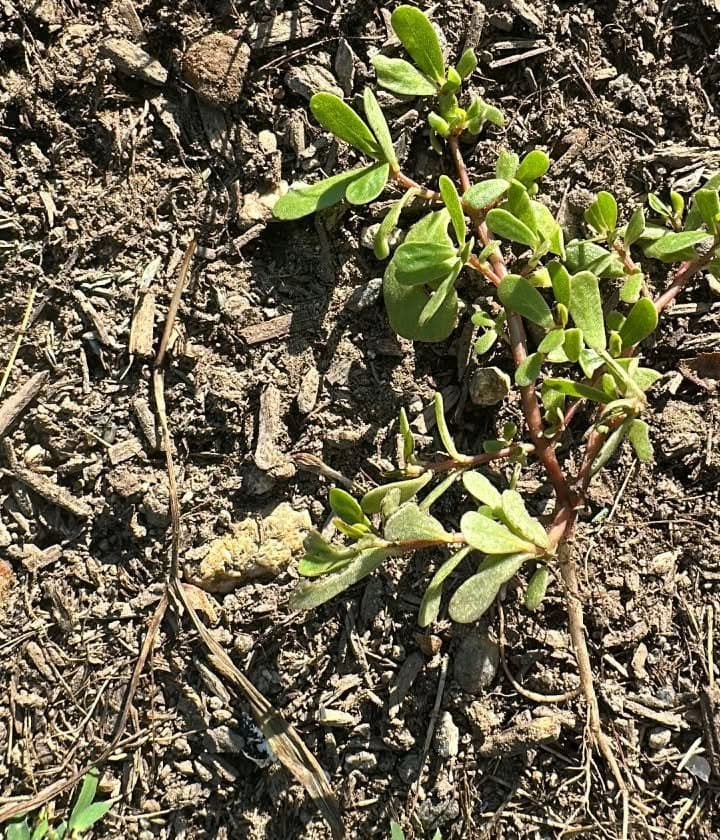
A juvenile common purslane plant beginning its prostrate branching habit in exposed soil.
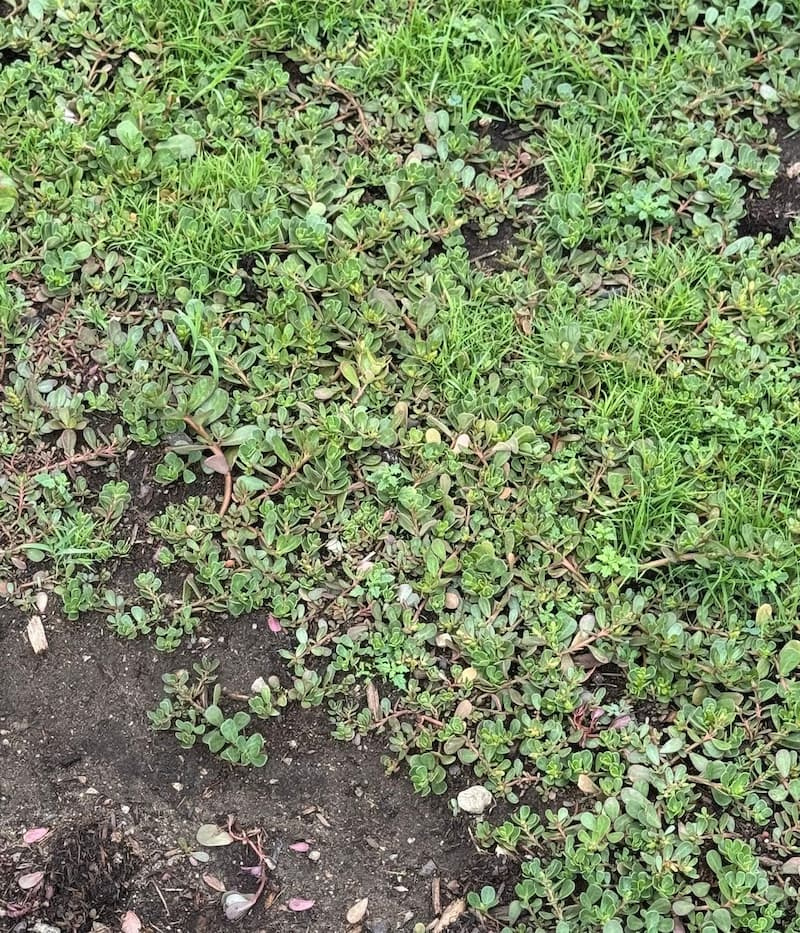
Heavy common purslane groundcover forming a thick, competitive mat over open soil and turf boundaries.
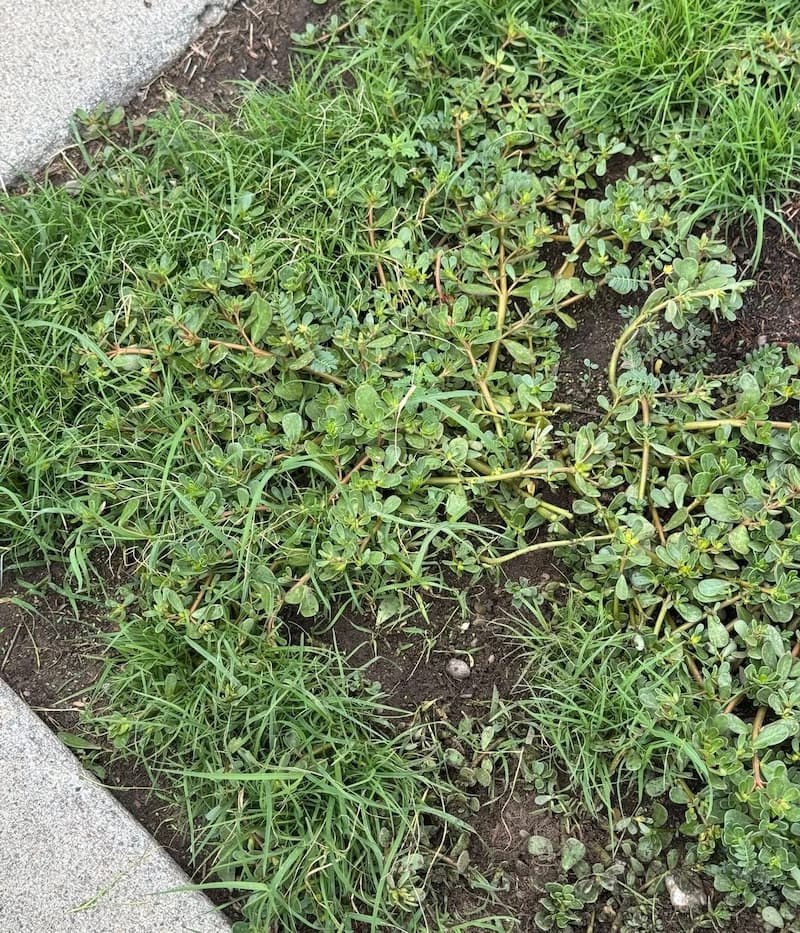
A mature common purslane mat growing along a concrete curb, showing small yellow flower buds forming in the leaf axils.
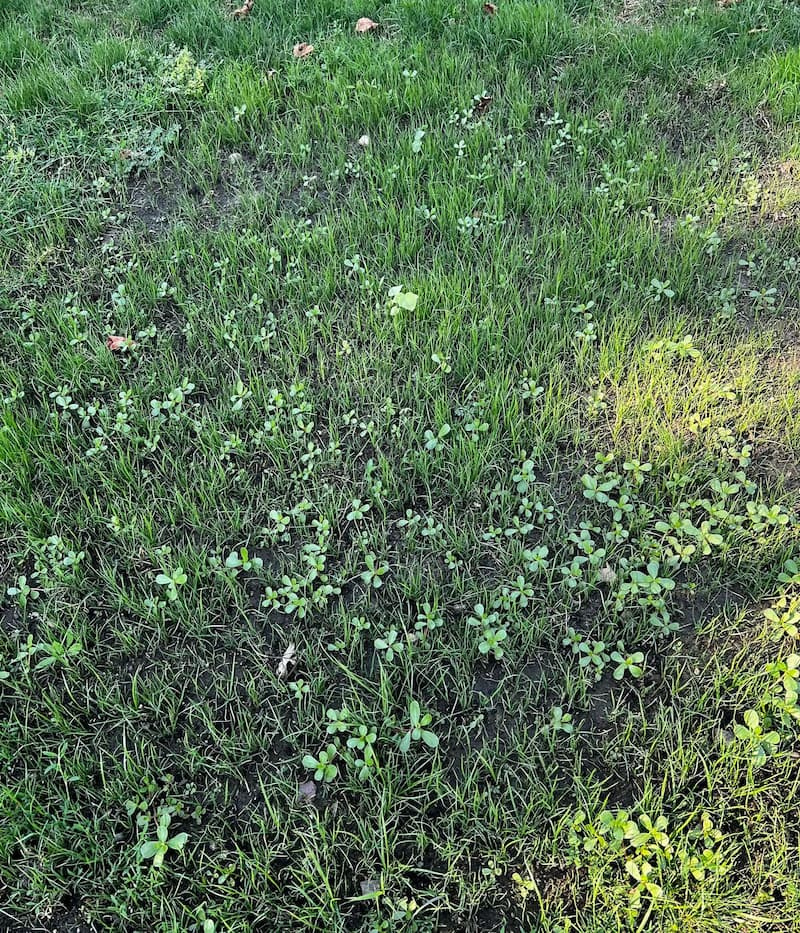
Widespread common purslane establishment taking advantage of thin, patchy turfgrass cover.
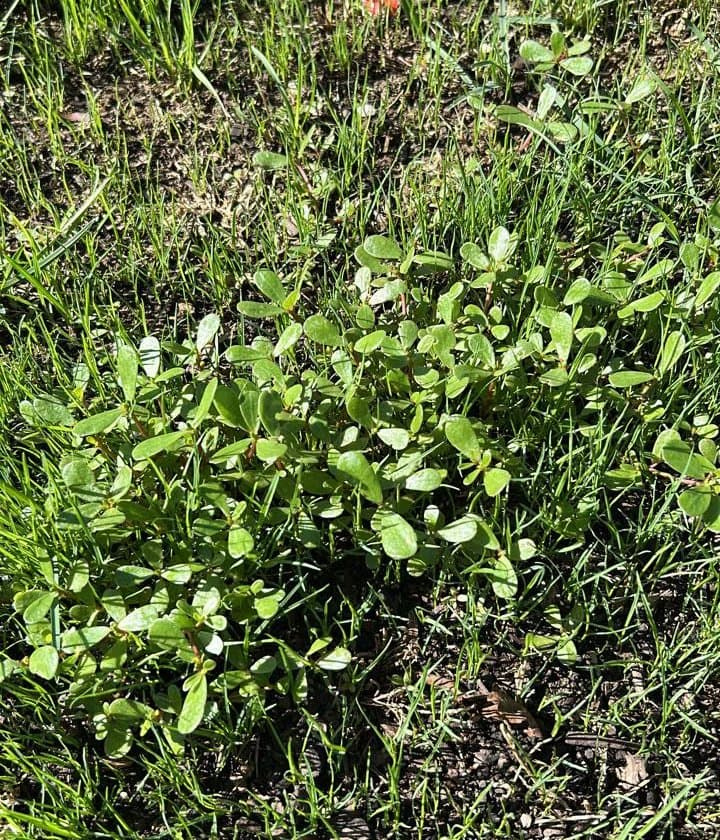
A concentrated patch of common purslane crowding out lawn grass in an active turf area.
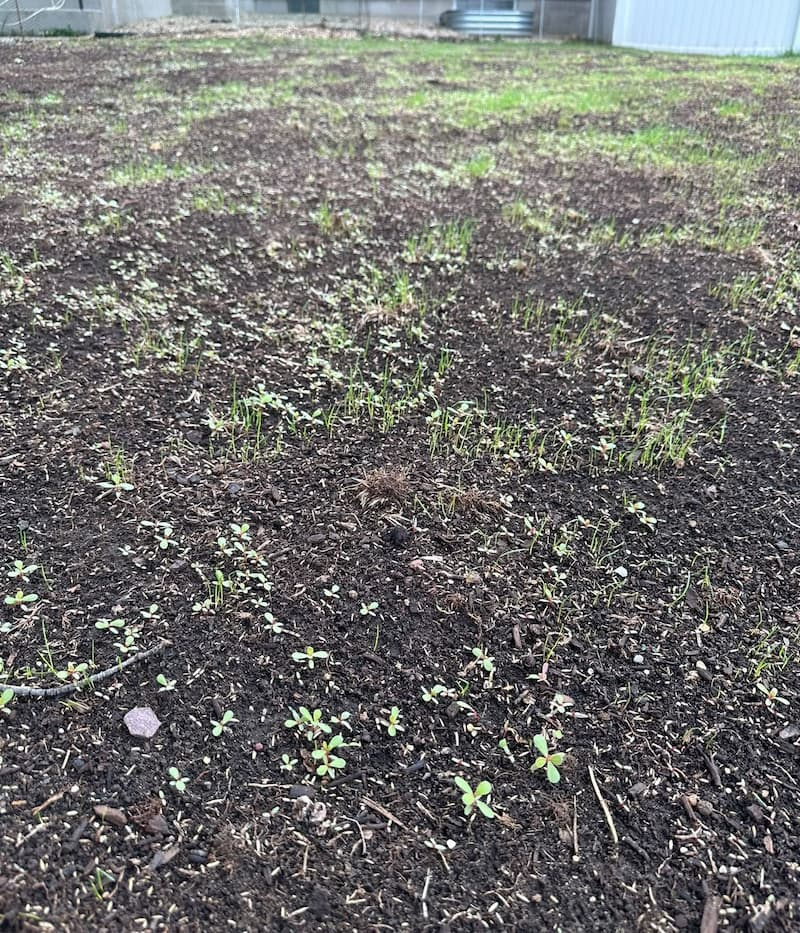
Common purslane seedlings rapidly germinating alongside newly seeded turfgrass in bare soil.
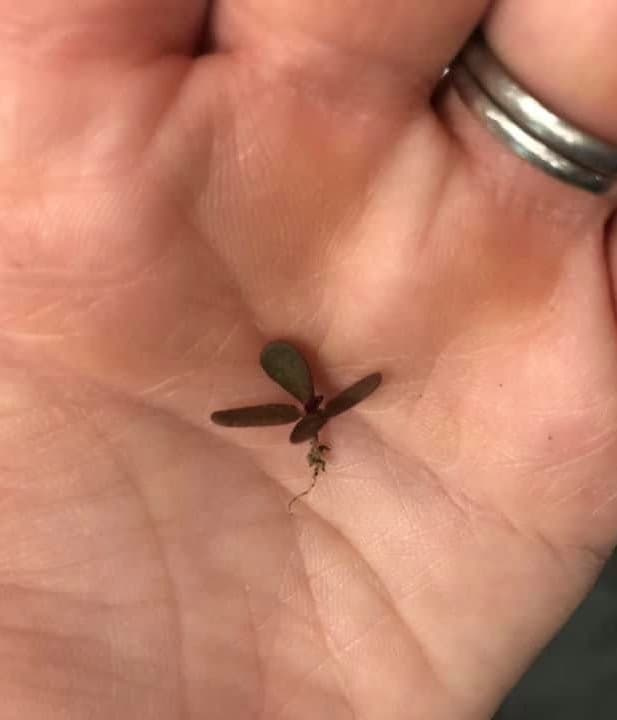
An early-stage common purslane seedling showing succulent cotyledons and delicate initial taproot formation.
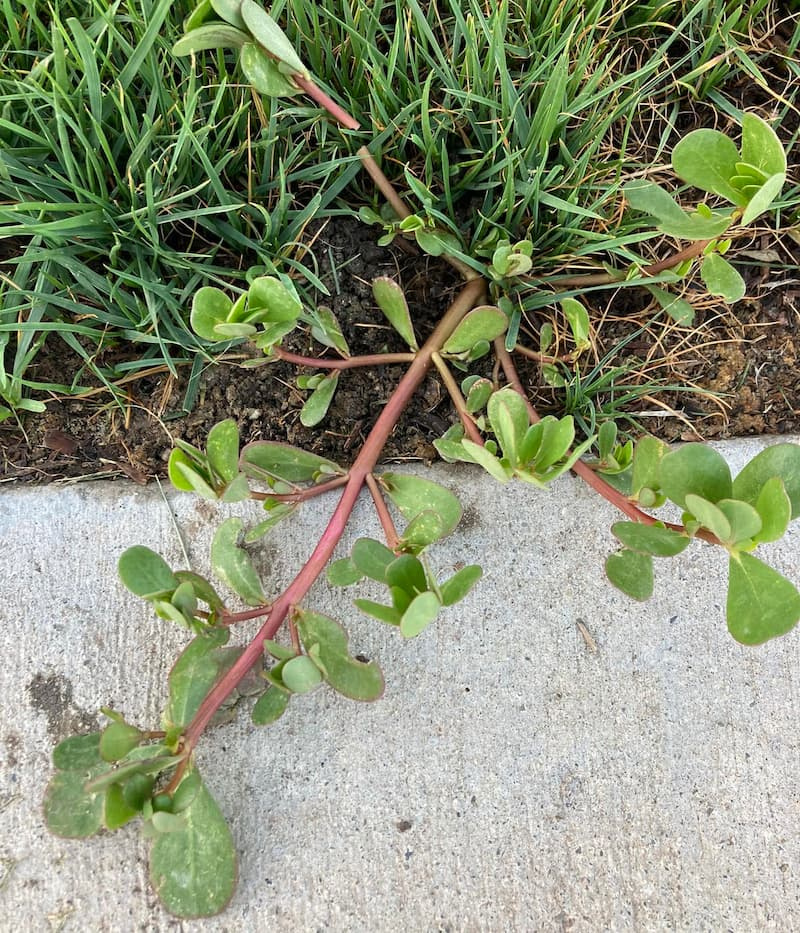
A trailing common purslane branch extending across a hardscape border, illustrating its thick, hairless stem structure.
The Identity Trap
Common Lookalikes
Spotted Spurge (Euphorbia maculata) is the look-alike that trips up the most homeowners — it forms a similarly flat, mat-like carpet in the same hot, sunny, thin-turf spots purslane prefers. Prostrate Knotweed (Polygonum aviculare) is the second common mix-up, since both plants colonize the same sidewalk cracks and compacted path edges.
Identification Differentiators: How to Tell Them Apart
Snap a stem. Spotted spurge instantly weeps sticky, white, milky sap — purslane never does. That single test resolves the confusion faster than any leaf comparison. If you want a second confirmation, spotted spurge leaves are thin, non-succulent, and often carry a small dark maroon spot in the center, nothing like purslane’s thick, glossy, spot-free leaves.
Prostrate knotweed is easier to separate once you know what to look for: its stems are wiry, tough, and completely non-succulent — nothing like purslane’s thick, water-filled stems — and each leaf joint is wrapped in a thin, papery sheath called an ochrea, a structure purslane simply doesn’t have.
Growing Conditions
Host Grasses
Purslane is opportunistic in both cool-season lawns (Kentucky bluegrass, tall fescue, perennial ryegrass) and warm-season lawns (bermudagrass, zoysiagrass, St. Augustinegrass, centipedegrass). It rarely troubles a dense, healthy stand of either — its real opening is thin turf, bare patches, and newly seeded or recently renovated areas, since it needs direct light at the soil surface to germinate and a full-density canopy simply blocks that.
Host Environment/Area
In lawns, purslane concentrates in worn, high-traffic zones — walkways, cart paths, thin edges, and any spot where the turf canopy has broken open to bare soil. It has an equally strong, arguably stronger, pull toward sidewalk cracks, driveway margins, and other paved edges, where reflected heat creates a warm microclimate it thrives in. But its real preferred habitat is cultivated ornamental beds and garden soil — loose, disturbed, nutrient-rich ground gives its taproot exactly the structure it wants, which is why beds usually see heavier pressure than the surrounding lawn.
Soil Indicators: What the Presence of This Weed Reveals About Your Yard
Purslane is one of the more reliable soil messages in the yard: its presence signals soil that’s been overfed, particularly with soluble nitrogen, phosphorus, and potassium. It’s a nitrogen-hungry plant that thrives on exactly the nutrient load that stresses many ornamentals and turfgrasses. Its sudden mass appearance after a rain or irrigation cycle also flags warm, consistently moist surface soil. One important thing it does not indicate: poor drainage or waterlogging. Unlike moss, sedges, or dollarweed, purslane’s water-storing succulent tissue means it’s just as happy in loose, well-drained, sandy soil — so don’t read a purslane patch as a compaction or drainage problem the way you would prostrate knotweed.
Lifecycle and Season
Lifecycle Category and Management Implications
Purslane is a true summer annual — it germinates from seed, completes its entire life cycle, and dies with the first hard frost, leaving no living root, rhizome, or crown behind to survive winter. That single fact is good news and bad news at once. The good news: pre-emergent herbicide is a legitimate, effective tool here, since there’s a real germination event to intercept. The bad news: this plant is a seed-production machine, with a single unchecked plant capable of dropping up to 240,000 seeds in one season, and those seeds can lie dormant in the soil for decades. Killing this year’s visible plants barely dents next year’s problem — the real fight is against the seed bank, not the plant in front of you.
Germination Trigger
Soil temperature has to hold consistently at 70°F to 75°F before purslane germinates in most of the country (it can germinate at soil temperatures as high as 100°F+ in peak summer heat). Because its seeds are exceptionally small and require light exposure to break dormancy, germination happens right at the soil surface — never from any real depth. That’s also why any soil disturbance that flips buried seed up to the light — aerating, tilling, even dethatching — can trigger a fresh germination flush regardless of season.
In cool-season lawns, purslane is a late-arriving summer annual — seedlings start showing up in May and keep germinating in flushes into August, well after the early-spring crabgrass window has closed. That timing gap matters for pre-emergent planning: if you only treated for crabgrass in early spring, that chemical barrier is often degrading right around the time purslane’s germination window opens in late spring and early summer, so a second, purslane-timed application is usually necessary rather than optional. Post-emergent control is most effective on young seedlings; once plants sprawl and thicken, standard rates lose their punch.
In warm-season lawns, the germination window opens earlier in the calendar — typically late February through mid-March — but the underlying soil-temperature trigger hasn’t actually changed; the ground there just warms up sooner. Because a single pre-emergent application only holds for 6 to 12 weeks and warm-season purslane pressure runs from spring through November, one round of pre-emergent is rarely enough — extension programs recommend a second sequential application roughly 60 days after the first to cover the full season. Post-emergent applications need to wait until the lawn has fully greened up and been mowed at least three times; applying broadleaf chemistry into spring transition risks real turf injury.
The transition zone carries the most complications of any region for this weed. Purslane’s germination threshold sits above crabgrass’s, so an early pre-emergent timed for crabgrass frequently degrades before purslane’s window even opens — a split or sequential application is the norm here, not the exception. Fall overseeding adds a second wrinkle: since pre-emergent chemistry can’t distinguish weed seed from turf seed, extension guidance calls for cutting off pre-emergent applications by July 1 so the barrier has fully broken down before September seeding — which leaves a real vulnerability window through the peak of purslane’s July–August germination flush, one that has to be covered by post-emergent spot treatment instead. On top of that, transition zone lawns often mix cool-season and warm-season turf, and several of the most effective warm-season herbicides (atrazine, simazine) will kill cool-season grass outright, while a cool-season staple like mesotrione is highly toxic to warm-season turf — so product choice has to match the actual grass on the ground, not just the weed.
Herbicide Control
Pre-emergent is a solid option here since purslane has no perennial structure to dodge it — the whole strategy is timing the barrier to the germination window described under Germination Trigger rather than the earlier crabgrass window most homeowners default to.
Cool-season lawns: isoxaben, dithiopyr, pendimethalin, and prodiamine are all labeled and effective on established turf, applied in late spring to early summer ahead of purslane’s germination window. None of these are safe on newly seeded turf until it’s been mowed at least three times.
Warm-season lawns: dithiopyr + isoxaben, isoxaben alone, simazine, and prodiamine + sulfentrazone are all labeled across bermudagrass, zoysiagrass, St. Augustinegrass, and centipedegrass (prodiamine + sulfentrazone is the one exception — don’t use it on St. Augustinegrass). Atrazine is an option, but only on St. Augustinegrass, centipedegrass, zoysiagrass, or dormant bermudagrass, and never during spring green-up.
Whatever the product, it needs 0.25 to 0.5 inches of irrigation or rainfall shortly after application to activate — a dry pre-emergent application is a pre-emergent application that’s quietly failing.
The single biggest factor in success is hitting purslane while it’s still young and actively growing — its thick, waxy cuticle gets tougher as the plant matures, and a mature sprawling mat can shrug off rates that would have killed the same plant as a seedling.
Cool-season lawns: triclopyr + fluroxypyr gives strong systemic control on young seedlings. 2,4-D + MCPP + dicamba combinations work well too — use an ester formulation in cool spring weather for faster uptake, but switch to an amine formulation once temperatures climb past 80–85°F, since esters volatilize and can drift onto nearby ornamentals in the heat. Mesotrione is the go-to if you’ve just overseeded, since it’s one of the few options safe on new grass; it works by bleaching the weed white before it dies. Whatever you use, add a surfactant — plain water beads right off that waxy purslane cuticle without one.
Warm-season lawns: metsulfuron-methyl (alone or combined with dicamba or sulfentrazone) gives excellent control across all four major warm-season species. Atrazine works on weeds under 1.5 inches tall but is restricted to St. Augustinegrass, centipedegrass, zoysiagrass, and dormant bermudagrass. Be careful with any 2,4-D combination product — St. Augustinegrass and centipedegrass are sensitive enough to be damaged or killed outright by chemistry that bermudagrass tolerates fine.
Verdict: neither zone resolves in one season. The seed bank is the real opponent, and it takes a multi-year program — repeated pre-emergent barriers, prompt post-emergent spot treatment before seed set, and strict cleanup of anything pulled — to gradually run it down.
Mowing height is the single most useful lever you have, because purslane’s seeds need direct light to germinate — a tall, dense canopy simply denies them that. Cool-season turf should be kept at 3.0 to 3.5 inches; warm-season species have their own ranges (roughly 1–2 inches for bermudagrass and zoysiagrass, up to 2.5–3 inches for St. Augustinegrass), but the principle is the same: never scalp, never remove more than a third of the blade at once.
Nitrogen management cuts the other way from what you’d expect with most weeds — purslane is a nitrogen-hungry plant that thrives on the same fertilizer that thickens your turf, so the goal isn’t to withhold nitrogen but to time it well. Cool-season lawns should get 60–100% of their annual nitrogen in two fall applications, which builds density heading into next year’s purslane season. Warm-season lawns should concentrate nitrogen during active summer growth and avoid excess soluble, quick-release nitrogen, which purslane exploits more efficiently than the turf itself does.
Irrigation matters just as much: frequent, shallow watering keeps the surface soil constantly moist and is practically an invitation for purslane seed to germinate. Deep, infrequent watering does the opposite — it dries out that top inch of soil where seeds need moisture, while pushing turf roots deeper and more resilient. For bare or thin patches, cool-season overseeding timed to mid-August through mid-September gives new turf a head start before next year’s purslane flush; overseeding in spring or summer just hands purslane a competitive advantage over slow-establishing seedlings.
Several pre-emergents are labeled safe around established ornamentals, but the right choice depends heavily on what’s actually planted nearby. Granular formulations are consistently the safer call over liquid sprays in beds, since granules are less likely to stick to and burn foliage.
Napropamide is about as broadly safe as it gets for both woody and herbaceous ornamentals. Pendimethalin is broadly safe on herbaceous plants too, though the liquid form carries more burn risk than granular. Trifluralin is documented as one of the safest choices for herbaceous perennials and bedding plants, if a bit weaker on overall control. Oryzalin, prodiamine, isoxaben, and oxadiazon all work well but come with real sensitivity lists worth checking against what’s actually growing in the bed — oryzalin can girdle young azaleas, prodiamine damages a specific list including petunia, viola, zinnia, and sedum, isoxaben injures astilbe, echinacea, and foxglove among others, and oxadiazon is restricted to woody landscape beds because it burns herbaceous plants and spring bulbs on contact.
Application placement matters too: applied on top of mulch, these products intercept seed blown or washed in from outside; applied to bare soil before mulching, they sit right at the soil-seed interface. Either way, the barrier needs 0.25 to 0.5 inches of water shortly after application to activate.
Broadcast spraying isn’t an option once ornamentals are established — drift risk is too high. Directed, shielded spot-treatment is the standard approach: glyphosate applied through a shielded nozzle handles established purslane effectively, though mature succulent tissue often needs a higher rate than you’d use on a thinner-leaved weed. Glufosinate-ammonium and diquat dibromide work as directed contact burns but only kill what they touch — they won’t reach the root. Organic contact options (pelargonic acid, cinnamon/clove oil blends, orange oil, strong vinegar) are genuinely effective on small emerging seedlings but only scorch foliage on anything more established. Bentazon can be used as a directed spray around specific labeled woody ornamentals and groundcovers, but skip the crop oil booster in hot, humid weather — that combination burns foliage on plants that would otherwise tolerate the herbicide fine. (Buying tip: not every product labeled “Roundup” is glyphosate anymore — check the active-ingredient panel.)
Timing is unusually tight in beds: because purslane goes from seedling to seed-dropping mature plant in as little as three to six weeks, extension guidance is to physically remove or treat within one to two weeks of first spotting it. Wait past flowering, and the act of pulling ruptures the seed pods and reseeds the very spot you’re weeding.
Verdict: same story as lawn — this isn’t a one-and-done weed in beds either. The seed bank persists regardless of which environment it’s sitting in; beds just make physical removal a bit cleaner if you stay on top of it early and often.
Purslane is exactly the kind of shallow-germinating annual mulch was made to stop — its seeds are tiny, carry almost no energy reserve, and need direct light to break dormancy, so a solid mulch layer denies them both. Coarse mulches (bark nuggets, double-ground hardwood) work best at 3 to 4 inches; finer materials (composted bark, leaf mold) should stay to 2 to 3 inches to avoid suffocating ornamental roots; grass clippings and shredded leaves need to stay under 2 inches or they mat into a water-repelling crust. The one failure point worth watching for: fine, decomposing mulch that stays consistently damp can actually let purslane seed germinate right in the mulch layer itself, bypassing the soil barrier entirely — so thin, shifted, or soggy patches of mulch need topping off promptly.
Herbicide Application Reference
Ester formulations of 2,4-D and similar phenoxy herbicides volatilize above 80–85°F — restrict them to cool spring applications and switch to amine formulations for anything applied in summer heat, especially near ornamental beds where drift can cause real damage. In the transition zone specifically, keep atrazine and simazine strictly off cool-season turf (they’re lethal to it) and keep mesotrione strictly off warm-season turf (same result, reversed). St. Augustinegrass and centipedegrass are notably more sensitive than bermudagrass or zoysiagrass to several combination products, including standard 2,4-D mixes — check the label against your specific turf species before spraying, not just the weed you’re targeting.
A product note that is easy to miss: the consumer “Roundup” brand no longer reliably means glyphosate. Several reformulated versions now use different active ingredients, and some of them — imazapic is one — stay active in the soil, where nearby ornamental roots can take them up. That is the exact problem glyphosate is chosen to avoid here. Before you buy, read the active-ingredient panel and pick a product whose only active ingredient is glyphosate.
Herbicide Application Guide
New to spraying, or want to get it right? Our Herbicide Application Guide covers the practical steps this page assumes — mixing, calibration, protective gear, and the wind and temperature limits that decide whether a treatment works or drifts. Read it before you spray.
See Guide
Where Two Lawns Meet
Does your lawn border a neighbor’s — or meet a different type of grass? Spraying near that line can quietly damage the yard next door, sometimes weeks later. Where Two Lawns Meet shows you how to treat safely without harming either side.
Read ArticlePulling
Pulling purslane works, but only if you do it exactly right — done carelessly, it's one of the few weeds where pulling can make your problem worse instead of better.
The Biological Reason
Purslane’s stems are over 90% water, which makes them wonderfully easy to snap out of the ground — and that’s exactly the problem. Any stem fragment that breaks off with even a single node attached can grow a whole new root system the moment it touches moist soil, often within days. Because the tissue is so succulent, a severed piece doesn’t dry out and die the way most weed clippings would; it can sit on the surface for days, alive and viable, waiting for the next watering or rain shower to root in place. And a plant that’s been pulled but not removed doesn’t stop developing — its seed capsules will keep ripening and popping open even while the roots sit exposed in the sun, so a “dead” pulled plant left on the lawn can still seed the area it was pulled from.
The technique that actually works: pull when the soil is moist (not soaked), so the whole taproot slides out intact instead of snapping at the surface. Then — this is the step that matters most — bag every piece, root and fragment alike, and get it off the property immediately. Never leave pulled purslane lying on the lawn or in a backyard compost pile; ordinary compost piles rarely get hot enough (140°F–170°F) to kill either the seeds or the stem tissue, so tossing it in the bin just relocates the infestation to wherever you spread that compost later.
Lawn vs. Bed Pulling Difference
Loose, cultivated bed soil actually makes a clean pull easier than compacted turf does — the taproot comes out whole more often. But that same loose soil is a double-edged sword: it’s also exactly the kind of soil purslane prefers to begin with, so beds tend to carry heavier pressure than lawns in the first place, and any hoeing or tilling during bed maintenance risks scattering fragments across freshly loosened, easy-to-root ground.
Quick Reference Summary
| Lifecycle Category | Summer annual |
| Active Zone(s) | Cool-season, warm-season, and transition zone lawns; equally or more common in ornamental beds |
| Germination Trigger | Soil temp 70–75°F, sustained; germinates right at the surface (light-triggered) |
| Pre-Emergent | Yes |
| Post-Emergent Timing Window | Young, actively growing seedlings — control drops sharply once mats mature |
| Pull | With Caution |
| Lawn Primary Tool | Pre-emergent timed past the crabgrass window, plus post-emergent on young growth |
| Bed Primary Tool | Mulch (3–4″) + labeled pre-emergent, with prompt hand removal or shielded spot-treatment |
| One-and-Done or Multi-Season | Multi-season, in both lawn and bed |
Frequently Asked Questions
These answers are synthesized from botanical morphology studies and herbicide efficacy trials conducted by leading university agricultural extensions.
Two reasons, both biological. Any stem fragment with a node can re-root within days if it touches moist soil, and a pulled plant left lying on the ground keeps ripening its seed pods even with the root exposed. Bag everything, immediately, and you remove both problems at once.
No — it’s actually edible, and university extension sources note it’s notably high in vitamin A, vitamin E, and omega-3 fatty acids. That doesn’t change the control approach, but it does mean an accidental nibble by a curious kid or dog isn’t a poisoning concern the way some other weeds are.
Keeping your mower height up helps prevent it from establishing in the first place, since a dense canopy blocks the light its seeds need. But running a mower over an already-established patch can chop stems into node-bearing fragments and scatter them — so mowing height is prevention, not a treatment for a patch that’s already there.
It depends entirely on the herbicide. Mesotrione is one of the few post-emergents labeled safe for use on newly seeded cool-season turf. Most 2,4-D combination products are not — check the specific product label for a required waiting period before seeding.
Usually one of two things: the mulch has thinned or shifted somewhere, opening a gap to light, or the mulch itself is fine-textured and staying damp enough that seed is germinating right in the mulch layer rather than the soil beneath it. Either way, topping off thin spots promptly closes the opening.
Scientific Authority
This profile is constructed using forensic botanical data and Integrated Pest Management (IPM) research. We prioritize scientifically-vetted identification and control methods that protect the broader ecosystem while ensuring successful eradication based on peer-reviewed agricultural studies.
Primary Resources
- Penn State Extension. Lawn and Turfgrass Weeds: Common Purslane (Portulaca oleracea L.) — extension.psu.edu
- Penn State Extension. Purslane — extension.psu.edu
- Penn State Extension. Amines or Esters; Which Should You Use? — extension.psu.edu
- Michigan State University Extension. Common Purslane — Turf — canr.msu.edu
- Michigan State University Extension. Common purslane, weed it or reap? — canr.msu.edu
- UC Statewide IPM Program. Common Purslane — ipm.ucanr.edu
- UC Weed Science. Common purslane: weed it and eat it — ucanr.edu
- UF/IFAS Ask IFAS. Biology and Control of Horse Purslane and Common Purslane in Sugarcane — ask.ifas.ufl.edu
- UF/IFAS Ask IFAS. Biology and Management of Common Purslane in Fruiting Vegetables, Cucurbits, and Strawberries — ask.ifas.ufl.edu
- UF/IFAS Everglades Research and Education Center. Common Purslane — erec.ifas.ufl.edu
- NC State Extension. Portulaca oleracea — Plant Toolbox — plants.ces.ncsu.edu
- LSU AgCenter. Common Purslane: Louisiana Home Lawn Series — lsuagcenter.com
- LSU AgCenter. LAWN AND TURF WEED MANAGEMENT — lsuagcenter.com
- Clemson HGIC. Managing Weeds in Warm Season Lawns — hgic.clemson.edu
- Clemson HGIC. Controlling Weeds by Cultivating & Mulching — hgic.clemson.edu
- Clemson HGIC. Controlling Weeds in Landscaped Beds Without Glyphosate — hgic.clemson.edu
- Purdue Turf. Common Purslane — turf.purdue.edu
- University of Illinois Extension. Common Purslane — Blessing or Bane? — hyg.ipm.illinois.edu
- University of Wisconsin. Turfgrass weed resources — hort.extension.wisc.edu
- Washington State University Hortsense. Weeds: Purslane, common — hortsense.cahnrs.wsu.edu
- NC State TurfFiles. When to Apply Preemergent Herbicides for Turfgrasses — turffiles.ncsu.edu
- NC State TurfFiles. Effect of Waterlogged Soil on Preemergence Herbicides in Turfgrass Systems — turffiles.ncsu.edu
- Oklahoma State University Extension. Consumer Broadleaf Weed Control For Lawns in Oklahoma — extension.okstate.edu
- Kansas State Research and Extension. MF2385 Weed Control in Home Lawns — bookstore.ksre.ksu.edu
- University of Missouri Extension. Managing Lawns and Turfgrass — extension.missouri.edu
- West Virginia University Extension. Common Purslane — extension.wvu.edu
- Virginia Cooperative Extension. Part XIII. Weeds and Weed Management — pubs.ext.vt.edu
- University of Georgia Extension. Turfgrass Pest Control Recommendations for Professionals — fieldreport.caes.uga.edu
- Colorado State University Extension. Purslane One-Pager — growgive.extension.colostate.edu
- University of Nebraska–Lincoln. Biology and Control of Common Purslane (Portulaca oleracea L.), Christopher A. Proctor — digitalcommons.unl.edu
- Weed Science Society of America. Edible Weeds — wssa.net