
Scientific Name: Digitaria sanguinalis (Large), Digitaria ischaemum (Smooth)
Crabgrass (Large/Smooth)
Beaten only by timing
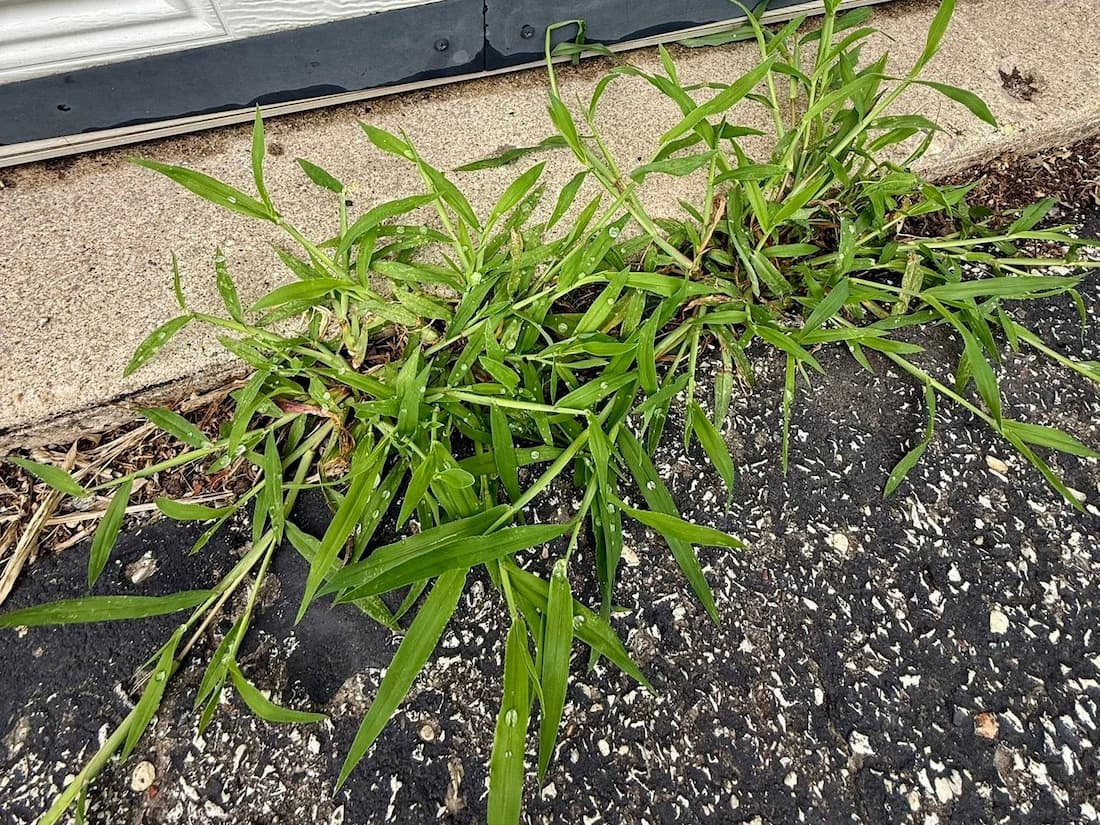
Crabgrass (Large/Smooth) At-a-Glance
Weed Type
Grass
Life Cycle
Summer annual
Growth Habit
Prostrate to ascending (a flat starburst under mowing; taller and more upright when unmown)
Root Type
Fibrous
Spreading Risk
High — by seed (one plant can shed thousands, up to 150,000 in the extreme)
Pull
With Caution
Identity & Diagnostics
Visual Fingerprint
From standing height, crabgrass reads as a pale, yellow-green patch that looks coarser and flatter than the lawn around it, usually where the turf is already thin — along a driveway, around a sprinkler head, or in a summer-scorched strip. The plant grows as a low starburst: stems radiate flat out from one central point like the spokes of a wheel, then late in summer send up slender, finger-like seedheads that split into two to several “fingers” at the top. Younger plants sit tight and flat; older ones flush red or purple at the base of the stems.
Structural Anatomy
Up close, crabgrass gives you the grass-ID basics that rule out most look-alikes: the young leaf is rolled in the bud (not folded), there are no auricles (no little claspers where the blade meets the stem), the sheath margins are open, and the flattened stems turn reddish-purple near the ground. Beyond that, the two species on this page are separated almost entirely by hairiness — and that one feature is the whole game when you’re deciding which crabgrass you have.
Grass-Specific Anatomy
| Feature | Large Crabgrass (D. sanguinalis) | Smooth Crabgrass (D. ischaemum) |
| Vernation (leaf in bud) | Rolled | Rolled |
| Auricles | Absent | Absent |
| Sheath margin | Open | Open |
| Blade & sheath hairs | Densely, obviously hairy on both leaf surfaces and the sheath | Smooth and hairless, except a few hairs right at the leaf base |
| Ligule | Membranous, jagged/toothed tip, often reddish | Membranous, blunt and wavy, not jagged |
| Collar | Indistinct, hairy edges | Distinct, a tuft of long hairs at the edge |
| Stem base | Flattened, reddish-purple | Flattened, reddish-purple |
The plain-language version: if the leaves and stems are conspicuously fuzzy, it’s large crabgrass; if they’re smooth and nearly bald, it’s smooth crabgrass. Everything else on the table is confirmation.
Growth Patterns & Life Stages
Crabgrass runs one fast generation a year and shows four stages worth knowing, because each one sets a different control decision.
The seedling is a pale, light-green blade that stands out against darker, established turf — its first true leaves sit almost at right angles to the stem, short and stubby. This is your pre-emergent-worked-or-didn’t checkpoint. The juvenile plant stays compact and upright for a while, then begins tillering (throwing side shoots) once it has four or five leaves — this is the post-emergent sweet spot, while the plant is still small and easy to kill. As it matures through early summer, the stems fan out flat into the signature starburst and the base reddens; control gets harder with every new tiller. Finally, from July into September, it throws seedheads — and the moment you see those finger-like spikes, the plant is racing to shatter seed. That’s your “too late to pull cleanly” warning flag.
Gallery
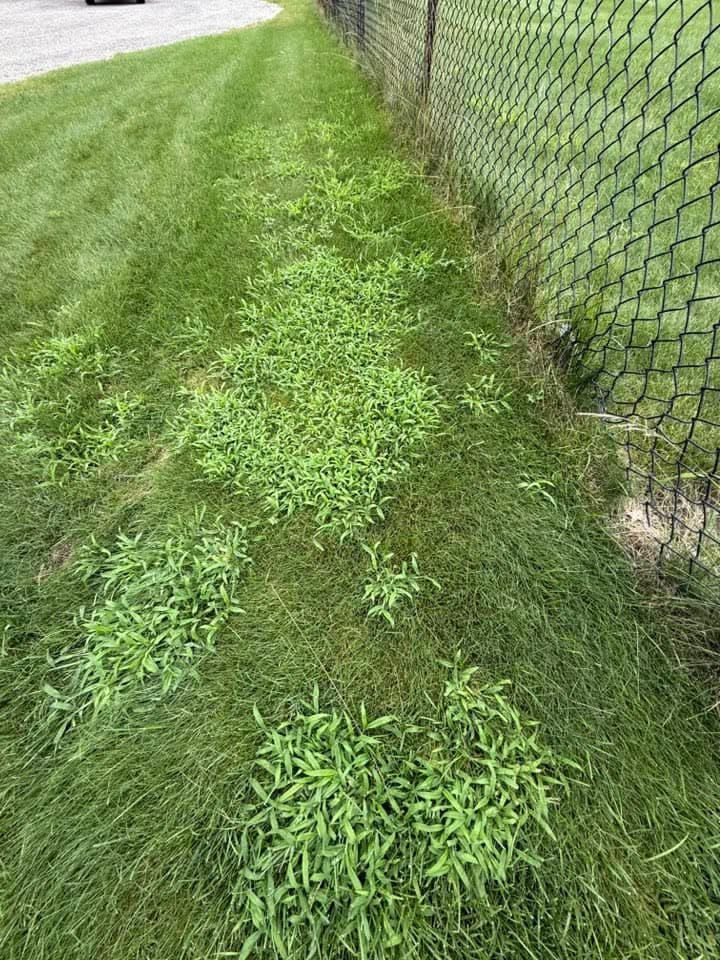
Unchecked crabgrass forming dense, sprawling mats in thin turf along a fence border.
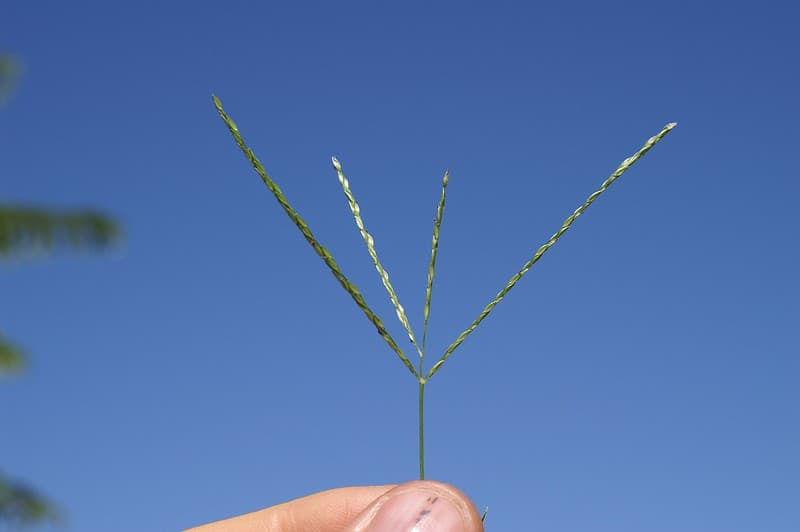
Diagnostic Feature: Left unmowed, crabgrass sends up a seedhead of slender finger-like spikes radiating from one point — the trait that gave the plant its name.
“Digitaria sanguinalis flowerhead NC3” by Macleay Grass Man is licensed under CC BY 2.0.
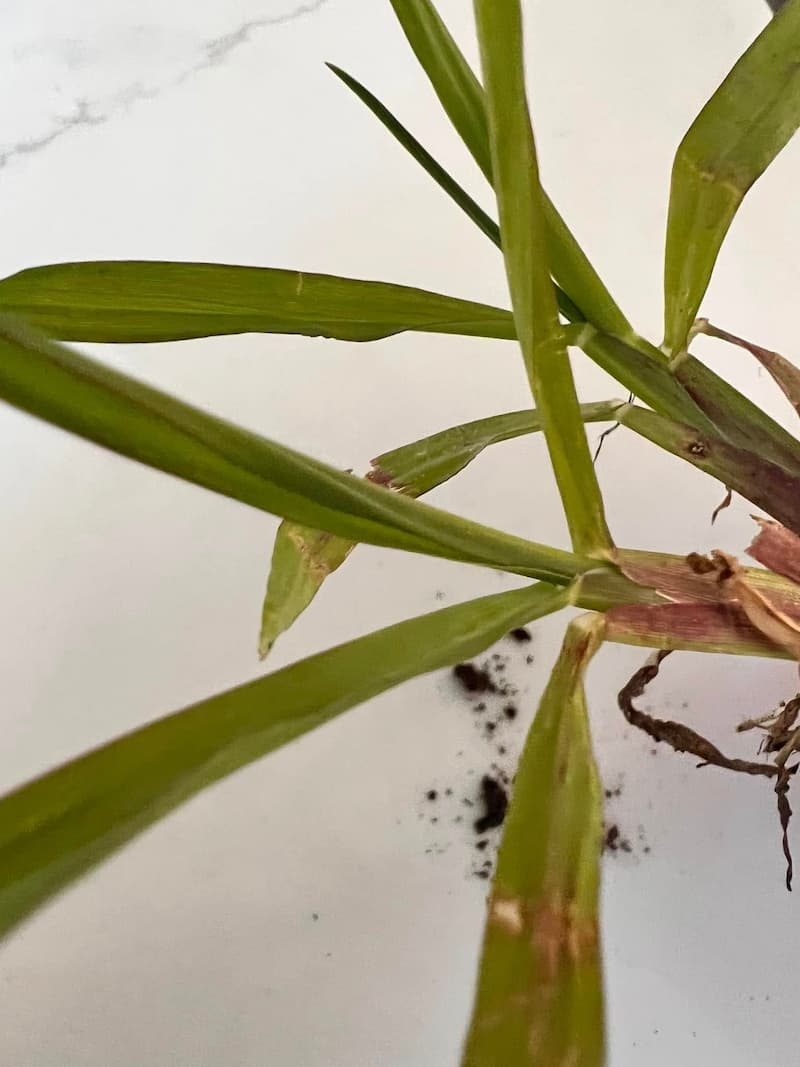
Detailed view of the leaf collar and sheath region highlighting smooth leaf margins and absence of auricles.
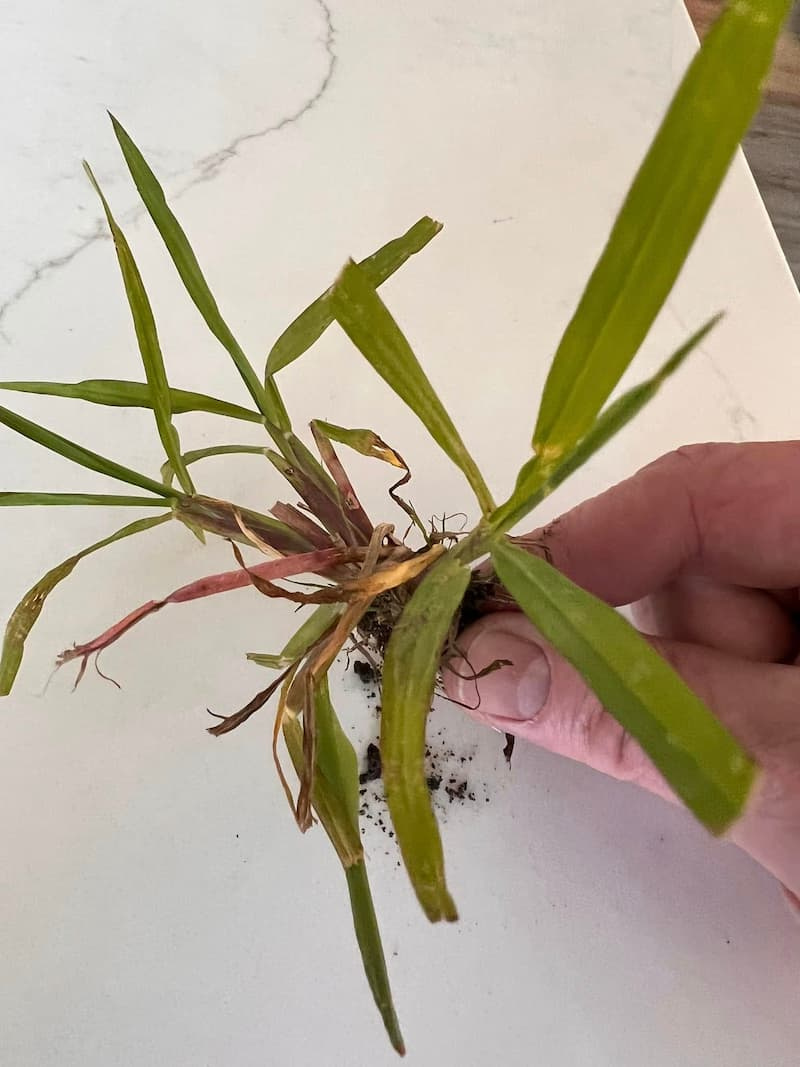
Handheld view showing wide, pale-green leaf blades and the V-shaped collar structure typical of smooth crabgrass.
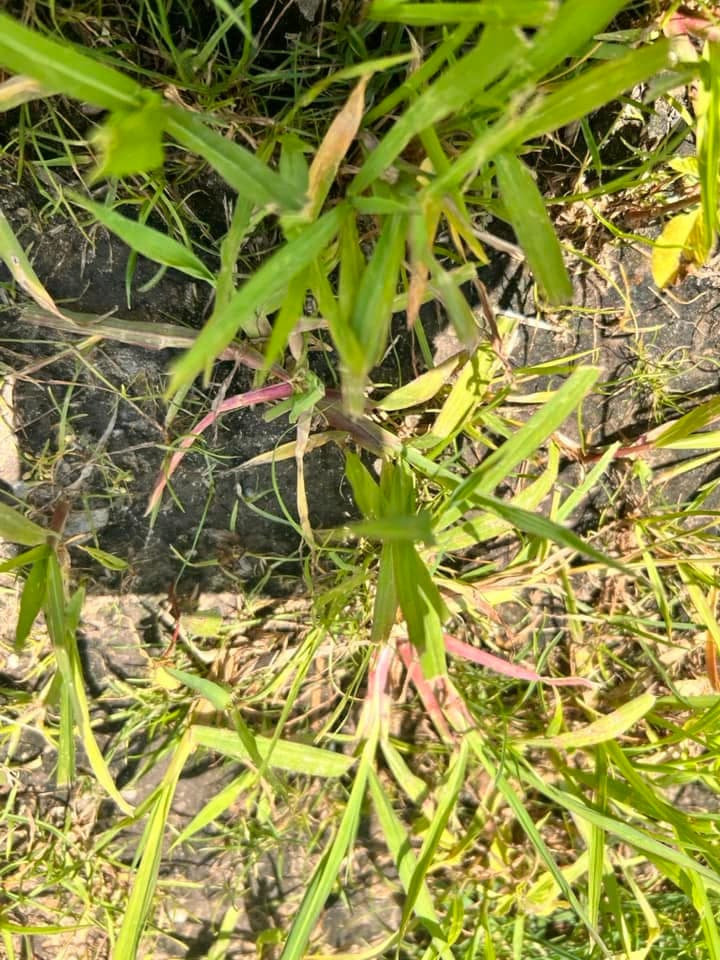
Prostrate smooth crabgrass expanding low to the ground with distinct purple-tinged lower sheaths.
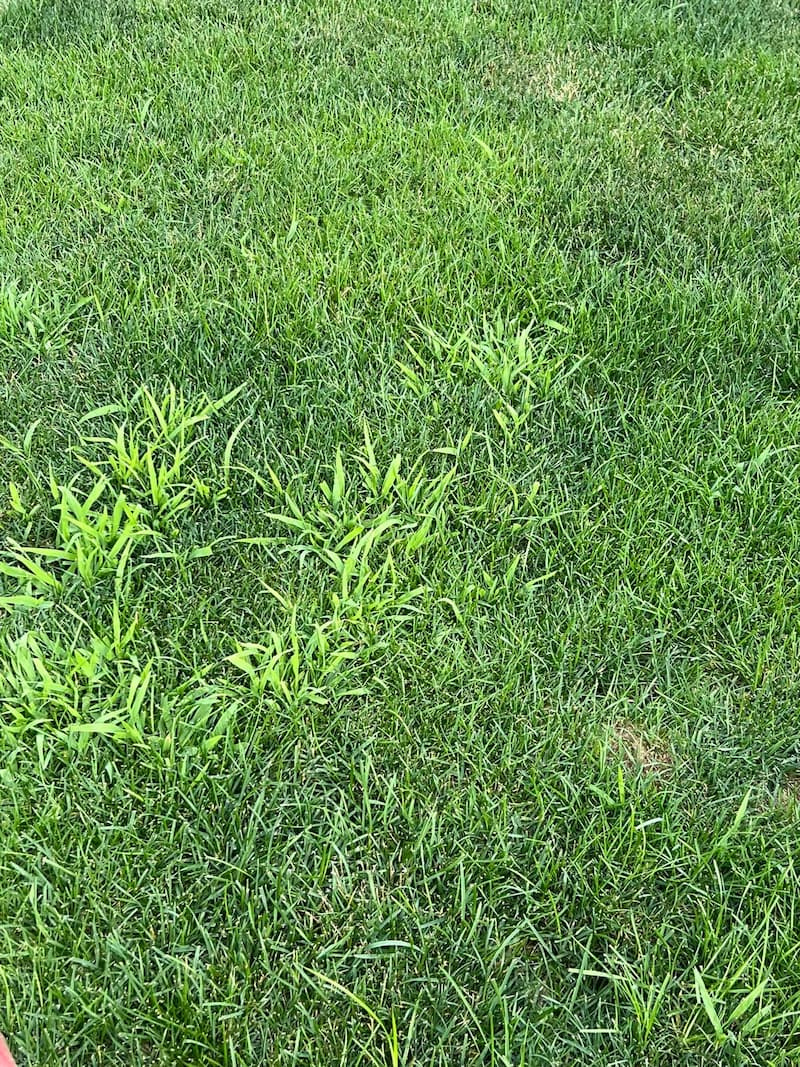
Early-stage smooth crabgrass seedlings sprouting in weak turf areas during early summer.
The Identity Trap
Common Lookalikes
The two confusions that actually cost homeowners are goosegrass, which looks so similar that people spray “crabgrass killer” on it and watch it shrug the treatment off, and telling large from smooth crabgrass apart on the same lawn, since they call for slightly different expectations about spread.
Identification Differentiators: How to Tell Them Apart
Crabgrass vs. goosegrass: look at the base and the bud. Goosegrass has a distinctive white-to-silvery, flattened crown in the center of the plant — often called “silver crabgrass” for it — and its leaves are folded in the bud, not rolled. Crabgrass has no silvery center and rolls its leaves. If your grassy-weed product “isn’t working,” this is very likely why: it’s goosegrass, which also germinates weeks later than crabgrass, so a crabgrass-timed pre-emergent has often faded before goosegrass even comes up. (See the Goosegrass page.)
Large vs. smooth crabgrass: run a thumb along a leaf and sheath. Large is fuzzy, smooth is bald. That’s the reliable field call — the hairiness gradient beats every other feature. It matters because large crabgrass is the one that roots at its stem nodes and dominates beds; smooth is the low, mowing-tough one that rules the lawn and spreads by seed.
Growing Conditions
Host Grasses
Crabgrass establishes wherever the desirable stand goes thin, but some turf is easier prey than others. Perennial ryegrass is especially vulnerable — it slows badly in summer heat and hands crabgrass the openings. Denser, more competitive stands of Kentucky bluegrass or tall fescue hold it off better, which is why overseeding to those species is a standard recommendation for a crabgrass-prone lawn. In the South, dense centipedegrass and St. Augustinegrass actually push back chemically — research shows their root and leaf compounds can suppress crabgrass germination, in one Clemson study by more than half. The common thread across all turf types: crabgrass seed needs direct light to germinate, so the density of the canopy above it decides everything.
Host Environment/Area
Crabgrass is not evenly spread across a property — it concentrates in predictable hot spots, and the two species even split up by location. Smooth crabgrass favors the mown lawn, sports fields, and manicured turf, because its low, ground-hugging habit shrugs off close mowing. Large crabgrass leans the other way, toward landscape beds, garden edges, disturbed soil, and unmown ground where it can grow upright to two or three feet. Within a lawn, both crowd into the same microhabitats: the strip along a driveway, sidewalk, or foundation (the concrete stores heat and warms that soil weeks ahead of the open lawn, triggering early germination), compacted foot-traffic paths, bare or scalped spots around sprinkler heads, and any thin edge. In beds, the tilled, unshaded margins are the first to go.
Soil Indicators: What the Presence of This Weed Reveals About Your Yard
Crabgrass is a genuinely useful diagnostic — where it dominates, it’s usually telling you three things about that spot. It signals compaction (it tolerates dense, low-oxygen soil that starves turf roots — a flag to core-aerate), low nitrogen fertility (a pale, thin lawn shot through with yellow-green crabgrass patches is a classic under-fertilization picture), and acidic soil — Penn State documents both species as indicator weeds for low pH, so a spreading crabgrass problem is a cue to soil-test and likely lime. It also shows up in dry, sandy, or shallow soils where its deep fibrous roots (large crabgrass can reach several feet down) pull moisture that shallow-rooted turf can’t. Read together, a crabgrass patch is often pointing at compacted, hungry, acidic, or droughty ground — fix that, and you’ve removed its advantage.
Lifecycle and Season
Lifecycle Category and Management Implications
Crabgrass is a summer annual: it sprouts from seed in spring, grows and sets seed through summer, and every plant dies at the first hard frost — nothing overwinters but the seed. That single fact is the good news of this whole page. Because there’s no perennial root, rhizome, or bulb to fight, a pre-emergent barrier laid down before the seed germinates is the primary, highly effective tool — you’re intercepting a germination event, not battling an established survivor. The catch is entirely about timing and about the seed bank the plant leaves behind, not about killing something that refuses to die.
Germination Trigger
Crabgrass germinates when soil temperature at the surface (roughly the top inch or two, measured as a daily mean) holds around 55°F for several consecutive days with adequate moisture — some sources put the first stirrings as low as 50°F, others near 58°F, the spread depending on measurement depth. The heavy flush comes later, once soil warms into the 60–70°F+ range, and that’s when most of the season’s seedlings arrive. Practically: forsythia in full bloom is the classic phenological signal that the window is opening.
In cool-season lawns (the northern tier — Kentucky bluegrass, tall fescue, perennial ryegrass country), crabgrass exploits the summer slump: when heat pushes C3 turf into semi-dormancy and thins the canopy, the heat-loving crabgrass moves into the gaps. Pre-emergent goes down in spring about 10–14 days before that 55°F germination point — you want the barrier built and watered in before the soil hits the threshold, because the herbicide stops germinating seed, not emerged plants. Time it to forsythia bloom before the blossoms drop. Because germination arrives in overlapping flushes from mid-spring into midsummer rather than one clean wave, a single application often fades before the late flushes stop; a split application (a second, lower dose 5–8 weeks later) is commonly needed on heavy-pressure or sandy sites. The post-emergent window opens as soon as escaped seedlings appear and stays useful only while they’re small (under about four tillers).
In the South, the calendar shifts dramatically earlier and the season runs longer. Warm-season turf (bermuda, zoysia, St. Augustine, centipede) greens up late, so in late winter and early spring there’s a wide-open window while the turf is still dormant and the soil is already warming — crabgrass pours into it. Pre-emergent timing runs from late January (South Florida, Deep South) through February into March further north; because the growing season is so long and pre-emergents break down faster in warm, moist soil, sequential applications are the rule, not the exception — extension programs document repeat intervals from about 60 to 90 days. Two warm-season cautions carry their mechanism: don’t put nitrogen “weed-and-feed” down during the dormant late-winter pre-emergent window (the turf can’t use it and it feeds emerging crabgrass instead), and don’t apply pre-emergents to turf that may have suffered winter-kill — several of these products prune the very roots the turf needs to recover.
The transition zone is the hardest of the three because both turf types struggle here and the timing conflicts stack up. Germination generally runs March into early May, earlier on south- and west-facing slopes that warm first, and rapid spring warm-ups have pushed some emergence into late February — so extension programs now advise applying pre-emergent up to two weeks earlier than the old calendar dates. Split applications 30–45 days apart are standard, and after a saturated winter the sequential dose may need to be raised (waterlogged soil breeds microbes that chew through the barrier early).
Two conflicts are unique to this zone. First, the spring seeding collision: if you need to reseed a thin cool-season lawn in spring, a normal pre-emergent will block your desirable grass seed just as effectively as it blocks crabgrass. The documented way out is a seeding-safe pre-emergent — siduron (Tupersan) or mesotrione (Tenacity) — either can go down at the time of cool-season seeding and still stop crabgrass. Critical caveat: mesotrione must never touch bermudagrass or zoysiagrass — it causes severe bleaching injury on warm-season turf. Second, the green-up injury risk: applying post-emergents (or a glyphosate winter clean-up) to warm-season turf while it’s breaking dormancy causes splotchy, delayed green-up — NC State found glyphosate on 15%-greened bermudagrass left it far behind untreated turf for weeks. Wait for full green-up, or treat the whole stand uniformly rather than spot-spraying.
Herbicide Control
Pre-emergent is the main event for crabgrass in turf. Applied and watered in before germination (that ~55°F window, forsythia-bloom timing, roughly 10–14 days ahead of the threshold), it builds a thin barrier in the top inch or two of soil that stops the germinating seedling. The standard active ingredients are prodiamine, pendimethalin, and dithiopyr (all Group 3); dithiopyr has a bonus, giving early post-emergent knockdown of seedlings up to the one-tiller stage. Because germination comes in flushes, plan on a split application — a second, reduced rate 5–8 weeks after the first — on heavy-pressure or sandy lawns.
Two things make or break it. The barrier must be watered in within 2–3 days (a quarter to half inch of rain or irrigation), or sunlight degrades it while seeds germinate safely underneath. And don’t disturb the barrier afterward — dethatching, aeration, or heavy raking cracks the chemical layer and drags buried seed up into the light, undoing the whole application.
One important restriction: standard pre-emergents block desirable grass seed too, so you generally can’t seed for weeks to months after applying. If you must do both in the same spring, use a seeding-safe pre-emergent — siduron (safe with all cool-season seedings) or mesotrione (safe with new Kentucky bluegrass, tall fescue, and perennial ryegrass, but not new fine fescue).
Once crabgrass is up, selective post-emergents take over — but the growth stage decides everything: kill it small. Under about four tillers it’s easy; a tillered, mature midsummer plant often needs higher rates, repeat sprays, or simply won’t respond well.
The workhorses in cool-season turf are quinclorac (Group 4; excellent on young seedlings and on large mature plants, but with a documented weak spot at the awkward 2-to-4-tiller middle stage — needs methylated seed oil, and watch fine-fescue lawns), fenoxaprop-p-ethyl (Group 1; strong on young-to-mid crabgrass, but don’t tank-mix it with broadleaf weed-killers like 2,4-D, which chemically cancels it out), and the HPPD bleachers mesotrione and topramezone (Group 27; both need an oil adjuvant and both cause a temporary white bleaching of the target). In warm-season turf the safe choices differ sharply by grass — for example quinclorac suits bermuda and zoysia but injures St. Augustine and centipede, while topramezone and mesotrione are safe on centipede but bleach bermuda. Always match the product to your turf species.
The verdict for the lawn: you can win this season, but not the war in one year. Correct pre-emergent timing plus small-stage post-emergent cleanup will give you a clean lawn this summer. But the seed bank runs deep, so a lasting fix is a 2-to-3-year program — never letting a single escaped plant reach seed — before the buried seed is drawn down.
Cultural control isn’t a footnote for crabgrass — it’s the foundation, because the seed needs light to germinate and a dense canopy denies it. Mowing height is the single most powerful lever. NC State’s field data is stark: tall fescue mowed at 1, 2, 3, and 4 inches ended the season with 95%, 48%, 13%, and 0% crabgrass cover. Mow cool-season turf at 3 inches or higher; the taller canopy shades and cools the soil below the germination trigger. Fertilize nitrogen in fall (and lightly in late spring) when the desirable grass can use it — never in midsummer, which does little for heat-stressed C3 turf and directly feeds the C4 crabgrass. Water deep and infrequent, never light and daily, since constant surface moisture is a germination cue. And core-aerate compaction, soil-test and lime acidity, and overseed thin spots in late summer/early fall — closing the canopy gaps is what keeps the seed in the dark.
Beds get their own pre-emergent logic because the products are chosen for ornamental safety, not turf safety, and they’re applied differently. In a bed you apply over the top of the mulch and water in within about five days — the herbicide moves down through the mulch to the soil surface where seed waits. Granular formulations are the safer choice around plants than sprayables. Good bed options include pendimethalin (broadly safe around herbaceous and woody ornamentals, granular safest), dithiopyr and prodiamine (safe around woody trees and shrubs, but labeled for few annual flowers), and, near established woody plants only, oryzalin or flumioxazin. The hard rule: never apply over the root zone or inside the dripline of any ornamental not listed as tolerant on the label — pre-emergents are taken up by non-target roots and cause chlorosis, leaf necrosis, and dieback in sensitive species.
The bed’s advantage is a class of herbicides that lawns can’t fully use: selective graminicides — sethoxydim, fluazifop, clethodim, and fenoxaprop (all Group 1) — that kill grasses while sparing broadleaf ornamentals, shrubs, and trees. These are the preferred post-emergent tools in beds; apply to young, actively growing crabgrass (efficacy falls off fast as it matures), and check each product’s ornamental tolerance list, because they differ (clethodim, for instance, is the one that also handles annual bluegrass, but injures blue fescue). A directed, shielded non-selective spot spray is a last resort where selective options don’t fit — kept strictly off ornamental foliage. Hand-removal follows the same rules as the lawn but with node-rooting large crabgrass the likely target, so lift entire plants with all stem fragments and bag them — every two weeks, before anything flowers.
The verdict for beds: also multi-season, and leans harder on prevention — because beds are disturbed and open, mulch and vigilance do more of the work here than any single spray.
Mulch stops crabgrass the same way a thick lawn does — by blocking the light the seed needs. A 2-to-4-inch layer of organic mulch (bark, wood chips, pine straw) is highly effective; coarse mulches need the deeper end of that range, fine mulches the shallower, and shallow bedding-plant beds only 1–2 inches. Two limits matter: thin spots under an inch, gaps, and disturbed bed edges let crabgrass right through (those edges are its favorite niche), and going thicker than 4 inches backfires — it can smother ornamental roots and even form a decomposed “humus” layer on top where crabgrass seed happily germinates in the mulch itself. Landscape fabric under mulch makes this worse over time, not better, and crabgrass roots punch straight through it.
Herbicide Application Reference
Match the post-emergent to your exact turf or ornamental species — the injury risk here is specific and unforgiving. In warm-season turf, quinclorac injures St. Augustine and centipede; topramezone and mesotrione bleach bermuda; fenoxaprop injures bermuda; and MSMA is banned on residential lawns. In cool-season turf, fenoxaprop should not be tank-mixed with phenoxy broadleaf herbicides (2,4-D, MCPP) — they antagonize it and gut its performance. Do not spray any of these post-emergents on drought-stressed turf or when air temperatures top about 85°F; you’ll injure the lawn and get poor weed control. On warm-season grass breaking dormancy, hold all post-emergents (and any glyphosate winter clean-up) until full green-up — treating during green-up causes weeks of splotchy, delayed recovery.
Resistance note: UGA CAES documents confirmed ACCase-inhibitor (Group 1) resistant crabgrass biotypes in Georgia turf. Where the Group 1 graminicides (fenoxaprop, sethoxydim) have been leaned on year after year, they can simply fail — rotate to a different mode of action (quinclorac Group 4, or the Group 27 HPPD bleachers) rather than spraying more of the same.
A product note: if you do reach for glyphosate as a directed spot-spray, read the active-ingredient panel first. The consumer “Roundup” brand no longer reliably means glyphosate — several reformulated versions contain other active ingredients, and some leave residue in the soil that nearby ornamental roots can take up.
Herbicide Application Guide
New to spraying, or want to get it right? Our Herbicide Application Guide covers the practical steps this page assumes — mixing, calibration, protective gear, and the wind and temperature limits that decide whether a treatment works or drifts. Read it before you spray.
See Guide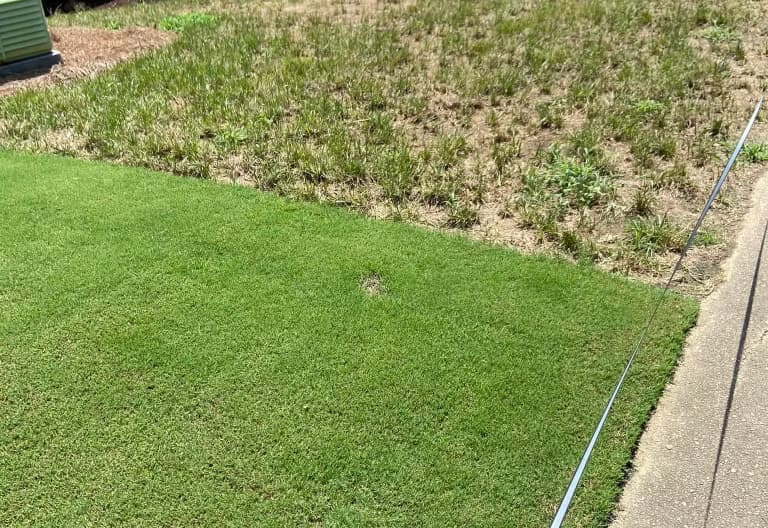
Where Two Lawns Meet
Does your lawn border a neighbor’s — or meet a different type of grass? Spraying near that line can quietly damage the yard next door, sometimes weeks later. Where Two Lawns Meet shows you how to treat safely without harming either side.
Read ArticlePulling
Pull with caution — and only before the seedheads appear. Hand-pulling works for small patches, but two things can turn it against you: shattering ripe seed as you tug, and, with large crabgrass, leaving rooted stem fragments behind that simply regrow.
The Biological Reason
Crabgrass has a shallow, fibrous root system and a single central crown — extract that crown whole and the plant is done, because there’s no perennial storage organ to resprout from. So the technique is straightforward: pull when the soil is moist so the whole root lifts out intact, and get the central crown, not just the top growth.
The two risks are what demand caution. The first is seed shatter. A single plant can carry an enormous seed load — up to 150,000 on a big, unmown plant in the open, and still thousands on a mowed lawn plant — and once the finger-like seedheads have formed, disturbing the plant scatters viable seed straight into the soil. Worse, a flowering plant can keep ripening and dropping seed even after it’s uprooted. So the safe pulling window slams shut the moment seedheads show; after that, you’re planting next year’s crop as you weed.
The second risk is node rooting, and here the two species behave differently. Large crabgrass sends out sprawling stems that root wherever a node touches moist soil — so if you pull roughly and snap off rooted pieces, each fragment left behind can re-root into a new plant. Smooth crabgrass barely does this; some extension sources say it doesn’t root at the nodes at all, and it depends almost entirely on seed. Either way the rule is the same: lift the plant whole, and don’t leave rooted stem pieces lying on damp soil. Bag pulled plants (especially any with seedheads) rather than composting or leaving them on the lawn.
Lawn vs. Bed Pulling Difference
This is where the two species matter most. In the lawn, you’re usually dealing with smooth crabgrass, which spreads by seed and hardly node-roots — so a clean pull before seed set genuinely works, and seed shatter is your only real worry. In a bed, you’re usually dealing with large crabgrass in loose, moist, cultivated soil — exactly the conditions that make its stems root at every node. There, sloppy pulling scatters re-rooting fragments, so removing the entire plant intact, fragments and all, matters far more. Loose bed soil makes a clean full extraction easier if you’re careful, but far more punishing if you’re not.
Quick Reference Summary
| Lifecycle | Summer annual (dies at frost; returns from seed) |
| Active Zones | All — cool-season, warm-season, transition |
| Germination Trigger | Soil ~55°F for several consecutive days near the surface; heavy flush at 60–70°F+ |
| Pre-Emergent | Yes — the primary tool; time ~10–14 days before germination |
| Post-Emergent Window | While small — under ~4 tillers; efficacy drops fast with maturity |
| Pull | With caution — before seedheads; lift the whole crown |
| Lawn Primary Tool | Pre-emergent (split application) + dense, tall-mowed turf |
| Bed Primary Tool | Mulch + selective graminicides (sethoxydim/fluazifop/clethodim) |
| One-and-Done or Multi-Season | Multi-season — 2–3 years to draw down the seed bank |
Frequently Asked Questions
These answers are synthesized from botanical morphology studies and herbicide efficacy trials conducted by leading university agricultural extensions.
Almost always timing or watering. If the preventer went down after the soil already hit ~55°F, the first seedlings were already up and the barrier can’t touch emerged plants. If it wasn’t watered in within a couple of days, sunlight broke it down. And if you aerated or dethatched afterward, you cracked the barrier and pulled buried seed up into the light. Along hot driveway and sidewalk edges, the soil warms early, so crabgrass there often beats a correctly timed application everywhere else.
Yes — for those plants. Pre-emergents only stop seed as it germinates; they do nothing to a plant that’s already up. At that point you switch to a selective post-emergent and target the plants while they’re still small (under about four tillers), because they get much harder to kill as they tiller out.
Every crabgrass plant dies at the first hard frost — the green plant won’t survive winter. What comes back is the seed. One plant can leave thousands of seeds in the soil that stay viable for about three years, so next spring’s crop rises from that seed bank. That’s why the real goal is preventing any plant from reaching seed, year after year.
Possibly goosegrass, which looks nearly identical but has a telltale white-silvery flattened center and germinates weeks later than crabgrass — so a crabgrass-timed preventer has often faded before goosegrass even emerges. Check the crown: silvery-white center means goosegrass, and it needs its own timing.
Not with a standard preventer — it blocks your grass seed just like it blocks crabgrass, sometimes for months. If you need to seed and prevent crabgrass in the same window, use a seeding-safe product: siduron with any cool-season seeding, or mesotrione with new Kentucky bluegrass, tall fescue, or perennial ryegrass (never on new fine fescue, and never on warm-season grass).
Scientific Authority
This profile is constructed using forensic botanical data and Integrated Pest Management (IPM) research. We prioritize scientifically-vetted identification and control methods that protect the broader ecosystem while ensuring successful eradication based on peer-reviewed agricultural studies.
Primary Resources
- Penn State Extension — Control of Summer Annual Grass Weeds in Turfgrasses; Lawn and Turfgrass Weeds: Smooth Crabgrass and Large Crabgrass; Postemergence Control of Crabgrass and Other Summer Annual Grasses in Lawns; Indicator Weeds Provide Insight into Growing a Better Lawn
- Rutgers NJAES — FS1308: Crabgrass Control in Lawns for Homeowners in the Northern US; FS1309: Crabgrass and Goosegrass Identification and Control in Cool-Season Turfgrass
- Purdue University Turf / Extension — When Will Crabgrass Germinate?; Crabgrass Control; Large Crabgrass; Smooth Crabgrass
- University of Illinois Extension — Managing Crabgrass in Lawns; How to Prevent Crabgrass
- Iowa State University Extension and Outreach — How to Control Crabgrass; Application of Preemergence Herbicides
- University of Wisconsin Horticulture / Extension — Crabgrass Management in Lawns
- University of Minnesota Extension — Crabgrass; Managing Weeds in Lawns
- Michigan State University Extension — Pain in the Grass: Crabgrass; Postemergence Crabgrass Control in Turf; Biology and Management of Large Crabgrass in Christmas Tree Production; Timing Crabgrass Preemergence Applications in Spring
- Cornell CALS / Cornell Cooperative Extension — Large Crabgrass; Smooth and Large Crabgrass
- University of Florida IFAS Extension — Weed Management Guide for Florida Lawns; Controlling Crabgrass in Lawns; Crabgrass Management
- University of Georgia CAES / GeorgiaTurf — Large Crabgrass and Southern Crabgrass; Weed Control in Home Lawns; Controlling Crabgrass and Goosegrass with Resistance to Sethoxydim and Other ACCase-Inhibitors in Georgia Turf
- Clemson Cooperative Extension / HGIC — Weed of the Month: Crabgrass; Managing Weeds in Warm Season Lawns; Weed Control in Landscapes: Herbicides; Controlling Weeds in Landscaped Beds Without Glyphosate; Preemergence Herbicides: A Proactive Approach
- NC State Extension (TurfFiles / CES) — Large Crabgrass; Smooth Crabgrass; When to Apply Preemergent Herbicides for Turfgrasses; Effect of Waterlogged Soil on Preemergence Herbicides; Mowing Height Impacts Weed Populations; Weed Management in Annual Color Beds; Spraying Glyphosate on Slightly Greened-Up Bermudagrass in Winter
- Auburn University / Alabama Extension — Home Lawns: Chemical Weed Control; Commercial Turf and Lawns
- LSU AgCenter — Louisiana Home Lawn Series: Crabgrass; Preemergence Options for Crabgrass Control in Louisiana Lawns
- University of Arkansas Cooperative Extension — Preemergence Herbicides in the Home Lawn; Home Lawn Weed Control; Summertime Weeds
- University of Missouri Extension — Now Is the Time to Apply Spring Preemergent Herbicides on Lawns; Managing Lawns and Turfgrass
- University of Kentucky Extension — AGR-206: Lawn Management; Lawn Establishment in Kentucky
- Oklahoma State University Extension — Controlling Weeds in Home Lawns (HLA-6421); Crabgrass
- West Virginia University Extension — Crabgrass
- Virginia Tech / VCE — Turf publications; Control of Common Grassy Weeds
- Kansas State Research and Extension — MF3644 (crabgrass biology/forage)
- UC IPM / UC ANR — Pest Notes: Crabgrass; Smooth Crabgrass Identification Gallery; Weed Management in Landscapes; Weed Seed Biology, Seedbanks and Management
- Ohio State University Extension (Buckeye Turf) — Grassy Weed Control Update