
Scientific Name: Bouteloua dactyloides (Nutt.) J.T. Columbus. Accepted synonym: Buchloe dactyloides (Nutt.) Engelm., also written Buchloë dactyloides. The older Buchloe name is still in active use in turf-breeding literature and in most extension publications written before about 2018, so both binomials should be searchable.
Common Names: Buffalograss, buffalo grass, buffalo turfgrass, Great Plains buffalograss
Buffalograss
The only major turfgrass native to North America, and the only one you can kill with kindness.
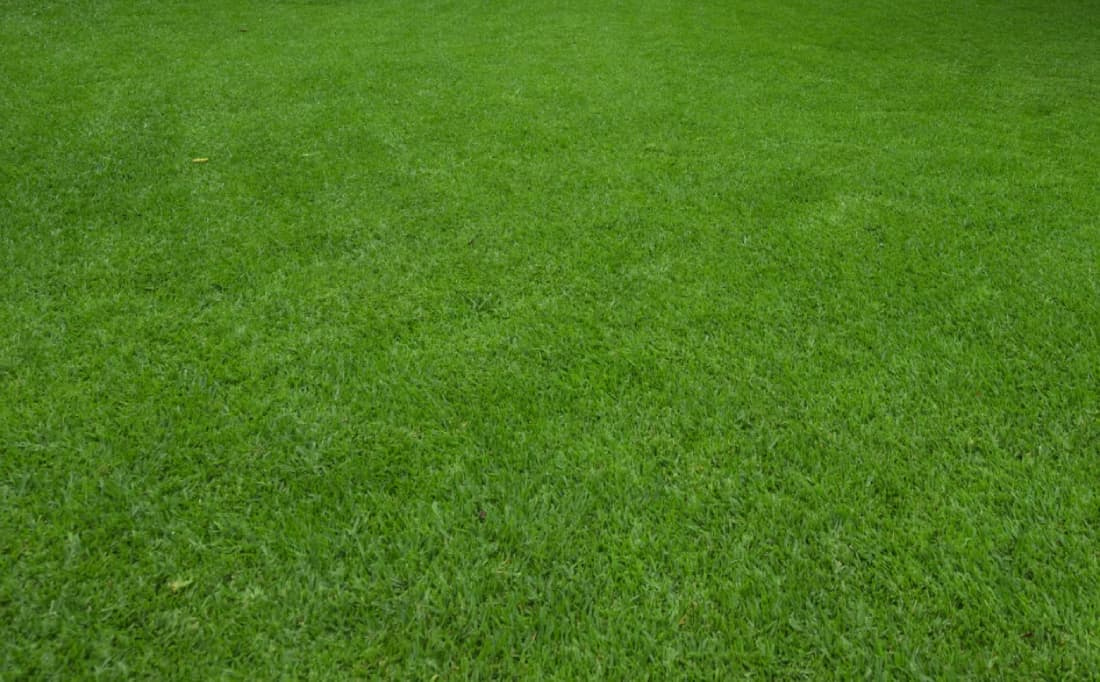
Buffalograss At-a-Glance
Hardiness Zone Min
Zone 4
Water Requirement
Very Low
Sun Requirement
Full Sun (6+ hrs direct)
Wear Tolerance
Low
Establishment Speed
Slow
Labor Intensity
Low
From Sod Houses To Front Lawns
Buffalograss is the only major lawn grass in North America that actually comes from North America. Bermudagrass, zoysiagrass, tall fescue, Kentucky bluegrass — every one of them was carried here from somewhere else. This one was already here, covering the shortgrass prairie from central Canada down into northern Mexico and holding the ground under the bison herds.
That history is written into the plant. The shortgrass prairie gets 10 to 25 inches of rain a year, hard sun, hard cold, and no irrigation. Buffalograss evolved to run on almost nothing. It stays short, it loses very little water, and when the soil dries out it stops rather than dies. When the rain comes back, so does it.
Settlers put that toughness to a use nobody plans for a lawn grass. On a treeless prairie there was no lumber, so families cut the prairie sod itself into bricks and built their houses out of it. Buffalograss was one of the grasses they hunted for, because its dense mat of surface runners and fine roots held a sod brick together when it was cut and stacked (Texas A&M AgriLife). A grass strong enough to be a wall is a grass that will hold a bank.
For the next hundred years it stayed a range grass. Serious turf breeding did not begin until 1984, when Terrance Riordan and Ed Kinbacher started a selection program at the University of Nebraska-Lincoln, with the USGA funding the work because golf courses wanted turf that drank less. The first improved vegetative selections reached the market in 1991, and the first seeded turf-type followed in 1995 — the moment a homeowner could plant buffalograss out of a bag instead of off a sod truck. The Nebraska program is still running, and it is the reason modern buffalograss has darker color, faster establishment, and far better density than the prairie plant it came from.
Two things from that history still decide what you buy. First, buffalograss is dioecious — male and female plants are separate individuals. Males raise flag-like seed stalks above the canopy; females keep their hard little burs down at soil level. Breeders learned to isolate female plants and sell them as sod or plugs, which is why a vegetative lawn has no seedheads and barely needs mowing, while a seeded lawn carries both sexes and needs its seedheads cut. Second, the bred turf types and the old cheap rangeland seed are both still on sale, side by side, and they are not the same product. That is where most buffalograss disappointments begin.
Gallery
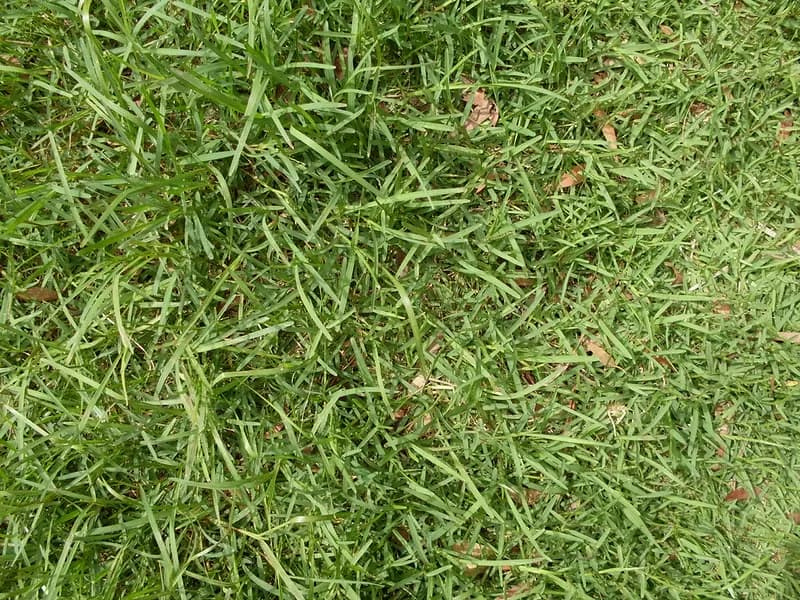
Macro view showing the fine leaf texture, stoloniferous growth habit, and characteristic grey-green canopy of native buffalograss.
“Buffalo grass” by John Tann is licensed under CC BY 2.0.
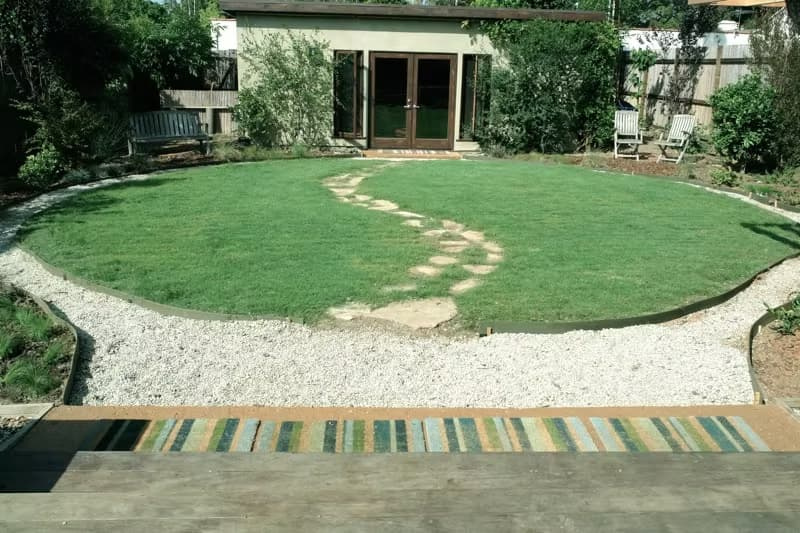
A circular courtyard lawn established with UC Verde buffalograss (Bouteloua dactyloides 'UC Verde'), showcasing its soft texture and low-water utility in sustainable residential landscaping.
“UC Verde Buffalograss” by Gardener Susan is licensed under CC BY 2.0.
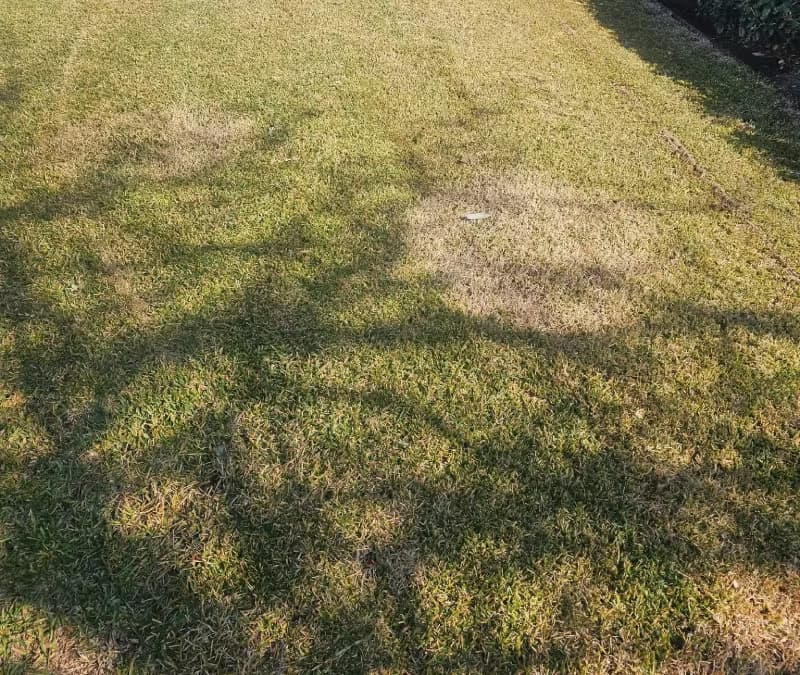
Irregular brown patches on a Sir Walter DNA Certified buffalo grass (Stenotaphrum secundatum) lawn, displaying characteristic Large Patch (Rhizoctonia solani) symptoms during cool, humid conditions.
Telling It Apart
Buffalograss is a fine-bladed, low, gray-green to blue-green grass that spreads by wiry surface runners. Up close, the diagnostic markers are rolled vernation, an open, smooth (glabrous) sheath, a short ciliate ligule which is a fringe of hairs rather than a membrane, no auricles, and a broad, continuous collar with long hairs. Blades are often hairy on both faces, though hairiness varies a lot between cultivars. USDA-NRCS gives blade dimensions of about 1/8 inch wide and 3 to 6 inches long, and plant height of 4 to 6 inches; be aware that figure describes rangeland material, and the bred turf types run noticeably finer. No reliable published width exists for improved turf buffalograss, which is worth knowing when you see a texture claim on a seed bag.
The giveaway is the flowering habit. Because it is dioecious, male plants fly little one-sided, flag-like seed spikes 3 to 8 inches above the canopy, while female plants hide hard burs down near the soil.
Blue grama is the one it is honestly confused with. The two co-occur on the prairie and are sold together in native mixes, and they share the same drought, heat, and cold toughness — but they grow differently. Blue grama is a bunchgrass; it does not run and does not form a tight sod, and buffalograss’s aggressive surface stolons are the tell. Its seedhead is unmistakable too: 1 to 4 curved, one-sided branches that hook backward like an eyebrow or a comb when dry, nothing like buffalograss’s flags and burs.
Bermudagrass is the invader to distinguish, and the weed section explains why it matters so much. It also creeps and goes dormant, but it spreads by both stolons and underground rhizomes, while buffalograss has no rhizomes at all. Its seedhead is a windmill of 3 to 5 finger-like branches radiating from a single point. Bermuda also tends to be a deeper green and far more aggressive, so a suddenly darker, faster-growing patch spreading through a buffalograss lawn is almost always bermuda.
Where it sits against other lawns. Texture fine. Color gray-green to blue-green, with newer cultivars greener. Wear low, with poor recovery. Shade poor, full sun only. Drought very high and best in class. Input level the lowest of any major turfgrass. Establishment slow. Buffalograss is the anchor at the extreme end of most of these axes — it defines the low-water, low-input, full-sun, slow-to-establish, long-dormant corner of the turf world.
Identification Photos
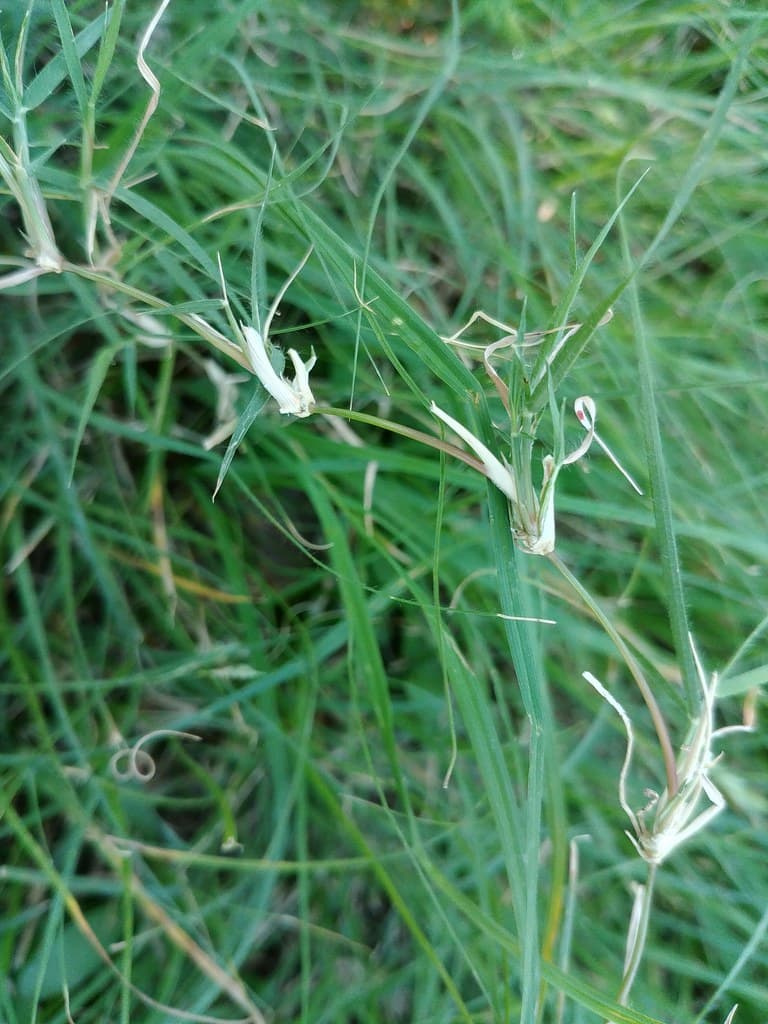
Look For: Fine, curly, gray-green blades with tan burrs down in the turf. The color and the burrs together separate buffalograss from bermudagrass.
“20180628_083624 Bouteloua dactyloides” by Maria Vorontsova is marked with CC0 1.0.
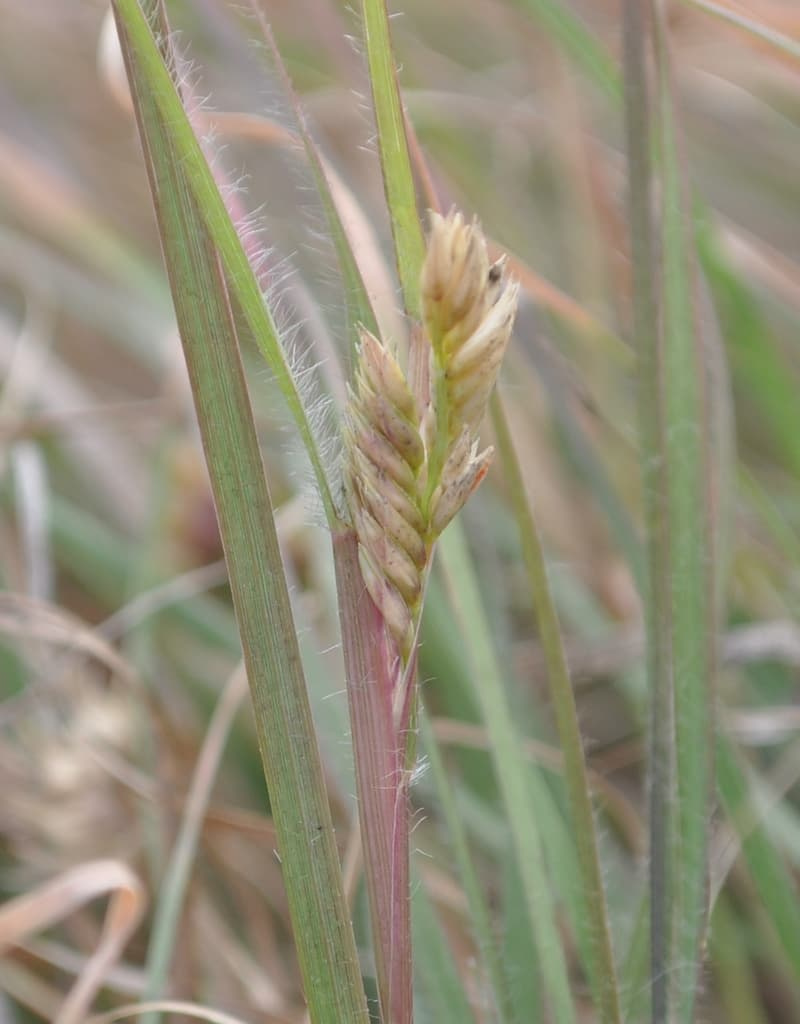
Diagnostic Feature: Burr-like female flowers. Female plants produce tan, seed-bearing burrs tucked among the leaves near the base instead of on tall stalks.
“Buchloe dactyloides, Gaserans 01” by Josep Gesti is licensed under CC BY-SA 4.0.
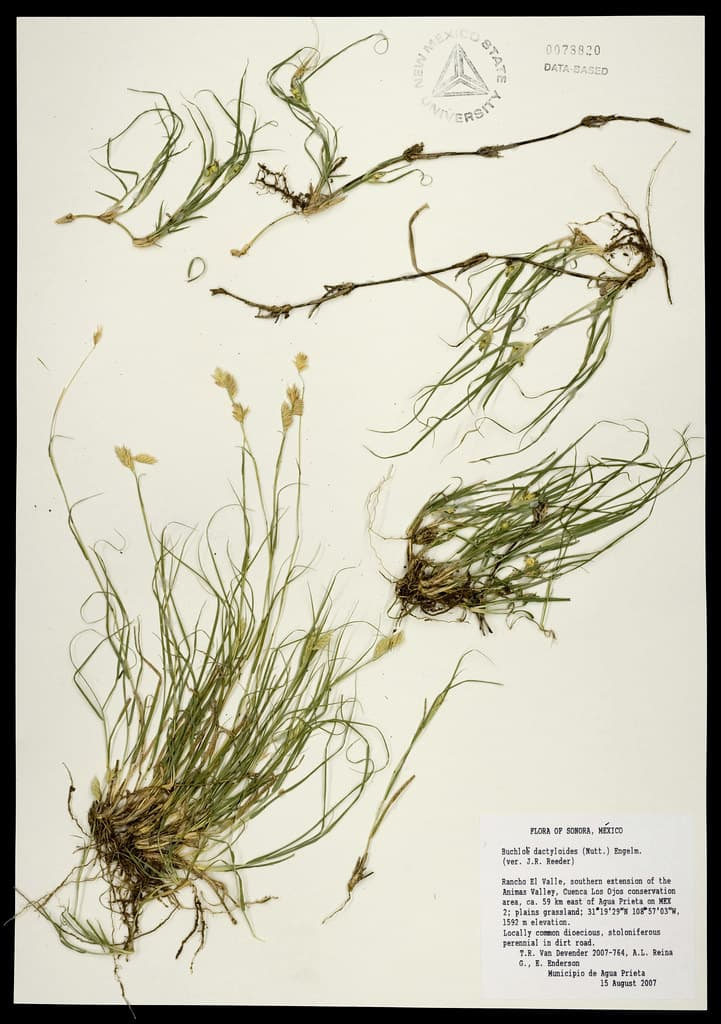
Key Identifier: Long, thin stolons connecting small tufts. Buffalograss spreads by stolons that root at the nodes.
“Bouteloua dactyloides” by aspidoscelis is marked with CC0 1.0.
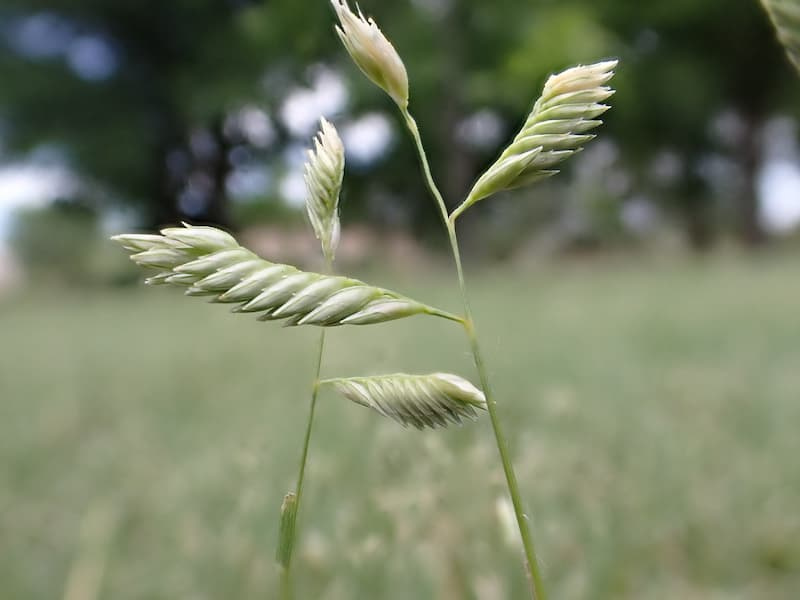
Diagnostic Feature: Separate male and female plants. Male plants hold curved, flag-like flower spikes above the leaves, while female plants keep their seed low in the turf.
“Bouteloua dactyloides – buffalograss” by Matt Lavin is licensed under CC BY-SA 2.0.
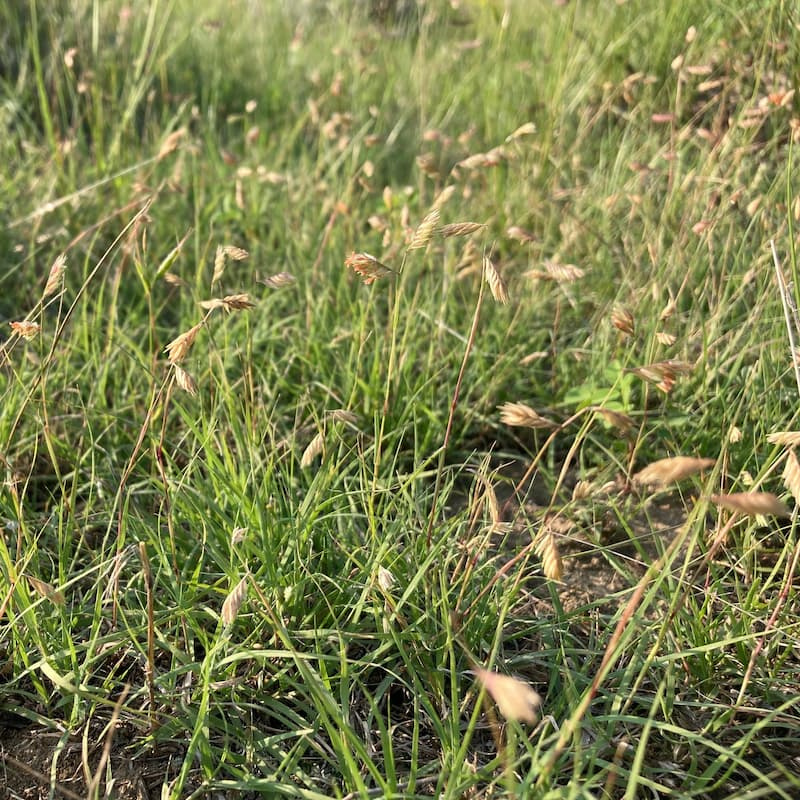
Key Identifier: A thin, fine-textured, gray-green sward. Compared with bermudagrass, buffalograss looks sparser and sits lower to the ground.
“Bouteloua dactyloides – Patrick Alexander 01” by Patrick Alexander https://www.inaturalist.org/people/aspidoscelis is marked with CC0 1.0.
Is Buffalograss Right For Your Yard?
Advantages:
The lowest measured water use of any lawn grass. In a comparison of eleven warm- and cool-season turfgrasses, buffalograss used the least water of the group, about 0.19 inch a day. Inside its adapted range an established stand needs no irrigation at all.
The lowest fertilizer demand of any major turfgrass. Zero to 2 pounds of nitrogen a year, and zero is a real option.
Mowing every 2 to 4 weeks, or not at all. A female vegetative lawn can go a whole season on one or two mowings.
It survives where other grass quits. In a non-irrigated Texas trial, buffalograss survival ran 85 to 98 percent after three years against 5 to 35 percent for bermudagrass.
Cold-hardy for a warm-season grass. Zone 4 is well past bermudagrass, and the winter-survival margin over St. Augustine and centipede is large.
Genuinely pest- and disease-free in its adapted range. Most of the trouble list only activates in humidity or under heavy inputs.
Dormancy is reversible. A brown buffalograss lawn in August is asleep, and it greens up in 7 to 14 days after rain.
It is native. No noxious status anywhere in its range, and it is the grass the shortgrass prairie is actually made of.
Best If:
- You live in the Great Plains, the Front Range, the Mountain West, or the arid Southwest, where annual rain is around 25 inches or less.
- You have a yard that gets 6 to 8 hours or more of direct sun, with no meaningful shade anywhere you want lawn.
- You want to stop irrigating, or you are under permanent water restrictions.
- You would rather mow monthly than weekly, and would rather never fertilize.
- You can accept a tan lawn from the first hard frost to mid-to-late May, and would honestly rather have that than a water bill.
- You have loam, silt loam, or clay soil rather than deep sand.
- You use the lawn lightly — walking on it, sitting on it, looking at it.
- You are patient enough to grow it in across one or two seasons, or willing to pay for sod or plugs to skip that.
Disadvantages:
Six to seven months of tan. It browns at the first hard frost and does not green up until mid-to-late May in northern and transition zones.
No usable shade tolerance. Under 6 hours of direct sun it thins out and hands the ground to weeds.
Poor recovery. With stolons and no rhizomes, a killed patch does not refill from below. Damage means replugging.
Low wear tolerance. It takes light foot traffic and not much more.
Slow to establish. Ninety to 120 days to cover, and two seasons of heavy weed pressure while it gets there.
It fails in humid regions regardless of hardiness zone. Above about 25 inches of annual rain, faster grasses and leaf diseases take it apart.
Bermudagrass beats it permanently. No selective herbicide can remove bermuda from buffalograss.
A narrow herbicide list. Several products that are routine on other warm-season lawns injure it, which makes weed control a research job.
Seeded lawns show male seedheads, which is a look some people dislike and which drives the mowing schedule.
Dog spots persist. Urine tolerance is low and recovery is slow, so burns sit there for weeks or months.
Avoid If:
- You live east of about the 25-inch rainfall line, or anywhere humid. This is the single most common way people waste money on buffalograss.
- Any part of the lawn area is shaded by trees, a fence, or the house.
- You need year-round green.
- Kids, dogs, or sports use the lawn hard. Low wear plus very poor recovery is a bad combination for a play surface.
- Bermudagrass borders your property and you are not prepared to fight it at the edge forever.
- You want a finished lawn this season from seed.
- Your soil is deep sand, or it stays saturated through the growing season.
- You genuinely enjoy lawn care and will water and feed on a schedule anyway. That is the most reliable way there is to lose a buffalograss lawn.
Is It Safe for Pets and Kids?
No toxicity to pets, livestock, or people is documented in extension or USDA literature.
Where It Grows and Where It Fails
Buffalograss is a Great Plains native built for a hard, dry climate, and it fails in places that treat it kindly. Most extension programs recommend it across USDA hardiness zones 4 through 9, but the zone number is only half the story. The real boundaries are rainfall, sun, and elevation.
The eastern edge is a rain and humidity wall. Move buffalograss east into humid country and it loses. In Virginia, where rain tops 40 inches a year, and in East Texas above 30 inches, faster and taller grasses simply outgrow it, and the damp air feeds leaf diseases it never evolved to resist. Colorado State, Nebraska, and Texas A&M all draw the same line: this grass belongs where annual rainfall is roughly 25 inches or less. Oklahoma State and Kansas State recommend it for the western halves of their states, under about 25 to 26 inches, and not the wetter east. The humid-east transition programs — Maryland, Kentucky, West Virginia — mostly do not recommend it at all, and NC State notes it is not widely planted in the Carolinas because it cannot compete there and is prone to leaf spot, brown patch, and summer patch. Here is the plain test: if cool-season lawns stay green and lush around you without much effort, that is a sign buffalograss will struggle, not thrive.
It needs full sun, and this one is not negotiable. Buffalograss requires a minimum of 6 to 8 hours of direct daily sun. In shade it does not merely grow slower — it unravels. The blades stretch upward and thin out, the stolons stop running, and the bare ground fills with weeds or moss. There is no shade-tolerant version of this grass for practical purposes, so treat any meaningfully shaded yard as the wrong site rather than a challenge.
Elevation caps it too. Colorado State puts the ceiling near 6,500 feet, with a protected south- or west-facing slope stretching that to about 7,000. Above that, cool nights and a short season keep it from ever filling in.
Across the five climate profiles the selector uses:
- Warm-arid — the best fit. The deserts and dry valleys of the Southwest play straight to its drought and heat strengths, and desert-adapted vegetative clones use less water here than any other lawn grass in the country.
- Cool-arid — its home turf. The Colorado Front Range, Wyoming, and Utah below about 6,500 feet. Cold-hardy and heat-tolerant at the same time, exactly as the Great Plains built it.
- Transition — only the dry, western end. Fine on well-drained upland sites in the 12- to 25-inch rainfall belt: western Oklahoma, western Kansas, the drier parts of Missouri. Not the humid eastern transition, where it is simply the wrong grass.
- Warm-humid — unsuited to marginal. High rain and humidity thin the stand and hand it to more aggressive grasses.
- Cool-humid — unsuited. Too much water, too little light intensity, too much disease. It gets crowded out.
Getting Established
You can start buffalograss two ways, from seed or from live plants, and the choice decides more than cost. It decides the genetics of your lawn, because of that male and female split.
Seed gives you both sexes; sod and plugs give you females only. Seeded stands are roughly half male plants, and male plants push up flag-like seed stalks 3 to 8 inches above the canopy. They look ragged, and cutting them off means mowing every 1 to 2 weeks through summer. Vegetative material is selected female clones: no elevated seedheads, no pollen, denser turf, and mowing as rarely as once a year. So the real trade is that seed is cheap and covers big areas but is slower, more variable, and seedheady, while sod and plugs are expensive but instant, uniform, pollen-free, and true to type.
The seed dormancy trap — buy treated seed. Raw buffalograss burs have tough, deeply dormant seed coats. Plant them and germination is slow and scattered over weeks, sometimes a full year, leaving wide-open ground for weeds. Extension is firm about this: buy only pre-treated (stratified) seed, which has been soaked in potassium nitrate and chilled to break dormancy. Treated seed comes up in 5 to 10 days in warm soil. Untreated seed is a gamble, and lawn-planting guidance from USDA-NRCS and Colorado State assumes a 7- to 21-day emergence window because of it. If you are stuck with untreated seed, soak the burs yourself for three days, changing the water every 24 hours so they do not rot, then plant immediately into moist soil.
Timing is warm-season timing. Seed needs soil at least 60°F, ideally in the 70s, so late spring — May into June — is the window. Too early and the seed sits and rots in cold ground while weeds take the site. Too late is the dangerous mistake: seed sown after about August 1 in the west, or August 15 in the eastern transition, sprouts but cannot build a cold-hardy root system before frost, and the whole young stand winterkills. Skip dormant winter seeding; northern programs discourage it outright.
Rates and depth. Seed at 2 to 3 pounds of bulk burs per 1,000 square feet, or 3 to 5 pounds where you want fast cover in an arid climate. Plant a quarter to a half inch deep and never deeper than three-quarters of an inch. Plugs go in on 12- to 18-inch centers for a standard lawn, or 6 to 12 inches if you want faster fill. Sod is laid solid for instant cover.
Grow-in is the one demanding phase. This is the paradox of a low-maintenance grass: while it is establishing it needs real attention, because it is slow, open, and cannot yet defend itself. Full cover from seed or plugs takes 90 to 120 days. Through that window you water often and shallow at first — a few minutes several times a day to keep the surface damp — then step down in stages to deep, infrequent watering that drives roots down and dries the surface out to starve weed seeds. Feed lightly: about 1 pound of nitrogen per 1,000 square feet at planting, repeated monthly on plugs through the first summer until cover closes, or about six weeks after seedlings emerge on a seeded stand. Pre-rooted plugs, grown in pots for a few weeks before they go in the ground, beat bare plugs badly. They cover in 8 to 12 weeks, while bare plugs sulk and brown for 3 to 4 weeks before they even start.
Mixing with blue grama. Front Range and Intermountain extension strongly endorse a buffalograss and blue grama mix for non-irrigated native lawns, at 20 percent blue grama to 80 percent buffalograss by weight. Be clear about what those percentages do, because the weights are deceptive. Blue grama seed is tiny — roughly 700,000 to 800,000 seeds per pound against about 50,000 burs per pound for buffalograss (USDA-NRCS) — so a fifth of the weight is the large majority of the actual seeds going into the ground. That is not a flaw in the recipe; it is the point of it. Blue grama comes up fast and shades out weeds while the slow buffalograss finds its feet, and buffalograss then spends the following seasons running stolons into the gaps between the blue grama bunches. Expect the young lawn to look like blue grama and grow into a mix. It works to about 6,800 feet, above which blue grama alone is the better call. Established, the mix needs only 8 to 10 inches of supplemental water a season, and you can tune how tall the canopy sits by how often you water it.
The weed window and young-stand herbicide rules. Expect heavy weed pressure — crabgrass, foxtail, sandbur — for the first two seasons, and know that young buffalograss is touchy about chemicals. Most ordinary pre-emergents will wreck a new seeded stand if they go down too early, because they stop buffalograss roots just as surely as weed roots. A short researched list can go down safely at or near seeding: mesotrione, sulfentrazone, quinclorac, and carfentrazone among them. Full details are in Weeds In This Grass below. Keep 2,4-D off entirely during the first year. On plugs, pendimethalin can go down at planting; on seeded ground, patience is the rule.
Keeping It Healthy
The entire maintenance program for buffalograss fits in one line: do less than feels right. The prairie built it to survive on nothing, and almost every input you add past a low baseline works against you.
Mowing — rarely, and not too short. Mow at 2.5 to 3.5 inches; anywhere from 2 to 4 is fine and 2.5 is the sweet spot. Because it grows slowly and low, you mow only every 2 to 4 weeks in summer, a fraction of a cool-season lawn’s schedule. You can also skip mowing almost entirely and let it fall into a soft, waving 4- to 8-inch meadow, which actually improves drought and weed resistance because the taller canopy shades the soil. The catch is that a seeded lawn will show those ragged male seedheads, and tall unmowed turf traps humidity and can harbor ticks and fleas — that is Texas A&M’s caution, and it matters if you have pets. Whatever height you choose, follow the one-third rule and never cut off more than a third of the height at once. Let it grow tall and then scalp it short and you slice off the growing points sitting near the soil, killing shoots and stalling the roots.
Fertility — almost none. This is where most buffalograss lawns die of kindness. Annual nitrogen need is 0 to 2 pounds per 1,000 square feet, and a true low-input lawn can take zero, living on natural nutrient cycling. A standard home lawn wants just 0.5 to 1.0 pound a year. The timing is narrow: fertilize only when it is actively growing, roughly June 15 to July 15. Feed in April or May and the nitrogen cannot be used by still-dormant grass, so it fertilizes your cool-season weeds instead. Feed after September 1 and you push tender growth that winterkills. There is a documented split on form: Nebraska likes quick-release nitrogen such as urea in that summer window, to drive stolon rooting and density; Kansas State prefers slow-release to avoid growth flushes and thatch. Both programs are valid, so choose by what you want — quick-release for maximum density fast, slow-release for the least mowing and thatch. And skip balanced fertilizers like 10-10-10. The extra phosphorus does nothing for established buffalograss and directly feeds broadleaf weeds.
Why over-feeding backfires, mechanically. Push nitrogen past 2 pounds and you force fast, soft, upright leaf growth at the expense of roots and stolon reserves. The canopy goes tall, thin, and weak, the open turf invites weeds, and — the killer — high fertility hands the advantage to bermudagrass, which loves nitrogen and will overrun a fed, watered buffalograss stand. On top of that, the growth flush builds thatch faster than soil microbes can break it down, and thick thatch breeds large patch disease. Restraint is not laziness here. It is the mechanism that keeps the stand competitive.
Water — deep, rare, and mostly optional. Two things make buffalograss the least thirsty lawn grass measured. It pulls moisture from a fraction of roots reaching 3 to 6 feet down, and it loses remarkably little water from its leaves. In a comparison of eleven warm- and cool-season turfgrasses, buffalograss showed the lowest average water use of the group, about 0.19 inch a day (Kim and Beard 1988). The practical result is that it needs 50 to 75 percent less water than Kentucky bluegrass. To hold green color through summer, give it 1 to 2 inches every 2 to 4 weeks, applied deep and infrequent — never light and frequent, which shallows the roots and builds thatch. Within its home range, an established stand needs no irrigation at all beyond rainfall. In true desert, or through a brutal dry summer, a little water keeps it from browning out.
One correction worth making while we are here, because seed marketing leans on it: buffalograss does not have a uniformly deep root system. On silt loam soils, about 70 percent of its root mass by weight sat in the top 6 inches, same as most grasses. What is unusual is the deep minority of roots combined with very low daily water use. Those two together are the drought story — not depth alone.
Dormancy versus death — an important distinction. When the soil dries out, buffalograss does not die; it shuts down. The blades roll, go bluish-gray, then turn straw-brown as it goes dormant, but the crowns and stolon nodes stay alive and green up within days of rain. It can hold that way for weeks. The limit is real though: under extreme heat, above about 80°F, with zero water, unwatered crowns start dying after 3 to 4 weeks. If you want to hold a dormant lawn through a long drought without waking it up, a survival sip of about an eighth to a quarter inch every 2 to 4 weeks keeps the crowns viable.
Thatch and aeration — usually leave it alone. Managed lean, buffalograss barely thatches, and a thin layer under half an inch actually helps by insulating the soil, so leave it. Only if thatch tops three-quarters of an inch — which is itself a sign you have been over-watering or over-feeding — should you verticut, and only while the grass is actively growing, late May through July, never on dormant turf. On heavy clay, core aeration with hollow tines pulling 3-inch-deep cores, spaced 3 inches or less, relieves compaction in that same active window. Leave the cores on the surface to break down.
The winter-color trade-off, and do not fight it. Buffalograss is warm-season, so it goes fully dormant and tan for a long stretch — 6 to 7 months in northern and transition zones. It browns with the first hard frost and does not green up again until mid-to-late May, weeks after the cool-season lawns next door. That is the honest cost of a low-water native lawn. The tempting fix, overseeding with ryegrass for winter green, is one extension programs strongly reject: buffalograss has weak seedling vigor and cannot compete, so the aggressive ryegrass shades and starves the emerging buffalograss the following spring, stunting or killing the stand. Nebraska’s own trials point the other way, toward blue grama as a mixing partner rather than ryegrass. Accept the tan winter, or plant a different grass.
What Goes Wrong
The headline is good news. In its adapted, semi-arid range, buffalograss is one of the most disease- and pest-free turfgrasses there is, and that resilience is much of the point of planting it. The problems below mostly show up when the grass is pushed into humidity or managed too hard, or they are a handful of native specialists worth knowing by name.
Diseases — mostly a humid-climate and over-input story.
- Leaf spot (Bipolaris and Curvularia) is the main one, and the most common and destructive foliar disease per Nebraska research. It fires up above 86°F and worsens with humidity, rain, and cloudy stretches, thinning the canopy into ragged patches. There is a genetic angle: smooth-leaved cultivars resist it while hairy types are more susceptible. Management is cultural — good vigor, no late-day watering — rather than fungicides, which are not really part of a low-input lawn.
- Large patch (Rhizoctonia solani) shows up in the dormancy transitions of spring and fall, when soil is cool below 70°F and wet, especially in over-fertilized, thatchy, poorly drained turf. Look for circular patches with a yellow-orange margin and rotted shoots that pull loose easily. It is an over-management disease — fix drainage, fertility, and thatch.
- Dollar spot is occasional and, unusually, favored by low nitrogen plus long dew: bleached, hourglass-shaped lesions with reddish-brown borders. Balanced fertility and a canopy that dries by mid-morning suppress it.
- Minor notes. Spring dead spot is a bermudagrass disease and rarely bothers buffalograss. False smut only matters in seed-production fields, not home lawns.
Insect and mite pests — a few native specialists.
- Western chinch bug (Blissus occiduus) is the serious one, and buffalograss is a favorite host. It sucks sap from the crowns and injects a toxin, causing reddish-purple and then straw-brown patches that, unlike drought, do not recover when you water. The threshold is 20 to 25 bugs per square foot; confirm with a flotation test before treating. The strongest defense is a resistant cultivar, with insecticides as backup — resistance varies enormously by subtype, so see the subtype pages.
- Buffalograss mealybug (Tridiscus and Trionymus) is a native specialist that hides behind leaf sheaths under white waxy fluff, causing reddish-purple, yellowing, thinning damage that is easily mistaken for drought. Peel back the sheaths to find them. There are no registered insecticides; management is cultural, including protecting its natural wasp predator, plus resistant smooth-leaved types.
- Buffalograss mite causes a distinctive “witch’s broom” — tufted, rosetted, dwarfed growth that is unmistakable once you have seen it. Clover mite stipples blades silvery and gets worse in over-fertilized turf.
- White grubs (May and June beetles, masked chafers) chew roots, with a threshold of 5 to 10 per square foot, and the secondary damage comes from skunks and raccoons digging for them. The buffalograss webworm severs blades at night and is dangerous precisely because summer dormancy hides the damage until fall.
Abiotic disorders — the real risk list.
- Over-management decline is the number-one failure mode. Too much water and nitrogen force shallow, thatchy, thin turf that weeds and bermudagrass overrun. This is where most buffalograss lawns are lost, and it is not close.
- Scalping from breaking the one-third rule removes elevated growing points and kills tillers.
- Shade thinning is guaranteed in low light. It is an obligate sun grass.
- Winterkill is genuinely a minor issue in the adapted northern range — a real advantage over St. Augustine and centipede — but it is cultivar-dependent, and southern clones can winterkill completely in Colorado. It also strikes late-seeded stands, plugs set within six weeks of frost, and turf walked on while frozen.
How to tell look-alike problems apart. Because so many of these end in the same straw-brown thinning, read the pattern. Drought dormancy is uniform across sunny areas, the roots stay firm, and it greens up in 7 to 14 days with water. Fungal disease makes distinct circular patches with lesioned, dark or orange-margined leaves and rotted crowns, and watering makes it worse. Chinch bug damage is localized and expanding, often near pavement, with reddish-purple crowns, and it does not recover with water. Over-management decline is a spongy, thatchy, gradually thinning lawn despite heavy water and feed. And the tufted witch’s broom of the buffalograss mite looks like nothing else.
Weeds In This Grass
Buffalograss handles herbicides very differently from both cool-season lawns and other warm-season grasses, so a product that is a staple elsewhere can wreck it. What is safe in buffalograss is often narrower than what a weed page lists for turf generally — check here before you spray.
Your first and best defense is not chemical, it is restraint. Because over-watering and over-feeding are the leading cause of weed invasion, a correctly starved buffalograss lawn is its own weed control. A dense, lean stand shades the soil and crowds weeds out; a pampered one opens the door. Mow at 2.5 to 3.5 inches to shade weed seeds, keep nitrogen at or below 2 pounds, skip the phosphorus, and water deep and rare. Get the culture right and you will spray very little.
Pre-emergents — safe on established turf, dangerous on new seedlings. Established buffalograss tolerates a wide list including benefin, dithiopyr, isoxaben, oryzalin, pendimethalin, prodiamine, and indaziflam. But it is badly injured by atrazine, simazine, diuron, and metolachlor — chemistries that are fine on other warm-season lawns, which is exactly the trap. On a newly seeded stand the timing rules are strict, because pre-emergents stop buffalograss roots just as surely as weed roots: dithiopyr waits until the second year, pendimethalin until four mowings or 90 days, prodiamine at least 60 days. Applied right at seeding, prodiamine cut final cover below 10 percent. A researched short list — mesotrione, sulfentrazone, quinclorac, and carfentrazone — can go down safely at seeding on some improved seeded types and buy the young stand its cover, but the window is tight, and applying even two weeks late means the weeds have already won. On plugs, pendimethalin is safe at planting. On sod, wait 4 to 6 weeks for rooting.
Post-emergents — a specific safe set. On established buffalograss, metsulfuron, quinclorac, carfentrazone, clopyralid, and bentazon for nutsedge cause little or no injury. Handle MSMA, DSMA, and sethoxydim with care, since they cause temporary yellowing. Avoid the ones that kill it outright: fluazifop, fenoxaprop, and mecoprop are off the table. The signature conflict is 2,4-D. It is a cool-season staple, but on actively growing buffalograss it causes severe, season-long injury. Spray 2,4-D only on fully dormant turf, never in the first year, and never above about 80°F. Also keep any broadleaf spray off during the tender mid-to-late-May green-up.
Renovation and the bermudagrass problem. Before replanting buffalograss, let soil-active pre-emergents break down for 2 to 4 months. A non-selective systemic herbicide can be used on fully dormant turf after the first hard freeze, or to clear ground before planting, with planting safe 5 to 7 days after the final application since it leaves no soil residual. One caution on product choice: do not assume a consumer “Roundup”-branded product still contains glyphosate. The brand has been reformulated with different active ingredients, so read the active-ingredient panel and match the chemistry to the job before you spray anywhere near turf you want to keep.
The hardest weed of all is bermudagrass, and it deserves its own warning. Both grasses are warm-season and both spread by stolons, so no selective herbicide can remove bermudagrass from buffalograss — anything that kills the bermuda kills the buffalograss too. Under high water and fertility, bermuda simply outcompetes and replaces it, which is one more reason to keep inputs low. Small invasions can be dug out, taking every rhizome, or spot-sprayed non-selectively 2 to 3 feet past the visible edge, 2 to 3 times a season, accepting that you will be replanting those spots. A full renovation off bermudagrass takes 10 to 12 months of repeated herbicide, till, and fallow cycles before you plant.
Subtypes
Northern Clone Buffalograss
Female-only clones that never throw a seedhead and never shed pollen — the closest buffalograss gets to a manicured lawn.
Best For: A Zone 4 to 7 yard in the Plains, the Front Range, the Midwest or the drier transition zone where you want buffalograss to look deliberate rather than wild. It earns its price where someone in the house has a pollen allergy, where chinch bugs have hit before, or where the goal is to almost never start the mower.
Tradeoff: There's no seed — you buy live plants, so a 1,000-square-foot lawn starts at six to fourteen plug trays and fills in over a season.
Seeded Buffalograss
The only buffalograss you can plant from a bag, and by far the cheapest way to cover a large dry yard.
Best For: A big, full-sun yard in the dry country west of about the 25-inch rain line — the Plains, the Front Range, western Kansas and Oklahoma, the Southwest — anywhere in Zones 4 through 8 where sodding the whole thing would cost more than the lawn is worth. Best if you can plant in late spring and wait out a slow first season.
Tradeoff: Roughly half the plants you grow will be male, so you'll mow every one to two weeks all summer just to cut off seedheads that a clone lawn never grows.
Southwestern Clone Buffalograss
The lowest-water lawn grass sold anywhere, with a fine, bermuda-like surface built for desert heat.
Best For: Southern California, Arizona, southern Nevada, New Mexico and West Texas — full sun, real heat, and usually a watering restriction. Zones 7 through 10, on a yard where a quarter inch of water a week has to be enough.
Tradeoff: It's winter-tender, and the failure is total rather than gradual — '609' and 'Prairie' winterkill completely in Colorado.
The Seasonal Care Calendar

Spring (Mar-May)
Waiting Out A Late Green Up
Spring is mostly a waiting game, and the hardest part is not doing things. Your buffalograss will sit tan and flat while the cool-season lawns around you green up, and it will stay that way until soil warms in mid-to-late May. That is normal and not a sign of winterkill.
Do not fertilize early. Nitrogen in April or May cannot be used by dormant grass, so it goes straight to your cool-season weeds instead. Wait for the June window.
Pre-emergent goes down on established turf only, before soil temperatures push weed seeds into germination. On a stand seeded last year, check the interval for the product you are holding — most of them need a full season before they are safe.
Keep broadleaf sprays off during green-up. The mid-to-late-May transition is when the grass is most tender, and 2,4-D in particular will do season-long damage to actively growing buffalograss.
Watch for large patch in the cool, wet stretch of the transition, especially if last year’s lawn was fed and watered hard. Circular patches with a yellow-orange margin and shoots that pull loose easily are the sign, and the fix is drainage, fertility, and thatch rather than a fungicide.
Late spring is the planting window. Seed once soil hits at least 60°F and ideally the 70s, which usually means May into June. Plugs go in after the last frost. This is the one time of year buffalograss needs real attention.
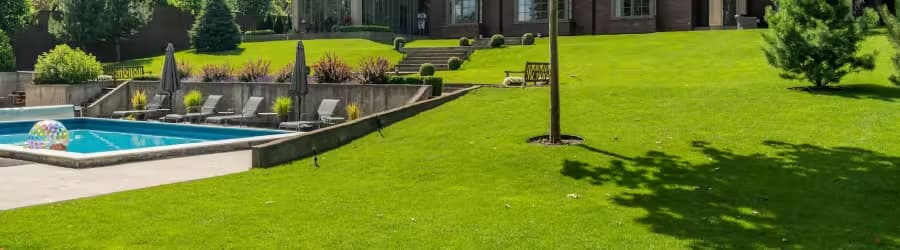
Summer (Jun-Aug)
The One Month It Gets Fed
Summer is the grass’s whole growing season, and it is also the only month of the year it gets fed. Roughly June 15 to July 15, apply the year’s nitrogen if you are applying any — 0.5 to 1.0 pound per 1,000 square feet for a standard lawn, up to 2 pounds maximum. Quick-release drives stolon rooting and density; slow-release means less mowing and less thatch. Both are defensible programs, so choose by what you want out of the lawn.
Mow every 2 to 4 weeks at 2.5 to 3.5 inches, or let it go and accept a meadow. Never take more than a third of the height in one cut.
Water deeply and rarely, or not at all. One to 2 inches every 2 to 4 weeks holds green color. Inside its home range you can skip it entirely and let the lawn go dormant. If it does brown out and you want it to stay alive rather than green, an eighth to a quarter inch every 2 to 4 weeks keeps the crowns viable. Under sustained heat above 80°F with zero water, crowns start dying after 3 to 4 weeks, so that survival sip matters in a long drought.
Scout for chinch bugs, especially in reddish-purple patches near pavement that do not recover after watering. Threshold is 20 to 25 per square foot; confirm with a flotation test before you treat anything.
Leaf spot fires up above 86°F in humid or cloudy stretches. Do not water late in the day, and do not respond by feeding it — the answer is cultural.
This is the only window for verticutting or aeration, late May through July while the grass is actively growing. Do not touch dormant turf. And keep 2,4-D off entirely — above about 80°F it does serious damage.
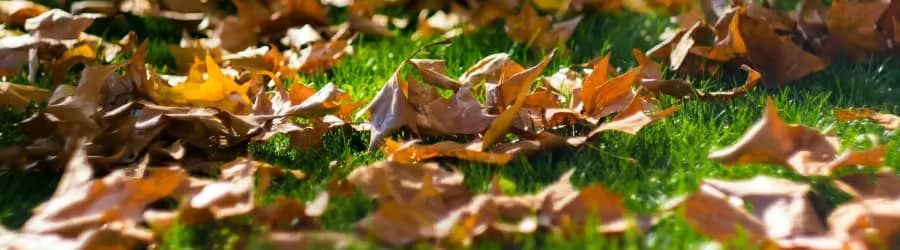
Fall (Sep-Nov)
Stop Feeding And Let It Brown
Fall is a stopping season. No nitrogen after September 1. Late feeding pushes tender growth that has no time to harden off, and that growth is what winterkills.
The planting window is already closed. Do not seed after about August 1 in the west or August 15 in the eastern transition. A stand that sprouts in September cannot build a cold-hardy root system before frost, and you will lose the whole thing. Plugs need at least six weeks in the ground before the first frost, so late plugging carries the same risk.
Large patch returns as soil cools below 70°F and stays wet. Same disease as spring, same causes, same answer.
Expect the color to go early. Buffalograss browns at the first hard frost, weeks before your neighbors’ lawns, and stays tan through winter. It is dormant, not dead.
After the first hard freeze, the dormant-turf herbicide window opens. This is the safe time for a 2,4-D application on a fully dormant stand, or for non-selective spot treatment on a bermudagrass invasion. Read the active-ingredient panel rather than trusting a brand name, and only spray turf that is genuinely dormant.
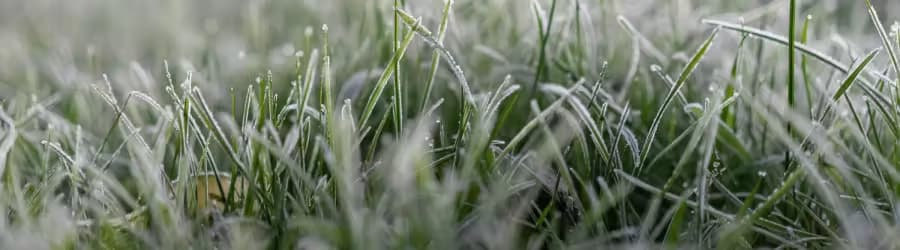
Winter (Dec-Feb)
Dormant Tan And Best Left Alone
There is essentially nothing to do, and that is the point of the grass. The lawn is fully dormant, straw-brown to reddish-tan, and it will stay that way for 6 to 7 months in northern and transition zones. Dormancy is a survival state, not decline. The crowns and stolon nodes are alive under there.
Do not overseed with ryegrass for winter color. It is the most tempting fix and the one extension programs reject hardest. Buffalograss has weak seedling vigor, so aggressive ryegrass shades and starves it during the spring transition and can stunt or kill the stand outright. If you want winter green badly enough to overseed, buffalograss is the wrong grass for your yard.
Skip dormant winter seeding as well. Northern programs discourage it, and the seed sits exposed for months.
Stay off frozen turf. Foot traffic on frozen buffalograss crushes crowns, and with no rhizomes those spots do not knit back in spring.
If you have a broadleaf weed problem to deal with, this is the safe window for a 2,4-D application, because the grass is fully dormant and cannot be injured by it.
Buffalograss Against Bermuda And Blue Grama
Versus bermudagrass. These two get compared constantly because both are warm-season, both go dormant, and both creep. The differences that matter are water and aggression. Buffalograss needs far less water and almost no nitrogen; bermuda needs 4 to 6 pounds of nitrogen a year and real irrigation to look good. But bermuda spreads by rhizomes as well as stolons, so it recovers from damage and buffalograss does not, and bermuda handles traffic that buffalograss cannot. If your lawn takes hard use and you have the water, bermuda is the better product. If you want to stop irrigating, buffalograss wins outright — and remember that bermuda will invade buffalograss and cannot be selectively removed once it does.
Versus blue grama. Its closest relative and its usual mixing partner rather than its competitor. Blue grama is a bunchgrass, so it never forms a tight sod on its own and leaves gaps between clumps; buffalograss runs stolons and closes ranks. Blue grama establishes faster from seed and takes higher elevation, working above 6,800 feet where buffalograss gives out. Most Front Range extension advice is to plant both rather than choose.
Versus zoysiagrass. Zoysia gives you a denser, more traffic-tolerant lawn with better appearance, but it wants more water and fertility, establishes even more slowly, and stays dormant almost as long. Zoysia is the choice for a manicured low-input lawn in a moderate climate; buffalograss is the choice for a genuinely dry one.
Versus Kentucky bluegrass and tall fescue. This is the trade most people are actually making. Cool-season lawns give you green through spring and fall and better shade and traffic tolerance, at the cost of 50 to 75 percent more water and several times the nitrogen. In the dry West, that difference is the entire argument. Where cool-season grass grows easily without much help, though, buffalograss is not competitive and will be crowded out.
Versus fine fescue. Both get sold as low-input grasses, and they solve opposite problems. Fine fescue is the low-input answer for shade and cool climates; buffalograss is the low-input answer for full sun and heat. Neither substitutes for the other, and a shaded yard in a dry climate is a fine fescue question, not a buffalograss one.
Find Your Precision Match
Choosing between species requires balancing your specific soil profile, local micro-climate, and maintenance goals. Use our Turf Match Tool to generate a data-backed recommendation for your specific yard.
Start Your MatchTechnical Specifications
Scientific Name: Bouteloua dactyloides (Nutt.) J.T. Columbus. Accepted synonym: Buchloe dactyloides (Nutt.) Engelm., also written Buchloë dactyloides. The older Buchloe name is still in active use in turf-breeding literature and in most extension publications written before about 2018, so both binomials should be searchable.
Common Names: Buffalograss, buffalo grass, buffalo turfgrass, Great Plains buffalograss
Family: Poaceae (the grass family), subfamily Chloridoideae, tribe Cynodonteae. Genus Bouteloua, the grama grasses, which is why blue grama is its closest field look-alike and its standard mixing partner.
Origin: Native to North America. Shortgrass and mixed-grass prairie of the Great Plains, distributed from central Canada south to Texas, New Mexico, eastern Arizona and northern Mexico, and east to Louisiana (USDA Forest Service FEIS; USDA-NRCS). Domesticated for turf only in the last forty years.
Season Type: Warm-Season
Growth Habit: Stoloniferous
Growth Rate: Slow
Texture: Fine
Root System Depth: Fine, wiry roots reach 3 to 6 feet deep, but the root system is top-weighted rather than uniformly deep. In silt loam soils, roughly 70 percent of root mass by weight sat in the top 6 inches (Weaver 1958, reported in the USDA-NRCS plant guide). The deep fraction is what carries the plant through drought; it is not the bulk of the system.
Spread Mechanism Intensity: Aboveground stolons only, no rhizomes. Stolons run quickly across the surface in full sun and warm soil and root down at the nodes. Spread stops in shade, stalls under drought, and shuts down as nights cool. Full cover from seed or plugs takes 90 to 120 days. Because there is no underground network, a killed patch cannot refill from below and has to be replugged.
Typical Lifespan & Invasiveness Risk: Long-lived perennial. An established stand persists indefinitely under low input. Ecological invasiveness risk is very low: it is native across its entire planting range, carries no federal or state noxious status, has weak seedling vigor, and is outcompeted rather than a competitor anywhere rainfall runs much above 25 inches a year. The practical risk is cosmetic, not ecological — surface stolons will creep a foot or two into an adjacent bed, and a mowed or spaded edge stops them. Note the direction of travel: in a buffalograss lawn the invasion problem is bermudagrass coming in, not buffalograss going out.
Hardiness Zone Min: Zone 4
Hardiness Zone Max: Zone 9
Hardiness Zone Notes: Ideal band for improved turf types is Zones 4 to 8; Zone 9 is the recommendable ceiling for the species, and arid-adapted sterile clones are grown in the frost-free low desert beyond it. The zone number is the least useful half of the story. The real limits are rainfall, sun, and elevation: it belongs where annual rainfall is about 25 inches or less, needs 6 to 8 hours of direct sun, and runs out near 6,500 feet of elevation (about 7,000 feet on a protected south- or west-facing slope, per Colorado State). Cold hardiness is strongly cultivar-dependent rather than fixed at the species level — southern clones winterkill in Colorado while northern seeded lines come through routinely. Winterkill in the adapted northern range is a minor issue, and mostly strikes stands seeded after about August 1, plugs set within six weeks of frost, and turf walked on while frozen.
Cold Tolerance Rating: High
Winter Color Profile: Dormant
Climate Cool Humid: Unsuitable
Climate Cool Arid: Good
Climate Warm Humid: Poor
Climate Warm Arid: Excellent
Climate Transition: Fair
Sun Requirement: Full Sun (6+ hrs direct)
Shade Tolerance: Low
Water Requirement: Very Low
Drought Survival Strategy: Both (avoidance then dormancy)
Soil Texture Fit:
Sandy Loam
Loam
Silt Loam
Clay Loam
Clay
pH Optimal Min: 6
pH Optimal Max: 7.5
pH Stress Max: 8
Wet Feet Tolerance: Low
Compaction Tolerance: Moderate
Salinity Tolerance: Moderate
Wear Tolerance: Low
Recovery: Very Low
Recovery Mechanism: Stolons
Input Intensity: Very Low
Labor Intensity: Low
Thatch Production: Low
Annual N Figure: 0 to 2 lb nitrogen per 1,000 sq ft per year, with 0.5 to 1.0 lb the standard home-lawn figure and a true low-input stand able to take zero. Apply only during active growth, roughly June 15 to July 15. Above 2 lb the grass thins, thatches, and loses ground to weeds and bermudagrass.
Urine Resistance: Low
Preferred NPK Ratio: No ratio is published, which is normal. Extension direction is nitrogen-only for established turf: skip balanced products such as 10-10-10, because the extra phosphorus does nothing for established buffalograss and directly feeds broadleaf weeds. Route phosphorus and potassium through a soil test instead. A 1 lb per 1,000 sq ft starter-type application at planting is the one documented exception.
Establishment Methods:
Seed
Sod
Plugs
Germination Speed: Moderate (7–14 days)
Establishment Speed: Slow
Seeding Rate: Seed at 2 to 3 lb of bulk burs per 1,000 sq ft, or 3 to 5 lb where fast cover matters in an arid climate; USDA-NRCS gives 3 to 5 lb per 1,000 sq ft for broadcast lawn seeding. Plant 1/4 to 1/2 inch deep and never deeper than 3/4 inch. Plugs go on 12- to 18-inch centers for a standard lawn, or 6 to 12 inches for faster fill. Sod is laid solid. No routine overseeding rate applies — buffalograss is not overseeded on a schedule, and winter ryegrass overseeding is specifically rejected by extension because the ryegrass shades out the emerging buffalograss the following spring.
Improved Cultivar Availability: High
NTEP Note: Buffalograss carries a long run of NTEP trial data, scored on the standard 1-to-9 visual scale for turf quality, spring green-up, and wear. That data does not resolve into a single "best cultivar" answer, because the species splits on two structural axes at once — how it is planted (seeded stands carry both sexes; vegetative clones are female-only) crossed with cold adaptation (northern versus southern material). Cultivar-level guidance therefore lives on the three subtype pages, matched on establishment method and cold hardiness rather than on a trial ranking. One guardrail belongs at species level and is not a cultivar recommendation: do not buy rangeland or forage-grade buffalograss seed for a lawn. Forage selections such as 'Texoka' and 'Sharp's Improved' are bred for biomass, not turf; they grow open, coarse, and seedy, rate roughly 3.0 to 4.5 for turf quality against 5.5 to 8.0 for the improved turf types, and produce a weedy pasture rather than a lawn.
Deep Dives & Practical Guides
How to Establish a New Lawn From Bare Soil to First Mow
Bare soil doesn't turn into a lawn just because you scattered seed or rolled out sod — it becomes one based on a handful of specific steps done in the right order, matched to your specific grass. This guide walks through soil prep, seeding or planting method, starter fertilizer, watering as the grass grows, and knowing when it's actually safe to mow, for both cool-season and warm-season lawns.
Read Article
Cool Season vs Warm Season Lawn and Landscape Guide
Your lawn and your flower beds don't follow the same calendar — one runs on a cool-season engine, the other on a warm-season one, and using the wrong playbook on either can do real damage. This guide helps you figure out which system you actually have and how to care for it correctly, plus how the same cool/warm split applies to your ornamental beds.
Read Article
The Hole You Dug Is Killing Your New Plants
A shrub that looked fine all summer and stalled the next year usually didn't fail because of the plant, the weather, or the nursery. It failed because the hole it went into was a container — smooth-walled, water-holding, and impossible to root out of.
Read Article
What You Can Actually Change About Bad Soil
Heavy clay and loose sand feel like permanent sentences, and half of that is true. What your soil is made of will not change. How those particles are arranged will — and that is the half that decides whether anything grows.
Read Article
Why Your Plants Survive Winter and Die in July
Your hardiness zone is built from one number — the coldest night of an average year. It says nothing about the hottest afternoon, which is what actually kills most plants people lose. Here's how to read the other half of the map.
Read Article
Why Poa Annua Keeps Coming Back — and the 3-Year Plan That Finally Ends the Cycle
You've pulled it. You've sprayed it. You've watched the little white seedheads mock you every single spring. And every fall, like clockwork, it's back — in the lawn, in the beds, in the cracks you didn't know you had. Here's the hard truth nobody at the big-box store will tell you: you're not losing because you're doing it wrong — you're losing because you're fighting the wrong enemy on the wrong timeline. Poa annua isn't a one-season problem, and once you understand why, the three-year plan below stops feeling like a chore and starts feeling like a countdown.
Read Article
How to Apply Herbicides Correctly in Your Lawn and Garden Beds
Getting real results from a weed product has almost nothing to do with the brand on the bottle and everything to do with matching the method to the moment — the right chemistry, in the right place, at the right time. Learn how to apply herbicides correctly across both your lawn and your garden beds, whether you’re stopping weeds before they sprout or killing the ones already growing, without wasting product or harming the plants you want to keep.
Read Article
How to Kill Weeds Where Two Lawns Meet Without Harming Your Neighbor’s Grass
Controlling weeds along a shared property line is where good intentions quietly backfire—the season that's safe for your own lawn is often the season the lawn next door is most easily harmed. Learn the seasonal timing collision behind most fence-line damage, and the two habits that prevent it—reading what's actually in the bottle and spraying directed instead of broadcast—so you can clear the weeds without hurting your grass, your neighbor's, or the peace between you.
Read Article
The Truth About One-and-Done Weed Control
Most homeowners lose the fight against weeds not because they work too little, but because they act before they understand. One-and-done weed control is real — but it only works when identification, timing, and the right tool all line up. This guide explains how that sequence works across your lawn and your ornamental beds, and how each weed page in the MFY hub puts it into practice for your specific invader.
Read Article
Solving the Mystery of the False Evidence in Your Lawn and Landscape
A brown leaf or a yellowing lawn is rarely what it seems. When symptoms act as decoys, a calm, forensic approach brings clarity to the confusion. Learn how to look past the surface to find the quiet truth of what your plants are truly asking for.
Read Article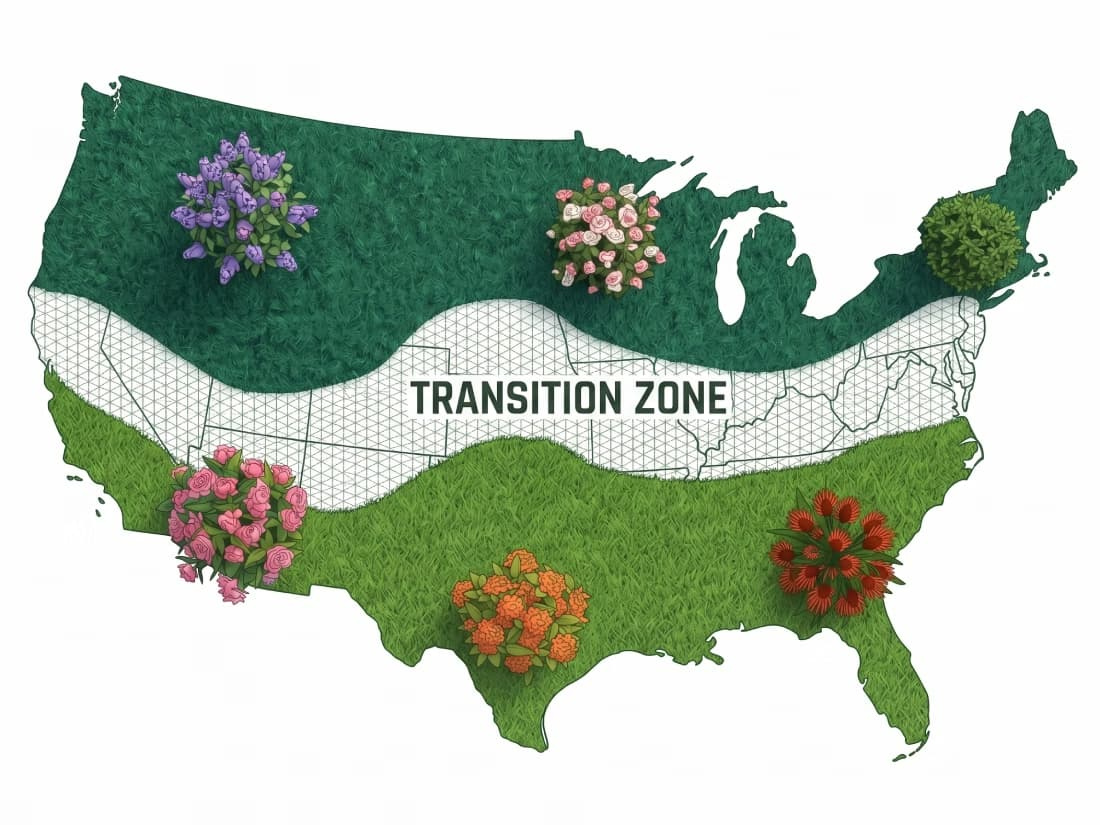
Living in the Middle: The Deep-Dive Guide to Transition Zone Lawns and Landscapes
The Transition Zone is a biological tug-of-war where neither northern nor southern species perfectly adapt. By using resilient "bridge" species and mastering maintenance levers like the Mowing Pivot, you can transform a struggling yard into a healthy landscape.
Read Article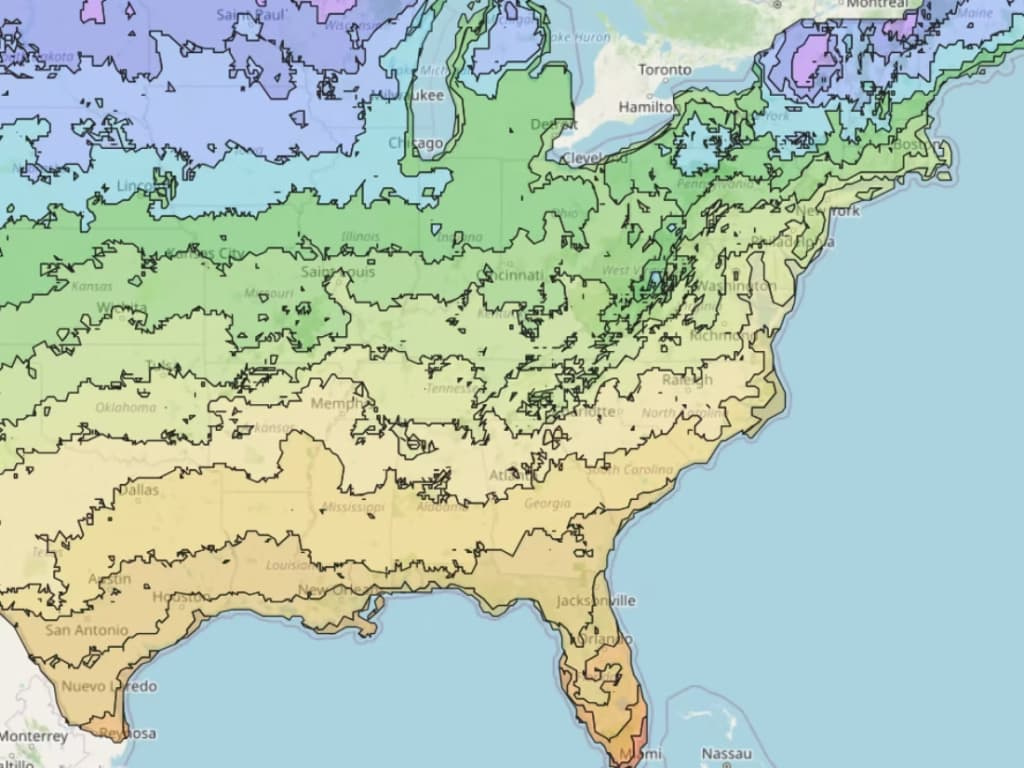
What Your Hardiness Zone Really Means for Your Lawn and Plants
Uncover the foundation of a resilient landscape by mastering the science of hardiness zones. Learn how these climate boundaries are calculated and why understanding your local temperature limits is the first step toward choosing plants that thrive year after year.
Read ArticleFrequently Asked Questions
Our maintenance and establishment guidance is derived from long-term agronomic field studies and turfgrass performance data from top research institutions.
Almost certainly not. Buffalograss responds to dry soil by shutting down rather than dying — the blades roll, go bluish-gray, then turn straw-brown, but the crowns and stolon nodes stay alive and green up within 7 to 14 days of rain. The way to check is the pattern. Drought dormancy is uniform across the sunny parts of the lawn and the roots stay firm. Circular patches with dark or orange-margined leaves are disease. Expanding reddish-purple patches near pavement that do not respond to water are chinch bugs. The one real limit: above about 80°F with zero water at all, unwatered crowns start dying after 3 to 4 weeks, so in a long drought give it an eighth to a quarter inch every 2 to 4 weeks to keep it alive without waking it up.
Inside its adapted range, which means roughly 25 inches of annual rain or less, an established stand genuinely needs no irrigation and can take zero nitrogen. This is not a marketing line — buffalograss showed the lowest average water use of eleven turfgrasses in a controlled comparison. If you want to hold green color rather than let it go dormant, that costs 1 to 2 inches of water every 2 to 4 weeks and 0.5 to 1.0 pound of nitrogen a year, applied in a narrow window from about June 15 to July 15. Going past 2 pounds of nitrogen a year actively harms the lawn.
No, and this is the mistake that costs people their lawns. Buffalograss has weak seedling vigor. Ryegrass is aggressive and fast, so it shades and starves the buffalograss during the mid-to-late-May green-up, exactly when the buffalograss is trying to restart. Extension programs reject the practice outright. If a tan lawn from first frost to late May is unacceptable to you, the honest answer is that buffalograss is the wrong grass for your yard, not that it needs overseeding.
No. Buffalograss needs 6 to 8 hours of direct sun and there is no practical workaround. In shade it does not simply grow slower — the blades stretch upward and thin, the stolons stop running, and the open ground fills with weeds or moss. Extra water and fertilizer make it worse, not better, because they accelerate the same thinning. A shaded yard in a dry climate is a fine fescue question.
No, and this is the single most important shopping guardrail on this page. Cheap rangeland and forage-grade buffalograss seed is bred for grazing biomass and soil stabilization, not for turf. It grows open, coarse, tall, and seedy, and it rates roughly 3.0 to 4.5 for turf quality against 5.5 to 8.0 for improved turf types. Planted as a lawn it gives you a weedy pasture. Buy seed sold as turf-type, and buy it pre-treated — raw burs are deeply dormant and germinate erratically over weeks or even a full year, while treated seed comes up in 5 to 10 days.
Nothing selective, and there is no product coming. Both grasses are warm-season and both spread by stolons, so anything that kills the bermuda kills the buffalograss with it. Your options are mechanical — dig it out and get every rhizome — or spot-spray non-selectively 2 to 3 feet past the visible edge, 2 to 3 times a season, and accept that you will replant those spots. Keeping your inputs low is genuine defense here: bermuda thrives on the nitrogen and water that weaken buffalograss, so a lean lawn is a harder lawn to invade. A full renovation off an established bermuda infestation takes 10 to 12 months of repeated herbicide, till, and fallow cycles.
Slowly, and only from the edges. Buffalograss spreads by aboveground stolons and has no rhizomes at all, so there is no underground network to push new shoots up into a dead patch — it has to creep in from the perimeter. That is why its recovery rating is the lowest on this site even though the grass itself is tough. For anything larger than a dinner plate, plugging is faster than waiting. It is also why buffalograss is a poor choice for a lawn that takes hard, repeated use in the same spots.
It decides more than cost, because of the male and female split. Seeded stands contain both sexes, so male plants raise flag-like seed stalks 3 to 8 inches above the canopy and you will mow every 1 to 2 weeks in summer just to cut them. Sod and plugs are selected female clones — no seedheads, no pollen, denser turf, and mowing as rarely as once a year, at a much higher price. Beyond that, cold adaptation splits the vegetative material: northern-adapted clones and southern desert-adapted clones are not interchangeable, and putting a southern clone in the cold north will winterkill it. Pick your subtype by how you want to establish and where you live, then choose within it.
Scientific Authority
This profile is grounded in turfgrass agronomy and soil science. Every recommendation—from irrigation requirements to nutrient management—is verified against agricultural research data to ensure optimal plant health and environmental sustainability in the Transition Zone.
Primary Resources
- USDA-NRCS East Texas Plant Materials Center: Plant Guide for Buffalograss (Bouteloua dactyloides)[cite: 1]
- USDA-NRCS Manhattan Plant Materials Center: Plant Guide for Blue Grama (Bouteloua gracilis)[cite: 2]
- USDA Forest Service FEIS: Bouteloua dactyloides Profile
- University of Nebraska-Lincoln Turfgrass Science & Buffalograss Breeding Program
- Colorado State University Extension: Buffalograss Lawns (CMG Garden Notes #565)
- Kansas State University Extension: Buffalograss Lawn and Turfgrass Thatch Publications
- Texas A&M AgriLife Extension: Buffalograss Profile (Duble)
- University of Missouri Extension: Establishment and Care of Buffalograss Lawns (Dunn & Ervin)
- Oklahoma State University Extension: Buffalograss Management & Selection
- University of California Agriculture and Natural Resources & UC IPM: Buffalograss Management
- National Turfgrass Evaluation Program (NTEP): Buffalograss Trials
- NC State Extension: Buffalograss Regional Adaptation Profile
- University of Wyoming, Utah State University, New Mexico State University & University of Arizona Extension: Intermountain & Western Adaptation Studies