
Wild Garlic At-a-Glance
Weed Type
Bulb-forming monocot (Allium) — not a true grass or broadleaf
Life Cycle
Bulbous perennial
Growth Habit
Erect, clumping
Root Type
Bulb (layered cluster)
Spreading Risk
High — by underground bulbs and aerial bulblets
Pull
No
Identity & Diagnostics
Visual Fingerprint
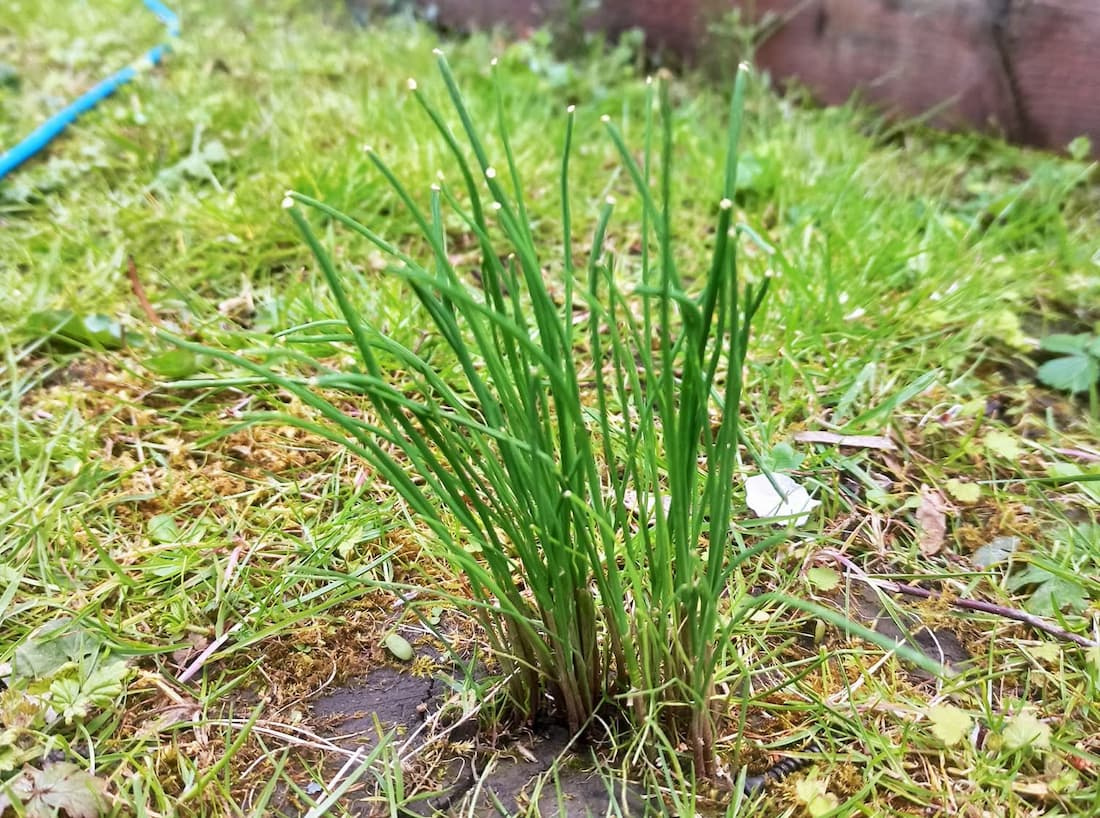
Look for a tight clump of thin, dark-green leaves standing straight up and noticeably taller than the grass around it, most often from fall through spring. From a standing position it reads as a spiky green tuft breaking an otherwise even lawn. The one test that settles it instantly: crush a leaf between your fingers. If you get a strong, unmistakable garlic-or-onion smell, you have an Allium. Nothing else in a normal lawn smells like that.
Structural Anatomy
Up close, the leaves are the giveaway. They are slender, smooth, and — when you roll one between your fingers or slice it — round and hollow, like a miniature drinking straw. That hollow, tube-shaped leaf is the single most reliable feature, and it separates wild garlic from grasses (which have flat or folded solid blades) and from its closest look-alike, wild onion (which has flat, solid leaves).
The leaf surface carries a waxy coating that makes water bead up and roll off. This matters far beyond identification: it’s the reason ordinary sprays fail on this weed, which the herbicide sections cover in detail.
Below ground, the plant grows from a small basal bulb wrapped in a thin, smooth, papery skin, with fine roots coming only off the flat plate at the bulb’s base. When the plant sends up a flower stalk later in the season, the leaves wrap around the lower half of that stalk rather than all rising from the ground.
You can confirm wild garlic with no flower present using four features together: round hollow leaves, a waxy coating, a strong garlic smell when crushed, and an underground bulb in a thin papery skin.
Growth Patterns & Life Stages
Wild garlic runs on a fall-to-spring schedule, the opposite of most lawn weeds. Autumn: shoots emerge from underground bulbs as the soil cools, looking at first like stray grass seedlings — until you notice the round hollow leaf. Winter: it forms a dense green clump and keeps growing while the lawn slows or goes dormant. Spring: the clump shoots upward fast, rising well above the turf — this is when most people spot it. Late spring: mature plants send up a single smooth stalk topped with a papery-covered head that opens to reveal a dense cluster of tiny aerial bulblets (often with few or no real flowers). Summer: the top growth dies back completely and the plant waits out the heat underground as bulbs.
For control, that means two windows when the plant is actively growing and catchable — late fall and early spring — and a “too late” point once the flower stalk forms and the plant heads toward summer dieback.
Gallery
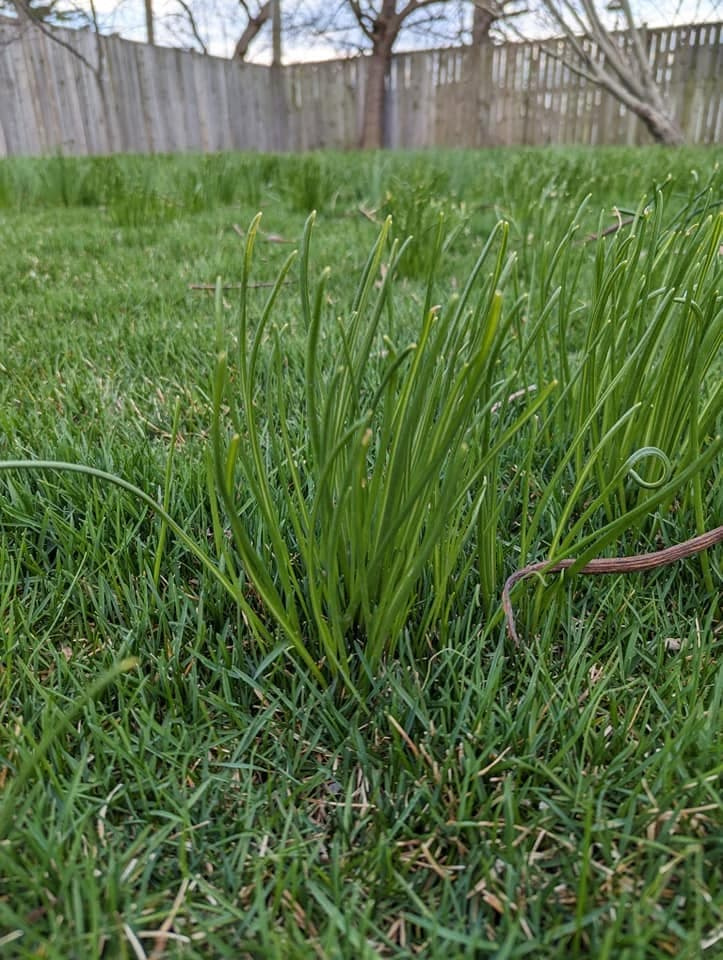
Wild garlic actively outgrowing a manicured lawn in early spring, illustrating its tall, upright growth habit above surrounding turfgrass.
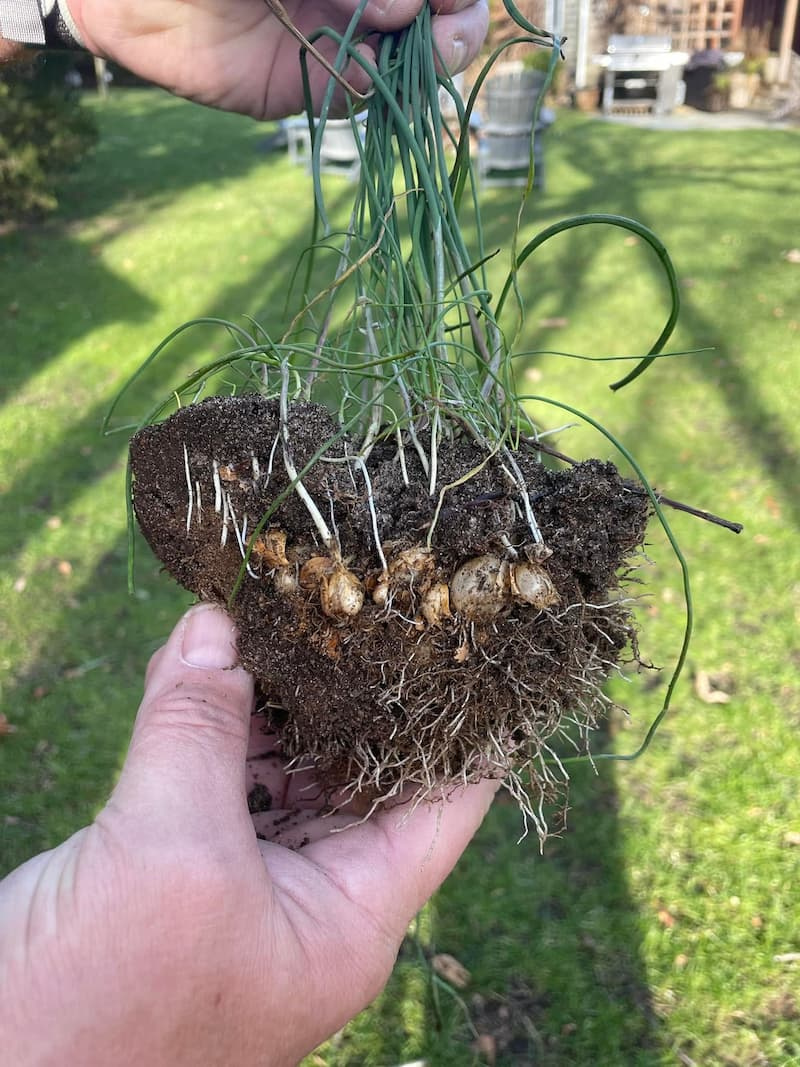
An exposed root mass revealing the subterranean offset bulblets that allow wild garlic to persist and spread beneath the soil surface.
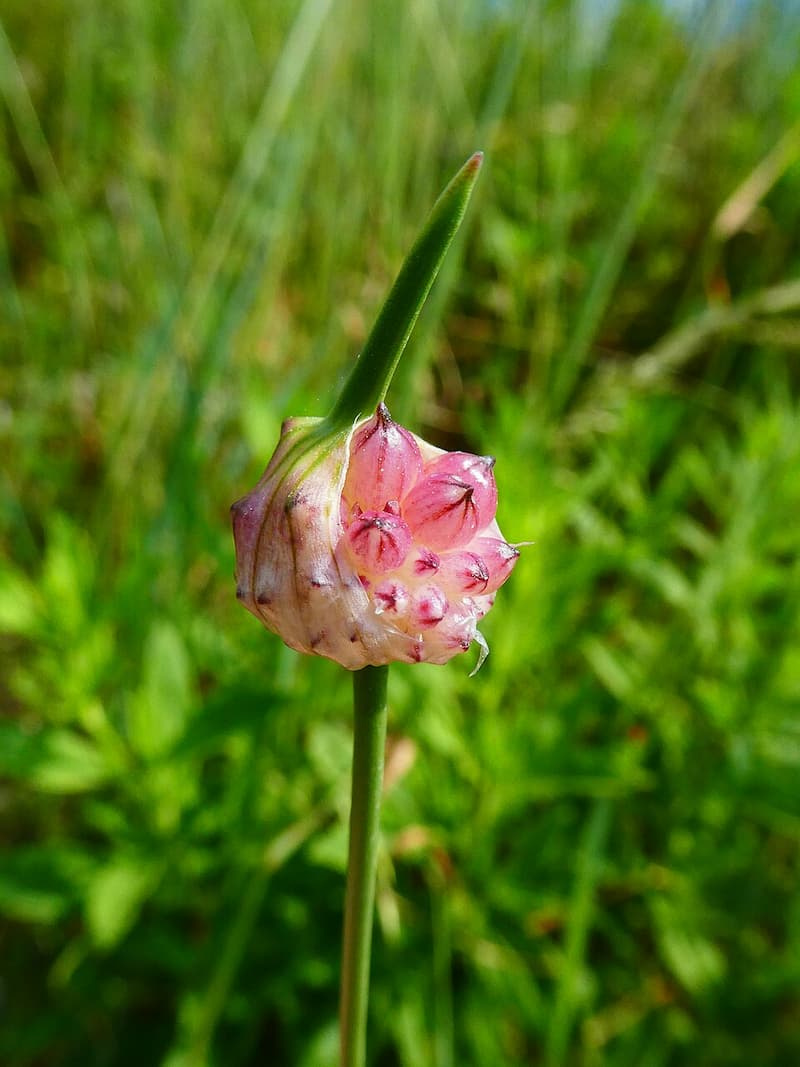
Growth Stage: In late spring, wild garlic sends up a tall stalk topped with a tight cluster of small bulbils, sometimes mixed with a few purple flowers — another way this weed spreads and reseeds itself, on top of the underground bulbs.
“Allium vineale bulbil 04” by Syrio is licensed under CC BY-SA 4.0.
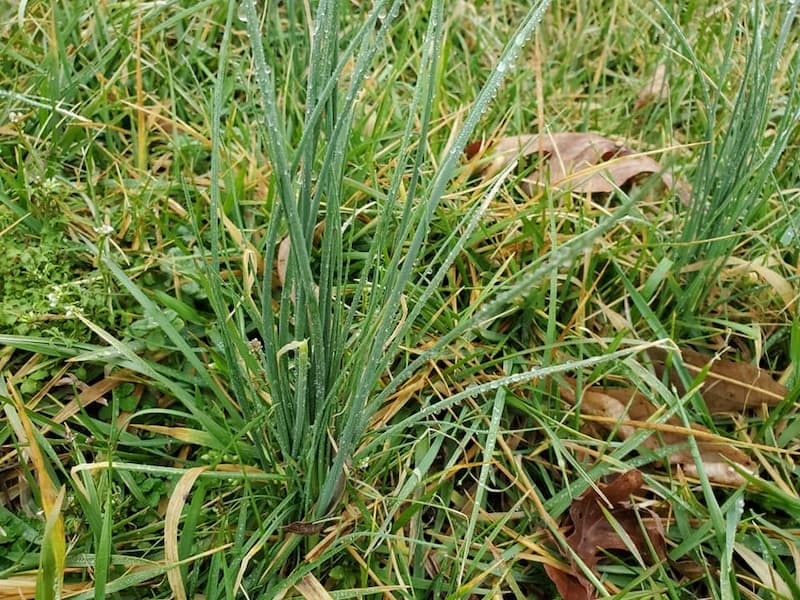
Slender wild garlic shoots waking up early in the season, creating sharp color contrast as they emerge through dormant lawn grass.
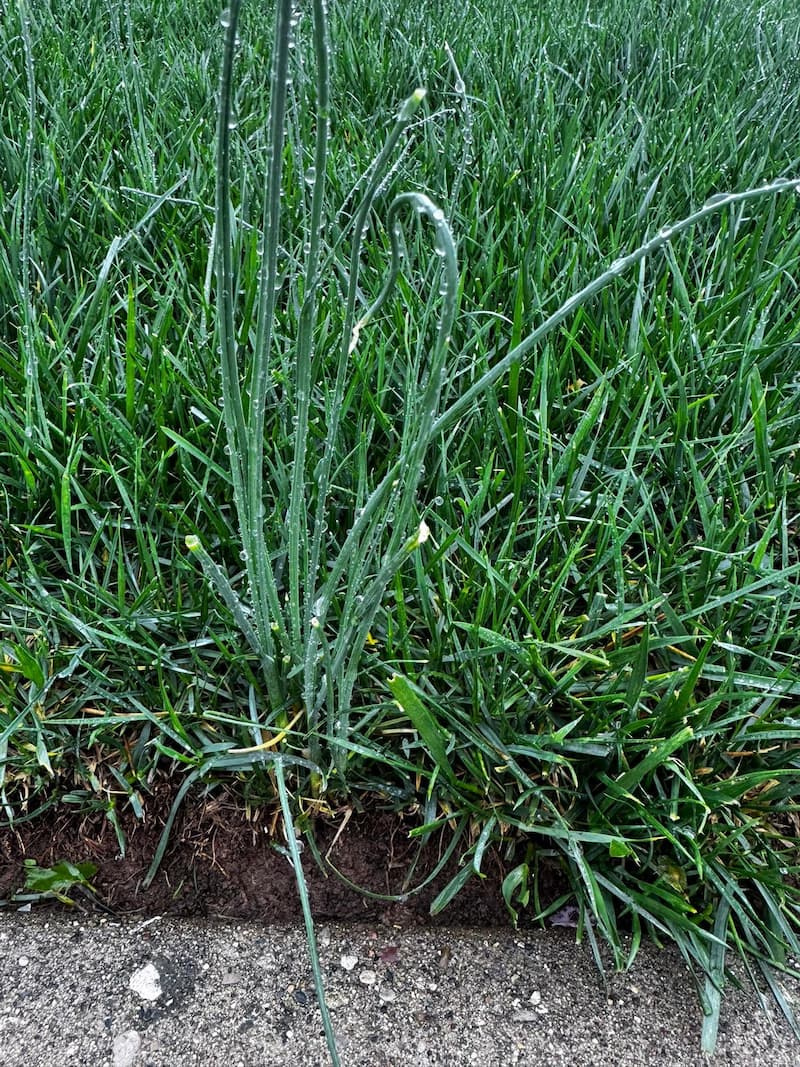
A close-up view of wild garlic (Allium vineale) foliage displaying its characteristic round, hollow stems and curling tips covered in morning dew.
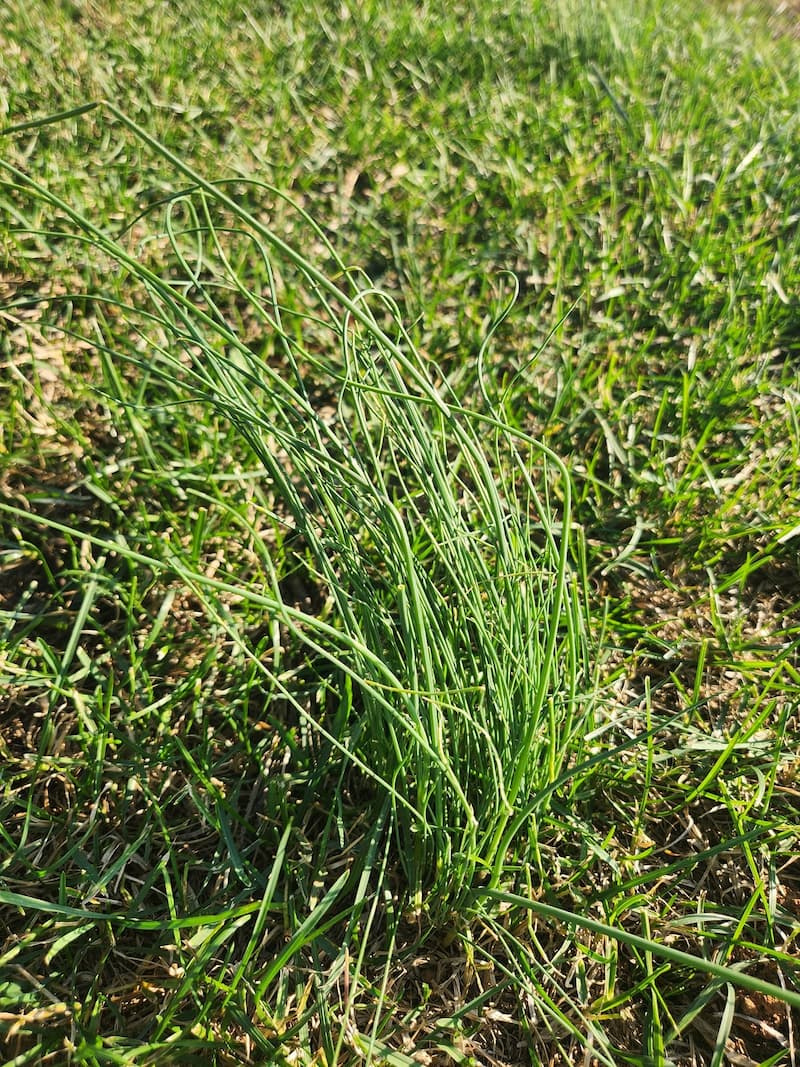
A mature, high-density cluster of wild garlic highlighting the characteristic fine, drooping, and twisted leaf ends.
The Identity Trap
Common Lookalikes
Wild onion (Allium canadense) is the classic mix-up — same upright grassy clumps, same onion-garlic smell, often growing side by side. Star-of-Bethlehem (Ornithogalum umbellatum) looks similar from a distance: low clumps of narrow, dark-green leaves in the same cool seasons.
Identification Differentiators: How to Tell Them Apart
Wild garlic vs. wild onion: slice or roll a leaf. Wild garlic leaves are round and hollow; wild onion leaves are flat and solid. (Bonus confirmation if you dig one up: wild garlic’s bulb has a smooth papery skin, while wild onion’s is wrapped in a coarse, net-like fibrous coat.)
Wild garlic vs. star-of-Bethlehem: crush a leaf and smell it. Wild garlic reeks of garlic; star-of-Bethlehem has no smell at all. Star-of-Bethlehem also carries a distinct white stripe down the middle of each leaf, which wild garlic lacks. This one matters for control, too — star-of-Bethlehem shrugs off the systemic herbicides that work on wild garlic, so getting the ID right changes your whole approach.
Growing Conditions
Host Grasses
Wild garlic isn’t picky about which lawn it invades — it shows up in cool-season turf (tall fescue, Kentucky bluegrass, perennial ryegrass, fine fescues) and warm-season turf (bermudagrass, zoysiagrass, centipedegrass, St. Augustinegrass) alike. What it needs is an opening. It’s a weak competitor, so it establishes in thin, patchy, or stressed turf where it isn’t being crowded and shaded out. A dense, healthy lawn is genuinely hostile to it.
Host Environment/Area
This weed handles a wide range of conditions but leans toward heavy, clay-rich, moist soils, and it tolerates wet, poorly drained spots that would drown out desirable grass. It’s found in both lawns and landscape beds, but it behaves very differently between the two. In a mowed lawn it stays low and spreads almost entirely by underground bulbs. In an unmowed bed, it grows to full height, flowers, and can produce a head packed with up to 300 aerial bulblets — which is why beds act as a hidden supply depot, constantly reseeding the lawn next to them.
Soil Indicators: What the Presence of This Weed Reveals About Your Yard
Wild garlic is a fairly reliable signal of wet, poorly drained, or compacted soil. It thrives in low, heavy, clay-heavy spots where water collects and turf struggles. If it keeps returning to the same area, treat that as a hint to look at drainage and compaction — core aeration, improving runoff, or easing back on irrigation — because fixing the site conditions makes the turf more competitive and the weed less at home.
Lifecycle and Season
Lifecycle Category and Management Implications
Wild garlic is a bulbous perennial, and that single fact drives everything about controlling it. It does not die at season’s end and it does not regrow from seed each year — it comes back from bulbs already sitting in your soil. That means pre-emergent herbicides are useless against it (there’s no seed-germination event to intercept), pulling fails (the bulb stays behind), and the only tools that reach the bulb are systemic post-emergent herbicides timed to the two seasons when the plant is actively moving food down into that bulb. It’s a multi-year job, not a weekend one.
Germination Trigger
Emergence is driven by cooling fall temperatures, not a spring warm-up. Shoots break from the bulbs as nights drop into the 30s–40s°F and days sit in the 60s–70s°F. Because the plant comes up from established bulbs rather than seed, soil-temperature “germination thresholds” of the kind used for annual weeds don’t really apply here — you’re timing to the plant’s emergence and growth, not to seed sprouting.
Wild garlic is active from fall through spring here, staying green and growing while the lawn slows over winter. The best treatment window is late fall (around November). The reason is mechanical, not arbitrary: in fall the plant is pulling sugars down into its bulbs to stock up for winter, and a systemic herbicide rides that downward flow straight into the bulb — which is the only way to actually kill it. A second window opens in late winter to early spring (February–March), and it must be used before the plant starts building its next round of underground bulblets and flower stalks. Once it bolts and heads toward summer dieback, spraying stops working.
Here the plant exploits a gap: it grows all winter while bermudagrass, zoysiagrass, and the rest sit dormant and straw-brown, so the green clumps stand out sharply. Treat during that dormant window — late November through December, and again February to early March. The hard rule in this zone: do not spray as the lawn is greening up in spring. Warm-season grasses rebuilding their roots during green-up are extremely vulnerable to injury, and products like imazaquin or three-way broadleaf mixes applied then can cause serious yellowing and delayed green-up. One extra wrinkle: if you overseed bermudagrass with winter ryegrass, several of the most effective products (imazaquin, metsulfuron) will damage that ryegrass — you’ll need to respect label waiting periods or skip them.
This is the most complicated zone, because both cool- and warm-season grasses may be present and they want opposite things. Wild garlic is most exposed in late fall (after the first hard frost) and early spring, before the waxy flower stalks form. The tension: the ideal fall spray window (late September–November) collides head-on with the ideal fall overseeding window for cool-season grass — broadleaf herbicides will stunt or kill new grass seedlings, so you can’t do both at once. On dormant warm-season turf, imazaquin works well in late fall but will delay spring green-up if used in late winter/spring — so switch to metsulfuron for the spring window there. And be careful with fall core aeration or dethatching: churning the soil can physically scatter the dormant hard offsets and wake them up, spreading the problem. Schedule aeration well before any herbicide plan, not during it.
Herbicide Control
Pre-emergents do nothing for wild garlic. They work by forming a thin barrier that stops seeds from establishing, and wild garlic doesn’t spread from seed in lawns — it comes up from established bulbs full of stored energy that push right through any surface barrier. No extension program lists a pre-emergent product, rate, or timing for this weed, because there’s no seed-germination step to intercept. Skip this aisle entirely and go straight to post-emergent.
Systemic post-emergent herbicides are the main tool, and — despite this being a grass-looking weed — it’s controlled with the broadleaf-lawn herbicide aisle, not crabgrass or grassy-weed products. Match the product to your grass, because some of the best ones will hurt certain lawns:
- 2,4-D (low-volatile ester) and three-way mixes (2,4-D + MCPP + dicamba) — synthetic-auxin products, safe on most common lawns (Kentucky bluegrass, tall fescue, perennial ryegrass, fine fescue, plus bermuda and zoysia). The ester form outperforms the amine form here because it penetrates the waxy leaf better. These burn back top growth well but may need repeating to finish the bulb.
- Metsulfuron-methyl and chlorsulfuron (ALS inhibitors) — very effective, but in cool-season lawns they’re safe only on Kentucky bluegrass and fine fescue; they can injure or kill perennial ryegrass and tall fescue. They tolerate bermuda and zoysia well. Require a non-ionic surfactant.
- Imazaquin and trifloxysulfuron (ALS inhibitors) — strong options on dormant warm-season turf; not for cool-season lawns.
- Avoid: clopyralid (labeled but prohibited on residential lawns due to long compost persistence) and atrazine (simply doesn’t work on this weed).
The waxy-leaf problem, and how to beat it. Wild garlic’s leaves are waxy and near-vertical, so spray beads up and rolls off — poor coverage is the #1 reason treatments fail. Three fixes, all backed by extension:
- Add a non-ionic surfactant (typically 0.25% by volume) so the spray flattens out and sticks instead of rolling off.
- Mow or bruise the clumps right before you spray. This is the opposite of normal broadleaf advice, and it’s deliberate: cutting the hollow leaves opens the plant’s plumbing so the herbicide goes straight in, bypassing the wax.
- Then don’t mow for about two weeks, so the herbicide has time to travel down into the bulb before you remove the treated leaves.
Multi-season reality. Plan on at least two to three years — often three to four in cool-season lawns — of two-treatments-per-year (fall and early spring). The reason isn’t weak chemistry; it’s the dormant hard offsets waking up in later years. Each season’s spray only kills what’s actively growing, so you’re steadily draining a reserve that releases itself over time.
A thick lawn is your cheapest long-term defense, because wild garlic can’t compete with dense turf. Mow at the high end of your grass’s range to shade the soil, keep the canopy full, and repair thin or bare patches fast (overseed cool-season lawns in fall). Feed the lawn on its schedule, not the weed’s — fall nitrogen for cool-season grass; for warm-season grass, wait until it’s fully green in spring, because feeding dormant turf just feeds the wild garlic instead. Lime acidic soils per a soil test to keep the grass vigorous. One specific trap: never mow wild garlic once its flower heads have matured — the blades shatter the heads and fling bulblets across the yard on the clippings and tires. If you’re going to mow it for suppression, do it before the heads ripen.
As in lawns, there’s no effective pre-emergent for established wild garlic in beds. Pre-emergents stop seeds, and this weed comes from bulbs. A product like prodiamine or pendimethalin might block the rare true seedling, but that’s a negligible fraction of the problem, so it’s not worth treating as a control tool here.
Broadcast spraying is off the table around ornamentals — you have to isolate the weed. Two directed approaches:
- Directed glyphosate (non-selective) as a shielded spot-spray or wick/sponge wipe on the wild garlic leaves that stand above the ornamental canopy. It kills foliage and bulb, but any contact with a desirable plant’s green tissue or bark can severely injure or kill it — use a nozzle shield or wipe-on applicator, never a broadcast spray. (Buying tip: not every product labeled “Roundup” is glyphosate anymore — check the active-ingredient panel.)
- Sulfosulfuron (Certainty) is selective and labeled to go over the top of a number of tolerant woody ornamentals (boxwood, holly, arborvitae, juniper, liriope, and others — check the label for your specific plants). It needs a surfactant.
The same waxy-leaf tricks apply: add a surfactant, or crush the foliage right before applying. Be careful with two products in particular: synthetic-auxin sprays (2,4-D, dicamba, MCPP) are highly toxic to broadleaf ornamentals and drift and leach easily — keep them outside tree and shrub driplines entirely; and imazaquin is readily taken up by ornamental roots (it stunts azalea, birch, and holly) and persists in the soil, so it must not be used where bedding plants grow now or will be planted next season. Metsulfuron is turf-only — keep it out of beds. Expect the same multi-season commitment in beds as in lawns.
Mulch mostly doesn’t stop this weed. A 3–4 inch layer of bark or wood chips suppresses seed-based weeds, but wild garlic’s energy-packed bulbs generate enough upward force to push the tubular leaves straight through several inches of mulch with no trouble. Mulch will catch the occasional rare seedling, but against established bulbs it’s ineffective. Where you need a real physical barrier in a bed, extension sources point to synthetic landscape fabric or heavy sheeting rather than loose organic mulch.
Herbicide Application Reference
- 2,4-D ester volatility: the ester form that works best on wild garlic is prone to vaporizing and drifting in warm weather (roughly above 85°F). Spray in cool, calm conditions, especially near beds.
- Dicamba mobility: dicamba moves in soil and can reach the roots of nearby shrubs and trees — never apply it over the root zone or inside the dripline of desirable woody plants.
- Imazaquin soil residue: it lingers in soil and can injure ornamentals planted later; don’t use it where bedding plants are or will be growing.
- Metsulfuron is for turf only: keep it away from ornamental beds — it’s severely phytotoxic to broadleaf plants.
- Surfactant caution: the surfactant you need for coverage can also cause temporary turf yellowing; that’s expected and short-lived.
- A product note that is easy to miss: the consumer “Roundup” brand no longer reliably means glyphosate. Several reformulated versions now use different active ingredients, and some of them — imazapic is one — stay active in the soil, where nearby ornamental roots can take them up. That is the exact problem glyphosate is chosen to avoid here. Before you buy, read the active-ingredient panel and pick a product whose only active ingredient is glyphosate.
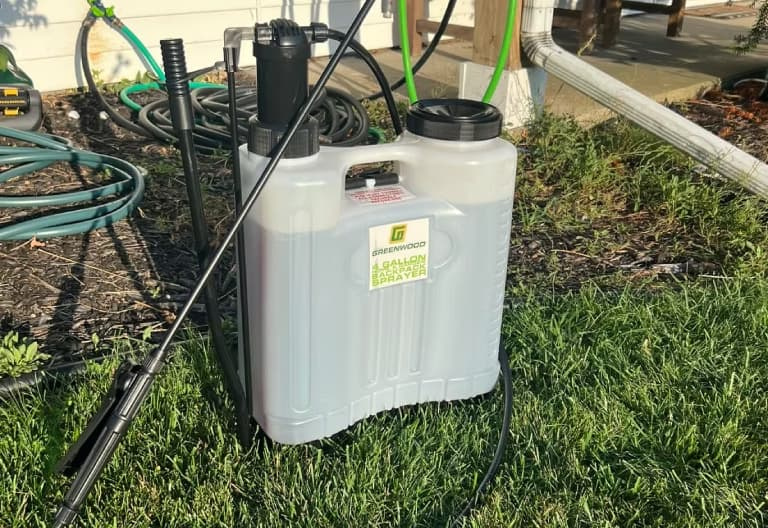
Herbicide Application Guide
New to spraying, or want to get it right? Our Herbicide Application Guide covers the practical steps this page assumes — mixing, calibration, protective gear, and the wind and temperature limits that decide whether a treatment works or drifts. Read it before you spray.
See Guide
Where Two Lawns Meet
Does your lawn border a neighbor’s — or meet a different type of grass? Spraying near that line can quietly damage the yard next door, sometimes weeks later. Where Two Lawns Meet shows you how to treat safely without harming either side.
Read ArticlePulling
Don't pull it. Hand-pulling almost always fails and can leave you worse off than before.
The Biological Reason
Here’s what actually happens when you pull. The leaf is thin, hollow, and weak, so it snaps off cleanly at the soil line — and the entire bulb stays behind, completely undamaged, ready to send up fresh shoots within days. You feel like you removed the weed, but you removed the top of a plant whose whole survival system is underground. Extension programs call this a “total-miss” failure: it isn’t that you damaged the bulb and it regrew, it’s that you never touched the bulb at all.
Digging can work, but it’s demanding, because of what’s under the soil.
Underground Structure Explainer
Wild garlic doesn’t grow from one simple bulb — it grows from a layered cluster, and each layer is a different survival strategy:
- The mother bulb — the central bulb the visible plant grows from, wrapped in a thin papery skin.
- Soft offset bulblets — larger, whitish daughter bulbs held against the mother bulb. They have no real dormancy and sprout that same fall, quietly replacing the parent.
- Hard-shelled offset bulblets — small, flattened, and sealed in a tough, varnished brown shell. These are the problem. They stay dormant in the soil and sprout on their own schedule over the next one to five years — a couple this year, a couple two years from now, a couple you’d forgotten about by year four.
Aerial bulblets — up to a few hundred tiny bulblets formed in the flower head, which drop to the ground (usually within about a foot of the parent) and start new clumps nearby.
That five-year dormant reserve is the whole reason wild garlic is so hard to be rid of. When you dig, you have to get all of it, and the offsets that matter most sit deeper than the plant looks like it should. The visible cluster is often only 3–4 inches down, but the dormant hard offsets — the ones that cause the comebacks — can sit as deep as 8–10 inches. So:
- Dig, don’t pull, and dig when the soil is moist. Wet, soft soil lets the whole cluster slide out; dry or compacted soil shatters it and strips the offsets off, leaving them behind.
- Go deeper than you think you need to — get the trowel or fork well beneath the cluster, at least 6 inches and deeper where you can, to reach the low-sitting hard offsets.
- Bag everything, including loose bulblets and any flower heads. Screen the soil you lifted. A single hard offset left behind resets the clock. Never compost the debris or use infested soil as fill — you’ll just plant it somewhere new.
Repeatedly mowing or snapping off the tops, on its own, won’t win. It slowly drains the bulb’s stored energy and it does usefully stop flower stalks from forming — but it rarely starves the bulb out completely, so it’s a helper, not a cure.
Lawn vs. Bed Pulling Difference
Loose, cultivated bed soil makes digging physically easier — but it actually makes the total-miss problem worse, not better. The soft and hard offsets are held onto the mother bulb by a fragile papery membrane, and disturbing loose soil ruptures that membrane easily, so the offsets detach and stay behind in the worked ground. In a bed, a careless dig can scatter more bulblets than it removes.
Quick Reference Summary
| Lifecycle | Bulbous perennial (monocot) |
| Active Zones | Cool-season, warm-season, transition — active fall through spring |
| Emergence Trigger | Fall cooling (nights 30s–40s°F); emerges from bulbs, not seed |
| Pre-Emergent | No — ineffective (no seed step to intercept) |
| Post-Emergent Timing | Late fall (~Nov) and late winter/early spring (Feb–Mar) |
| Pull | No — snaps off, leaves bulb intact |
| Lawn Primary Tool | Systemic post-emergent (2,4-D ester / three-way; sulfonylureas by grass type) + surfactant + mow-before-spray |
| Bed Primary Tool | Directed/shielded glyphosate or wick-wipe; sulfosulfuron over tolerant ornamentals |
| One-and-Done or Multi-Season | Multi-season — plan 2–3 years, often 3–4 in cool-season lawns |
Frequently Asked Questions
These answers are synthesized from botanical morphology studies and herbicide efficacy trials conducted by leading university agricultural extensions.
Because the part that regrows is underground and you probably never removed it. Pulling snaps the hollow leaf off and leaves the whole bulb in place. Even digging usually leaves behind small hard-shelled offset bulblets that can stay dormant for up to five years and sprout whenever they’re ready — so new plants keep appearing long after you thought you were done.
No. The bulbs sit safely below the blade. Mowing helps only in two narrow ways: it slowly weakens the plant over years, and it stops flower stalks from forming. But timing matters — if you mow after the flower heads mature, you’ll shatter them and spread hundreds of bulblets across the lawn. Cut before the heads ripen, or not at all.
Only if you help it stick. Wild garlic’s waxy, upright leaves make spray bead up and roll off, so a plain application often does little. Add a non-ionic surfactant and mow or bruise the clumps right before spraying so the herbicide can get in. Also note: atrazine, a common lawn herbicide, simply doesn’t work on this weed.
Not right away in fall. The broadleaf herbicides used on wild garlic will stunt or kill new grass seedlings, and the fall treatment window overlaps the fall overseeding window. You have to pick one for that timing, or space them out — check your product’s label for how long to wait before seeding.
It’s a true Allium and smells the part, but it’s not the culinary garlic you’d want on your plate — it’s strong, bitter, and taints milk and flour when livestock or crops get into it. Like other onions and garlics, alliums can be toxic to dogs, cats, and livestock in quantity, so it’s not something to feed animals or eat off an unknown lawn. Best treated as a weed, not a harvest.
Scientific Authority
This profile is constructed using forensic botanical data and Integrated Pest Management (IPM) research. We prioritize scientifically-vetted identification and control methods that protect the broader ecosystem while ensuring successful eradication based on peer-reviewed agricultural studies.
Primary Resources
- Penn State Extension — Wild Onion and Wild Garlic
- Purdue University Turf — Wild Garlic / Controlling Wild Onion or Wild Garlic in Lawns
- Ohio State University Extension — Wild Garlic (Allium vineale), Ohio Perennial and Biennial Weed Guide
- Cornell Cooperative Extension (Cornell CALS) — Wild Garlic weed profile
- Rutgers Cooperative Extension — Wild Garlic (Burlington County)
- UMass Amherst — Allium vineale, Landscape/Nursery/Urban Forestry Program
- Michigan State University — Wild garlic vs. wild onion (IPM); MSU Turfgrass Information archive (sulfonylurea tolerance)
- University of Georgia CAES / Extension — Wild Garlic (GeorgiaTurf); “A Stinky Story” – Controlling Wild Garlic in Home Lawns
- Clemson Cooperative Extension (HGIC) — Wild Garlic & Wild Onion; Weed of the Month – Wild Garlic
- NC State Extension — Wild Garlic (TurfFiles); Allium vineale (Extension Gardener Plant Toolbox); Controlling Sedges in Landscape Plantings
- University of Florida IFAS Extension — Postemergence Herbicides for Use in Ornamentals; Weeds as Indicators of Soil Conditions
- Auburn University (Alabama Extension) — Home Lawns: Chemical Weed Control
- University of Arkansas Cooperative Extension — Wild Garlic / Onion; Home Lawn Weed Control
- Virginia Tech / Virginia Cooperative Extension — Wild Garlic weed profile (VT Weed ID); warm- and cool-season lawn management publications
- University of Missouri Extension — Wild Garlic (Mizzou WeedID); turf management publications
- University of Tennessee (UTIA) — Wild Garlic (Allium vineale)
- Kansas State Research and Extension — Weed Control in Home Lawns (MF2385)
- Oklahoma State University Extension — Controlling Weeds in Home Lawns (HLA-6421)
- West Virginia University Extension — Star-of-Bethlehem
- UC IPM (UC ANR) — Wild Garlic pest/identification pages
- Washington State University Extension — Wild Garlic: Allium vineale L.
- Weed Science Society of America (WSSA) — weed biology fact sheets
- University of Kansas, Bever/Schultz Lab — peer-reviewed research on sexual vs. asexual reproduction in Allium vineale