
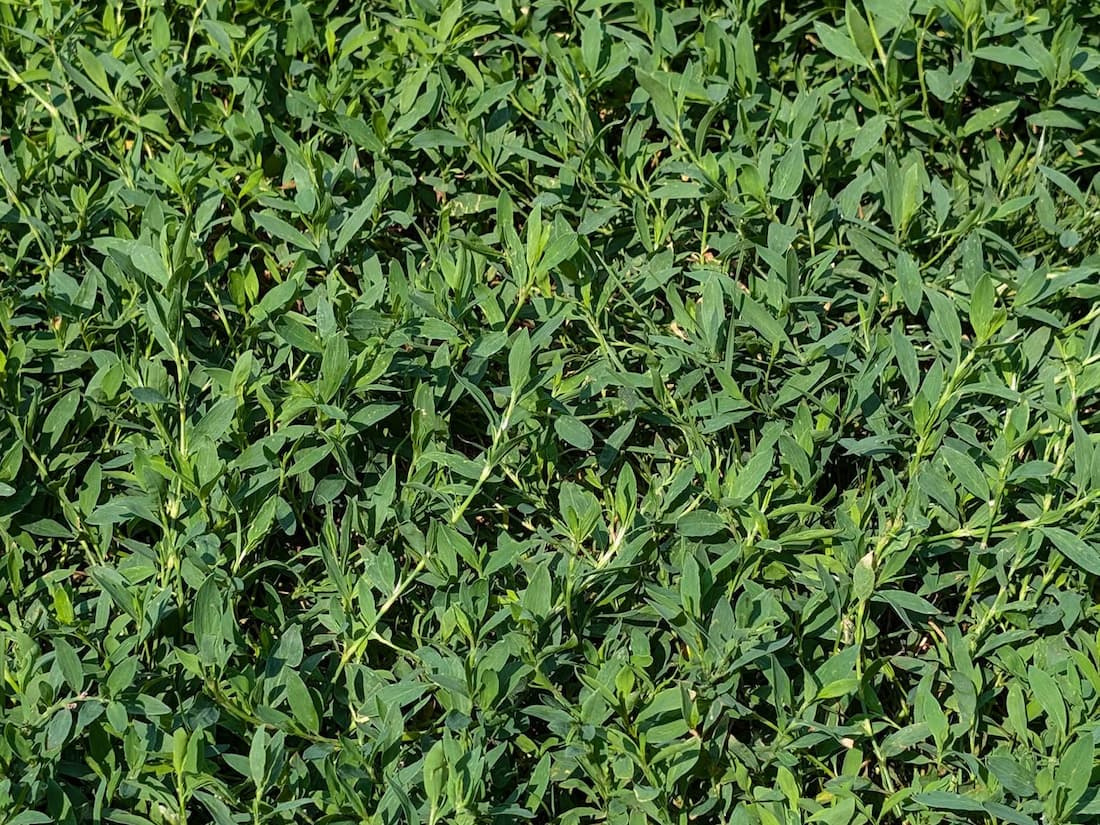
Prostrate Knotweed At-a-Glance
Weed Type
Broadleaf
Life Cycle
Summer annual
Growth Habit
Prostrate / mat-forming
Root Type
Taproot (fine, deep, branching)
Spreading Risk
High — by seed only
Pull
With Caution
Identity & Diagnostics
Visual Fingerprint
Look for a flat, wiry mat that spreads out from one central point like spokes on a wheel, hugging the ground so tightly the mower rolls right over it. The stems are tough, thin, and zigzag between slightly swollen joints. The small oblong leaves are a dull blue-green, often with a faint waxy, powdery cast. You’ll almost always find it in the hardest, most beaten-down ground on the property — sidewalk edges, driveway cracks, worn footpaths — not out in the healthy middle of the lawn.
Structural Anatomy
The one feature that confirms knotweed and nothing else is the ocrea: a thin, papery, silvery sheath that wraps completely around the stem at every joint where a leaf attaches. If you slide a fingernail up the stem to a node and find a little papery collar, you have a member of the buckwheat family, and in a lawn that almost always means knotweed. On knotweed the ocrea is smooth — no fringe of hairs, no obvious veins.
Everything else supports that one feature. The leaves are simple, hairless, smooth-edged, and arranged alternately (one leaf per joint, staggered — not paired). The stems are round in cross-section with fine lengthwise ribs, and the joints are visibly swollen and knobby — that swelling is where “knotweed” gets its name. Snap a stem and the sap runs clear and watery, never milky. Below ground sits a fine but deep central taproot, not a shallow spreading net of fibers.
So, with no flowers present, you can confirm knotweed by four things together: a papery ocrea at every node, alternate blue-green hairless leaves, wiry zigzag stems with swollen joints, and clear (not milky) sap over a central taproot.
Growth Patterns & Life Stages
Knotweed’s stages matter because each one changes what you can do about it.
Seedling (very early spring). The first thing up in the yard each year. It emerges with a reddish stem base and two long, extremely narrow seed leaves that look so much like grass blades that people mistake it for the lawn recovering on its own — and leave it alone. That mistake is how it gets a head start. This is the stage to catch.
Juvenile (spring). It briefly grows upright, then the joints swell, the papery ocrea appears, and it starts to sprawl. Still tender here, still easy to kill or pull.
Mature mat (early summer on). It flattens into a tough, wiry, many-branched mat that can reach three to four feet across. The stems get woody and the leaves develop a waxy coat. Once it hits this stage, sprays struggle to get in and hand-pulling starts to fail.
Flowering and seed set (June through fall). Tiny, petal-less flowers — five green sepals edged in white or pink — appear tucked in the leaf joints and open only in bright, hot sun. Seed follows right behind and keeps coming, plant after plant, all the way to frost. Once flowering starts, you’re in the danger window for spreading seed.
Gallery
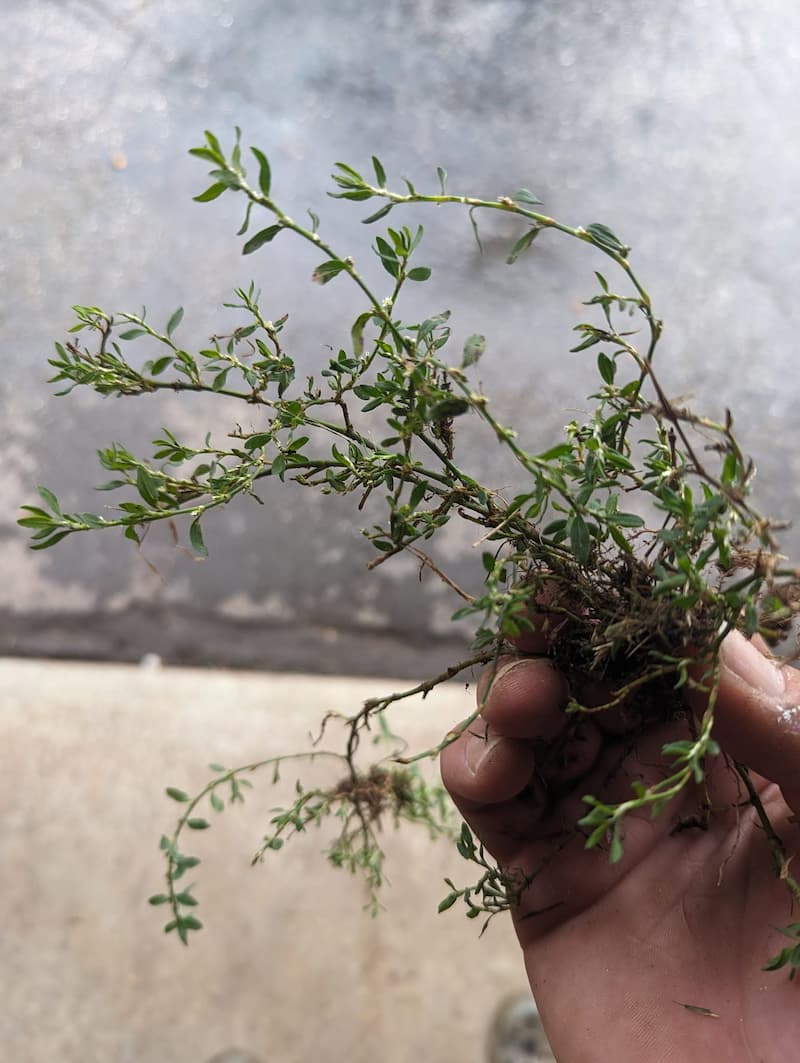
Uprooted prostrate knotweed specimen highlighting the central taproot and small axillary flowers along the stems.
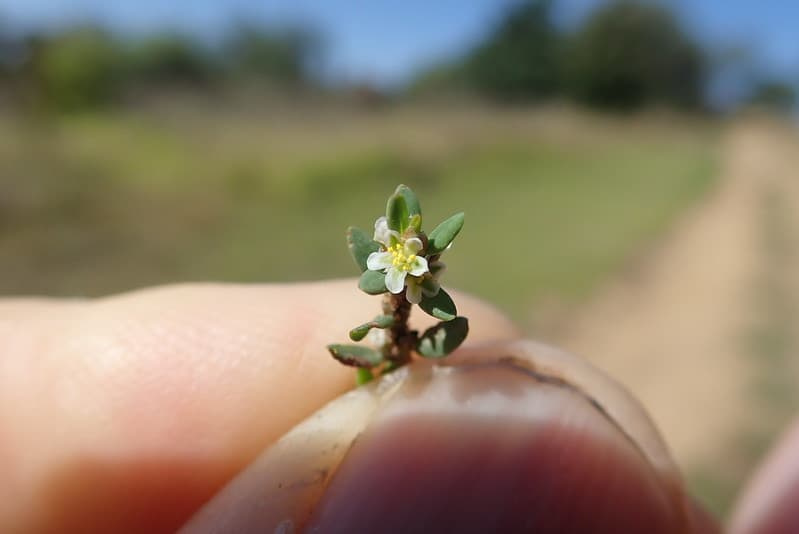
Diagnostic Feature: Tiny white-to-pink flowers cluster tightly at each leaf joint along the wiry stem — a detail easy to miss but the surest way to confirm you've got knotweed and not a look-alike like spotted spurge.
“Polygonum aviculare flower CWS 1” by Macleay Grass Man is licensed under CC BY 2.0.
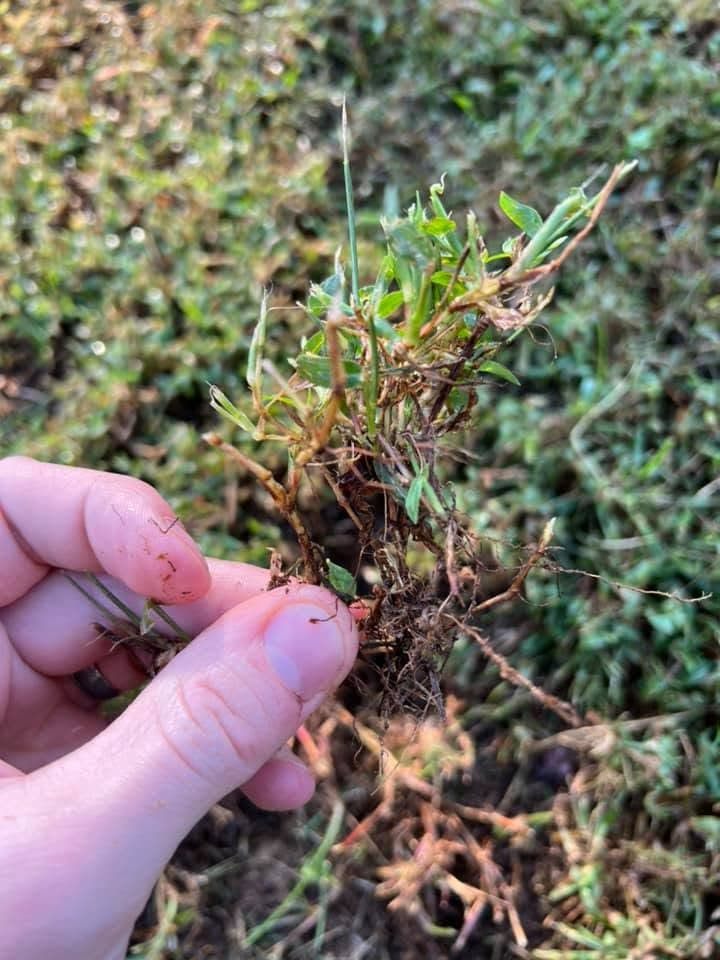
A specimen of prostrate knotweed showing the extent of its root mass and low growth, even when intertwined with established turfgrass.
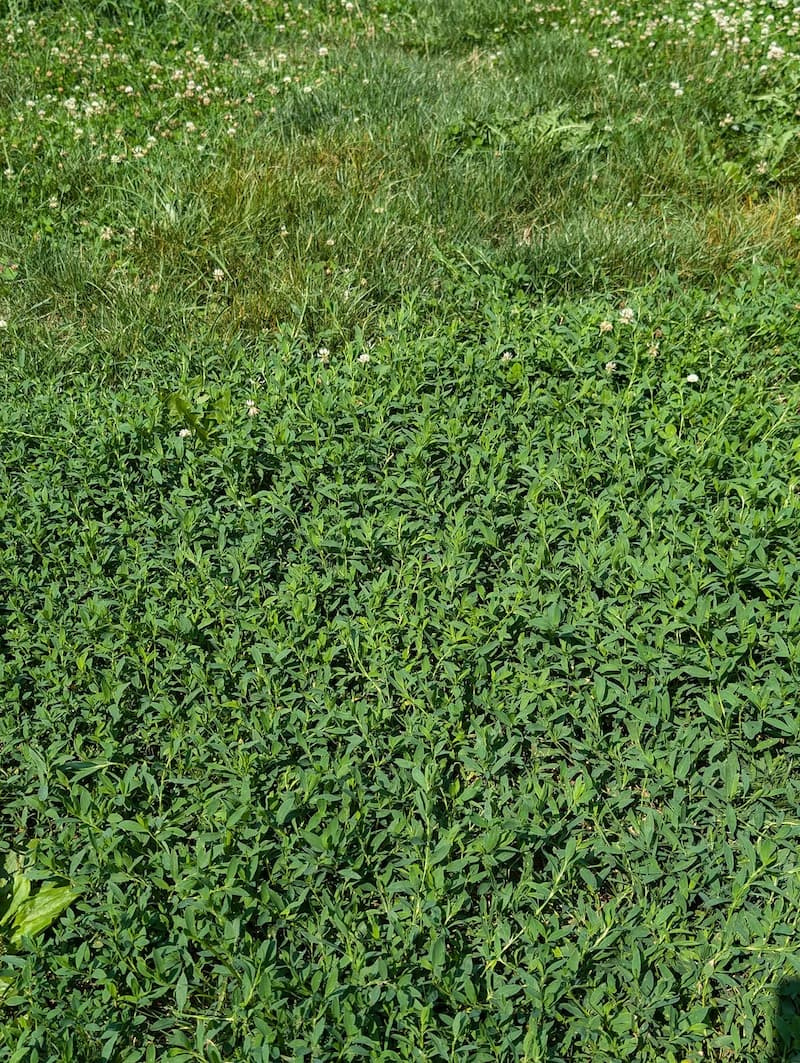
Aggressive prostrate knotweed growth forming a solid cover and suppressing neighboring broadleaf weeds.
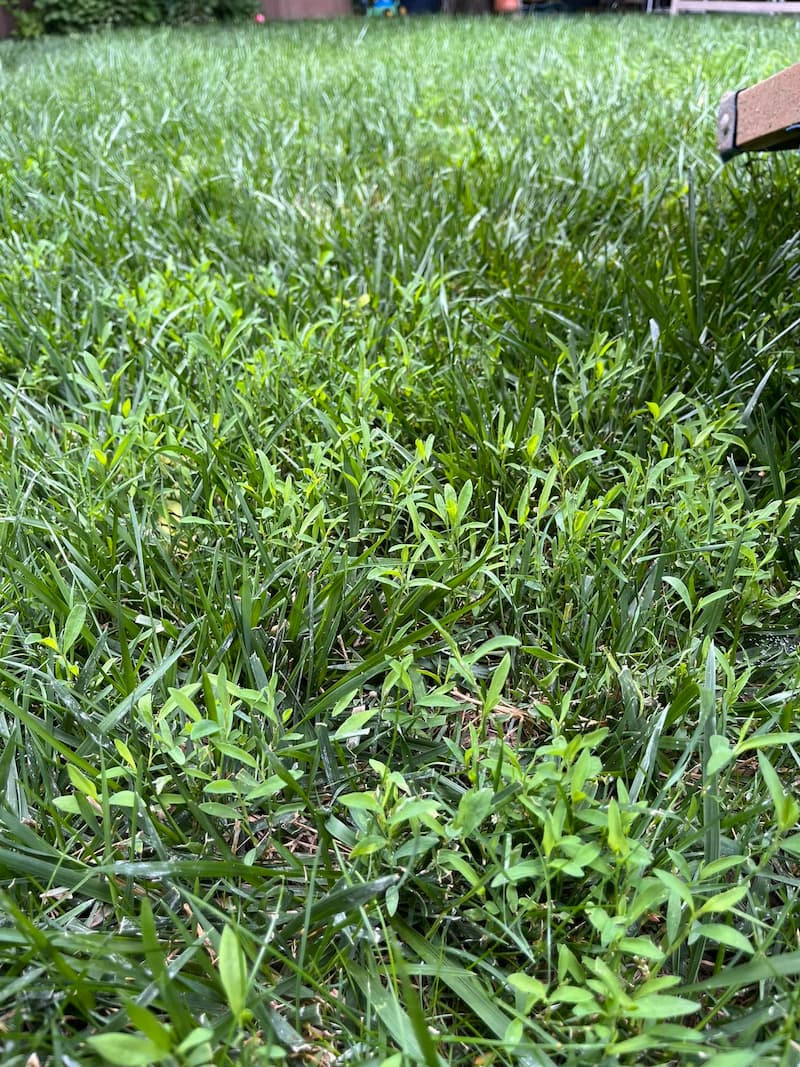
Prostrate knotweed establishing within a turfgrass canopy, illustrating its ability to compete in lawn areas.
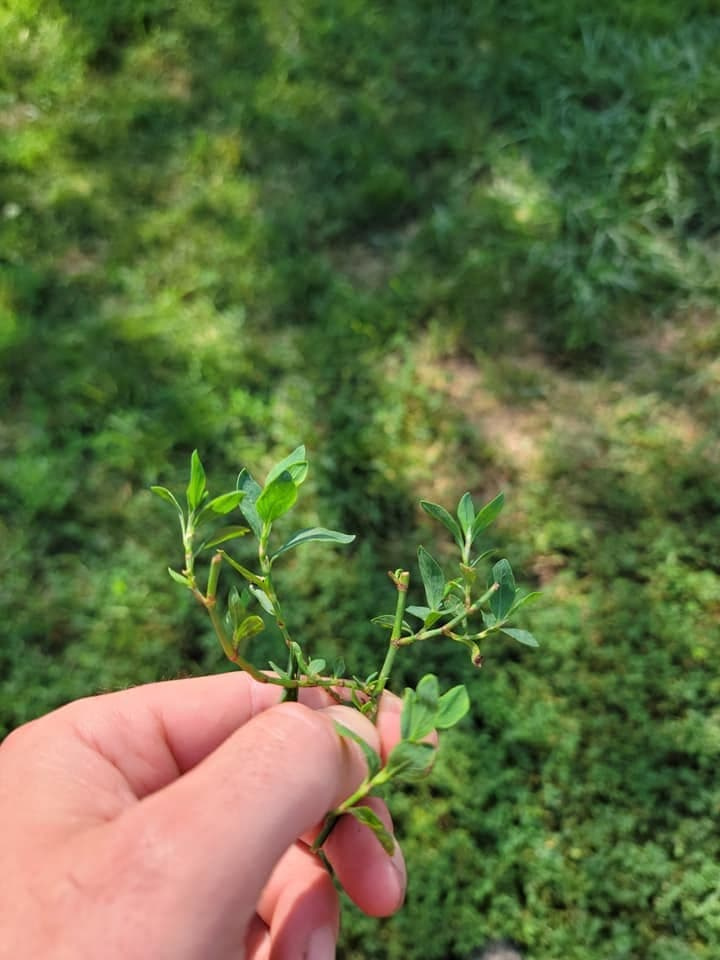
This perspective illustrates prostrate knotweed’s ability to form a dense ground cover, outcompeting other common weeds and grasses.
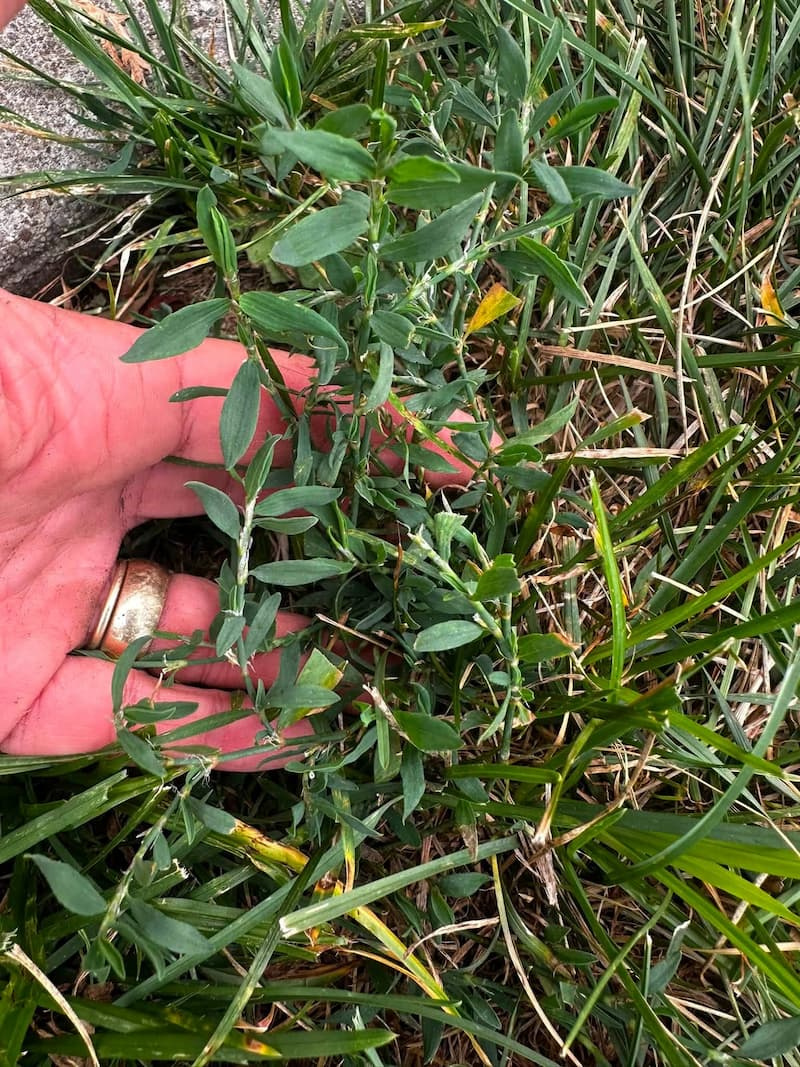
Detailed view of alternate leaves and the distinctive papery sheath (ochrea) wrapped around the stem nodes.
The Identity Trap
Common Lookalikes
Spotted spurge shares the same flat mat and the same compacted cracks and edges, so the two are constantly mixed up. Common purslane is another low, sprawling summer-annual mat that shows up in the same beaten ground.
Identification Differentiators: How to Tell Them Apart
Knotweed vs. spotted spurge — snap a stem. Spurge bleeds a sticky, milky-white sap; knotweed’s sap is clear and watery. That single test settles it every time. If you want a second check: spurge leaves are paired (opposite) and often carry a small maroon blotch, knotweed leaves are staggered (alternate) and plain — and spurge has no papery ocrea at the joints.
Knotweed vs. common purslane — pinch a stem. Purslane is a juicy succulent: thick, fleshy, rubbery stems and plump leaves that feel like a jade plant. Knotweed is the opposite — thin, dry, wiry, and tough. Purslane also has no ocrea. (One more reason this difference matters: broken purslane stems can re-root where they land; knotweed stems can’t.)
Growing Conditions
Host Grasses
Knotweed isn’t picky about grass species — it’s picky about grass weakness. It invades thin, worn, compacted stands of every common turf: cool-season Kentucky bluegrass, tall fescue, and perennial ryegrass, and warm-season bermudagrass, zoysiagrass, centipedegrass, and St. Augustinegrass. What it needs is an opening. Wherever the canopy has thinned enough to let light reach bare soil, knotweed seed germinates and moves in. Healthy, dense turf shades it out before it can start.
Host Environment/Area
This weed lives in the hardest ground you have. Its signature spots are compacted, high-traffic strips: sidewalk and driveway edges, footpaths and shortcuts across the lawn, gravel areas, cart paths, play areas, and the worn margins of landscape beds. These are places where constant foot, wheel, and equipment traffic has packed the soil so tight that oxygen and water barely move through it — conditions that kill turf roots but that knotweed’s fine taproot handles easily.
The lawn-versus-bed difference here is real and useful: knotweed is mostly an edge problem in beds, not an interior one. It colonizes the compacted, thinly-mulched border where a bed meets a walkway or driveway, then creeps inward. The loose, cultivated soil in the middle of a well-kept bed is actually poor habitat for it.
Soil Indicators: What the Presence of This Weed Reveals About Your Yard
Knotweed is one of the most reliable indicator weeds there is, and this is the most important thing to understand about it: its presence is a near-certain sign of compacted soil. Extension sources call it the “poster child” for compaction, and you can trust that reading with high confidence — because knotweed doesn’t just tolerate packed soil, it’s built to thrive in it while everything else fails. If knotweed is thriving in a strip of your yard, that strip is compacted, and no amount of spraying will fix the underlying reason it’s there.
Two weaker signals ride along with it. Knotweed also tends to favor low-fertility, nitrogen-poor ground. And it’s sometimes listed as an acidic-soil (low pH) indicator — but treat that one loosely, because knotweed tolerates a huge pH range, from strongly acidic to strongly alkaline. Compaction is the signal you can bank on; pH is not.
Lifecycle and Season
Lifecycle Category and Management Implications
Prostrate knotweed is a summer annual that reproduces only by seed — no roots, runners, or bulbs survive the winter. Every plant you see grew this year from seed in the soil. That’s good news and bad news. The good news: a soil barrier that stops seeds from establishing (pre-emergent) is your single most powerful tool, which is not true for perennial weeds. The bad news: the seed bank is enormous and long-lived, so one clean season doesn’t end it. Control is about intercepting germination year after year while fixing the compaction that keeps inviting it back.
Germination Trigger
Knotweed germinates when soil temperature at a one-inch depth reaches about 40°F (5°C) — roughly late February to early March in much of the country. That makes it the earliest summer annual to emerge, well ahead of crabgrass (which needs about 55°F) and goosegrass (60–65°F). Nearly the whole population comes up in one big early flush, with only a small trickle of later germinators through summer and fall.
Knotweed is active from that first ~40°F soil warming in late winter until frost. Because it’s up and growing weeks before cool-season grasses shake off dormancy, it grabs bare, compacted spots before the lawn can compete.
The pre-emergent window is the whole story here, and it’s earlier than you think. The barrier has to be in the ground before soil hits 40°F, which means a late-fall application (November–December) is ideal, with very early spring as a fallback. Here’s the trap: the standard crabgrass-preventer timing — mid-spring, around when forsythia blooms — is 6 to 8 weeks too late for knotweed. By then it has already germinated, and pre-emergent does nothing to a plant that’s already up. The post-emergent window opens in spring while plants are small and closes fast as they toughen.
Warmer spring soils mean the barrier has to go down even sooner — often January or early February — to beat the earliest flush. There’s a bonus to going that early: pre-emergents break down mainly through soil microbes, and microbes are sluggish in cold soil, so an early application degrades slowly and holds its barrier longer.
The warm-season angle worth knowing is the green-up gap. Bermudagrass, zoysiagrass, centipedegrass, and St. Augustinegrass are still dormant or barely greening in late winter, giving no canopy competition exactly when knotweed is exploding out of the ground. Two cautions: never apply broadleaf post-emergents during the sensitive spring green-up transition, and never spray them when it’s above 90°F — both cause serious warm-season turf injury.
The transition zone is the hardest, because knotweed’s mid-February germination collides with everything else on the calendar.
The barrier still has to be down in late winter, before 40°F soil. But three conflicts stack up. First, spring overseeding: the pre-emergents that block knotweed seed block desirable grass seed just as effectively, so you can’t put down an early barrier and overseed thin fescue in the same spring — you have to choose. Second, warm-season green-up injury: a late-winter glyphosate cleanup on dormant bermudagrass will badly delay green-up if even 15% of the leaves have started to green, and liquid pre-emergents like oxadiazon will burn foliage once green-up begins. Third, aeration timing: early spring core aeration punches through the pre-emergent barrier you just laid down, opening untreated holes for knotweed to sprout in. These conflicts are covered in more depth under Herbicide Control and in the FAQs, but the short version is: in the transition zone, plan the calendar deliberately, because the default schedules fight each other.
Herbicide Control
Pre-emergent is the most effective chemical tool against knotweed, but only if you fix the timing — and only if you pick the right active ingredient. Two commonly-sold pre-emergents, dithiopyr (Dimension) and trifluralin used alone, are documented as weak and unreliable on knotweed even though they work fine on crabgrass. Reach for these instead:
- Isoxaben — the top-rated broadleaf pre-emergent for knotweed. Very safe on established cool- and warm-season turf. Note it blocks overseeding.
- Prodiamine and pendimethalin — effective and safe on established lawns, but they prune roots, so they’ll stall recovery of newly seeded or sprigged turf and can require a long wait (up to ~120 days) before you can seed.
- Oxadiazon — useful on worn warm-season turf because, unlike the others, it doesn’t inhibit stolon and sprig rooting, so damaged bermudagrass can still knit back in.
Apply the barrier before soil reaches 40°F — late fall (November–December) is best, very early spring at the latest. Because the barrier degrades over the season and a small fraction of seeds germinate later, a second (split) application about 60 days after the first is what actually holds the line through summer. Water the barrier in with about half an inch of rain or irrigation within a day or two of applying, or it won’t activate.
Verdict: multi-season, not one-and-done. Post-emergent is your backup for plants that beat the barrier, and it lives or dies on growth stage. Hit knotweed young, small, and actively growing in spring, and it’s very controllable. Let it mature into a waxy, woody mat and sprays barely penetrate — you’ll get some leaf burn and fast regrowth.
Plain 2,4-D alone gives only fair control — knotweed is too tough for it. What works is 2,4-D combined with triclopyr or dicamba (sold as three-way products), because those partners drive systemic kill into the woody stems. On warm-season lawns, selective options like metsulfuron-methyl and the combination product Celsius (thiencarbazone + iodosulfuron + dicamba) give strong control with good turf safety. Because knotweed’s leaf surface is waxy, add a non-ionic surfactant or methylated seed oil so the chemical can get in. Spray on actively growing plants with soil moisture present, between about 55°F and 85°F; never during warm-season green-up, and never above 90°F on warm-season turf. Expect to treat over several seasons, not once.
This is the part most people skip, and it’s the part that actually ends the problem — because knotweed is a compaction weed, and chemicals don’t decompact soil.
The primary lever is relieving compaction with hollow-tine core aeration (the kind that pulls out soil plugs, not solid spikes that just press the soil harder). Aerate when the desirable turf is actively growing so it fills in fast — spring or fall for cool-season grass, early summer for warm-season. There’s one catch to manage: aeration lifts buried knotweed seed to the surface where it can sprout, so always aerate and overseed together, then feed the turf to close the canopy quickly. Pair that with traffic management — rope off or reroute the worn paths that caused the compaction, or it just packs down again.
Two more levers matter. Mow high — 3 to 4 inches for most cool-season lawns, the upper end of the range for warm-season — because a tall, dense canopy shades the soil and denies knotweed seed the light it needs. (Research puts real numbers on this: mowing cool-season turf at 3.5 inches instead of 1.5 can cut annual weed populations by up to 80%.) And feed correctly: build turf density with well-timed fertility, avoid dumping heavy nitrogen on cool-season lawns in spring, and never fertilize dormant warm-season turf in early spring — that nitrogen skips the sleeping grass and feeds the wide-awake knotweed instead. Note that mowing does not control knotweed itself — it grows flat, below the blade, and sails through untouched.
The same broadleaf pre-emergents that work in turf work in beds, applied to clean, weed-free soil: isoxaben is again the best choice, with pendimethalin, oryzalin, prodiamine, oxadiazon, and others labeled for landscapes. Skip dithiopyr and trifluralin alone here for the same reason as in lawns — they’re weak on knotweed. Timing is identical: get the barrier down in late fall (November–December), or early February at the latest, to beat the late-winter sprout.
Two bed-specific notes. First, apply to bare soil before laying mulch; if you must apply over existing mulch, water it in thoroughly so the chemical reaches the soil beneath. Second, the barrier sits in the top half-inch of soil, so any digging, planting, or raking after application tears a hole in it — and drip irrigation that only wets the plant root zones may leave the open soil dry and the barrier un-activated, so plan for overhead water or a rain event.
Verdict: multi-season, and it leans harder on spot-treatment and hand-work than the lawn does, because you can’t broadcast a selective broadleaf spray around broadleaf ornamentals.
The main chemical tool is directed glyphosate — it kills systemically, root and all, and is safe around woody trunks and mature bark as long as no green tissue is hit. Apply it as a shielded, targeted spray or a wipe; any drift onto leaves, buds, or green stems will injure the ornamental. Contact options (pelargonic acid, diquat, glufosinate) burn only what they touch, so a stray droplet causes a spot rather than killing the plant, but they don’t move into the root and work poorly on hardened-off knotweed. For knotweed in gravel, cracks, and path edges, flame or steam weeding kills seedlings well — but never use heat near dry wood-chip or pine-straw mulch, for obvious fire reasons. A caution on selective chemistry near beds: dicamba moves through soil and is taken up by roots, so keep dicamba products outside the driplines of trees and shrubs; and clopyralid, though excellent on knotweed’s plant family, is restricted from residential use and persists in clippings, so treated material must never become mulch or compost. (Buying tip: not every product labeled “Roundup” is glyphosate anymore — check the active-ingredient panel.)
Mulch works by blocking the light knotweed seed needs to germinate. Use 2 to 4 inches of coarse organic mulch — bark or wood chips, not fine compost or leaf mold, because fine material holds moisture and becomes a seedbed itself. Coarse mulch drains and dries fast, which starves seedlings. Gravel works at 1 to 1.5 inches. Here’s the knotweed-specific weakness, though: mulch thins to nothing at the bed edges — exactly the compacted, sunny margins knotweed prefers — so it slips in along those borders and then creeps into the mulched interior. Keep the edges topped up, and consider a paper or cardboard layer under the mulch for extra light-blocking.
Herbicide Application Reference
A few warnings specific to knotweed’s control chemistry. Dicamba is root-absorbed and soil-mobile — keep it outside the dripline of desirable trees and shrubs, or you can injure them through their roots. 2,4-D injures St. Augustinegrass and centipedegrass at standard rates; on those grasses use a low-2,4-D “Southern” formulation or a different chemistry. Don’t spray phenoxy/broadleaf products above about 85–90°F — heat drives both volatility (drift onto nearby plants) and direct turf injury, and it’s especially dangerous on greening-up warm-season grass. Clopyralid is restricted from residential lawns and beds and stays active in clippings — never mulch or compost treated material near ornamentals.
A product note that is easy to miss: the consumer “Roundup” brand no longer reliably means glyphosate. Several reformulated versions now use different active ingredients, and some of them — imazapic is one — stay active in the soil, where nearby ornamental roots can take them up. That is the exact problem glyphosate is chosen to avoid here. Before you buy, read the active-ingredient panel and pick a product whose only active ingredient is glyphosate.
Herbicide Application Guide
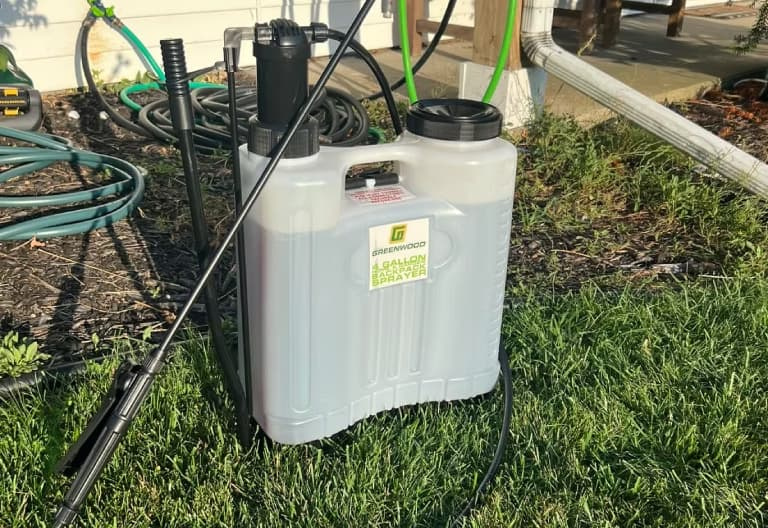
New to spraying, or want to get it right? Our Herbicide Application Guide covers the practical steps this page assumes — mixing, calibration, protective gear, and the wind and temperature limits that decide whether a treatment works or drifts. Read it before you spray.
See Guide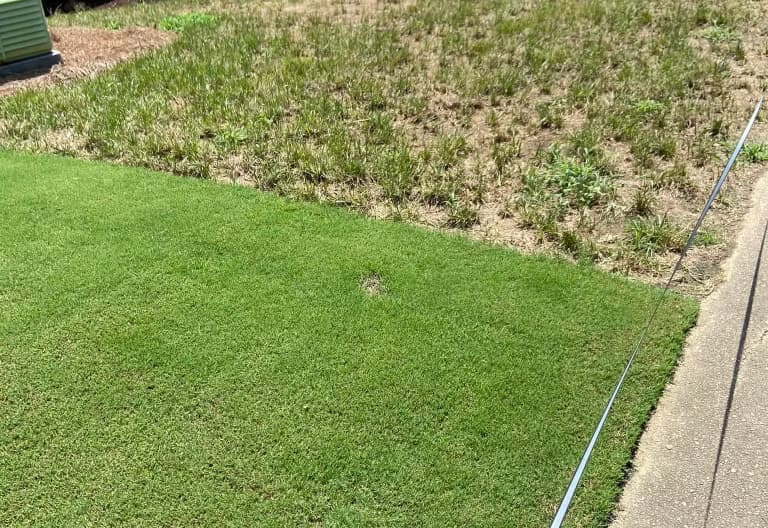
Where Two Lawns Meet
Does your lawn border a neighbor’s — or meet a different type of grass? Spraying near that line can quietly damage the yard next door, sometimes weeks later. Where Two Lawns Meet shows you how to treat safely without harming either side.
Read ArticlePulling
Pull it — but only while it's young and small, and know that it comes out far more cleanly in a loose bed than in packed turf.
The Biological Reason
Pulling works on knotweed for one key reason and fails for another, and the timing between them is everything.
Why it works: knotweed cannot regrow from stem pieces. Its wiry stems don’t root at the joints the way purslane or spotted spurge can, so a fragment left behind just dries up and dies. You’re not going to accidentally multiply it by breaking it — which is a risk with several other mat weeds.
Why timing is everything: the real danger of pulling a knotweed plant is seed shatter. A single mature plant carries anywhere from a few hundred to several thousand seeds (documented range: 125 to 6,400), and yanking a seeding plant flings those seeds straight into the soil to sprout next year. So the safe window is narrow — pull while plants are small seedlings in spring, before flowering starts in June. Once it’s flowering, every plant you disturb is a seed spreader; at that point bag it and remove it, don’t just rip and drop it.
The second failure is the taproot. Young knotweed has a thin, shallow root that lifts out easily. But as it matures it drives down a tough, deep, branching taproot — past 18 inches in loose soil. Pull a mature plant and the wiry top usually snaps off at the crown, leaving the root to push up new shoots within weeks. Pull only when the soil is thoroughly moist (after rain or a good watering), grip low at the base, and use a weeding knife or narrow trowel to get under the crown on older plants.
Whatever you pull after flowering, bag it and bin it off-site — don’t compost it. Home compost piles rarely get hot enough to kill buckwheat-family seed, so composting knotweed just re-seeds wherever you spread the compost.
Lawn vs. Bed Pulling Difference
This is where the environment genuinely changes the outcome. In a loose, cultivated bed the entire taproot slides out in one piece, so pulling is clean and highly effective. In compacted turf, gravel, or a hard path edge, the tough stems shear off at the crown and leave the root behind to regrow — so in those spots, pulling young or not at all, and reaching under the crown with a tool, is the only version that works.
Quick Reference Summary
| Lifecycle | Summer annual, broadleaf, seed only |
| Active Zones | Cool-season, warm-season, transition (all) |
| Germination Trigger | ~40°F soil at 1 inch — earliest summer annual, ahead of crabgrass |
| Pre-Emergent | Yes — the primary tool. Apply late fall or before 40°F soil. Use isoxaben; NOT dithiopyr/trifluralin |
| Post-Emergent Window | Young spring seedlings; 2,4-D + triclopyr or dicamba. Closes fast as plant toughens |
| Pull | With Caution — young only, before seed set; clean in beds, snaps in packed turf |
| Lawn Primary Tool | Early pre-emergent + core aeration to fix compaction |
| Bed Primary Tool | Directed glyphosate + coarse mulch; hand-pull in loose soil |
| Verdict | Multi-season — 20+ year seed bank; must fix compaction |
Frequently Asked Questions
These answers are synthesized from botanical morphology studies and herbicide efficacy trials conducted by leading university agricultural extensions.
Because you were almost certainly too late — not wrong, just too late. Knotweed sprouts at about 40°F, roughly 6 to 8 weeks before crabgrass, so a preventer applied at normal crabgrass timing (mid-spring) lands after the knotweed is already up. Pre-emergent can’t touch a plant that has already germinated. To catch knotweed, the barrier has to be down in late fall or before soil hits 40°F.
Because that strip is compacted, and knotweed is a compaction weed — its presence is basically a signal telling you the soil there is packed too tight for grass. If you kill the plants but never relieve the compaction (core aeration) or reroute the traffic causing it, the same conditions simply grow a new crop from the seed bank.
No. Knotweed grows dead flat against the ground, below the height of any mower, so it sails through mowing untouched while your grass gets cut. Mowing high helps prevent it by shading the soil, but it won’t remove an established mat.
Knotweed itself is not toxic — its sap is clear and harmless. Worth knowing because its most common look-alike, spotted spurge, does have an irritating milky sap. If you’re not sure which one you’re handling, snap a stem: milky sap means spurge, clear sap means knotweed.
Usually not right away. The pre-emergent barrier that stops knotweed seed also stops grass seed, and some products (like prodiamine) require waiting up to about 120 days before seeding. This is the core spring dilemma in the transition zone: you generally can’t lay an early knotweed barrier and overseed thin turf in the same spring — plan to do your seeding in late summer/early fall instead.
Scientific Authority
This profile is constructed using forensic botanical data and Integrated Pest Management (IPM) research. We prioritize scientifically-vetted identification and control methods that protect the broader ecosystem while ensuring successful eradication based on peer-reviewed agricultural studies.
Primary Resources
- Penn State Extension — Prostrate Knotweed; Indicator Weeds Provide Insight into Growing a Better Lawn; Controlling Weeds in Nursery and Landscape Plantings (extension.psu.edu)
- Purdue University Turfgrass Science / Extension — Prostrate Knotweed; Knotweed Germinating Next to Sidewalks and Other Hotspots; Weed Management Next to Sidewalks and Driveways (turf.purdue.edu, extension.purdue.edu)
- Michigan State University Extension — Prostrate Knotweed – Turf; Scouting for Weeds: Prostrate Knotweed, Prostrate Pigweed, Prostrate Spurge and Common Purslane (canr.msu.edu)
- Ohio State University Extension (Ohioline / Buckeye Turf / U.OSU) — Prostrate Knotweed; Turfgrass Weed Control (u.osu.edu, buckeyeturf.osu.edu)
- Rutgers Cooperative Extension / Center for Turfgrass Science — “Looks Like Grass… But It Isn’t”; Hurry Up and Wait. Now Go!; FS385: Broadleaf Weed Control in Cool Season Lawns (plant-pest-advisory.rutgers.edu, turf.rutgers.edu, njaes.rutgers.edu)
- University of Illinois Extension — Prostrate Knotweed — A Harbinger of Spring; Fall Broadleaf Weed Control in Turf (hyg.ipm.illinois.edu)
- University of Minnesota Extension — Managing Weeds in Lawns; Options for Controlling Weeds in Your Lawn; roadside turfgrass weed survey (extension.umn.edu, turf.umn.edu)
- Cornell Cooperative Extension — Prostrate Knotweed (Turfgrass & Landscape Weed ID); Common Purslane; landscape weed and gravel/weed-barrier resources (turfweeds.cals.cornell.edu, cals.cornell.edu)
- UMass Amherst Turf Program — Polygonum aviculare profile; characteristics of turf herbicides; cultural practices for weed management (umass.edu)
- NC State Extension (TurfFiles / Extension Publications / Plant Toolbox) — Prostrate Knotweed; When to Apply Preemergent Herbicides; Timing of Preemergent Applications — Apply Earlier; pendimethalin and dithiopyr labels (turffiles.ncsu.edu, content.ces.ncsu.edu, plants.ces.ncsu.edu)
- University of Georgia CAES (GeorgiaTurf) — Prostrate Knotweed; Spotted Spurge (Prostrate Spurge); Weed Control in Home Lawns (turf.caes.uga.edu, fieldreport.caes.uga.edu)
- Clemson Cooperative Extension (HGIC) — Weeds as Indicators; broadleaf weed listings (hgic.clemson.edu, media.clemson.edu)
- Texas A&M AgriLife Extension (AggieTurf) — Turfgrass Weeds; Weed, Insect and Disease Control in Turfgrass (aggieturf.tamu.edu, agrilifeextension.tamu.edu)
- University of Florida IFAS Extension — Weeds as Indicators of Soil Conditions; Improving Weed Control in Landscape Planting Beds; Glyphosate and Herbicide Alternatives in Landscape Beds (ask.ifas.ufl.edu)
- Virginia Tech Extension — Prostrate Knotweed Weed Profile (weedid.cals.vt.edu, pubs.ext.vt.edu)
- University of Missouri Extension (Mizzou WeedID / IPM) — Prostrate Knotweed; pre-emergence timing newsletters (weedid.missouri.edu, ipm.missouri.edu)
- Kansas State Research and Extension — MF2451 Bermudagrass Football Fields (bookstore.ksre.ksu.edu)
- University of Kentucky Extension — vegetable/turf weed guidance (uknowledge.uky.edu)
- Oklahoma State University Extension — Controlling Weeds / Broadleaf Weeds in Home Lawns (extension.okstate.edu)
- University of Tennessee Extension / UT Institute of Agriculture — bermudagrass calendars; fescue establishment; School Grounds IPM (utia.tennessee.edu, uthort.tennessee.edu, schoolipm.tennessee.edu)
- West Virginia University Extension — Weed Management in Lawns (extension.wvu.edu)
- University of Arkansas Cooperative Extension — Home Lawn Weed Control; MP44 Recommended Chemicals (uaex.uada.edu)
- University of Nebraska–Lincoln Extension — Lawn Care Pro Series: Broadleaf Weed Control; Managing Turf and Landscape Weeds (turf.unl.edu, extensionpublications.unl.edu)
- University of Wisconsin Extension (OGRAIN) — weed management planning (ograin.cals.wisc.edu)
- UC IPM / UC ANR — Common Knotweed (Prostrate Knotweed); Identifying Prostrate Knotweed and Distinguishing It from Spurge; Weed Management in Landscapes (ipm.ucanr.edu, ucanr.edu)
- Iowa State University Integrated Crop Management — Prostrate Knotweed (crops.extension.iastate.edu)
- North Dakota State University Agriculture — Dakota Gardener: In Knots About Prostrate Knotweed (ag.ndsu.edu)
- Weed Science Society of America — Weeds as Soil Indicators; and Alaska Center for Conservation Science / WSSA, Seed Viability and Dormancy of 17 Weed Species After 19.7 Years of Burial in Alaska (wssa.net, accs.uaa.alaska.edu)