
Scientific Name: Cynodon dactylon (common, seeded); Cynodon dactylon × C. transvaalensis (hybrid, vegetative)
Common Names: Bermudagrass; bermuda grass; common bermuda (the seeded type); hybrid bermuda (the vegetative type). Also called couchgrass, devilgrass, wiregrass and dogtooth grass — the last three usually when it’s being treated as a weed. Cynodon transvaalensis, the second parent of every hybrid, is called African bermudagrass.
Bermudagrass
The toughest, fastest-healing lawn grass in the South — if you can give it full sun and accept a brown winter.
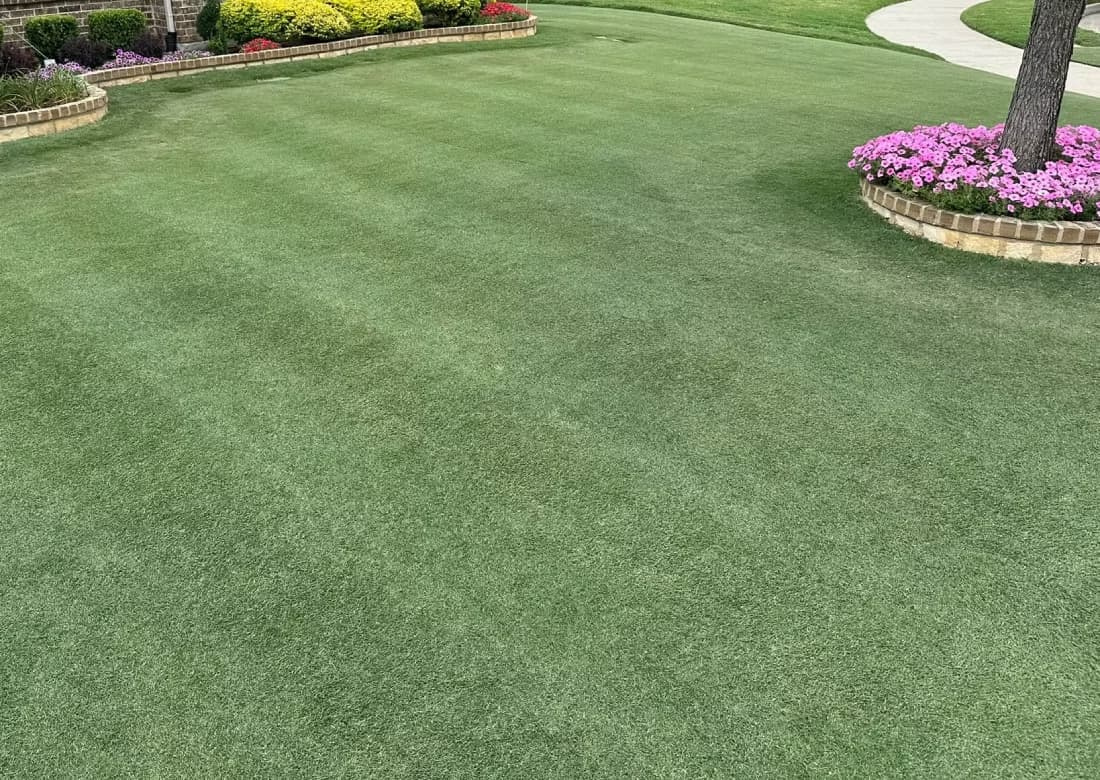
Bermudagrass At-a-Glance
Hardiness Zone Min
Zone 7
Water Requirement
Low
Sun Requirement
Full Sun (6+ hrs direct)
Wear Tolerance
Very High
Establishment Speed
Fast
Labor Intensity
High
The Breeding Programs Behind Modern Bermuda
Start with the name, because it’s wrong. Bermudagrass is not from Bermuda. It’s African — Cynodon dactylon comes out of tropical and southeastern Africa, and it arrived in North America in 1751 as a livestock forage, not as a lawn. It spread through the South on its own from there, and it has been both a valued crop and a stubborn weed ever since.
Almost everything that makes it a good lawn grass came later, out of university breeding programs rather than out of the wild plant.
The first big leap was the sterile hybrid, and it started at UGA’s Coastal Plain Experiment Station in Tifton in the 1940s under Glenn Burton. Crossing common bermudagrass with African bermudagrass (C. transvaalensis, a finer, South African species) produces a plant with an odd chromosome count that cannot make viable seed. That sounds like a defect, and commercially it is one — you can only sell it as sod, sprigs or plugs. But sterility buys something valuable. A sterile plant puts no energy into seedheads, and because every plant in the lawn is a clone of the same parent, the turf comes out uniform in color, texture and growth rate in a way a bag of seed never will. Tifway 419 came out of that Tifton work and spent decades as the standard everything else was measured against.
The second leap was pushing bermuda north, and it belongs to Oklahoma State, where Charles Taliaferro began breeding for cold-hardiness in the mid-1980s and Yanqi Wu has carried it on since. Winterkill is what stops this grass, so the program went straight at it and released cultivars that survive winters bermuda used to lose — Midlawn and Midfield in 1993, Patriot in the mid-2000s, then Latitude 36 and NorthBridge in 2010, and Tahoma 31 more recently. Just as important, the same program produced Yukon and Riviera as seed. That seeded work matters more than it sounds: it means a homeowner in the transition zone has a cheap path to a cold-hardy lawn, not just an expensive one.
The third leap is still in progress, and it is about water. UGA’s TifTuf, released in 2014 after roughly 25 years of testing, behaves differently from the rest of the species — it holds its green color under drought instead of dropping into dormancy, and uses around a third less water than Tifway. UC Riverside has newer releases aimed at the arid Southwest. The trend line is clear: the same grass, asked to use less water and survive colder winters.
All of this is tracked publicly. The National Turfgrass Evaluation Program (NTEP) has run National Bermudagrass Tests since 1992, rating both seeded and vegetative cultivars on a 1–9 scale across many sites at once. When a cultivar name on a bag or a sod invoice is backed by NTEP data, that is a real, independent number — not a marketing claim.
Gallery
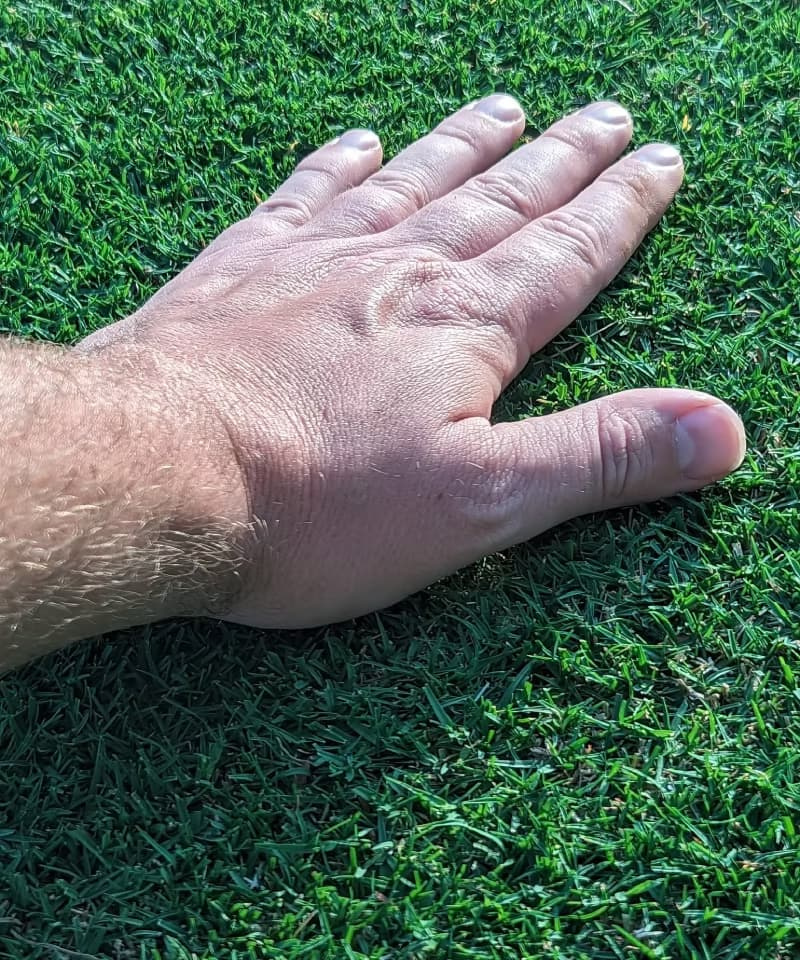
Close-up view highlighting blade texture and turf canopy density.
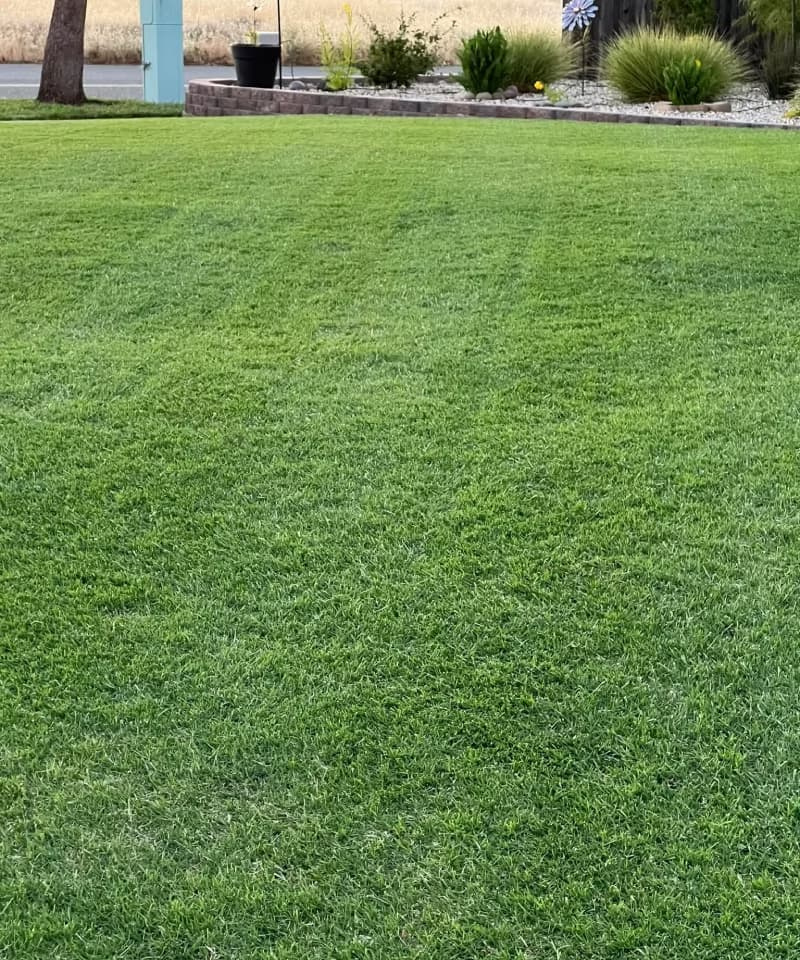
GCI Turf Alpha Elite Bermudagrass established in a residential yard.
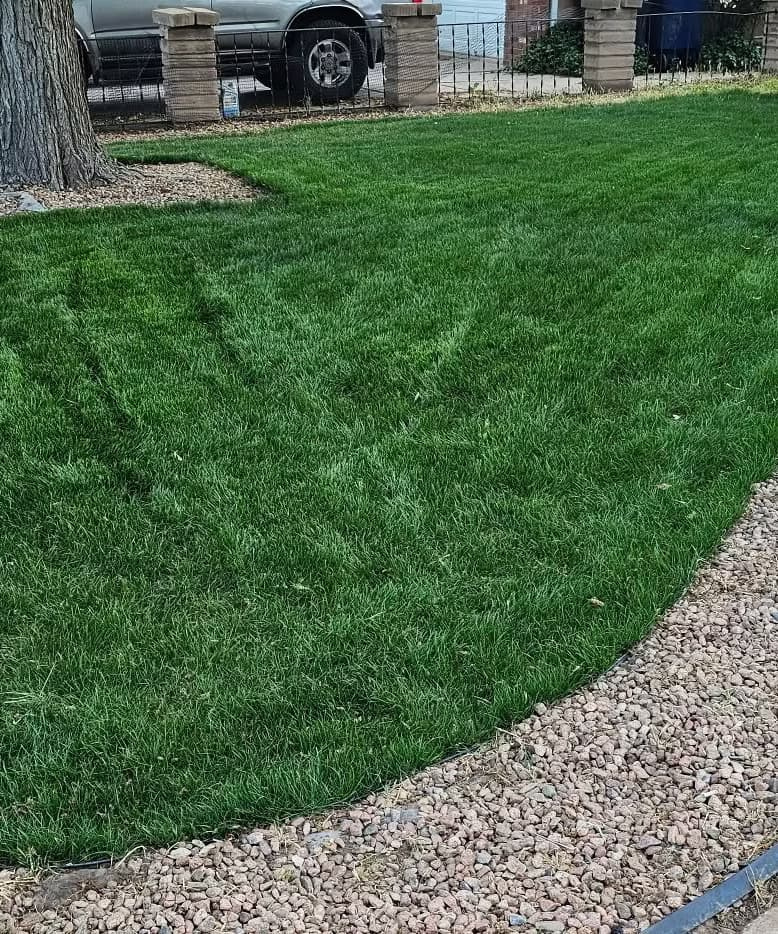
Bermudagrass integrated into a xeriscaped landscape with gravel borders.
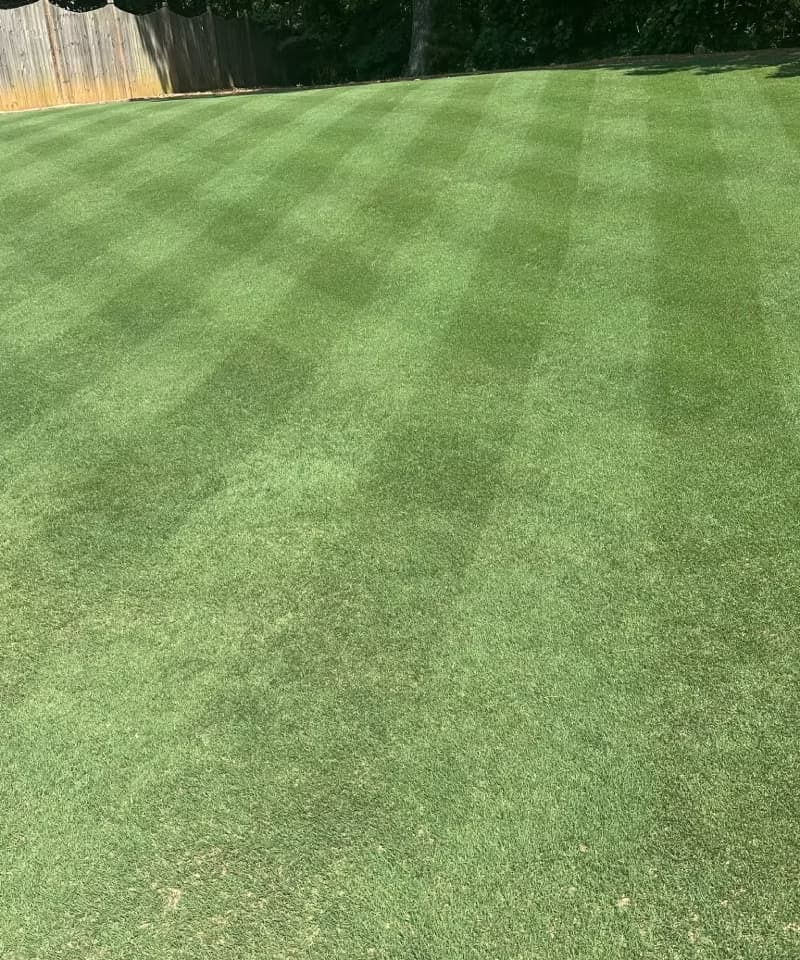
Coastal Bermudagrass showcasing stripe reflection and density under full sun exposure.
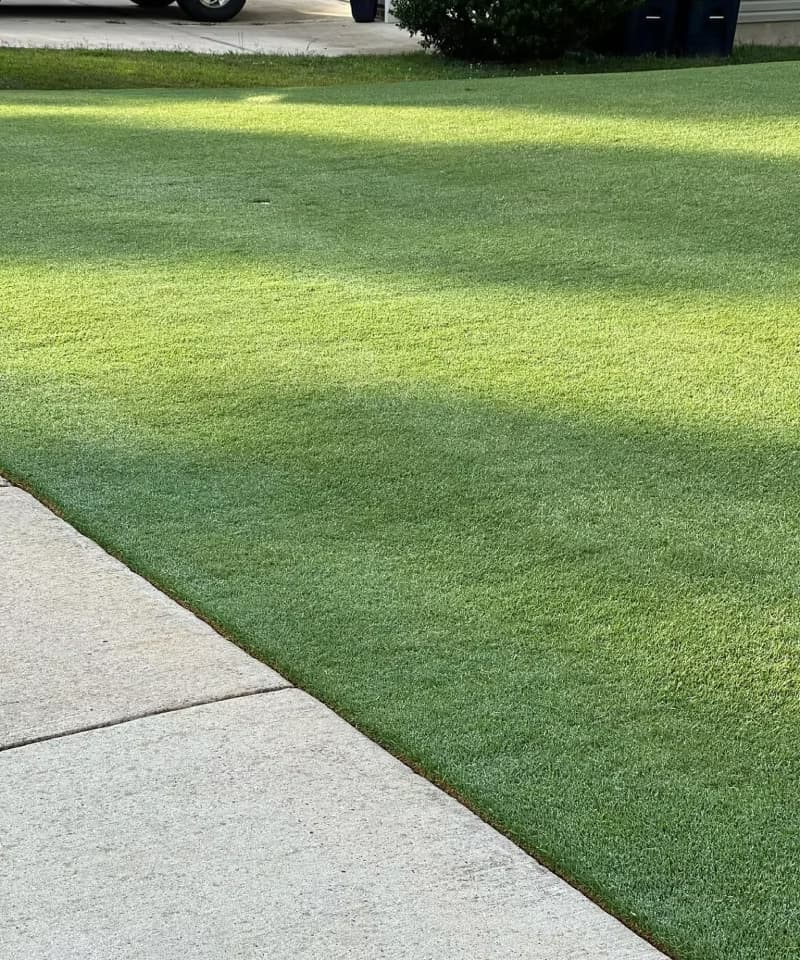
Reel-mowed Bermudagrass maintained at a low height of cut.
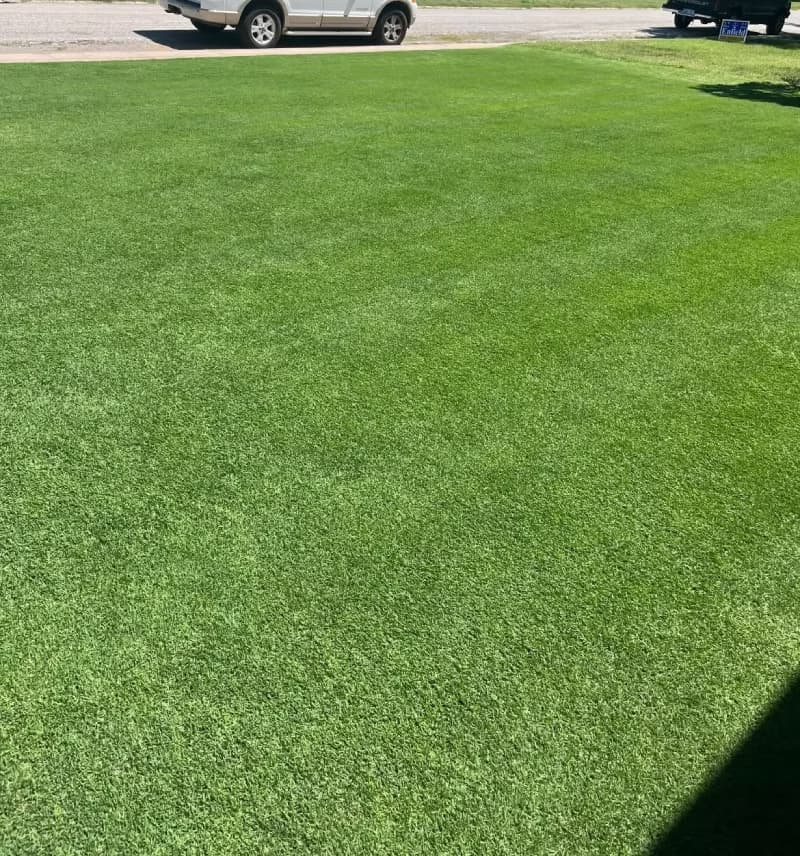
Monaco Bermudagrass cultivar established as a uniform residential lawn.

Healthy turf density achieved through Bermudagrass sod installation.
Telling It Apart
How to know it’s bermuda. Look at a leaf as it emerges from the shoot: bermuda is folded in the bud, not rolled. At the collar there is a fringe of white hairs — the ligule — rather than a papery membrane, and there are no auricles, meaning no claw-like flaps clasping the stem. Blades are narrow (about 1.5–3 mm), soft, and taper to a point. The plant runs across the ground on both above-ground stolons and below-ground rhizomes. The seedhead is distinctive: three to six finger-like spikes radiating from a single point, like a bird’s foot.
What it gets confused with. The main mix-up is zoysiagrass, the other fine warm-season spreader. Quick tells: zoysia is rolled in the bud, and its blades are stiff and wiry from high silica content and stand up against your hand, while bermuda’s are soft and give way. In dormancy zoysia cures to a clean golden-yellow and bermuda to a duller gray-brown. The second confusion is crabgrass, but crabgrass is a clumping summer annual with no stolons or rhizomes and much wider, hairier blades. If it spreads by runners that root at the nodes, it’s bermuda, not crabgrass.
Spotting common-bermuda contamination in a hybrid lawn. This is the classic problem in a fine hybrid stand: patches of coarser wild common invade and stand out. Look for wider blades — over about 2–3 mm against the hybrid’s ultra-fine 1.5–1.7 mm — a burst of seedheads where hybrids are sterile and make almost none, faster vertical regrowth that pokes above the canopy a day or two after mowing, and an off, lighter or yellow-green color. In fall these patches brown out first; in spring they green up last. There is no selective cure. The only option is spot-spraying with glyphosate during active summer growth, with the same check-the-label caution as above, which is why buying certified, contamination-free sod up front matters so much.
Is Bermudagrass Right For Your Yard?
Advantages:
Repairs itself faster than any other warm-season grass. Stolons and rhizomes together mean damage fills back in during active growth without you reseeding anything.
Handles heavy traffic — it is the standard for athletic fields for a reason.
Genuinely drought-tough. Deep roots find water, and when the water runs out it goes dormant and comes back from its rhizomes.
Excellent heat and salt tolerance, including coastal salt and reclaimed or effluent irrigation water.
Tolerates more herbicides than most lawn grasses, which makes weed control far easier.
Available both cheaply and beautifully — a seed bag for a utility lawn, or premium sod for a showcase one.
Deep cultivar bench with independent NTEP data behind it on both the seeded and vegetative sides.
Best If:
- Live in the warm South or Southwest, or in the transition zone and are willing to plant a cold-hardy cultivar.
- Have a full-sun yard with six to eight hours of direct light.
- Need a lawn that survives kids, dogs and real use, and heals itself when it doesn’t.
- Want drought resilience and can accept dormant brown as the price of it.
- Are on a coastal or salty site, or irrigate with reclaimed water.
- Want a premium, fine-textured showcase lawn and will fund the reel mower and the higher feeding schedule (hybrid), or want a tough functional lawn on a budget you can seed yourself (common).
Disadvantages:
Brown all winter. Dormancy is normal and healthy, but it lasts months, and only overseeding changes that.
No shade tolerance at all. Below six hours of direct sun it thins and dies, and no cultivar rescues it.
Aggressive thatch producer. Verticutting and core aeration are recurring chores, not optional extras.
Invasive. It escapes into beds, borders and neighbors’ lawns, and it is very hard to remove once it’s in.
Disease pressure in humid climates — spring dead spot in the transition zone, large patch, dollar spot and leaf spot in the Southeast.
Winterkill risk in the transition zone, which makes cultivar choice a survival decision rather than a preference.
Frequent mowing, weekly for common and two to three times a week for hybrids, and a reel mower below one inch.
Avoid If:
- Any meaningful part of the lawn is shaded — pick zoysia, St. Augustine or tall fescue instead.
- You live in a cool-season climate, humid or arid. Bermuda will be brown for six or seven months and leave weedy bare soil all winter.
- Green winter color matters to you and you don’t want to overseed every fall.
- You want a low-chore lawn. Thatch management, frequent mowing and edging against its own spread are permanent commitments.
- You have flower beds or a neighbor’s cool-season lawn you can’t afford to have bermuda invade.
- The site drains poorly. Wet feet rot the roots and sharply raise winterkill risk.
Is It Safe for Pets and Kids?
No toxicity documented. Handles pet traffic well, and while urine burns it like any grass, it fills the damaged spots back in faster than cool-season turf because it regrows from stolons and rhizomes rather than from seed.
Where It Grows and Where It Fails
Bermudagrass is built for heat, sun, drought and hard use. In the right climate almost nothing beats it for a tough, dense, self-repairing lawn. In the wrong climate it is brown for half the year, or dead by spring. Knowing which side of that line you live on is the whole decision.
It thrives in the warm South and Southwest. In the humid Southeast and along the Gulf Coast it grows fast and lush, but it pays a disease tax — the same humidity that feeds the grass feeds fungi, so you will fight large patch, dollar spot and leaf spot. In the dry Southwest — Arizona, inland and Southern California, New Mexico — it may be the single best-adapted lawn grass there is, as long as you can irrigate. The dry air actually keeps disease down.
In cool-season regions it is a poor choice. Bermuda only grows in summer. The first fall frosts turn it brown for six or seven months, leaving bare, weed-prone soil all winter.
The hard boundary is the transition zone — the band running from the Mid-Atlantic across to the southern Plains where summers suit bermuda but winters can kill it. Here the make-or-break fact is winterkill. Extreme cold ruptures the crowns, stolons and rhizomes the grass regrows from, and a lawn that looked fine in October simply never greens up in spring. In this zone cultivar choice is not cosmetic — it decides survival. Plant a cold-hardy cultivar (some are seeded, some are sod), and know that winterkill risk climbs on north-facing slopes, in shade, in poorly drained soil, and where potassium is low.
Bermuda has one requirement it will not bend on: full sun, roughly six to eight hours of direct light a day. In shade it stretches, thins and slowly dies. No cultivar fixes this. In a shady yard, zoysia, St. Augustine or tall fescue will beat it every time.
Getting Established
Timing first, because getting it wrong is fatal. Bermuda is a warm-season grass, so it goes into warm soil in late spring or early summer — when soil four inches down holds steady at 65°F or higher, which is roughly mid-May through June across most of its range. Never plant bermuda in fall. Young plants cannot build the roots and rhizomes they need before winter, and they die. This is the opposite of how cool-season grasses work, and it trips people up constantly.
If you seed. Only common bermuda can be seeded. Sow improved turf-type seed at about 1–2 lb of pure live seed per 1,000 sq ft; coated seed runs a bit higher. Seed is cheap and DIY-friendly, but it establishes slowly and carries a real risk of weeds and off-type contamination while it grows in. Buy an improved seeded variety, not the cheapest “common” or VNS bag — the improvement is what buys you density, color and cold tolerance.
If you go vegetative. Hybrids are sold this way only, and some commons are too. Sod gives an instant, weed-free lawn and roots in one to two weeks; it is also the most expensive option. Sprigs — shredded stems with live nodes — are broadcast, worked lightly into the soil and rolled; cheaper than sod, but labor-intensive and easy to let dry out. Plugs, small sod pieces set 10–12 inches apart, are the cheapest vegetative route but slow to fill in. Whatever you buy, insist on certified blue-tag stock so the sod or sprigs are genetically pure and free of weedy common-bermuda contamination.
The tradeoff, plainly: seed is cheap, slow and variable. Sod and sprigs are instant, true-to-type and expensive. In the transition zone, extension guidance generally points toward a cold-hardy cultivar — and you can get cold-hardiness either way, seeded (Yukon, Riviera) or vegetative (Tahoma 31, Latitude 36).
The fork that decides everything else. Seeded common and vegetative hybrid aren’t better and worse, they’re different lawns for different people, and no tool can pick for you because the deciding factor is your budget and how you want to work. Seeded common is coarser (blades around 1.5–3 mm), less dense, throws seedheads, and asks for roughly 2–4.5 lb of nitrogen a year with weekly rotary mowing at 1–2 inches. Hybrid is much finer (1.5–1.7 mm), denser and more uniform, takes heavy wear beautifully, and asks for about 4–6 lb of nitrogen, mowing two or three times a week, and a reel mower below one inch. Choose common for large or irregular areas, utility lawns and tight budgets; choose hybrid for a showcase lawn or a high-traffic yard, if the budget carries the upkeep and not just the installation. One note on the numbers on this page: they’re rated at the seeded end, because that’s the version most homeowners should default to. Going hybrid means adding a point to every maintenance expectation here.
Grow-in. In warm weather bermuda establishes faster than almost anything. Seed germinates in 7–14 days and gives basic cover in about a month, though full maturity takes six to nine months. Sprigs and plugs cover in roughly six to eight weeks. Sod is ready for full traffic in three to four weeks. Water is the variable that decides the outcome: keep new seed, sprigs or plugs continuously moist with light watering three or four times a day for the first 7–10 days, then taper to deep, infrequent watering so roots chase moisture downward. Feed hard during grow-in — about 0.5–0.75 lb of quick-release nitrogen per 1,000 sq ft every week or two until the lawn fills in — because bermuda covers ground by spreading, and spreading runs on nitrogen.
Weeds during grow-in. Bare, constantly watered soil is perfect for crabgrass and goosegrass, but young bermuda is chemically fragile. Do not put a standard pre-emergent on a newly seeded, sprigged or sodded lawn — these products work by stopping root tips from dividing, and your grass is doing exactly that. Wait for broadleaf sprays until the lawn is truly established: runners 8–10 inches long, or a “snap test” where a tugged stem snaps instead of pulling out by the roots.
Before you buy, four things go wrong at the till. First, “hybrid bermuda seed” cannot exist — true hybrids are sterile. A bag claiming it holds either a fertile common type (Princess 77 is the honest version) or a wrong label. Buy hybrids as sod, sprigs or plugs only. Second, skip the cheap unimproved bags — “Arizona Common” and VNS seed give a light green, coarse, thin lawn that’s more winterkill-prone than any improved variety. Third, watch for giant-type bermuda in budget blends. Seeded commons are often sold as 2–4-cultivar blends, which is fine and even useful, but cheap mixes sometimes include giant type (C. dactylon var. aridus, sold as NK-37), which gives lush first-summer cover and then winterkills completely. Fourth, insist on certified blue-tag sod and sprigs — certification guarantees genetic purity and freedom from weedy common-bermuda contamination, and once common invades a fine hybrid stand there’s no selective cure. Separately: bermuda is a major forage crop too, and forage varieties like Coastal and Tifton 85 are bred for hay tonnage — tall, coarse and sparse as a lawn. Some names (Guymon, Wrangler) sell into both markets, so the variety name won’t tell you. Confirm the bag says “Turf-Type.” One last note: hybrids are planted as single-cultivar stands, never blended, because mixing clones with different textures and dormancy timing gives a patchy lawn.
Keeping It Healthy
Mow low, and match the mower to the type. Bermuda’s low, creeping habit lets it take mowing heights other lawns cannot. Mow seeded common at about 1–2 inches with a sharp rotary. Mow fine hybrids at 0.5–1 inch, and use a reel mower below 1 inch — a rotary’s spinning blade tears fine blades and leaves ragged wounds that invite disease, while a reel shears cleanly like scissors. Mow often enough in summer that you never remove more than a third of the height at once. Skip that and you scalp, cutting into the brown woody stems, which starves the roots and opens wounds. Two seasonal adjustments pay off: raise the height about half an inch in early fall so the extra leaf insulates the crowns through winter, and in early spring scalp the dead brown canopy down by 50–75% so sunlight can reach and warm the soil, which speeds green-up.
Feed to the type, and time it to growth. Bermuda is a medium-to-high nitrogen grass — hungrier than centipede or zoysia. Seeded common needs about 2–4.5 lb N per 1,000 sq ft per year; vegetative hybrids need about 4–6 lb; in the arid Southwest a lawn that isn’t overseeded sits lower, around 3.5 or less. Spread it across the warm months, roughly April or May through August or September, never more than about 1 lb per application, blending quick- and slow-release sources. Timing matters as much as the amount. Wait until the lawn has fully greened up in spring before the first feeding — fertilizing a half-dormant lawn pushes weak top growth on a shallow root system. Stop nitrogen within about four weeks of your first expected fall frost so the grass can harden off. A late-summer dose of potassium helps the plant store carbohydrates and get through winter. Over-feeding backfires twice: it builds thatch, and it grows soft tissue that fungi punch straight through.
Water deep, then let it ride. Once established, bermuda is genuinely drought-tough. Water deeply and infrequently, wetting the soil to about six inches — check with a screwdriver — so roots follow the moisture down. Under real drought bermuda first turns dull blue-gray and rolls its leaves, then goes fully dormant and straw-brown to protect its crowns. Healthy turf survives three to six weeks in that state and greens back up from its rhizomes within days of water returning. Do not confuse dormancy with death. In winter, cut irrigation way back — soaking dormant, oxygen-starved soil invites root rot. (One honest gap: extension publishes clear irrigation figures for the arid Southwest, roughly 2.4 inches per month in February climbing to about 6.7 in July, but comparable numbers for humid climates aren’t in the source literature.)
On salty sites and recycled water, bermuda is unusually forgiving — with one hard exception. It tolerates salt better than most lawn grasses, handling soil salinity up to roughly 6.9 dS/m before growth starts to suffer, which makes it a real option on coastal lots and on reclaimed or effluent irrigation water where other turf would fail. The exception is water from a household softener, which must never go on the lawn. Softeners work by swapping calcium and magnesium for sodium, and sodium at that concentration collapses soil structure — the clay particles disperse, the pores seal, and water stops moving through the soil at all. That damage is to the soil itself, not the grass, and it is slow and expensive to undo. If your irrigation is plumbed through a softener, have that line bypassed.
Manage thatch, because with bermuda it is not optional. Bermuda spreads by woody, slow-to-rot stolons and rhizomes, which makes it an aggressive thatch producer. A thin layer, a quarter to half an inch, is good — it cushions wear and buffers temperature swings. Past half an inch it turns into a water-repellent sponge that sheds irrigation and fertilizer, forces roots up into the thatch where they cook in summer and freeze in winter, and shelters mites and disease. When thatch tops half an inch, verticut in late May or June — only after full green-up, or recovery drags — then core aerate during active summer growth to relieve compaction. The pulled cores also seed the surface with microbes that help break the thatch down.
The seasonal cycle and winter color. Bermuda’s calendar runs on soil temperature. Below about 50–55°F it pulls nutrients back into its rhizomes and stops growing; hard frost breaks down its chlorophyll and it goes dormant brown. It greens up again when nights stay above 60°F and soil at four inches reaches 60–65°F. Bermuda is dormant, not evergreen — it will go brown, and that is normal. In the South and Southwest, homeowners who want green all winter overseed in fall with perennial ryegrass, which is fine-textured, deep green and frost-tolerant. Overseeding is real work: stop nitrogen 30 days ahead, open the canopy, sow at about 5 lb per 1,000 sq ft for a stand that’s easy to remove later (heavier rates make spring transition harder), then transition the ryegrass out in spring by mowing it low, feeding the warming bermuda lightly, and finally stressing the shallow-rooted ryegrass with a dry-down so the bermuda takes the lawn back.
What Goes Wrong
Spring dead spot is the signature disease and the worst one bermuda faces in the transition zone. Soilborne fungi (Ophiosphaerella species) quietly rot the roots and rhizomes in fall, doing no visible damage at the time, but the weakened tissue cannot survive winter. You see it at spring green-up: circular, sunken, straw-colored dead patches, inches to feet across, that come back in the same spots and get bigger every year. Because the damage happens underground and is driven by cold, the defenses are cultural and preventive — keep thatch under half an inch, relieve compaction, avoid nitrogen after mid-September, plant a resistant cold-hardy cultivar, and if you need chemistry, apply DMI fungicides in fall and water them in, since the fungus lives down at the roots.
The humidity diseases are severe in warm-humid regions and mild in arid ones, which is exactly why bermuda earns a disease penalty in the Southeast. Large patch (Rhizoctonia) shows up as big circular yellow-brown patches with a telltale orange advancing edge in cool, wet spring and fall weather; shoots pull loose easily from rotted sheaths. Dollar spot makes silver-dollar-sized bleached spots — larger and more diffuse on higher-cut lawns — and is driven by long dew periods and low nitrogen, so feeding the lawn is part of the cure. Bipolaris leaf spot peaks in humid mid-summer and is favored by low potassium and heavy thatch. The common thread is that all three need 10–12 hours of leaf wetness to infect, so morning sun matters. Anything that keeps the canopy wet — shade, poor drainage, evening watering — escalates all of them. Water at dawn, improve airflow, and prune back whatever is blocking morning light.
Insects. The bermudagrass mite is a warm-dry-climate specialist too small to see, so you diagnose it by its damage: “witches’-brooming,” where growth bunches into tight tufts at the nodes, followed by thinning and dieback in summer heat. Common bermuda and Celebration are highly susceptible; a few cultivars resist. It hides under the leaf sheath, which is why control means keeping the lawn watered, not over-fertilizing, scalping and bagging clippings, and if needed using abamectin — ordinary pyrethroids don’t reach it. Fall armyworms can strip a lawn to bare soil in 48 hours; scout with a soap flush and treat above three or four per square foot, though established bermuda almost always recovers because armyworms don’t eat stolons or rhizomes. White grubs chew roots and make the sod feel spongy and peel up like loose carpet; treat above about six per square foot. Mole crickets tunnel and heave the soil in the sandy Southeast. Bermudagrass scale and Rhodesgrass mealybug favor thatchy, shady, stressed turf — one more reason thatch control isn’t optional.
Abiotic problems. Winterkill is the big one, and its allies are shade, late-season nitrogen, low potassium, traffic on dormant turf and wet soil. In late winter you can check survival with a snap test — living stolons snap crisply, dead ones are mushy — or by slicing crowns open, where firm and pearly-white means alive. Scalping, cutting into the brown stems by mowing too low or skipping mowings during fast growth, starves the plant and opens wounds. Follow the one-third rule and keep the blade sharp.
Weeds In This Grass
Bermuda’s best weed defense is itself. A healthy, dense, aggressively spreading stand crowds most weeds out, so correct mowing and feeding are the front line — a thin bermuda lawn is a weed problem waiting to happen.
Bermuda is also one of the most herbicide-tolerant lawn grasses, which gives you room to work. It tolerates the common pre-emergents (prodiamine, dithiopyr, oxadiazon) and a broad range of selective post-emergents that would injure fussier turf. Time your pre-emergent to soil temperature to catch crabgrass, and remember the new-lawn rule from above: no standard pre-emergents on immature bermuda. Oxadiazon is the usual exception on newly sprigged turf, because it doesn’t attack root tips.
The one place to slow down is renovation — killing an old bermuda stand to start over. Bermuda is famously hard to kill, which is the same trait that makes it a weed in cool-season lawns. Extension programs do this with a non-selective systemic herbicide whose active ingredient is glyphosate, applied to actively growing grass in mid-to-late summer, usually in two or three passes with a low scalp-and-remove between them to expose regrowth. A fluazifop tank-mix speeds up and completes the kill of the deep rhizomes.
Check the label, not the brand. Consumer “Roundup”-branded products no longer reliably contain glyphosate — several reformulated versions use other active ingredients (triclopyr, fluazifop, imazapic, diquat) that behave differently and carry different replant intervals. Read the active-ingredient panel and confirm it actually says glyphosate before you rely on it for renovation. If you do end up with a fluazifop-based product, that’s the tank-mix partner rather than the base, and the reseeding wait changes — roughly 7 days after glyphosate alone, but 14–30 days once fluazifop is involved.
Subtypes
Classic Southern Bermudagrass
The long-proven southern default, for lawns where winter is never the thing that kills the grass.
Best For: Yards across the Gulf South, Florida, coastal Georgia and the Carolinas, south and central Texas, and the low-desert Southwest, with six to eight hours of direct sun and no permanent watering restrictions. This is the group for people choosing on looks, wear and price rather than on survival.
Tradeoff: No winter margin — the standard here fails around 19°F, so one hard transition-zone winter can take the whole lawn.
Cold-Hardy Bermudagrass
The bermudas that survive a transition-zone winter — and some of them come as seed.
Best For: Transition-zone yards from the Mid-Atlantic west across Tennessee, Arkansas and Oklahoma to Kansas City and the southern two-thirds of Missouri, where summers suit bermuda but a bad winter can kill an ordinary cultivar outright.
Tradeoff: You are buying survival, not looks — and even the hardiest of these can still be lost on a north-facing slope, in shade, or in soil that stays wet.
Water-Saving Bermudagrass
The bermudas that stay green on less water instead of going brown to survive.
Best For: Yards under standing watering restrictions, on sandy soil that will not hold moisture, or anywhere you meter and pay for every gallon — the low-desert Southwest most of all. Also anyone who wants bermuda's toughness without a straw-brown lawn in August.
Tradeoff: There is no seeded route in — all four are sterile hybrids, so it is sod, sprigs or plugs at premium prices.
The Seasonal Care Calendar

Spring (Mar-May)
Scalping Down and Greening Up
Spring is about getting the soil warm and staying patient. Once the worst frosts are past, scalp the dead brown canopy down by 50–75% and remove the clippings, so sunlight reaches the soil and warms it — that soil warmth, not the calendar, is what triggers green-up. The grass comes out of dormancy when nights hold above 60°F and soil at four inches reaches 60–65°F.
Do not feed a half-dormant lawn. Wait for full green-up before the first nitrogen; fertilizing early pushes soft top growth on a root system that hasn’t recovered yet. Put your pre-emergent down on soil temperature to catch crabgrass, not on a fixed date — unless the lawn is new, in which case skip it entirely this year.
Spring is also when spring dead spot shows itself, as sunken circular patches that never green up. The infection happened last fall; there is nothing to spray now, so note where the patches are and change the fall program. If you overseeded with ryegrass, this is when you transition it out: mow it low, feed the warming bermuda lightly, then let a dry-down stress the shallow-rooted ryegrass so the bermuda reclaims the ground. Once the lawn is fully green — late May or June in most of the range — verticut if thatch has passed half an inch.
Summer (Jun-Aug)
Peak Growth and Thatch Control
Summer is bermuda’s season, and most of the year’s work happens now. The grass is growing fast enough that you should be mowing weekly for common and two to three times a week for a hybrid, always taking off no more than a third of the height. Skipping a mowing in July means scalping when you catch up.
This is also the only window for cultivation. Core aerate during active growth, because bermuda needs to be growing hard to fill the holes back in — the same work in fall leaves open wounds going into winter. Spread the bulk of the year’s nitrogen across these months, never more than about 1 lb per 1,000 sq ft at a time.
Water deep and infrequently. Wet the soil to about six inches and then leave it alone, so roots follow the moisture down instead of staying shallow. Water at dawn, not in the evening — dew plus evening irrigation gives fungi the 10–12 hours of leaf wetness they need to infect. Watch for fall armyworms, which can strip a lawn in 48 hours; a soap flush tells you what’s in there, and established bermuda recovers because they don’t eat the runners. If drought forces the grass dormant and brown, that is the plant protecting itself, and it will come back from its rhizomes within days of water returning.
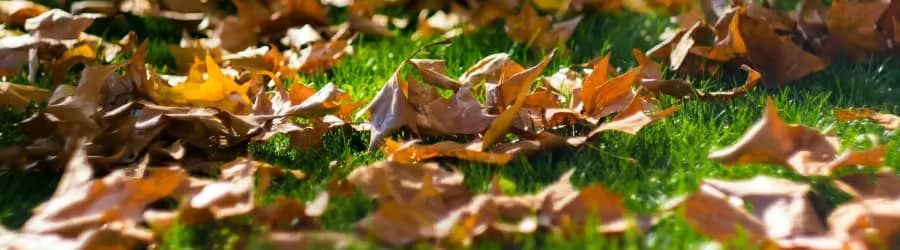
Fall (Sep-Nov)
Hardening Off Before First Frost
Everything you do in fall is about surviving winter, and the single biggest mistake is feeding too late. Stop nitrogen about four weeks before your first expected frost, and in the transition zone stop after mid-September — late nitrogen grows soft tissue that both winterkill and spring dead spot exploit. Swap it for a late-summer or early-fall potassium application, which helps the plant store carbohydrates for the winter.
Raise the mowing height about half an inch. The extra leaf insulates the crowns and rhizomes the grass has to regrow from. Keep traffic off as the lawn slows down, and get drainage problems fixed now, because saturated soil is one of winterkill’s main allies.
Fall is also when the spring dead spot fungi are actually infecting, silently, at the roots — nothing shows above ground. If you had patches last spring, this is when a DMI fungicide goes down, watered in so it reaches the root zone. If you want green through winter, overseed with perennial ryegrass now: stop nitrogen 30 days ahead, open the canopy, and sow around 5 lb per 1,000 sq ft. Resist going heavier — a thick ryegrass stand is much harder to remove come spring.
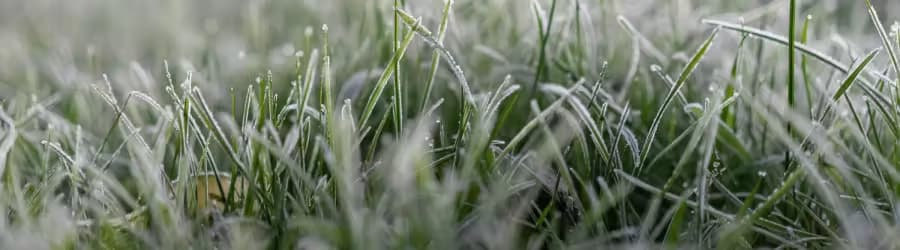
Winter (Dec-Feb)
Dormant Brown and Left Alone
Bermuda is brown in winter, and that is normal. Below roughly 50–55°F soil temperature the grass pulls its nutrients back into the rhizomes and stops growing, and the first hard frost breaks down the chlorophyll. A straw-brown lawn in January is a healthy lawn, not a dead one.
The main job is restraint. Cut irrigation way back — dormant grass isn’t using water, and soaking cold, oxygen-starved soil invites root rot. Keep traffic off dormant turf, because it isn’t growing and cannot repair the wear.
If you’re worried after a hard freeze, you can check rather than guess. Pull a few stolons: living tissue snaps crisply, while dead tissue is mushy. Or slice a crown open — firm and pearly-white means the plant is alive. Winterkill damage usually doesn’t reveal itself until the lawn fails to green up in spring, so a late-winter check tells you whether to plan a repair before the planting window opens in late spring.
Bermuda Against Zoysia and St. Augustine
Versus zoysiagrass. These two are the closest comparison and the most commonly confused. Zoysia tolerates shade meaningfully better, so any yard with a real shade component points to zoysia. Zoysia also holds a cleaner golden-yellow in dormancy against bermuda’s gray-brown, and it needs less nitrogen. What bermuda wins on is recovery: zoysia is slow to fill damage back in, while bermuda repairs itself fast. For a heavily used yard in full sun, bermuda; for a partly shaded yard where you’d rather not chase repairs, zoysia.
Versus St. Augustinegrass. St. Augustine is the standard answer for shaded warm-season lawns and will beat bermuda anywhere light is short. It is coarser, and it doesn’t take traffic the way bermuda does. Full sun and hard use favor bermuda; shade favors St. Augustine.
Versus tall fescue. In the transition zone these are the two realistic options, and they fail in opposite directions. Tall fescue stays green all winter and handles shade, but it struggles in the hottest summers. Bermuda thrives in that heat and dies in hard winters. If winter color and shade matter more, choose tall fescue; if summer heat and traffic recovery matter more, choose bermuda with a cold-hardy cultivar.
Versus centipedegrass. Centipede is the low-input option — much less nitrogen, much less mowing — but it is far weaker on traffic and recovery. If you want a lawn you barely touch and won’t use hard, centipede; if you want a lawn that takes a beating, bermuda.
On perennial ryegrass, which isn’t really an alternative: it is bermuda’s winter partner. Overseeding a dormant bermuda lawn with ryegrass is the standard Southern route to green winter color, and it comes back out in spring.
Find Your Precision Match
Choosing between species requires balancing your specific soil profile, local micro-climate, and maintenance goals. Use our Turf Match Tool to generate a data-backed recommendation for your specific yard.
Start Your MatchTechnical Specifications
Scientific Name: Cynodon dactylon (common, seeded); Cynodon dactylon × C. transvaalensis (hybrid, vegetative)
Common Names: Bermudagrass; bermuda grass; common bermuda (the seeded type); hybrid bermuda (the vegetative type). Also called couchgrass, devilgrass, wiregrass and dogtooth grass — the last three usually when it’s being treated as a weed. Cynodon transvaalensis, the second parent of every hybrid, is called African bermudagrass.
Family: Poaceae; genus Cynodon, tribe Cynodonteae
Origin: Africa, despite the name — bermudagrass is not from Bermuda. Cynodon dactylon is native to tropical and southeastern Africa and spread across the warm parts of the world; C. transvaalensis, the finer second parent of every hybrid, is native to South Africa specifically. It reached North America in 1751, introduced as a livestock forage, and spread through the South from there.
Season Type: Warm-Season
Growth Habit: Rhizomatous + Stoloniferous
Growth Rate: Fast
Texture: Medium
Root System Depth: Deep — roots run several feet down, which is what lets the grass avoid drought rather than just endure it.
Spread Mechanism Intensity: Aggressive on two fronts at once. Stolons creep across the surface and root at every node; rhizomes run underground. This is why bermuda repairs itself faster than any other warm-season grass — and why it becomes a weed in cool-season lawns and is famously hard to remove.
Typical Lifespan & Invasiveness Risk: Perennial. Invasiveness risk is high: bermuda spreads by both stolons and rhizomes, escapes into flower beds and neighboring lawns, and is one of the hardest lawn grasses to kill once established. It belongs on the “grasses that become weeds in other lawns” list.
Hardiness Zone Min: Zone 7
Hardiness Zone Max: Zone 10
Hardiness Zone Notes: Ideal range is roughly Zones 7–10. Cold-hardy cultivars stretch the cold edge to about Zone 6 — Manhattan, Kansas City, and the southern two-thirds of Missouri all hold bermuda with the right cultivar. Ordinary common bermuda is generally a south-of-34°N grass. Note that the source literature defines bermuda’s range by latitude and metro area rather than USDA zones; this zone bracket is an MFY translation.
Cold Tolerance Rating: Low
Winter Color Profile: Dormant
Climate Cool Humid: Unsuitable
Climate Cool Arid: Unsuitable
Climate Warm Humid: Good
Climate Warm Arid: Excellent
Climate Transition: Fair
Sun Requirement: Full Sun (6+ hrs direct)
Shade Tolerance: Very Low
Water Requirement: Low
Drought Survival Strategy: Both (avoidance then dormancy)
Soil Texture Fit:
Sand
Loamy Sand
Sandy Loam
Loam
Silt Loam
Clay Loam
pH Survival Min: 5
pH Optimal Min: 6
pH Optimal Max: 7
pH Stress Max: 7.5
Wet Feet Tolerance: Low
Compaction Tolerance: Moderate
Salinity Tolerance: High
Wear Tolerance: Very High
Recovery: Very High
Recovery Mechanism: Rhizomes + Stolons
Input Intensity: Moderate
Labor Intensity: High
Thatch Production: Very High
Annual N Figure: Seeded common ≈ 2–4.5 lb N per 1,000 sq ft per year; vegetative hybrid ≈ 4–6 lb. In the arid Southwest, a lawn that isn’t overseeded sits lower — around 3.5 lb or less.
Urine Resistance: Moderate
Preferred NPK Ratio: Soil test first — it’s the only way to know what your yard actually lacks, and it’s worth repeating every other year. Without one, use a turf-grade fertilizer in a 3-1-2 or 4-1-2 ratio (12-4-8 and 16-4-8 are the common bag analyses) through the growing season. For the late-season application, switch to low nitrogen and high potassium — something like 5-10-30, or supplement with about 1 lb of potash per 1,000 sq ft four to six weeks before the first expected frost.
Establishment Methods:
Seed
Sod
Sprigs
Plugs
Germination Speed: Moderate (7–14 days)
Establishment Speed: Fast
Seeding Rate: 1–2 lb of pure live seed per 1,000 sq ft; coated seed runs a little higher. For winter overseeding with perennial ryegrass, about 5 lb per 1,000 sq ft — heavier rates make spring transition harder.
Improved Cultivar Availability: High
NTEP Note: NTEP’s National Bermudagrass Tests rank both halves of the species — seeded and vegetative — on a 1–9 scale, where 9 is best. The 2013 test carried 35 entries (17 vegetative, 18 seeded) across 19 sites, with the final report published as NTEP 18-14 in December 2018. The 2019 test is now finished too, with its final report (NTEP 24-11f) covering 2019–2023 data. Earlier national tests ran in 2007, 2002, 1997, 1992 and 1986, so there are four decades of comparable cultivar data behind this grass.
Deep Dives & Practical Guides
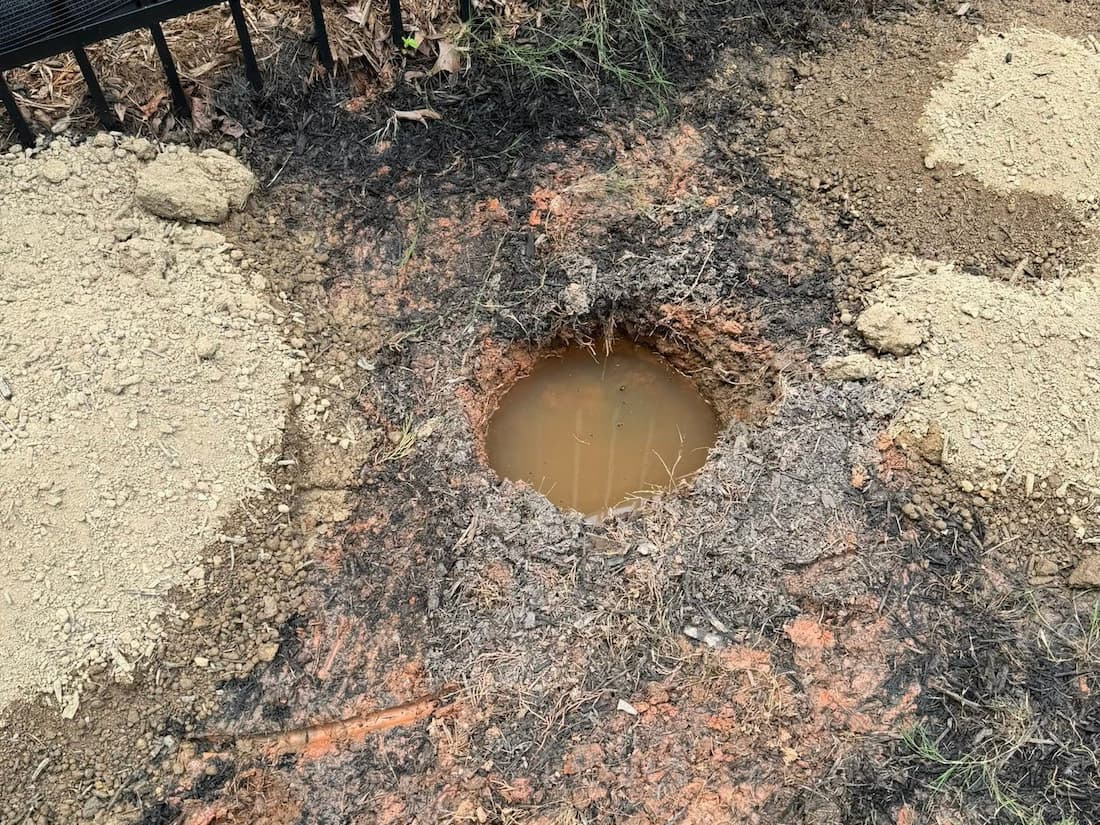
The Hole You Dug Is Killing Your New Plants
A shrub that looked fine all summer and stalled the next year usually didn't fail because of the plant, the weather, or the nursery. It failed because the hole it went into was a container — smooth-walled, water-holding, and impossible to root out of.
Read Article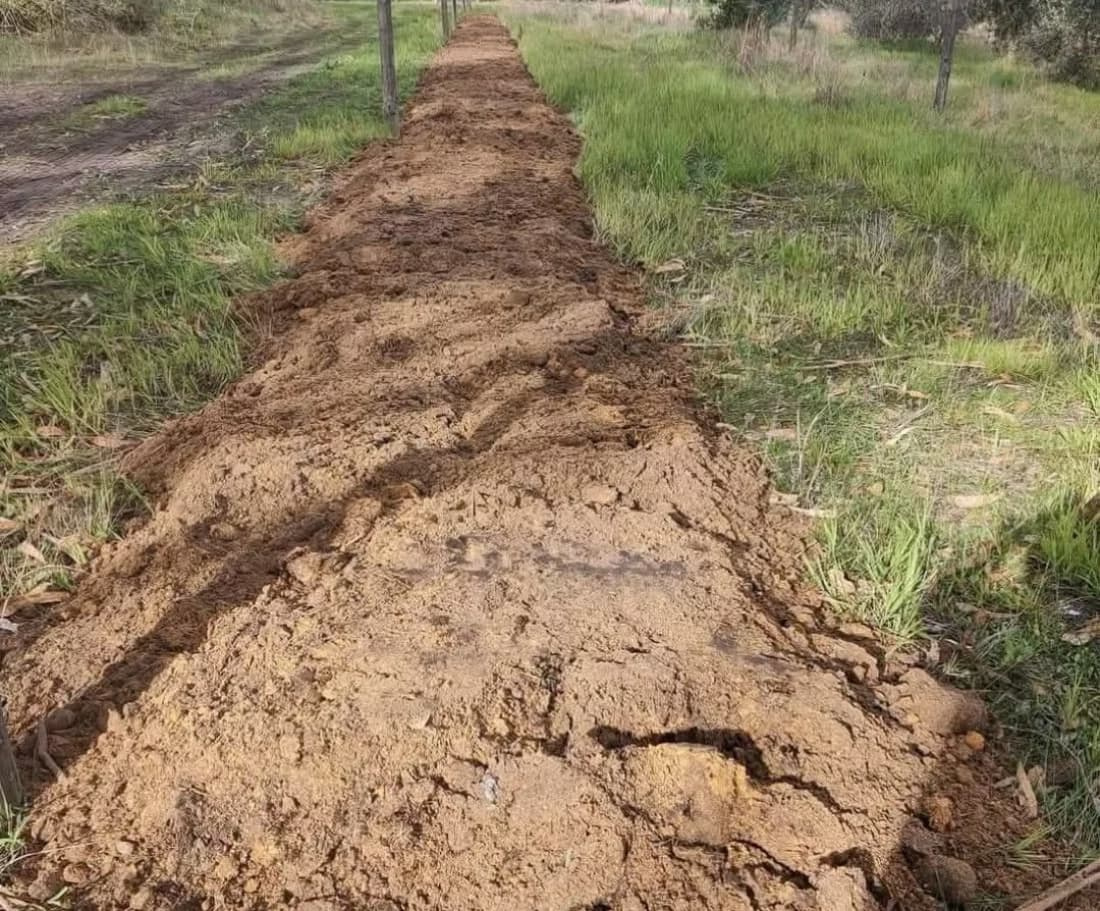
What You Can Actually Change About Bad Soil
Heavy clay and loose sand feel like permanent sentences, and half of that is true. What your soil is made of will not change. How those particles are arranged will — and that is the half that decides whether anything grows.
Read Article
Why Your Plants Survive Winter and Die in July
Your hardiness zone is built from one number — the coldest night of an average year. It says nothing about the hottest afternoon, which is what actually kills most plants people lose. Here's how to read the other half of the map.
Read Article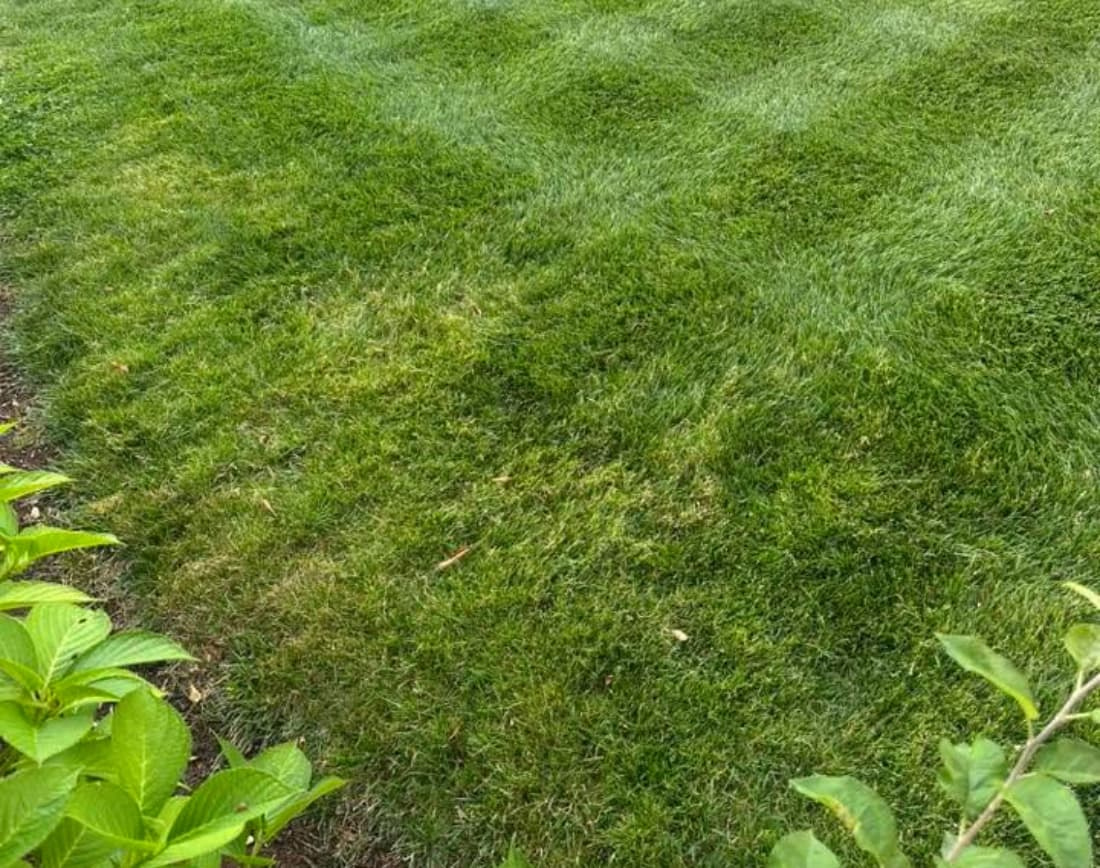
Why Poa Annua Keeps Coming Back — and the 3-Year Plan That Finally Ends the Cycle
You've pulled it. You've sprayed it. You've watched the little white seedheads mock you every single spring. And every fall, like clockwork, it's back — in the lawn, in the beds, in the cracks you didn't know you had. Here's the hard truth nobody at the big-box store will tell you: you're not losing because you're doing it wrong — you're losing because you're fighting the wrong enemy on the wrong timeline. Poa annua isn't a one-season problem, and once you understand why, the three-year plan below stops feeling like a chore and starts feeling like a countdown.
Read Article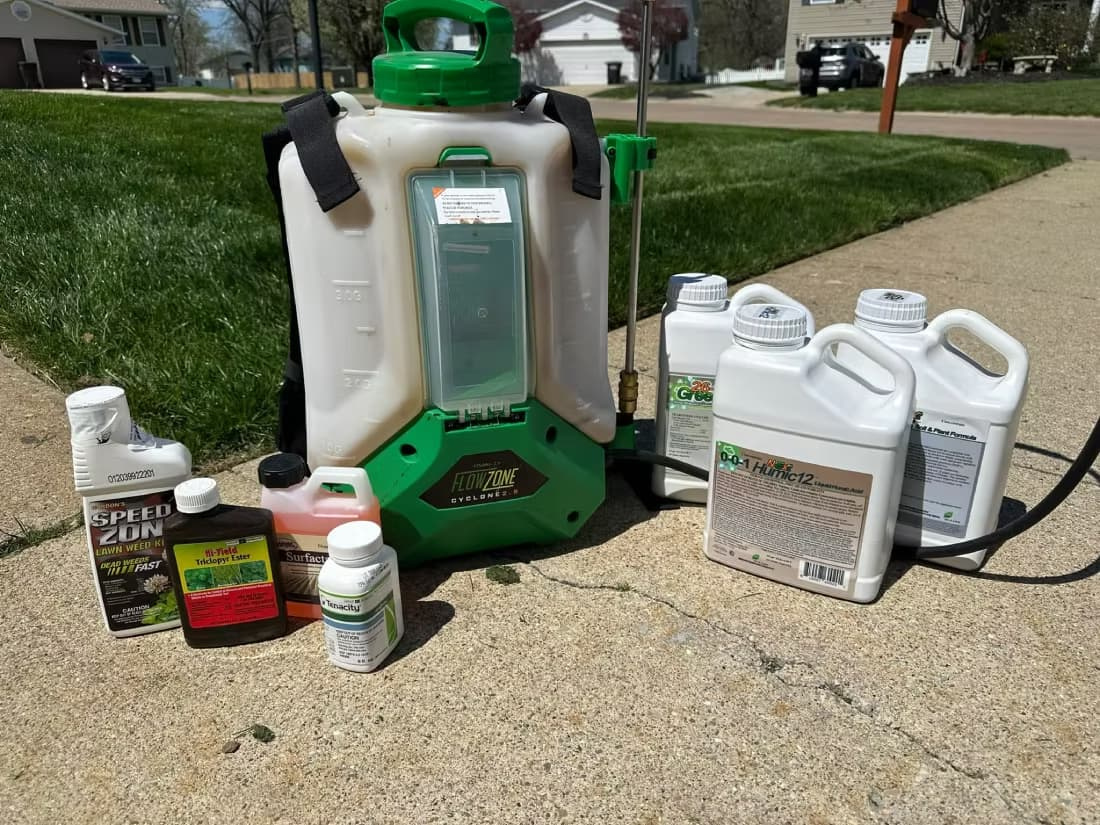
How to Apply Herbicides Correctly in Your Lawn and Garden Beds
Getting real results from a weed product has almost nothing to do with the brand on the bottle and everything to do with matching the method to the moment — the right chemistry, in the right place, at the right time. Learn how to apply herbicides correctly across both your lawn and your garden beds, whether you’re stopping weeds before they sprout or killing the ones already growing, without wasting product or harming the plants you want to keep.
Read Article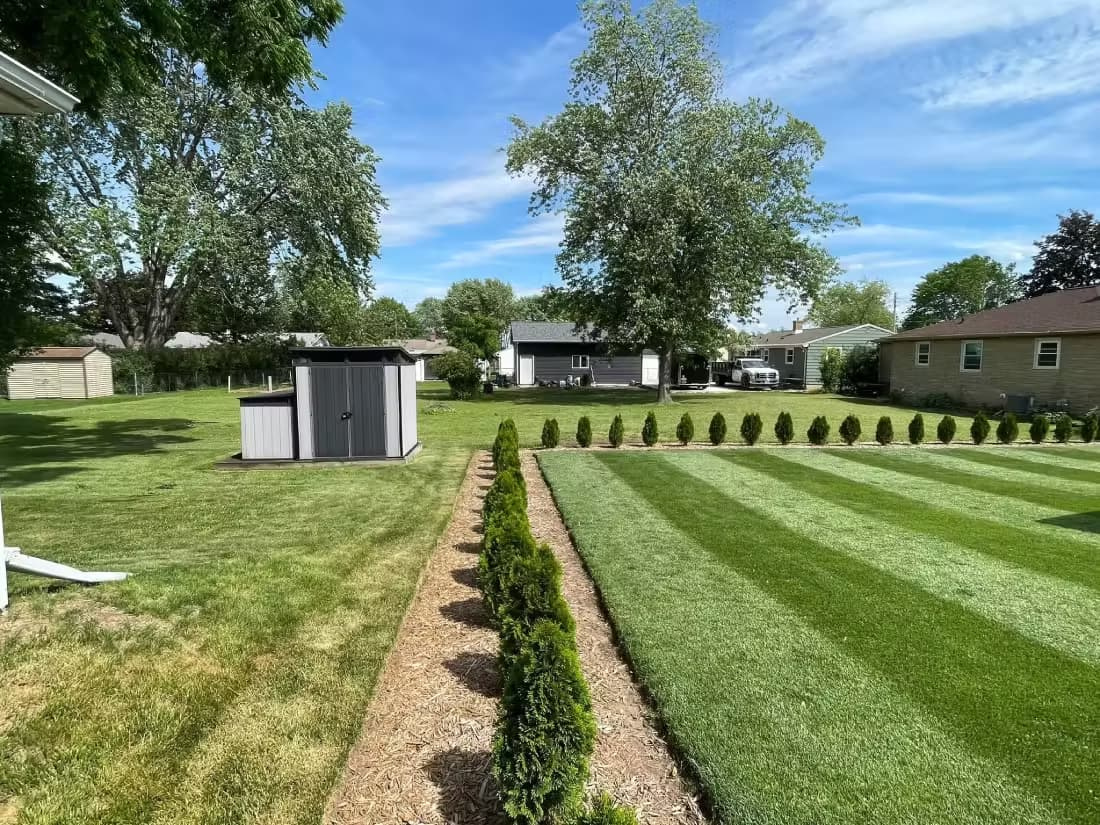
How to Kill Weeds Where Two Lawns Meet Without Harming Your Neighbor’s Grass
Controlling weeds along a shared property line is where good intentions quietly backfire—the season that's safe for your own lawn is often the season the lawn next door is most easily harmed. Learn the seasonal timing collision behind most fence-line damage, and the two habits that prevent it—reading what's actually in the bottle and spraying directed instead of broadcast—so you can clear the weeds without hurting your grass, your neighbor's, or the peace between you.
Read Article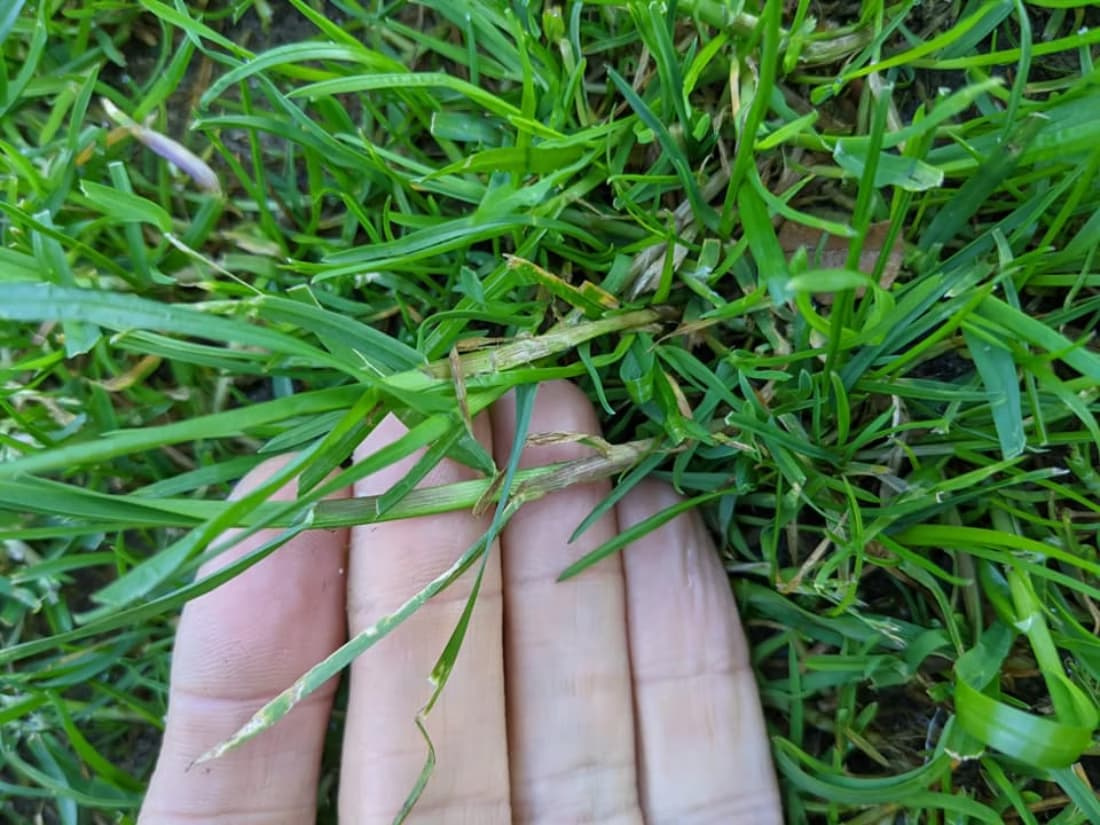
The Truth About One-and-Done Weed Control
Most homeowners lose the fight against weeds not because they work too little, but because they act before they understand. One-and-done weed control is real — but it only works when identification, timing, and the right tool all line up. This guide explains how that sequence works across your lawn and your ornamental beds, and how each weed page in the MFY hub puts it into practice for your specific invader.
Read Article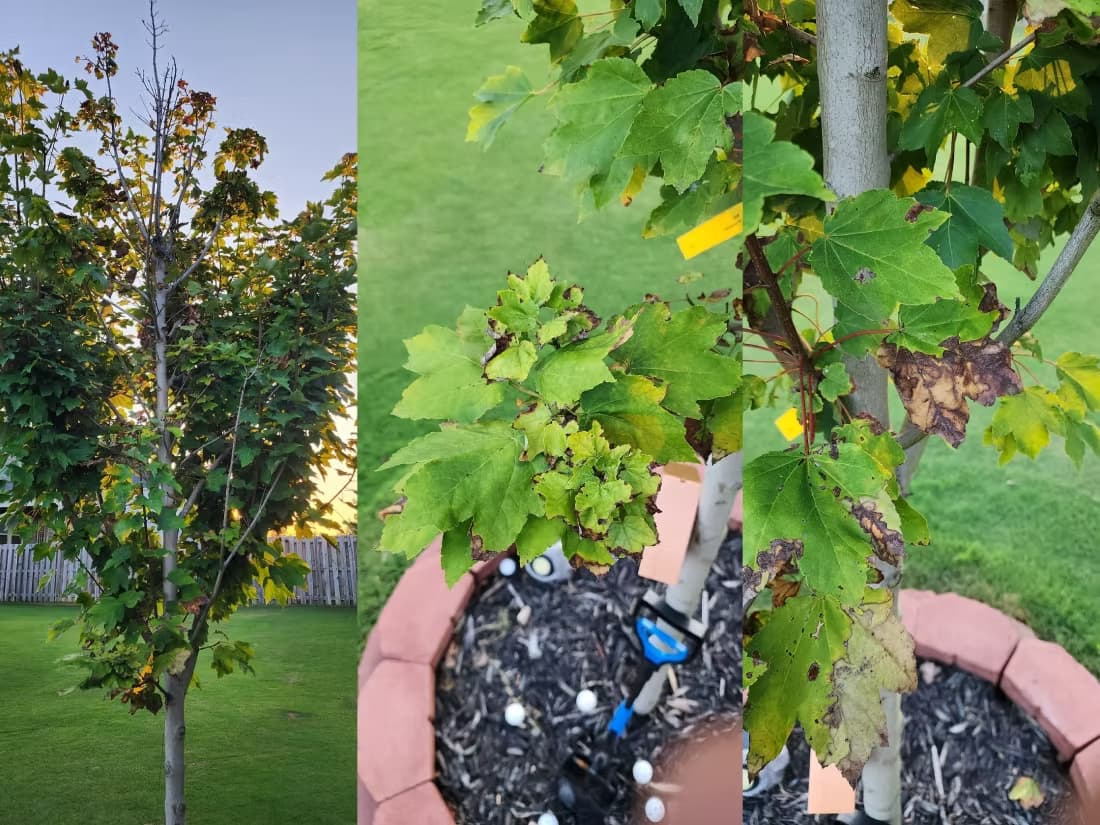
Solving the Mystery of the False Evidence in Your Lawn and Landscape
A brown leaf or a yellowing lawn is rarely what it seems. When symptoms act as decoys, a calm, forensic approach brings clarity to the confusion. Learn how to look past the surface to find the quiet truth of what your plants are truly asking for.
Read Article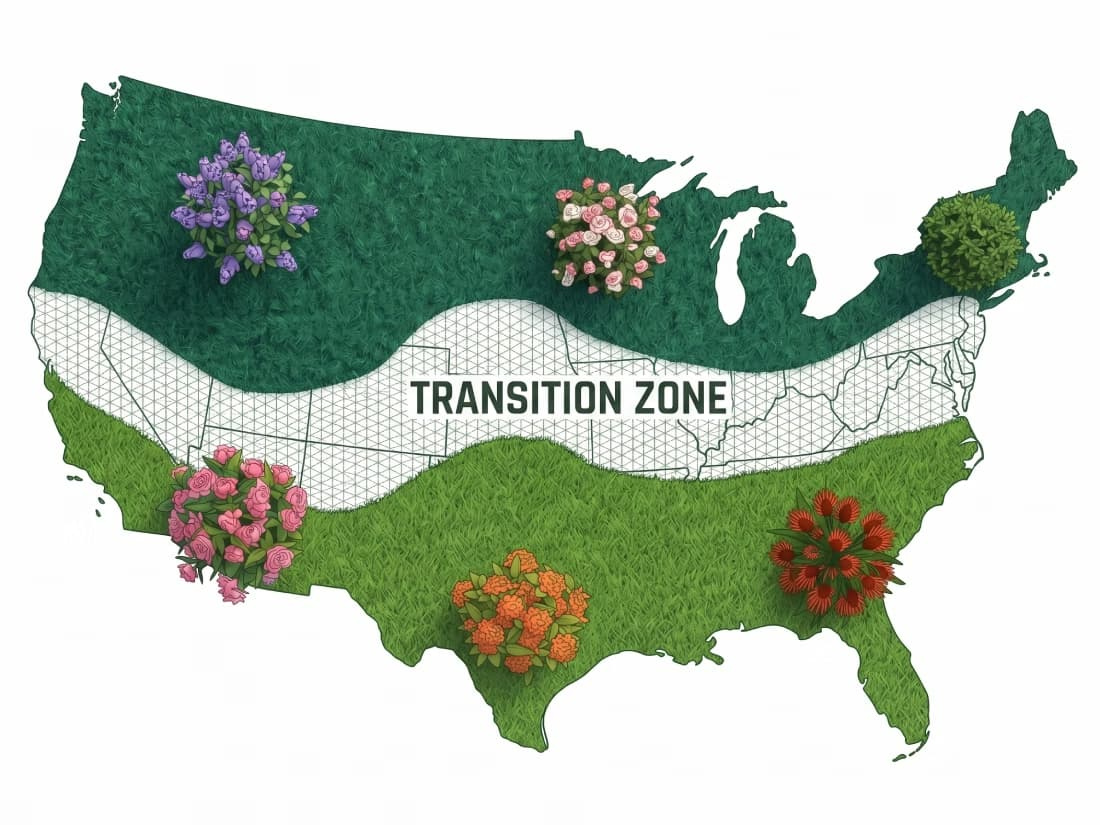
Living in the Middle: The Deep-Dive Guide to Transition Zone Lawns and Landscapes
The Transition Zone is a biological tug-of-war where neither northern nor southern species perfectly adapt. By using resilient "bridge" species and mastering maintenance levers like the Mowing Pivot, you can transform a struggling yard into a healthy landscape.
Read Article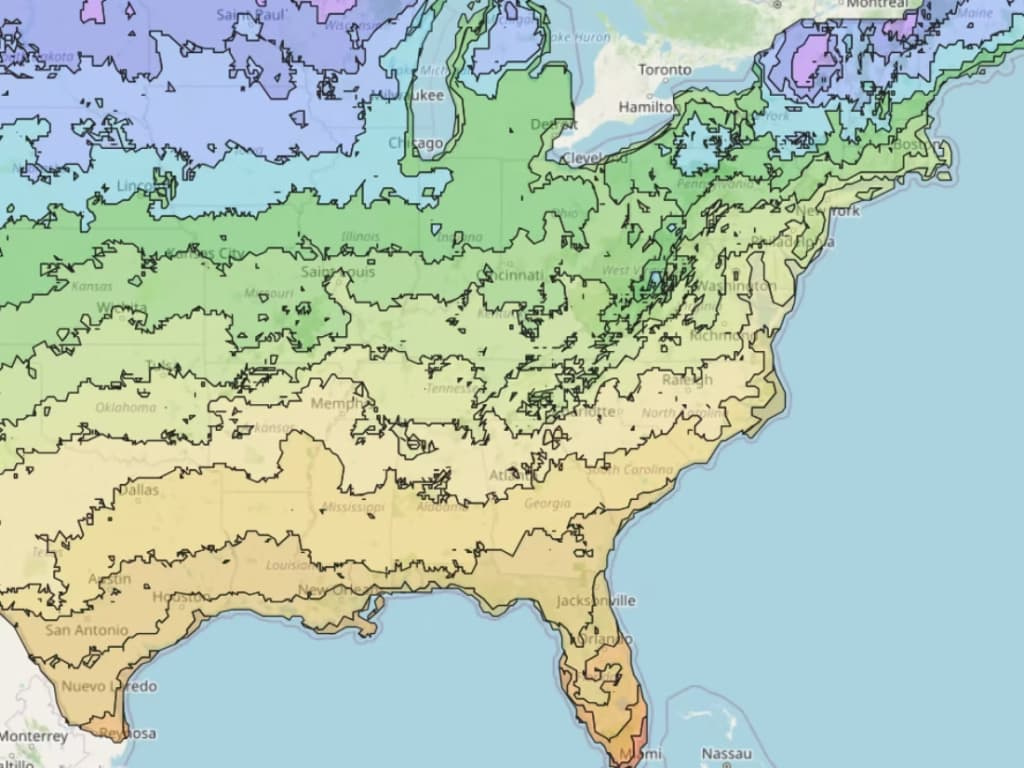
What Your Hardiness Zone Really Means for Your Lawn and Plants
Uncover the foundation of a resilient landscape by mastering the science of hardiness zones. Learn how these climate boundaries are calculated and why understanding your local temperature limits is the first step toward choosing plants that thrive year after year.
Read Article
The One-Third Mowing Rule: A Species-Specific Guide to Mowing Heights
Stop guessing your lawn's health. While the one-third rule is the foundation, every grass species has its own threshold for stress. This guide provides exact 'mow-at' heights, seasonal frequency adjustments, and mower setting tips for over 12 grass types to ensure a professional-grade cut every time.
Read Article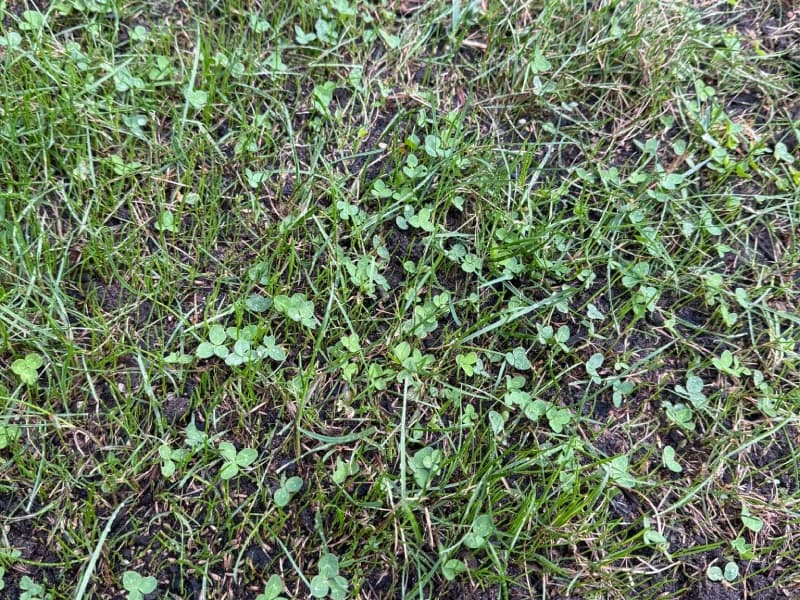
How to Kill Weeds in New Grass Without Killing the Grass
You spent weeks preparing the soil and watering your new seeds, only to see a "carpet of green" that looks more like a weed patch than a lawn. It is frustrating to watch weeds grow twice as fast as your tiny seedlings, leading to a "Panic Phase" where many homeowners make the mistake of spraying too early. Before you reach for the herbicide and risk killing your investment, you need to understand the precise timing required to save your new grass while clearing out the invaders.
Read ArticleFrequently Asked Questions
Our maintenance and establishment guidance is derived from long-term agronomic field studies and turfgrass performance data from top research institutions.
That’s dormancy, and it’s normal. Below about 50–55°F soil temperature the grass pulls its nutrients back into its rhizomes and stops growing, and the first hard frost breaks down the chlorophyll. It greens up again when nights hold above 60°F and soil at four inches reaches 60–65°F. If you want green through winter, overseed with perennial ryegrass in fall.
No. Hybrid bermuda is a sterile cross and makes no viable seed at all, so it only exists as sod, sprigs or plugs. A bag labeled “hybrid bermuda seed” is either mislabeled or a fertile common type like Princess 77 being marketed loosely.
No. Bermuda needs roughly six to eight hours of direct sun a day. In shade it stretches, thins and slowly declines, and no cultivar fixes this. In a shaded yard, zoysia, St. Augustine or tall fescue are the realistic choices.
Yes, but the cultivar decides whether it survives. Winterkill is the limiting factor, so you need a cold-hardy cultivar — and you can get one either as seed (Yukon, Riviera) or as sod (Tahoma 31, Latitude 36). Risk climbs on north-facing slopes, in shade, in poorly drained soil, and where potassium is low.
Late spring or early summer, once soil four inches down holds steady at 65°F or higher — roughly mid-May through June across most of its range. Never plant bermuda in fall. Young plants can’t build the roots and rhizomes they need before winter, and they die.
That’s the classic look of spring dead spot. Soilborne fungi rot the roots and rhizomes the previous fall without showing any damage at the time, and the weakened tissue doesn’t survive winter. There’s nothing to spray in spring — the fixes are cultural and happen in fall: keep thatch under half an inch, relieve compaction, stop nitrogen after mid-September, and plant a resistant cold-hardy cultivar.
Only below one inch. Seeded common mows fine at 1–2 inches with a sharp rotary. Fine hybrids cut at half an inch to an inch need a reel, because a rotary’s spinning blade tears fine blades and leaves ragged wounds that invite disease, while a reel shears cleanly like scissors.
Slowly and deliberately — it’s one of the hardest lawn grasses to remove. Extension programs use a non-selective systemic herbicide with glyphosate as the active ingredient, applied to actively growing grass in mid-to-late summer, usually in two or three passes with a low scalp-and-remove in between. Check the active-ingredient panel rather than the brand name: consumer “Roundup” products no longer reliably contain glyphosate.
Scientific Authority
This profile is grounded in turfgrass agronomy and soil science. Every recommendation—from irrigation requirements to nutrient management—is verified against agricultural research data to ensure optimal plant health and environmental sustainability in the Transition Zone.
Primary Resources
- National Turfgrass Evaluation Program — National Bermudagrass Tests – Cultivar rankings across both seeded and vegetative types; the 1–9 scale; test history 1986–2023
- NTEP — 2013 National Bermudagrass Test, Final Report (18-14) – The 35-entry, 19-site trial cited on this page
- NTEP — 2019 National Bermudagrass Test, Final Report (24-11f) – The most recent completed national trial, 2019–2023
- Oklahoma State University Extension — Comparison of Bermudagrass Cultivars – Cultivar traffic and winter-survival comparisons; green-up thresholds
- K-State Turf and Landscape — Cold-Hardy Bermudagrass Varieties – The OSU cold-hardy release list and its seeded/vegetative split
- UGA CAES — Lawns in Georgia, Selection and Species (B1533) – TifTuf water use and shade persistence; blue-tag certification
- UGA CAES — Turfgrass Fertility, Understanding Fertilizer Labels – Fertilizer ratios and why lawn analyses are potassium-weighted
- NC State Extension — Bermudagrass Lawn Maintenance Calendar – Nitrogen rates and timing; the low-N high-K late-season application
- Texas A&M AgriLife — Bermudagrass Home Lawn Management Calendar – Seasonal program; per-application nitrogen limits; soil testing
- Clemson HGIC — Bermudagrass – African origin; common versus hybrid characteristics
- UC IPM — Bermudagrass – 1751 introduction; regional aliases; behaviour as an invasive
- University of Arizona Extension — Turf Irrigation in the Desert (AZ1314) – Monthly ET figures for the arid Southwest